
PARTS OF SPEECHPARTS OF SPEECH
ENG 101ENG 101
M.BILAL YOUNASM.BILAL YOUNAS
Mass Communication & Media
Bs. 1st. semester
03236168636
Silent_heart.sameer@yahoo.comSilent_heart.sameer@yahoo.com
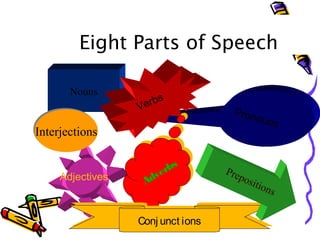
Eight Parts of Speech
Nouns
Pronouns
Adjectives Adverbs
Adverbs
Conj unct ionsConj unct ions
Prepositions
Verbs
InterjectionsInterjections
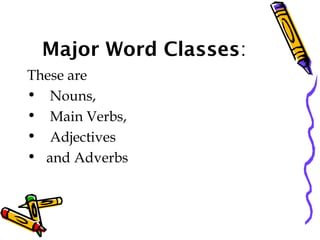
Major Word Classes:
These are
• Nouns,
• Main Verbs,
• Adjectives
• and Adverbs
Minor Word Classes:
These are
• Pronouns,
• Auxiliary Verbs,
• Determiners,
• Articles,
• Prepositions,
• Conjunctions,
• and Interjections
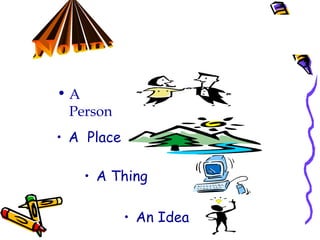
Word that names
• A
Person
• An Idea
• A Thing
• A Place
• A noun is often defined as a word which names a
person, place,thing or idea.  Here are some examples
of nouns: boy, river, friend, Mexico, triangle, day,
school, truth, university, idea, John F. Kennedy,
movie, aunt, vacation, eye, dream, flag, teacher,
class, grammar. John F. Kennedy is a noun because
it is the name of a person; Mexico is a noun
because it is the name of a place; and boy is a noun
because it is the name of a thing.
• Some grammar books divide nouns into 2
groups - proper nouns and common nouns. 
Proper nouns are nouns which begin with a
capital letter because it is the name of a
specific or particular person place or thing. 
Some examples of proper nouns are: Mexico,
John F. Kennedy, Atlantic Ocean, February,
Monday, New York City, Susan, Maple
Street, Burger King. If you see a word
beginning with a capital letter in in the
middle of a sentence, it is probably a proper
noun.  Most nouns are common nouns and
do not begin with a capital letter.
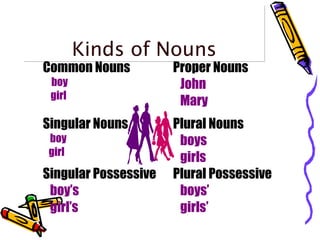
Kinds of NounsKinds of Nouns
Common Nouns
boy
girl
Proper Nouns
John
Mary
Singular Nouns
boy
girl
Plural Nouns
boys
girls
Singular Possessive
boy’s
girl’s
Plural Possessive
boys’
girls’
COLLECTIVE NOUN
• They are words that refer to groups of
people, animals, or things each
regarded as one whole.
• Examples:
• Team, crowd, class, flock, army, family,
etc
ABSTRACT NOUNS
• These are not concrete nouns like other
categories. They refer to things, ideas
that have no physical existance ie they
cannot be touched.
• Examples:
• Beauty, truth, health, happiness etc
COUNTABLE NOUNS
Countable nouns are the names of
objects, people, etc. that we can count
Example:
Book, pen, apple, boy, sister etc
UNCOUNTABLE NOUNS
• These are the names of the things
which we cannot count.
• Example
• Milk, oil, sugar, gold, honesty
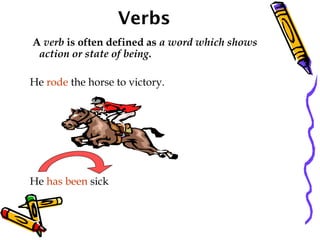
Verbs
A verb is often defined as a word which shows
action or state of being.
He rode the horse to victory.
He has been sick
Every sentenceEvery sentence mustmust
havehave
aa
• Recognizing the verb is often the most
important step in understanding the
meaning of a sentence. In the sentence The
dog bit the man, bit is the verb and the word
which shows the action of the sentence.  In
the sentence The man is sitting on a chair,
even though the action doesn't show much
activity, sitting is the verb of the sentence. 
In the sentence She is a smart girl, there is
no action but a state of being expressed by
the verb is. The word be is different from
other verbs in many ways but can still be
thought of as a verb.
Types of verbs
• Verbs can be classified, according to their function,
into ordinary and auxiliary verbs.
• Ordinary verbs: they are the verbs that can be
conjugated and have different forms
• Example
• Play, eat, read, clean etc
• Some have three forms: cut cuts cutting
• Some have four forms: help, helps,helping,helped
• Some have five forms
write, writes, wrote, written,writing
• And only one verb be has eight forms
• Be, am, is, are, was, were, been, being
AUXILARY VERBS
• They are the verbs that help ordinary verbs.
They are of two types
1. Primary Aux.
• The primary aux. can be used as an ordinary
verb( as the only verb in a sentence), and can
be used as a helping verb ( with an ordinary
verb).
• I am here.
• I am studying.
• Be, is, am, are, was, were, being, have, has,
had, do, does, did
2. Modal
The modal aux. are: can, shall, will, may,
might, must, need, dare, used to, ought
to
Relationship between
time and verbs
• One of the most important things about
verbs is their relationship to time.  Verbs tell
if something has already happened, if it
will happen later, or if it is happening now. 
For things happening now, we use the
present tense of a verb; for something that
has already happened, we use the past
tense; and for something that will happen
later, we use the future tense
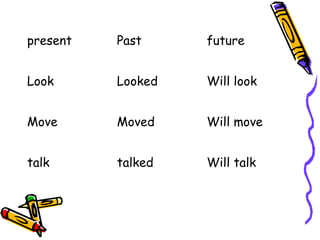
present Past future
Look Looked Will look
Move Moved Will move
talk talked Will talk
Regular Verbs:
• The great majority of English verbs are
regular; that is, they have four forms:
• The base (the uninflected or unchanged
form) play
• The—s form
plays
• The—ing form
playing
• The—ed form
played
Irregular Verbs:
• Verbs in which all three parts (the base,
the past, the past participle) are
identical: let—let—let.
• Verbs in which two of the three parts
are identical: build—built—built.
• Verbs in which all three parts are
different: speak—spoke—spoken.
Transitive and
Intransitive Verbs:
• A verb that requires an object for
meaning is called a transitive verb
because the action transfers to the
object.
• A verb that does not require an object
for meaning is called an intransitive
verb because the action is complete in
itself.
For example: (TV)
• He poisoned the cat.
• Everybody sang the national anthem.
• She cleaned her house.
For example: ( ITV)
• John wept.
• Zubair smokes.
• I sleep late at night.
• Such verbs as give, ask, offer, promise,
tell etc take two objects i.e. direct object
and indirect object.
• A verb can be used transitively or
intransitively e.g.
• He spoke the truth. He spoke
haughtily.

Lectur=1

  • 1.
    PARTS OF SPEECHPARTSOF SPEECH ENG 101ENG 101 M.BILAL YOUNASM.BILAL YOUNAS Mass Communication & Media Bs. 1st. semester 03236168636 Silent_heart.sameer@yahoo.comSilent_heart.sameer@yahoo.com
  • 2.
    Eight Parts ofSpeech Nouns Pronouns Adjectives Adverbs Adverbs Conj unct ionsConj unct ions Prepositions Verbs InterjectionsInterjections
  • 3.
    Major Word Classes: Theseare • Nouns, • Main Verbs, • Adjectives • and Adverbs
  • 4.
    Minor Word Classes: Theseare • Pronouns, • Auxiliary Verbs, • Determiners, • Articles, • Prepositions, • Conjunctions, • and Interjections
  • 5.
    Word that names •A Person • An Idea • A Thing • A Place
  • 6.
    • A nounis often defined as a word which names a person, place,thing or idea.  Here are some examples of nouns: boy, river, friend, Mexico, triangle, day, school, truth, university, idea, John F. Kennedy, movie, aunt, vacation, eye, dream, flag, teacher, class, grammar. John F. Kennedy is a noun because it is the name of a person; Mexico is a noun because it is the name of a place; and boy is a noun because it is the name of a thing.
  • 7.
    • Some grammarbooks divide nouns into 2 groups - proper nouns and common nouns.  Proper nouns are nouns which begin with a capital letter because it is the name of a specific or particular person place or thing.  Some examples of proper nouns are: Mexico, John F. Kennedy, Atlantic Ocean, February, Monday, New York City, Susan, Maple Street, Burger King. If you see a word beginning with a capital letter in in the middle of a sentence, it is probably a proper noun.  Most nouns are common nouns and do not begin with a capital letter.
  • 8.
    Kinds of NounsKindsof Nouns Common Nouns boy girl Proper Nouns John Mary Singular Nouns boy girl Plural Nouns boys girls Singular Possessive boy’s girl’s Plural Possessive boys’ girls’
  • 9.
    COLLECTIVE NOUN • Theyare words that refer to groups of people, animals, or things each regarded as one whole. • Examples: • Team, crowd, class, flock, army, family, etc
  • 10.
    ABSTRACT NOUNS • Theseare not concrete nouns like other categories. They refer to things, ideas that have no physical existance ie they cannot be touched. • Examples: • Beauty, truth, health, happiness etc
  • 11.
    COUNTABLE NOUNS Countable nounsare the names of objects, people, etc. that we can count Example: Book, pen, apple, boy, sister etc
  • 12.
    UNCOUNTABLE NOUNS • Theseare the names of the things which we cannot count. • Example • Milk, oil, sugar, gold, honesty
  • 13.
    Verbs A verb isoften defined as a word which shows action or state of being. He rode the horse to victory. He has been sick
  • 14.
    Every sentenceEvery sentencemustmust havehave aa
  • 15.
    • Recognizing theverb is often the most important step in understanding the meaning of a sentence. In the sentence The dog bit the man, bit is the verb and the word which shows the action of the sentence.  In the sentence The man is sitting on a chair, even though the action doesn't show much activity, sitting is the verb of the sentence.  In the sentence She is a smart girl, there is no action but a state of being expressed by the verb is. The word be is different from other verbs in many ways but can still be thought of as a verb.
  • 16.
    Types of verbs •Verbs can be classified, according to their function, into ordinary and auxiliary verbs. • Ordinary verbs: they are the verbs that can be conjugated and have different forms • Example • Play, eat, read, clean etc • Some have three forms: cut cuts cutting • Some have four forms: help, helps,helping,helped • Some have five forms write, writes, wrote, written,writing • And only one verb be has eight forms • Be, am, is, are, was, were, been, being
  • 17.
    AUXILARY VERBS • Theyare the verbs that help ordinary verbs. They are of two types 1. Primary Aux. • The primary aux. can be used as an ordinary verb( as the only verb in a sentence), and can be used as a helping verb ( with an ordinary verb). • I am here. • I am studying. • Be, is, am, are, was, were, being, have, has, had, do, does, did
  • 18.
    2. Modal The modalaux. are: can, shall, will, may, might, must, need, dare, used to, ought to
  • 19.
    Relationship between time andverbs • One of the most important things about verbs is their relationship to time.  Verbs tell if something has already happened, if it will happen later, or if it is happening now.  For things happening now, we use the present tense of a verb; for something that has already happened, we use the past tense; and for something that will happen later, we use the future tense
  • 20.
    present Past future LookLooked Will look Move Moved Will move talk talked Will talk
  • 21.
    Regular Verbs: • Thegreat majority of English verbs are regular; that is, they have four forms: • The base (the uninflected or unchanged form) play • The—s form plays • The—ing form playing • The—ed form played
  • 22.
    Irregular Verbs: • Verbsin which all three parts (the base, the past, the past participle) are identical: let—let—let. • Verbs in which two of the three parts are identical: build—built—built. • Verbs in which all three parts are different: speak—spoke—spoken.
  • 23.
    Transitive and Intransitive Verbs: •A verb that requires an object for meaning is called a transitive verb because the action transfers to the object. • A verb that does not require an object for meaning is called an intransitive verb because the action is complete in itself.
  • 24.
    For example: (TV) •He poisoned the cat. • Everybody sang the national anthem. • She cleaned her house.
  • 25.
    For example: (ITV) • John wept. • Zubair smokes. • I sleep late at night.
  • 26.
    • Such verbsas give, ask, offer, promise, tell etc take two objects i.e. direct object and indirect object. • A verb can be used transitively or intransitively e.g. • He spoke the truth. He spoke haughtily.