English Basics
Punctuation
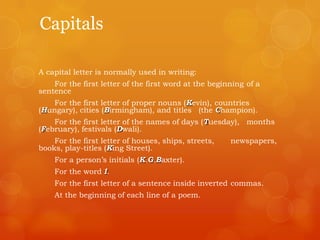
Capitals
A capital letter is normally used in writing:
For the first letter of the first word at the beginning of a
sentence
For the first letter of proper nouns (Kevin), countries
(Hungary), cities (Birmingham), and titles (the Champion).
For the first letter of the names of days (Tuesday), months
(February), festivals (Dwali).
For the first letter of houses, ships, streets, newspapers,
books, play-titles (King Street).
For a person‟s initials (K.G.Baxter).
For the word I.
For the first letter of a sentence inside inverted commas.
At the beginning of each line of a poem.
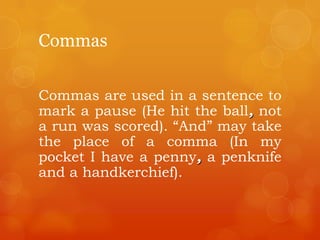
Commas
Commas are used in a sentence to
mark a pause (He hit the ball, not
a run was scored). “And” may take
the place of a comma (In my
pocket I have a penny, a penknife
and a handkerchief).
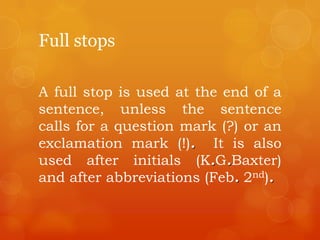
Full stops
A full stop is used at the end of a
sentence, unless the sentence
calls for a question mark (?) or an
exclamation mark (!). It is also
used after initials (K.G.Baxter)
and after abbreviations (Feb. 2nd).
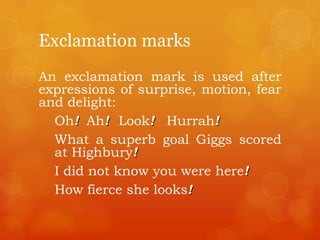
Exclamation marks
An exclamation mark is used after
expressions of surprise, motion, fear
and delight:
Oh! Ah! Look! Hurrah!
What a superb goal Giggs scored
at Highbury!
I did not know you were here!
How fierce she looks!
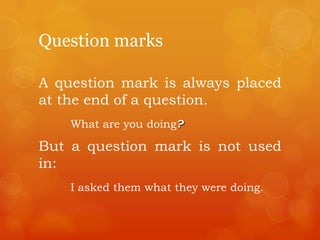
Question marks
A question mark is always placed
at the end of a question.
What are you doing?
But a question mark is not used
in:
I asked them what they were doing.
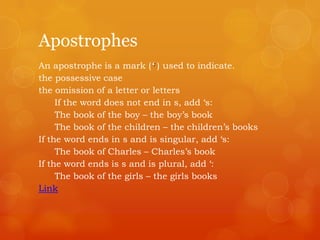
Apostrophes
An apostrophe is a mark (‘ ) used to indicate.
the possessive case
the omission of a letter or letters
If the word does not end in s, add „s:
The book of the boy – the boy‟s book
The book of the children – the children‟s books
If the word ends in s and is singular, add „s:
The book of Charles – Charles‟s book
If the word ends is s and is plural, add „:
The book of the girls – the girls books
Link
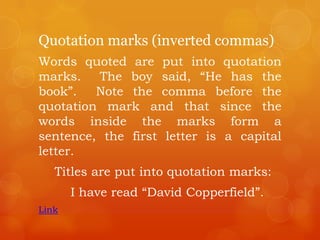
Quotation marks (inverted commas)
Words quoted are put into quotation
marks. The boy said, “He has the
book”. Note the comma before the
quotation mark and that since the
words inside the marks form a
sentence, the first letter is a capital
letter.
Titles are put into quotation marks:
I have read “David Copperfield”.
Link
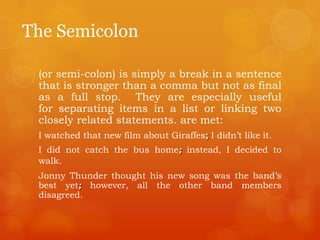
The Semicolon
(or semi-colon) is simply a break in a sentence
that is stronger than a comma but not as final
as a full stop. They are especially useful
for separating items in a list or linking two
closely related statements. are met:
I watched that new film about Giraffes; I didn‟t like it.
I did not catch the bus home; instead, I decided to
walk.
Jonny Thunder thought his new song was the band‟s
best yet; however, all the other band members
disagreed.
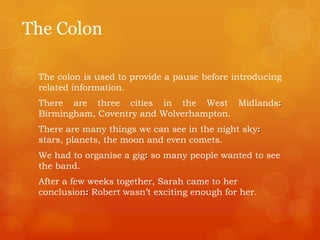
The Colon
The colon is used to provide a pause before introducing
related information.
There are three cities in the West Midlands:
Birmingham, Coventry and Wolverhampton.
There are many things we can see in the night sky:
stars, planets, the moon and even comets.
We had to organise a gig: so many people wanted to see
the band.
After a few weeks together, Sarah came to her
conclusion: Robert wasn‟t exciting enough for her.
Hyphen
The sign (-) used to join words to
indicate that they have a
combined meaning or that they
are linked in the grammar of a
sentence

English basics punctuation

  • 1.
  • 2.
    Capitals A capital letteris normally used in writing: For the first letter of the first word at the beginning of a sentence For the first letter of proper nouns (Kevin), countries (Hungary), cities (Birmingham), and titles (the Champion). For the first letter of the names of days (Tuesday), months (February), festivals (Dwali). For the first letter of houses, ships, streets, newspapers, books, play-titles (King Street). For a person‟s initials (K.G.Baxter). For the word I. For the first letter of a sentence inside inverted commas. At the beginning of each line of a poem.
  • 3.
    Commas Commas are usedin a sentence to mark a pause (He hit the ball, not a run was scored). “And” may take the place of a comma (In my pocket I have a penny, a penknife and a handkerchief).
  • 4.
    Full stops A fullstop is used at the end of a sentence, unless the sentence calls for a question mark (?) or an exclamation mark (!). It is also used after initials (K.G.Baxter) and after abbreviations (Feb. 2nd).
  • 5.
    Exclamation marks An exclamationmark is used after expressions of surprise, motion, fear and delight: Oh! Ah! Look! Hurrah! What a superb goal Giggs scored at Highbury! I did not know you were here! How fierce she looks!
  • 6.
    Question marks A questionmark is always placed at the end of a question. What are you doing? But a question mark is not used in: I asked them what they were doing.
  • 7.
    Apostrophes An apostrophe isa mark (‘ ) used to indicate. the possessive case the omission of a letter or letters If the word does not end in s, add „s: The book of the boy – the boy‟s book The book of the children – the children‟s books If the word ends in s and is singular, add „s: The book of Charles – Charles‟s book If the word ends is s and is plural, add „: The book of the girls – the girls books Link
  • 8.
    Quotation marks (invertedcommas) Words quoted are put into quotation marks. The boy said, “He has the book”. Note the comma before the quotation mark and that since the words inside the marks form a sentence, the first letter is a capital letter. Titles are put into quotation marks: I have read “David Copperfield”. Link
  • 9.
    The Semicolon (or semi-colon)is simply a break in a sentence that is stronger than a comma but not as final as a full stop. They are especially useful for separating items in a list or linking two closely related statements. are met: I watched that new film about Giraffes; I didn‟t like it. I did not catch the bus home; instead, I decided to walk. Jonny Thunder thought his new song was the band‟s best yet; however, all the other band members disagreed.
  • 10.
    The Colon The colonis used to provide a pause before introducing related information. There are three cities in the West Midlands: Birmingham, Coventry and Wolverhampton. There are many things we can see in the night sky: stars, planets, the moon and even comets. We had to organise a gig: so many people wanted to see the band. After a few weeks together, Sarah came to her conclusion: Robert wasn‟t exciting enough for her.
  • 11.
    Hyphen The sign (-)used to join words to indicate that they have a combined meaning or that they are linked in the grammar of a sentence