
NOUNSDEFINITION OF NOUNS
What is a noun ?
A noun is the name of a
person, place, thing, or
idea. Whatever exists, we
assume, can be named,
and that name is a noun.
Noun Examples
president Barrack Obama
school University of Antique
book Les Miserables
celebration Independence Day
company Global Container Shipping Company
Kinds/Types of Nouns
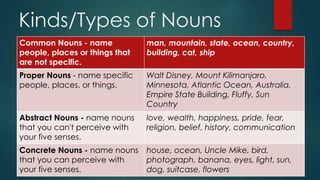
Common Nouns - name
people, places or things that
are not specific.
man, mountain, state, ocean, country,
building, cat, ship
Proper Nouns - name specific
people, places, or things.
Walt Disney, Mount Kilimanjaro,
Minnesota, Atlantic Ocean, Australia,
Empire State Building, Fluffy, Sun
Country
Abstract Nouns - name nouns
that you can't perceive with
your five senses.
love, wealth, happiness, pride, fear,
religion, belief, history, communication
Concrete Nouns - name nouns
that you can perceive with
your five senses.
house, ocean, Uncle Mike, bird,
photograph, banana, eyes, light, sun,
dog, suitcase, flowers
Kinds/Types of Nouns
Countable Nouns - name nouns
that you can count.
bed, cat, movie, train, country,
book, phone, match, speaker,
clock, pen, David, violin
Uncountable Nouns name nouns
that you can't count
milk, rice, snow, rain, water, food,
music
Compound Nouns are made up of
two or more words.
tablecloth, eyeglasses, New York,
photograph, daughter-in-law,
pigtails, sunlight, snowflake
Collective Nouns - refer to things or
people as a unit.
bunch, audience, flock, team,
group, family, band, village
Kinds/Types of Nouns
Singular Nouns name
one person, place,
thing, or idea.
cat, sock, ship, hero,
monkey, baby, match
Plural Nouns name
more than one person,
place, thing, or idea.
cats, socks, ships,
heroes, monkeys,
babies, matches
Possessive Nouns -
show ownership.
Mom's car, Beth's cat,
the student's book
8 Uses of Nouns
1. Subject of the Sentence – The subject is the
person, place, thing, or idea that the sentence is
about.
The book was heavy.
The girls are pretty.
University of Antique is a state school.
8 Uses of Nouns
2. Predicate Noun – A predicate noun comes
after the verb to be or a linking verb that
replaces or means the same thing as the subject
of the sentence.
My brother is the clown.
The thief is the murderer.
The students are the speakers.
8 Uses of Nouns
3. Appositive – An appositive is a word or
phrase that comes after another word. It
explains, identifies, or gives information about
that word. The appositive is set off from the
sentence by one or two commas.
Our teacher, Mr. Samillano, taught us English
My favorite team, the Golden State Warriors,
won the NBA playoffs yesterday.
8 Uses of Nouns
4. Direct Object of a verb – The direct
object is the person, place, thing, or idea,
that receives the action of the verb.
Jack slammed the door.
Golden State Warriors beat the opponent.
8 Uses of Nouns
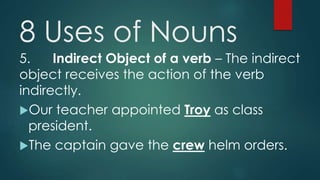
5. Indirect Object of a verb – The indirect
object receives the action of the verb
indirectly.
Our teacher appointed Troy as class
president.
The captain gave the crew helm orders.
8 Uses of Nouns
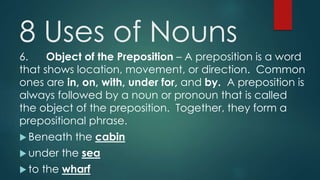
6. Object of the Preposition – A preposition is a word
that shows location, movement, or direction. Common
ones are in, on, with, under for, and by. A preposition is
always followed by a noun or pronoun that is called
the object of the preposition. Together, they form a
prepositional phrase.
 Beneath the cabin
 under the sea
 to the wharf
8 Uses of Nouns
7. Object Complement – An object
complement is a word that completes the
meaning of a direct object. It is used when the
direct object would not make complete sense
by itself.
I named my cat Budoy.
My best friend named her daughter Agnes.
8 Uses of Nouns
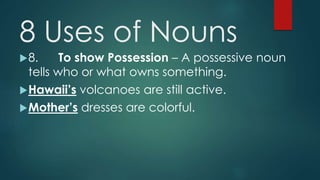
8. To show Possession – A possessive noun
tells who or what owns something.
Hawaii’s volcanoes are still active.
Mother’s dresses are colorful.
Special Nouns
1. Nouns that are plural in form but singular in meaning
Examples: Philippines , statistics, molasses,
politics, aerobics, civics
economics, phonetics, Mathematics,
measles, Physics, gymnastics,
billiards, cosmetics, ethics,
a. The Philippines is the land of the Filipinos.
b. Mathematics is my favorite subject.
c. Molasses is used to feed horses.
Special Nouns
2. Nouns that are plural in form and in
meaning.
Examples: jeans, tweezers, scissors,
braces, eyeglasses, pincers, shorts, riches,
thanks, tongs, clothes, socks, slacks, pliers,
goods, ashes, proceeds, archives
The End

Nouns

  • 1.
  • 2.
    What is anoun ? A noun is the name of a person, place, thing, or idea. Whatever exists, we assume, can be named, and that name is a noun.
  • 3.
    Noun Examples president BarrackObama school University of Antique book Les Miserables celebration Independence Day company Global Container Shipping Company
  • 4.
    Kinds/Types of Nouns CommonNouns - name people, places or things that are not specific. man, mountain, state, ocean, country, building, cat, ship Proper Nouns - name specific people, places, or things. Walt Disney, Mount Kilimanjaro, Minnesota, Atlantic Ocean, Australia, Empire State Building, Fluffy, Sun Country Abstract Nouns - name nouns that you can't perceive with your five senses. love, wealth, happiness, pride, fear, religion, belief, history, communication Concrete Nouns - name nouns that you can perceive with your five senses. house, ocean, Uncle Mike, bird, photograph, banana, eyes, light, sun, dog, suitcase, flowers
  • 5.
    Kinds/Types of Nouns CountableNouns - name nouns that you can count. bed, cat, movie, train, country, book, phone, match, speaker, clock, pen, David, violin Uncountable Nouns name nouns that you can't count milk, rice, snow, rain, water, food, music Compound Nouns are made up of two or more words. tablecloth, eyeglasses, New York, photograph, daughter-in-law, pigtails, sunlight, snowflake Collective Nouns - refer to things or people as a unit. bunch, audience, flock, team, group, family, band, village
  • 6.
    Kinds/Types of Nouns SingularNouns name one person, place, thing, or idea. cat, sock, ship, hero, monkey, baby, match Plural Nouns name more than one person, place, thing, or idea. cats, socks, ships, heroes, monkeys, babies, matches Possessive Nouns - show ownership. Mom's car, Beth's cat, the student's book
  • 7.
    8 Uses ofNouns 1. Subject of the Sentence – The subject is the person, place, thing, or idea that the sentence is about. The book was heavy. The girls are pretty. University of Antique is a state school.
  • 8.
    8 Uses ofNouns 2. Predicate Noun – A predicate noun comes after the verb to be or a linking verb that replaces or means the same thing as the subject of the sentence. My brother is the clown. The thief is the murderer. The students are the speakers.
  • 9.
    8 Uses ofNouns 3. Appositive – An appositive is a word or phrase that comes after another word. It explains, identifies, or gives information about that word. The appositive is set off from the sentence by one or two commas. Our teacher, Mr. Samillano, taught us English My favorite team, the Golden State Warriors, won the NBA playoffs yesterday.
  • 10.
    8 Uses ofNouns 4. Direct Object of a verb – The direct object is the person, place, thing, or idea, that receives the action of the verb. Jack slammed the door. Golden State Warriors beat the opponent.
  • 11.
    8 Uses ofNouns 5. Indirect Object of a verb – The indirect object receives the action of the verb indirectly. Our teacher appointed Troy as class president. The captain gave the crew helm orders.
  • 12.
    8 Uses ofNouns 6. Object of the Preposition – A preposition is a word that shows location, movement, or direction. Common ones are in, on, with, under for, and by. A preposition is always followed by a noun or pronoun that is called the object of the preposition. Together, they form a prepositional phrase.  Beneath the cabin  under the sea  to the wharf
  • 13.
    8 Uses ofNouns 7. Object Complement – An object complement is a word that completes the meaning of a direct object. It is used when the direct object would not make complete sense by itself. I named my cat Budoy. My best friend named her daughter Agnes.
  • 14.
    8 Uses ofNouns 8. To show Possession – A possessive noun tells who or what owns something. Hawaii’s volcanoes are still active. Mother’s dresses are colorful.
  • 15.
    Special Nouns 1. Nounsthat are plural in form but singular in meaning Examples: Philippines , statistics, molasses, politics, aerobics, civics economics, phonetics, Mathematics, measles, Physics, gymnastics, billiards, cosmetics, ethics, a. The Philippines is the land of the Filipinos. b. Mathematics is my favorite subject. c. Molasses is used to feed horses.
  • 16.
    Special Nouns 2. Nounsthat are plural in form and in meaning. Examples: jeans, tweezers, scissors, braces, eyeglasses, pincers, shorts, riches, thanks, tongs, clothes, socks, slacks, pliers, goods, ashes, proceeds, archives
  • 17.