Engineering Management
in Remote Teams
Andreas Klinger
Head of Remote, AngelList
former CTO of Product Hunt & VPE of CoinList
✌
@andreasklinger
⏩ I shared all slides on www.twitter.com/andreasklinger
Hi. 👋
@andreasklinger
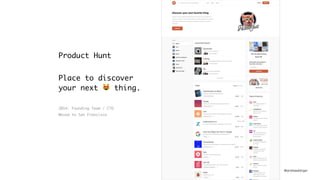
Product Hunt
Place to discover
your next 😻 thing.
2014: Founding Team / CTO
Moved to San Francisco
@andreasklinger
Product Hunt
Place to discover
your next 😻 thing.
@andreasklinger
Product Hunt ➡ AngelList
Current Role: Head of Remote
Product strategy lead for
remote centric products
Helping international talent 

finding international careers
2017
@andreasklinger
angel.co/jobs
Free job listings
7.000+ startups hiring remote
incl 1.000+ fully remote startups
alist.co
Premium Recruiting services
Hire your VP of Engineering
angel.co/talent/source
Talent Search Engine
1.000.000+ registered users,
who are open to remote jobs
@andreasklinger
Starting an invite-only
investment syndicate
Investing as a group of experts
in remote startups and remote work tools
Ping me if you want to co-invest
or looking for investments
💰
@andreasklinger
Disclaimer
Talk is opinion-heavy, feel free to disagree

- what worked for me might not work for you
- i am experienced with small (not large) teams
- concepts can be applied to non-remote or non-tech teams 👍
Consult your doctor, use at own risk
@andreasklinger
Goal of talk
- Differences for remote teams
- PH’s approach to autonomy
- Decision making and ownership in your team
@andreasklinger
Why remote work?
- Logical evolution of digital knowledge work
- Everybody is already working remote 

The only question is just how much and how enabled?


- Large companies (like eg google) are basically

remote teams in denial
- Optimizing daily life leads to better productivity,
inclusion, happiness & retention
And my personal motivation:
- International talent should have international careers
@andreasklinger
Remote teams require ~5x the process as colocated teams.
- eg 5 people need to act like 20-25 people (until large size)
- you plan meetings, have agenda, define work processes.
Co-located teams can monkey-patch bad processes
- eg more meetings, “management by walking around” or 

simply by micro-manging
Co-located teams: meetings are easy, writing stuff down is exhausting
Remote teams: writing stuff down is easy, meetings are exhausting
Remote good for iteration (focus)
In person good for innovation (nuance)
Strong connections to team needed to “know what’s going on” 

because video-calls suck.
How is managing remote teams different?
@andreasklinger
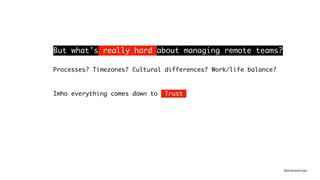
Processes? Timezones? Cultural differences? Work/life balance?
Imho everything comes down to Trust
But what’s really hard about managing remote teams?
@andreasklinger
Trust
“Is she coding?
…or playing fortnite?”
@andreasklinger
( “Is he actually motivated?”
Trust
@andreasklinger
🖥😐 “I am so excited”
Trust
@andreasklinger
+ “Mein feedback:
This solution sucks…”
Trust
,
@andreasklinger
🗺
“Nobody takes ownership.

And if they do it’s the
wrong path… so I have to

involve myself.”
Trust
@andreasklinger
🔨 “Are these refactoring
really necessary? 

We ship so slow already…”
Trust
@andreasklinger
Trust
/0
0/
“When did we start to need
8 people to decide even
small stuff?”
@andreasklinger
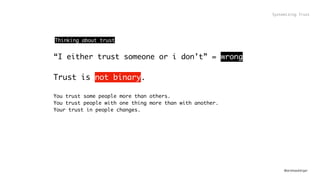
“I either trust someone or i don’t” = wrong
Trust is not binary.
You trust some people more than others.
You trust people with one thing more than with another.
Your trust in people changes.
Systemizing Trust
Thinking about trust
@andreasklinger
“Trust is earned” = true, but…
What about new people joining?
How will you enable the new Product Manager to really give their best?
Systemizing Trust
@andreasklinger
“Trust comes natural to me…” = sure…
Without creating systems around how/when/why we give trust and 

what we expect in return we are opening up ourselves (or the company)
to biases.
Martha joined, and just gets it… She is a go-getter showing where we can improve.
Steven on the other hand is constantly out of line and nagging about problems.
… or we risk losing your values (that enabled us to work efficiently) as we scale.
“When i joined you said this is a ‘ask for forgiveness’ type of company?

I had to get permission for every little step…”
Systemizing Trust
@andreasklinger
Systemizing Trust
Trust
… through process
… through explicit & transparent communication
… through sharing authority
… through decentralizing decisions
… through understanding each other's (eg cultural) differences
… through intentionally meeting each other
… etc
Without systemizing and managing trust remote teams simply don’t work.
Systemizing Trust
@andreasklinger
Always the most important thing:
Meet your people face to face
Getting to know each other as humans cannot be
replaced.
Meet for team retreats, project kickoffs, 

pivot discussions.
Regularly. It’s worth it.
Systemizing Trust
First PH team at YC Demo Day YC S14
This was the first time we met in person.

We had worked together for months, 

but we didn’t know if we should 

shake hands, hug, kiss… 


What kind of relationship did we 

have at this point?
Meeting in person is worth the ⏱ & 💰
Before we go into with PH’s approach on autonomy:
Optimize for
Single Player
Mode
Managing Trust:
Product Hunt’s
engineering team approach
to trust & autonomy
@andreasklinger
People are fast and capable
Unless they are blocked
Being blocked in remote teams is extremely expensive.
- No “Management by Walking Around”
- Timezone differences
2
Optimizing for Single Player Mode
Optimize for
Single Player
Mode
Thanks for
pressing jump
Now, please wait until Frank is online.
Optimize for
Single Player
Mode
Clear goals
Find paths
Rely on processes
Automate feedback
Enable to level up
Single Player Mode
Optimize for
Single Player
Mode
Does not mean isolating
or working always alone
But avoiding unneeded
inter-dependencies
and blocking
Autonomy != Abandonment
“We trust you do whatever you think is right”
without framework will just frustrate people.
Single Player Mode
@andreasklinger
Step 1:
Establish a “find a path” attitude
Product Hunt
“Design missing?” -> use standard components
“Product aspects unclear?” -> you decide, get feedback later
“Unsure what to work on next?” -> decide based on effectiveness
“Technical implementation too complex?” -> fake it for now
Optimizing for Single Player Mode
@andreasklinger
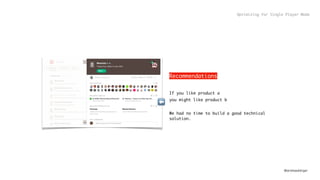
If you like product a
you might like product b
We had no time to build a good technical
solution.
⬅
Recommendations
Optimizing for Single Player Mode
@andreasklinger
* Product Hunt, a company backed by YCombinator, A16Z, Google Ventures,
Greylock, Betaworks, Naval Ravikant, Ashton Kutcher, Andrew Chen, GaryV,
Your uncle, Alexis Ohanian, …
Add recommended products:
Recommended Post Id:
*Some Post (delete)
*Some other Post (delete)
*Another Post (delete)
Recommended Products
Add
Product Hunt Admin Dashboard *
@andreasklinger
⬅
Product
Recommendations
Today
If possible still done manually.
Community suggested
Admin/Maker/Hunter curated.
*If* not enough: populated through
automatic recommendations
Optimizing for Single Player Mode
@andreasklinger
📺
🎮
Step 2:
Invest in tooling and automate feedback
🔎 Code—linter, static code analysis, tests, auto-formatting,
bots that check best practices of code-reviews, …
=> Developer knows code is good enough
🔦 Feature flags, dark launches, demo instances, easy deploys & reverts, …
=> Developer can ship with confidence
📝 Infrastructure changes in git, tool access in team keychain,
documented previous post-mortems, …
=> Developer can fix worstcase scenarios
Invest in Developer UX

So that people have fast constant feedback, before anyone gets even online.
Optimizing for Single Player Mode
Example 1: Code Reviews
- Everyone every morning
- People can rely on it and don’t need to remind
- Address feedback with code or comment. 

- No need to wait for people to “re-review and approve”
- As reviewer:
- Do not to critique but help to ship faster
- Don’t focus on how you’d do it unless it’s objectively better

- Focus on high level discussion not implementation details
- Never block unless dangerous. Give 👍 by default
- As reviewed coder:
- Get two +1 before going live
-> Need to ship earlier? Go for it. We trust you
- No codestyle discussions, ever
-> add linter rule or STFU
Step 3:
Processes to enable and avoid back/forth
@andreasklinger
Optimizing for Single Player Mode
Step 3:
Processes to enable and avoid back/forth
Example 2: Fix-it Friday
Every Friday everyone can work on whatever they think is useful.
Idea: The opposite of “death by thousand cuts” is “thousand little bandages”
🛠 No “authorized” backlog needed.
🛠 Let your developers decide…
🛠 Everything is fair game.
After 2-3 months you should start seeing
significant improvements.
Document and acknowledge achievements!
Apart of Fix-it Fridays avoid refactoring without product value
@andreasklinger
Don’t over-engineer
Instead refactor your processes
regularly
Every growing team needs to refactor their
processes ~6 months.
- keep them few & simple
- let problems emerge
- look naturally grown solutions

- discuss as a team
- make them explicit(!)
- accept that they won’t work forever
— wait for new problems to arise
- refactor again
🛠
Optimizing for Single Player Mode
Step 3.1:
@andreasklinger
Step 4:
Keep stuff out in the public
- By default
- discuss in public team chat channels (or leave summary)
- share documents
- take meeting notes
- share decision summaries (eg after each call)

- etc etc…
Never get to the point that someone needs to ask for information.
Because they won’t. Especially the new folks won’t.
Optimizing for Single Player Mode
Optimize for
Single Player
Mode
Clear goals
Find paths
Rely on processes
Automate feedback
Enable to level up
Single Player Mode
@andreasklinger
Outcome example: Onboarding
Product Hunt
day 1: ship something
even if just README.md update
week 1: demo something to the team

even if super small
month 1: remove something 

even if just small legacy code
build something reusable 

even if just small legacy code
if this isn’t possible. the team’s fault.
if you break something. the team’s fault.
if you are blocked. the team’s fault.
the on-boarding works.

new engineers spearhead (or often lead) projects usually within weeks after joining.
He is amazing.
Took over PH Engineering after i left.
Took our principles & brought them to the next level.
A lot I mention in this presentation I learned from him.
@rstankov CTO of PH
Optimizing for Single Player Mode
@andreasklinger
Optimizing for Single Player Mode
@devladinci ❤

(Sofia, Bulgaria) 


“But Andreas, i am not a web-developer”


Joined as junior iOS developer,
took over iOS development.

Later transitioned to leading web
projects within weeks,

Now owns SEO strategy at Product Hunt
(and works on multiple other products)
@rahulmfg ❤

(Chennai, India)
“i don’t think i can do this”


Submitted bug reports to PH,
learned rails + react to join PH,
was very much overwhelmed Jr when
joining ;)
Launched “Promoted Posts”.

Today PH’s biggest money maker
Outcome: Enabling people to grow as developers and take ownership

Process -> Confidence -> Ownership -> Momentum -> Trust
Disclaimer: Both (and many more in the team) are amazing developers and would have been successful with or without PH.

I don’t claim that this a magic technique. They rock. I believe our approach at PH is very healthy and should be done by more teams.
Decision making
🙀
Delegating Trust:
Approaches to 

delegation & decision making 

I learned over the years
@andreasklinger
…the person who decides
- Only every 10th decision should even reach you.
- Only every 100th decision you should override.
…a full-time communication hub
- try not to have full-time managers*
- see it as anti pattern / process mistake
- eg CEO of AngelList (until 100pax) helped w/ BD/Sales
- eg COO of CoinList does Design
- eg CTO of Product Hunt builds features and is #1 to pick 💩-y dev chores
A manager is not…
* changes when you get large… but see how long it doesn’t has to.
Delegation of Trust
@andreasklinger
Delegation of Trust
- define processes
- facilitate communication if processes fail
- provide a reason to go somewhere, not the path
- guide people when needed (incl. career)
You manage processes
You lead people
@andreasklinger
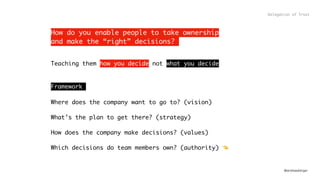
How do you enable people to take ownership

and make the “right” decisions?
Teaching them how you decide not what you decide
Framework
Where does the company want to go to? (vision)
What’s the plan to get there? (strategy)
How does the company make decisions? (values)
Which decisions do team members own? (authority) 👈
Delegation of Trust
@andreasklinger
Delegation of Trust
There is no right or wrong answer to this.
Hundreds of books were written about this.
You just need your answer.
But don’t worry too much…

Your answer will change a lot over time anyway.
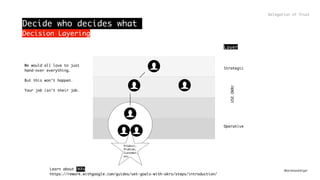
@andreasklingerLearn about OKRs
https://rework.withgoogle.com/guides/set-goals-with-okrs/steps/introduction/
Product,
Problem,
Customer,
etc
Layer
Strategic
Operative
USEOKRr
Decide who decides what
Decision Layering
Delegation of Trust
We would all love to just
hand-over everything.
But this won’t happen.
Your job isn’t their job.
@andreasklinger
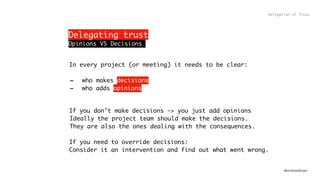
In every project (or meeting) it needs to be clear:
- who makes decisions
- who adds opinions
If you don’t make decisions -> you just add opinions
Ideally the project team should make the decisions.
They are also the ones dealing with the consequences.
If you need to override decisions:
Consider it an intervention and find out what went wrong.
Delegating trust
Delegation of Trust
Opinions VS Decisions
@andreasklinger
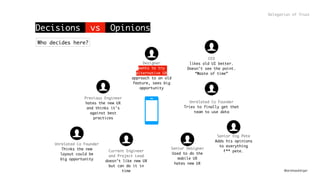
Previous Engineer
hates the new UX
and thinks it’s
against best
practices
Senior Designer
Used to do the
mobile UX 

hates new UX
Unrelated Co Founder
Tries to finally get that

team to use data
CEO
likes old UI better.
Doesn’t see the point.
“Waste of time”
Current Engineer
and Project Lead
doesn’t like new UX
but can do it in
time
Designer
wants to try
alternative UX
approach to an old
feature, sees big
opportunity
Senior Eng Pete
Adds his opinions
to everything
F** pete.
Decisions vs Opinions
Delegation of Trust
Unrelated Co Founder
Thinks the new
layout could be
big opportunity
Who decides here?
@andreasklinger
Previous Engineer
hates the new UX
and thinks it’s
against best
practices
Senior Designer
Used to do the
mobile UX 

hates new UX
Unrelated Co Founder
Tries to finally get that

team to use data
CEO
likes old UI better.
Doesn’t see the point.
“Waste of time”
Current Engineer
and Project Lead
doesn’t like new UX
but can do it in
time
Designer
wants to try
alternative UX
approach to an old
feature, sees big
opportunity
Senior Eng Pete
Adds his opinions
to everything
F** pete.
Decisions vs Opinions
Delegation of Trust
Unrelated Co Founder
Thinks the new
layout could be
big opportunity
Who decides here?
The team right?
Right?
But who in the project team?
The Lead?

The Designer should “own” design decisions, right?
Everybody?
@andreasklinger
Whenever stuck, reframe decisions 

as risk discussions
Delegation of Trust
Sometimes authorities and competences overlap. But when people try to
convince each other who is right, they have a binary discussion
What is the risk we are willing to commit? -> Usually risk = resources
What resources can they agree to commit?
1 week of the whole team? of the designer’s time?
What could be the outcome? A prototype?
Worstcase: Disagree and Commit
Tip #1
@andreasklinger
When stuck, sometimes you just need to ship
Discussions about readiness with “perfectionists” are sometimes tiring.
Is it ready or not? This is again a binary discussion.
Instead use feature flags
to release it to 1% of the audience
At PH used the 1% approach for multiple
“too large to ship, but still unfinished” products.
Heck i even shipped products missing essential
features to 1% of the audience.
As soon as it’s live… the discussion changes.
Delegation of Trust
Tip #2
@andreasklinger
Sometimes you accidentally derail decisions
Avoid drive-by management. Jumping into a discussion

and without context adding your opinions.
Remember:
Your opinion as manager/founder carries weight.
Use
#fyi tags to signal your intent.
Especially useful in multi-cultural teams
#fyi #suggestion #recommendation #plea
https://klinger.io/post/183526480955/fyi…
Method by
Dharmesh Shah
(HubSpot)
Delegation of Trust
Heard about it
via Wade Foster
(Zapier)
Tip #3
@andreasklinger
Embrace change ♻
Building teams is exhausting.
Problems will just get replaced with new problems.
Until your company stagnates or dies.
Differ between your frustration with people 

and your frustration with the situation.
Delegation of Trust
To wrap this up…
@andreasklinger
Ultimately everything is your fault.
You established the processes.
You mentored the people.
You hired the people.
You maybe didn’t fire the people.
If you struggle figuring this out,
don’t push your stress on the team:
Get a coach and level up
Delegation of Trust
Good news everyone,…
@andreasklinger
Giving and managing trust in a team
Your team is ok w/ more ownership.
Usually the problem is w/ yourself (the manager)
🤗
😬
Delegation of Trust
Ultimately, it comes down to…
@andreasklinger
Trust
“Is she coding?
…or playing fortnite?”
Delegation of Trust
@andreasklinger
Trust
“Is she coding?
…or playing fortnite?”
Why does it matter to you?
Establish trust in your team
Delegation of Trust
@andreasklinger
Further reading re management:
Joel Gascoigne about being servant leader
https://podtail.com/podcast/the-heartbeat/episode-31-
interview-with-joel-gascoigne-ceo-co-fo/
Presentation on Management:

https://www.slideshare.net/andreasklinger/engineering-
management-for-early-stage-startups-97402850
Managing remote teams: A crash course
https://klinger.io/post/180989912140/managing-remote-teams-
a-crash-course
Fin
@andreasklinger
Questions?
Thank you for your time!
PS: If we miss each other here: 

Send me questions via Twitter DM.

Engineering Management in Remote teams

  • 1.
    Engineering Management in RemoteTeams Andreas Klinger Head of Remote, AngelList former CTO of Product Hunt & VPE of CoinList ✌
  • 2.
    @andreasklinger ⏩ I sharedall slides on www.twitter.com/andreasklinger Hi. 👋
  • 3.
    @andreasklinger Product Hunt Place todiscover your next 😻 thing. 2014: Founding Team / CTO Moved to San Francisco
  • 4.
    @andreasklinger Product Hunt Place todiscover your next 😻 thing.
  • 5.
    @andreasklinger Product Hunt ➡AngelList Current Role: Head of Remote Product strategy lead for remote centric products Helping international talent 
 finding international careers 2017
  • 6.
    @andreasklinger angel.co/jobs Free job listings 7.000+startups hiring remote incl 1.000+ fully remote startups alist.co Premium Recruiting services Hire your VP of Engineering angel.co/talent/source Talent Search Engine 1.000.000+ registered users, who are open to remote jobs
  • 7.
    @andreasklinger Starting an invite-only investmentsyndicate Investing as a group of experts in remote startups and remote work tools Ping me if you want to co-invest or looking for investments 💰
  • 8.
    @andreasklinger Disclaimer Talk is opinion-heavy,feel free to disagree
 - what worked for me might not work for you - i am experienced with small (not large) teams - concepts can be applied to non-remote or non-tech teams 👍 Consult your doctor, use at own risk
  • 9.
    @andreasklinger Goal of talk -Differences for remote teams - PH’s approach to autonomy - Decision making and ownership in your team
  • 10.
    @andreasklinger Why remote work? -Logical evolution of digital knowledge work - Everybody is already working remote 
 The only question is just how much and how enabled?
 
 - Large companies (like eg google) are basically
 remote teams in denial - Optimizing daily life leads to better productivity, inclusion, happiness & retention And my personal motivation: - International talent should have international careers
  • 11.
    @andreasklinger Remote teams require~5x the process as colocated teams. - eg 5 people need to act like 20-25 people (until large size) - you plan meetings, have agenda, define work processes. Co-located teams can monkey-patch bad processes - eg more meetings, “management by walking around” or 
 simply by micro-manging Co-located teams: meetings are easy, writing stuff down is exhausting Remote teams: writing stuff down is easy, meetings are exhausting Remote good for iteration (focus) In person good for innovation (nuance) Strong connections to team needed to “know what’s going on” 
 because video-calls suck. How is managing remote teams different?
  • 12.
    @andreasklinger Processes? Timezones? Culturaldifferences? Work/life balance? Imho everything comes down to Trust But what’s really hard about managing remote teams?
  • 13.
  • 14.
    @andreasklinger ( “Is heactually motivated?” Trust
  • 15.
  • 16.
    @andreasklinger + “Mein feedback: Thissolution sucks…” Trust ,
  • 17.
    @andreasklinger 🗺 “Nobody takes ownership.
 Andif they do it’s the wrong path… so I have to
 involve myself.” Trust
  • 18.
    @andreasklinger 🔨 “Are theserefactoring really necessary? 
 We ship so slow already…” Trust
  • 19.
    @andreasklinger Trust /0 0/ “When did westart to need 8 people to decide even small stuff?”
  • 20.
    @andreasklinger “I either trustsomeone or i don’t” = wrong Trust is not binary. You trust some people more than others. You trust people with one thing more than with another. Your trust in people changes. Systemizing Trust Thinking about trust
  • 21.
    @andreasklinger “Trust is earned”= true, but… What about new people joining? How will you enable the new Product Manager to really give their best? Systemizing Trust
  • 22.
    @andreasklinger “Trust comes naturalto me…” = sure… Without creating systems around how/when/why we give trust and 
 what we expect in return we are opening up ourselves (or the company) to biases. Martha joined, and just gets it… She is a go-getter showing where we can improve. Steven on the other hand is constantly out of line and nagging about problems. … or we risk losing your values (that enabled us to work efficiently) as we scale. “When i joined you said this is a ‘ask for forgiveness’ type of company?
 I had to get permission for every little step…” Systemizing Trust
  • 23.
    @andreasklinger Systemizing Trust Trust … throughprocess … through explicit & transparent communication … through sharing authority … through decentralizing decisions … through understanding each other's (eg cultural) differences … through intentionally meeting each other … etc Without systemizing and managing trust remote teams simply don’t work. Systemizing Trust
  • 24.
    @andreasklinger Always the mostimportant thing: Meet your people face to face Getting to know each other as humans cannot be replaced. Meet for team retreats, project kickoffs, 
 pivot discussions. Regularly. It’s worth it. Systemizing Trust First PH team at YC Demo Day YC S14 This was the first time we met in person.
 We had worked together for months, 
 but we didn’t know if we should 
 shake hands, hug, kiss… 
 
 What kind of relationship did we 
 have at this point? Meeting in person is worth the ⏱ & 💰 Before we go into with PH’s approach on autonomy:
  • 25.
    Optimize for Single Player Mode ManagingTrust: Product Hunt’s engineering team approach to trust & autonomy
  • 26.
    @andreasklinger People are fastand capable Unless they are blocked Being blocked in remote teams is extremely expensive. - No “Management by Walking Around” - Timezone differences 2 Optimizing for Single Player Mode
  • 27.
    Optimize for Single Player Mode Thanksfor pressing jump Now, please wait until Frank is online.
  • 28.
    Optimize for Single Player Mode Cleargoals Find paths Rely on processes Automate feedback Enable to level up Single Player Mode
  • 29.
    Optimize for Single Player Mode Doesnot mean isolating or working always alone But avoiding unneeded inter-dependencies and blocking Autonomy != Abandonment “We trust you do whatever you think is right” without framework will just frustrate people. Single Player Mode
  • 30.
    @andreasklinger Step 1: Establish a“find a path” attitude Product Hunt “Design missing?” -> use standard components “Product aspects unclear?” -> you decide, get feedback later “Unsure what to work on next?” -> decide based on effectiveness “Technical implementation too complex?” -> fake it for now Optimizing for Single Player Mode
  • 31.
    @andreasklinger If you likeproduct a you might like product b We had no time to build a good technical solution. ⬅ Recommendations Optimizing for Single Player Mode
  • 32.
    @andreasklinger * Product Hunt,a company backed by YCombinator, A16Z, Google Ventures, Greylock, Betaworks, Naval Ravikant, Ashton Kutcher, Andrew Chen, GaryV, Your uncle, Alexis Ohanian, … Add recommended products: Recommended Post Id: *Some Post (delete) *Some other Post (delete) *Another Post (delete) Recommended Products Add Product Hunt Admin Dashboard *
  • 33.
    @andreasklinger ⬅ Product Recommendations Today If possible stilldone manually. Community suggested Admin/Maker/Hunter curated. *If* not enough: populated through automatic recommendations Optimizing for Single Player Mode
  • 34.
    @andreasklinger 📺 🎮 Step 2: Invest intooling and automate feedback 🔎 Code—linter, static code analysis, tests, auto-formatting, bots that check best practices of code-reviews, … => Developer knows code is good enough 🔦 Feature flags, dark launches, demo instances, easy deploys & reverts, … => Developer can ship with confidence 📝 Infrastructure changes in git, tool access in team keychain, documented previous post-mortems, … => Developer can fix worstcase scenarios Invest in Developer UX So that people have fast constant feedback, before anyone gets even online. Optimizing for Single Player Mode
  • 35.
    Example 1: CodeReviews - Everyone every morning - People can rely on it and don’t need to remind - Address feedback with code or comment. 
 - No need to wait for people to “re-review and approve” - As reviewer: - Do not to critique but help to ship faster - Don’t focus on how you’d do it unless it’s objectively better
 - Focus on high level discussion not implementation details - Never block unless dangerous. Give 👍 by default - As reviewed coder: - Get two +1 before going live -> Need to ship earlier? Go for it. We trust you - No codestyle discussions, ever -> add linter rule or STFU Step 3: Processes to enable and avoid back/forth
  • 36.
    @andreasklinger Optimizing for SinglePlayer Mode Step 3: Processes to enable and avoid back/forth Example 2: Fix-it Friday Every Friday everyone can work on whatever they think is useful. Idea: The opposite of “death by thousand cuts” is “thousand little bandages” 🛠 No “authorized” backlog needed. 🛠 Let your developers decide… 🛠 Everything is fair game. After 2-3 months you should start seeing significant improvements. Document and acknowledge achievements! Apart of Fix-it Fridays avoid refactoring without product value
  • 37.
    @andreasklinger Don’t over-engineer Instead refactoryour processes regularly Every growing team needs to refactor their processes ~6 months. - keep them few & simple - let problems emerge - look naturally grown solutions
 - discuss as a team - make them explicit(!) - accept that they won’t work forever — wait for new problems to arise - refactor again 🛠 Optimizing for Single Player Mode Step 3.1:
  • 38.
    @andreasklinger Step 4: Keep stuffout in the public - By default - discuss in public team chat channels (or leave summary) - share documents - take meeting notes - share decision summaries (eg after each call)
 - etc etc… Never get to the point that someone needs to ask for information. Because they won’t. Especially the new folks won’t. Optimizing for Single Player Mode
  • 39.
    Optimize for Single Player Mode Cleargoals Find paths Rely on processes Automate feedback Enable to level up Single Player Mode
  • 40.
    @andreasklinger Outcome example: Onboarding ProductHunt day 1: ship something even if just README.md update week 1: demo something to the team
 even if super small month 1: remove something 
 even if just small legacy code build something reusable 
 even if just small legacy code if this isn’t possible. the team’s fault. if you break something. the team’s fault. if you are blocked. the team’s fault. the on-boarding works.
 new engineers spearhead (or often lead) projects usually within weeks after joining. He is amazing. Took over PH Engineering after i left. Took our principles & brought them to the next level. A lot I mention in this presentation I learned from him. @rstankov CTO of PH Optimizing for Single Player Mode
  • 41.
    @andreasklinger Optimizing for SinglePlayer Mode @devladinci ❤
 (Sofia, Bulgaria) 
 
 “But Andreas, i am not a web-developer”
 
 Joined as junior iOS developer, took over iOS development.
 Later transitioned to leading web projects within weeks,
 Now owns SEO strategy at Product Hunt (and works on multiple other products) @rahulmfg ❤
 (Chennai, India) “i don’t think i can do this”
 
 Submitted bug reports to PH, learned rails + react to join PH, was very much overwhelmed Jr when joining ;) Launched “Promoted Posts”.
 Today PH’s biggest money maker Outcome: Enabling people to grow as developers and take ownership
 Process -> Confidence -> Ownership -> Momentum -> Trust Disclaimer: Both (and many more in the team) are amazing developers and would have been successful with or without PH.
 I don’t claim that this a magic technique. They rock. I believe our approach at PH is very healthy and should be done by more teams.
  • 42.
    Decision making 🙀 Delegating Trust: Approachesto 
 delegation & decision making 
 I learned over the years
  • 43.
    @andreasklinger …the person whodecides - Only every 10th decision should even reach you. - Only every 100th decision you should override. …a full-time communication hub - try not to have full-time managers* - see it as anti pattern / process mistake - eg CEO of AngelList (until 100pax) helped w/ BD/Sales - eg COO of CoinList does Design - eg CTO of Product Hunt builds features and is #1 to pick 💩-y dev chores A manager is not… * changes when you get large… but see how long it doesn’t has to. Delegation of Trust
  • 44.
    @andreasklinger Delegation of Trust -define processes - facilitate communication if processes fail - provide a reason to go somewhere, not the path - guide people when needed (incl. career) You manage processes You lead people
  • 45.
    @andreasklinger How do youenable people to take ownership
 and make the “right” decisions? Teaching them how you decide not what you decide Framework Where does the company want to go to? (vision) What’s the plan to get there? (strategy) How does the company make decisions? (values) Which decisions do team members own? (authority) 👈 Delegation of Trust
  • 46.
    @andreasklinger Delegation of Trust Thereis no right or wrong answer to this. Hundreds of books were written about this. You just need your answer. But don’t worry too much…
 Your answer will change a lot over time anyway.
  • 47.
    @andreasklingerLearn about OKRs https://rework.withgoogle.com/guides/set-goals-with-okrs/steps/introduction/ Product, Problem, Customer, etc Layer Strategic Operative USEOKRr Decidewho decides what Decision Layering Delegation of Trust We would all love to just hand-over everything. But this won’t happen. Your job isn’t their job.
  • 48.
    @andreasklinger In every project(or meeting) it needs to be clear: - who makes decisions - who adds opinions If you don’t make decisions -> you just add opinions Ideally the project team should make the decisions. They are also the ones dealing with the consequences. If you need to override decisions: Consider it an intervention and find out what went wrong. Delegating trust Delegation of Trust Opinions VS Decisions
  • 49.
    @andreasklinger Previous Engineer hates thenew UX and thinks it’s against best practices Senior Designer Used to do the mobile UX 
 hates new UX Unrelated Co Founder Tries to finally get that
 team to use data CEO likes old UI better. Doesn’t see the point. “Waste of time” Current Engineer and Project Lead doesn’t like new UX but can do it in time Designer wants to try alternative UX approach to an old feature, sees big opportunity Senior Eng Pete Adds his opinions to everything F** pete. Decisions vs Opinions Delegation of Trust Unrelated Co Founder Thinks the new layout could be big opportunity Who decides here?
  • 50.
    @andreasklinger Previous Engineer hates thenew UX and thinks it’s against best practices Senior Designer Used to do the mobile UX 
 hates new UX Unrelated Co Founder Tries to finally get that
 team to use data CEO likes old UI better. Doesn’t see the point. “Waste of time” Current Engineer and Project Lead doesn’t like new UX but can do it in time Designer wants to try alternative UX approach to an old feature, sees big opportunity Senior Eng Pete Adds his opinions to everything F** pete. Decisions vs Opinions Delegation of Trust Unrelated Co Founder Thinks the new layout could be big opportunity Who decides here? The team right? Right? But who in the project team? The Lead?
 The Designer should “own” design decisions, right? Everybody?
  • 51.
    @andreasklinger Whenever stuck, reframedecisions 
 as risk discussions Delegation of Trust Sometimes authorities and competences overlap. But when people try to convince each other who is right, they have a binary discussion What is the risk we are willing to commit? -> Usually risk = resources What resources can they agree to commit? 1 week of the whole team? of the designer’s time? What could be the outcome? A prototype? Worstcase: Disagree and Commit Tip #1
  • 52.
    @andreasklinger When stuck, sometimesyou just need to ship Discussions about readiness with “perfectionists” are sometimes tiring. Is it ready or not? This is again a binary discussion. Instead use feature flags to release it to 1% of the audience At PH used the 1% approach for multiple “too large to ship, but still unfinished” products. Heck i even shipped products missing essential features to 1% of the audience. As soon as it’s live… the discussion changes. Delegation of Trust Tip #2
  • 53.
    @andreasklinger Sometimes you accidentallyderail decisions Avoid drive-by management. Jumping into a discussion
 and without context adding your opinions. Remember: Your opinion as manager/founder carries weight. Use #fyi tags to signal your intent. Especially useful in multi-cultural teams #fyi #suggestion #recommendation #plea https://klinger.io/post/183526480955/fyi… Method by Dharmesh Shah (HubSpot) Delegation of Trust Heard about it via Wade Foster (Zapier) Tip #3
  • 54.
    @andreasklinger Embrace change ♻ Buildingteams is exhausting. Problems will just get replaced with new problems. Until your company stagnates or dies. Differ between your frustration with people 
 and your frustration with the situation. Delegation of Trust To wrap this up…
  • 55.
    @andreasklinger Ultimately everything isyour fault. You established the processes. You mentored the people. You hired the people. You maybe didn’t fire the people. If you struggle figuring this out, don’t push your stress on the team: Get a coach and level up Delegation of Trust Good news everyone,…
  • 56.
    @andreasklinger Giving and managingtrust in a team Your team is ok w/ more ownership. Usually the problem is w/ yourself (the manager) 🤗 😬 Delegation of Trust Ultimately, it comes down to…
  • 57.
    @andreasklinger Trust “Is she coding? …orplaying fortnite?” Delegation of Trust
  • 58.
    @andreasklinger Trust “Is she coding? …orplaying fortnite?” Why does it matter to you? Establish trust in your team Delegation of Trust
  • 59.
    @andreasklinger Further reading remanagement: Joel Gascoigne about being servant leader https://podtail.com/podcast/the-heartbeat/episode-31- interview-with-joel-gascoigne-ceo-co-fo/ Presentation on Management:
 https://www.slideshare.net/andreasklinger/engineering- management-for-early-stage-startups-97402850 Managing remote teams: A crash course https://klinger.io/post/180989912140/managing-remote-teams- a-crash-course Fin
  • 60.
    @andreasklinger Questions? Thank you foryour time! PS: If we miss each other here: 
 Send me questions via Twitter DM.