PROJECTIONS OF STRAIGHT LINES 
Definition of Straight line: 
A straight line is the shortest distance 
between two points. 
-Top views of two end points of a straight 
line, when joined, give the top view of 
the straight line. 
-Front views of the two end points of a 
straight line, when joined, give the front 
view of the straight line. 
-Both the above projections are straight 
lines.
Orientation of Straight Line in Space 
- A line in space may be parallel, 
perpendicular or inclined to either the H.P. 
or V.P. or both. 
- It may be in one or both the reference 
Planes. 
- Line ends may be in different Quadrants. 
- Position of Straight Line in space can be 
fixed by various combinations of data like 
distance of its end points from reference 
planes, inclinations of the line with the 
reference planes, distance between end 
projectors of the line etc.
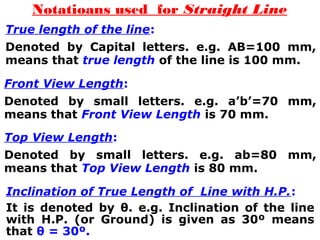
Notatioans used for Straight Line 
True length of the line: 
Denoted by Capital letters. e.g. AB=100 mm, 
means that true length of the line is 100 mm. 
Front View Length: 
Denoted by small letters. e.g. a’b’=70 mm, 
means that Front View Length is 70 mm. 
Top View Length: 
Denoted by small letters. e.g. ab=80 mm, 
means that Top View Length is 80 mm. 
Inclination of True Length of Line with H.P.: 
It is denoted by θ. e.g. Inclination of the line 
with H.P. (or Ground) is given as 30º means 
that θ = 30º.
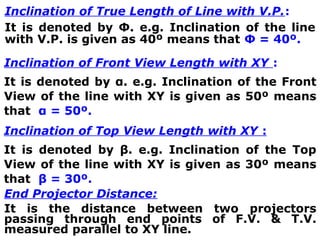
Inclination of True Length of Line with V.P.: 
It is denoted by Φ. e.g. Inclination of the line 
with V.P. is given as 40º means that Φ = 40º. 
Inclination of Front View Length with XY : 
It is denoted by α. e.g. Inclination of the Front 
View of the line with XY is given as 50º means 
that α = 50º. 
Inclination of Top View Length with XY : 
It is denoted by β. e.g. Inclination of the Top 
View of the line with XY is given as 30º means 
that β = 30º. 
End Projector Distance: 
It is the distance between two projectors 
passing through end points of F.V. & T.V. 
measured parallel to XY line.
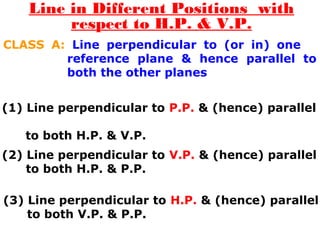
Line in Different Positions with 
respect to H.P. & V.P. 
CLASS A: Line perpendicular to (or in) one 
reference plane & hence parallel to 
both the other planes 
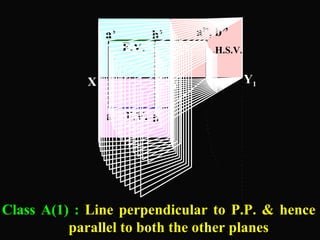
(1) Line perpendicular to P.P. & (hence) parallel 
to both H.P. & V.P. 
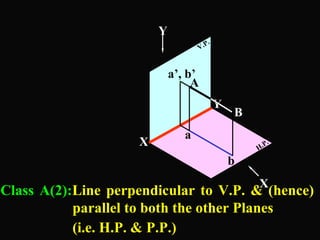
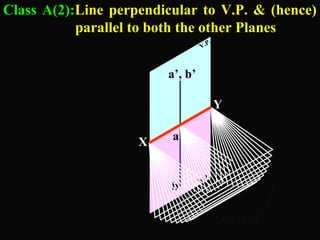
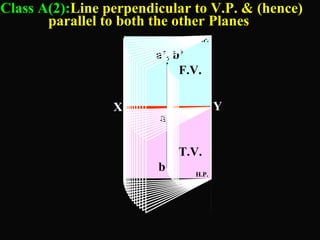
(2) Line perpendicular to V.P. & (hence) parallel 
to both H.P. & P.P. 
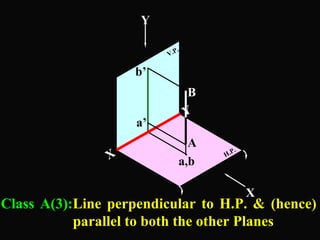
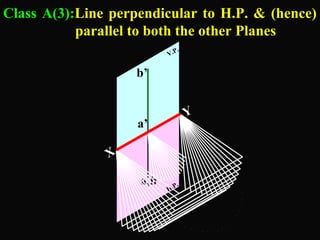
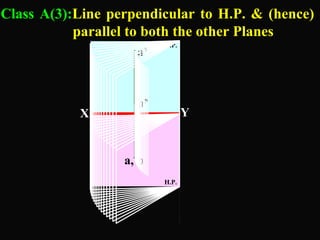
(3) Line perpendicular to H.P. & (hence) parallel 
to both V.P. & P.P.
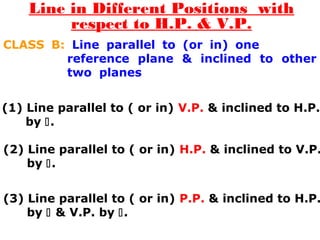
Line in Different Positions with 
respect to H.P. & V.P. 
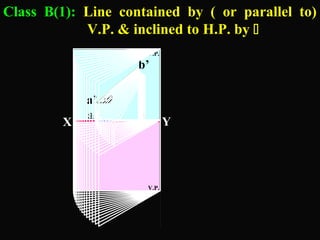
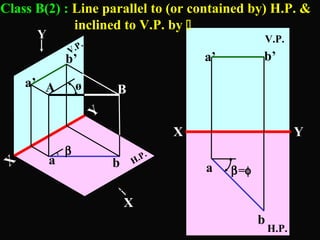
CLASS B: Line parallel to (or in) one 
reference plane & inclined to other 
two planes 
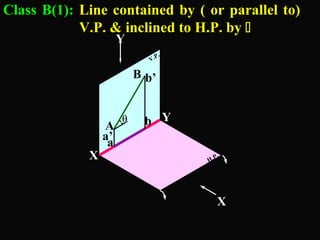
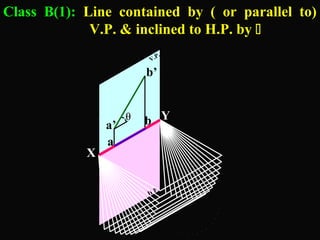
(1) Line parallel to ( or in) V.P. & inclined to H.P. 
by . 
(2) Line parallel to ( or in) H.P. & inclined to V.P. 
by . 
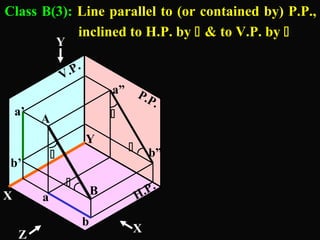
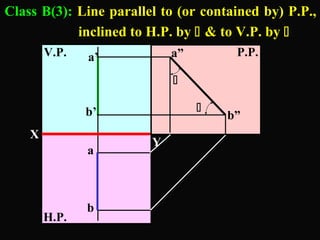
(3) Line parallel to ( or in) P.P. & inclined to H.P. 
by  & V.P. by .
Line in Different Positions with 
respect to H.P. & V.P. 
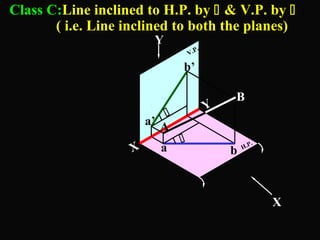
CLASS C: Line inclined to all three reference 
planes ( Oblique lines ) 
Line inclined to H.P. by , to V.P. by  and also 
inclined to profile plane.
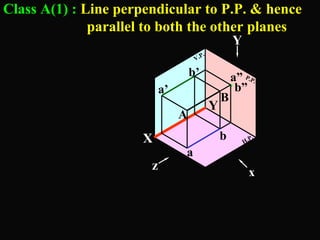
Class A(1) : Line perpendicular to P.P. & hence 
parallel to both the other planes 
Y 
a” 
P.P. 
. 
H.P. 
V.P. 
Y 
X 
B 
A 
a’ 
b’ 
b 
a 
b” 
z x
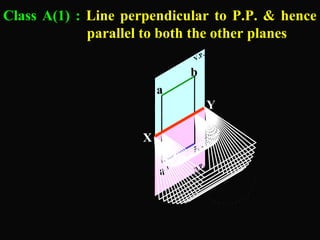
Class A(1) : Line perpendicular to P.P. & hence 
parallel to both the other planes 
X 
Y 
a’ 
V.P. 
b’ 
H.P. 
a 
b
P.P. 
a”, b” 
Y1 
. 
V.P. 
H.P. 
a’ 
b’ 
a 
b 
X 
Y 
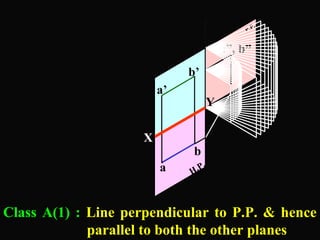
Class A(1) : Line perpendicular to P.P. & hence 
parallel to both the other planes
a’ b’ 
F.V. L.H.S.V. 
a b 
a”, b” 
. 
X Y1 
T.V. 
Y 
Class A(1) : Line perpendicular to P.P. & hence 
parallel to both the other planes
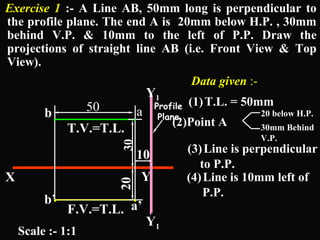
Exercise 1 :- A Line AB, 50mm long is perpendicular to 
the profile plane. The end A is 20mm below H.P. , 30mm 
behind V.P. & 10mm to the left of P.P. Draw the 
projections of straight line AB (i.e. Front View & Top 
View). 
b . . 
30 
Y1 
X Y 
Profile 
Plane 
20 
a’ 
. 
b’ 
a 
T.V.=T.L. 
F.V.=T.L. 
10 
Y1 
50 
Data given :- 
(1)T.L. = 50mm 
(2)Point A 
20 below H.P. 
30mm Behind 
V.P. 
(3)Line is perpendicular 
to P.P. 
(4)Line is 10mm left of 
P.P. 
Scale :- 1:1 
.
V.P. 
H.P. 
Y 
X 
a’,. b’ 
A 
B 
b 
a 
Y 
Class A(2):Line perpendicular to V.P. &X (hence) 
parallel to both the other Planes 
(i.e. H.P. & P.P.)
Class A(2):Line perpendicular to V.P. & (hence) 
parallel to both the other Planes 
a’, b’ 
X 
Y 
V.P. 
H.P. 
a 
b 
.
Class A(2):Line perpendicular to V.P. & (hence) 
parallel to both the other Planes 
V.P. 
F.V. 
H.P. 
a’, b’ 
X Y 
a 
b 
T.V. 
.
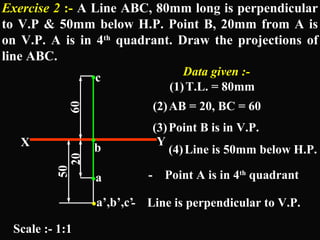
Exercise 2 :- A Line ABC, 80mm long is perpendicular 
to V.P & 50mm below H.P. Point B, 20mm from A is 
on V.P. A is in 4th quadrant. Draw the projections of 
line ABC. 
c 
. 
b 
50 a 
. 
a’,b’,c’ 
20 60 
X Y 
Data given :- 
(1)T.L. = 80mm 
(3)Point B is in V.P. 
(4)Line is 50mm below H.P. 
- Line is perpendicular to V.P. 
Scale :- 1:1 
(2)AB = 20, BC = 60 
- Point A is in 4th quadrant 
. 
.
H.P. 
Y X 
. 
V.P. 
B 
A 
a,b 
b’ 
a’ 
X 
Y 
Class A(3):Line perpendicular to H.P. & (hence) 
parallel to both the other Planes
Class A(3):Line perpendicular to H.P. & (hence) 
parallel to both the other Planes 
b’ 
Y X 
a.,b 
V.P. 
H.P. 
a’
Class A(3):Line perpendicular to H.P. & (hence) 
parallel to both the other Planes 
a’ 
b’ 
V.P. 
X Y 
a,. b 
H.P.
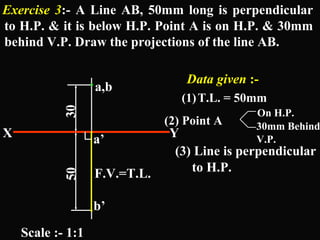
Exercise 3:- A Line AB, 50mm long is perpendicular 
to H.P. & it is below H.P. Point A is on H.P. & 30mm 
behind V.P. Draw the projections of the line AB. 
a,b 
. 
X Y 
a’ 
F.V.=T.L. 
b’ 
30 50 
Data given :- 
(1)T.L. = 50mm 
(2) Point A On H.P. 
30mm Behind 
V.P. 
(3) Line is perpendicular 
to H.P. 
Scale :- 1:1 
. 
.
Class B(1): Line contained by ( or parallel to) 
V.P. & inclined to H.P. by  
H.P. 
V.P. 
a’ 
b’ 
X 
Y 
a 
b 
X 
Y 
A 
B 
θθ
Class B(1): Line contained by ( or parallel to) 
V.P. & inclined to H.P. by  
Y 
X 
V.P. 
b’ 
a’ 
a 
θθ b 
H.P.
Class B(1): Line contained by ( or parallel to) 
V.P. & inclined to H.P. by  
b’ 
V.P. 
a’ 
a b 
V.P. 
θθ 
X Y
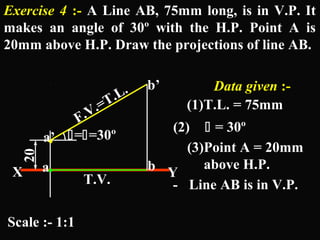
Exercise 4 :- A Line AB, 75mm long, is in V.P. It 
makes an angle of 30º with the H.P. Point A is 
20mm above H.P. Draw the projections of line AB. 
20 
F.V.=T.L. 
==30º 
b’ 
. 
a’ 
a b 
X T.V. Y 
Data given :- 
(1)T.L. = 75mm 
Scale :- 1:1 
(2)  = 30º 
(3)Point A = 20mm 
above H.P. 
- Line AB is in V.P. 
.
Class B(2) : Line parallel to (or contained by) H.P. & 
V.P. 
b’ a’ b’ 
H.P. 
a’ A B 
V.P. 
H.P. 
b=f 
a b 
a 
b 
X 
Y 
ø 
X Y 
b 
X 
Y 
inclined to V.P. by 
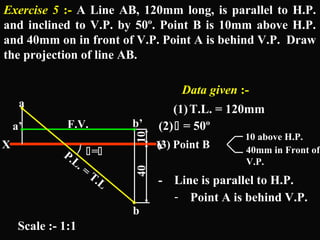
Exercise 5 :- A Line AB, 120mm long, is parallel to H.P. 
and inclined to V.P. by 50º. Point B is 10mm above H.P. 
and 40mm on in front of V.P. Point A is behind V.P. Draw 
the projection of line AB. 
. . 
a’ b’ 
10 
a 
F.V. 
X Y 
b 
= 
P.L. = T.L 
40 
Data given :- 
(1)T.L. = 120mm 
(3) Point B 10 above H.P. 
40mm in Front of 
V.P. 
- Line is parallel to H.P. 
- Point A is behind V.P. 
Scale :- 1:1 
(2)  = 50º 
. 
.
Class B(3): Line parallel to (or contained by) P.P., 
inclined to H.P. by  & to V.P. by  
H.P. 
V.P. 
P.P. 
Y 
a’ 
b’ 
X 
A 
B 
a” 
 b” 
 
Y 
b 
a 
 
 
Z X
Class B(3): Line parallel to (or contained by) P.P., 
V.P. 
H.P. 
inclined to H.P. by  & to V.P. by  
P.P. 
 
 
a’ 
b’ 
X Y 
a 
b 
b” 
a”
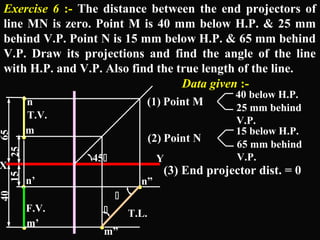
Exercise 6 :- The distance between the end projectors of 
line MN is zero. Point M is 40 mm below H.P. & 25 mm 
behind V.P. Point N is 15 mm below H.P. & 65 mm behind 
V.P. Draw its projections and find the angle of the line 
with H.P. and V.P. Also find the true length of the line. 
Data given :- 
(1) Point M 40 below H.P. 
25 mm behind 
V.P. 
(2) Point N 15 below H.P. 
65 mm behind 
V.P. 
. 
n 
.. 
65 
m 
45 
X Y 
.. 
(3) End projector dist. = 0 . 
F.V.  
T.L. 
.. 
.. 
25 
15 
40 
n’ 
m’ 
 
n” 
m” 
T.V.
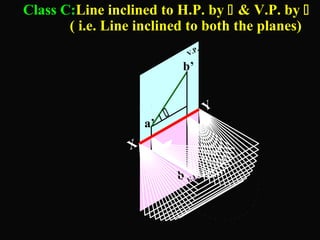
Class C:Line inclined to H.P. by  & V.P. by  
( i.e. Line inclined to both the planes) 
H.P. 
V.P. 
X Y 
a b 
a’ 
b’ 
 
 
Y 
X 
B 
A
Class C:Line inclined to H.P. by  & V.P. by  
( i.e. Line inclined to both the planes) 
V.P. 
X Y 
a 
b 
 
H.P. 
 
a’ 
b’
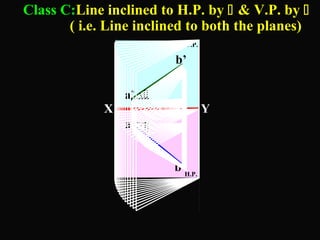
Class C:Line inclined to H.P. by  & V.P. by  
( i.e. Line inclined to both the planes) 
V.P. 
b’ 
X Y 
a  
b 
H.P. 
a’ 
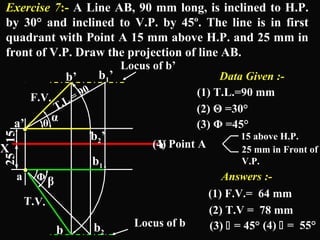
Exercise 7:- A Line AB, 90 mm long, is inclined to H.P. 
by 30° and inclined to V.P. by 45º. The line is in first 
quadrant with Point A 15 mm above H.P. and 25 mm in 
front of V.P. Draw the projection of line AB. 
25 15 
Φ 
α 
β 
.. 
a’ 
a 
b’ b1’ 
X Y 
b b2 
θ 
Locus of b’ 
Locus of b 
Data Given :- 
(1) T.L.=90 mm 
(2) Θ =30° 
(3) Φ =45° 
(4) Point A 15 above H.P. 
25 mm in Front of 
V.P. 
F.V. 
T.V. 
Answers :- 
(1) F.V.= 64 mm 
(2) T.V = 78 mm 
(3)  = 45° (4)  = 55° 
T.L.= 90 
b2’ 
b1 ..
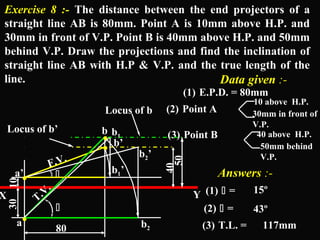
Exercise 8 :- The distance between the end projectors of a 
straight line AB is 80mm. Point A is 10mm above H.P. and 
30mm in front of V.P. Point B is 40mm above H.P. and 50mm 
behind V.P. Draw the projections and find the inclination of 
straight line AB with H.P & V.P. and the true length of the 
line. Data given :- 
(1) E.P.D. = 80mm 
(2) Point A 10 above H.P. 
(3) Point B 40 above H.P. 
50mm behind 
V.P. 
. Locus of b’ . 
a’ 
Locus of b 
 Answers :- 
X Y 
30mm in front of 
V.P. 
80 30 10 a 
b1 b 
40 
50 
b’ 
b2’ 
 
(1)  = 
(2)  = 
(3) T.L. = 
15º 
43º 
117mm 
. 
. 
b2 
b1’ 
F.V. 
T.V.
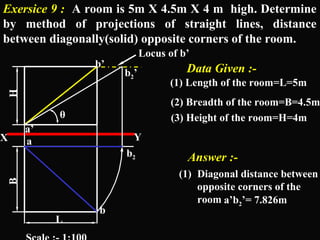
Exersice 9 : A room is 5m X 4.5m X 4 m high. Determine 
by method of projections of straight lines, distance 
between diagonally(solid) opposite corners of the room. 
b2’ 
H B 
b’ 
a’ 
a 
X Y 
b 
L 
Data Given :- 
(1) Length of the room=L=5m 
(2) Breadth of the room=B=4.5m 
(3) Height of the room=H=4m 
Answer :- 
(1) Diagonal distance between 
opposite corners of the 
room 
a’b2’= 7.826m 
Scale :- 1:100 
b2 
Locus of b’ 
θ
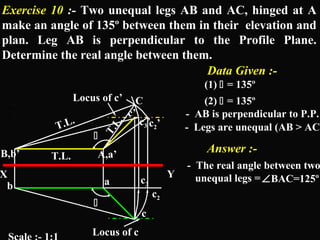
Exercise 10 :- Two unequal legs AB and AC, hinged at A 
make an angle of 135º between them in their elevation and 
plan. Leg AB is perpendicular to the Profile Plane. 
Determine the real angle between them. Data Given :- 
C 
c2’ 
(1)  = 135º 
(2)  = 135º 
- AB is perpendicular to P.P. 
- Legs are unequal (AB > AC) 
Answer :- 
- The real angle between two 
unequal legs = ÐBAC=125º 
 
B,b’ A,a’ 
b a 
c 
c’ 
X Y 
 
Scale :- 1:1 Locus of c 
c3’ 
Locus of c’ 
c2 
c3 
T.L. 
T.L. 
T.L.
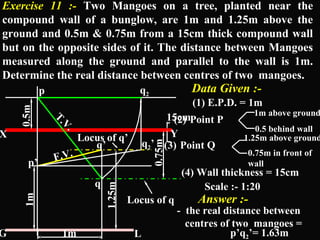
Exercise 11 :- Two Mangoes on a tree, planted near the 
compound wall of a bunglow, are 1m and 1.25m above the 
ground and 0.5m & 0.75m from a 15cm thick compound wall 
but on the opposite sides of it. The distance between Mangoes 
measured along the ground and parallel to the wall is 1m. 
Determine the real distance between centres of two mangoes. 
1m 0.5m 
Locus of q’ 
q2 
q’ 
q’ F.V. 
21.25m 
15cm 
(3) Point Q 
0.75m 
T.V. 
q 
p’ 
p 
(2) Point P 1m above ground 
X Y 
Locus of q 
G L 
Data Given :- 
(1) E.P.D. = 1m 
0.5 behind wall 
1.25m above ground 
0.75m in front of 
wall 
(4) Wall thickness = 15cm 
Scale :- 1:20 
Answer :- 
- the real distance between 
centres of two mangoes = 
p’q21m ’= 1.63m
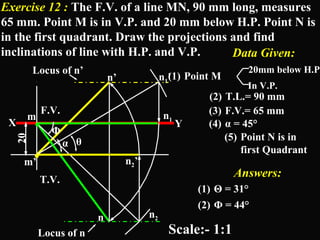
Exercise 12 : The F.V. of a line MN, 90 mm long, measures 
65 mm. Point M is in V.P. and 20 mm below H.P. Point N is 
in the first quadrant. Draw the projections and find 
inclinations of line with H.P. and V.P. Data Given: 
(1) Point M 20mm below H.P. 
In V.P. 
(2) T.L.= 90 mm 
(3) F.V.= 65 mm 
(4) α = 45° 
(5) Point N is in 
first Quadrant 
Locus of n’ 
. 
F.V. 
. 
m 
X Y 
20 
m’ 
n’ n1’ 
n1 
n2 
n2’ 
n 
θ 
Answers: 
(1) Θ = 31° 
(2) Φ = 44° 
Φ 
T.V. 
α 
Locus of n 
Scale:- 1:1
TRACES OF A LINE 
Definition: When a line is inclined to a plane, it 
will meet that plane, produced if 
necessary. The point where the line or 
line produced meets the plane is called 
trace. 
Horizontal Trace: The point of intersection of 
the inclined line with the H.P. is called 
Horizontal Trace or simply H.T. 
Vertical Trace: The point of intersection of the 
inclined line with the V.P. is called 
Vertical Trace or simply V.T.
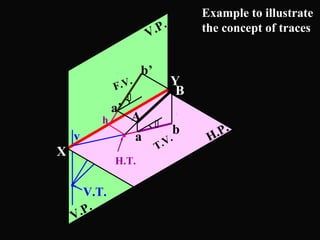
V.P. 
. 
b’ 
a b 
H.P. 
. 
V.P. a’ 
B 
A 
Y 
X 
Example to illustrate 
the concept of traces 
 
 
F.V. 
T.V. 
H.T. 
h 
v 
V.T.
IMPORTANT POINTS REGARDING 
TRACES OF A LINE 
- If a line is inclined to both H.P. & V.P. then 
its Front view, h’ and V.T. must be on the 
same straight line. 
e.g. if front view of a line AB is a’b’, then 
h,a’,b’ and V.T. must be on a same straight 
line. 
- If a line is inclined to both H.P. & V.P. then 
its Top view, v and H.T. must be on the same 
straight line. 
e.g. if Top View of a line AB is ab, then v, a, b 
and H.T. must be on a same straight line.
IMPORTANT POINTS REGARDING 
TRACES OF A LINE 
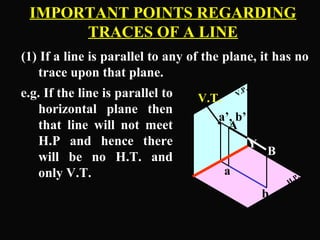
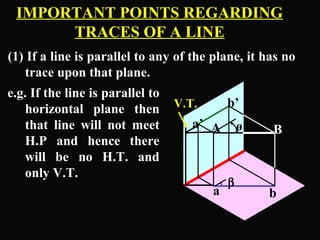
(1) If a line is parallel to any of the plane, it has no 
trace upon that plane. 
e.g. If the line is parallel to 
V.P. 
horizontal plane then 
that line will not meet 
H.P and hence there 
will be no H.T. and 
only V.T. 
H.P. 
a’,. b’ 
A 
B 
b 
a 
V.T. 
Y
IMPORTANT POINTS REGARDING 
TRACES OF A LINE 
(1) If a line is parallel to any of the plane, it has no 
trace upon that plane. 
e.g. If the line is parallel to 
horizontal plane then 
V.T. 
b’ 
that line will not meet 
a’ A ø 
B 
H.P and hence there 
will be no H.T. and 
only V.T. 
b 
a b 
.
IMPORTANT POINTS REGARDING 
TRACES OF A LINE 
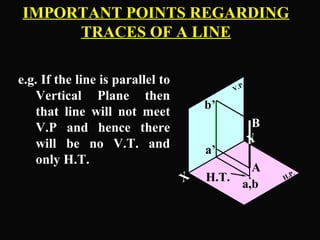
e.g. If the line is parallel to 
Vertical Plane then 
that line will not meet 
V.P and hence there 
will be no V.T. and 
only H.T. 
V.P. 
B 
b’ 
Y X 
H.P. 
. 
A 
a,b 
a’ 
H.T.
IMPORTANT POINTS REGARDING 
TRACES OF A LINE 
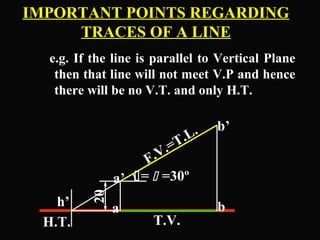
e.g. If the line is parallel to Vertical Plane 
then that line will not meet V.P and hence 
there will be no V.T. and only H.T. 
20 
F.V.=T.L. 
=  =30º 
b’ 
a’ 
a b 
T.V. 
h’ 
H.T.
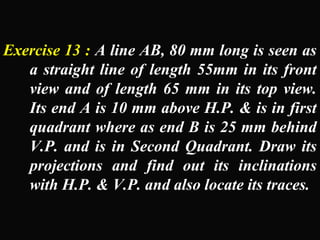
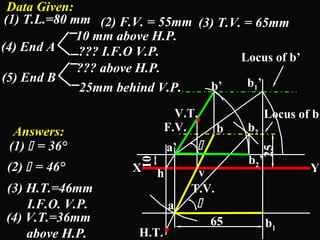
Exercise 13 : A line AB, 80 mm long is seen as 
a straight line of length 55mm in its front 
view and of length 65 mm in its top view. 
Its end A is 10 mm above H.P. & is in first 
quadrant where as end B is 25 mm behind 
V.P. and is in Second Quadrant. Draw its 
projections and find out its inclinations 
with H.P. & V.P. and also locate its traces.
Data Given: 
(1) T.L.=80 mm (2) F.V. = 55mm (3) T.V. = 65mm 
(4) End A 
10 mm above H.P. 
??? I.F.O V.P. 
(5) End B 
??? above H.P. 
25mm behind V.P. 
b’ 
b 
Locus of b’ 
Locus of b 
b1’ 
25 
F.V. 
b2 
X Y 
b1 65 
H.T. 
a 
V.T. 
v 
T.V. 
10 
a’ 
. 
. 
b2’ 
h 
Answers: 
(1)  = 36° 
(2)  = 46° 
(3) H.T.=46mm 
I.F.O. V.P. 
(4) V.T.=36mm 
above H.P. 
 

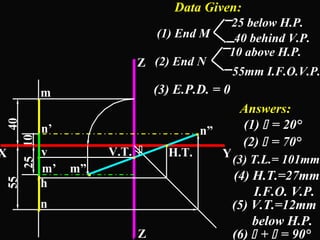
Exercise 14 : The end projectors distance of a 
line MN is zero. Its end M is 25mm below 
H.P. & 40mm behind V.P. where as end N 
is 10 above H.P. & 55mm in front of V.P. 
Draw its projections and find out its 
inclinations with H.P. & V.P. and also 
locate its traces.
. 
m 
. 
n’ 
. 
v 
40 
10 
25 
m’ 
. 
. 
. 
V.T. H.T. 
X Y 
n 
n” 
m” 
Z 
Z 
h 
55 
. . 
Data Given: 
(1) End M 
25 below H.P. 
40 behind V.P. 
(2) End N 
10 above H.P. 
55mm I.F.O.V.P. 
(3) E.P.D. = 0 
Answers: 
(1)  = 20° 
(2)  = 70° 
(4) H.T.=27mm 
(3) T.L.= 101mm 
I.F.O. V.P. 
(5) V.T.=12mm 
below H.P. 
.. 
 
(6)  +  = 90°
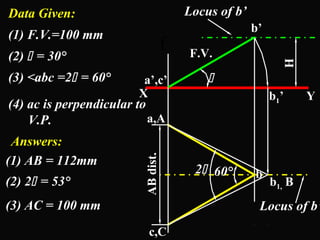
Exercise 15 : A divider instrument of a compass box 
having two equal arms AB & BC hinged at B is kept 
in H.P. on its needle point A & C with the line 
joining A & C is perpendicular to V.P. It is seen in 
front view as a straight line 100mm long inclined at 
30° to H.P. while it is seen in top view as an angle abc 
with <abc = 60°. Draw its front view and top view 
and find; 
(1) The height of point B above H.P. 
(2) The apart distance between the needle points 
A & C 
(3)The lengths of arms AB & BC with real 
between them
Data Given: 
(1) F.V.=100 mm f (2)  = 30° 
(3) <abc =2 = 60° 
(4) ac is perpendicular to 
a’,c’ 
V.P. a,A 
c,C 
H 
b1’ 
b1, B 
b’ 
Locus of b’ 
F.V. 
 
X Y 
2 60° 
b 
Locus of b’ 
AB dist. 
Answers: 
(1) AB = 112mm 
(2) 2 = 53° 
(3) AC = 100 mm
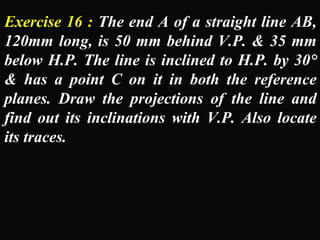
Exercise 16 : The end A of a straight line AB, 
120mm long, is 50 mm behind V.P. & 35 mm 
below H.P. The line is inclined to H.P. by 30° 
& has a point C on it in both the reference 
planes. Draw the projections of the line and 
find out its inclinations with V.P. Also locate 
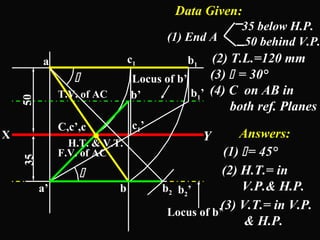
its traces.
Data Given: 
(1) End A 
35 below H.P. 
50 behind V.P. 
(2) T.L.=120 mm 
(3)  = 30° 
(4) C on AB in 
both ref. Planes 
Answers: 
(1)  = 45° 
(2) H.T.= in 
a 
 
b1 
. 
Locus of b’ 
T.V. of AC 
H.T. & V.T. . 
X Y 
& H.P. 35 
V.P.& H.P. 
(3) V.T.= in V.P. 
a’ 
b 
b’ 
C,c’,c 
c1 
50 
b2 
c1’ 
b1’ 
b2’ 
.  
Locus of b’ 
F.V. of AC
PROJECTIONS 
OF STRAIGHT 
LINES

Engineering line

  • 2.
    PROJECTIONS OF STRAIGHTLINES Definition of Straight line: A straight line is the shortest distance between two points. -Top views of two end points of a straight line, when joined, give the top view of the straight line. -Front views of the two end points of a straight line, when joined, give the front view of the straight line. -Both the above projections are straight lines.
  • 3.
    Orientation of StraightLine in Space - A line in space may be parallel, perpendicular or inclined to either the H.P. or V.P. or both. - It may be in one or both the reference Planes. - Line ends may be in different Quadrants. - Position of Straight Line in space can be fixed by various combinations of data like distance of its end points from reference planes, inclinations of the line with the reference planes, distance between end projectors of the line etc.
  • 4.
    Notatioans used forStraight Line True length of the line: Denoted by Capital letters. e.g. AB=100 mm, means that true length of the line is 100 mm. Front View Length: Denoted by small letters. e.g. a’b’=70 mm, means that Front View Length is 70 mm. Top View Length: Denoted by small letters. e.g. ab=80 mm, means that Top View Length is 80 mm. Inclination of True Length of Line with H.P.: It is denoted by θ. e.g. Inclination of the line with H.P. (or Ground) is given as 30º means that θ = 30º.
  • 5.
    Inclination of TrueLength of Line with V.P.: It is denoted by Φ. e.g. Inclination of the line with V.P. is given as 40º means that Φ = 40º. Inclination of Front View Length with XY : It is denoted by α. e.g. Inclination of the Front View of the line with XY is given as 50º means that α = 50º. Inclination of Top View Length with XY : It is denoted by β. e.g. Inclination of the Top View of the line with XY is given as 30º means that β = 30º. End Projector Distance: It is the distance between two projectors passing through end points of F.V. & T.V. measured parallel to XY line.
  • 6.
    Line in DifferentPositions with respect to H.P. & V.P. CLASS A: Line perpendicular to (or in) one reference plane & hence parallel to both the other planes (1) Line perpendicular to P.P. & (hence) parallel to both H.P. & V.P. (2) Line perpendicular to V.P. & (hence) parallel to both H.P. & P.P. (3) Line perpendicular to H.P. & (hence) parallel to both V.P. & P.P.
  • 7.
    Line in DifferentPositions with respect to H.P. & V.P. CLASS B: Line parallel to (or in) one reference plane & inclined to other two planes (1) Line parallel to ( or in) V.P. & inclined to H.P. by . (2) Line parallel to ( or in) H.P. & inclined to V.P. by . (3) Line parallel to ( or in) P.P. & inclined to H.P. by  & V.P. by .
  • 8.
    Line in DifferentPositions with respect to H.P. & V.P. CLASS C: Line inclined to all three reference planes ( Oblique lines ) Line inclined to H.P. by , to V.P. by  and also inclined to profile plane.
  • 9.
    Class A(1) :Line perpendicular to P.P. & hence parallel to both the other planes Y a” P.P. . H.P. V.P. Y X B A a’ b’ b a b” z x
  • 10.
    Class A(1) :Line perpendicular to P.P. & hence parallel to both the other planes X Y a’ V.P. b’ H.P. a b
  • 11.
    P.P. a”, b” Y1 . V.P. H.P. a’ b’ a b X Y Class A(1) : Line perpendicular to P.P. & hence parallel to both the other planes
  • 12.
    a’ b’ F.V.L.H.S.V. a b a”, b” . X Y1 T.V. Y Class A(1) : Line perpendicular to P.P. & hence parallel to both the other planes
  • 13.
    Exercise 1 :-A Line AB, 50mm long is perpendicular to the profile plane. The end A is 20mm below H.P. , 30mm behind V.P. & 10mm to the left of P.P. Draw the projections of straight line AB (i.e. Front View & Top View). b . . 30 Y1 X Y Profile Plane 20 a’ . b’ a T.V.=T.L. F.V.=T.L. 10 Y1 50 Data given :- (1)T.L. = 50mm (2)Point A 20 below H.P. 30mm Behind V.P. (3)Line is perpendicular to P.P. (4)Line is 10mm left of P.P. Scale :- 1:1 .
  • 14.
    V.P. H.P. Y X a’,. b’ A B b a Y Class A(2):Line perpendicular to V.P. &X (hence) parallel to both the other Planes (i.e. H.P. & P.P.)
  • 15.
    Class A(2):Line perpendicularto V.P. & (hence) parallel to both the other Planes a’, b’ X Y V.P. H.P. a b .
  • 16.
    Class A(2):Line perpendicularto V.P. & (hence) parallel to both the other Planes V.P. F.V. H.P. a’, b’ X Y a b T.V. .
  • 17.
    Exercise 2 :-A Line ABC, 80mm long is perpendicular to V.P & 50mm below H.P. Point B, 20mm from A is on V.P. A is in 4th quadrant. Draw the projections of line ABC. c . b 50 a . a’,b’,c’ 20 60 X Y Data given :- (1)T.L. = 80mm (3)Point B is in V.P. (4)Line is 50mm below H.P. - Line is perpendicular to V.P. Scale :- 1:1 (2)AB = 20, BC = 60 - Point A is in 4th quadrant . .
  • 18.
    H.P. Y X . V.P. B A a,b b’ a’ X Y Class A(3):Line perpendicular to H.P. & (hence) parallel to both the other Planes
  • 19.
    Class A(3):Line perpendicularto H.P. & (hence) parallel to both the other Planes b’ Y X a.,b V.P. H.P. a’
  • 20.
    Class A(3):Line perpendicularto H.P. & (hence) parallel to both the other Planes a’ b’ V.P. X Y a,. b H.P.
  • 21.
    Exercise 3:- ALine AB, 50mm long is perpendicular to H.P. & it is below H.P. Point A is on H.P. & 30mm behind V.P. Draw the projections of the line AB. a,b . X Y a’ F.V.=T.L. b’ 30 50 Data given :- (1)T.L. = 50mm (2) Point A On H.P. 30mm Behind V.P. (3) Line is perpendicular to H.P. Scale :- 1:1 . .
  • 22.
    Class B(1): Linecontained by ( or parallel to) V.P. & inclined to H.P. by  H.P. V.P. a’ b’ X Y a b X Y A B θθ
  • 23.
    Class B(1): Linecontained by ( or parallel to) V.P. & inclined to H.P. by  Y X V.P. b’ a’ a θθ b H.P.
  • 24.
    Class B(1): Linecontained by ( or parallel to) V.P. & inclined to H.P. by  b’ V.P. a’ a b V.P. θθ X Y
  • 25.
    Exercise 4 :-A Line AB, 75mm long, is in V.P. It makes an angle of 30º with the H.P. Point A is 20mm above H.P. Draw the projections of line AB. 20 F.V.=T.L. ==30º b’ . a’ a b X T.V. Y Data given :- (1)T.L. = 75mm Scale :- 1:1 (2)  = 30º (3)Point A = 20mm above H.P. - Line AB is in V.P. .
  • 26.
    Class B(2) :Line parallel to (or contained by) H.P. & V.P. b’ a’ b’ H.P. a’ A B V.P. H.P. b=f a b a b X Y ø X Y b X Y inclined to V.P. by 
  • 27.
    Exercise 5 :-A Line AB, 120mm long, is parallel to H.P. and inclined to V.P. by 50º. Point B is 10mm above H.P. and 40mm on in front of V.P. Point A is behind V.P. Draw the projection of line AB. . . a’ b’ 10 a F.V. X Y b = P.L. = T.L 40 Data given :- (1)T.L. = 120mm (3) Point B 10 above H.P. 40mm in Front of V.P. - Line is parallel to H.P. - Point A is behind V.P. Scale :- 1:1 (2)  = 50º . .
  • 28.
    Class B(3): Lineparallel to (or contained by) P.P., inclined to H.P. by  & to V.P. by  H.P. V.P. P.P. Y a’ b’ X A B a”  b”  Y b a   Z X
  • 29.
    Class B(3): Lineparallel to (or contained by) P.P., V.P. H.P. inclined to H.P. by  & to V.P. by  P.P.   a’ b’ X Y a b b” a”
  • 30.
    Exercise 6 :-The distance between the end projectors of line MN is zero. Point M is 40 mm below H.P. & 25 mm behind V.P. Point N is 15 mm below H.P. & 65 mm behind V.P. Draw its projections and find the angle of the line with H.P. and V.P. Also find the true length of the line. Data given :- (1) Point M 40 below H.P. 25 mm behind V.P. (2) Point N 15 below H.P. 65 mm behind V.P. . n .. 65 m 45 X Y .. (3) End projector dist. = 0 . F.V.  T.L. .. .. 25 15 40 n’ m’  n” m” T.V.
  • 31.
    Class C:Line inclinedto H.P. by  & V.P. by  ( i.e. Line inclined to both the planes) H.P. V.P. X Y a b a’ b’   Y X B A
  • 32.
    Class C:Line inclinedto H.P. by  & V.P. by  ( i.e. Line inclined to both the planes) V.P. X Y a b  H.P.  a’ b’
  • 33.
    Class C:Line inclinedto H.P. by  & V.P. by  ( i.e. Line inclined to both the planes) V.P. b’ X Y a  b H.P. a’ 
  • 34.
    Exercise 7:- ALine AB, 90 mm long, is inclined to H.P. by 30° and inclined to V.P. by 45º. The line is in first quadrant with Point A 15 mm above H.P. and 25 mm in front of V.P. Draw the projection of line AB. 25 15 Φ α β .. a’ a b’ b1’ X Y b b2 θ Locus of b’ Locus of b Data Given :- (1) T.L.=90 mm (2) Θ =30° (3) Φ =45° (4) Point A 15 above H.P. 25 mm in Front of V.P. F.V. T.V. Answers :- (1) F.V.= 64 mm (2) T.V = 78 mm (3)  = 45° (4)  = 55° T.L.= 90 b2’ b1 ..
  • 35.
    Exercise 8 :-The distance between the end projectors of a straight line AB is 80mm. Point A is 10mm above H.P. and 30mm in front of V.P. Point B is 40mm above H.P. and 50mm behind V.P. Draw the projections and find the inclination of straight line AB with H.P & V.P. and the true length of the line. Data given :- (1) E.P.D. = 80mm (2) Point A 10 above H.P. (3) Point B 40 above H.P. 50mm behind V.P. . Locus of b’ . a’ Locus of b  Answers :- X Y 30mm in front of V.P. 80 30 10 a b1 b 40 50 b’ b2’  (1)  = (2)  = (3) T.L. = 15º 43º 117mm . . b2 b1’ F.V. T.V.
  • 36.
    Exersice 9 :A room is 5m X 4.5m X 4 m high. Determine by method of projections of straight lines, distance between diagonally(solid) opposite corners of the room. b2’ H B b’ a’ a X Y b L Data Given :- (1) Length of the room=L=5m (2) Breadth of the room=B=4.5m (3) Height of the room=H=4m Answer :- (1) Diagonal distance between opposite corners of the room a’b2’= 7.826m Scale :- 1:100 b2 Locus of b’ θ
  • 37.
    Exercise 10 :-Two unequal legs AB and AC, hinged at A make an angle of 135º between them in their elevation and plan. Leg AB is perpendicular to the Profile Plane. Determine the real angle between them. Data Given :- C c2’ (1)  = 135º (2)  = 135º - AB is perpendicular to P.P. - Legs are unequal (AB > AC) Answer :- - The real angle between two unequal legs = ÐBAC=125º  B,b’ A,a’ b a c c’ X Y  Scale :- 1:1 Locus of c c3’ Locus of c’ c2 c3 T.L. T.L. T.L.
  • 38.
    Exercise 11 :-Two Mangoes on a tree, planted near the compound wall of a bunglow, are 1m and 1.25m above the ground and 0.5m & 0.75m from a 15cm thick compound wall but on the opposite sides of it. The distance between Mangoes measured along the ground and parallel to the wall is 1m. Determine the real distance between centres of two mangoes. 1m 0.5m Locus of q’ q2 q’ q’ F.V. 21.25m 15cm (3) Point Q 0.75m T.V. q p’ p (2) Point P 1m above ground X Y Locus of q G L Data Given :- (1) E.P.D. = 1m 0.5 behind wall 1.25m above ground 0.75m in front of wall (4) Wall thickness = 15cm Scale :- 1:20 Answer :- - the real distance between centres of two mangoes = p’q21m ’= 1.63m
  • 39.
    Exercise 12 :The F.V. of a line MN, 90 mm long, measures 65 mm. Point M is in V.P. and 20 mm below H.P. Point N is in the first quadrant. Draw the projections and find inclinations of line with H.P. and V.P. Data Given: (1) Point M 20mm below H.P. In V.P. (2) T.L.= 90 mm (3) F.V.= 65 mm (4) α = 45° (5) Point N is in first Quadrant Locus of n’ . F.V. . m X Y 20 m’ n’ n1’ n1 n2 n2’ n θ Answers: (1) Θ = 31° (2) Φ = 44° Φ T.V. α Locus of n Scale:- 1:1
  • 40.
    TRACES OF ALINE Definition: When a line is inclined to a plane, it will meet that plane, produced if necessary. The point where the line or line produced meets the plane is called trace. Horizontal Trace: The point of intersection of the inclined line with the H.P. is called Horizontal Trace or simply H.T. Vertical Trace: The point of intersection of the inclined line with the V.P. is called Vertical Trace or simply V.T.
  • 41.
    V.P. . b’ a b H.P. . V.P. a’ B A Y X Example to illustrate the concept of traces   F.V. T.V. H.T. h v V.T.
  • 42.
    IMPORTANT POINTS REGARDING TRACES OF A LINE - If a line is inclined to both H.P. & V.P. then its Front view, h’ and V.T. must be on the same straight line. e.g. if front view of a line AB is a’b’, then h,a’,b’ and V.T. must be on a same straight line. - If a line is inclined to both H.P. & V.P. then its Top view, v and H.T. must be on the same straight line. e.g. if Top View of a line AB is ab, then v, a, b and H.T. must be on a same straight line.
  • 43.
    IMPORTANT POINTS REGARDING TRACES OF A LINE (1) If a line is parallel to any of the plane, it has no trace upon that plane. e.g. If the line is parallel to V.P. horizontal plane then that line will not meet H.P and hence there will be no H.T. and only V.T. H.P. a’,. b’ A B b a V.T. Y
  • 44.
    IMPORTANT POINTS REGARDING TRACES OF A LINE (1) If a line is parallel to any of the plane, it has no trace upon that plane. e.g. If the line is parallel to horizontal plane then V.T. b’ that line will not meet a’ A ø B H.P and hence there will be no H.T. and only V.T. b a b .
  • 45.
    IMPORTANT POINTS REGARDING TRACES OF A LINE e.g. If the line is parallel to Vertical Plane then that line will not meet V.P and hence there will be no V.T. and only H.T. V.P. B b’ Y X H.P. . A a,b a’ H.T.
  • 46.
    IMPORTANT POINTS REGARDING TRACES OF A LINE e.g. If the line is parallel to Vertical Plane then that line will not meet V.P and hence there will be no V.T. and only H.T. 20 F.V.=T.L. =  =30º b’ a’ a b T.V. h’ H.T.
  • 47.
    Exercise 13 :A line AB, 80 mm long is seen as a straight line of length 55mm in its front view and of length 65 mm in its top view. Its end A is 10 mm above H.P. & is in first quadrant where as end B is 25 mm behind V.P. and is in Second Quadrant. Draw its projections and find out its inclinations with H.P. & V.P. and also locate its traces.
  • 48.
    Data Given: (1)T.L.=80 mm (2) F.V. = 55mm (3) T.V. = 65mm (4) End A 10 mm above H.P. ??? I.F.O V.P. (5) End B ??? above H.P. 25mm behind V.P. b’ b Locus of b’ Locus of b b1’ 25 F.V. b2 X Y b1 65 H.T. a V.T. v T.V. 10 a’ . . b2’ h Answers: (1)  = 36° (2)  = 46° (3) H.T.=46mm I.F.O. V.P. (4) V.T.=36mm above H.P.  
  • 49.
    Exercise 14 :The end projectors distance of a line MN is zero. Its end M is 25mm below H.P. & 40mm behind V.P. where as end N is 10 above H.P. & 55mm in front of V.P. Draw its projections and find out its inclinations with H.P. & V.P. and also locate its traces.
  • 50.
    . m . n’ . v 40 10 25 m’ . . . V.T. H.T. X Y n n” m” Z Z h 55 . . Data Given: (1) End M 25 below H.P. 40 behind V.P. (2) End N 10 above H.P. 55mm I.F.O.V.P. (3) E.P.D. = 0 Answers: (1)  = 20° (2)  = 70° (4) H.T.=27mm (3) T.L.= 101mm I.F.O. V.P. (5) V.T.=12mm below H.P. ..  (6)  +  = 90°
  • 51.
    Exercise 15 :A divider instrument of a compass box having two equal arms AB & BC hinged at B is kept in H.P. on its needle point A & C with the line joining A & C is perpendicular to V.P. It is seen in front view as a straight line 100mm long inclined at 30° to H.P. while it is seen in top view as an angle abc with <abc = 60°. Draw its front view and top view and find; (1) The height of point B above H.P. (2) The apart distance between the needle points A & C (3)The lengths of arms AB & BC with real between them
  • 52.
    Data Given: (1)F.V.=100 mm f (2)  = 30° (3) <abc =2 = 60° (4) ac is perpendicular to a’,c’ V.P. a,A c,C H b1’ b1, B b’ Locus of b’ F.V.  X Y 2 60° b Locus of b’ AB dist. Answers: (1) AB = 112mm (2) 2 = 53° (3) AC = 100 mm
  • 53.
    Exercise 16 :The end A of a straight line AB, 120mm long, is 50 mm behind V.P. & 35 mm below H.P. The line is inclined to H.P. by 30° & has a point C on it in both the reference planes. Draw the projections of the line and find out its inclinations with V.P. Also locate its traces.
  • 54.
    Data Given: (1)End A 35 below H.P. 50 behind V.P. (2) T.L.=120 mm (3)  = 30° (4) C on AB in both ref. Planes Answers: (1)  = 45° (2) H.T.= in a  b1 . Locus of b’ T.V. of AC H.T. & V.T. . X Y & H.P. 35 V.P.& H.P. (3) V.T.= in V.P. a’ b b’ C,c’,c c1 50 b2 c1’ b1’ b2’ .  Locus of b’ F.V. of AC
  • 55.