PROJECTION OF LINE
 A straight line is the shortest distance between any two
points in space.
 A line represents the locus of a point moving along a fixed
linear path in space.
 As a line consists of a number of points, its projections
are drawn by joining the projections of any two points on
the line (preferably the end points) or on the extension of
the line.
 RP`S means VP and HP.
Projection of Line
SIMPLE CASES OF THE LINE
1. LINE PARALLEL TO BOTH HP & VP.
2. A VERTICAL LINE ( LINE PERPENDICULAR TO HP & // TO VP)
3. LINE INCLINED TO HP & PARALLEL TO VP.
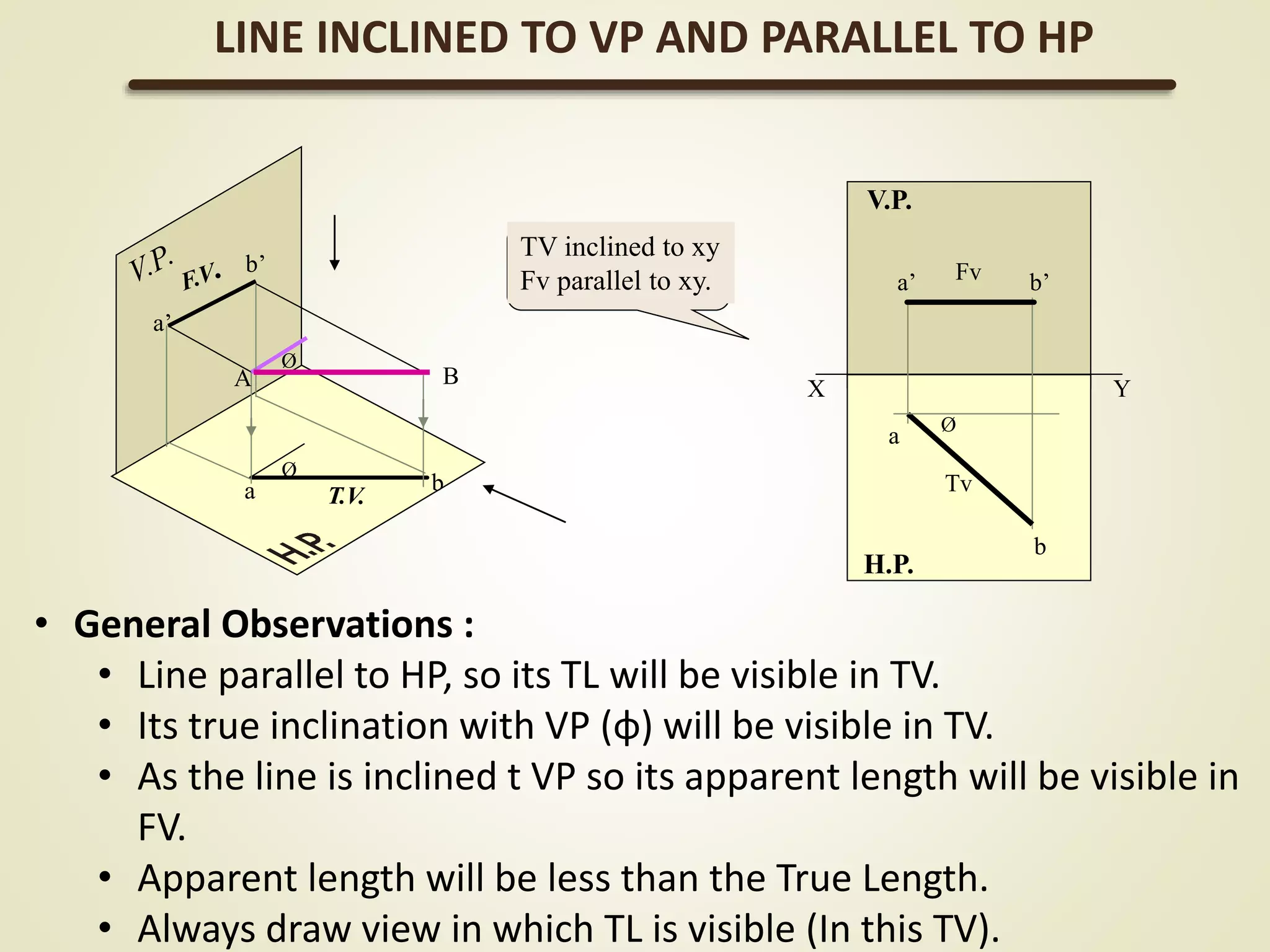
4. LINE INCLINED TO VP & PARALLEL TO HP.
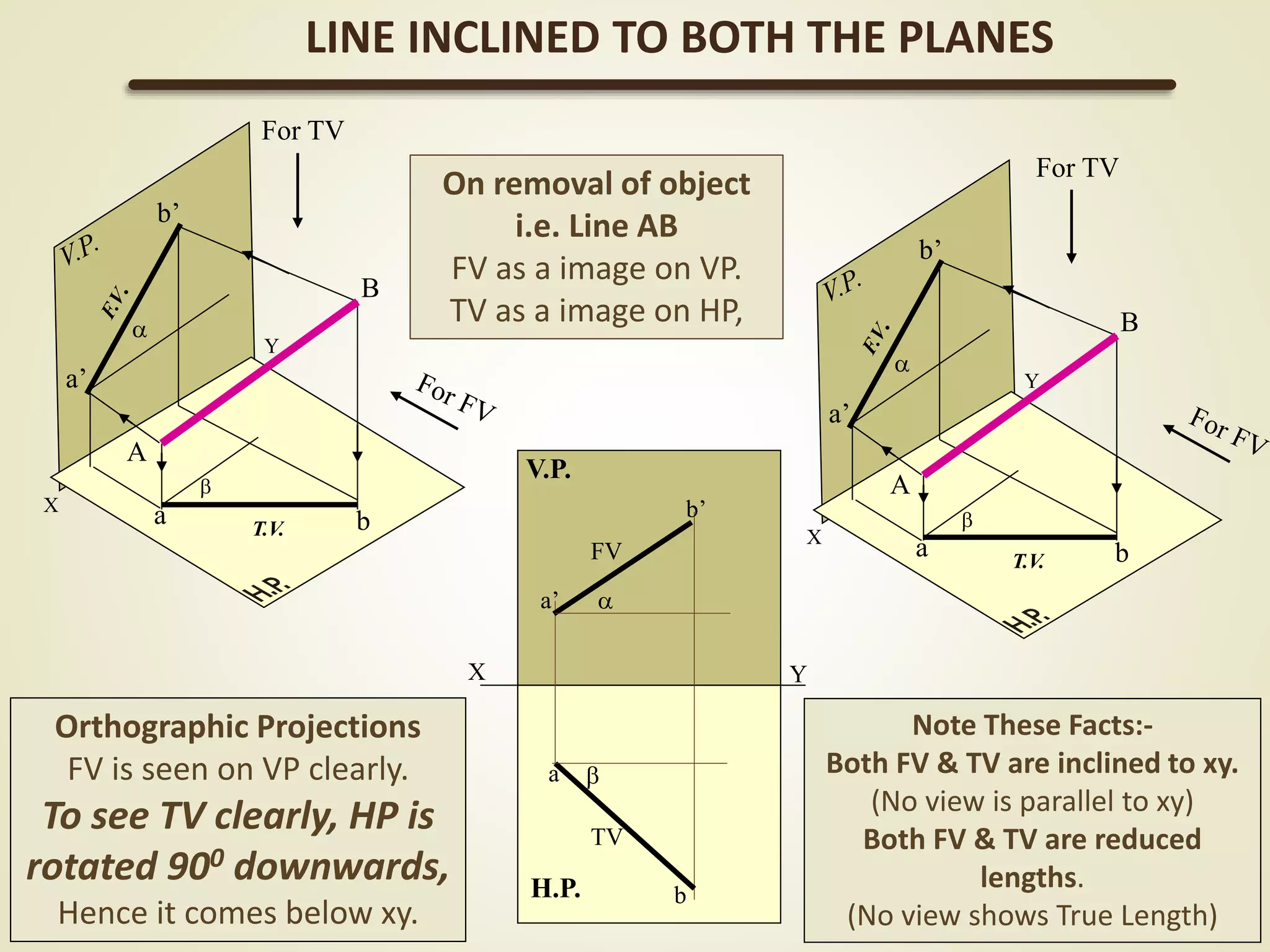
5. LINE INCLINED TO BOTH HP & VP.
Information regarding a line means it’s length, position
of it’s ends with HP & VP, it’s inclinations with HP & VP will be
given.
Projection of Line
AIM:- TO DRAW IT’S PROJECTIONS - MEANS FV & TV.
Terms used in Projections of Lines
 True Length (TL): The actual length of a line is called its true length.
 Plan Length (PL) or Top View Length: The apparent length of a line seen in TV is
called the plan length or top view length.
 Elevation Length (EL) or Front View Length: The apparent length of a line seen in
FV is called the elevation length or front view length.
 Side View Length (SVL): The apparent length of a line seen in SV is called its side
view length.
 Inclination with the HP (θ): It is the true angle that a line makes with its
projection on the HP. It is indicated by θ (True inclination with HP).
 Inclination with the VP (Φ): It is the true angle that a line makes with its
projection on the VP. It is indicated by Φ (True inclination with VP).
 Apparent Angle with the HP (α): It is the angle which an oblique line seems
to be making with the HP in FV. It is the angle between FV and XY. It is
indicated by α.
 Apparent Angle with the VP (β): It is the angle which an oblique line seems
to be making with the VP in TV. It is the angle between TV and XY. It is
indicated by β.
 Horizontal Trace (HT): The point of intersection of the line (or its extension)
with the HP is called the horizontal trace of the line.
 Vertical Trace (VT): The point of intersection of the line (or its extension)
with the VP is called the vertical trace of the line.
 Point View of the Line: The view of a line seen as a point (i.e., when the
views of two ends coincide) is called the point view.
Terms used in Projections of Lines
X
Y
b’
a’
b
a
A
B
X Y
H.P.
V.P.
a b
a’ b’Fv
Tv
For TV
Note:
FV & TV both are
// to xy
&
both show T L
LINE PARALLEL TO BOTH THE PLANES
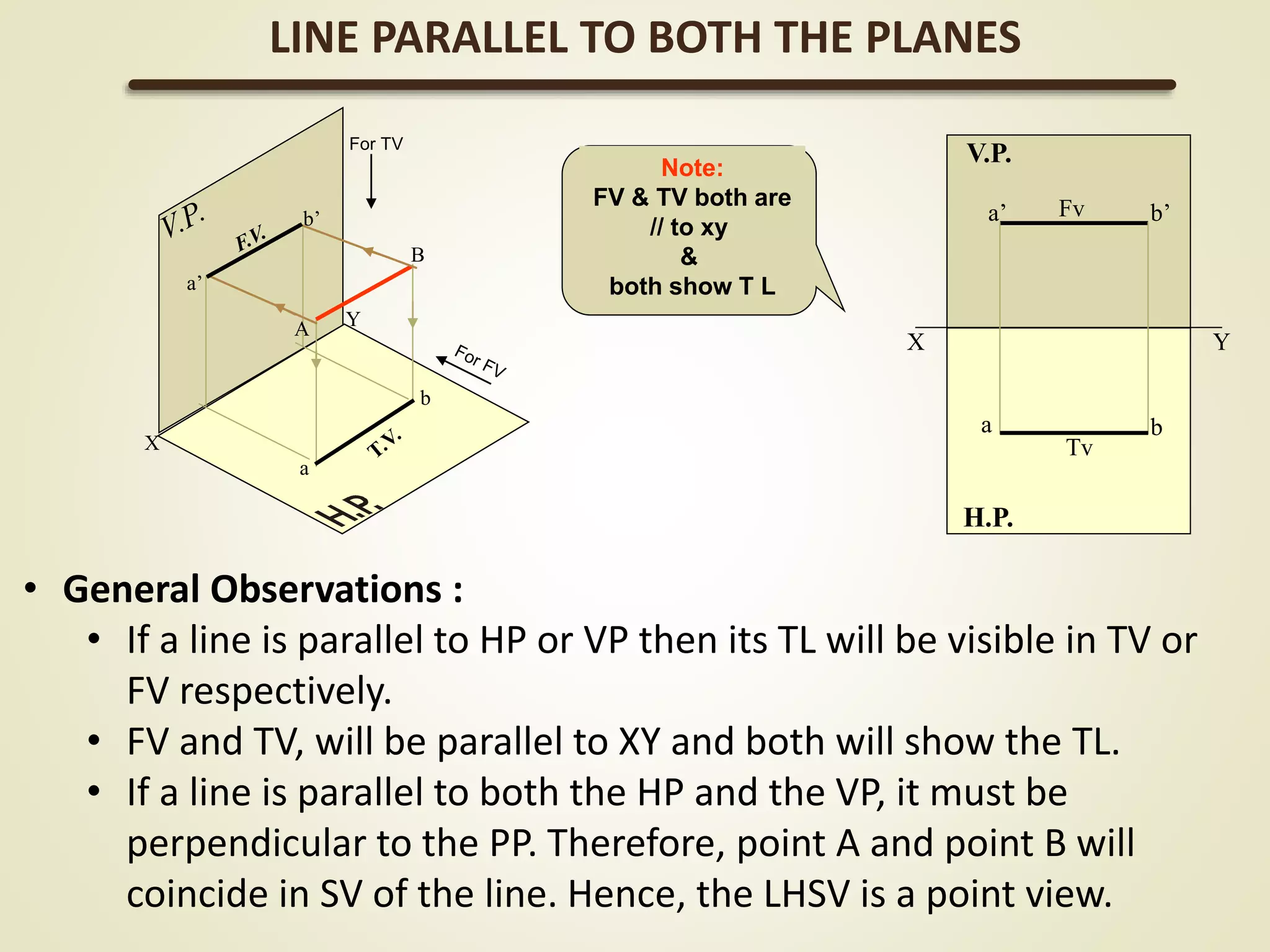
• General Observations :
• If a line is parallel to HP or VP then its TL will be visible in TV or
FV respectively.
• FV and TV, will be parallel to XY and both will show the TL.
• If a line is parallel to both the HP and the VP, it must be
perpendicular to the PP. Therefore, point A and point B will
coincide in SV of the line. Hence, the LHSV is a point view.
X
Y
H.P.
b’
a’
b
a
A
B
x y
V.P.
a b
a’ b’
FV
TV
For TV
NOTE:
FV & TV BOTH ARE
// TO XY
&
BOTH SHOW T. L.
Orthographic Pattern
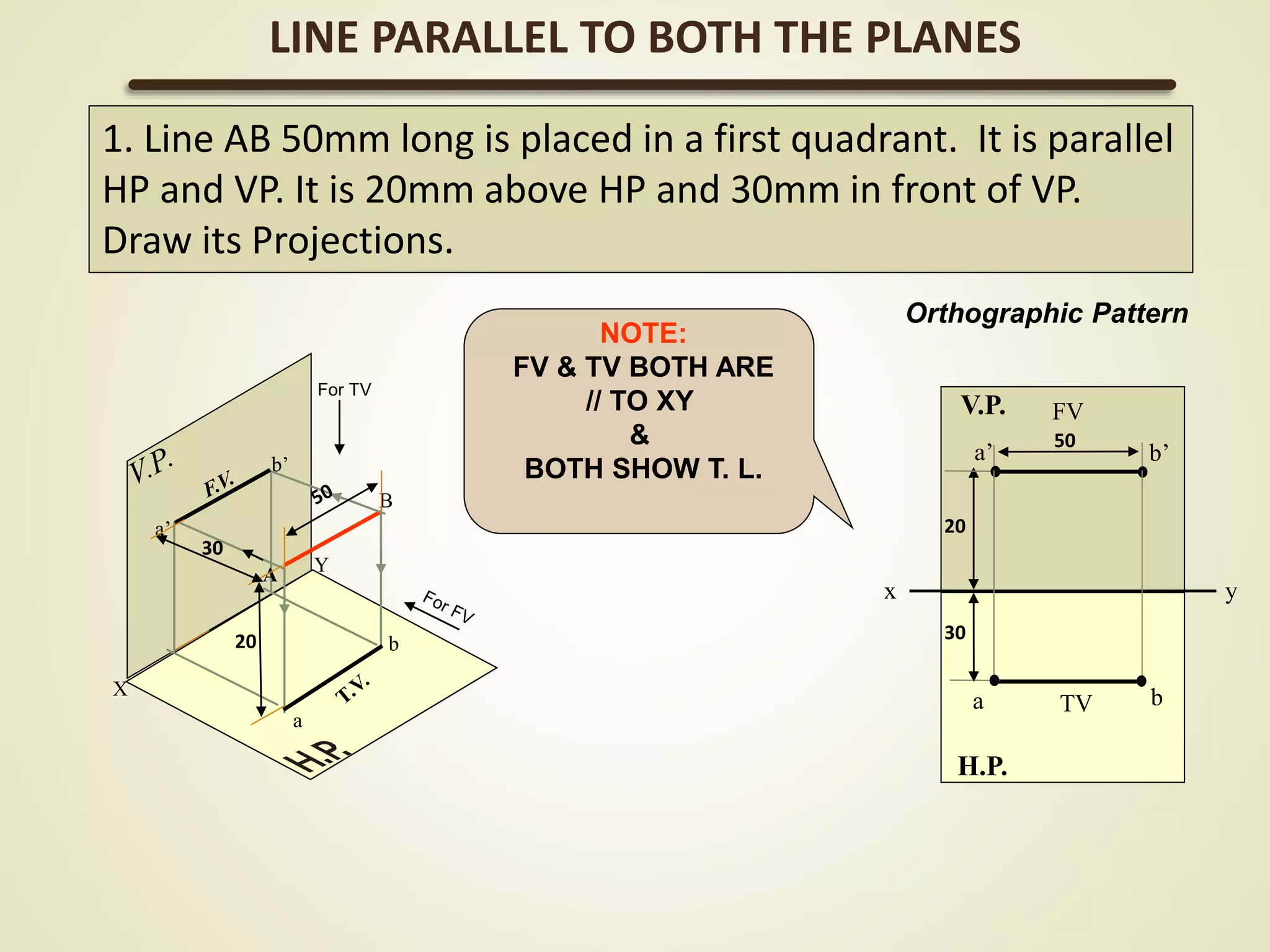
1. Line AB 50mm long is placed in a first quadrant. It is parallel
HP and VP. It is 20mm above HP and 30mm in front of VP.
Draw its Projections.
20
30
20
30
50
LINE PARALLEL TO BOTH THE PLANES
2. Line AB 50mm long is placed in a first quadrant. Its
side view is a point and it is 60 mm from the
intersection of HP and VP. It is equidistant from both
the reference planes. Draw the projections and
specify the position of a line.
LINE PARALLEL TO BOTH THE PLANES
LINE PERPENDICULAR TO EITHER OF THE RPs
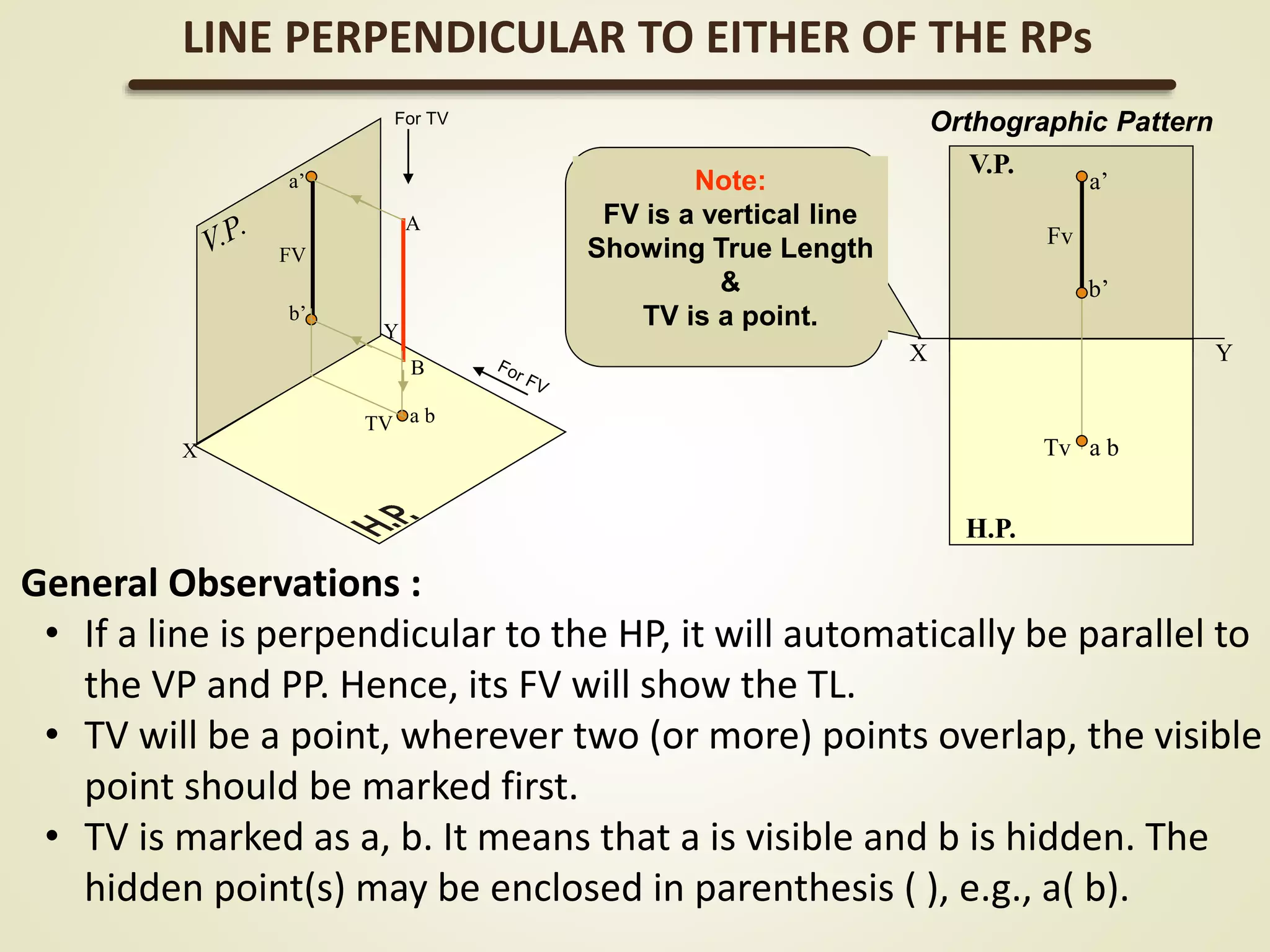
General Observations :
• If a line is perpendicular to the HP, it will automatically be parallel to
the VP and PP. Hence, its FV will show the TL.
• TV will be a point, wherever two (or more) points overlap, the visible
point should be marked first.
• TV is marked as a, b. It means that a is visible and b is hidden. The
hidden point(s) may be enclosed in parenthesis ( ), e.g., a( b).
X
Y
a b
a’
b’
B
A
TV
FV
X Y
H.P.
V.P.
a’
b’
a b
Fv
Tv
For TV
Note:
FV is a vertical line
Showing True Length
&
TV is a point.
Orthographic Pattern
X
Y
H.P.
b’
a’
ab
A
B
x y
V.P.
a b
a’
b’
For TV
Orthographic Projection
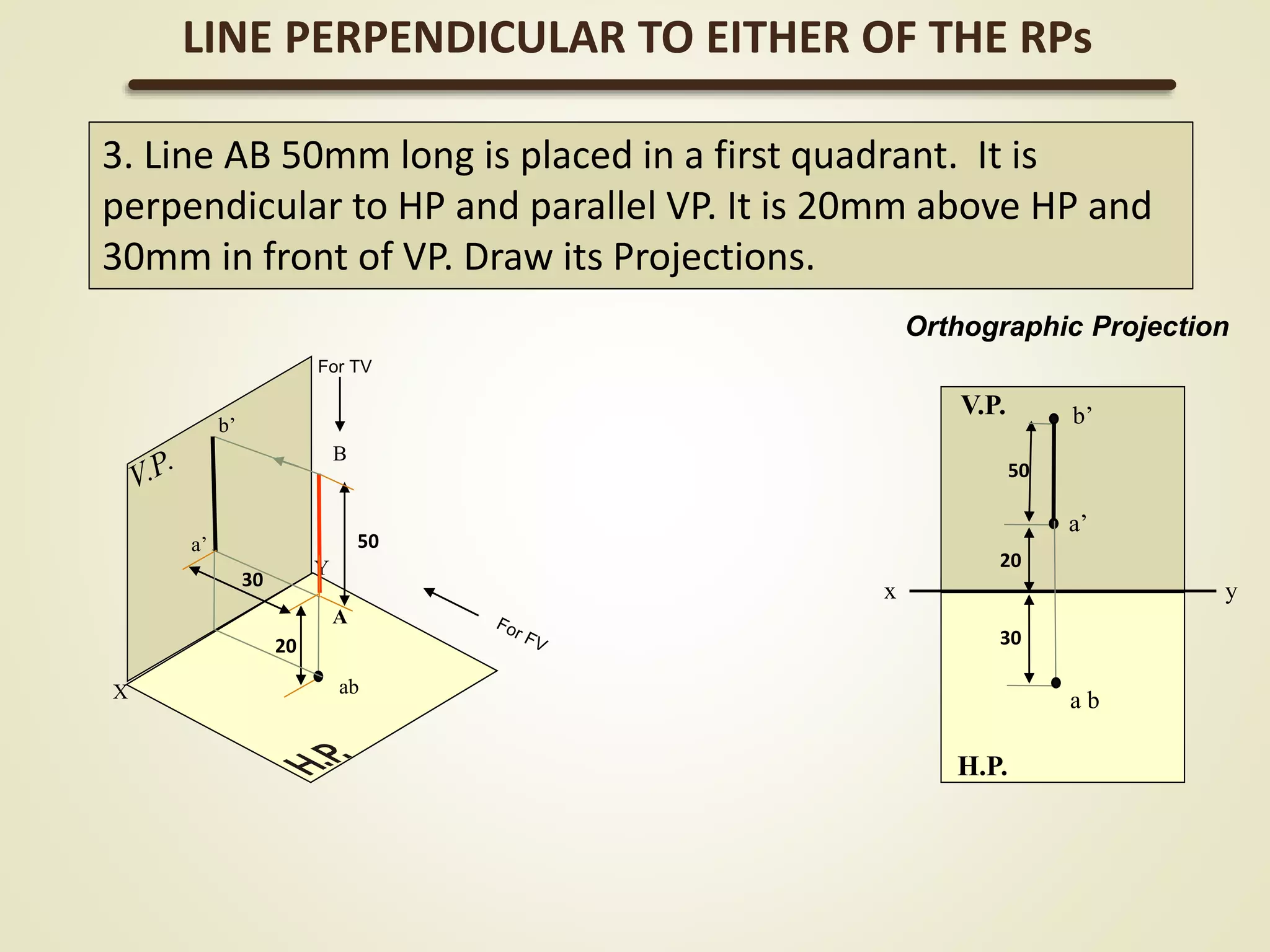
3. Line AB 50mm long is placed in a first quadrant. It is
perpendicular to HP and parallel VP. It is 20mm above HP and
30mm in front of VP. Draw its Projections.
50
20
30
20
30
50
LINE PERPENDICULAR TO EITHER OF THE RPs
4. Line PQ of 50mm length. The top view of
line is a point which lies 20mm above XY line.
One of the end of line lies 30mm below the
reference line. Draw the projections of line,
specify the quadrants and its location with
respect to reference planes.
LINE PERPENDICULAR TO EITHER OF THE RPs
LINE INCLINED TO HP AND PARALLEL TO VP
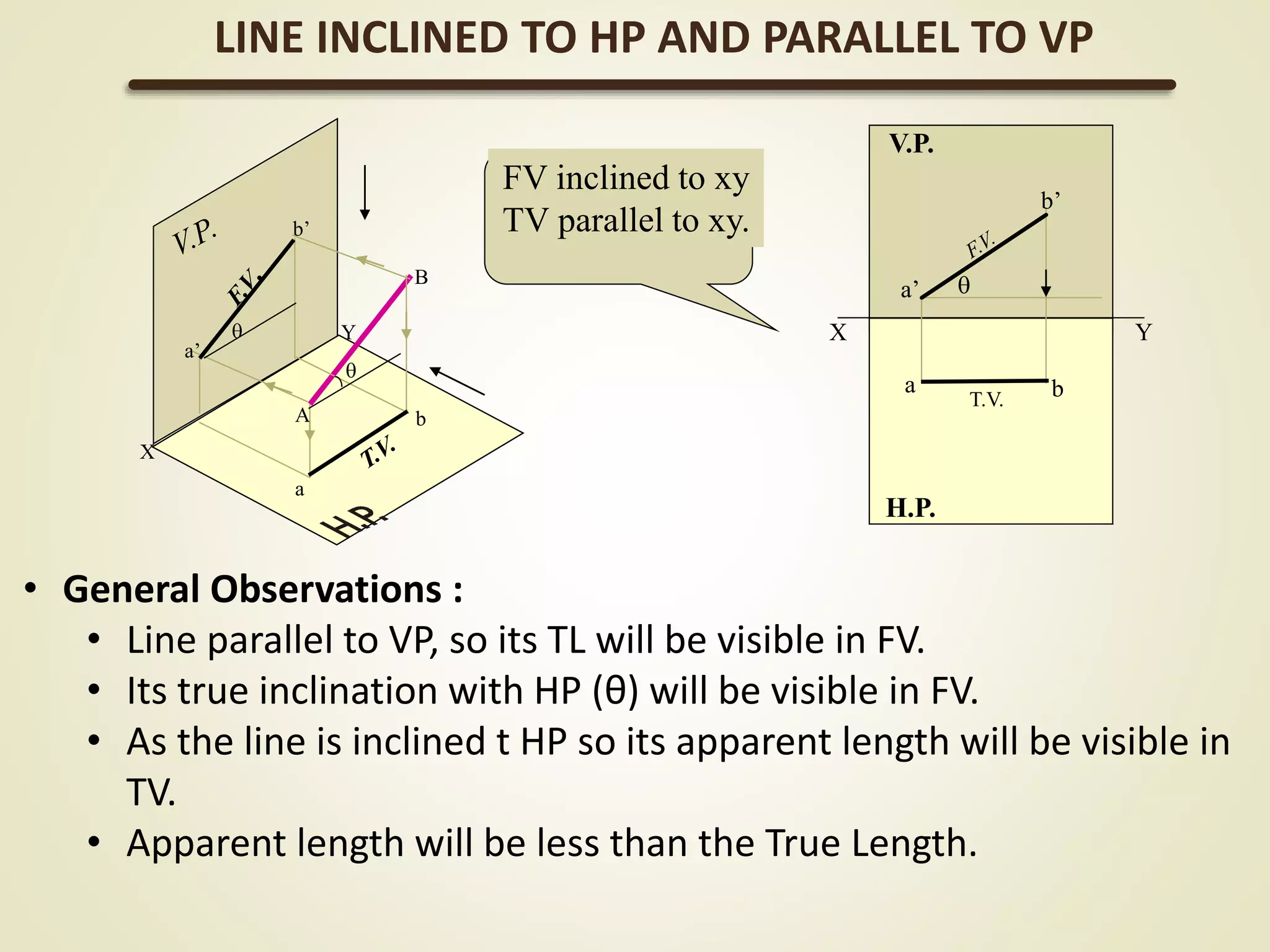
• General Observations :
• Line parallel to VP, so its TL will be visible in FV.
• Its true inclination with HP (θ) will be visible in FV.
• As the line is inclined t HP so its apparent length will be visible in
TV.
• Apparent length will be less than the True Length.
X
Y
A
B
b’
a’
b
a


X Y
H.P.
V.P.
T.V.
a b
a’
b’

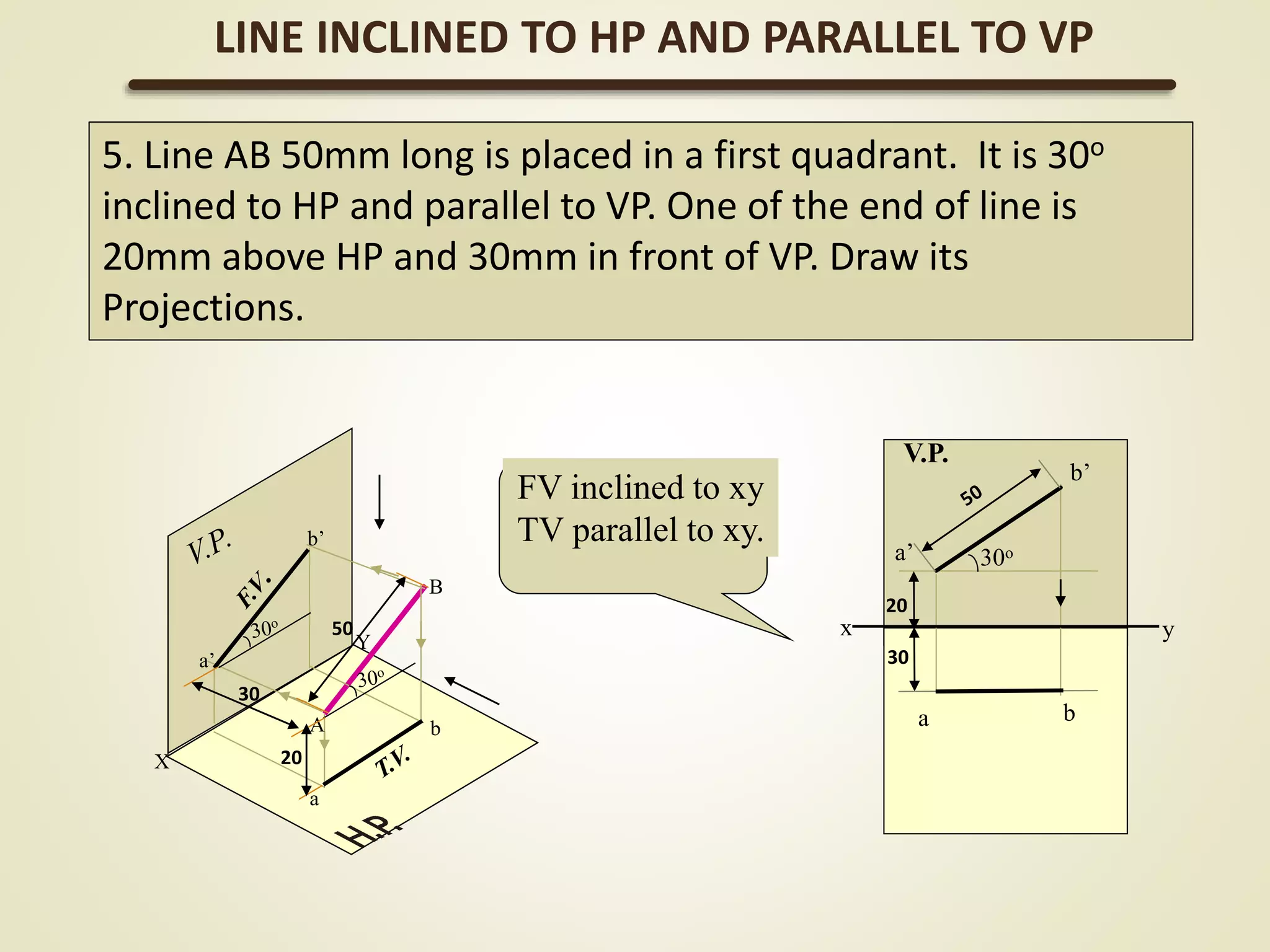
FV inclined to xy
TV parallel to xy.
V.P.
H.P.
LINE INCLINED TO HP AND PARALLEL TO VP
X
Y
A
B
b’
a’
b
a
x y
a b
a’
b’
30o
FV inclined to xy
TV parallel to xy.
50
20
30
20
30
5. Line AB 50mm long is placed in a first quadrant. It is 30o
inclined to HP and parallel to VP. One of the end of line is
20mm above HP and 30mm in front of VP. Draw its
Projections.
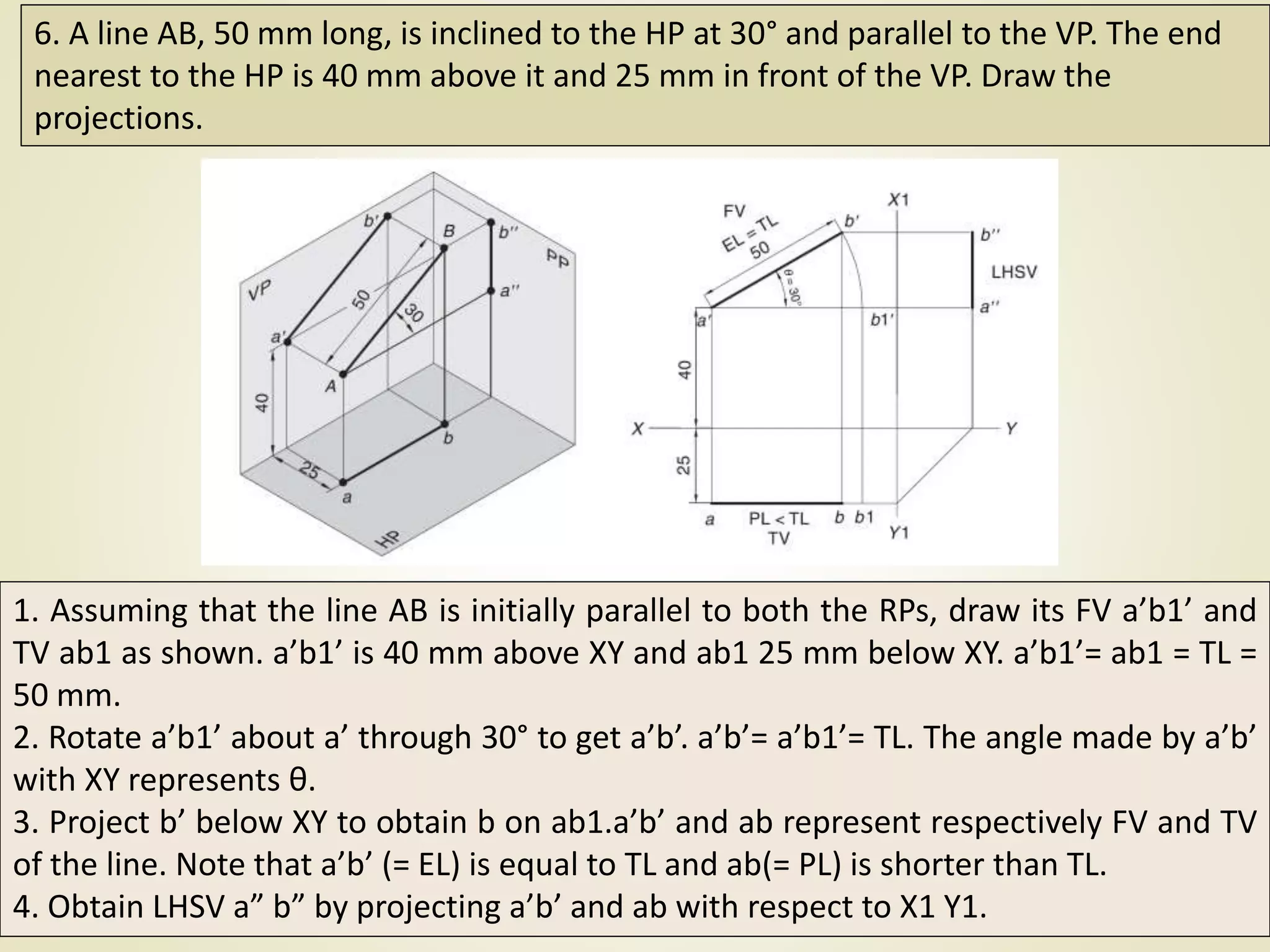
6. A line AB, 50 mm long, is inclined to the HP at 30° and parallel to the VP. The end
nearest to the HP is 40 mm above it and 25 mm in front of the VP. Draw the
projections.
1. Assuming that the line AB is initially parallel to both the RPs, draw its FV a’b1’ and
TV ab1 as shown. a’b1’ is 40 mm above XY and ab1 25 mm below XY. a’b1’= ab1 = TL =
50 mm.
2. Rotate a’b1’ about a’ through 30° to get a’b’. a’b’= a’b1’= TL. The angle made by a’b’
with XY represents θ.
3. Project b’ below XY to obtain b on ab1.a’b’ and ab represent respectively FV and TV
of the line. Note that a’b’ (= EL) is equal to TL and ab(= PL) is shorter than TL.
4. Obtain LHSV a” b” by projecting a’b’ and ab with respect to X1 Y1.
7. Line AB 70mm long lies in the first quadrant and it is
inclined to HP and parallel to VP. One end of line lies
20mm above HP while another end lies 50mm above
HP. Line is 30 mm in front of VP. Draw its projections,
find out its inclination with HP and its apparent length.
8. Line AB 70mm long lies in the third quadrant and it
is inclined to HP and parallel to VP. One of the end of
line is 25 mm below HP and 35 mm behind VP. The
distance between the projections of end points is
50mm (Apparent length). Draw its projections and find
out its inclination with HP.
Ø
a b
a’
b’
BA
Ø
X Y
H.P.
V.P.
Ø
a
b
a’ b’
Tv
Fv
TV inclined to xy
Fv parallel to xy.
LINE INCLINED TO VP AND PARALLEL TO HP
• General Observations :
• Line parallel to HP, so its TL will be visible in TV.
• Its true inclination with VP (φ) will be visible in TV.
• As the line is inclined t VP so its apparent length will be visible in
FV.
• Apparent length will be less than the True Length.
• Always draw view in which TL is visible (In this TV).
45
a b
a’
b’
BA
45
TV inclined to xy
Fv parallel to xy.
LINE INCLINED TO VP AND PARALLEL TO HP
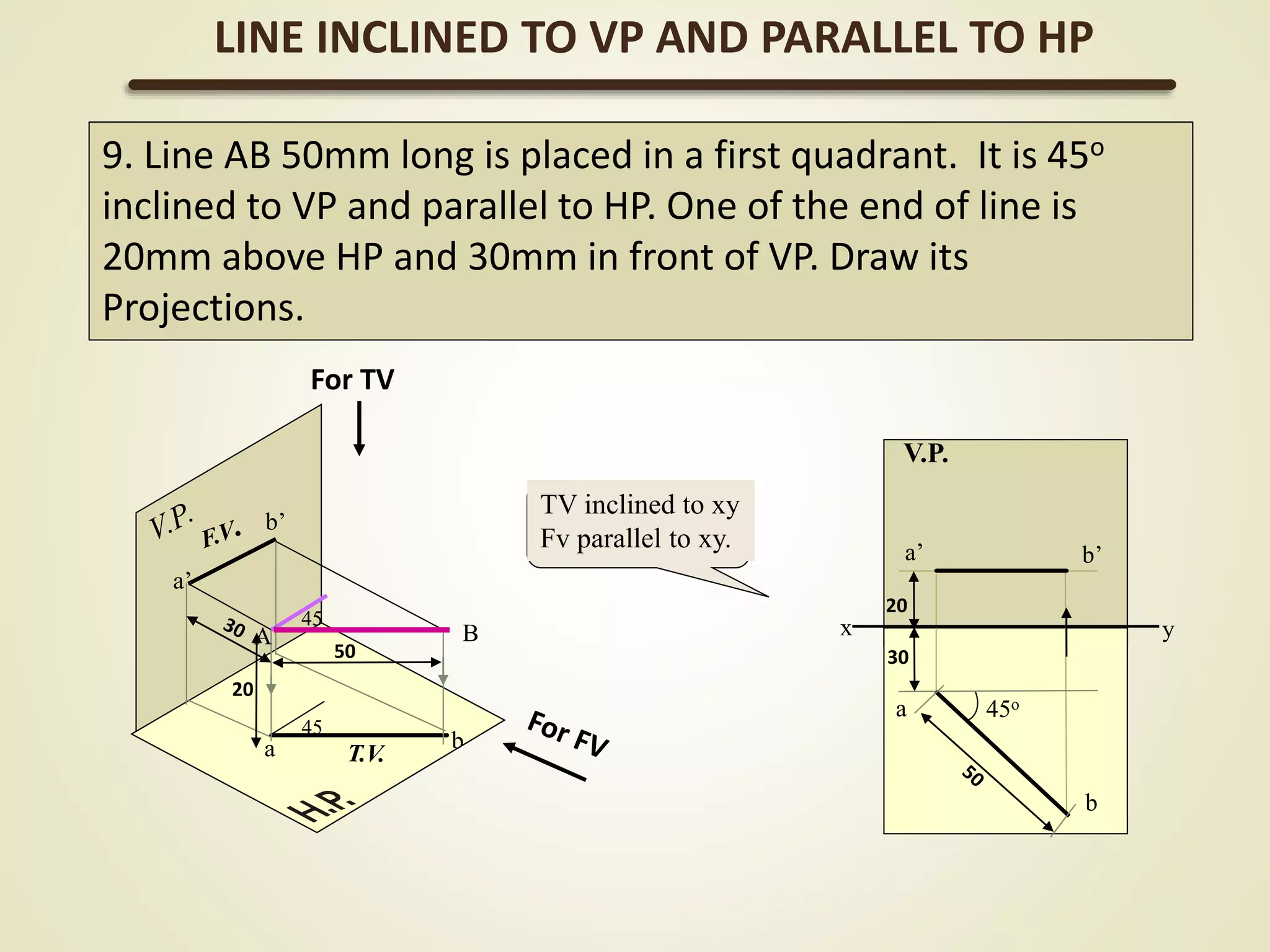
9. Line AB 50mm long is placed in a first quadrant. It is 45o
inclined to VP and parallel to HP. One of the end of line is
20mm above HP and 30mm in front of VP. Draw its
Projections.
For TV
50
20
V.P.
H.P.
x y
a
b
a’ b’
45o
20
30
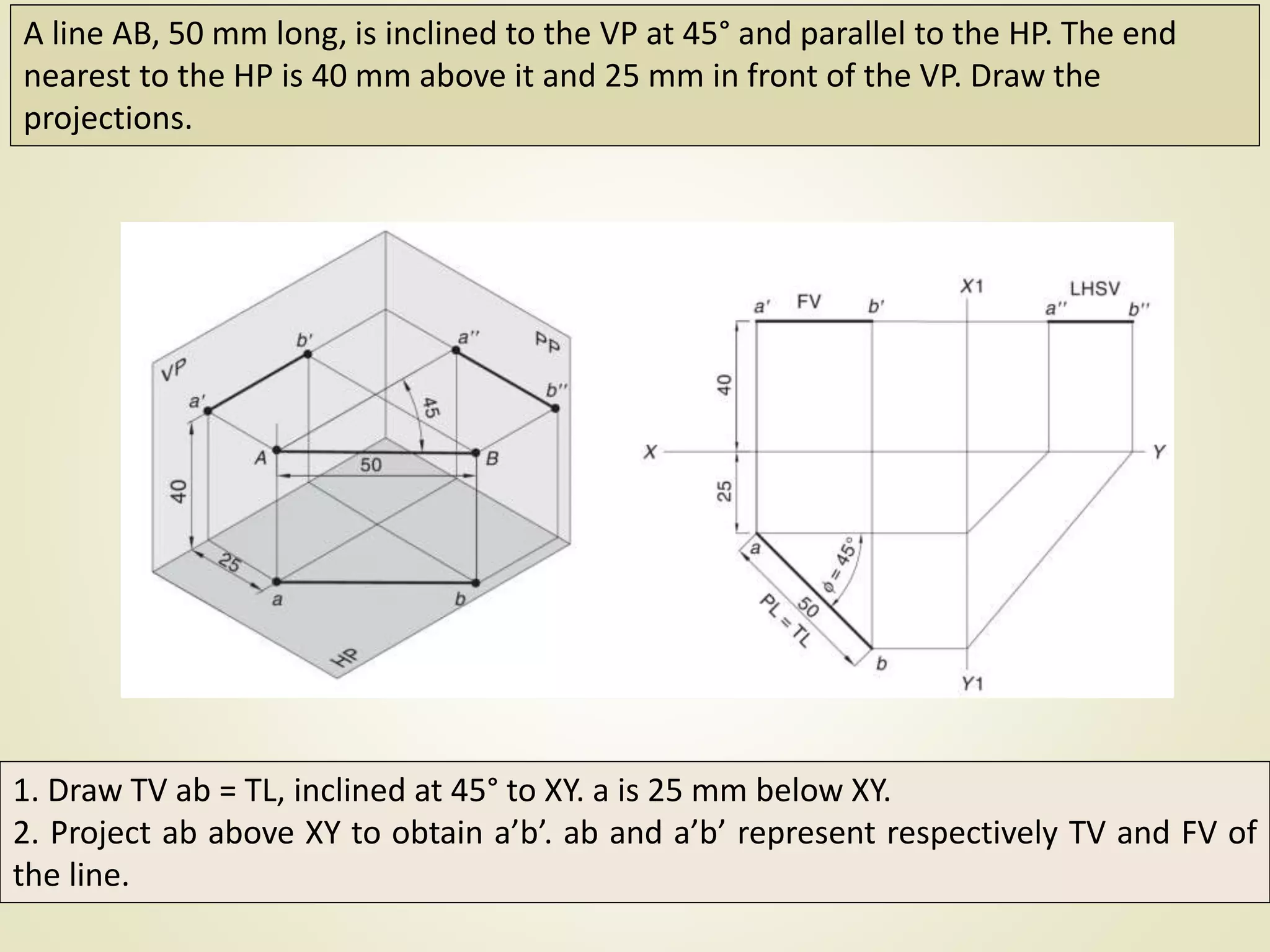
A line AB, 50 mm long, is inclined to the VP at 45° and parallel to the HP. The end
nearest to the HP is 40 mm above it and 25 mm in front of the VP. Draw the
projections.
1. Draw TV ab = TL, inclined at 45° to XY. a is 25 mm below XY.
2. Project ab above XY to obtain a’b’. ab and a’b’ represent respectively TV and FV of
the line.
X
Y
a’
b’
a b
B
A


For TV
T.V. X
Y
a’
b’
a b


T.V.
For TV
B
A
X Y


H.P.
V.P.
a
b
FV
TV
a’
b’
Note These Facts:-
Both FV & TV are inclined to xy.
(No view is parallel to xy)
Both FV & TV are reduced
lengths.
(No view shows True Length)
Orthographic Projections
FV is seen on VP clearly.
To see TV clearly, HP is
rotated 900 downwards,
Hence it comes below xy.
On removal of object
i.e. Line AB
FV as a image on VP.
TV as a image on HP,
LINE INCLINED TO BOTH THE PLANES
X Y

H.P.
V.P.
a
b
TV
a’
b’
FV
X Y
H.P.
V.P.
TV
b2
b1’
TL
X Y


H.P.
V.P.
a
b
FV
TV
a’
b’
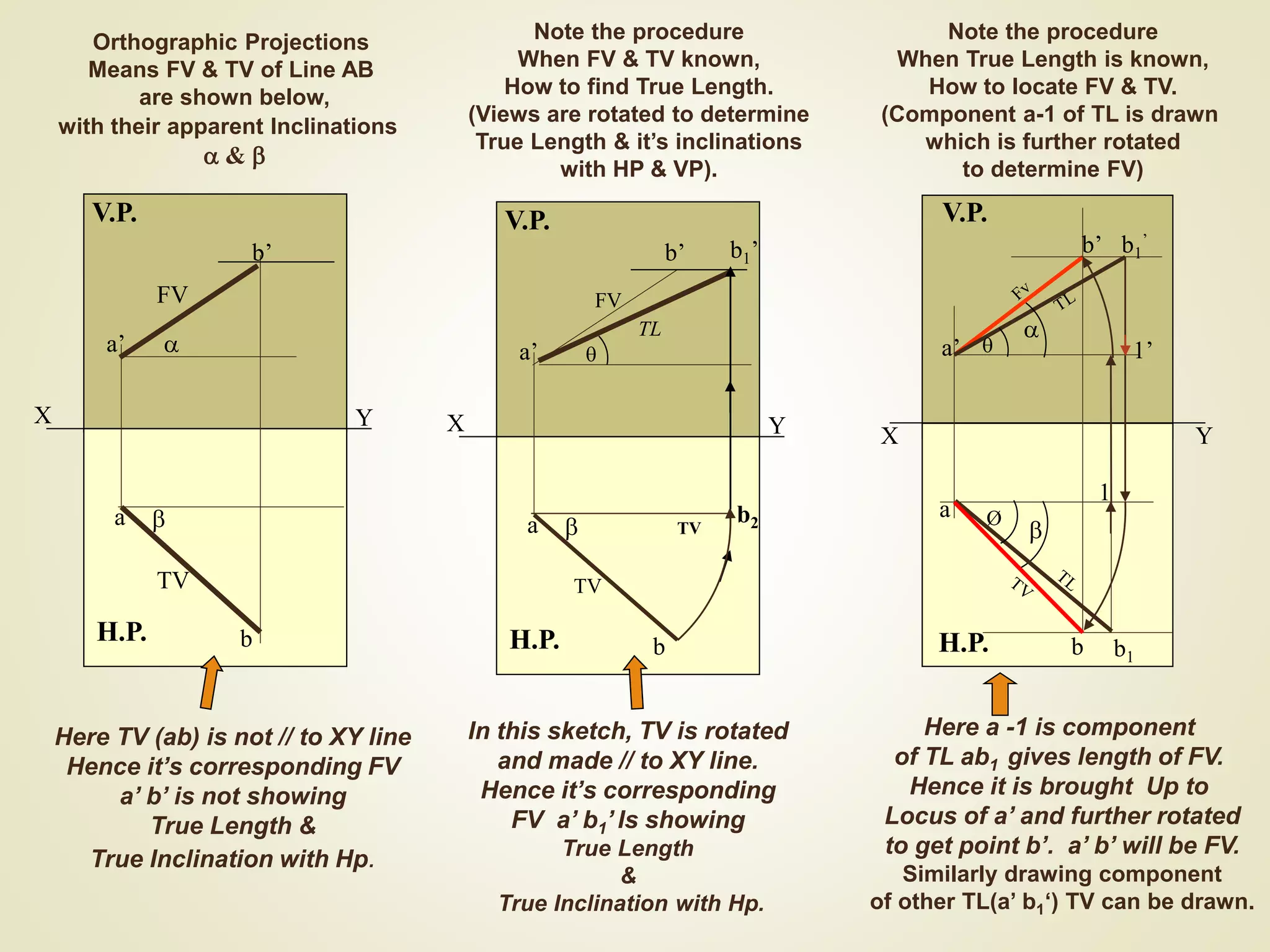
Here TV (ab) is not // to XY line
Hence it’s corresponding FV
a’ b’ is not showing
True Length &
True Inclination with Hp.
In this sketch, TV is rotated
and made // to XY line.
Hence it’s corresponding
FV a’ b1’ Is showing
True Length
&
True Inclination with Hp.
Note the procedure
When FV & TV known,
How to find True Length.
(Views are rotated to determine
True Length & it’s inclinations
with HP & VP).
Note the procedure
When True Length is known,
How to locate FV & TV.
(Component a-1 of TL is drawn
which is further rotated
to determine FV)
1
a
a’
b’
1’
b

b1
’


b1
Ø
Orthographic Projections
Means FV & TV of Line AB
are shown below,
with their apparent Inclinations
 & 
Here a -1 is component
of TL ab1 gives length of FV.
Hence it is brought Up to
Locus of a’ and further rotated
to get point b’. a’ b’ will be FV.
Similarly drawing component
of other TL(a’ b1‘) TV can be drawn.

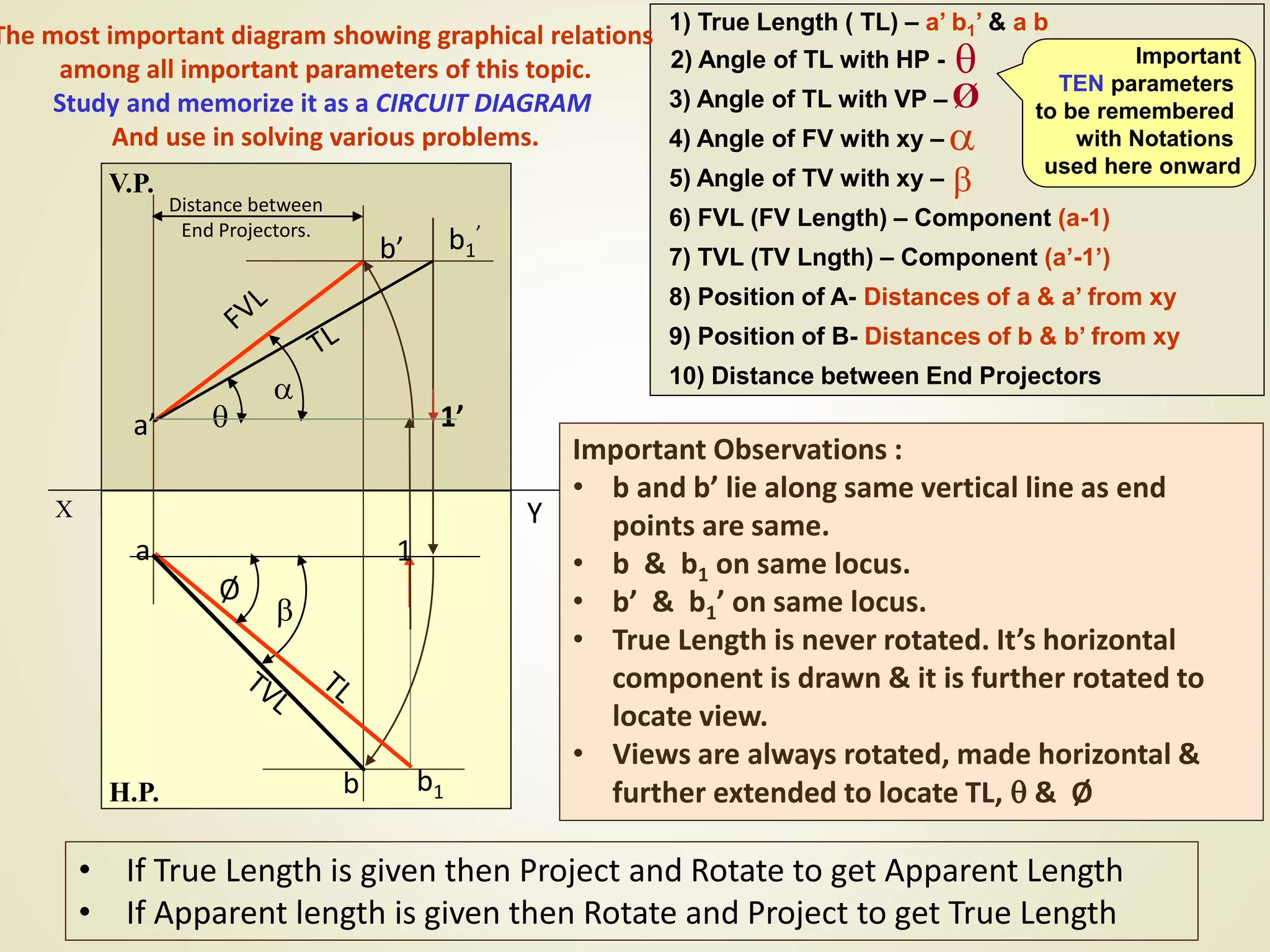
The most important diagram showing graphical relations
among all important parameters of this topic.
Study and memorize it as a CIRCUIT DIAGRAM
And use in solving various problems.
Important
TEN parameters
to be remembered
with Notations
used here onward
Ø



1) True Length ( TL) – a’ b1’ & a b
2) Angle of TL with HP -
3) Angle of TL with VP –
4) Angle of FV with xy –
5) Angle of TV with xy –
6) FVL (FV Length) – Component (a-1)
7) TVL (TV Lngth) – Component (a’-1’)
8) Position of A- Distances of a & a’ from xy
9) Position of B- Distances of b & b’ from xy
10) Distance between End Projectors
X Y
H.P.
V.P.
1a
b

b1
Ø
a’
b’
1’
b1
’


Distance between
End Projectors.
Important Observations :
• b and b’ lie along same vertical line as end
points are same.
• b & b1 on same locus.
• b’ & b1’ on same locus.
• True Length is never rotated. It’s horizontal
component is drawn & it is further rotated to
locate view.
• Views are always rotated, made horizontal &
further extended to locate TL,  & Ø
• If True Length is given then Project and Rotate to get Apparent Length
• If Apparent length is given then Rotate and Project to get True Length
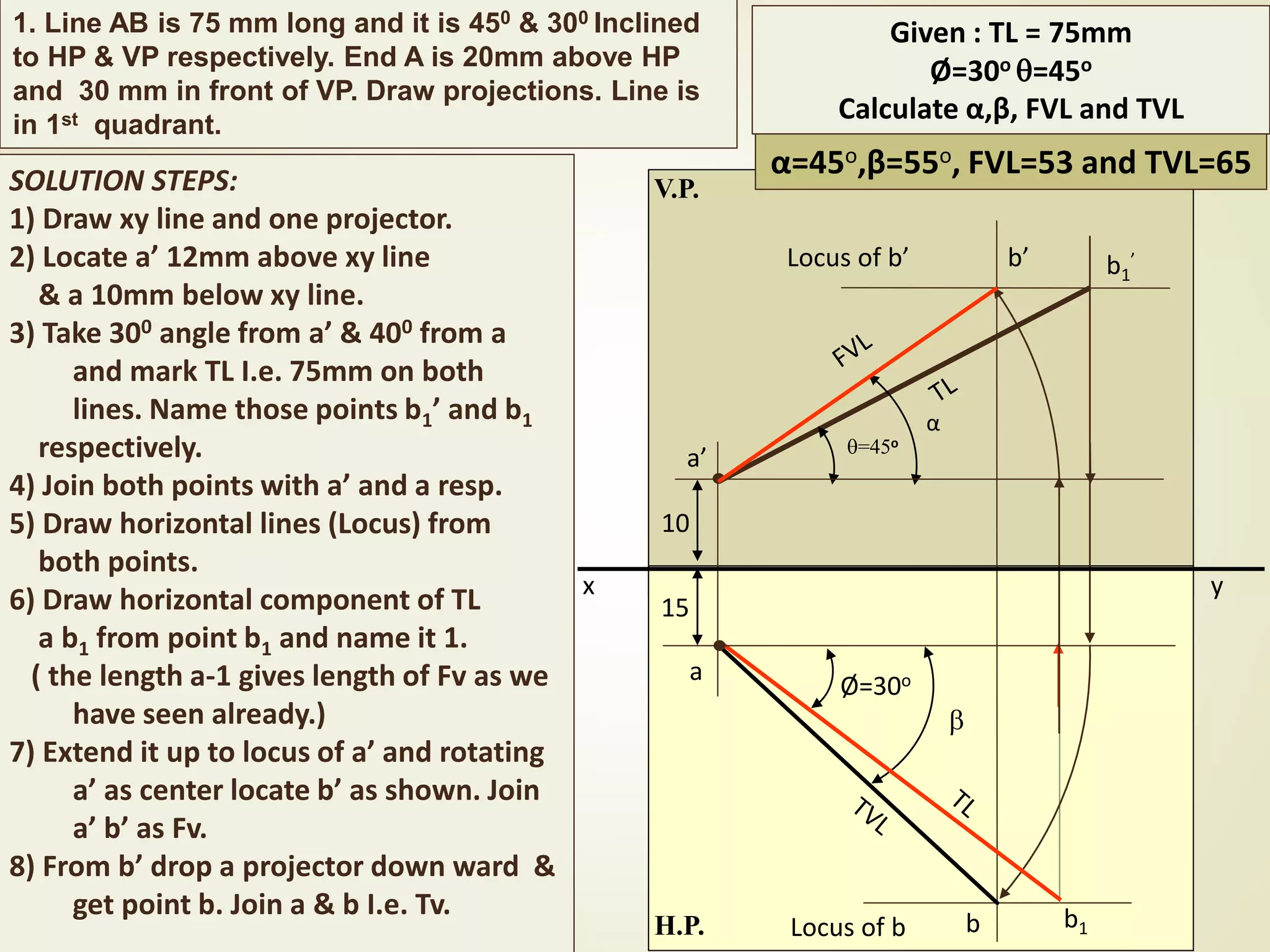
1. Line AB is 75 mm long and it is 450 & 300 Inclined
to HP & VP respectively. End A is 20mm above HP
and 30 mm in front of VP. Draw projections. Line is
in 1st quadrant.
SOLUTION STEPS:
1) Draw xy line and one projector.
2) Locate a’ 12mm above xy line
& a 10mm below xy line.
3) Take 300 angle from a’ & 400 from a
and mark TL I.e. 75mm on both
lines. Name those points b1’ and b1
respectively.
4) Join both points with a’ and a resp.
5) Draw horizontal lines (Locus) from
both points.
6) Draw horizontal component of TL
a b1 from point b1 and name it 1.
( the length a-1 gives length of Fv as we
have seen already.)
7) Extend it up to locus of a’ and rotating
a’ as center locate b’ as shown. Join
a’ b’ as Fv.
8) From b’ drop a projector down ward &
get point b. Join a & b I.e. Tv.
Given : TL = 75mm
Ø=30o =45o
Calculate α,β, FVL and TVL
x y
V.P.
H.P.
a
b

b1
Ø=30o
a’
b’ b1
’
α
=45o
15
10
Locus of b
Locus of b’
α=45o,β=55o, FVL=53 and TVL=65
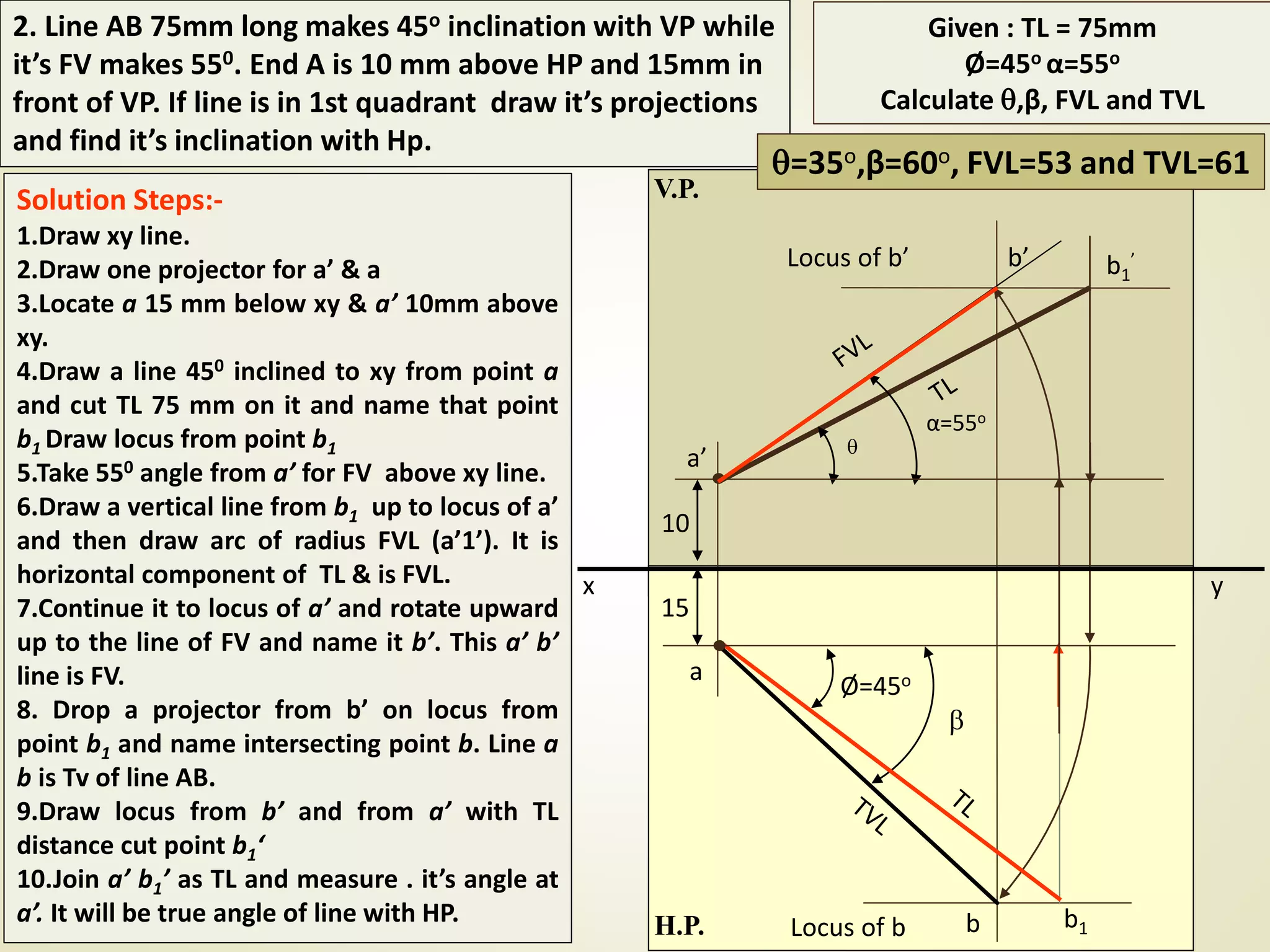
2. Line AB 75mm long makes 45o inclination with VP while
it’s FV makes 550. End A is 10 mm above HP and 15mm in
front of VP. If line is in 1st quadrant draw it’s projections
and find it’s inclination with Hp.
Solution Steps:-
1.Draw xy line.
2.Draw one projector for a’ & a
3.Locate a 15 mm below xy & a’ 10mm above
xy.
4.Draw a line 450 inclined to xy from point a
and cut TL 75 mm on it and name that point
b1 Draw locus from point b1
5.Take 550 angle from a’ for FV above xy line.
6.Draw a vertical line from b1 up to locus of a’
and then draw arc of radius FVL (a’1’). It is
horizontal component of TL & is FVL.
7.Continue it to locus of a’ and rotate upward
up to the line of FV and name it b’. This a’ b’
line is FV.
8. Drop a projector from b’ on locus from
point b1 and name intersecting point b. Line a
b is Tv of line AB.
9.Draw locus from b’ and from a’ with TL
distance cut point b1‘
10.Join a’ b1’ as TL and measure . it’s angle at
a’. It will be true angle of line with HP.
Given : TL = 75mm
Ø=45o α=55o
Calculate ,β, FVL and TVL
x y
V.P.
H.P.
a
b

b1
Ø=45o
a’
b’ b1
’
α=55o

15
10
Locus of b
Locus of b’
=35o,β=60o, FVL=53 and TVL=61
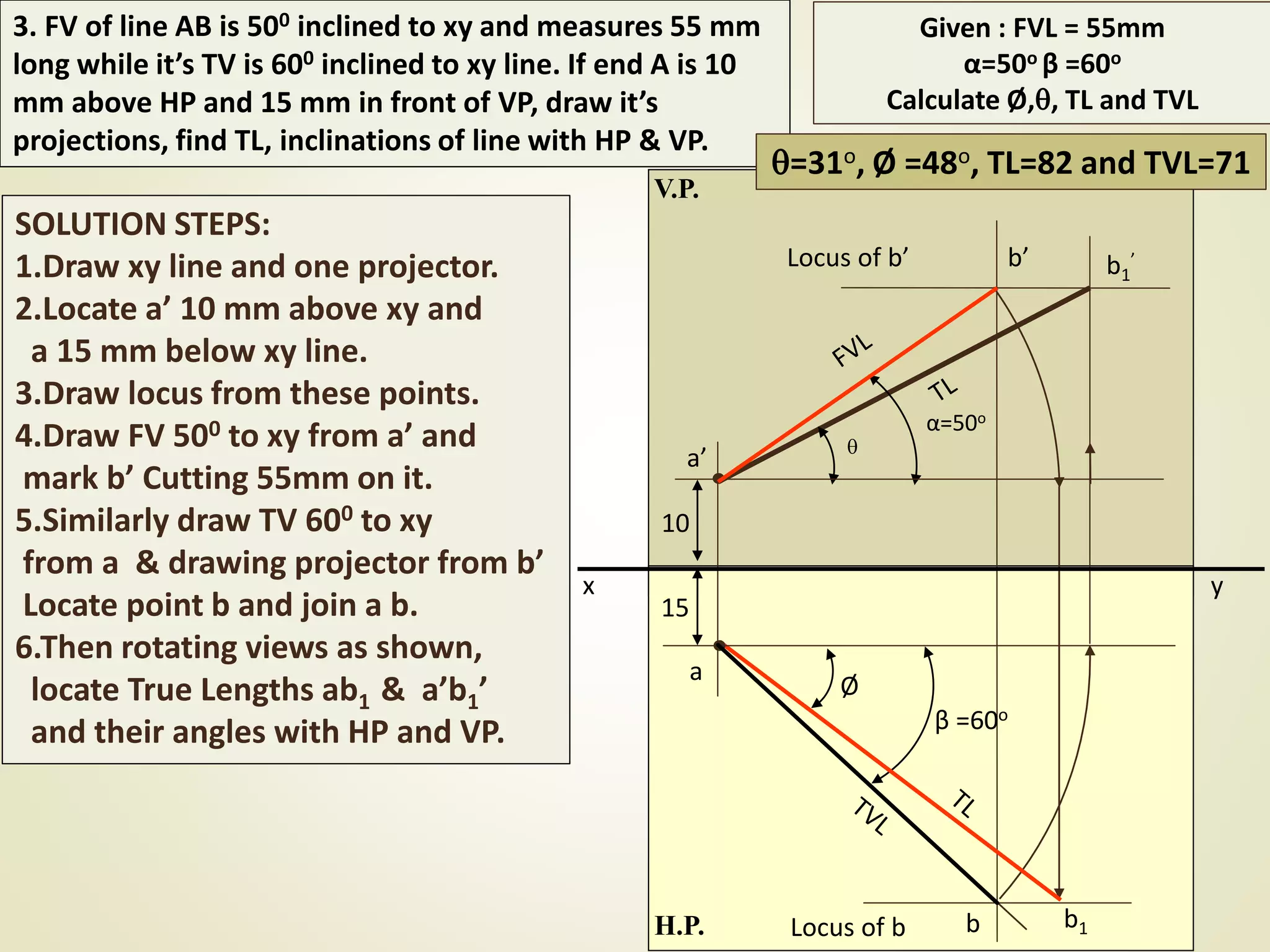
3. FV of line AB is 500 inclined to xy and measures 55 mm
long while it’s TV is 600 inclined to xy line. If end A is 10
mm above HP and 15 mm in front of VP, draw it’s
projections, find TL, inclinations of line with HP & VP.
SOLUTION STEPS:
1.Draw xy line and one projector.
2.Locate a’ 10 mm above xy and
a 15 mm below xy line.
3.Draw locus from these points.
4.Draw FV 500 to xy from a’ and
mark b’ Cutting 55mm on it.
5.Similarly draw TV 600 to xy
from a & drawing projector from b’
Locate point b and join a b.
6.Then rotating views as shown,
locate True Lengths ab1 & a’b1’
and their angles with HP and VP.
Given : FVL = 55mm
α=50o β =60o
Calculate Ø,, TL and TVL
x y
V.P.
H.P.
a
b
β =60o
b1
Ø
a’
b’ b1
’
α=50o

15
10
Locus of b
Locus of b’
=31o, Ø =48o, TL=82 and TVL=71
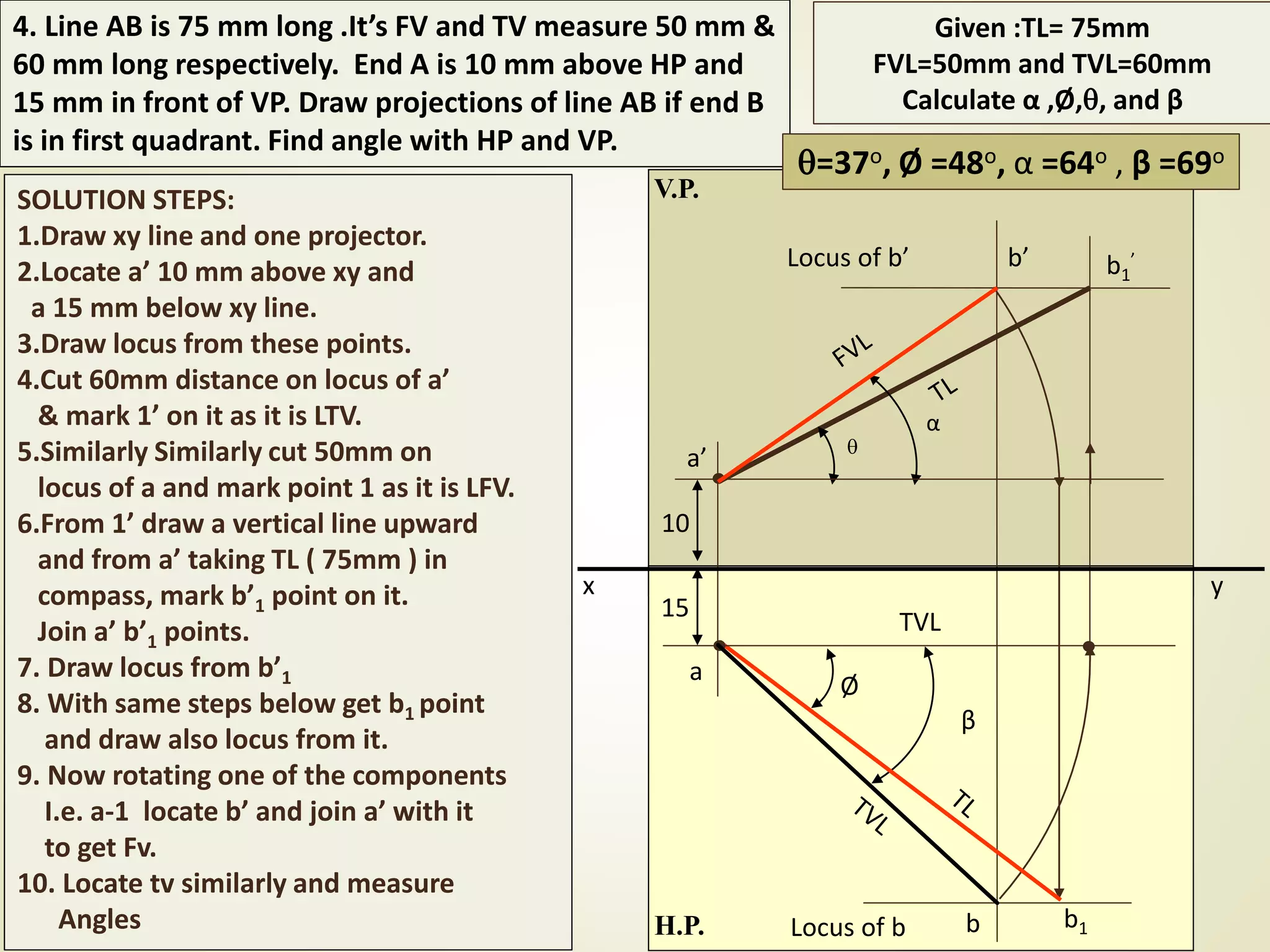
4. Line AB is 75 mm long .It’s FV and TV measure 50 mm &
60 mm long respectively. End A is 10 mm above HP and
15 mm in front of VP. Draw projections of line AB if end B
is in first quadrant. Find angle with HP and VP.
SOLUTION STEPS:
1.Draw xy line and one projector.
2.Locate a’ 10 mm above xy and
a 15 mm below xy line.
3.Draw locus from these points.
4.Cut 60mm distance on locus of a’
& mark 1’ on it as it is LTV.
5.Similarly Similarly cut 50mm on
locus of a and mark point 1 as it is LFV.
6.From 1’ draw a vertical line upward
and from a’ taking TL ( 75mm ) in
compass, mark b’1 point on it.
Join a’ b’1 points.
7. Draw locus from b’1
8. With same steps below get b1 point
and draw also locus from it.
9. Now rotating one of the components
I.e. a-1 locate b’ and join a’ with it
to get Fv.
10. Locate tv similarly and measure
Angles
Given :TL= 75mm
FVL=50mm and TVL=60mm
Calculate α ,Ø,, and β
x y
V.P.
H.P.
a
b
β
b1
Ø
a’
b’ b1
’
α

15
10
Locus of b
Locus of b’
=37o, Ø =48o, α =64o , β =69o
TVL
X Y
c’
c
LOCUS OF d & d1d d1
d’ d’1


LOCUS OF d’ & d’1
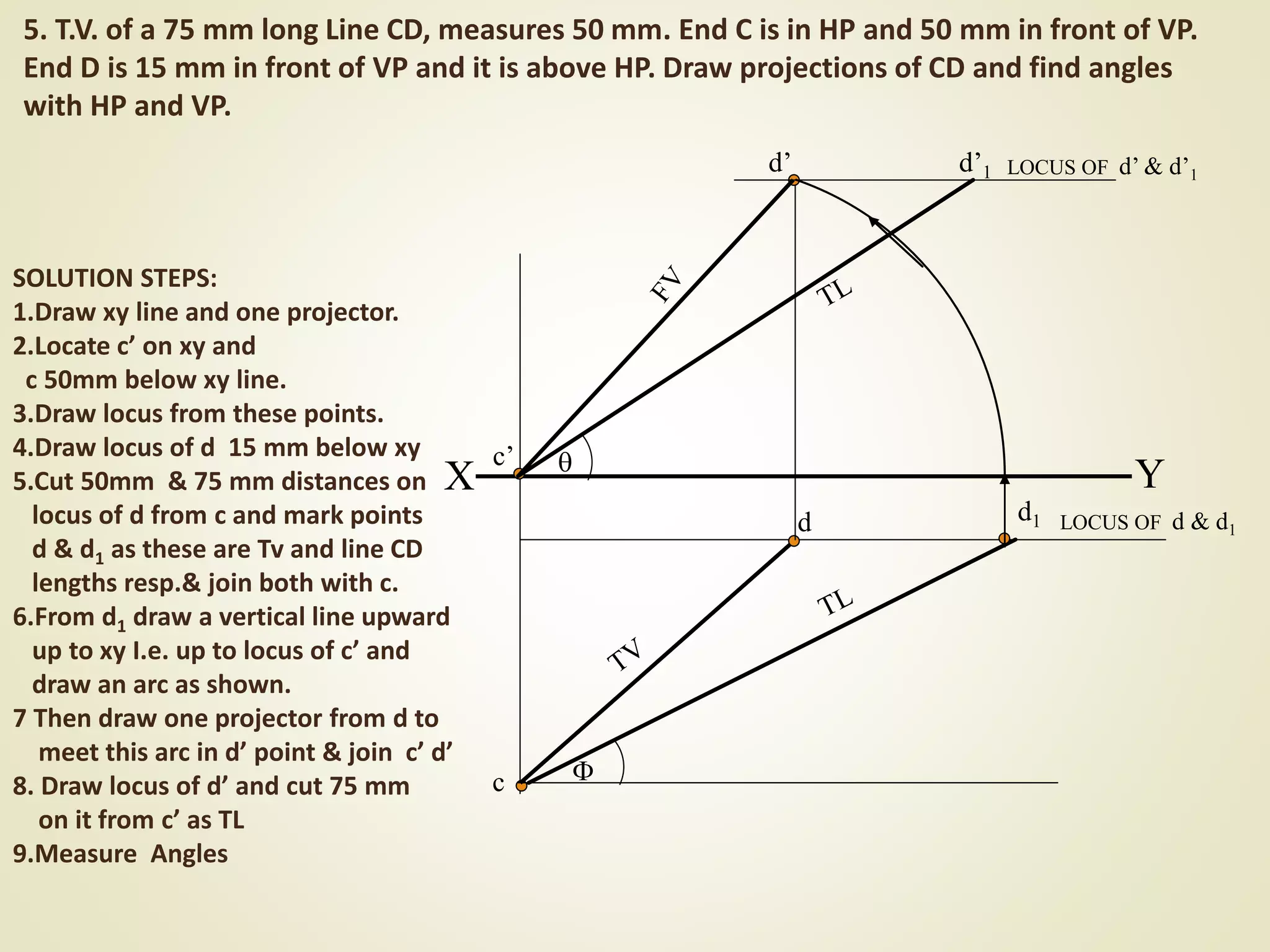
5. T.V. of a 75 mm long Line CD, measures 50 mm. End C is in HP and 50 mm in front of VP.
End D is 15 mm in front of VP and it is above HP. Draw projections of CD and find angles
with HP and VP.
SOLUTION STEPS:
1.Draw xy line and one projector.
2.Locate c’ on xy and
c 50mm below xy line.
3.Draw locus from these points.
4.Draw locus of d 15 mm below xy
5.Cut 50mm & 75 mm distances on
locus of d from c and mark points
d & d1 as these are Tv and line CD
lengths resp.& join both with c.
6.From d1 draw a vertical line upward
up to xy I.e. up to locus of c’ and
draw an arc as shown.
7 Then draw one projector from d to
meet this arc in d’ point & join c’ d’
8. Draw locus of d’ and cut 75 mm
on it from c’ as TL
9.Measure Angles
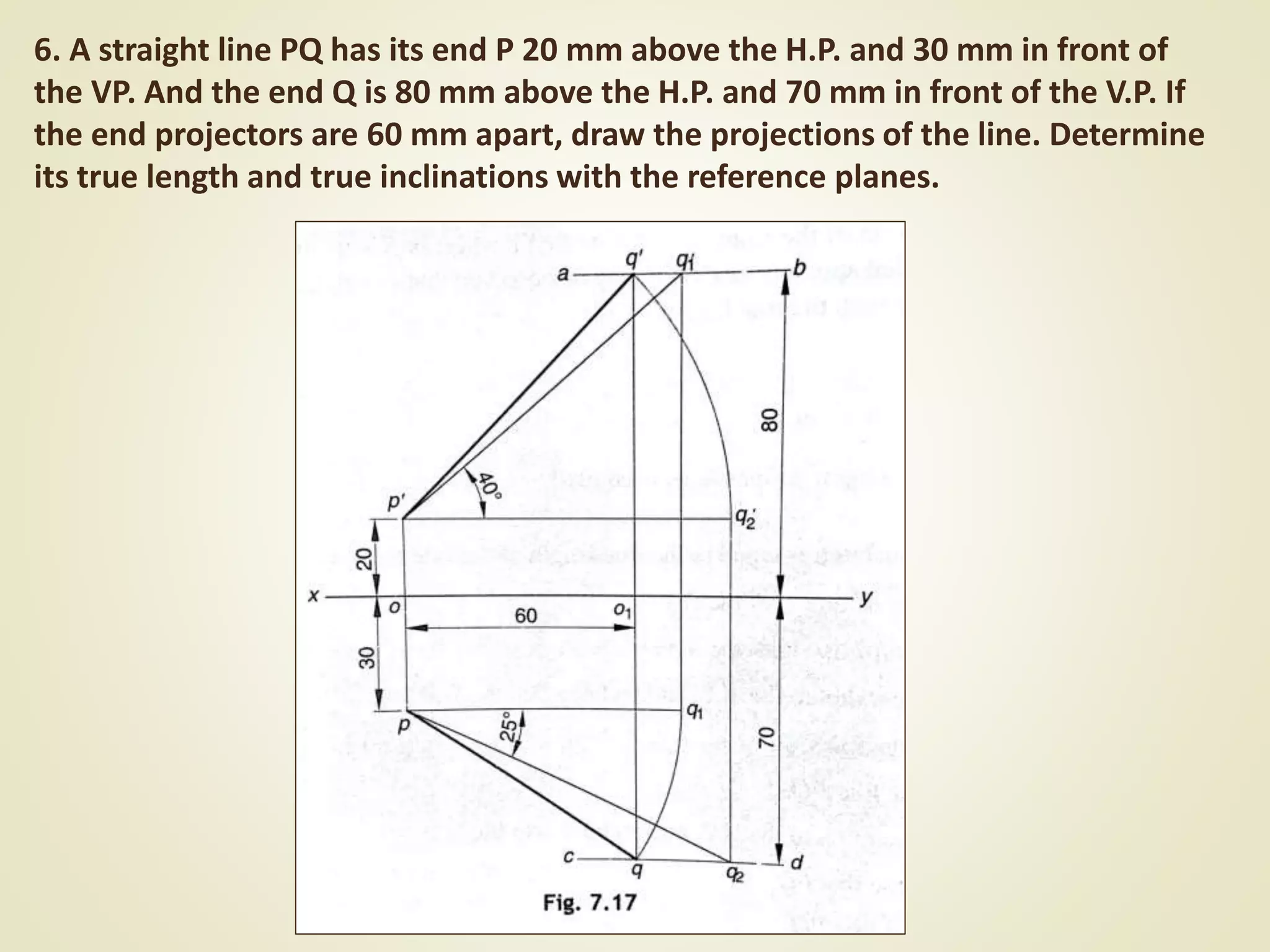
6. A straight line PQ has its end P 20 mm above the H.P. and 30 mm in front of
the VP. And the end Q is 80 mm above the H.P. and 70 mm in front of the V.P. If
the end projectors are 60 mm apart, draw the projections of the line. Determine
its true length and true inclinations with the reference planes.
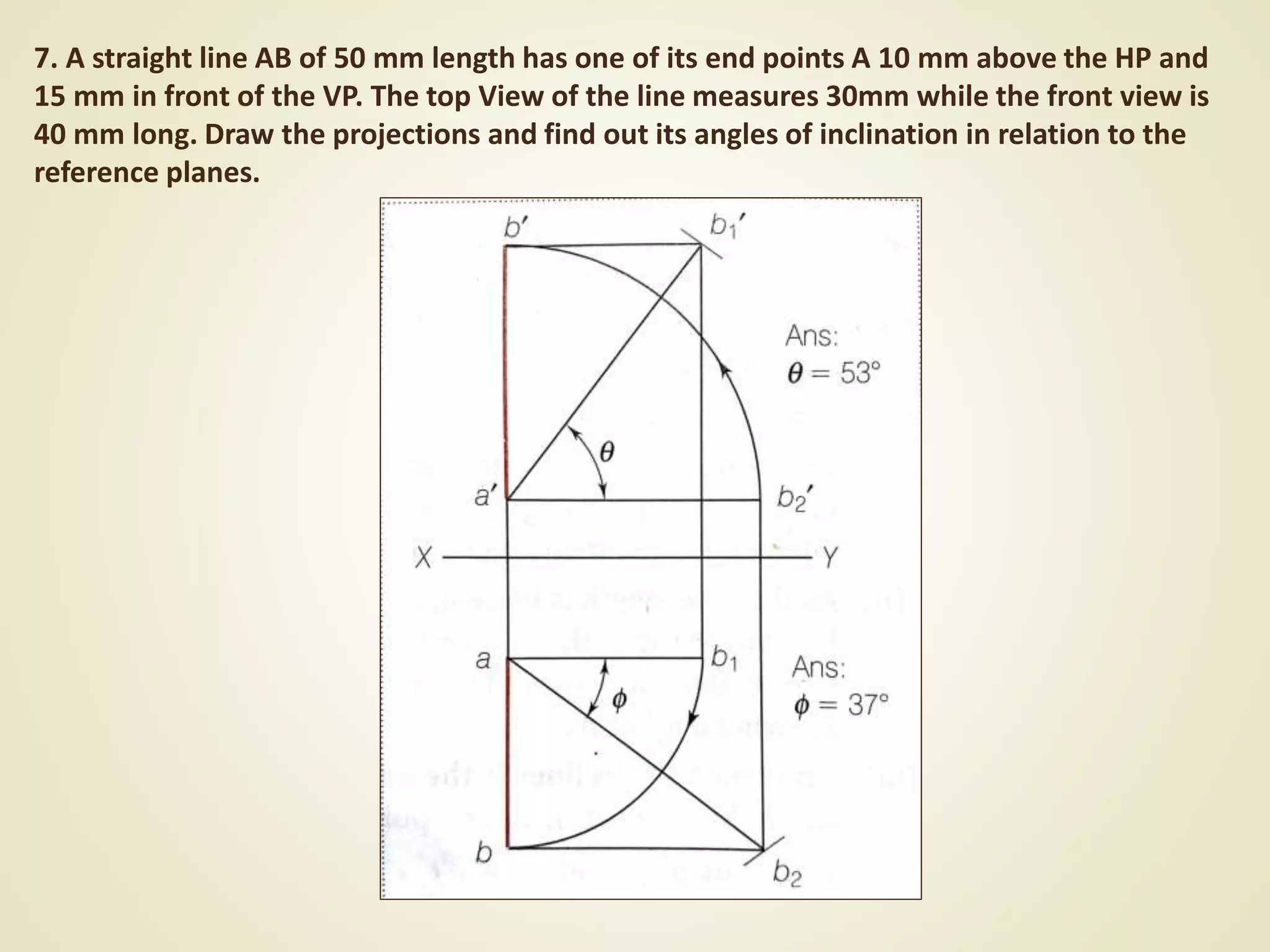
7. A straight line AB of 50 mm length has one of its end points A 10 mm above the HP and
15 mm in front of the VP. The top View of the line measures 30mm while the front view is
40 mm long. Draw the projections and find out its angles of inclination in relation to the
reference planes.
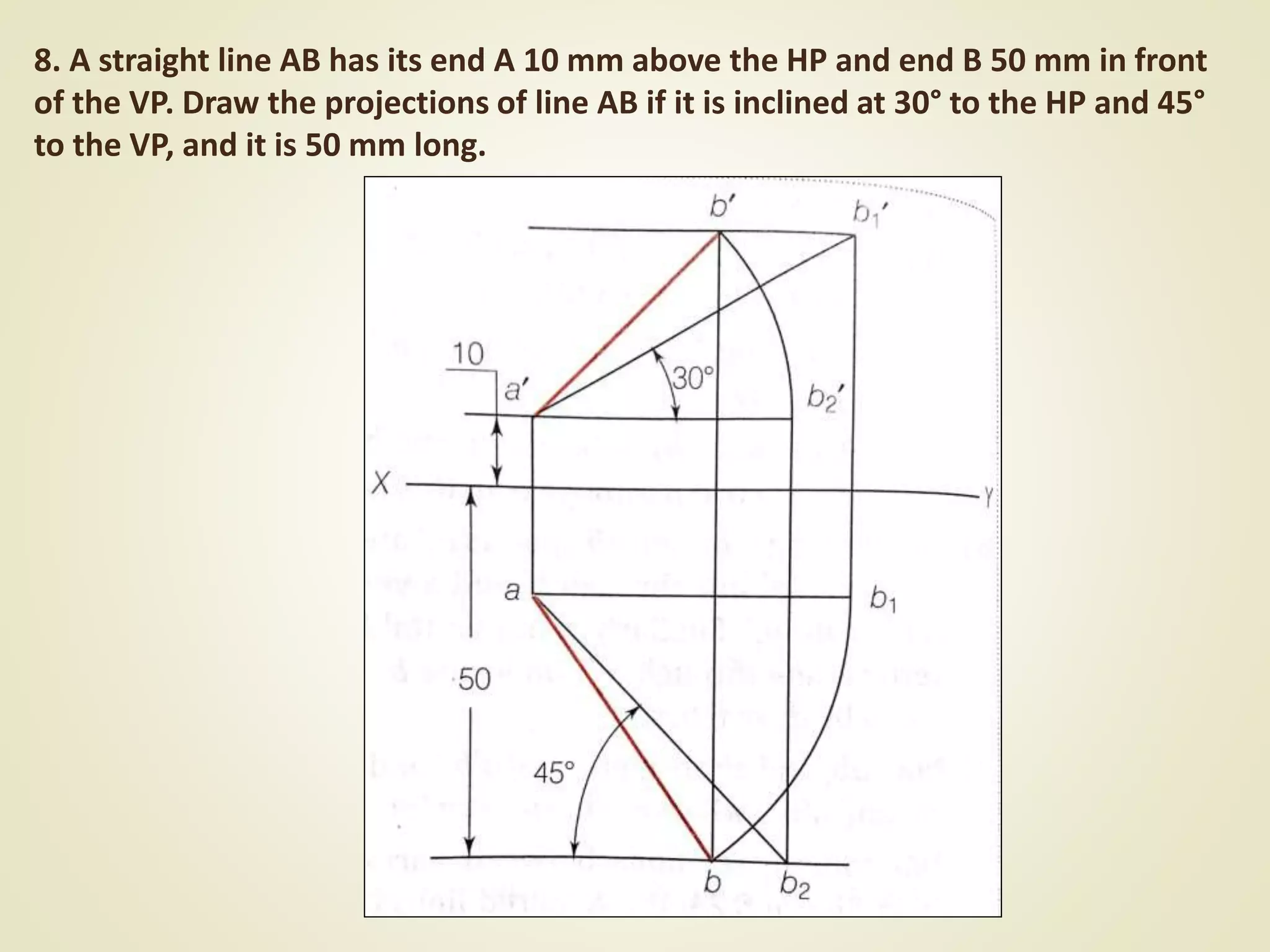
8. A straight line AB has its end A 10 mm above the HP and end B 50 mm in front
of the VP. Draw the projections of line AB if it is inclined at 30° to the HP and 45°
to the VP, and it is 50 mm long.
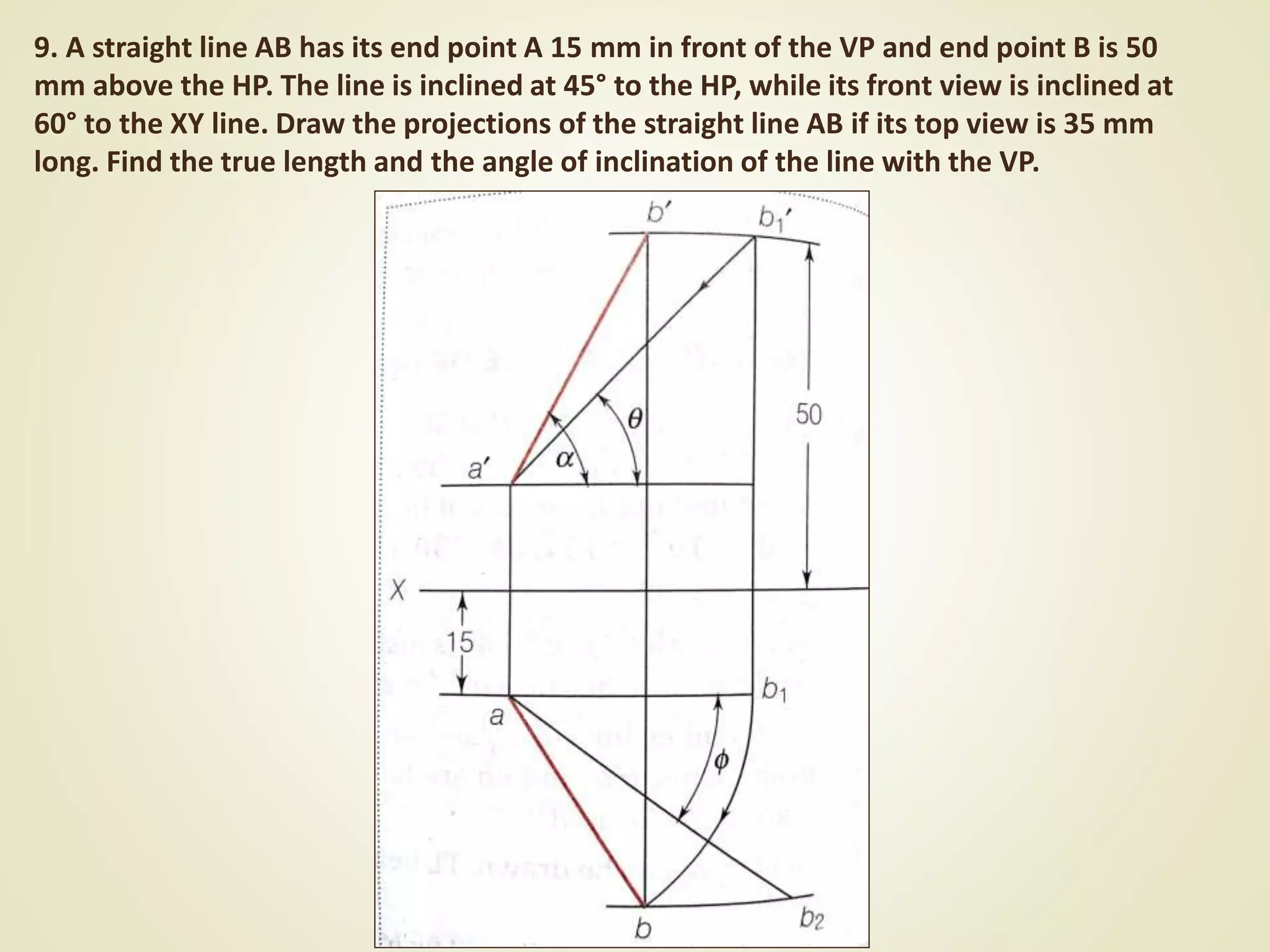
9. A straight line AB has its end point A 15 mm in front of the VP and end point B is 50
mm above the HP. The line is inclined at 45° to the HP, while its front view is inclined at
60° to the XY line. Draw the projections of the straight line AB if its top view is 35 mm
long. Find the true length and the angle of inclination of the line with the VP.
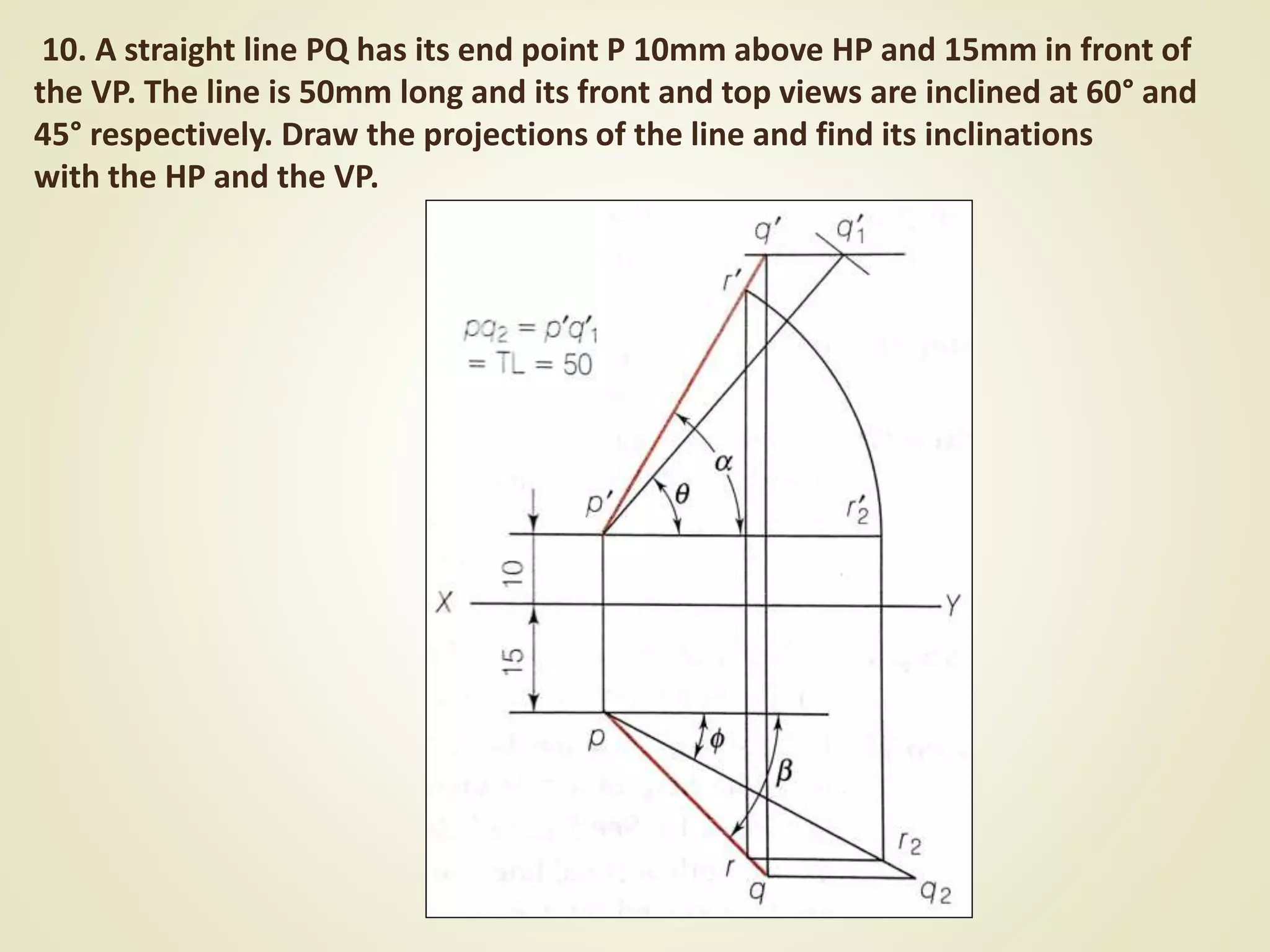
10. A straight line PQ has its end point P 10mm above HP and 15mm in front of
the VP. The line is 50mm long and its front and top views are inclined at 60° and
45° respectively. Draw the projections of the line and find its inclinations
with the HP and the VP.
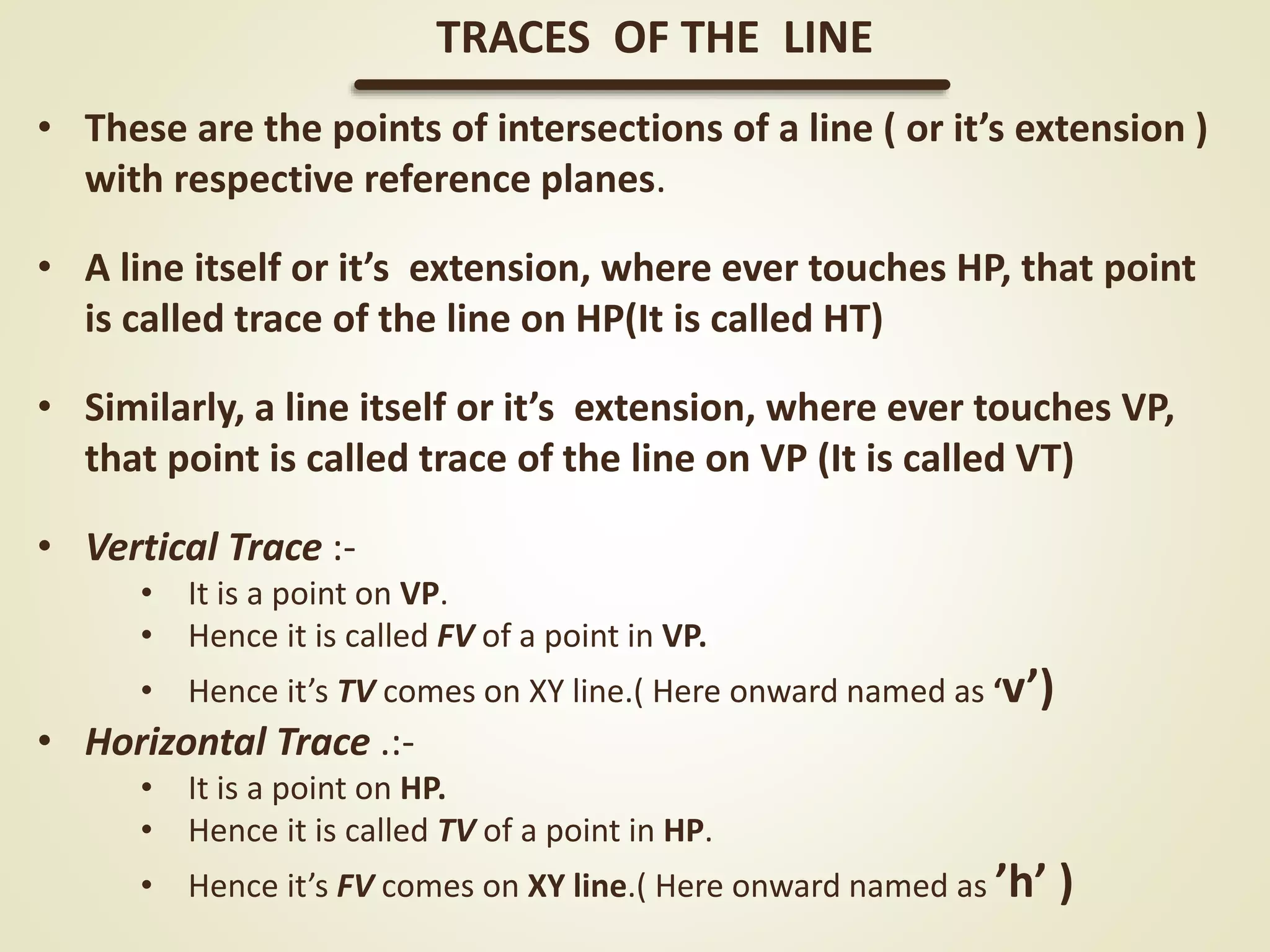
• These are the points of intersections of a line ( or it’s extension )
with respective reference planes.
• A line itself or it’s extension, where ever touches HP, that point
is called trace of the line on HP(It is called HT)
• Similarly, a line itself or it’s extension, where ever touches VP,
that point is called trace of the line on VP (It is called VT)
• Vertical Trace :-
• It is a point on VP.
• Hence it is called FV of a point in VP.
• Hence it’s TV comes on XY line.( Here onward named as ‘v’)
• Horizontal Trace .:-
• It is a point on HP.
• Hence it is called TV of a point in HP.
• Hence it’s FV comes on XY line.( Here onward named as ’h’ )
TRACES OF THE LINE
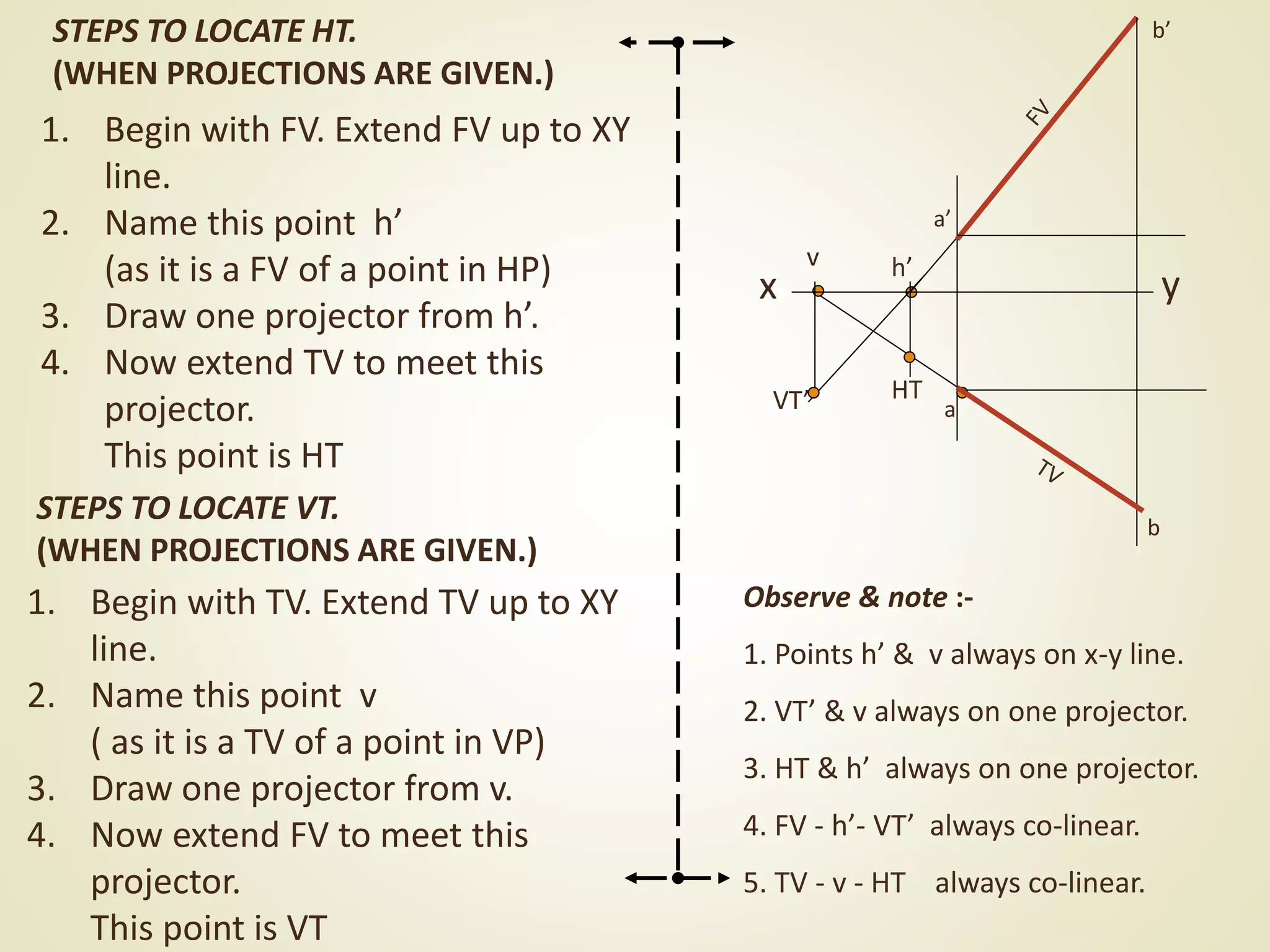
1. Begin with FV. Extend FV up to XY
line.
2. Name this point h’
(as it is a FV of a point in HP)
3. Draw one projector from h’.
4. Now extend TV to meet this
projector.
This point is HT
STEPS TO LOCATE HT.
(WHEN PROJECTIONS ARE GIVEN.)
1. Begin with TV. Extend TV up to XY
line.
2. Name this point v
( as it is a TV of a point in VP)
3. Draw one projector from v.
4. Now extend FV to meet this
projector.
This point is VT
STEPS TO LOCATE VT.
(WHEN PROJECTIONS ARE GIVEN.)
h’
HTVT’
v
a’
x y
a
b’
b
Observe & note :-
1. Points h’ & v always on x-y line.
2. VT’ & v always on one projector.
3. HT & h’ always on one projector.
4. FV - h’- VT’ always co-linear.
5. TV - v - HT always co-linear.
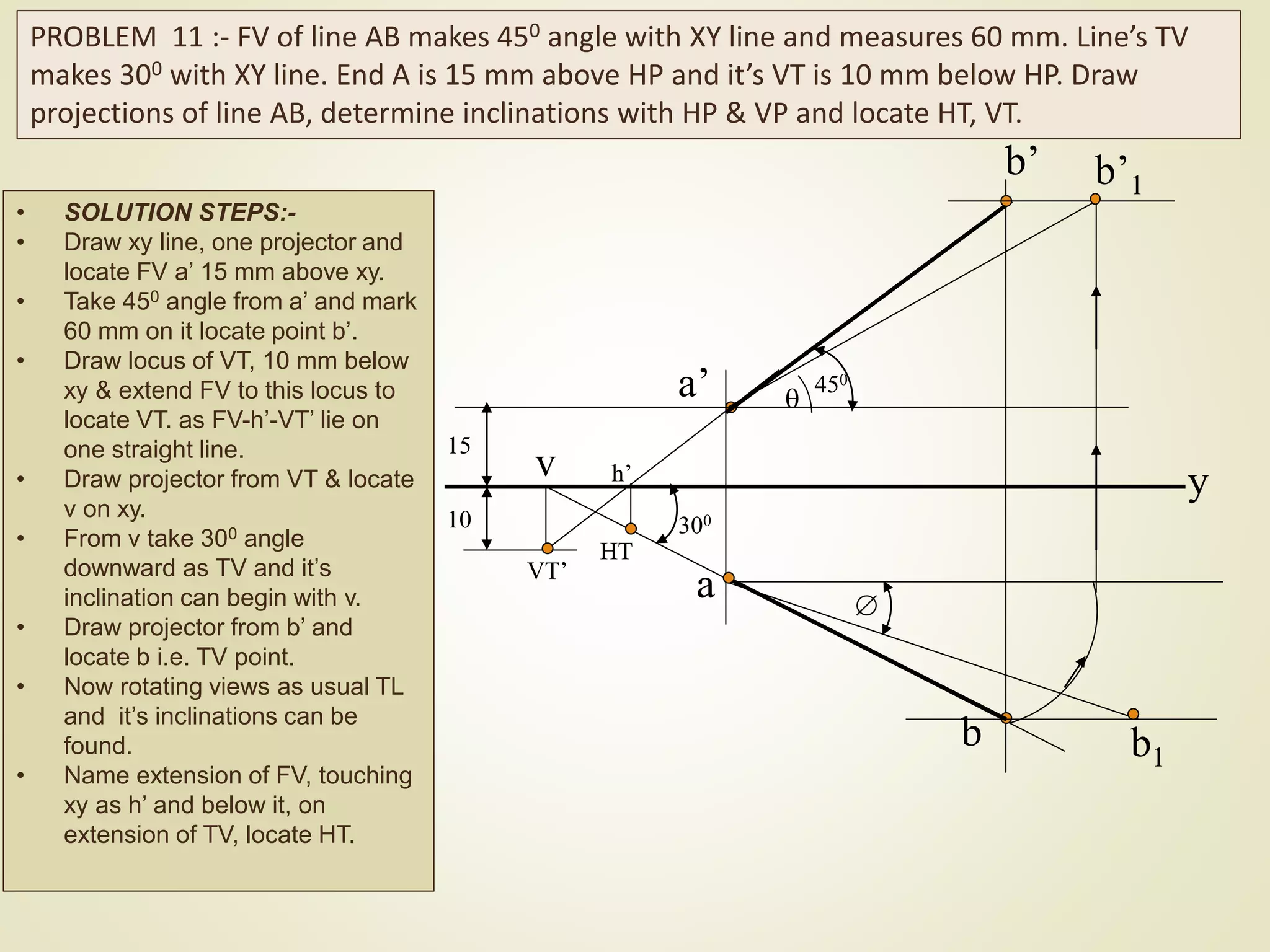
x y
b’ b’1
a
v
VT’
a’
HT
b
h’
b1

300

450
PROBLEM 11 :- FV of line AB makes 450 angle with XY line and measures 60 mm. Line’s TV
makes 300 with XY line. End A is 15 mm above HP and it’s VT is 10 mm below HP. Draw
projections of line AB, determine inclinations with HP & VP and locate HT, VT.
15
10
• SOLUTION STEPS:-
• Draw xy line, one projector and
locate FV a’ 15 mm above xy.
• Take 450 angle from a’ and mark
60 mm on it locate point b’.
• Draw locus of VT, 10 mm below
xy & extend FV to this locus to
locate VT. as FV-h’-VT’ lie on
one straight line.
• Draw projector from VT & locate
v on xy.
• From v take 300 angle
downward as TV and it’s
inclination can begin with v.
• Draw projector from b’ and
locate b i.e. TV point.
• Now rotating views as usual TL
and it’s inclinations can be
found.
• Name extension of FV, touching
xy as h’ and below it, on
extension of TV, locate HT.
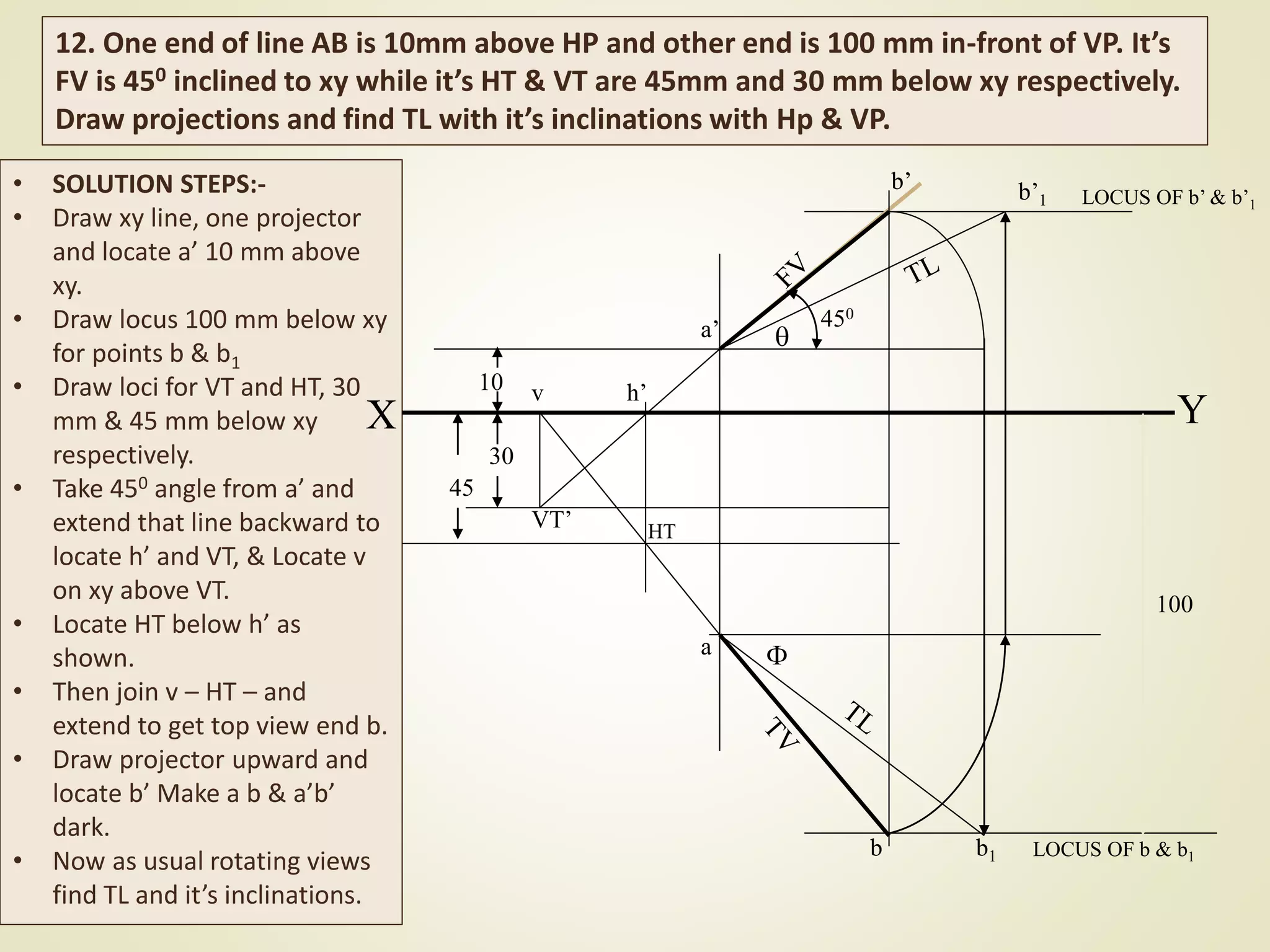
• SOLUTION STEPS:-
• Draw xy line, one projector
and locate a’ 10 mm above
xy.
• Draw locus 100 mm below xy
for points b & b1
• Draw loci for VT and HT, 30
mm & 45 mm below xy
respectively.
• Take 450 angle from a’ and
extend that line backward to
locate h’ and VT, & Locate v
on xy above VT.
• Locate HT below h’ as
shown.
• Then join v – HT – and
extend to get top view end b.
• Draw projector upward and
locate b’ Make a b & a’b’
dark.
• Now as usual rotating views
find TL and it’s inclinations.
a’
b’
30
45
10
LOCUS OF b’ & b’1
X Y
450
VT’
v
HT
h’
LOCUS OF b & b1
100
a
b
b’1


b1
12. One end of line AB is 10mm above HP and other end is 100 mm in-front of VP. It’s
FV is 450 inclined to xy while it’s HT & VT are 45mm and 30 mm below xy respectively.
Draw projections and find TL with it’s inclinations with Hp & VP.
X y
HT
VT
h’
a’
v
b’
a
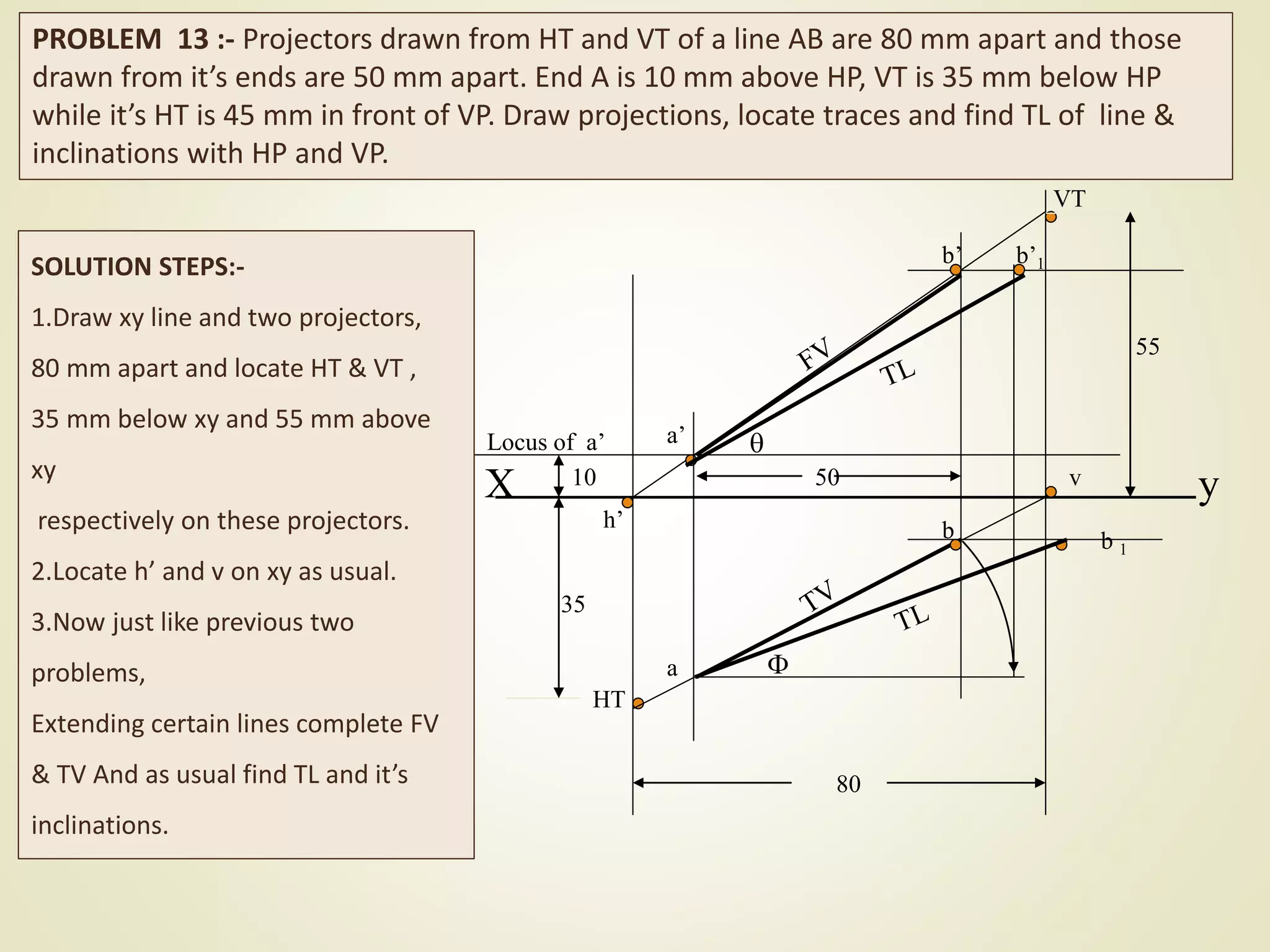
b
80
50
b’1


b 1
10
35
55
Locus of a’
PROBLEM 13 :- Projectors drawn from HT and VT of a line AB are 80 mm apart and those
drawn from it’s ends are 50 mm apart. End A is 10 mm above HP, VT is 35 mm below HP
while it’s HT is 45 mm in front of VP. Draw projections, locate traces and find TL of line &
inclinations with HP and VP.
SOLUTION STEPS:-
1.Draw xy line and two projectors,
80 mm apart and locate HT & VT ,
35 mm below xy and 55 mm above
xy
respectively on these projectors.
2.Locate h’ and v on xy as usual.
3.Now just like previous two
problems,
Extending certain lines complete FV
& TV And as usual find TL and it’s
inclinations.

Projection of Line

  • 1.
  • 2.
     A straightline is the shortest distance between any two points in space.  A line represents the locus of a point moving along a fixed linear path in space.  As a line consists of a number of points, its projections are drawn by joining the projections of any two points on the line (preferably the end points) or on the extension of the line.  RP`S means VP and HP. Projection of Line
  • 3.
    SIMPLE CASES OFTHE LINE 1. LINE PARALLEL TO BOTH HP & VP. 2. A VERTICAL LINE ( LINE PERPENDICULAR TO HP & // TO VP) 3. LINE INCLINED TO HP & PARALLEL TO VP. 4. LINE INCLINED TO VP & PARALLEL TO HP. 5. LINE INCLINED TO BOTH HP & VP. Information regarding a line means it’s length, position of it’s ends with HP & VP, it’s inclinations with HP & VP will be given. Projection of Line AIM:- TO DRAW IT’S PROJECTIONS - MEANS FV & TV.
  • 4.
    Terms used inProjections of Lines  True Length (TL): The actual length of a line is called its true length.  Plan Length (PL) or Top View Length: The apparent length of a line seen in TV is called the plan length or top view length.  Elevation Length (EL) or Front View Length: The apparent length of a line seen in FV is called the elevation length or front view length.  Side View Length (SVL): The apparent length of a line seen in SV is called its side view length.  Inclination with the HP (θ): It is the true angle that a line makes with its projection on the HP. It is indicated by θ (True inclination with HP).  Inclination with the VP (Φ): It is the true angle that a line makes with its projection on the VP. It is indicated by Φ (True inclination with VP).
  • 5.
     Apparent Anglewith the HP (α): It is the angle which an oblique line seems to be making with the HP in FV. It is the angle between FV and XY. It is indicated by α.  Apparent Angle with the VP (β): It is the angle which an oblique line seems to be making with the VP in TV. It is the angle between TV and XY. It is indicated by β.  Horizontal Trace (HT): The point of intersection of the line (or its extension) with the HP is called the horizontal trace of the line.  Vertical Trace (VT): The point of intersection of the line (or its extension) with the VP is called the vertical trace of the line.  Point View of the Line: The view of a line seen as a point (i.e., when the views of two ends coincide) is called the point view. Terms used in Projections of Lines
  • 6.
    X Y b’ a’ b a A B X Y H.P. V.P. a b a’b’Fv Tv For TV Note: FV & TV both are // to xy & both show T L LINE PARALLEL TO BOTH THE PLANES • General Observations : • If a line is parallel to HP or VP then its TL will be visible in TV or FV respectively. • FV and TV, will be parallel to XY and both will show the TL. • If a line is parallel to both the HP and the VP, it must be perpendicular to the PP. Therefore, point A and point B will coincide in SV of the line. Hence, the LHSV is a point view.
  • 7.
    X Y H.P. b’ a’ b a A B x y V.P. a b a’b’ FV TV For TV NOTE: FV & TV BOTH ARE // TO XY & BOTH SHOW T. L. Orthographic Pattern 1. Line AB 50mm long is placed in a first quadrant. It is parallel HP and VP. It is 20mm above HP and 30mm in front of VP. Draw its Projections. 20 30 20 30 50 LINE PARALLEL TO BOTH THE PLANES
  • 8.
    2. Line AB50mm long is placed in a first quadrant. Its side view is a point and it is 60 mm from the intersection of HP and VP. It is equidistant from both the reference planes. Draw the projections and specify the position of a line. LINE PARALLEL TO BOTH THE PLANES
  • 9.
    LINE PERPENDICULAR TOEITHER OF THE RPs General Observations : • If a line is perpendicular to the HP, it will automatically be parallel to the VP and PP. Hence, its FV will show the TL. • TV will be a point, wherever two (or more) points overlap, the visible point should be marked first. • TV is marked as a, b. It means that a is visible and b is hidden. The hidden point(s) may be enclosed in parenthesis ( ), e.g., a( b). X Y a b a’ b’ B A TV FV X Y H.P. V.P. a’ b’ a b Fv Tv For TV Note: FV is a vertical line Showing True Length & TV is a point. Orthographic Pattern
  • 10.
    X Y H.P. b’ a’ ab A B x y V.P. a b a’ b’ ForTV Orthographic Projection 3. Line AB 50mm long is placed in a first quadrant. It is perpendicular to HP and parallel VP. It is 20mm above HP and 30mm in front of VP. Draw its Projections. 50 20 30 20 30 50 LINE PERPENDICULAR TO EITHER OF THE RPs
  • 11.
    4. Line PQof 50mm length. The top view of line is a point which lies 20mm above XY line. One of the end of line lies 30mm below the reference line. Draw the projections of line, specify the quadrants and its location with respect to reference planes. LINE PERPENDICULAR TO EITHER OF THE RPs
  • 12.
    LINE INCLINED TOHP AND PARALLEL TO VP • General Observations : • Line parallel to VP, so its TL will be visible in FV. • Its true inclination with HP (θ) will be visible in FV. • As the line is inclined t HP so its apparent length will be visible in TV. • Apparent length will be less than the True Length. X Y A B b’ a’ b a   X Y H.P. V.P. T.V. a b a’ b’  FV inclined to xy TV parallel to xy.
  • 13.
    V.P. H.P. LINE INCLINED TOHP AND PARALLEL TO VP X Y A B b’ a’ b a x y a b a’ b’ 30o FV inclined to xy TV parallel to xy. 50 20 30 20 30 5. Line AB 50mm long is placed in a first quadrant. It is 30o inclined to HP and parallel to VP. One of the end of line is 20mm above HP and 30mm in front of VP. Draw its Projections.
  • 14.
    6. A lineAB, 50 mm long, is inclined to the HP at 30° and parallel to the VP. The end nearest to the HP is 40 mm above it and 25 mm in front of the VP. Draw the projections. 1. Assuming that the line AB is initially parallel to both the RPs, draw its FV a’b1’ and TV ab1 as shown. a’b1’ is 40 mm above XY and ab1 25 mm below XY. a’b1’= ab1 = TL = 50 mm. 2. Rotate a’b1’ about a’ through 30° to get a’b’. a’b’= a’b1’= TL. The angle made by a’b’ with XY represents θ. 3. Project b’ below XY to obtain b on ab1.a’b’ and ab represent respectively FV and TV of the line. Note that a’b’ (= EL) is equal to TL and ab(= PL) is shorter than TL. 4. Obtain LHSV a” b” by projecting a’b’ and ab with respect to X1 Y1.
  • 15.
    7. Line AB70mm long lies in the first quadrant and it is inclined to HP and parallel to VP. One end of line lies 20mm above HP while another end lies 50mm above HP. Line is 30 mm in front of VP. Draw its projections, find out its inclination with HP and its apparent length.
  • 16.
    8. Line AB70mm long lies in the third quadrant and it is inclined to HP and parallel to VP. One of the end of line is 25 mm below HP and 35 mm behind VP. The distance between the projections of end points is 50mm (Apparent length). Draw its projections and find out its inclination with HP.
  • 17.
    Ø a b a’ b’ BA Ø X Y H.P. V.P. Ø a b a’b’ Tv Fv TV inclined to xy Fv parallel to xy. LINE INCLINED TO VP AND PARALLEL TO HP • General Observations : • Line parallel to HP, so its TL will be visible in TV. • Its true inclination with VP (φ) will be visible in TV. • As the line is inclined t VP so its apparent length will be visible in FV. • Apparent length will be less than the True Length. • Always draw view in which TL is visible (In this TV).
  • 18.
    45 a b a’ b’ BA 45 TV inclinedto xy Fv parallel to xy. LINE INCLINED TO VP AND PARALLEL TO HP 9. Line AB 50mm long is placed in a first quadrant. It is 45o inclined to VP and parallel to HP. One of the end of line is 20mm above HP and 30mm in front of VP. Draw its Projections. For TV 50 20 V.P. H.P. x y a b a’ b’ 45o 20 30
  • 19.
    A line AB,50 mm long, is inclined to the VP at 45° and parallel to the HP. The end nearest to the HP is 40 mm above it and 25 mm in front of the VP. Draw the projections. 1. Draw TV ab = TL, inclined at 45° to XY. a is 25 mm below XY. 2. Project ab above XY to obtain a’b’. ab and a’b’ represent respectively TV and FV of the line.
  • 20.
    X Y a’ b’ a b B A   For TV T.V.X Y a’ b’ a b   T.V. For TV B A X Y   H.P. V.P. a b FV TV a’ b’ Note These Facts:- Both FV & TV are inclined to xy. (No view is parallel to xy) Both FV & TV are reduced lengths. (No view shows True Length) Orthographic Projections FV is seen on VP clearly. To see TV clearly, HP is rotated 900 downwards, Hence it comes below xy. On removal of object i.e. Line AB FV as a image on VP. TV as a image on HP, LINE INCLINED TO BOTH THE PLANES
  • 21.
    X Y  H.P. V.P. a b TV a’ b’ FV X Y H.P. V.P. TV b2 b1’ TL XY   H.P. V.P. a b FV TV a’ b’ Here TV (ab) is not // to XY line Hence it’s corresponding FV a’ b’ is not showing True Length & True Inclination with Hp. In this sketch, TV is rotated and made // to XY line. Hence it’s corresponding FV a’ b1’ Is showing True Length & True Inclination with Hp. Note the procedure When FV & TV known, How to find True Length. (Views are rotated to determine True Length & it’s inclinations with HP & VP). Note the procedure When True Length is known, How to locate FV & TV. (Component a-1 of TL is drawn which is further rotated to determine FV) 1 a a’ b’ 1’ b  b1 ’   b1 Ø Orthographic Projections Means FV & TV of Line AB are shown below, with their apparent Inclinations  &  Here a -1 is component of TL ab1 gives length of FV. Hence it is brought Up to Locus of a’ and further rotated to get point b’. a’ b’ will be FV. Similarly drawing component of other TL(a’ b1‘) TV can be drawn. 
  • 22.
    The most importantdiagram showing graphical relations among all important parameters of this topic. Study and memorize it as a CIRCUIT DIAGRAM And use in solving various problems. Important TEN parameters to be remembered with Notations used here onward Ø    1) True Length ( TL) – a’ b1’ & a b 2) Angle of TL with HP - 3) Angle of TL with VP – 4) Angle of FV with xy – 5) Angle of TV with xy – 6) FVL (FV Length) – Component (a-1) 7) TVL (TV Lngth) – Component (a’-1’) 8) Position of A- Distances of a & a’ from xy 9) Position of B- Distances of b & b’ from xy 10) Distance between End Projectors X Y H.P. V.P. 1a b  b1 Ø a’ b’ 1’ b1 ’   Distance between End Projectors. Important Observations : • b and b’ lie along same vertical line as end points are same. • b & b1 on same locus. • b’ & b1’ on same locus. • True Length is never rotated. It’s horizontal component is drawn & it is further rotated to locate view. • Views are always rotated, made horizontal & further extended to locate TL,  & Ø • If True Length is given then Project and Rotate to get Apparent Length • If Apparent length is given then Rotate and Project to get True Length
  • 23.
    1. Line ABis 75 mm long and it is 450 & 300 Inclined to HP & VP respectively. End A is 20mm above HP and 30 mm in front of VP. Draw projections. Line is in 1st quadrant. SOLUTION STEPS: 1) Draw xy line and one projector. 2) Locate a’ 12mm above xy line & a 10mm below xy line. 3) Take 300 angle from a’ & 400 from a and mark TL I.e. 75mm on both lines. Name those points b1’ and b1 respectively. 4) Join both points with a’ and a resp. 5) Draw horizontal lines (Locus) from both points. 6) Draw horizontal component of TL a b1 from point b1 and name it 1. ( the length a-1 gives length of Fv as we have seen already.) 7) Extend it up to locus of a’ and rotating a’ as center locate b’ as shown. Join a’ b’ as Fv. 8) From b’ drop a projector down ward & get point b. Join a & b I.e. Tv. Given : TL = 75mm Ø=30o =45o Calculate α,β, FVL and TVL x y V.P. H.P. a b  b1 Ø=30o a’ b’ b1 ’ α =45o 15 10 Locus of b Locus of b’ α=45o,β=55o, FVL=53 and TVL=65
  • 24.
    2. Line AB75mm long makes 45o inclination with VP while it’s FV makes 550. End A is 10 mm above HP and 15mm in front of VP. If line is in 1st quadrant draw it’s projections and find it’s inclination with Hp. Solution Steps:- 1.Draw xy line. 2.Draw one projector for a’ & a 3.Locate a 15 mm below xy & a’ 10mm above xy. 4.Draw a line 450 inclined to xy from point a and cut TL 75 mm on it and name that point b1 Draw locus from point b1 5.Take 550 angle from a’ for FV above xy line. 6.Draw a vertical line from b1 up to locus of a’ and then draw arc of radius FVL (a’1’). It is horizontal component of TL & is FVL. 7.Continue it to locus of a’ and rotate upward up to the line of FV and name it b’. This a’ b’ line is FV. 8. Drop a projector from b’ on locus from point b1 and name intersecting point b. Line a b is Tv of line AB. 9.Draw locus from b’ and from a’ with TL distance cut point b1‘ 10.Join a’ b1’ as TL and measure . it’s angle at a’. It will be true angle of line with HP. Given : TL = 75mm Ø=45o α=55o Calculate ,β, FVL and TVL x y V.P. H.P. a b  b1 Ø=45o a’ b’ b1 ’ α=55o  15 10 Locus of b Locus of b’ =35o,β=60o, FVL=53 and TVL=61
  • 25.
    3. FV ofline AB is 500 inclined to xy and measures 55 mm long while it’s TV is 600 inclined to xy line. If end A is 10 mm above HP and 15 mm in front of VP, draw it’s projections, find TL, inclinations of line with HP & VP. SOLUTION STEPS: 1.Draw xy line and one projector. 2.Locate a’ 10 mm above xy and a 15 mm below xy line. 3.Draw locus from these points. 4.Draw FV 500 to xy from a’ and mark b’ Cutting 55mm on it. 5.Similarly draw TV 600 to xy from a & drawing projector from b’ Locate point b and join a b. 6.Then rotating views as shown, locate True Lengths ab1 & a’b1’ and their angles with HP and VP. Given : FVL = 55mm α=50o β =60o Calculate Ø,, TL and TVL x y V.P. H.P. a b β =60o b1 Ø a’ b’ b1 ’ α=50o  15 10 Locus of b Locus of b’ =31o, Ø =48o, TL=82 and TVL=71
  • 26.
    4. Line ABis 75 mm long .It’s FV and TV measure 50 mm & 60 mm long respectively. End A is 10 mm above HP and 15 mm in front of VP. Draw projections of line AB if end B is in first quadrant. Find angle with HP and VP. SOLUTION STEPS: 1.Draw xy line and one projector. 2.Locate a’ 10 mm above xy and a 15 mm below xy line. 3.Draw locus from these points. 4.Cut 60mm distance on locus of a’ & mark 1’ on it as it is LTV. 5.Similarly Similarly cut 50mm on locus of a and mark point 1 as it is LFV. 6.From 1’ draw a vertical line upward and from a’ taking TL ( 75mm ) in compass, mark b’1 point on it. Join a’ b’1 points. 7. Draw locus from b’1 8. With same steps below get b1 point and draw also locus from it. 9. Now rotating one of the components I.e. a-1 locate b’ and join a’ with it to get Fv. 10. Locate tv similarly and measure Angles Given :TL= 75mm FVL=50mm and TVL=60mm Calculate α ,Ø,, and β x y V.P. H.P. a b β b1 Ø a’ b’ b1 ’ α  15 10 Locus of b Locus of b’ =37o, Ø =48o, α =64o , β =69o TVL
  • 27.
    X Y c’ c LOCUS OFd & d1d d1 d’ d’1   LOCUS OF d’ & d’1 5. T.V. of a 75 mm long Line CD, measures 50 mm. End C is in HP and 50 mm in front of VP. End D is 15 mm in front of VP and it is above HP. Draw projections of CD and find angles with HP and VP. SOLUTION STEPS: 1.Draw xy line and one projector. 2.Locate c’ on xy and c 50mm below xy line. 3.Draw locus from these points. 4.Draw locus of d 15 mm below xy 5.Cut 50mm & 75 mm distances on locus of d from c and mark points d & d1 as these are Tv and line CD lengths resp.& join both with c. 6.From d1 draw a vertical line upward up to xy I.e. up to locus of c’ and draw an arc as shown. 7 Then draw one projector from d to meet this arc in d’ point & join c’ d’ 8. Draw locus of d’ and cut 75 mm on it from c’ as TL 9.Measure Angles
  • 28.
    6. A straightline PQ has its end P 20 mm above the H.P. and 30 mm in front of the VP. And the end Q is 80 mm above the H.P. and 70 mm in front of the V.P. If the end projectors are 60 mm apart, draw the projections of the line. Determine its true length and true inclinations with the reference planes.
  • 29.
    7. A straightline AB of 50 mm length has one of its end points A 10 mm above the HP and 15 mm in front of the VP. The top View of the line measures 30mm while the front view is 40 mm long. Draw the projections and find out its angles of inclination in relation to the reference planes.
  • 30.
    8. A straightline AB has its end A 10 mm above the HP and end B 50 mm in front of the VP. Draw the projections of line AB if it is inclined at 30° to the HP and 45° to the VP, and it is 50 mm long.
  • 31.
    9. A straightline AB has its end point A 15 mm in front of the VP and end point B is 50 mm above the HP. The line is inclined at 45° to the HP, while its front view is inclined at 60° to the XY line. Draw the projections of the straight line AB if its top view is 35 mm long. Find the true length and the angle of inclination of the line with the VP.
  • 32.
    10. A straightline PQ has its end point P 10mm above HP and 15mm in front of the VP. The line is 50mm long and its front and top views are inclined at 60° and 45° respectively. Draw the projections of the line and find its inclinations with the HP and the VP.
  • 33.
    • These arethe points of intersections of a line ( or it’s extension ) with respective reference planes. • A line itself or it’s extension, where ever touches HP, that point is called trace of the line on HP(It is called HT) • Similarly, a line itself or it’s extension, where ever touches VP, that point is called trace of the line on VP (It is called VT) • Vertical Trace :- • It is a point on VP. • Hence it is called FV of a point in VP. • Hence it’s TV comes on XY line.( Here onward named as ‘v’) • Horizontal Trace .:- • It is a point on HP. • Hence it is called TV of a point in HP. • Hence it’s FV comes on XY line.( Here onward named as ’h’ ) TRACES OF THE LINE
  • 34.
    1. Begin withFV. Extend FV up to XY line. 2. Name this point h’ (as it is a FV of a point in HP) 3. Draw one projector from h’. 4. Now extend TV to meet this projector. This point is HT STEPS TO LOCATE HT. (WHEN PROJECTIONS ARE GIVEN.) 1. Begin with TV. Extend TV up to XY line. 2. Name this point v ( as it is a TV of a point in VP) 3. Draw one projector from v. 4. Now extend FV to meet this projector. This point is VT STEPS TO LOCATE VT. (WHEN PROJECTIONS ARE GIVEN.) h’ HTVT’ v a’ x y a b’ b Observe & note :- 1. Points h’ & v always on x-y line. 2. VT’ & v always on one projector. 3. HT & h’ always on one projector. 4. FV - h’- VT’ always co-linear. 5. TV - v - HT always co-linear.
  • 35.
    x y b’ b’1 a v VT’ a’ HT b h’ b1  300  450 PROBLEM11 :- FV of line AB makes 450 angle with XY line and measures 60 mm. Line’s TV makes 300 with XY line. End A is 15 mm above HP and it’s VT is 10 mm below HP. Draw projections of line AB, determine inclinations with HP & VP and locate HT, VT. 15 10 • SOLUTION STEPS:- • Draw xy line, one projector and locate FV a’ 15 mm above xy. • Take 450 angle from a’ and mark 60 mm on it locate point b’. • Draw locus of VT, 10 mm below xy & extend FV to this locus to locate VT. as FV-h’-VT’ lie on one straight line. • Draw projector from VT & locate v on xy. • From v take 300 angle downward as TV and it’s inclination can begin with v. • Draw projector from b’ and locate b i.e. TV point. • Now rotating views as usual TL and it’s inclinations can be found. • Name extension of FV, touching xy as h’ and below it, on extension of TV, locate HT.
  • 36.
    • SOLUTION STEPS:- •Draw xy line, one projector and locate a’ 10 mm above xy. • Draw locus 100 mm below xy for points b & b1 • Draw loci for VT and HT, 30 mm & 45 mm below xy respectively. • Take 450 angle from a’ and extend that line backward to locate h’ and VT, & Locate v on xy above VT. • Locate HT below h’ as shown. • Then join v – HT – and extend to get top view end b. • Draw projector upward and locate b’ Make a b & a’b’ dark. • Now as usual rotating views find TL and it’s inclinations. a’ b’ 30 45 10 LOCUS OF b’ & b’1 X Y 450 VT’ v HT h’ LOCUS OF b & b1 100 a b b’1   b1 12. One end of line AB is 10mm above HP and other end is 100 mm in-front of VP. It’s FV is 450 inclined to xy while it’s HT & VT are 45mm and 30 mm below xy respectively. Draw projections and find TL with it’s inclinations with Hp & VP.
  • 37.
    X y HT VT h’ a’ v b’ a b 80 50 b’1   b 1 10 35 55 Locusof a’ PROBLEM 13 :- Projectors drawn from HT and VT of a line AB are 80 mm apart and those drawn from it’s ends are 50 mm apart. End A is 10 mm above HP, VT is 35 mm below HP while it’s HT is 45 mm in front of VP. Draw projections, locate traces and find TL of line & inclinations with HP and VP. SOLUTION STEPS:- 1.Draw xy line and two projectors, 80 mm apart and locate HT & VT , 35 mm below xy and 55 mm above xy respectively on these projectors. 2.Locate h’ and v on xy as usual. 3.Now just like previous two problems, Extending certain lines complete FV & TV And as usual find TL and it’s inclinations.