Engineering Geology
Mohd Sharique Ahmad
Assistant Professor
JIT Barabanki
5/20/2017 Mohd Sharique Ahmad 1
UNIT 1
5/20/2017 Mohd Sharique Ahmad 2
Earth Science and its important in civil engg
• Geology is the study of earth, the materials of which it is
made, the structure of those materials and the effects of the
natural forces acting upon them and is important to civil
engineering because all work performed by civil engineers
involves earth and its features.
5/20/2017 Mohd Sharique Ahmad 3
Mineral and their physical properties
• The physical characteristics of minerals include traits which
are used to identify and describe mineral species. These
traits include color, streak, luster, density, hardness, cleavage,
fracture, tenacity, and crystal habit.
5/20/2017 Mohd Sharique Ahmad 4
Common Rock Forming minerals
• The six minerals olivine, quartz, feldspar, mica, pyroxene and
amphibole are the commonest rock-forming minerals and
are used as important tools in classifying rocks, particularly
igneous rocks. Except for quartz, all the minerals listed are
actually mineral groups.
5/20/2017 Mohd Sharique Ahmad 5
Internal Structure of earth
• The interior structure of the Earth is layered in spherical shells,
like an onion. These layers can be defined by their chemical and
their rheological properties. Earth has an outer silicate solid crust,
a highly viscous mantle, a liquid outer core that is much less
viscous than the mantle, and a solid inner core
5/20/2017 Mohd Sharique Ahmad 6
Building Stones
• Building stones are naturally occurring rocks of igneous,
sedimentary or metamorphic origin which are sufficiently
consolidated to enable them to be cut or shaped into blocks
or slabs for use as walling, paving or roofing materials in the
construction of buildings and other structures.
5/20/2017 Mohd Sharique Ahmad 7
Occurrence of Building Stones
Building Stones resources occur in all geological systems of the
stratigraphic column. There are complex issues involved in
defining mineral reserves for and roofing stone. Geological
factors such as bedding planes, joint spacing etc. are an
important consideration, affecting yields at the quarry, as are
physical characteristics and visual appearance, color and
texture.
5/20/2017 Mohd Sharique Ahmad 8
Characteristics Building Stones
• Igneous Building Stone
• Sedimentary building Stone
– Sandstone
– Lime Stone
5/20/2017 Mohd Sharique Ahmad 9
Use of Building Stones
• Stone Cladding
• Walling Stone
• Flags Stone
• Slate
• Monumental Stone
• Marble
• Decorative Stone
5/20/2017 Mohd Sharique Ahmad 10
UNIT 2
5/20/2017 Mohd Sharique Ahmad 11
Origin Of Rocks
• Rocks are divided into three basic types depending on how
they were formed: igneous, sedimentary and metamorphic.
When the lava cools and hardens on the earth's surface, it is
called volcanic igneous rock. If the magma cools and hardens
under the ground, it is called plutonic igneous rock
5/20/2017 Mohd Sharique Ahmad 12
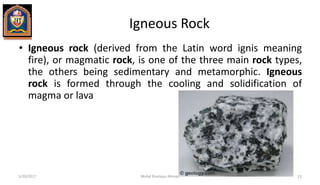
Igneous Rock
• Igneous rock (derived from the Latin word ignis meaning
fire), or magmatic rock, is one of the three main rock types,
the others being sedimentary and metamorphic. Igneous
rock is formed through the cooling and solidification of
magma or lava
5/20/2017 Mohd Sharique Ahmad 13
Properties of Igneous Rock
• Magmatic consolidation
• Both Crystalline and Non-Crystalline
• Non-porous
• Poorly eroded
• Content of Silica
• No Fossils
5/20/2017 Mohd Sharique Ahmad 14
Sedimentary Rocks
• Sedimentary rocks are types of rock that are formed by the
deposition and subsequent cementation of that material at
the Earth's surface and within bodies of water. Sedimentation
is the collective name for processes that cause mineral
and/or organic particles (detritus) to settle in place.
5/20/2017 Mohd Sharique Ahmad 15
Properties of Sedimentary Rocks
• Color: The color of a sedimentary rock is often mostly
determined by iron, an element with two major oxides: iron II
oxide and iron III oxide.
• Texture The size, form and orientation of clasts (the original
pieces of rock) in a sediment is called its texture. The texture
is a small-scale property of a rock, but determines many of its
large-scale properties, such as the density, porosity or
permiability.
5/20/2017 Mohd Sharique Ahmad 16
Metamorphic Rock
• A metamorphic rock is a result of a transformation of a pre-
existing rock. The original rock is subjected to very high heat
and pressure, which cause obvious physical and/or chemical
changes. Examples of these rock types include marble, slate,
gneiss, schist
5/20/2017 Mohd Sharique Ahmad 17
Properties of Metamorphic Rock
• Foliated metamorphic rocks such as gneiss, phyllite, schist,
and slate have a layered or banded appearance that is
produced by exposure to heat and directed pressure.
• Non-foliated metamorphic rocks such as hornfels, marble,
quartzite, and novaculite do not have a layered or banded
appearance
5/20/2017 Mohd Sharique Ahmad 18
UNIT 3
5/20/2017 Mohd Sharique Ahmad 19
Strike and dip of strata
• Strike and dip refer to the orientation or attitude of a
geologic feature. The strike line of a bed, fault, or other
planar feature, is a line representing the intersection of that
feature with a horizontal plane. On a geologic map, this is
represented with a short straight line segment oriented
parallel to the strike line.
5/20/2017 Mohd Sharique Ahmad 20
Folds
• A geological fold occurs when one or a stack of originally flat
and planar surfaces, such as sedimentary strata, are bent or
curved as a result of permanent deformation.
Synsedimentary folds are those due to slumping of
sedimentary material before it is lithified.
5/20/2017 Mohd Sharique Ahmad 21
Faults
• A fault is a crack in the Earth's crust. Typically, faults are
associated with, or form, the boundaries between Earth's
tectonic plates. In an active fault, the pieces of the Earth's
crust along a fault move over time. The moving rocks can
cause earthquakes
5/20/2017 Mohd Sharique Ahmad 22
Joints
• In geology, a joint is a fracture dividing rock into two sections
that have not moved away from each other. A joint sees little
or no displacement. In other kinds of fracturing, like in a
fault, the rock is parted by a visible crack that forms a gap in
the rock.
5/20/2017 Mohd Sharique Ahmad 23
Unconformity
• Unconformities are gaps in the
geologic rock record. They are
surfaces of contact between
older rocks and younger
sedimentary rocks, formed
due to erosion or lack of
sediment deposition over
extended periods of time
5/20/2017 Mohd Sharique Ahmad 24
Overlap
• Onlap or overlap is the geologic phenomenon of successively
wedge-shaped younger rock strata extending progressively
further across an erosion surface cut in older rocks. It is
generally associated with a marine transgression.
5/20/2017 Mohd Sharique Ahmad 25
Landslides
• A landslide, also known as a landslip, is a form of mass
wasting that includes a wide range of ground movements,
such as rock falls, deep failure of slopes, and shallow debris
flows. Landslides can occur in underwater, called a submarine
landslide, coastal and onshore environments
5/20/2017 Mohd Sharique Ahmad 26
Landslide Causes
• The causes of landslides are usually related to instabilities in
slopes. It is usually possible to identify one or more landslide
causes and one landslide trigger.
• The difference between these two concepts is subtle but
important. The landslide causes are the reasons that a
landslide occurred in that location and at that time.
• Landslide causes are listed in the following table, and include
geological factors, morphological factors, physical factors and
factors associated with human activity.
5/20/2017 Mohd Sharique Ahmad 27
Preventive measure of lanslides
• Improving surface and subsurface drainage
• Constructing piles and retaining walls
• Excavating the head
• Buttressing the toe
5/20/2017 Mohd Sharique Ahmad 28
Unit 4
5/20/2017 Mohd Sharique Ahmad 29
Earthquake
• An earthquake (also known as a quake, tremor or temblor) is
the perceptible shaking of the surface of the Earth, resulting
from the sudden release of energy in the Earth's crust that
creates seismic waves. Earthquakes can be violent enough to
toss people around and destroy whole cities.
5/20/2017 Mohd Sharique Ahmad 30
Causes of Earthquake
• Earthquakes are usually caused when rock underground
suddenly breaks along a fault.
• This sudden release of energy causes the seismic waves that
make the ground shake.
• When two blocks of rock or two plates are rubbing against
each other, they stick a little. When the rocks break, the
earthquake occurs
5/20/2017 Mohd Sharique Ahmad 31
Classification of Earthquake
Based on Location
• Interplate
• Intraplate
Based on Focal Depth
• Shallow Earthquake
• Deep Earthquake
Based on Cause
• Non Techtonic Earthquake
• Techtonic Earthquake
5/20/2017 Mohd Sharique Ahmad 32
Classification Contd..
• Based on the Magnitute of Earthquake
5/20/2017 Mohd Sharique Ahmad 33
CLASS MAGNITUDE
Great 8 or more
Major 7 – 7.9
Strong 6 – 6.9
Moderate 5 – 5.9
Light 4 – 4.9
Minor 3 – 3.9
Contd..
Based on Epicenter Distance
• Local Earthquakes
• Regional Earthquakes
• Teleseismic Earthquake
5/20/2017 Mohd Sharique Ahmad 34
Earthquake wave
Seismic waves are waves of energy that travel through the
Earth's layers, and are a result of earthquake, volcanic,
eruptions, magma movement, large landslides and large man-
made explosions that give out low-frequency acoustic energy.
Types
• Body Waves
• Primary Waves
• Secondary Waves
• Rayleigh Waves
• Stoneley Waves5/20/2017 Mohd Sharique Ahmad 35
Earthquake intensity
• The severity of earthquake shaking is assessed using a
descriptive scale – the Modified Mercalli Intensity Scale.
Magnitude: Earthquake size is a quantitative measure of the
size of the earthquake at its source. The Richter Magnitude
Scale measures the amount of seismic energy released by an
earthquake.
5/20/2017 Mohd Sharique Ahmad 36
Earthquake magnitude
Magnitude Earthquake Effects
Estimated Number Each
Year
2.5 or less
Usually not felt, but can be
recorded by seismograph.
900,000
2.5 to 5.4
Often felt, but only causes
minor damage.
30,000
5.5 to 6.0
Slight damage to buildings
and other structures.
500
6.1 to 6.9
May cause a lot of damage
in very populated areas.
100
5/20/2017 Mohd Sharique Ahmad 37
Seismic Zones of India
• Zone - II: This is said to be the least active seismic zone.
• Zone - III: It is included in the moderate seismic zone.
• Zone - IV: This is considered to be the high seismic zone.
• Zone - V: It is the highest seismic zone
5/20/2017 Mohd Sharique Ahmad 38
Underground Water
• Groundwater is the water found underground in the cracks
and spaces in soil, sand and rock. It is stored in and moves
slowly through geologic formations of soil, sand and rocks
called aquifers
5/20/2017 Mohd Sharique Ahmad 39
Sources of Underground water
A. Surface or Direct Sources of Water
 Rivers
 Streams
 Intermittent Streams
 Springs
 Torrents
 Lakes
 Reservoirs
5/20/2017 Mohd Sharique Ahmad 40
B. Underground or Indirect Sources of Water
• Open Wells
• Tube Wells
• Artesian Wells
• Infiltration Gallery
• Infiltration wells
5/20/2017 Mohd Sharique Ahmad 41
Aquifer
An aquifer is an underground layer of water-bearing permeable
rock, rock fractures or unconsolidated materials (gravel, sand or
silt) from which groundwater can be extracted using a water
well. The study of water flow in aquifers and the
characterization of aquifers is called hydrogeology.
5/20/2017 Mohd Sharique Ahmad 42
Aquiclude
• An impermeable body of rock or stratum of sediment that
acts as a barrier to the flow of water.
• It is a solid, impermeable area underlying or overlying an
aquifer. If the impermeable area overlies the aquifer,
pressure could cause it to become a confined aquifer
• It can absorb water but cannot transmit it in a significant
amount.
5/20/2017 Mohd Sharique Ahmad 43
Artesian Well
• An artesian aquifer is a
Confined aquifer containing
groundwater under positive
pressure. This causes the
water level in a well to rise
to a point where hydrostatic
equilibrium has been
reached
• A well drilled into such an
aquifer is called an artesian
well.
5/20/2017 Mohd Sharique Ahmad 44
Groundwater province of india
The ground water provinces occurring in India have been classified into 8 as follows
1. The Precambrian Crystalline province
2. Precambrian Sedimentary province
3. Gondwana Sedimentary province
4. Deccan Trap province
5. Cenozoic Sedimentary province
6. Cenozoic Fault Basin province
7. Indo-Gangetic Alluvial province
8. Himalayan High Land province
5/20/2017 Mohd Sharique Ahmad 45
UNIT 5
5/20/2017 Mohd Sharique Ahmad 46
Geological investigations for site selection
• The main objective of geological investigations for most
engineering projects is to determine : The geological structure of
the area The lithology of area The ground water conditions in the
region The seismicity of the region.
• The geological structure of the area, which also includes
topography and geomorphology, is determined by conducting
extensive and intensive geological surveys.
• The lithological details as revealed by these investigations would
include the type of rock that make up different parts of the area
5/20/2017 Mohd Sharique Ahmad 47
Purpose of Dams
• Generation of hydropower energy
• Providing water for irrigation facilities
• Providing water supply for domestic consumption and
industrial use
• Fighting droughts and controlling floods
• Providing navigational facilities
• Additional benefits of fisheries and recreational facilities and
greenery along reservoir
5/20/2017 Mohd Sharique Ahmad 48
Site Selection for Dam
• Suitable foundation must be available.
• For economy, the length of the dam should be as small as possible, and
for a given height, it should store the maximum volume of water.
• The general bed level at dam site should preferably be higher than that
of the river basin. This will reduce the height of the dam.
• A suitable site for the spillway should be available in the near vicinity.
• Materials required for the construction of dam should be easily available,
either locally or in the near vicinity.
• The value of land and property submerged by the proposed dam should
be as low as possible.
• The dam site should be easily accessible, so that it can be economically
connected to important towns and cities.
• Site for establishing labor colonies and a healthy environment should be
available near the site.5/20/2017 Mohd Sharique Ahmad 49
Site selection for reservoirs
• Surface topography
The site should provide a large area for storage of the water. Also,
there should be suitable routes available for pipelines
• Sub-surface geology:
The site must provide :
 Safe foundation for dam structure.
 Water tightness against seepage
• Absence of objectionable soluble materials
• Availability of local construction material
5/20/2017 Mohd Sharique Ahmad 50
Site Investigation for tunnel
• Selection of tunnel Site
• Selection of excavation method
• Selection of design for tunnel
• Assessment of Cost and Stability
• Assessment of environment Hazard
5/20/2017 Mohd Sharique Ahmad 51
Site Selection for highways
• Topography
• Lithology
 Consolidated Ground
 Unconsolidated Ground
 Geological Structures
 Dip and Strike
 Parallel to Dip-safe
 Perpendicular to dip unsafe
 Angular to dip-unsafe
 Precautions: Enlarging the section to cutting to stable limit
 Strong retaining wall
 Good Drainage system
 Joint
 Fault
 Ground Water Condition
 Weathering
5/20/2017 Mohd Sharique Ahmad 52
Reservoir induced seismicity
• Though understanding of
reservoir-induced seismic
activity is very limited, it has
been noted that seismicity
appears to occur on dams
with heights larger than 330
feet (100 m).
• The extra water pressure
created by large reservoirs is
the most accepted
explanation for the seismic
activity.
5/20/2017 Mohd Sharique Ahmad 53
Methods of Geophysical Exploration
Geophysical exploration may be used with advantage to locate
boundaries between different elements of the subsoil as these
procedures are based on the fact that the gravitational,
magnetic, electrical, radioactive or elastic properties of the
different elements of the subsoil may be different.
• Electrical resistivity method
• Seismic Refraction Method
5/20/2017 Mohd Sharique Ahmad 54
Thanks
5/20/2017 Mohd Sharique Ahmad 55

Engineering geology

  • 1.
    Engineering Geology Mohd ShariqueAhmad Assistant Professor JIT Barabanki 5/20/2017 Mohd Sharique Ahmad 1
  • 2.
    UNIT 1 5/20/2017 MohdSharique Ahmad 2
  • 3.
    Earth Science andits important in civil engg • Geology is the study of earth, the materials of which it is made, the structure of those materials and the effects of the natural forces acting upon them and is important to civil engineering because all work performed by civil engineers involves earth and its features. 5/20/2017 Mohd Sharique Ahmad 3
  • 4.
    Mineral and theirphysical properties • The physical characteristics of minerals include traits which are used to identify and describe mineral species. These traits include color, streak, luster, density, hardness, cleavage, fracture, tenacity, and crystal habit. 5/20/2017 Mohd Sharique Ahmad 4
  • 5.
    Common Rock Formingminerals • The six minerals olivine, quartz, feldspar, mica, pyroxene and amphibole are the commonest rock-forming minerals and are used as important tools in classifying rocks, particularly igneous rocks. Except for quartz, all the minerals listed are actually mineral groups. 5/20/2017 Mohd Sharique Ahmad 5
  • 6.
    Internal Structure ofearth • The interior structure of the Earth is layered in spherical shells, like an onion. These layers can be defined by their chemical and their rheological properties. Earth has an outer silicate solid crust, a highly viscous mantle, a liquid outer core that is much less viscous than the mantle, and a solid inner core 5/20/2017 Mohd Sharique Ahmad 6
  • 7.
    Building Stones • Buildingstones are naturally occurring rocks of igneous, sedimentary or metamorphic origin which are sufficiently consolidated to enable them to be cut or shaped into blocks or slabs for use as walling, paving or roofing materials in the construction of buildings and other structures. 5/20/2017 Mohd Sharique Ahmad 7
  • 8.
    Occurrence of BuildingStones Building Stones resources occur in all geological systems of the stratigraphic column. There are complex issues involved in defining mineral reserves for and roofing stone. Geological factors such as bedding planes, joint spacing etc. are an important consideration, affecting yields at the quarry, as are physical characteristics and visual appearance, color and texture. 5/20/2017 Mohd Sharique Ahmad 8
  • 9.
    Characteristics Building Stones •Igneous Building Stone • Sedimentary building Stone – Sandstone – Lime Stone 5/20/2017 Mohd Sharique Ahmad 9
  • 10.
    Use of BuildingStones • Stone Cladding • Walling Stone • Flags Stone • Slate • Monumental Stone • Marble • Decorative Stone 5/20/2017 Mohd Sharique Ahmad 10
  • 11.
    UNIT 2 5/20/2017 MohdSharique Ahmad 11
  • 12.
    Origin Of Rocks •Rocks are divided into three basic types depending on how they were formed: igneous, sedimentary and metamorphic. When the lava cools and hardens on the earth's surface, it is called volcanic igneous rock. If the magma cools and hardens under the ground, it is called plutonic igneous rock 5/20/2017 Mohd Sharique Ahmad 12
  • 13.
    Igneous Rock • Igneousrock (derived from the Latin word ignis meaning fire), or magmatic rock, is one of the three main rock types, the others being sedimentary and metamorphic. Igneous rock is formed through the cooling and solidification of magma or lava 5/20/2017 Mohd Sharique Ahmad 13
  • 14.
    Properties of IgneousRock • Magmatic consolidation • Both Crystalline and Non-Crystalline • Non-porous • Poorly eroded • Content of Silica • No Fossils 5/20/2017 Mohd Sharique Ahmad 14
  • 15.
    Sedimentary Rocks • Sedimentaryrocks are types of rock that are formed by the deposition and subsequent cementation of that material at the Earth's surface and within bodies of water. Sedimentation is the collective name for processes that cause mineral and/or organic particles (detritus) to settle in place. 5/20/2017 Mohd Sharique Ahmad 15
  • 16.
    Properties of SedimentaryRocks • Color: The color of a sedimentary rock is often mostly determined by iron, an element with two major oxides: iron II oxide and iron III oxide. • Texture The size, form and orientation of clasts (the original pieces of rock) in a sediment is called its texture. The texture is a small-scale property of a rock, but determines many of its large-scale properties, such as the density, porosity or permiability. 5/20/2017 Mohd Sharique Ahmad 16
  • 17.
    Metamorphic Rock • Ametamorphic rock is a result of a transformation of a pre- existing rock. The original rock is subjected to very high heat and pressure, which cause obvious physical and/or chemical changes. Examples of these rock types include marble, slate, gneiss, schist 5/20/2017 Mohd Sharique Ahmad 17
  • 18.
    Properties of MetamorphicRock • Foliated metamorphic rocks such as gneiss, phyllite, schist, and slate have a layered or banded appearance that is produced by exposure to heat and directed pressure. • Non-foliated metamorphic rocks such as hornfels, marble, quartzite, and novaculite do not have a layered or banded appearance 5/20/2017 Mohd Sharique Ahmad 18
  • 19.
    UNIT 3 5/20/2017 MohdSharique Ahmad 19
  • 20.
    Strike and dipof strata • Strike and dip refer to the orientation or attitude of a geologic feature. The strike line of a bed, fault, or other planar feature, is a line representing the intersection of that feature with a horizontal plane. On a geologic map, this is represented with a short straight line segment oriented parallel to the strike line. 5/20/2017 Mohd Sharique Ahmad 20
  • 21.
    Folds • A geologicalfold occurs when one or a stack of originally flat and planar surfaces, such as sedimentary strata, are bent or curved as a result of permanent deformation. Synsedimentary folds are those due to slumping of sedimentary material before it is lithified. 5/20/2017 Mohd Sharique Ahmad 21
  • 22.
    Faults • A faultis a crack in the Earth's crust. Typically, faults are associated with, or form, the boundaries between Earth's tectonic plates. In an active fault, the pieces of the Earth's crust along a fault move over time. The moving rocks can cause earthquakes 5/20/2017 Mohd Sharique Ahmad 22
  • 23.
    Joints • In geology,a joint is a fracture dividing rock into two sections that have not moved away from each other. A joint sees little or no displacement. In other kinds of fracturing, like in a fault, the rock is parted by a visible crack that forms a gap in the rock. 5/20/2017 Mohd Sharique Ahmad 23
  • 24.
    Unconformity • Unconformities aregaps in the geologic rock record. They are surfaces of contact between older rocks and younger sedimentary rocks, formed due to erosion or lack of sediment deposition over extended periods of time 5/20/2017 Mohd Sharique Ahmad 24
  • 25.
    Overlap • Onlap oroverlap is the geologic phenomenon of successively wedge-shaped younger rock strata extending progressively further across an erosion surface cut in older rocks. It is generally associated with a marine transgression. 5/20/2017 Mohd Sharique Ahmad 25
  • 26.
    Landslides • A landslide,also known as a landslip, is a form of mass wasting that includes a wide range of ground movements, such as rock falls, deep failure of slopes, and shallow debris flows. Landslides can occur in underwater, called a submarine landslide, coastal and onshore environments 5/20/2017 Mohd Sharique Ahmad 26
  • 27.
    Landslide Causes • Thecauses of landslides are usually related to instabilities in slopes. It is usually possible to identify one or more landslide causes and one landslide trigger. • The difference between these two concepts is subtle but important. The landslide causes are the reasons that a landslide occurred in that location and at that time. • Landslide causes are listed in the following table, and include geological factors, morphological factors, physical factors and factors associated with human activity. 5/20/2017 Mohd Sharique Ahmad 27
  • 28.
    Preventive measure oflanslides • Improving surface and subsurface drainage • Constructing piles and retaining walls • Excavating the head • Buttressing the toe 5/20/2017 Mohd Sharique Ahmad 28
  • 29.
    Unit 4 5/20/2017 MohdSharique Ahmad 29
  • 30.
    Earthquake • An earthquake(also known as a quake, tremor or temblor) is the perceptible shaking of the surface of the Earth, resulting from the sudden release of energy in the Earth's crust that creates seismic waves. Earthquakes can be violent enough to toss people around and destroy whole cities. 5/20/2017 Mohd Sharique Ahmad 30
  • 31.
    Causes of Earthquake •Earthquakes are usually caused when rock underground suddenly breaks along a fault. • This sudden release of energy causes the seismic waves that make the ground shake. • When two blocks of rock or two plates are rubbing against each other, they stick a little. When the rocks break, the earthquake occurs 5/20/2017 Mohd Sharique Ahmad 31
  • 32.
    Classification of Earthquake Basedon Location • Interplate • Intraplate Based on Focal Depth • Shallow Earthquake • Deep Earthquake Based on Cause • Non Techtonic Earthquake • Techtonic Earthquake 5/20/2017 Mohd Sharique Ahmad 32
  • 33.
    Classification Contd.. • Basedon the Magnitute of Earthquake 5/20/2017 Mohd Sharique Ahmad 33 CLASS MAGNITUDE Great 8 or more Major 7 – 7.9 Strong 6 – 6.9 Moderate 5 – 5.9 Light 4 – 4.9 Minor 3 – 3.9
  • 34.
    Contd.. Based on EpicenterDistance • Local Earthquakes • Regional Earthquakes • Teleseismic Earthquake 5/20/2017 Mohd Sharique Ahmad 34
  • 35.
    Earthquake wave Seismic wavesare waves of energy that travel through the Earth's layers, and are a result of earthquake, volcanic, eruptions, magma movement, large landslides and large man- made explosions that give out low-frequency acoustic energy. Types • Body Waves • Primary Waves • Secondary Waves • Rayleigh Waves • Stoneley Waves5/20/2017 Mohd Sharique Ahmad 35
  • 36.
    Earthquake intensity • Theseverity of earthquake shaking is assessed using a descriptive scale – the Modified Mercalli Intensity Scale. Magnitude: Earthquake size is a quantitative measure of the size of the earthquake at its source. The Richter Magnitude Scale measures the amount of seismic energy released by an earthquake. 5/20/2017 Mohd Sharique Ahmad 36
  • 37.
    Earthquake magnitude Magnitude EarthquakeEffects Estimated Number Each Year 2.5 or less Usually not felt, but can be recorded by seismograph. 900,000 2.5 to 5.4 Often felt, but only causes minor damage. 30,000 5.5 to 6.0 Slight damage to buildings and other structures. 500 6.1 to 6.9 May cause a lot of damage in very populated areas. 100 5/20/2017 Mohd Sharique Ahmad 37
  • 38.
    Seismic Zones ofIndia • Zone - II: This is said to be the least active seismic zone. • Zone - III: It is included in the moderate seismic zone. • Zone - IV: This is considered to be the high seismic zone. • Zone - V: It is the highest seismic zone 5/20/2017 Mohd Sharique Ahmad 38
  • 39.
    Underground Water • Groundwateris the water found underground in the cracks and spaces in soil, sand and rock. It is stored in and moves slowly through geologic formations of soil, sand and rocks called aquifers 5/20/2017 Mohd Sharique Ahmad 39
  • 40.
    Sources of Undergroundwater A. Surface or Direct Sources of Water  Rivers  Streams  Intermittent Streams  Springs  Torrents  Lakes  Reservoirs 5/20/2017 Mohd Sharique Ahmad 40
  • 41.
    B. Underground orIndirect Sources of Water • Open Wells • Tube Wells • Artesian Wells • Infiltration Gallery • Infiltration wells 5/20/2017 Mohd Sharique Ahmad 41
  • 42.
    Aquifer An aquifer isan underground layer of water-bearing permeable rock, rock fractures or unconsolidated materials (gravel, sand or silt) from which groundwater can be extracted using a water well. The study of water flow in aquifers and the characterization of aquifers is called hydrogeology. 5/20/2017 Mohd Sharique Ahmad 42
  • 43.
    Aquiclude • An impermeablebody of rock or stratum of sediment that acts as a barrier to the flow of water. • It is a solid, impermeable area underlying or overlying an aquifer. If the impermeable area overlies the aquifer, pressure could cause it to become a confined aquifer • It can absorb water but cannot transmit it in a significant amount. 5/20/2017 Mohd Sharique Ahmad 43
  • 44.
    Artesian Well • Anartesian aquifer is a Confined aquifer containing groundwater under positive pressure. This causes the water level in a well to rise to a point where hydrostatic equilibrium has been reached • A well drilled into such an aquifer is called an artesian well. 5/20/2017 Mohd Sharique Ahmad 44
  • 45.
    Groundwater province ofindia The ground water provinces occurring in India have been classified into 8 as follows 1. The Precambrian Crystalline province 2. Precambrian Sedimentary province 3. Gondwana Sedimentary province 4. Deccan Trap province 5. Cenozoic Sedimentary province 6. Cenozoic Fault Basin province 7. Indo-Gangetic Alluvial province 8. Himalayan High Land province 5/20/2017 Mohd Sharique Ahmad 45
  • 46.
    UNIT 5 5/20/2017 MohdSharique Ahmad 46
  • 47.
    Geological investigations forsite selection • The main objective of geological investigations for most engineering projects is to determine : The geological structure of the area The lithology of area The ground water conditions in the region The seismicity of the region. • The geological structure of the area, which also includes topography and geomorphology, is determined by conducting extensive and intensive geological surveys. • The lithological details as revealed by these investigations would include the type of rock that make up different parts of the area 5/20/2017 Mohd Sharique Ahmad 47
  • 48.
    Purpose of Dams •Generation of hydropower energy • Providing water for irrigation facilities • Providing water supply for domestic consumption and industrial use • Fighting droughts and controlling floods • Providing navigational facilities • Additional benefits of fisheries and recreational facilities and greenery along reservoir 5/20/2017 Mohd Sharique Ahmad 48
  • 49.
    Site Selection forDam • Suitable foundation must be available. • For economy, the length of the dam should be as small as possible, and for a given height, it should store the maximum volume of water. • The general bed level at dam site should preferably be higher than that of the river basin. This will reduce the height of the dam. • A suitable site for the spillway should be available in the near vicinity. • Materials required for the construction of dam should be easily available, either locally or in the near vicinity. • The value of land and property submerged by the proposed dam should be as low as possible. • The dam site should be easily accessible, so that it can be economically connected to important towns and cities. • Site for establishing labor colonies and a healthy environment should be available near the site.5/20/2017 Mohd Sharique Ahmad 49
  • 50.
    Site selection forreservoirs • Surface topography The site should provide a large area for storage of the water. Also, there should be suitable routes available for pipelines • Sub-surface geology: The site must provide :  Safe foundation for dam structure.  Water tightness against seepage • Absence of objectionable soluble materials • Availability of local construction material 5/20/2017 Mohd Sharique Ahmad 50
  • 51.
    Site Investigation fortunnel • Selection of tunnel Site • Selection of excavation method • Selection of design for tunnel • Assessment of Cost and Stability • Assessment of environment Hazard 5/20/2017 Mohd Sharique Ahmad 51
  • 52.
    Site Selection forhighways • Topography • Lithology  Consolidated Ground  Unconsolidated Ground  Geological Structures  Dip and Strike  Parallel to Dip-safe  Perpendicular to dip unsafe  Angular to dip-unsafe  Precautions: Enlarging the section to cutting to stable limit  Strong retaining wall  Good Drainage system  Joint  Fault  Ground Water Condition  Weathering 5/20/2017 Mohd Sharique Ahmad 52
  • 53.
    Reservoir induced seismicity •Though understanding of reservoir-induced seismic activity is very limited, it has been noted that seismicity appears to occur on dams with heights larger than 330 feet (100 m). • The extra water pressure created by large reservoirs is the most accepted explanation for the seismic activity. 5/20/2017 Mohd Sharique Ahmad 53
  • 54.
    Methods of GeophysicalExploration Geophysical exploration may be used with advantage to locate boundaries between different elements of the subsoil as these procedures are based on the fact that the gravitational, magnetic, electrical, radioactive or elastic properties of the different elements of the subsoil may be different. • Electrical resistivity method • Seismic Refraction Method 5/20/2017 Mohd Sharique Ahmad 54
  • 55.