UNIT 1
INTRODUCTION TO
PETROLOGY
Structure______________________________________________
1.1 Introduction
Expected Learning Outcomes
1.2 What are the Rocks?
1.3 Why Do We Study Rocks?
1.4 Classification of Rocks
1.5 Igneous Rocks
1.6 Sedimentary Rocks
1.7 Metamorphic Rocks
1.8 Rock Cycle
1.9 Uses of the Rocks
1.10 Introduction to Extraterrestrial Rocks
1.11 Summary
1.12 Activity
1.13 Terminal Questions
1.14 References
1.15 Further/Suggested Readings
1.16 Answers
1.1 INTRODUCTION
Rocks have always been a matter of fascination for human beings. Stones were among the first tools
and weapons used by humans. The rock caves provided shelter to the prehistoric man. He could ignite
fire by rubbing pieces of rocks. Rocks have been and are being explored by human beings for
extraction of minerals and metals. Later, metals became the basis of wealth and the foundation of
empires. After having learnt megascopic and microscopic properties of minerals in the course BGYCT-
133, let us study about rocks. Rocks are the most common and abundant materials found on the Earth.
On closer examination we observe that rock consists of smaller crystals or grains. Rock is defined as a
naturally occurring solid aggregate of minerals. Its character and appearance depend on the nature and
volume of the constituents mineral(s). They may occur in various colours and textures. They act as
vehicles in all Earth processes such as volcanic eruptions, mountain building, weathering, erosion, and
even earthquakes. The rocks provide a historical record of geologic events giving insight into
……………………………………………………………………………………………….….............….….......
14
Unit 1 Introduction to Petrology
interactions among components (crust and mantle) and spheres (lithosphere,
atmosphere, hydrosphere and biosphere) of the Earth System. Now in this unit,
you will be introduced to the basic concepts of petrology, i.e. study of rocks.
Petrology (derived from the Greek word petra meaning ‘rock’, and logos meaning
‘discourse or explanation’), is the branch of geology dealing with the origin,
occurrence, structure and history of rocks.
Let us realise, what the term rock means to geologists? What are the rock
constituents? How to distinguish one rock type from other? We will also discuss
about rock cycle and the uses of rock to the human and society.
Expected Learning
Outcomes__________________________
After reading this unit you should be able to:
❖ define rocks and discuss the importance of their study;
❖ classify and distinguish principal rock types;
❖ explain the concept of rock cycle;
❖ appreciate the uses of rocks to human beings; and
❖ discuss briefly about the extraterrestrial rocks.
1.2 WHAT ARE ROCKS?
We live on the rocks, even though we don’t always see them. Strange!
Unbelievable, isn’t it.
These rocks are sometimes exposed on Earth’s surface and we can see them,
whereas, often they are concealed by the debris, soil, water and ice. Try to recall
that in unit 9, Introduction to Structural Geology of the course BGYCT-131, you
must have read that when a portion of the rock below appears at the surface it is
termed as outcrop. The rocks which are not exposed on the surface are referred
to incrop. Rock occurs at the Earth’s surface either as broken chunks (pebbles,
cobbles or boulders) that have moved down a slope or by being transported in ice,
water or wind or as bedrock on the surface of the Earth. Geologists refer to an
exposure of bedrock as an outcrop. An outcrop may appear as a rounded knob in
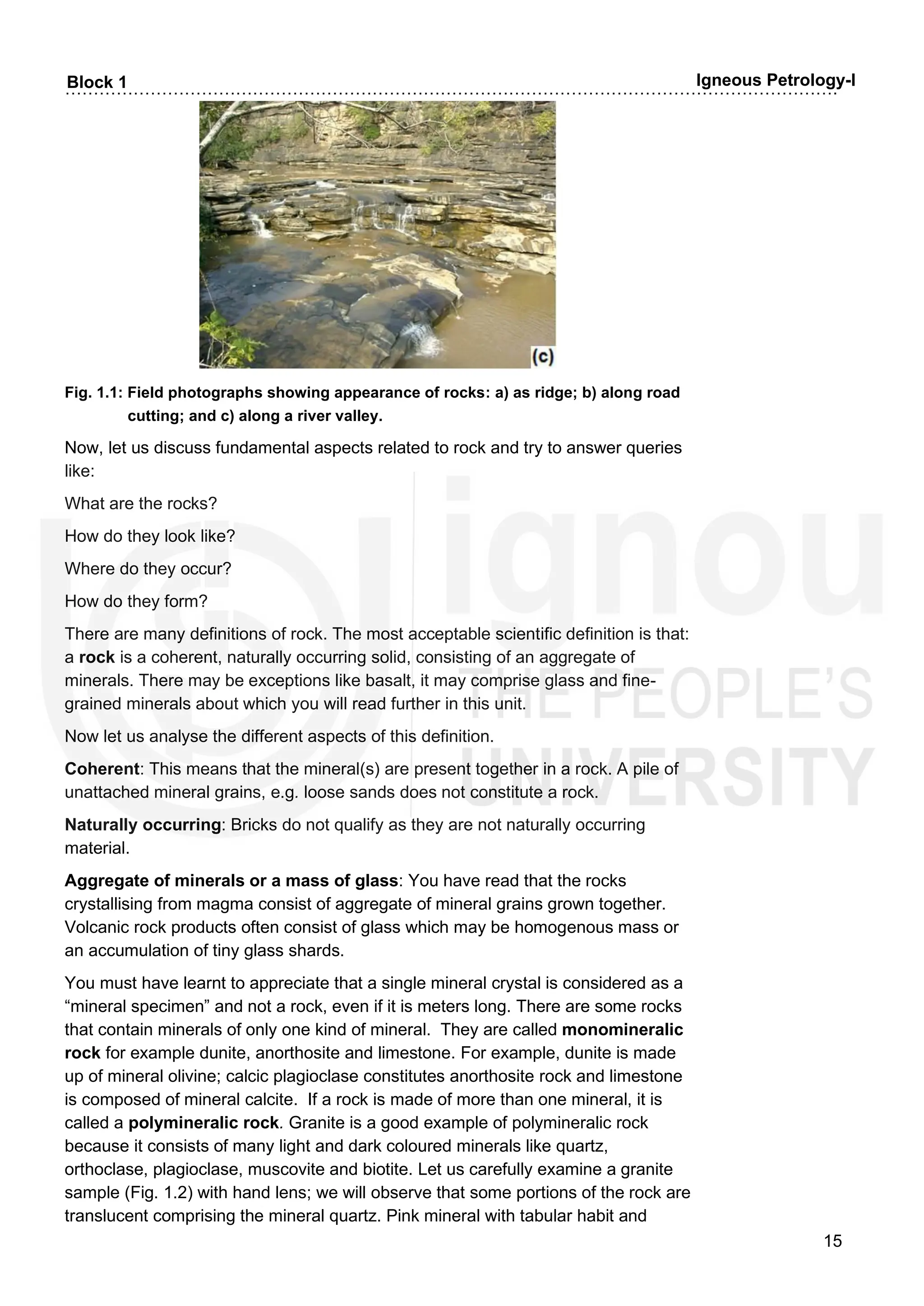
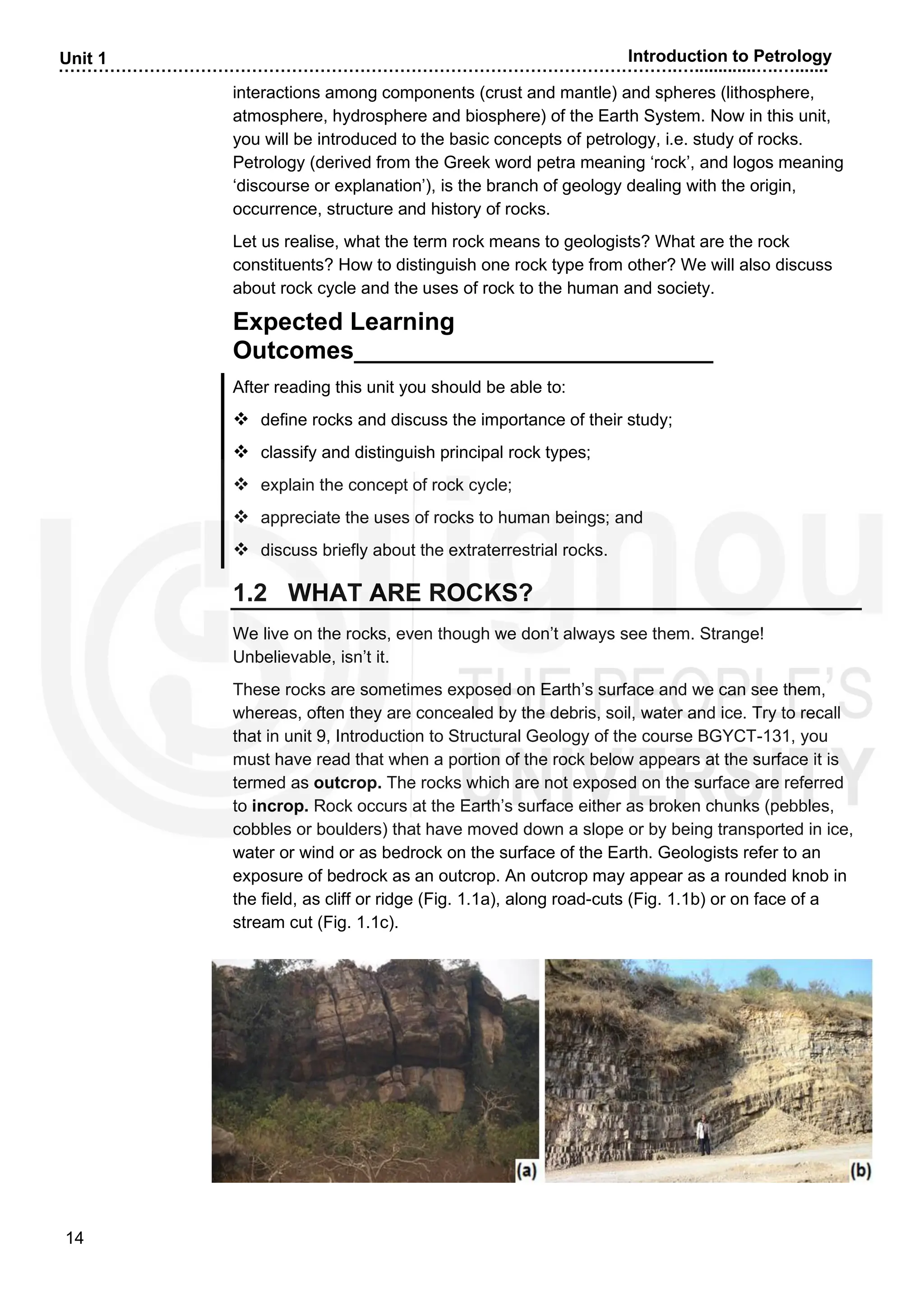
the field, as cliff or ridge (Fig. 1.1a), along road-cuts (Fig. 1.1b) or on face of a
stream cut (Fig. 1.1c).
……………………………………………………………………………………………………………………….
15
Block 1 Igneous Petrology-I
Fig. 1.1: Field photographs showing appearance of rocks: a) as ridge; b) along road
cutting; and c) along a river valley.
Now, let us discuss fundamental aspects related to rock and try to answer queries
like:
What are the rocks?
How do they look like?
Where do they occur?
How do they form?
There are many definitions of rock. The most acceptable scientific definition is that:
a rock is a coherent, naturally occurring solid, consisting of an aggregate of
minerals. There may be exceptions like basalt, it may comprise glass and fine-
grained minerals about which you will read further in this unit.
Now let us analyse the different aspects of this definition.
Coherent: This means that the mineral(s) are present together in a rock. A pile of
unattached mineral grains, e.g. loose sands does not constitute a rock.
Naturally occurring: Bricks do not qualify as they are not naturally occurring
material.
Aggregate of minerals or a mass of glass: You have read that the rocks
crystallising from magma consist of aggregate of mineral grains grown together.
Volcanic rock products often consist of glass which may be homogenous mass or
an accumulation of tiny glass shards.
You must have learnt to appreciate that a single mineral crystal is considered as a
“mineral specimen” and not a rock, even if it is meters long. There are some rocks
that contain minerals of only one kind of mineral. They are called monomineralic
rock for example dunite, anorthosite and limestone. For example, dunite is made
up of mineral olivine; calcic plagioclase constitutes anorthosite rock and limestone
is composed of mineral calcite. If a rock is made of more than one mineral, it is
called a polymineralic rock. Granite is a good example of polymineralic rock
because it consists of many light and dark coloured minerals like quartz,
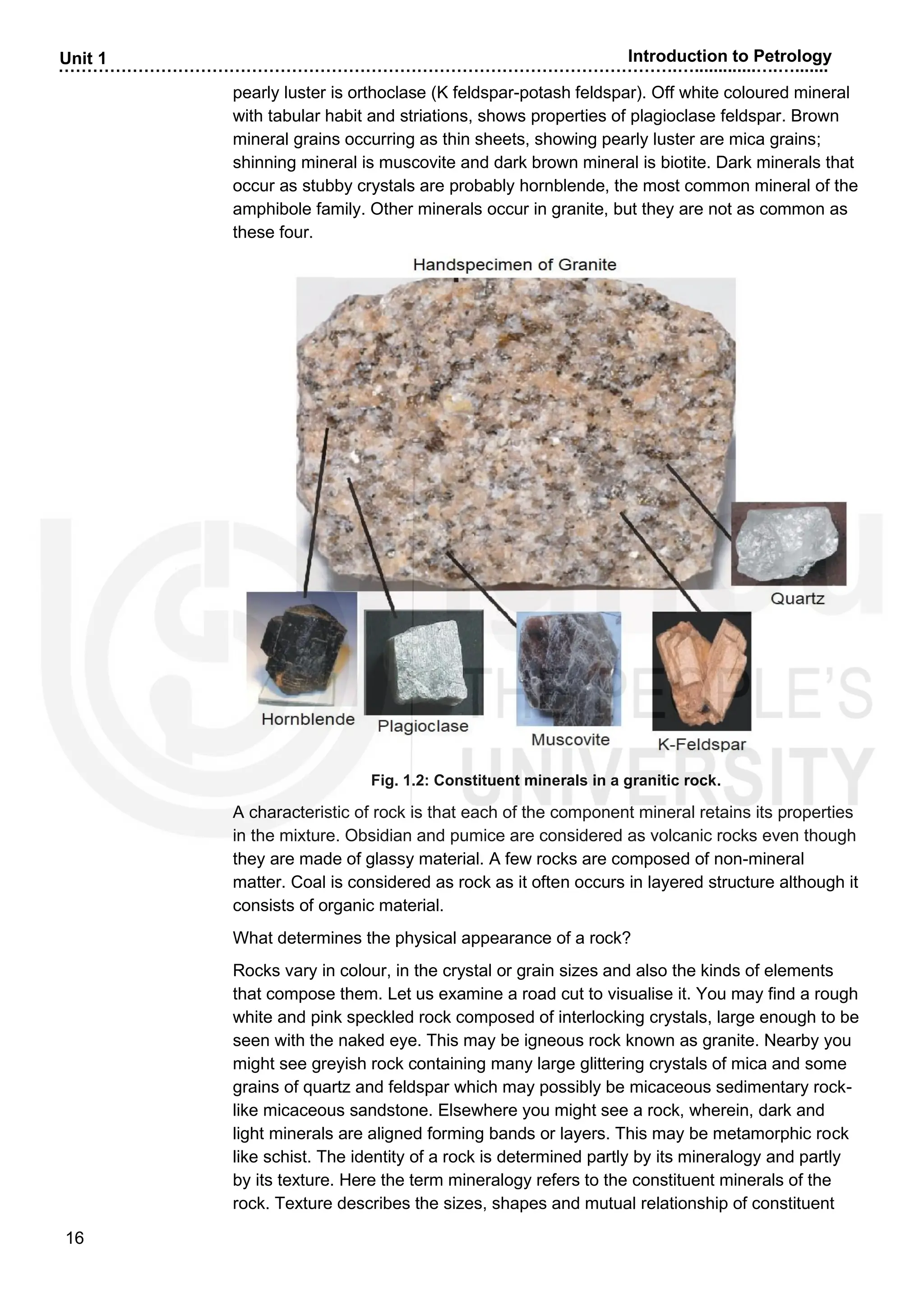
orthoclase, plagioclase, muscovite and biotite. Let us carefully examine a granite
sample (Fig. 1.2) with hand lens; we will observe that some portions of the rock are
translucent comprising the mineral quartz. Pink mineral with tabular habit and
……………………………………………………………………………………………….….............….….......
16
Unit 1 Introduction to Petrology
pearly luster is orthoclase (K feldspar-potash feldspar). Off white coloured mineral
with tabular habit and striations, shows properties of plagioclase feldspar. Brown
mineral grains occurring as thin sheets, showing pearly luster are mica grains;
shinning mineral is muscovite and dark brown mineral is biotite. Dark minerals that
occur as stubby crystals are probably hornblende, the most common mineral of the
amphibole family. Other minerals occur in granite, but they are not as common as
these four.
Fig. 1.2: Constituent minerals in a granitic rock.
A characteristic of rock is that each of the component mineral retains its properties
in the mixture. Obsidian and pumice are considered as volcanic rocks even though
they are made of glassy material. A few rocks are composed of non-mineral
matter. Coal is considered as rock as it often occurs in layered structure although it
consists of organic material.
What determines the physical appearance of a rock?
Rocks vary in colour, in the crystal or grain sizes and also the kinds of elements
that compose them. Let us examine a road cut to visualise it. You may find a rough
white and pink speckled rock composed of interlocking crystals, large enough to be
seen with the naked eye. This may be igneous rock known as granite. Nearby you
might see greyish rock containing many large glittering crystals of mica and some
grains of quartz and feldspar which may possibly be micaceous sedimentary rock-
like micaceous sandstone. Elsewhere you might see a rock, wherein, dark and
light minerals are aligned forming bands or layers. This may be metamorphic rock
like schist. The identity of a rock is determined partly by its mineralogy and partly
by its texture. Here the term mineralogy refers to the constituent minerals of the
rock. Texture describes the sizes, shapes and mutual relationship of constituent
……………………………………………………………………………………………………………………….
17
Block 1 Igneous Petrology-I
minerals. If in a rock most of the crystals or grains are a few millimetres in
dimension that is they are large enough to be seen with the unaided eyes, the rock
is categorised as coarse- grained. If they are not large enough to be seen, the rock
is categorised as fine- grained.
According to the estimation made by Clarke and Washington, the lithosphere
consists of 95% igneous rocks, 5% sedimentary rocks, including shale, sandstone
and limestone (the metamorphic rocks being the altered equivalent of one or other
of these rocks).
Now you must be curious to know about the origin of rock?
The discovery of the origin of rock was a century long struggle. Neptunists, led by
Abraham Gottlob Werner (1749–1817) believed that all rocks were derived by the
processes of chemical precipitation from ocean. Vulcanists (or plutonist)
championed by James Hutton (1726–1797) were of the belief that most rocks
initially formed were of igneous origin. Hutton used careful, observation to refute
Neptunists’ claims by demonstrating the presence of igneous rocks and showing
evidence of Earth’s internal heat. James Hutton, a Scottish gentleman farmer and
doctor, with many others fostered the idea of the genetic scheme of classification
of rocks. Modern geologists revere Hutton as the “Father of Geology”.
Rocks are classified into three major groups based on their origin;
• igneous rocks
• sedimentary rocks
• metamorphic rocks
Igneous rocks: Rocks solidified from molten or partly molten magma are called
igneous rocks. They are also referred primary rocks.
Sedimentary rocks: These rocks have resulted from the consolidation of loose
sediments derived by mechanical and chemical weathering. These rocks are also
termed as secondary rocks because they are derived from pre-existing rocks.
Sedimentary rocks can also form from the chemical precipitation from solution or
from an organic rock, consisting of secretions or remains of plants and animals at
a normal temperature and pressure.
Metamorphic rocks: A rock derived from pre-existing igneous, sedimentary or
metamorphic rocks when undergo mineralogical, chemical and/or structural
changes are called metamorphic rocks.
You will read more about these rocks and their interrelationship further in this unit
when we discuss the rock cycle.
1.3 WHY DO WE STUDY ROCKS?
You have studied that the rocks are aggregate of different minerals. In other
words, minerals are the building blocks of the rocks. Petrology is the branch of
geology that deals with the study of all the aspects of rocks. A petrologist studies
rocks, identifies minerals present and makes observations.
Why do the petrologists study rocks? Let us look for an answer to this question.
……………………………………………………………………………………………….….............….….......
18
Unit 1 Introduction to Petrology
Petrologists study rocks as they provide clues about Earth’s origin and historical
past because different rocks form under specific physico-chemical conditions.
Petrologists can also interpret how the Earth processes of the past might influence
the future. The processes that shaped and continue to shape, the Earth could be
understood by studying rocks, and minerals. The rocks form the landscape and
provide us with valuable mineral resources. Petrologists locate resources that
contain important metals, mineral deposits and plan the mining activities. They
also play an important role in exploration of oil and natural gas.
By now you must be questioning how the petrologists study rocks!
A petrologist studies the rocks by examining rock in an outcrop. They carefully
record observations of the outcrop in the field and then examine a broken fist sized
rock piece more closely with hand lens. Thereafter, its thin section is prepared and
examined under the petrological or polarising microscope. Recall you have been
introduced to the polarising microscope in Unit 8 of BGYCT-132. This microscope
helps in carrying out petrographic studies of the rocks. The branch of geology
dealing with the description and systematic classification of rocks by microscopic
examination of thin sections is known as petrography.
Let us discuss significance of petrography in geological studies that
• helps to understand the environmental conditions of rock formation;
• throws light on the mineralogical composition and interrelationship between
mineral grains;
• enables to determine the kinetics (energy of a body derived from its movement)
of their formation.
The petrography helps in mineral identification and provides the basic information
about the rocks. In the beginning of 1950s, sophisticated equipments became
available that enabled the petrologists to examine rocks on even finer scale.
Advanced research laboratories have instruments such as Electron Probe Micro
Analyser (EPMA), X-ray diffractometers (XRD) and mass spectrometers.
Geochemistry has proved to be indispensable tool for the petrologists. They make
use of geochemical data such as major oxides, trace elements, rare earth
elements and platinum group elements, stable and radiogenic isotopes.
Petrogenesis deals particularly with the origin and evolutionary history of igneous
rocks which depends on a thorough and systematic petrography and petrology.
Learners, you have learnt the fundamental concept of rocks. Before discussing
about the classification of rocks, spend few minutes to perform an exercise to
check your progress.
SAQ 1
a) Define rock.
b) Mention the three types of rocks.
c) Why do the petrologists study?
d) What is the significance of petrography?
……………………………………………………………………………………………………………………….
19
Block 1 Igneous Petrology-I
 Watch the following video to know more about uses of petrography.
• Igneous Textures, Processes and Pathways: An Overview
Link: https://www.youtube.com/watch?v=9NU3SL7HWF4
1.4 CLASSIFICATION OF ROCKS
Classification schemes help us to organise and appreciate significant aspects or
characteristics about the objects to be studied. They also help us recognise
similarities and differences among them. In the beginning of eighteenth century,
geologists struggled to develop a scientific way to classify rocks. By the end of the
eighteenth century, after much struggle, it became clear that different rocks were
formed under different conditions. Most geologists had accepted that the genetic
scheme of classifying rocks as an approach that we continue to use even today.
This approach became the foundation of the modern system of classification of
rocks. Using these approaches geologists recognised three major groups of rocks
(Table 1.1).
• Igneous rocks e.g. granite, basalt, dolerite
• Sedimentary rocks e.g. sandstone, shale, limestone
• Metamorphic rocks e.g. phyllite, quartzite, marble
Let us try to differentiate between the igneous, sedimentary and metamorphic rock.
Earlier you have learnt that igneous rocks form from cooling and consolidation of
the hot molten magma. Therefore, they mostly consist of crystals of minerals which
can be big or small and fit together like pieces of a jigsaw puzzle. However, there
are exceptions, such as pitchstone, obsidian and volcanic glass where the cooling
and consolidation is very fast. Igneous rocks do not contain fossils, but may
contain gas bubbles. Igneous rocks exhibit interlocking relationship between the
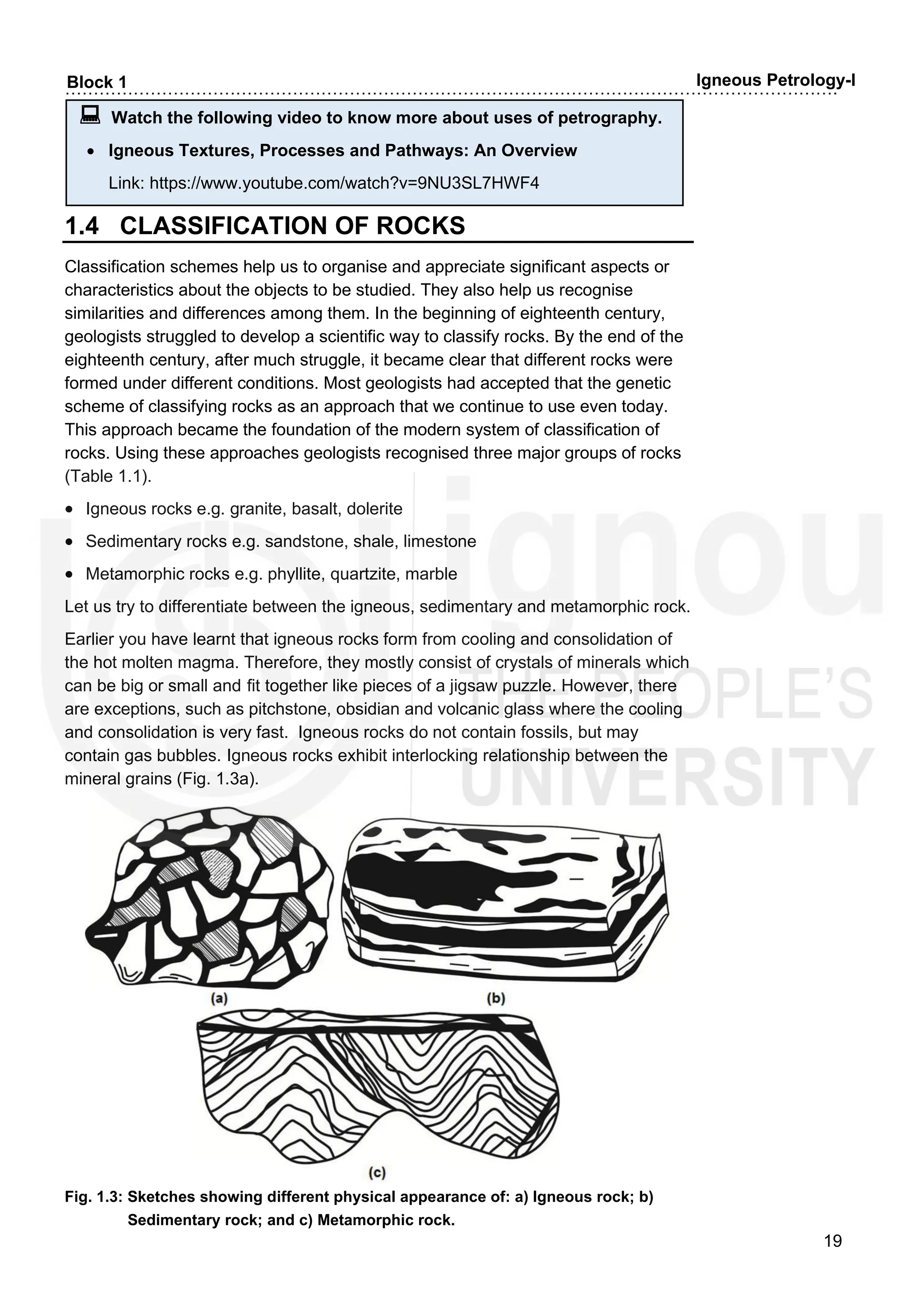
mineral grains (Fig. 1.3a).
Fig. 1.3: Sketches showing different physical appearance of: a) Igneous rock; b)
Sedimentary rock; and c) Metamorphic rock.
……………………………………………………………………………………………….….............….….......
20
Unit 1 Introduction to Petrology
Sedimentary rocks are made up of mineral grains or sediments that have resulted
from weathering and disintegration of the pre-existing rocks. The sediment grains
can be big or small; and angular or rounded. The grains are often cemented to
each other. Sedimentary rocks may be layered and may also contain fossils. The
hand specimen of sedimentary rock can also show layering (Fig. 1.3b).
Metamorphic rocks are formed when pre-existing rocks (may be igneous,
sedimentary or metamorphic) are subjected to heat and/or pressure. They show
evidences of recrystallisation resulting in the formation of bigger crystals, banding
of minerals or foliation (Fig. 1.3c).
Let us now summarise the general characteristics of igneous, sedimentary and
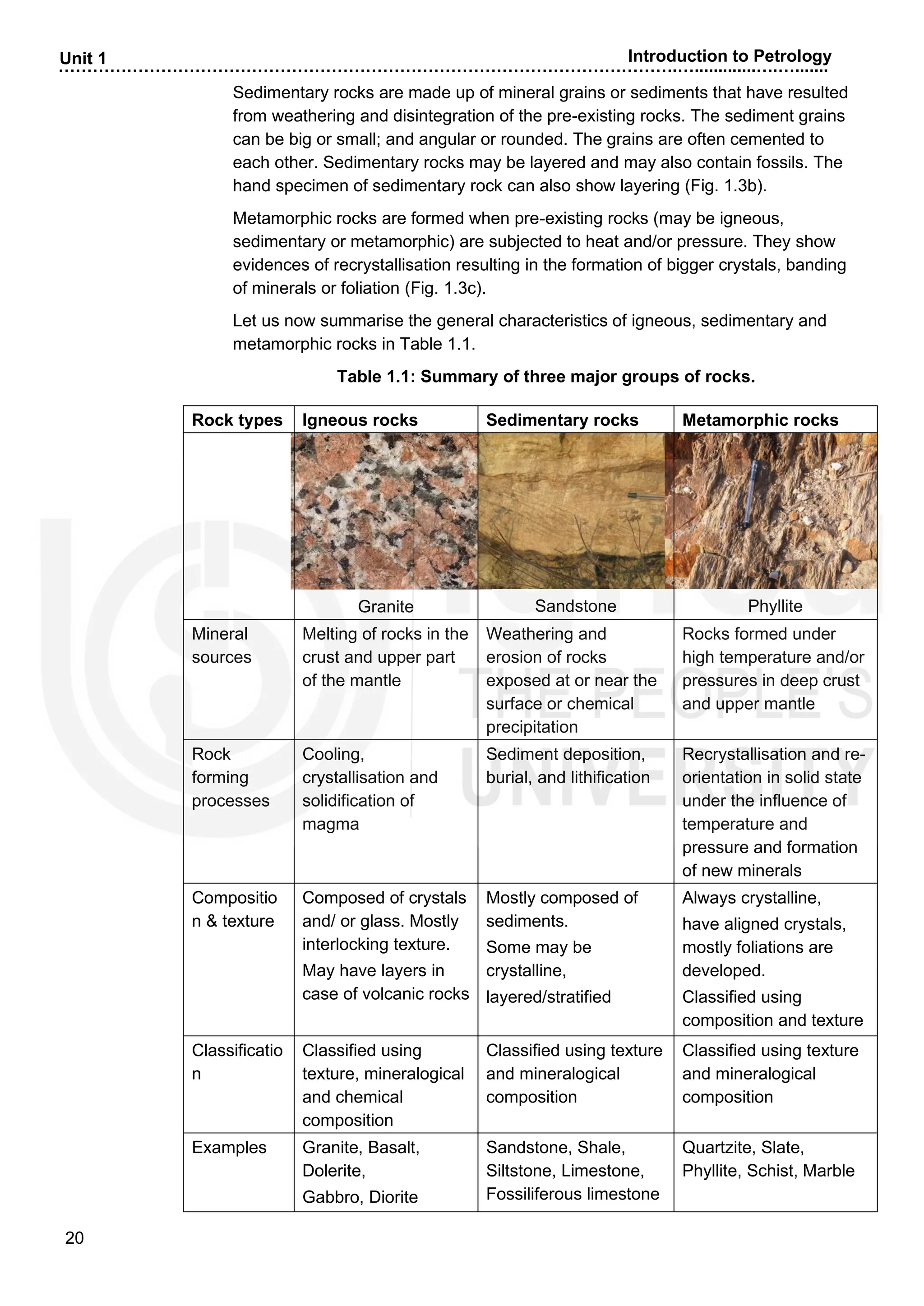
metamorphic rocks in Table 1.1.
Table 1.1: Summary of three major groups of rocks.
Rock types Igneous rocks Sedimentary rocks Metamorphic rocks
Granite Sandstone Phyllite
Mineral
sources
Melting of rocks in the
crust and upper part
of the mantle
Weathering and
erosion of rocks
exposed at or near the
surface or chemical
precipitation
Rocks formed under
high temperature and/or
pressures in deep crust
and upper mantle
Rock
forming
processes
Cooling,
crystallisation and
solidification of
magma
Sediment deposition,
burial, and lithification
Recrystallisation and re-
orientation in solid state
under the influence of
temperature and
pressure and formation
of new minerals
Compositio
n & texture
Composed of crystals
and/ or glass. Mostly
interlocking texture.
May have layers in
case of volcanic rocks
Mostly composed of
sediments.
Some may be
crystalline,
layered/stratified
Always crystalline,
have aligned crystals,
mostly foliations are
developed.
Classified using
composition and texture
Classificatio
n
Classified using
texture, mineralogical
and chemical
composition
Classified using texture
and mineralogical
composition
Classified using texture
and mineralogical
composition
Examples Granite, Basalt,
Dolerite,
Gabbro, Diorite
Sandstone, Shale,
Siltstone, Limestone,
Fossiliferous limestone
Quartzite, Slate,
Phyllite, Schist, Marble
……………………………………………………………………………………………………………………….
21
Block 1 Igneous Petrology-I
1.5 IGNEOUS ROCKS
About seven hundred types of igneous rocks are known today. Igneous petrology
is the field of geology. Its objective is to study the textural and mineralogical
characteristics of igneous rocks which are controlled by chemical and physical
properties of magmas and their surroundings. The igneous rocks dominate crustal
and upper mantle environments that provide understanding of melt generation and
crystallisation mechanisms, diverse rock types and their link to tectonic settings.
Study of igneous rocks is a key component of geology curriculum.
The word igneous is derived from the Latin word ignis, meaning ‘fire’ or ‘to ignite’.
Igneous rocks are formed due to cooling and crystallisation of hot molten material
called magma, which rises up from the mantle inside the Earth. The magma can
be derived from melting of pre-existing rocks in either crust or mantle. The cooling
of magma can take place either in deeper conditions or on the surface of the Earth.
The melting of rocks is caused by three processes like increase in temperature, a
decrease in pressure, or a change in composition. Depending upon the cooling
and crystallisation of magma that has taken place below or above the surface of
the Earth, igneous rocks may be grouped as intrusive or extrusive.
Intrusive igneous rocks: They are also known as plutonic igneous rocks.
These rocks crystallise when magma cools in the deeper conditions or magma
chamber or intrudes the country rocks or host rocks. When the cooling of
magma takes place below the surface of the Earth it is very slow. It has resulted in
the formation of large crystals, giving rise to coarse grained rocks recognised by
their interlocking crystals, visible in hand specimen, for example granite,
granodiorite, gabbro, and diorite.
Extrusive igneous rocks: They are known as volcanic igneous rocks. Hot or
partly molten rock material known as lava moves over the Earth's surface, where,
its cooling occurs very rapidly in the contact with air and water. If the overlying rock
has fractures, then the pressures may be released and a sizeable volume of
molten rock will extrude on the surface. The lava cools and crystallises rapidly, it is
fine grained or glassy. They may have air cavities, indicating that the volatile
material or gas escaped from the molten material on release of pressure. In case
of basalt, the open spaces or cavities called as vesicles that signifies top of the
lava flows. The term glassy is used for those igneous rocks which do not possess
discrete crystalline unit or structure. Extrusive igneous rocks, such as basalt,
rhyolite, trachyte, and pitchstone are easily recognised by their fine grained or
glassy texture.
Three types of igneous rocks based on their mode of occurrence have been
recognized:
Plutonic rocks: The term plutonic is derived from word Pluto ‘the Roman God’ of
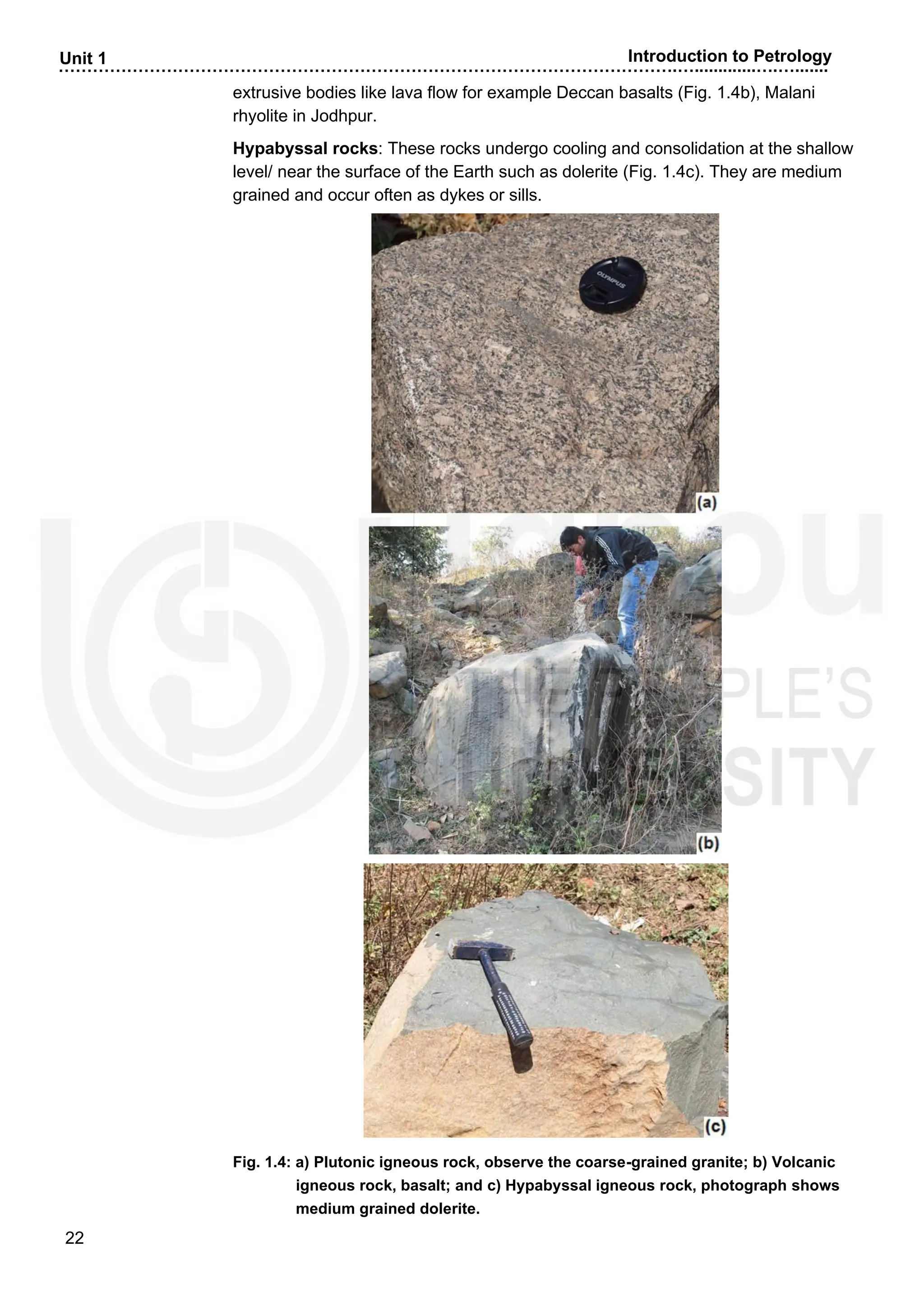
the underworld. These rocks undergo cooling and consolidation beneath (Fig.
1.4a) the surface of the Earth or within the magma chamber. Plutonic rocks occur
as intrusive bodies for example Mount Abu, Ladakh batholith.
Volcanic rocks: These rocks undergo cooling and consolidation at the surface of
the Earth in contact with air or water such as basalt, rhyolite. They occur as
……………………………………………………………………………………………….….............….….......
22
Unit 1 Introduction to Petrology
extrusive bodies like lava flow for example Deccan basalts (Fig. 1.4b), Malani
rhyolite in Jodhpur.
Hypabyssal rocks: These rocks undergo cooling and consolidation at the shallow
level/ near the surface of the Earth such as dolerite (Fig. 1.4c). They are medium
grained and occur often as dykes or sills.
Fig. 1.4: a) Plutonic igneous rock, observe the coarse-grained granite; b) Volcanic
igneous rock, basalt; and c) Hypabyssal igneous rock, photograph shows
medium grained dolerite.
……………………………………………………………………………………………………………………….
23
Block 1 Igneous Petrology-I
You have studied in units 6 and unit 7 of the course BGYCT-133 that most of the
minerals in the igneous rocks are silicates, partly because silicon is so abundant in
Earth’s crust and partly because many silicate minerals melt at the high
temperatures and pressures in deeper parts of the crust and in the mantle. The
most common silicate minerals found in igneous rocks include quartz, feldspar,
mica, pyroxene, amphibole and olivine.
1.6 SEDIMENTARY ROCKS
The layers of sedimentary rocks can be compared to the pages of book that record
stories of earlier events and environments of our geological past.
Sedimentologists are a specific group of geologists who study sedimentary rocks.
We have learnt that sedimentary rocks are formed due to the decomposition and
disintegration of the pre-existing rocks which can be igneous, metamorphic or even
earlier formed sedimentary rocks. These rocks are produced by the process of
weathering (physical, chemical and biological) by geological agents such as wind,
river, glaciers, oceans and groundwater. Therefore, they are categorised as
secondary rocks. The sedimentary rock is the rock that forms at or near the
surface of the Earth by processes:
• by cementing together of loose clasts (fragments or detrital grains) that had
been produced by physical or chemical weathering of pre-existing rock;
• by growth of shell masses or cementing together of shells and shell fragments;
• by accumulation and subsequent alteration of organic matter from living
organisms; or
• by precipitation of minerals from water solutions.
Sediments are the precursors of sedimentary rocks that are found at Earth’s
surface as layers of loose particles, such as sand, silt, and the shells of organisms.
These particles originate in the processes of weathering and erosion. The loose
grains of sediments transform into sedimentary rock by following five steps-
i) Weathering refers to the entire chemical, physical and biological processes that
break up and decay rocks into fragments and dissolved substances of various
sizes.
ii) Erosion refers to the combination of processes that separates rock or regolith
such as abrasion, plucking caused by moving air, water or ice.
iii) Transportation can occur by gravity, wind, water or ice. They can carry
sediments. The ability of a medium to carry sediment depends on its viscosity
and velocity.
iv) Deposition is the process by which sediments (a) settles out of transporting
medium due to decrease in velocity or (b) precipitate from a solution due to
saturation or change in temperature/pressure, the medium is no longer able to
carry sediments.
v) Lithification and diagenesis are the transformation of the loose sediment into
solid rock. Diagenesis is the process that occurs after deposition, but, prior to
lithification. In these processes the sediments accumulate in layers and are
……………………………………………………………………………………………….….............….….......
24
Unit 1 Introduction to Petrology
compressed under their own weight and/or what buries them and form a
hardened mass.
The sedimentary rocks may be classified into two groups based on their origin:
a) Clastic sedimentary rocks: They are also known as terrigenous rocks. They
comprise siliciclastic sediments which are made up of physically deposited
particles such as grains of quartz and feldspar derived from weathered pre-
existing rock. The term ‘clastic’ is derived from the Greek word klastos, meaning
‘broken’. These sediments are laid down by geological agents like water, wind
and ice. Common minerals in siliciclastics rocks are silicates because silicate
minerals predominate in the rocks that weather to form sedimentary particles
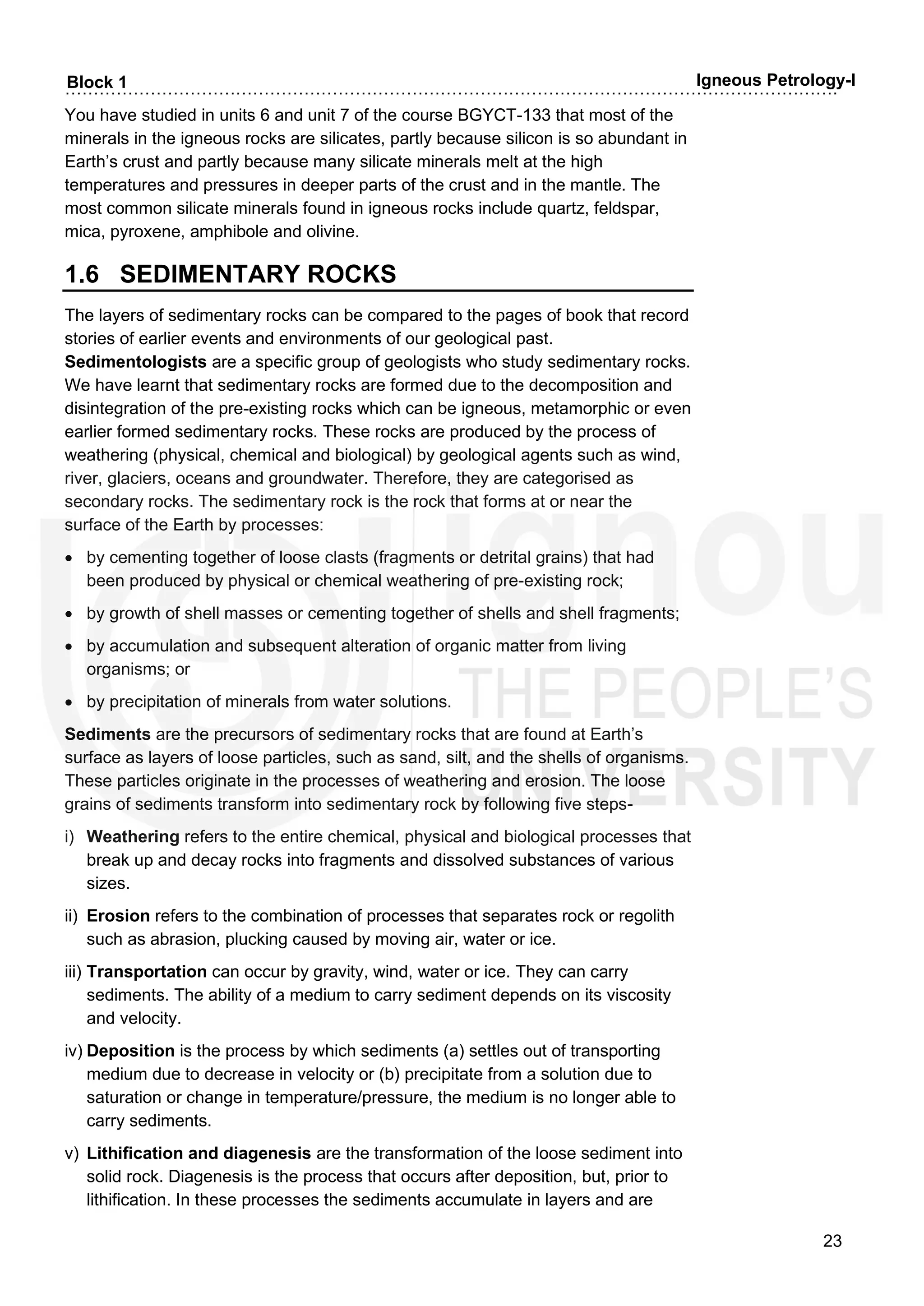
(Fig. 1.5a). The most abundant silicate minerals in siliciclastic sedimentary
rocks are quartz, feldspar and clay minerals. Clay minerals are formed by
weathering and alteration of pre-existing silicate minerals, such as feldspar,
micas, pyroxene and amphiboles.
b) Non clastic sedimentary rocks: They comprise the biological and chemical
group of sediments that are formed by the process of precipitation with or
without organic materials. For example, halite is chemical sediment that
precipitates directly from evaporating seawater. Calcite is precipitated by marine
organisms to form shells or skeletons which form biological sediments when the
organisms die. The most abundant minerals of chemical and biological
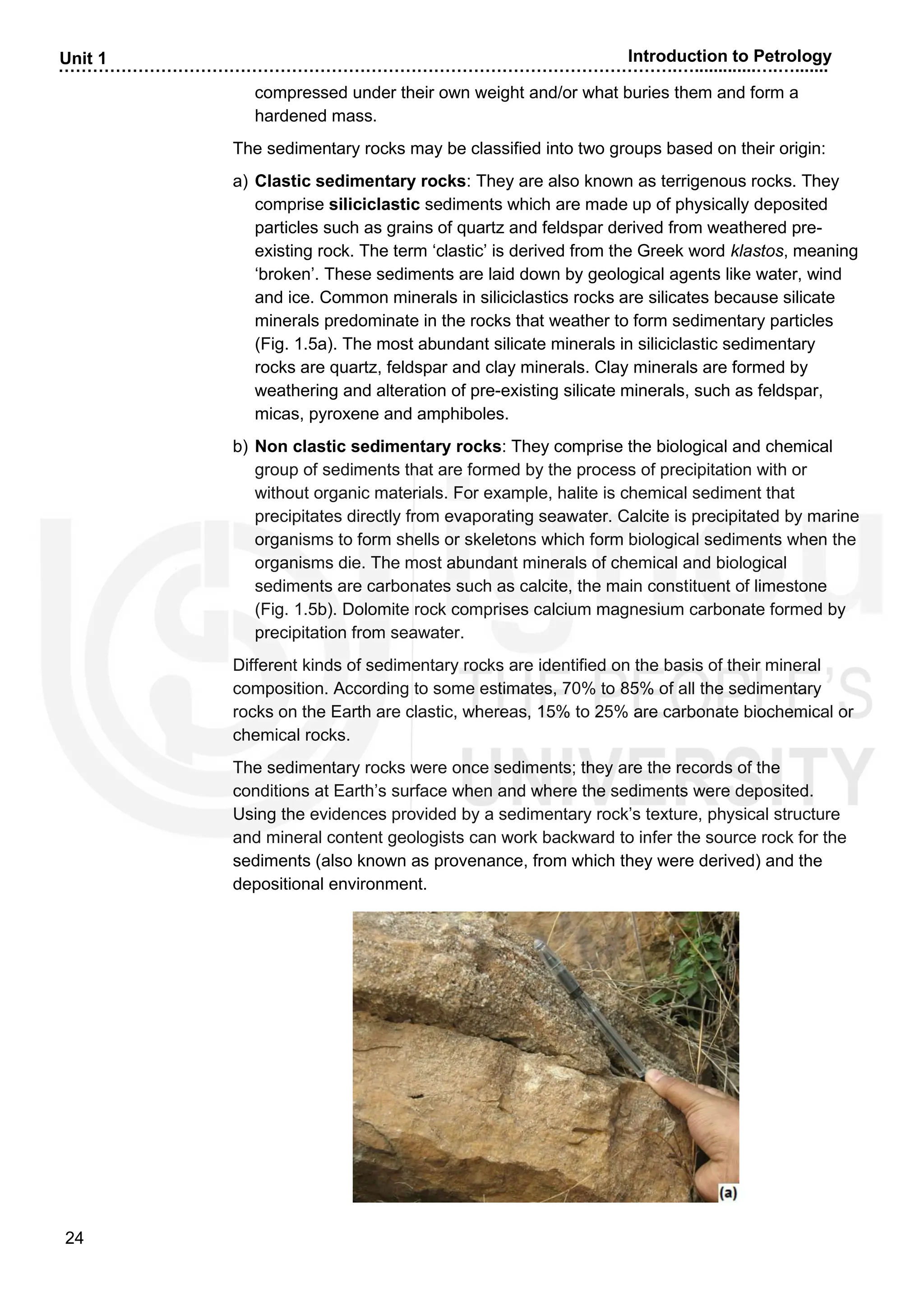
sediments are carbonates such as calcite, the main constituent of limestone
(Fig. 1.5b). Dolomite rock comprises calcium magnesium carbonate formed by
precipitation from seawater.
Different kinds of sedimentary rocks are identified on the basis of their mineral
composition. According to some estimates, 70% to 85% of all the sedimentary
rocks on the Earth are clastic, whereas, 15% to 25% are carbonate biochemical or
chemical rocks.
The sedimentary rocks were once sediments; they are the records of the
conditions at Earth’s surface when and where the sediments were deposited.
Using the evidences provided by a sedimentary rock’s texture, physical structure
and mineral content geologists can work backward to infer the source rock for the
sediments (also known as provenance, from which they were derived) and the
depositional environment.
……………………………………………………………………………………………………………………….
25
Block 1 Igneous Petrology-I
Fig. 1.5: a) Clastic sedimentary rock, coarse and medium grained sandstone; and b)
Non clastic sedimentary rock, limestone.
1.7 METAMORPHIC ROCKS
We have discussed igneous and sedimentary rocks now let us learn about
metamorphic rocks.
The term metamorphic derive its name from the Greek words meta meaning
‘change’ and morphe meaning ‘form’. Charles Lyell in 1833, first proposed the
word metamorphism in his book ‘Principles of Geology’.
A metamorphic rock forms when a pre-existing rock or protolith undergoes a
solid-state change (without melting) in response to elevated temperatures and
pressure in presence of a chemically active fluid. This may take thousands or
millions of years. Metamorphism is essentially an isochemical process, i.e. the
bulk chemical composition of a rock body is more or less unchanged from the
protolith, or original rock. This process is characterised by the growth of new
minerals from pre-existing minerals through recrystallisation and deformation of
existing minerals involving change in shape and orientation of mineral grains.
Let us discuss the causes of metamorphism.
• Heat: Increased heat allows chemical bonds to break easier.
• Pressure: Enhanced pressure causes minerals with ‘open’ lattices to collapse,
forming more dense crystals.
• Differential Stress: When forces are not equal in all directions, minerals may
deform and change shape.
• Hydrothermal Fluids: Apart from water, hydrothermal fluids are solutions that
chemically react with minerals.
To understand metamorphism, you can consider an analogy of a caterpillar and a
butterfly. Caterpillars undergo metamorphosis because of hormonal changes in
their bodies to form butterfly. Similarly, the rocks undergo metamorphism when
they are subjected to heat, pressure, compression and shear in presence of hot
chemically active fluid.
……………………………………………………………………………………………….….............….….......
26
Unit 1 Introduction to Petrology
So, we have learnt that the metamorphic rocks are formed when the pre-existing
rock (which can be igneous, sedimentary or metamorphic rock) is subjected to high
temperature and pressure deep within the Earth causing changes in the
mineralogy, texture or chemical composition while maintaining its solid form. The
temperatures of metamorphism are below the melting point of the rocks (about
700o
C), but, high enough (above 200o
C) for the rocks to be changed by
recrystallisation and chemical reactions. Metamorphism can produce a group of
minerals which together make up a metamorphic minerals assemblage. The
texture in metamorphic rocks is defined by the new or re-arrangement of mineral
grains. Commonly, the texture results in metamorphic foliation defined by the
parallel alignment of platy minerals (such as mica) and/or the presence of
alternating light coloured and dark coloured bands. For example, the
metamorphism of granite (a rock with randomly oriented crystals) can produce a
metamorphosed rock like schist showing parallel alignment of platy minerals or
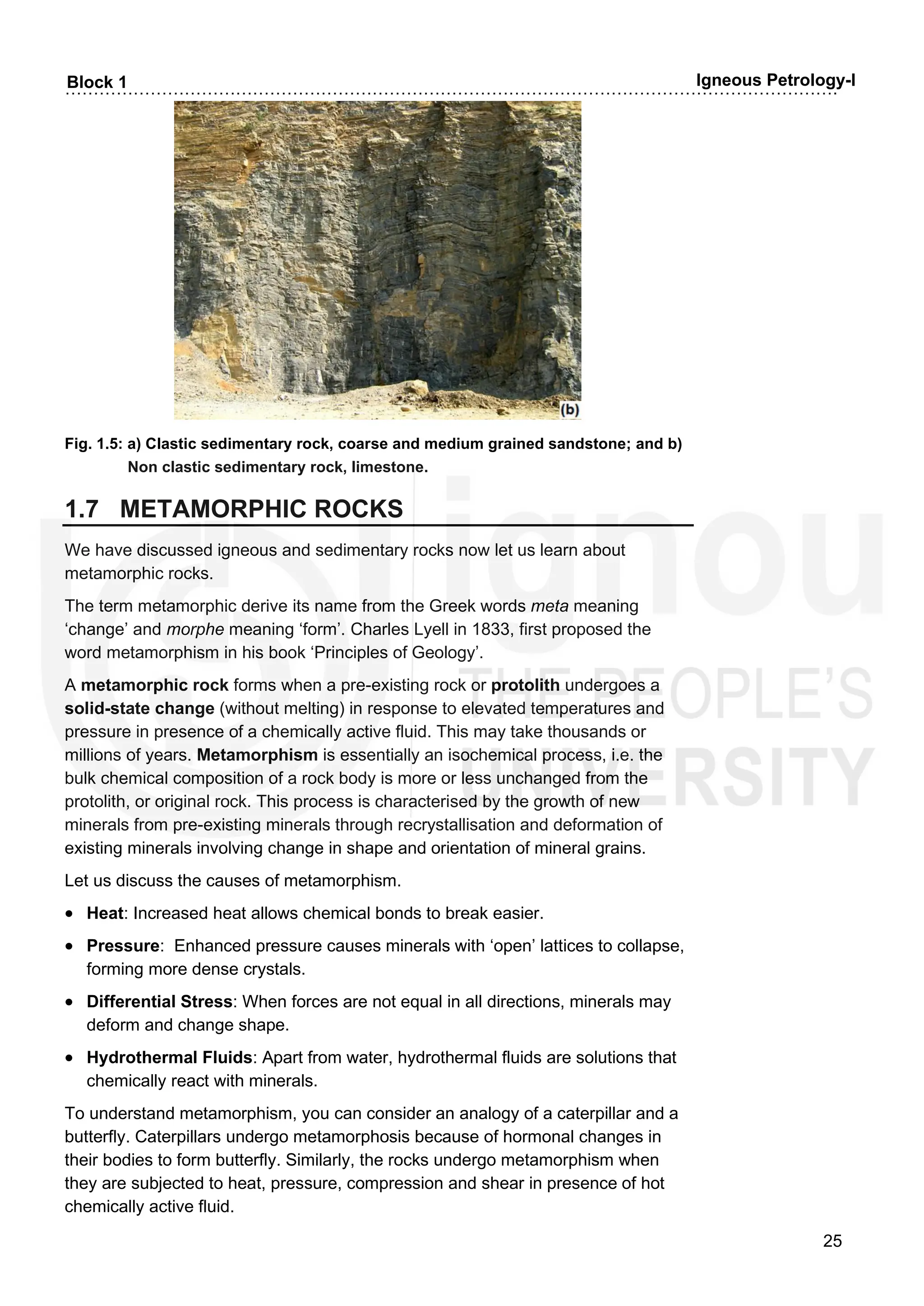
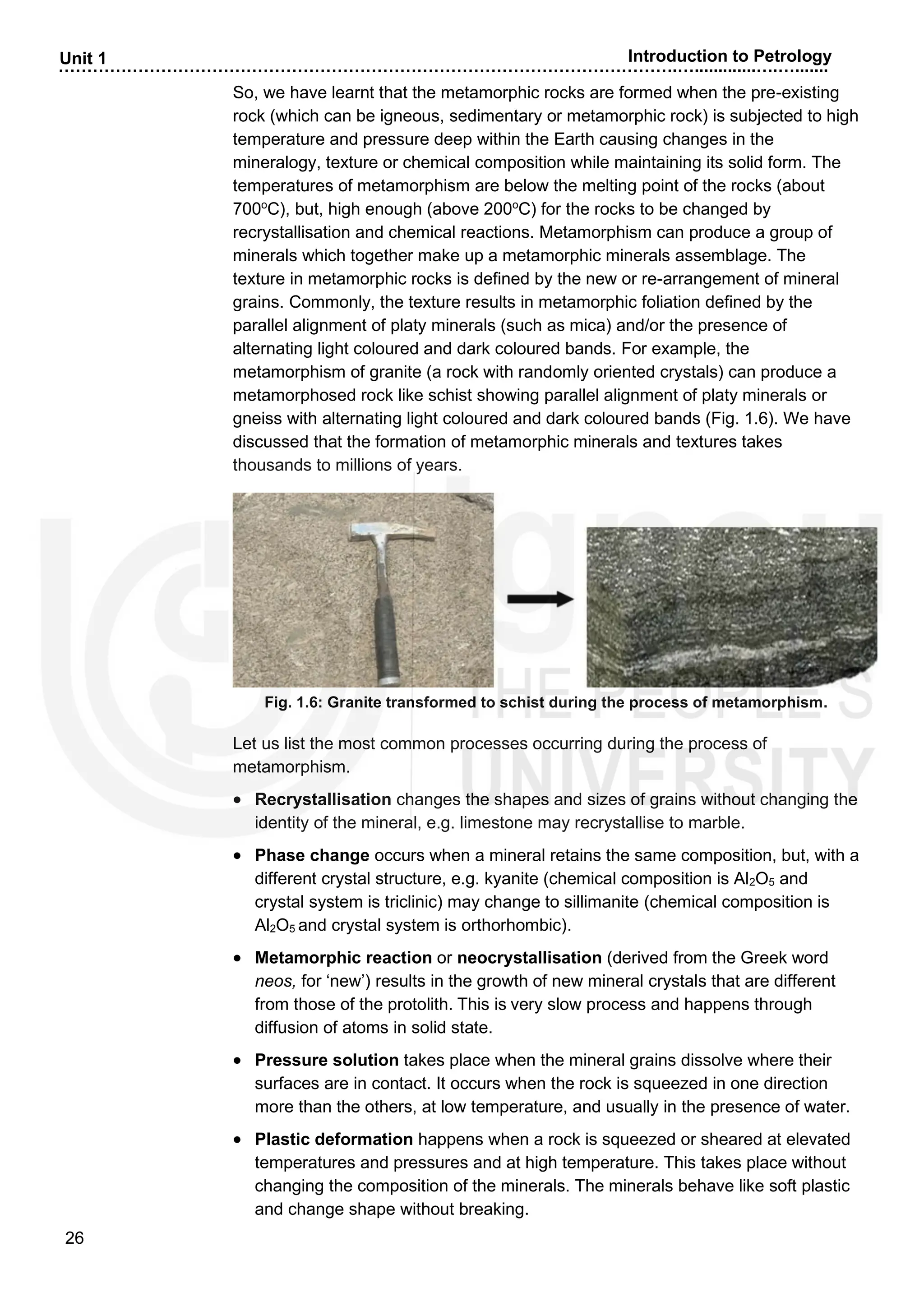
gneiss with alternating light coloured and dark coloured bands (Fig. 1.6). We have
discussed that the formation of metamorphic minerals and textures takes
thousands to millions of years.
Fig. 1.6: Granite transformed to schist during the process of metamorphism.
Let us list the most common processes occurring during the process of
metamorphism.
• Recrystallisation changes the shapes and sizes of grains without changing the
identity of the mineral, e.g. limestone may recrystallise to marble.
• Phase change occurs when a mineral retains the same composition, but, with a
different crystal structure, e.g. kyanite (chemical composition is Al2O5 and
crystal system is triclinic) may change to sillimanite (chemical composition is
Al2O5 and crystal system is orthorhombic).
• Metamorphic reaction or neocrystallisation (derived from the Greek word
neos, for ‘new’) results in the growth of new mineral crystals that are different
from those of the protolith. This is very slow process and happens through
diffusion of atoms in solid state.
• Pressure solution takes place when the mineral grains dissolve where their
surfaces are in contact. It occurs when the rock is squeezed in one direction
more than the others, at low temperature, and usually in the presence of water.
• Plastic deformation happens when a rock is squeezed or sheared at elevated
temperatures and pressures and at high temperature. This takes place without
changing the composition of the minerals. The minerals behave like soft plastic
and change shape without breaking.
……………………………………………………………………………………………………………………….
27
Block 1 Igneous Petrology-I
Common minerals found in the metamorphic rocks are silicate minerals like quartz,
feldspar, micas, pyroxenes and amphiboles. They are the most abundant minerals
in metamorphic rocks because most of the parent rocks (protolith) are rich in
silicate minerals. Several other minerals include kyanite, andalusite and some
varieties of garnet. Limestone composed of calcite mineral (CaCO3) is
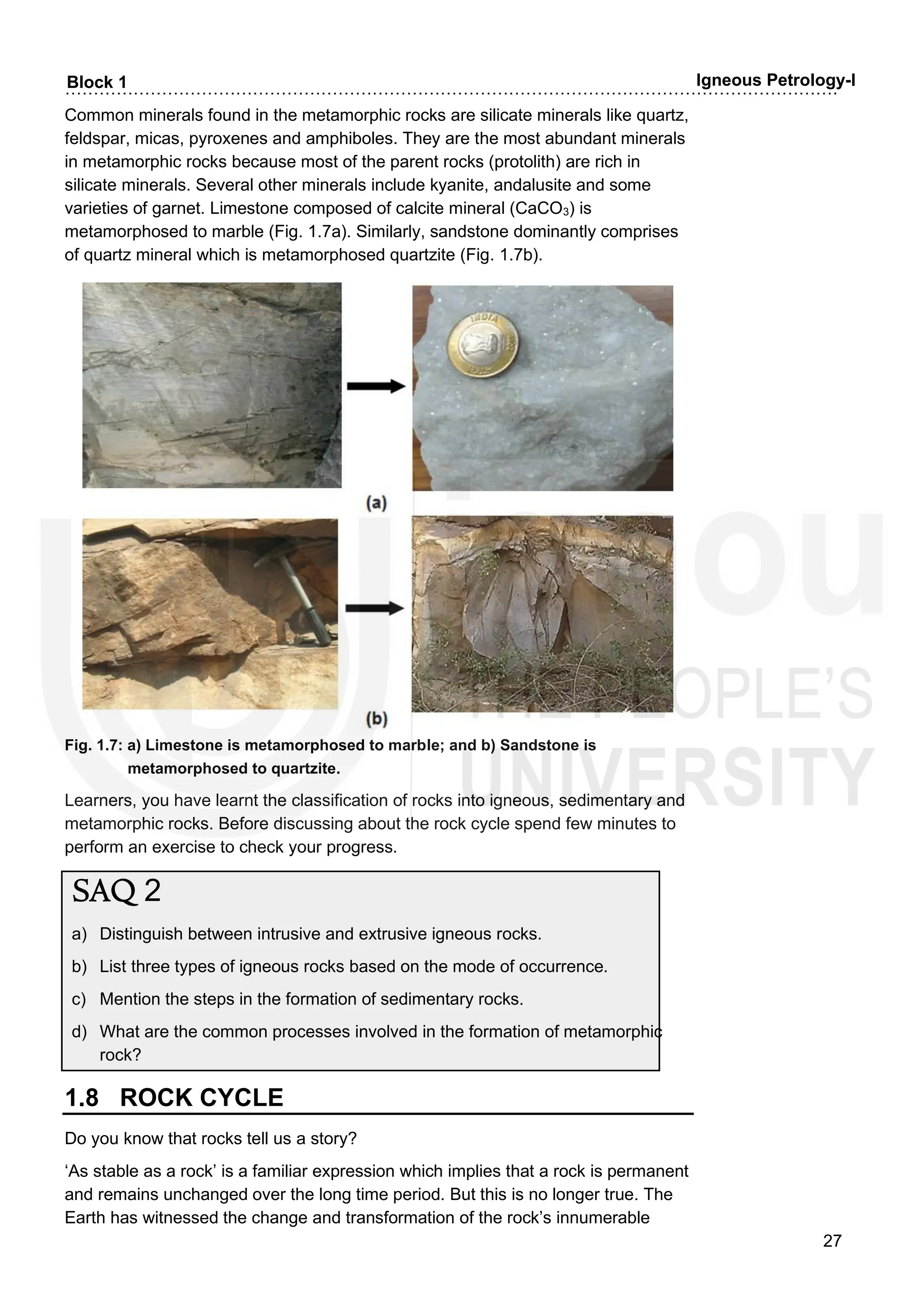
metamorphosed to marble (Fig. 1.7a). Similarly, sandstone dominantly comprises
of quartz mineral which is metamorphosed quartzite (Fig. 1.7b).
Fig. 1.7: a) Limestone is metamorphosed to marble; and b) Sandstone is
metamorphosed to quartzite.
Learners, you have learnt the classification of rocks into igneous, sedimentary and
metamorphic rocks. Before discussing about the rock cycle spend few minutes to
perform an exercise to check your progress.
SAQ 2
a) Distinguish between intrusive and extrusive igneous rocks.
b) List three types of igneous rocks based on the mode of occurrence.
c) Mention the steps in the formation of sedimentary rocks.
d) What are the common processes involved in the formation of metamorphic
rock?
1.8 ROCK CYCLE
Do you know that rocks tell us a story?
‘As stable as a rock’ is a familiar expression which implies that a rock is permanent
and remains unchanged over the long time period. But this is no longer true. The
Earth has witnessed the change and transformation of the rock’s innumerable
……………………………………………………………………………………………….….............….….......
28
Unit 1 Introduction to Petrology
times in the time span of 4.57 Ga in its history. The process is in continuum. We
just need to understand the language of rocks in order to decipher the narration of
the story.
Let us read the simplified story of the rocks on the Earth before learning about the
concept of rock cycle. Earth was originated from a ball of molten material during
the birth of the solar system. The molten material cooled, and solidified at the
surface, forming a shell of solid igneous rock. While the Earth’s crust was being
formed, volcanic activity, spewed gases and steam to create the first atmosphere
and oceans. Therefore, the first climate came into existence. The climatic
conditions generated on the surface of the planet worn down the igneous rock into
sediments. As the mountains wore down the eroded sediments were transported
and accumulated into the low-lying areas or depressions. The piles of sediment
stacked up to hundreds or thousands of feet. The intense weight of the sediments
began to coat the sediment grains as mineral cement. The combination of
compaction and cementation caused the sediments to bind together into solid
sedimentary rock in a process called lithification. The sedimentary rock, formed
at the bottom was driven deeper into the Earth under increasing pressure and
temperature. The minerals in the rock recrystallised, rearranged and formed
distorted structures forming new minerals giving rise to metamorphic rock. Even
though, a new rock has formed, the process of heating and pressurisation did not
stop. Eventually, the minerals reached their melting points and the rocks turned
into liquid magma. The return of the melted rock completes the cycle and the rocks
go on to become igneous again, then sedimentary and metamorphic rocks.
Hope you enjoyed reading this story the basic concept about the rock cycle.
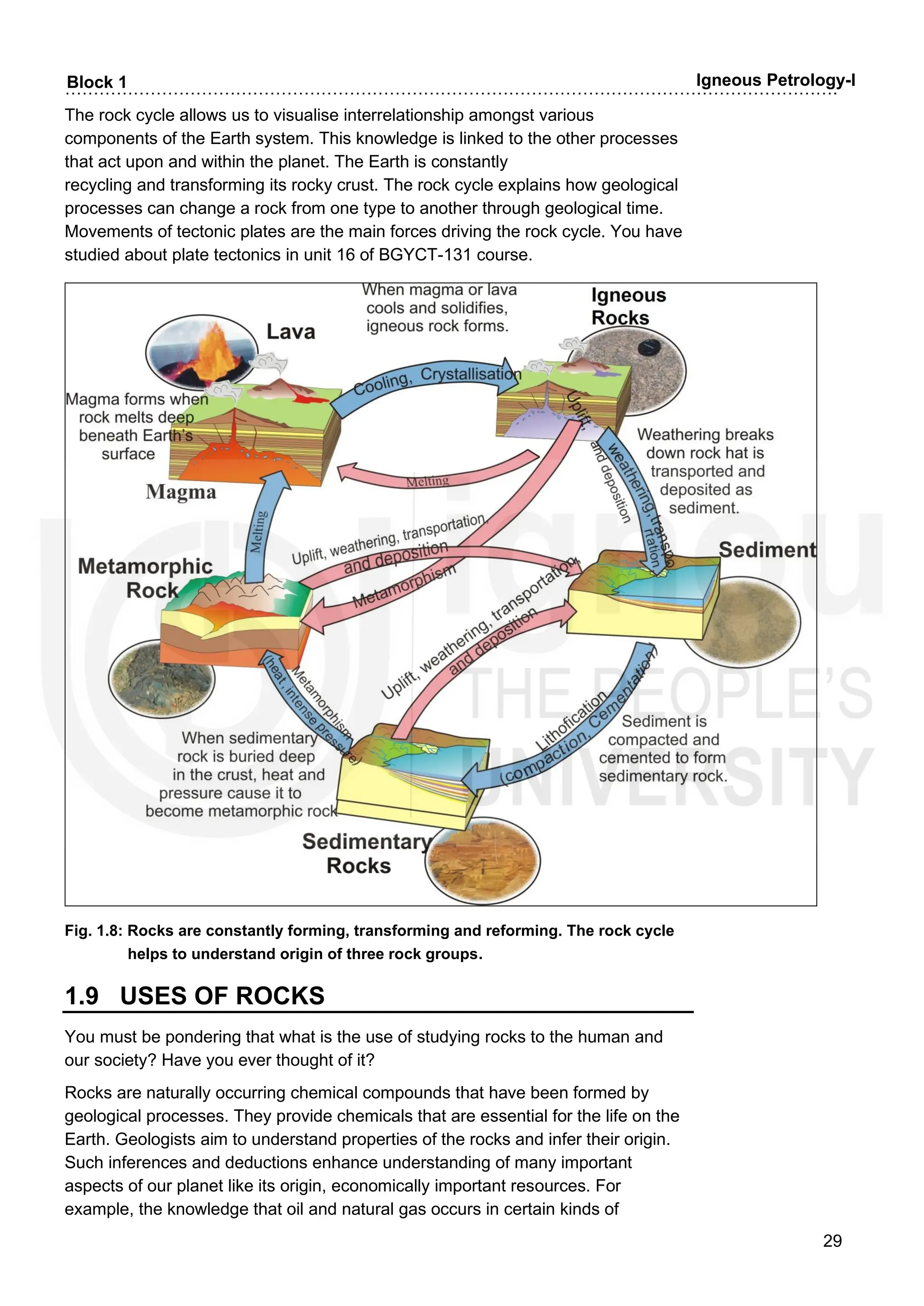
Now let us go through Fig. 1.8 and discuss rock cycle.
You have read that magma is molten fluid or material inside the Earth. It is the
source of all the igneous rocks. Since the Earth was largely molten during its
origin, magma may be considered as the beginning of the rock cycle. The
relationship between igneous, metamorphic and sedimentary rock
constitutes a rock cycle. Geologists consider rock cycle to have been operating
through ages; it is intimately involved with other cyclic processes of the Earth. This
is one of the basic concepts of geology and emerging out of as the principle of
uniformitarianism (the present is the key to the past) given by Hutton in 1785.
Rock cycle is particularly closely related to the plate tectonic processes. Basically,
the rock cycle is a continuous process. It starts with the cooling and consolidation
of mantle derived magmas which may erupt on the surface or confine below to
deeper level. The erosion of rocks exposed on the surface of the Earth produced
clastic materials which are transported to low lying depositional basins. The deeply
buried sediments in due course of time undergoes deformation and
metamorphism. The tectonic cycle leads to deformation, reconstitution, uplift and
accompanying erosion of fresh rocks so that the cycle continues. Thus, plate
tectonics is the driving force for rock cycle.
The rock cycle operation may be viewed as a function of energy changes or
redistribution of energy within the Earth systems. The rock cycle illustrates the role
of various geologic processes which act to transform one type into another.
……………………………………………………………………………………………………………………….
29
Block 1 Igneous Petrology-I
The rock cycle allows us to visualise interrelationship amongst various
components of the Earth system. This knowledge is linked to the other processes
that act upon and within the planet. The Earth is constantly
recycling and transforming its rocky crust. The rock cycle explains how geological
processes can change a rock from one type to another through geological time.
Movements of tectonic plates are the main forces driving the rock cycle. You have
studied about plate tectonics in unit 16 of BGYCT-131 course.
Fig. 1.8: Rocks are constantly forming, transforming and reforming. The rock cycle
helps to understand origin of three rock groups.
1.9 USES OF ROCKS
You must be pondering that what is the use of studying rocks to the human and
our society? Have you ever thought of it?
Rocks are naturally occurring chemical compounds that have been formed by
geological processes. They provide chemicals that are essential for the life on the
Earth. Geologists aim to understand properties of the rocks and infer their origin.
Such inferences and deductions enhance understanding of many important
aspects of our planet like its origin, economically important resources. For
example, the knowledge that oil and natural gas occurs in certain kinds of
……………………………………………………………………………………………….….............….….......
30
Unit 1 Introduction to Petrology
sedimentary rocks that are rich in organic matter allows us to explore for oil
reserves more intelligently. Understanding of the formation and properties of rocks
guides us in solving environmental problems, e.g. landslide. Geologists are
responsible to locate and assist in the extraction of mineral deposits such as gold,
metallic ores, coal, petroleum, building materials and economically useful clays.
They explore common, but vital materials such as stone aggregates for making
concrete and road building, limestone for the cement, fertilizer and chemical
industries, and sand for building or glass manufacture. The underground storage of
radioactive and other wastes depends on analysis of the rock to be used as a
repository. Human and our society depend on mineral resources. They are
essential for the development of our cities such as infrastructure, power
generation, transportation and communication. They enrich us in art, and we wear
them as personal adornments.
Let us discuss about the uses of rock to man and society.
• Ceramics, pottery, glass utensils: You must have used ceramics and pottery.
Ceramics are made up of mixtures of clay and earthen elements. Glasses are
made from silica sand, limestone, etc. The utensils are made from metals –
usually aluminum or steel or copper. We extract these metals from ores. Ore is
a mineral deposit from which valuable metals can be recovered profitably.
• Gemstones: They have been prized for thousands of years for their colour,
clarity, rarity, shape and durability. They are found in rocks and form in different
geological situations.
• Food industry: Minerals like sodium chloride (halite) and calcium carbonate
(calcite) and other mineral products used in preparation of food, bread, soups
and cereal, are powdered with these ingredients. Sand is used to filter water,
e.g. diatomite (silica mineral formed from fossilised algae). Diatomite and
bentonite clay both are used to purify drinks, such as beer, fruit juices and wine.
• Fertiliser industry: Phosphate rock, potash and lime are used in agricultural
fertilisers and some other mineral products to improve soil quality. A
sedimentary rock known as glauconitic sandstone is directly crushed and used
as fertilizer in agricultural fields.
• Packaging industry: Food, cold and energy drinks may be packaged in cans
made from aluminium or steel, or in glass made from silica sand which we get
from rocks. Plastic packaging is made from chemicals obtained from
hydrocarbons.
• Building materials: Have you ever thought from where do we get tonnes of
building material used in construction of roads and buildings? Rocks like
sandstones, quartzite, slate, etc. are used as building stones. These are locally
available material. Apart from these a wide range of materials such as iron used
in the framework of building, clay in bricks and roofing tiles, slate for roofing
tiles, limestone, clay, gypsum in cement, plaster of Paris, silica sand in window
glass, sand and gravel and crushed rock as aggregates are used in the
construction of buildings. The paints and pigments are derived from rock and
mineral sources. Granite is popularly used in buildings, bridges, paving, and
monuments and as polished granite slabs and tiles. For example, Red Fort in
……………………………………………………………………………………………………………………….
31
Block 1 Igneous Petrology-I
Delhi and Agra are made up of red sandstone while Taj Mahal in Agra is of
marble.
• Power generation: Energy used at home, industries, services and
transportation is derived from fuel minerals such as coal and petroleum. Coal is
used for domestic and industrial purposes such as thermal power houses for
generation of electricity. The geologists play a crucial role in exploration of
hydrocarbon reserves. We get many by-products from petroleum industry such
as plastic and many organic products. The nuclear power reactors use naturally
occurring radioactive materials such as uranium, thorium and potassium
associated with rocks.
• Transportation: Every journey you make depends on minerals (rocks are
aggregate of minerals), whether by car, train, plane, boat or foot. Aggregates
(crushed rock, sand and gravel) are used for roads and footpaths, while railway
tracks made from steel are laid on aggregate (known as ballast). Airports,
railway stations and shipping ports all use large amounts of construction
material to build their infrastructure.
• Information and computer technology: Many of us have access to a
computer and mobile phone, and many services depend on computers and
other forms of telecommunication. These technologies require a wide spectrum
of minerals and metals, including copper, gold, platinum, tantalum, tin, zinc and
nickel. Quartz crystals have unusual properties that are useful for high-tech
applications. For example, superconductors, lasers, molecular sieves and high-
temperature ceramics have been developed from natural crystals, which are
derived from rocks.
 Watch the following videos to learn more about uses of rocks.
• Geology Around Us-Part I
Link: http://egyankosh.ac.in//handle/123456789/63948
• Geology Around Us-Part II
Link: https://youtu.be/BtmJ8lOfxek
http://egyankosh.ac.in//handle/123456789/65950
1.10 INTRODUCTION TO EXTRATERRESTRIAL
ROCKS
We have discussed about the rocks found on our planet. Now, let us have an idea
about extraterrestrial rocks which generally referred to rock material found on the
Earth, but they were solidified prior to arriving on the Earth.
The extraterrestrial rocks include a vast range of material. They include:
a) Meteorites
b) Micrometeorites
c) Lunar samples brought to the Earth by Apollo missions
……………………………………………………………………………………………….….............….….......
32
Unit 1 Introduction to Petrology
a) Meteorites are the fragments of larger bodies called parent bodies which could
have been small planets or large asteroids or comets that were once part of
solar system. They can be classified generally into three types:
1. Stony meteorites are the most common type of meteorites. They resemble
the rocks found on and within the Earth. Stony meteorites are composed
mainly of the minerals like olivine and pyroxene having a composition that is
roughly equivalent to the Earth's mantle. They are of two types- chondrites
and achondrites.
• Chondrites are the most common type of stony meteorite. They are
made of olivine, pyroxene, and iron - nickel alloys that are magnetic in
nature. They are composed of small round spheres called chondrules.
They were possibly formed by rapid melting followed by rapid cooling
early in the history of the solar system. The chondrites have mostly
radiometric age dates of about 4.6 Ga.
• Achondrites are composed of the same minerals as chondrites, but they
lack chondrules and resemble igneous rocks found on the Earth. The
chondrules are absent because they have been heated, melted, and
recrystallised.
2. Iron meteorites are composed of alloys of iron and nickel. They have a
much higher density than normal crustal rocks. They are magnetic. When cut
and polished, iron meteorites show a distinct texture called a
Widmanstätten pattern which results from slow cooling of a very hot solid
material. Iron meteorites give us an idea of the composition of Earth's core.
3. Stony Iron meteorite consists of a mixture of stony silicate material and
iron. They exhibit silicates embedded in a matrix of iron-nickel alloy. They
also occur as a breccia, wherein the fragments of stony and iron material
have been cemented together either by heat or chemical reactions.
b) Micrometeorites are essentially un-melted micrometeoroid that has
survived entry through Earth's atmosphere. It ranges in size from 50 µm to
2 mm. They differ from meteorites in having a smaller size, more abundant, and
are different in composition. They include cosmic dust and
smaller interplanetary dust particles. Sometimes the meteoroids and
micrometeoroids entering the Earth's atmosphere are visible as meteors or
shooting stars.
c) Lunar samples brought to Earth by Apollo Missions: Six Apollo missions
between 1969 and 1972 brought back 382 kilograms of lunar rocks,
core samples, pebbles, sand and dust from the lunar surface. Study of rock and
soil samples from the Moon has yielded and will continue to provide useful
information about the early history of the Moon, the Earth and the inner solar
system.
1.11 SUMMARY
Let us summarise about what we have learnt in this unit:
• Rock is a coherent, naturally occurring solid, consisting of an aggregate of
minerals.
……………………………………………………………………………………………………………………….
33
Block 1 Igneous Petrology-I
• Geologists study rocks as they (i) contain clues about Earth’s historical aspect,
(ii) provide us with valuable resources, (iii) help to locate and produce oil,
natural gas, and ground water and building stones like granite, and (iv) discover
the mineral deposits.
• Rocks based on their mode of origin have been classified into three groups-
igneous, sedimentary and metamorphic.
• Igneous rock is a rock that solidified from the hot molten or partly molten
material called magma. Igneous rocks may be intrusive and extrusive
depending upon their placement below or above the surface. Based on their
mode of occurrence, they are grouped into: plutonic, volcanic and hypabyssal.
• Sedimentary rock is a rock resulting from the consolidation of loose sediment or
chemical precipitation from solution or an organic rock consisting of secretions
or remains of plants and animals. Sedimentary rock may be classified as (a)
mechanically formed clastic rocks, and (b) chemically formed nonclastic rocks.
• Metamorphic rock is a rock derived from recrystallisation of pre-existing rocks
by mineralogical, chemical or structural changes in response to temperature,
pressure and chemically active fluids at the depth of the Earth’s crust.
• Rock cycle is a continuous process closely related to the plate tectonics. Rock
cycle starts with cooling and consolidation of magma derived from the mantle,
which are subsequently exposed to atmospheric agencies to form sedimentary
rocks under normal temperature and pressure or metamorphic rocks under
increased temperature and/or pressure.
• The rocks are of manifold utility in every sphere of human life. Therefore, they
are used in industries like ceramics, pottery, glasses and utensils, gemstones,
food, fertilizer, packaging, building materials, power generation, transportation
and information and computer technology.
• The extraterrestrial rocks include a vast range of material like meteorites,
micrometeorites and lunar rocks brought to the Earth by Apollo missions.
1.12 ACTIVITY
1. Try to explore rocks around you and collect different types of rock and identify
them. Write their physical characters in a notebook.
2. Make a list of uses of rocks you see in your daily life.
1.13 TERMINAL QUESTIONS
1. Discuss the classification of rocks. Give suitable examples.
2. What is rock cycle? Mention its significance.
3. Discuss about uses of rocks to human beings.
4. What are the extraterrestrial rocks? Add a note on kinds of terrestrial rocks.
……………………………………………………………………………………………….….............….….......
34
Unit 1 Introduction to Petrology
Audio/Video Material-Based Questions:
• Why do you study textures in igneous rock?
• List few minerals and rocks used in the manufacture of glass and mirror.
• Name the rocks used as building stones.
• Mention about the rocks and minerals used in manufacture of computer.
• Write about the fossil fuels used in power generation.
1.14 REFERENCES
• Ehlers Ernest G. and Blatt, Harvey (1999) Petrology, Igneous, Sedimentary,
Metamorphic. CBS Publishers & Dist, New Delhi, ISBN: 9788123910321.
1.15 FURTHER/ SUGGESTED READINGS
• Mukherjee, P.K. (2000) A Text Book of Geology. The World Press, Kolkata,
ISBN: 81-87567-09-0, 638p.
• Singh, Parbin: Engineering and General Geology. S.K. Kataria and Sons. ISBN:
8188458511, 9788188458516, 600p.
• Tyrell, G. W. (1973) The principles of Petrology. John Wiley & Sons. ISBN
0470894806, 9780470894804, 349p.
1.16 ANSWERS
Self Assessment Questions
1. a) Rock is a coherent, naturally occurring solid, consisting of an aggregate of
minerals.
b) Rocks are classified into three groups, based on their origin- igneous,
sedimentary and metamorphic rocks.
c) Petrologists study rocks as they provide clues about the Earth’s origin and
geological past, unravel how the Earth processes of the past might
influence the future, provide us with valuable resources like metals, mineral
deposits, and explore non-renewable energy resources like coal, oil and
natural gas.
d) Petrography is significant in geological studies because it helps to
understand the environmental conditions of rock formation. It throws light
on the mineralogical composition and interrelationship between mineral
grains. It enables to discern the kinetics (energy of a body derived from its
movement) of their formation.
2. a) Intrusive igneous rocks are formed from magma at deeper level and are
known as intrusive or plutonic rocks. Intrusive igneous rocks crystallise
when magma cools in the magma chamber or intrudes the country rocks
below the Earth’s surface. They form when the magma erupts at the
Earth’s surface as lava and undergoes rapid cooling in the contact of air
and water.
……………………………………………………………………………………………………………………….
35
Block 1 Igneous Petrology-I
b) Plutonic, volcanic and hypabyssal.
c) The loose grains of sediment transform into sedimentary rock by following
five steps-weathering, erosion, transportation, deposition, lithification and
diagenesis.
d) Recrystallisation, phase change, plastic deformation, pressure solution,
metamorphic reaction or neocrystallisation.
Terminal Questions
1. Please refer section 1.4 and Table 1.1
2. Please refer section 1.8 and Fig. 1.8.
3. Please refer section 1.9.
4. Please refer section 1.10.
Introduction to petrology and how they are formed

  • 1.
    UNIT 1 INTRODUCTION TO PETROLOGY Structure______________________________________________ 1.1Introduction Expected Learning Outcomes 1.2 What are the Rocks? 1.3 Why Do We Study Rocks? 1.4 Classification of Rocks 1.5 Igneous Rocks 1.6 Sedimentary Rocks 1.7 Metamorphic Rocks 1.8 Rock Cycle 1.9 Uses of the Rocks 1.10 Introduction to Extraterrestrial Rocks 1.11 Summary 1.12 Activity 1.13 Terminal Questions 1.14 References 1.15 Further/Suggested Readings 1.16 Answers 1.1 INTRODUCTION Rocks have always been a matter of fascination for human beings. Stones were among the first tools and weapons used by humans. The rock caves provided shelter to the prehistoric man. He could ignite fire by rubbing pieces of rocks. Rocks have been and are being explored by human beings for extraction of minerals and metals. Later, metals became the basis of wealth and the foundation of empires. After having learnt megascopic and microscopic properties of minerals in the course BGYCT- 133, let us study about rocks. Rocks are the most common and abundant materials found on the Earth. On closer examination we observe that rock consists of smaller crystals or grains. Rock is defined as a naturally occurring solid aggregate of minerals. Its character and appearance depend on the nature and volume of the constituents mineral(s). They may occur in various colours and textures. They act as vehicles in all Earth processes such as volcanic eruptions, mountain building, weathering, erosion, and even earthquakes. The rocks provide a historical record of geologic events giving insight into
  • 2.
    ……………………………………………………………………………………………….….............….…....... 14 Unit 1 Introductionto Petrology interactions among components (crust and mantle) and spheres (lithosphere, atmosphere, hydrosphere and biosphere) of the Earth System. Now in this unit, you will be introduced to the basic concepts of petrology, i.e. study of rocks. Petrology (derived from the Greek word petra meaning ‘rock’, and logos meaning ‘discourse or explanation’), is the branch of geology dealing with the origin, occurrence, structure and history of rocks. Let us realise, what the term rock means to geologists? What are the rock constituents? How to distinguish one rock type from other? We will also discuss about rock cycle and the uses of rock to the human and society. Expected Learning Outcomes__________________________ After reading this unit you should be able to: ❖ define rocks and discuss the importance of their study; ❖ classify and distinguish principal rock types; ❖ explain the concept of rock cycle; ❖ appreciate the uses of rocks to human beings; and ❖ discuss briefly about the extraterrestrial rocks. 1.2 WHAT ARE ROCKS? We live on the rocks, even though we don’t always see them. Strange! Unbelievable, isn’t it. These rocks are sometimes exposed on Earth’s surface and we can see them, whereas, often they are concealed by the debris, soil, water and ice. Try to recall that in unit 9, Introduction to Structural Geology of the course BGYCT-131, you must have read that when a portion of the rock below appears at the surface it is termed as outcrop. The rocks which are not exposed on the surface are referred to incrop. Rock occurs at the Earth’s surface either as broken chunks (pebbles, cobbles or boulders) that have moved down a slope or by being transported in ice, water or wind or as bedrock on the surface of the Earth. Geologists refer to an exposure of bedrock as an outcrop. An outcrop may appear as a rounded knob in the field, as cliff or ridge (Fig. 1.1a), along road-cuts (Fig. 1.1b) or on face of a stream cut (Fig. 1.1c).
  • 3.
    ………………………………………………………………………………………………………………………. 15 Block 1 IgneousPetrology-I Fig. 1.1: Field photographs showing appearance of rocks: a) as ridge; b) along road cutting; and c) along a river valley. Now, let us discuss fundamental aspects related to rock and try to answer queries like: What are the rocks? How do they look like? Where do they occur? How do they form? There are many definitions of rock. The most acceptable scientific definition is that: a rock is a coherent, naturally occurring solid, consisting of an aggregate of minerals. There may be exceptions like basalt, it may comprise glass and fine- grained minerals about which you will read further in this unit. Now let us analyse the different aspects of this definition. Coherent: This means that the mineral(s) are present together in a rock. A pile of unattached mineral grains, e.g. loose sands does not constitute a rock. Naturally occurring: Bricks do not qualify as they are not naturally occurring material. Aggregate of minerals or a mass of glass: You have read that the rocks crystallising from magma consist of aggregate of mineral grains grown together. Volcanic rock products often consist of glass which may be homogenous mass or an accumulation of tiny glass shards. You must have learnt to appreciate that a single mineral crystal is considered as a “mineral specimen” and not a rock, even if it is meters long. There are some rocks that contain minerals of only one kind of mineral. They are called monomineralic rock for example dunite, anorthosite and limestone. For example, dunite is made up of mineral olivine; calcic plagioclase constitutes anorthosite rock and limestone is composed of mineral calcite. If a rock is made of more than one mineral, it is called a polymineralic rock. Granite is a good example of polymineralic rock because it consists of many light and dark coloured minerals like quartz, orthoclase, plagioclase, muscovite and biotite. Let us carefully examine a granite sample (Fig. 1.2) with hand lens; we will observe that some portions of the rock are translucent comprising the mineral quartz. Pink mineral with tabular habit and
  • 4.
    ……………………………………………………………………………………………….….............….…....... 16 Unit 1 Introductionto Petrology pearly luster is orthoclase (K feldspar-potash feldspar). Off white coloured mineral with tabular habit and striations, shows properties of plagioclase feldspar. Brown mineral grains occurring as thin sheets, showing pearly luster are mica grains; shinning mineral is muscovite and dark brown mineral is biotite. Dark minerals that occur as stubby crystals are probably hornblende, the most common mineral of the amphibole family. Other minerals occur in granite, but they are not as common as these four. Fig. 1.2: Constituent minerals in a granitic rock. A characteristic of rock is that each of the component mineral retains its properties in the mixture. Obsidian and pumice are considered as volcanic rocks even though they are made of glassy material. A few rocks are composed of non-mineral matter. Coal is considered as rock as it often occurs in layered structure although it consists of organic material. What determines the physical appearance of a rock? Rocks vary in colour, in the crystal or grain sizes and also the kinds of elements that compose them. Let us examine a road cut to visualise it. You may find a rough white and pink speckled rock composed of interlocking crystals, large enough to be seen with the naked eye. This may be igneous rock known as granite. Nearby you might see greyish rock containing many large glittering crystals of mica and some grains of quartz and feldspar which may possibly be micaceous sedimentary rock- like micaceous sandstone. Elsewhere you might see a rock, wherein, dark and light minerals are aligned forming bands or layers. This may be metamorphic rock like schist. The identity of a rock is determined partly by its mineralogy and partly by its texture. Here the term mineralogy refers to the constituent minerals of the rock. Texture describes the sizes, shapes and mutual relationship of constituent
  • 5.
    ………………………………………………………………………………………………………………………. 17 Block 1 IgneousPetrology-I minerals. If in a rock most of the crystals or grains are a few millimetres in dimension that is they are large enough to be seen with the unaided eyes, the rock is categorised as coarse- grained. If they are not large enough to be seen, the rock is categorised as fine- grained. According to the estimation made by Clarke and Washington, the lithosphere consists of 95% igneous rocks, 5% sedimentary rocks, including shale, sandstone and limestone (the metamorphic rocks being the altered equivalent of one or other of these rocks). Now you must be curious to know about the origin of rock? The discovery of the origin of rock was a century long struggle. Neptunists, led by Abraham Gottlob Werner (1749–1817) believed that all rocks were derived by the processes of chemical precipitation from ocean. Vulcanists (or plutonist) championed by James Hutton (1726–1797) were of the belief that most rocks initially formed were of igneous origin. Hutton used careful, observation to refute Neptunists’ claims by demonstrating the presence of igneous rocks and showing evidence of Earth’s internal heat. James Hutton, a Scottish gentleman farmer and doctor, with many others fostered the idea of the genetic scheme of classification of rocks. Modern geologists revere Hutton as the “Father of Geology”. Rocks are classified into three major groups based on their origin; • igneous rocks • sedimentary rocks • metamorphic rocks Igneous rocks: Rocks solidified from molten or partly molten magma are called igneous rocks. They are also referred primary rocks. Sedimentary rocks: These rocks have resulted from the consolidation of loose sediments derived by mechanical and chemical weathering. These rocks are also termed as secondary rocks because they are derived from pre-existing rocks. Sedimentary rocks can also form from the chemical precipitation from solution or from an organic rock, consisting of secretions or remains of plants and animals at a normal temperature and pressure. Metamorphic rocks: A rock derived from pre-existing igneous, sedimentary or metamorphic rocks when undergo mineralogical, chemical and/or structural changes are called metamorphic rocks. You will read more about these rocks and their interrelationship further in this unit when we discuss the rock cycle. 1.3 WHY DO WE STUDY ROCKS? You have studied that the rocks are aggregate of different minerals. In other words, minerals are the building blocks of the rocks. Petrology is the branch of geology that deals with the study of all the aspects of rocks. A petrologist studies rocks, identifies minerals present and makes observations. Why do the petrologists study rocks? Let us look for an answer to this question.
  • 6.
    ……………………………………………………………………………………………….….............….…....... 18 Unit 1 Introductionto Petrology Petrologists study rocks as they provide clues about Earth’s origin and historical past because different rocks form under specific physico-chemical conditions. Petrologists can also interpret how the Earth processes of the past might influence the future. The processes that shaped and continue to shape, the Earth could be understood by studying rocks, and minerals. The rocks form the landscape and provide us with valuable mineral resources. Petrologists locate resources that contain important metals, mineral deposits and plan the mining activities. They also play an important role in exploration of oil and natural gas. By now you must be questioning how the petrologists study rocks! A petrologist studies the rocks by examining rock in an outcrop. They carefully record observations of the outcrop in the field and then examine a broken fist sized rock piece more closely with hand lens. Thereafter, its thin section is prepared and examined under the petrological or polarising microscope. Recall you have been introduced to the polarising microscope in Unit 8 of BGYCT-132. This microscope helps in carrying out petrographic studies of the rocks. The branch of geology dealing with the description and systematic classification of rocks by microscopic examination of thin sections is known as petrography. Let us discuss significance of petrography in geological studies that • helps to understand the environmental conditions of rock formation; • throws light on the mineralogical composition and interrelationship between mineral grains; • enables to determine the kinetics (energy of a body derived from its movement) of their formation. The petrography helps in mineral identification and provides the basic information about the rocks. In the beginning of 1950s, sophisticated equipments became available that enabled the petrologists to examine rocks on even finer scale. Advanced research laboratories have instruments such as Electron Probe Micro Analyser (EPMA), X-ray diffractometers (XRD) and mass spectrometers. Geochemistry has proved to be indispensable tool for the petrologists. They make use of geochemical data such as major oxides, trace elements, rare earth elements and platinum group elements, stable and radiogenic isotopes. Petrogenesis deals particularly with the origin and evolutionary history of igneous rocks which depends on a thorough and systematic petrography and petrology. Learners, you have learnt the fundamental concept of rocks. Before discussing about the classification of rocks, spend few minutes to perform an exercise to check your progress. SAQ 1 a) Define rock. b) Mention the three types of rocks. c) Why do the petrologists study? d) What is the significance of petrography?
  • 7.
    ………………………………………………………………………………………………………………………. 19 Block 1 IgneousPetrology-I  Watch the following video to know more about uses of petrography. • Igneous Textures, Processes and Pathways: An Overview Link: https://www.youtube.com/watch?v=9NU3SL7HWF4 1.4 CLASSIFICATION OF ROCKS Classification schemes help us to organise and appreciate significant aspects or characteristics about the objects to be studied. They also help us recognise similarities and differences among them. In the beginning of eighteenth century, geologists struggled to develop a scientific way to classify rocks. By the end of the eighteenth century, after much struggle, it became clear that different rocks were formed under different conditions. Most geologists had accepted that the genetic scheme of classifying rocks as an approach that we continue to use even today. This approach became the foundation of the modern system of classification of rocks. Using these approaches geologists recognised three major groups of rocks (Table 1.1). • Igneous rocks e.g. granite, basalt, dolerite • Sedimentary rocks e.g. sandstone, shale, limestone • Metamorphic rocks e.g. phyllite, quartzite, marble Let us try to differentiate between the igneous, sedimentary and metamorphic rock. Earlier you have learnt that igneous rocks form from cooling and consolidation of the hot molten magma. Therefore, they mostly consist of crystals of minerals which can be big or small and fit together like pieces of a jigsaw puzzle. However, there are exceptions, such as pitchstone, obsidian and volcanic glass where the cooling and consolidation is very fast. Igneous rocks do not contain fossils, but may contain gas bubbles. Igneous rocks exhibit interlocking relationship between the mineral grains (Fig. 1.3a). Fig. 1.3: Sketches showing different physical appearance of: a) Igneous rock; b) Sedimentary rock; and c) Metamorphic rock.
  • 8.
    ……………………………………………………………………………………………….….............….…....... 20 Unit 1 Introductionto Petrology Sedimentary rocks are made up of mineral grains or sediments that have resulted from weathering and disintegration of the pre-existing rocks. The sediment grains can be big or small; and angular or rounded. The grains are often cemented to each other. Sedimentary rocks may be layered and may also contain fossils. The hand specimen of sedimentary rock can also show layering (Fig. 1.3b). Metamorphic rocks are formed when pre-existing rocks (may be igneous, sedimentary or metamorphic) are subjected to heat and/or pressure. They show evidences of recrystallisation resulting in the formation of bigger crystals, banding of minerals or foliation (Fig. 1.3c). Let us now summarise the general characteristics of igneous, sedimentary and metamorphic rocks in Table 1.1. Table 1.1: Summary of three major groups of rocks. Rock types Igneous rocks Sedimentary rocks Metamorphic rocks Granite Sandstone Phyllite Mineral sources Melting of rocks in the crust and upper part of the mantle Weathering and erosion of rocks exposed at or near the surface or chemical precipitation Rocks formed under high temperature and/or pressures in deep crust and upper mantle Rock forming processes Cooling, crystallisation and solidification of magma Sediment deposition, burial, and lithification Recrystallisation and re- orientation in solid state under the influence of temperature and pressure and formation of new minerals Compositio n & texture Composed of crystals and/ or glass. Mostly interlocking texture. May have layers in case of volcanic rocks Mostly composed of sediments. Some may be crystalline, layered/stratified Always crystalline, have aligned crystals, mostly foliations are developed. Classified using composition and texture Classificatio n Classified using texture, mineralogical and chemical composition Classified using texture and mineralogical composition Classified using texture and mineralogical composition Examples Granite, Basalt, Dolerite, Gabbro, Diorite Sandstone, Shale, Siltstone, Limestone, Fossiliferous limestone Quartzite, Slate, Phyllite, Schist, Marble
  • 9.
    ………………………………………………………………………………………………………………………. 21 Block 1 IgneousPetrology-I 1.5 IGNEOUS ROCKS About seven hundred types of igneous rocks are known today. Igneous petrology is the field of geology. Its objective is to study the textural and mineralogical characteristics of igneous rocks which are controlled by chemical and physical properties of magmas and their surroundings. The igneous rocks dominate crustal and upper mantle environments that provide understanding of melt generation and crystallisation mechanisms, diverse rock types and their link to tectonic settings. Study of igneous rocks is a key component of geology curriculum. The word igneous is derived from the Latin word ignis, meaning ‘fire’ or ‘to ignite’. Igneous rocks are formed due to cooling and crystallisation of hot molten material called magma, which rises up from the mantle inside the Earth. The magma can be derived from melting of pre-existing rocks in either crust or mantle. The cooling of magma can take place either in deeper conditions or on the surface of the Earth. The melting of rocks is caused by three processes like increase in temperature, a decrease in pressure, or a change in composition. Depending upon the cooling and crystallisation of magma that has taken place below or above the surface of the Earth, igneous rocks may be grouped as intrusive or extrusive. Intrusive igneous rocks: They are also known as plutonic igneous rocks. These rocks crystallise when magma cools in the deeper conditions or magma chamber or intrudes the country rocks or host rocks. When the cooling of magma takes place below the surface of the Earth it is very slow. It has resulted in the formation of large crystals, giving rise to coarse grained rocks recognised by their interlocking crystals, visible in hand specimen, for example granite, granodiorite, gabbro, and diorite. Extrusive igneous rocks: They are known as volcanic igneous rocks. Hot or partly molten rock material known as lava moves over the Earth's surface, where, its cooling occurs very rapidly in the contact with air and water. If the overlying rock has fractures, then the pressures may be released and a sizeable volume of molten rock will extrude on the surface. The lava cools and crystallises rapidly, it is fine grained or glassy. They may have air cavities, indicating that the volatile material or gas escaped from the molten material on release of pressure. In case of basalt, the open spaces or cavities called as vesicles that signifies top of the lava flows. The term glassy is used for those igneous rocks which do not possess discrete crystalline unit or structure. Extrusive igneous rocks, such as basalt, rhyolite, trachyte, and pitchstone are easily recognised by their fine grained or glassy texture. Three types of igneous rocks based on their mode of occurrence have been recognized: Plutonic rocks: The term plutonic is derived from word Pluto ‘the Roman God’ of the underworld. These rocks undergo cooling and consolidation beneath (Fig. 1.4a) the surface of the Earth or within the magma chamber. Plutonic rocks occur as intrusive bodies for example Mount Abu, Ladakh batholith. Volcanic rocks: These rocks undergo cooling and consolidation at the surface of the Earth in contact with air or water such as basalt, rhyolite. They occur as
  • 10.
    ……………………………………………………………………………………………….….............….…....... 22 Unit 1 Introductionto Petrology extrusive bodies like lava flow for example Deccan basalts (Fig. 1.4b), Malani rhyolite in Jodhpur. Hypabyssal rocks: These rocks undergo cooling and consolidation at the shallow level/ near the surface of the Earth such as dolerite (Fig. 1.4c). They are medium grained and occur often as dykes or sills. Fig. 1.4: a) Plutonic igneous rock, observe the coarse-grained granite; b) Volcanic igneous rock, basalt; and c) Hypabyssal igneous rock, photograph shows medium grained dolerite.
  • 11.
    ………………………………………………………………………………………………………………………. 23 Block 1 IgneousPetrology-I You have studied in units 6 and unit 7 of the course BGYCT-133 that most of the minerals in the igneous rocks are silicates, partly because silicon is so abundant in Earth’s crust and partly because many silicate minerals melt at the high temperatures and pressures in deeper parts of the crust and in the mantle. The most common silicate minerals found in igneous rocks include quartz, feldspar, mica, pyroxene, amphibole and olivine. 1.6 SEDIMENTARY ROCKS The layers of sedimentary rocks can be compared to the pages of book that record stories of earlier events and environments of our geological past. Sedimentologists are a specific group of geologists who study sedimentary rocks. We have learnt that sedimentary rocks are formed due to the decomposition and disintegration of the pre-existing rocks which can be igneous, metamorphic or even earlier formed sedimentary rocks. These rocks are produced by the process of weathering (physical, chemical and biological) by geological agents such as wind, river, glaciers, oceans and groundwater. Therefore, they are categorised as secondary rocks. The sedimentary rock is the rock that forms at or near the surface of the Earth by processes: • by cementing together of loose clasts (fragments or detrital grains) that had been produced by physical or chemical weathering of pre-existing rock; • by growth of shell masses or cementing together of shells and shell fragments; • by accumulation and subsequent alteration of organic matter from living organisms; or • by precipitation of minerals from water solutions. Sediments are the precursors of sedimentary rocks that are found at Earth’s surface as layers of loose particles, such as sand, silt, and the shells of organisms. These particles originate in the processes of weathering and erosion. The loose grains of sediments transform into sedimentary rock by following five steps- i) Weathering refers to the entire chemical, physical and biological processes that break up and decay rocks into fragments and dissolved substances of various sizes. ii) Erosion refers to the combination of processes that separates rock or regolith such as abrasion, plucking caused by moving air, water or ice. iii) Transportation can occur by gravity, wind, water or ice. They can carry sediments. The ability of a medium to carry sediment depends on its viscosity and velocity. iv) Deposition is the process by which sediments (a) settles out of transporting medium due to decrease in velocity or (b) precipitate from a solution due to saturation or change in temperature/pressure, the medium is no longer able to carry sediments. v) Lithification and diagenesis are the transformation of the loose sediment into solid rock. Diagenesis is the process that occurs after deposition, but, prior to lithification. In these processes the sediments accumulate in layers and are
  • 12.
    ……………………………………………………………………………………………….….............….…....... 24 Unit 1 Introductionto Petrology compressed under their own weight and/or what buries them and form a hardened mass. The sedimentary rocks may be classified into two groups based on their origin: a) Clastic sedimentary rocks: They are also known as terrigenous rocks. They comprise siliciclastic sediments which are made up of physically deposited particles such as grains of quartz and feldspar derived from weathered pre- existing rock. The term ‘clastic’ is derived from the Greek word klastos, meaning ‘broken’. These sediments are laid down by geological agents like water, wind and ice. Common minerals in siliciclastics rocks are silicates because silicate minerals predominate in the rocks that weather to form sedimentary particles (Fig. 1.5a). The most abundant silicate minerals in siliciclastic sedimentary rocks are quartz, feldspar and clay minerals. Clay minerals are formed by weathering and alteration of pre-existing silicate minerals, such as feldspar, micas, pyroxene and amphiboles. b) Non clastic sedimentary rocks: They comprise the biological and chemical group of sediments that are formed by the process of precipitation with or without organic materials. For example, halite is chemical sediment that precipitates directly from evaporating seawater. Calcite is precipitated by marine organisms to form shells or skeletons which form biological sediments when the organisms die. The most abundant minerals of chemical and biological sediments are carbonates such as calcite, the main constituent of limestone (Fig. 1.5b). Dolomite rock comprises calcium magnesium carbonate formed by precipitation from seawater. Different kinds of sedimentary rocks are identified on the basis of their mineral composition. According to some estimates, 70% to 85% of all the sedimentary rocks on the Earth are clastic, whereas, 15% to 25% are carbonate biochemical or chemical rocks. The sedimentary rocks were once sediments; they are the records of the conditions at Earth’s surface when and where the sediments were deposited. Using the evidences provided by a sedimentary rock’s texture, physical structure and mineral content geologists can work backward to infer the source rock for the sediments (also known as provenance, from which they were derived) and the depositional environment.
  • 13.
    ………………………………………………………………………………………………………………………. 25 Block 1 IgneousPetrology-I Fig. 1.5: a) Clastic sedimentary rock, coarse and medium grained sandstone; and b) Non clastic sedimentary rock, limestone. 1.7 METAMORPHIC ROCKS We have discussed igneous and sedimentary rocks now let us learn about metamorphic rocks. The term metamorphic derive its name from the Greek words meta meaning ‘change’ and morphe meaning ‘form’. Charles Lyell in 1833, first proposed the word metamorphism in his book ‘Principles of Geology’. A metamorphic rock forms when a pre-existing rock or protolith undergoes a solid-state change (without melting) in response to elevated temperatures and pressure in presence of a chemically active fluid. This may take thousands or millions of years. Metamorphism is essentially an isochemical process, i.e. the bulk chemical composition of a rock body is more or less unchanged from the protolith, or original rock. This process is characterised by the growth of new minerals from pre-existing minerals through recrystallisation and deformation of existing minerals involving change in shape and orientation of mineral grains. Let us discuss the causes of metamorphism. • Heat: Increased heat allows chemical bonds to break easier. • Pressure: Enhanced pressure causes minerals with ‘open’ lattices to collapse, forming more dense crystals. • Differential Stress: When forces are not equal in all directions, minerals may deform and change shape. • Hydrothermal Fluids: Apart from water, hydrothermal fluids are solutions that chemically react with minerals. To understand metamorphism, you can consider an analogy of a caterpillar and a butterfly. Caterpillars undergo metamorphosis because of hormonal changes in their bodies to form butterfly. Similarly, the rocks undergo metamorphism when they are subjected to heat, pressure, compression and shear in presence of hot chemically active fluid.
  • 14.
    ……………………………………………………………………………………………….….............….…....... 26 Unit 1 Introductionto Petrology So, we have learnt that the metamorphic rocks are formed when the pre-existing rock (which can be igneous, sedimentary or metamorphic rock) is subjected to high temperature and pressure deep within the Earth causing changes in the mineralogy, texture or chemical composition while maintaining its solid form. The temperatures of metamorphism are below the melting point of the rocks (about 700o C), but, high enough (above 200o C) for the rocks to be changed by recrystallisation and chemical reactions. Metamorphism can produce a group of minerals which together make up a metamorphic minerals assemblage. The texture in metamorphic rocks is defined by the new or re-arrangement of mineral grains. Commonly, the texture results in metamorphic foliation defined by the parallel alignment of platy minerals (such as mica) and/or the presence of alternating light coloured and dark coloured bands. For example, the metamorphism of granite (a rock with randomly oriented crystals) can produce a metamorphosed rock like schist showing parallel alignment of platy minerals or gneiss with alternating light coloured and dark coloured bands (Fig. 1.6). We have discussed that the formation of metamorphic minerals and textures takes thousands to millions of years. Fig. 1.6: Granite transformed to schist during the process of metamorphism. Let us list the most common processes occurring during the process of metamorphism. • Recrystallisation changes the shapes and sizes of grains without changing the identity of the mineral, e.g. limestone may recrystallise to marble. • Phase change occurs when a mineral retains the same composition, but, with a different crystal structure, e.g. kyanite (chemical composition is Al2O5 and crystal system is triclinic) may change to sillimanite (chemical composition is Al2O5 and crystal system is orthorhombic). • Metamorphic reaction or neocrystallisation (derived from the Greek word neos, for ‘new’) results in the growth of new mineral crystals that are different from those of the protolith. This is very slow process and happens through diffusion of atoms in solid state. • Pressure solution takes place when the mineral grains dissolve where their surfaces are in contact. It occurs when the rock is squeezed in one direction more than the others, at low temperature, and usually in the presence of water. • Plastic deformation happens when a rock is squeezed or sheared at elevated temperatures and pressures and at high temperature. This takes place without changing the composition of the minerals. The minerals behave like soft plastic and change shape without breaking.
  • 15.
    ………………………………………………………………………………………………………………………. 27 Block 1 IgneousPetrology-I Common minerals found in the metamorphic rocks are silicate minerals like quartz, feldspar, micas, pyroxenes and amphiboles. They are the most abundant minerals in metamorphic rocks because most of the parent rocks (protolith) are rich in silicate minerals. Several other minerals include kyanite, andalusite and some varieties of garnet. Limestone composed of calcite mineral (CaCO3) is metamorphosed to marble (Fig. 1.7a). Similarly, sandstone dominantly comprises of quartz mineral which is metamorphosed quartzite (Fig. 1.7b). Fig. 1.7: a) Limestone is metamorphosed to marble; and b) Sandstone is metamorphosed to quartzite. Learners, you have learnt the classification of rocks into igneous, sedimentary and metamorphic rocks. Before discussing about the rock cycle spend few minutes to perform an exercise to check your progress. SAQ 2 a) Distinguish between intrusive and extrusive igneous rocks. b) List three types of igneous rocks based on the mode of occurrence. c) Mention the steps in the formation of sedimentary rocks. d) What are the common processes involved in the formation of metamorphic rock? 1.8 ROCK CYCLE Do you know that rocks tell us a story? ‘As stable as a rock’ is a familiar expression which implies that a rock is permanent and remains unchanged over the long time period. But this is no longer true. The Earth has witnessed the change and transformation of the rock’s innumerable
  • 16.
    ……………………………………………………………………………………………….….............….…....... 28 Unit 1 Introductionto Petrology times in the time span of 4.57 Ga in its history. The process is in continuum. We just need to understand the language of rocks in order to decipher the narration of the story. Let us read the simplified story of the rocks on the Earth before learning about the concept of rock cycle. Earth was originated from a ball of molten material during the birth of the solar system. The molten material cooled, and solidified at the surface, forming a shell of solid igneous rock. While the Earth’s crust was being formed, volcanic activity, spewed gases and steam to create the first atmosphere and oceans. Therefore, the first climate came into existence. The climatic conditions generated on the surface of the planet worn down the igneous rock into sediments. As the mountains wore down the eroded sediments were transported and accumulated into the low-lying areas or depressions. The piles of sediment stacked up to hundreds or thousands of feet. The intense weight of the sediments began to coat the sediment grains as mineral cement. The combination of compaction and cementation caused the sediments to bind together into solid sedimentary rock in a process called lithification. The sedimentary rock, formed at the bottom was driven deeper into the Earth under increasing pressure and temperature. The minerals in the rock recrystallised, rearranged and formed distorted structures forming new minerals giving rise to metamorphic rock. Even though, a new rock has formed, the process of heating and pressurisation did not stop. Eventually, the minerals reached their melting points and the rocks turned into liquid magma. The return of the melted rock completes the cycle and the rocks go on to become igneous again, then sedimentary and metamorphic rocks. Hope you enjoyed reading this story the basic concept about the rock cycle. Now let us go through Fig. 1.8 and discuss rock cycle. You have read that magma is molten fluid or material inside the Earth. It is the source of all the igneous rocks. Since the Earth was largely molten during its origin, magma may be considered as the beginning of the rock cycle. The relationship between igneous, metamorphic and sedimentary rock constitutes a rock cycle. Geologists consider rock cycle to have been operating through ages; it is intimately involved with other cyclic processes of the Earth. This is one of the basic concepts of geology and emerging out of as the principle of uniformitarianism (the present is the key to the past) given by Hutton in 1785. Rock cycle is particularly closely related to the plate tectonic processes. Basically, the rock cycle is a continuous process. It starts with the cooling and consolidation of mantle derived magmas which may erupt on the surface or confine below to deeper level. The erosion of rocks exposed on the surface of the Earth produced clastic materials which are transported to low lying depositional basins. The deeply buried sediments in due course of time undergoes deformation and metamorphism. The tectonic cycle leads to deformation, reconstitution, uplift and accompanying erosion of fresh rocks so that the cycle continues. Thus, plate tectonics is the driving force for rock cycle. The rock cycle operation may be viewed as a function of energy changes or redistribution of energy within the Earth systems. The rock cycle illustrates the role of various geologic processes which act to transform one type into another.
  • 17.
    ………………………………………………………………………………………………………………………. 29 Block 1 IgneousPetrology-I The rock cycle allows us to visualise interrelationship amongst various components of the Earth system. This knowledge is linked to the other processes that act upon and within the planet. The Earth is constantly recycling and transforming its rocky crust. The rock cycle explains how geological processes can change a rock from one type to another through geological time. Movements of tectonic plates are the main forces driving the rock cycle. You have studied about plate tectonics in unit 16 of BGYCT-131 course. Fig. 1.8: Rocks are constantly forming, transforming and reforming. The rock cycle helps to understand origin of three rock groups. 1.9 USES OF ROCKS You must be pondering that what is the use of studying rocks to the human and our society? Have you ever thought of it? Rocks are naturally occurring chemical compounds that have been formed by geological processes. They provide chemicals that are essential for the life on the Earth. Geologists aim to understand properties of the rocks and infer their origin. Such inferences and deductions enhance understanding of many important aspects of our planet like its origin, economically important resources. For example, the knowledge that oil and natural gas occurs in certain kinds of
  • 18.
    ……………………………………………………………………………………………….….............….…....... 30 Unit 1 Introductionto Petrology sedimentary rocks that are rich in organic matter allows us to explore for oil reserves more intelligently. Understanding of the formation and properties of rocks guides us in solving environmental problems, e.g. landslide. Geologists are responsible to locate and assist in the extraction of mineral deposits such as gold, metallic ores, coal, petroleum, building materials and economically useful clays. They explore common, but vital materials such as stone aggregates for making concrete and road building, limestone for the cement, fertilizer and chemical industries, and sand for building or glass manufacture. The underground storage of radioactive and other wastes depends on analysis of the rock to be used as a repository. Human and our society depend on mineral resources. They are essential for the development of our cities such as infrastructure, power generation, transportation and communication. They enrich us in art, and we wear them as personal adornments. Let us discuss about the uses of rock to man and society. • Ceramics, pottery, glass utensils: You must have used ceramics and pottery. Ceramics are made up of mixtures of clay and earthen elements. Glasses are made from silica sand, limestone, etc. The utensils are made from metals – usually aluminum or steel or copper. We extract these metals from ores. Ore is a mineral deposit from which valuable metals can be recovered profitably. • Gemstones: They have been prized for thousands of years for their colour, clarity, rarity, shape and durability. They are found in rocks and form in different geological situations. • Food industry: Minerals like sodium chloride (halite) and calcium carbonate (calcite) and other mineral products used in preparation of food, bread, soups and cereal, are powdered with these ingredients. Sand is used to filter water, e.g. diatomite (silica mineral formed from fossilised algae). Diatomite and bentonite clay both are used to purify drinks, such as beer, fruit juices and wine. • Fertiliser industry: Phosphate rock, potash and lime are used in agricultural fertilisers and some other mineral products to improve soil quality. A sedimentary rock known as glauconitic sandstone is directly crushed and used as fertilizer in agricultural fields. • Packaging industry: Food, cold and energy drinks may be packaged in cans made from aluminium or steel, or in glass made from silica sand which we get from rocks. Plastic packaging is made from chemicals obtained from hydrocarbons. • Building materials: Have you ever thought from where do we get tonnes of building material used in construction of roads and buildings? Rocks like sandstones, quartzite, slate, etc. are used as building stones. These are locally available material. Apart from these a wide range of materials such as iron used in the framework of building, clay in bricks and roofing tiles, slate for roofing tiles, limestone, clay, gypsum in cement, plaster of Paris, silica sand in window glass, sand and gravel and crushed rock as aggregates are used in the construction of buildings. The paints and pigments are derived from rock and mineral sources. Granite is popularly used in buildings, bridges, paving, and monuments and as polished granite slabs and tiles. For example, Red Fort in
  • 19.
    ………………………………………………………………………………………………………………………. 31 Block 1 IgneousPetrology-I Delhi and Agra are made up of red sandstone while Taj Mahal in Agra is of marble. • Power generation: Energy used at home, industries, services and transportation is derived from fuel minerals such as coal and petroleum. Coal is used for domestic and industrial purposes such as thermal power houses for generation of electricity. The geologists play a crucial role in exploration of hydrocarbon reserves. We get many by-products from petroleum industry such as plastic and many organic products. The nuclear power reactors use naturally occurring radioactive materials such as uranium, thorium and potassium associated with rocks. • Transportation: Every journey you make depends on minerals (rocks are aggregate of minerals), whether by car, train, plane, boat or foot. Aggregates (crushed rock, sand and gravel) are used for roads and footpaths, while railway tracks made from steel are laid on aggregate (known as ballast). Airports, railway stations and shipping ports all use large amounts of construction material to build their infrastructure. • Information and computer technology: Many of us have access to a computer and mobile phone, and many services depend on computers and other forms of telecommunication. These technologies require a wide spectrum of minerals and metals, including copper, gold, platinum, tantalum, tin, zinc and nickel. Quartz crystals have unusual properties that are useful for high-tech applications. For example, superconductors, lasers, molecular sieves and high- temperature ceramics have been developed from natural crystals, which are derived from rocks.  Watch the following videos to learn more about uses of rocks. • Geology Around Us-Part I Link: http://egyankosh.ac.in//handle/123456789/63948 • Geology Around Us-Part II Link: https://youtu.be/BtmJ8lOfxek http://egyankosh.ac.in//handle/123456789/65950 1.10 INTRODUCTION TO EXTRATERRESTRIAL ROCKS We have discussed about the rocks found on our planet. Now, let us have an idea about extraterrestrial rocks which generally referred to rock material found on the Earth, but they were solidified prior to arriving on the Earth. The extraterrestrial rocks include a vast range of material. They include: a) Meteorites b) Micrometeorites c) Lunar samples brought to the Earth by Apollo missions
  • 20.
    ……………………………………………………………………………………………….….............….…....... 32 Unit 1 Introductionto Petrology a) Meteorites are the fragments of larger bodies called parent bodies which could have been small planets or large asteroids or comets that were once part of solar system. They can be classified generally into three types: 1. Stony meteorites are the most common type of meteorites. They resemble the rocks found on and within the Earth. Stony meteorites are composed mainly of the minerals like olivine and pyroxene having a composition that is roughly equivalent to the Earth's mantle. They are of two types- chondrites and achondrites. • Chondrites are the most common type of stony meteorite. They are made of olivine, pyroxene, and iron - nickel alloys that are magnetic in nature. They are composed of small round spheres called chondrules. They were possibly formed by rapid melting followed by rapid cooling early in the history of the solar system. The chondrites have mostly radiometric age dates of about 4.6 Ga. • Achondrites are composed of the same minerals as chondrites, but they lack chondrules and resemble igneous rocks found on the Earth. The chondrules are absent because they have been heated, melted, and recrystallised. 2. Iron meteorites are composed of alloys of iron and nickel. They have a much higher density than normal crustal rocks. They are magnetic. When cut and polished, iron meteorites show a distinct texture called a Widmanstätten pattern which results from slow cooling of a very hot solid material. Iron meteorites give us an idea of the composition of Earth's core. 3. Stony Iron meteorite consists of a mixture of stony silicate material and iron. They exhibit silicates embedded in a matrix of iron-nickel alloy. They also occur as a breccia, wherein the fragments of stony and iron material have been cemented together either by heat or chemical reactions. b) Micrometeorites are essentially un-melted micrometeoroid that has survived entry through Earth's atmosphere. It ranges in size from 50 µm to 2 mm. They differ from meteorites in having a smaller size, more abundant, and are different in composition. They include cosmic dust and smaller interplanetary dust particles. Sometimes the meteoroids and micrometeoroids entering the Earth's atmosphere are visible as meteors or shooting stars. c) Lunar samples brought to Earth by Apollo Missions: Six Apollo missions between 1969 and 1972 brought back 382 kilograms of lunar rocks, core samples, pebbles, sand and dust from the lunar surface. Study of rock and soil samples from the Moon has yielded and will continue to provide useful information about the early history of the Moon, the Earth and the inner solar system. 1.11 SUMMARY Let us summarise about what we have learnt in this unit: • Rock is a coherent, naturally occurring solid, consisting of an aggregate of minerals.
  • 21.
    ………………………………………………………………………………………………………………………. 33 Block 1 IgneousPetrology-I • Geologists study rocks as they (i) contain clues about Earth’s historical aspect, (ii) provide us with valuable resources, (iii) help to locate and produce oil, natural gas, and ground water and building stones like granite, and (iv) discover the mineral deposits. • Rocks based on their mode of origin have been classified into three groups- igneous, sedimentary and metamorphic. • Igneous rock is a rock that solidified from the hot molten or partly molten material called magma. Igneous rocks may be intrusive and extrusive depending upon their placement below or above the surface. Based on their mode of occurrence, they are grouped into: plutonic, volcanic and hypabyssal. • Sedimentary rock is a rock resulting from the consolidation of loose sediment or chemical precipitation from solution or an organic rock consisting of secretions or remains of plants and animals. Sedimentary rock may be classified as (a) mechanically formed clastic rocks, and (b) chemically formed nonclastic rocks. • Metamorphic rock is a rock derived from recrystallisation of pre-existing rocks by mineralogical, chemical or structural changes in response to temperature, pressure and chemically active fluids at the depth of the Earth’s crust. • Rock cycle is a continuous process closely related to the plate tectonics. Rock cycle starts with cooling and consolidation of magma derived from the mantle, which are subsequently exposed to atmospheric agencies to form sedimentary rocks under normal temperature and pressure or metamorphic rocks under increased temperature and/or pressure. • The rocks are of manifold utility in every sphere of human life. Therefore, they are used in industries like ceramics, pottery, glasses and utensils, gemstones, food, fertilizer, packaging, building materials, power generation, transportation and information and computer technology. • The extraterrestrial rocks include a vast range of material like meteorites, micrometeorites and lunar rocks brought to the Earth by Apollo missions. 1.12 ACTIVITY 1. Try to explore rocks around you and collect different types of rock and identify them. Write their physical characters in a notebook. 2. Make a list of uses of rocks you see in your daily life. 1.13 TERMINAL QUESTIONS 1. Discuss the classification of rocks. Give suitable examples. 2. What is rock cycle? Mention its significance. 3. Discuss about uses of rocks to human beings. 4. What are the extraterrestrial rocks? Add a note on kinds of terrestrial rocks.
  • 22.
    ……………………………………………………………………………………………….….............….…....... 34 Unit 1 Introductionto Petrology Audio/Video Material-Based Questions: • Why do you study textures in igneous rock? • List few minerals and rocks used in the manufacture of glass and mirror. • Name the rocks used as building stones. • Mention about the rocks and minerals used in manufacture of computer. • Write about the fossil fuels used in power generation. 1.14 REFERENCES • Ehlers Ernest G. and Blatt, Harvey (1999) Petrology, Igneous, Sedimentary, Metamorphic. CBS Publishers & Dist, New Delhi, ISBN: 9788123910321. 1.15 FURTHER/ SUGGESTED READINGS • Mukherjee, P.K. (2000) A Text Book of Geology. The World Press, Kolkata, ISBN: 81-87567-09-0, 638p. • Singh, Parbin: Engineering and General Geology. S.K. Kataria and Sons. ISBN: 8188458511, 9788188458516, 600p. • Tyrell, G. W. (1973) The principles of Petrology. John Wiley & Sons. ISBN 0470894806, 9780470894804, 349p. 1.16 ANSWERS Self Assessment Questions 1. a) Rock is a coherent, naturally occurring solid, consisting of an aggregate of minerals. b) Rocks are classified into three groups, based on their origin- igneous, sedimentary and metamorphic rocks. c) Petrologists study rocks as they provide clues about the Earth’s origin and geological past, unravel how the Earth processes of the past might influence the future, provide us with valuable resources like metals, mineral deposits, and explore non-renewable energy resources like coal, oil and natural gas. d) Petrography is significant in geological studies because it helps to understand the environmental conditions of rock formation. It throws light on the mineralogical composition and interrelationship between mineral grains. It enables to discern the kinetics (energy of a body derived from its movement) of their formation. 2. a) Intrusive igneous rocks are formed from magma at deeper level and are known as intrusive or plutonic rocks. Intrusive igneous rocks crystallise when magma cools in the magma chamber or intrudes the country rocks below the Earth’s surface. They form when the magma erupts at the Earth’s surface as lava and undergoes rapid cooling in the contact of air and water.
  • 23.
    ………………………………………………………………………………………………………………………. 35 Block 1 IgneousPetrology-I b) Plutonic, volcanic and hypabyssal. c) The loose grains of sediment transform into sedimentary rock by following five steps-weathering, erosion, transportation, deposition, lithification and diagenesis. d) Recrystallisation, phase change, plastic deformation, pressure solution, metamorphic reaction or neocrystallisation. Terminal Questions 1. Please refer section 1.4 and Table 1.1 2. Please refer section 1.8 and Fig. 1.8. 3. Please refer section 1.9. 4. Please refer section 1.10.