Engineering Classification Systems
for Rocks
INTACT ROCK
ROCK MASS
Rock mass refers to in situ rock with all its inherent
geomechanical anisotropies
Engg classification
• Geologists: have a genetic bias, provide little
information relating to engg behaviour
• Tests which are used for engg classification are called
Index Test
• If right index tests are chosen, then rocks having
similar index properties, irrespective of their origin,
will probably exhibit similar engg performance
• First Major classification by Terzaghi (1946)
• After that, there have been many classification =
some are oversimplified, misapplied = led to chaos,
multiplicity
• Last two decades = some effort done, to bring some
order from the chaos
Bases of Engg Classification
• Lithology
• Strength
• Modulus of deformation
• Discontinuities, Joint: spacing, inclination,
orientation, roughness, groundwater flow
• In situ stress
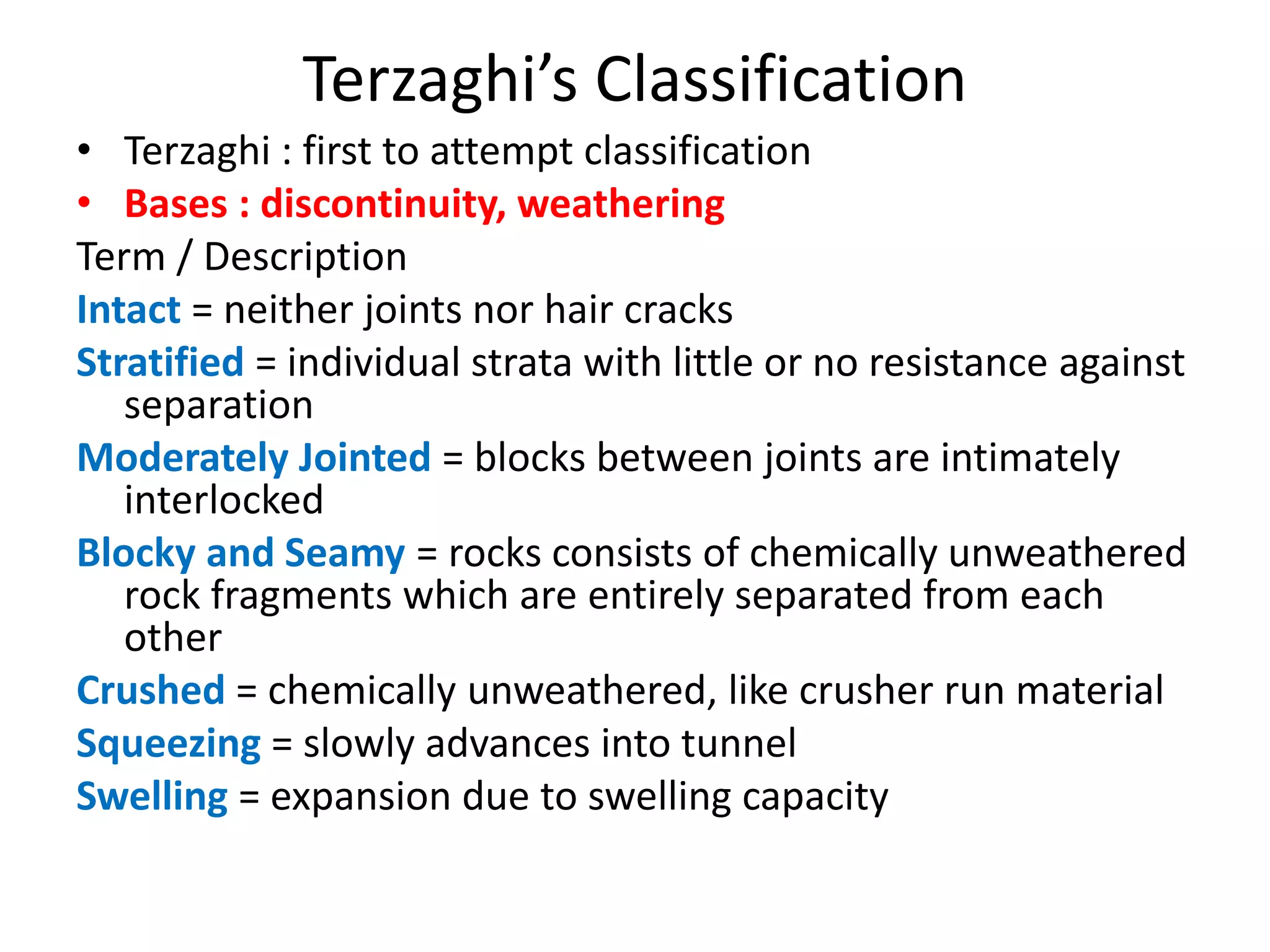
Terzaghi’s Classification
• Terzaghi : first to attempt classification
• Bases : discontinuity, weathering
Term / Description
Intact = neither joints nor hair cracks
Stratified = individual strata with little or no resistance against
separation
Moderately Jointed = blocks between joints are intimately
interlocked
Blocky and Seamy = rocks consists of chemically unweathered
rock fragments which are entirely separated from each
other
Crushed = chemically unweathered, like crusher run material
Squeezing = slowly advances into tunnel
Swelling = expansion due to swelling capacity
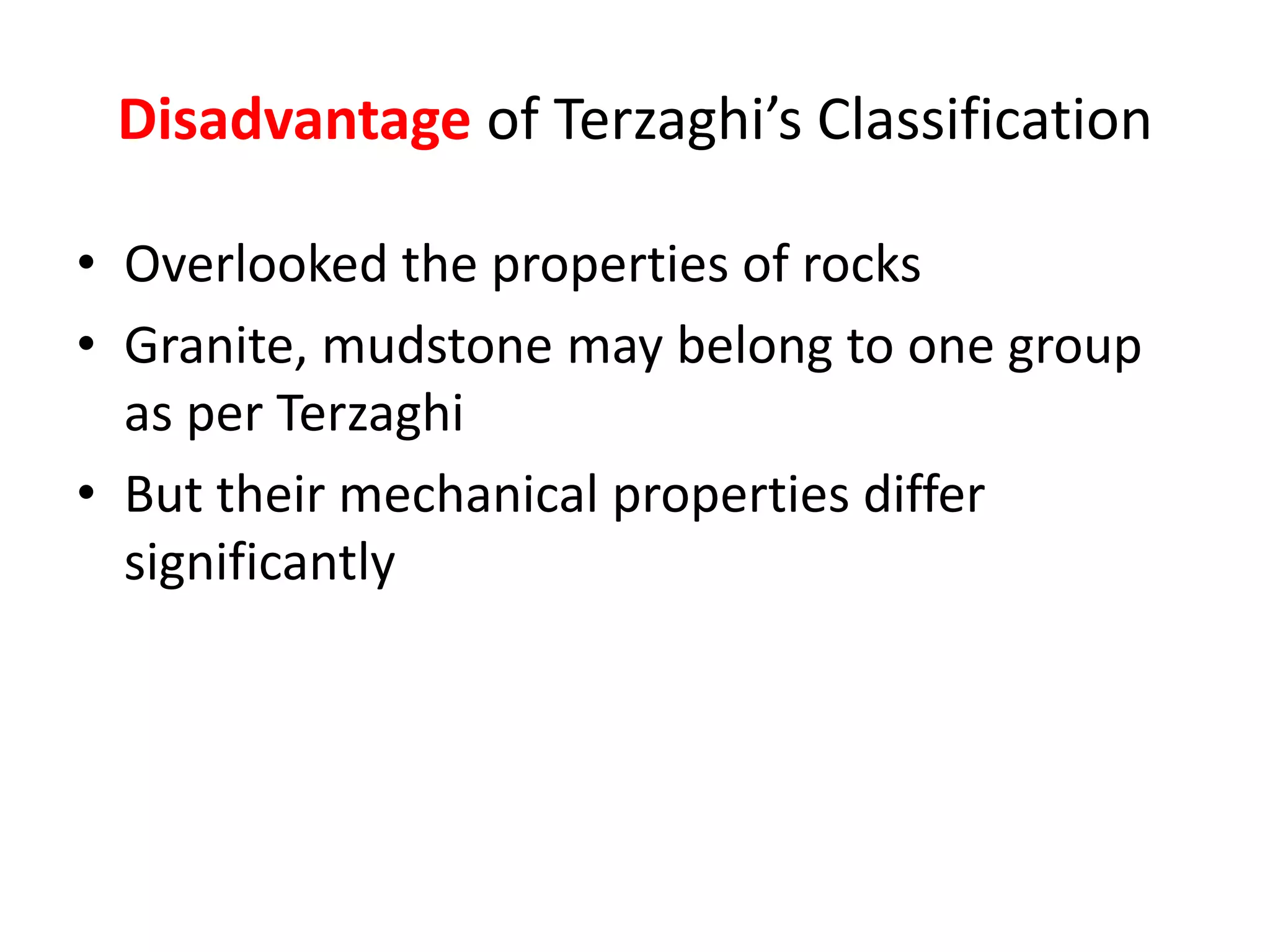
Disadvantage of Terzaghi’s Classification
• Overlooked the properties of rocks
• Granite, mudstone may belong to one group
as per Terzaghi
• But their mechanical properties differ
significantly
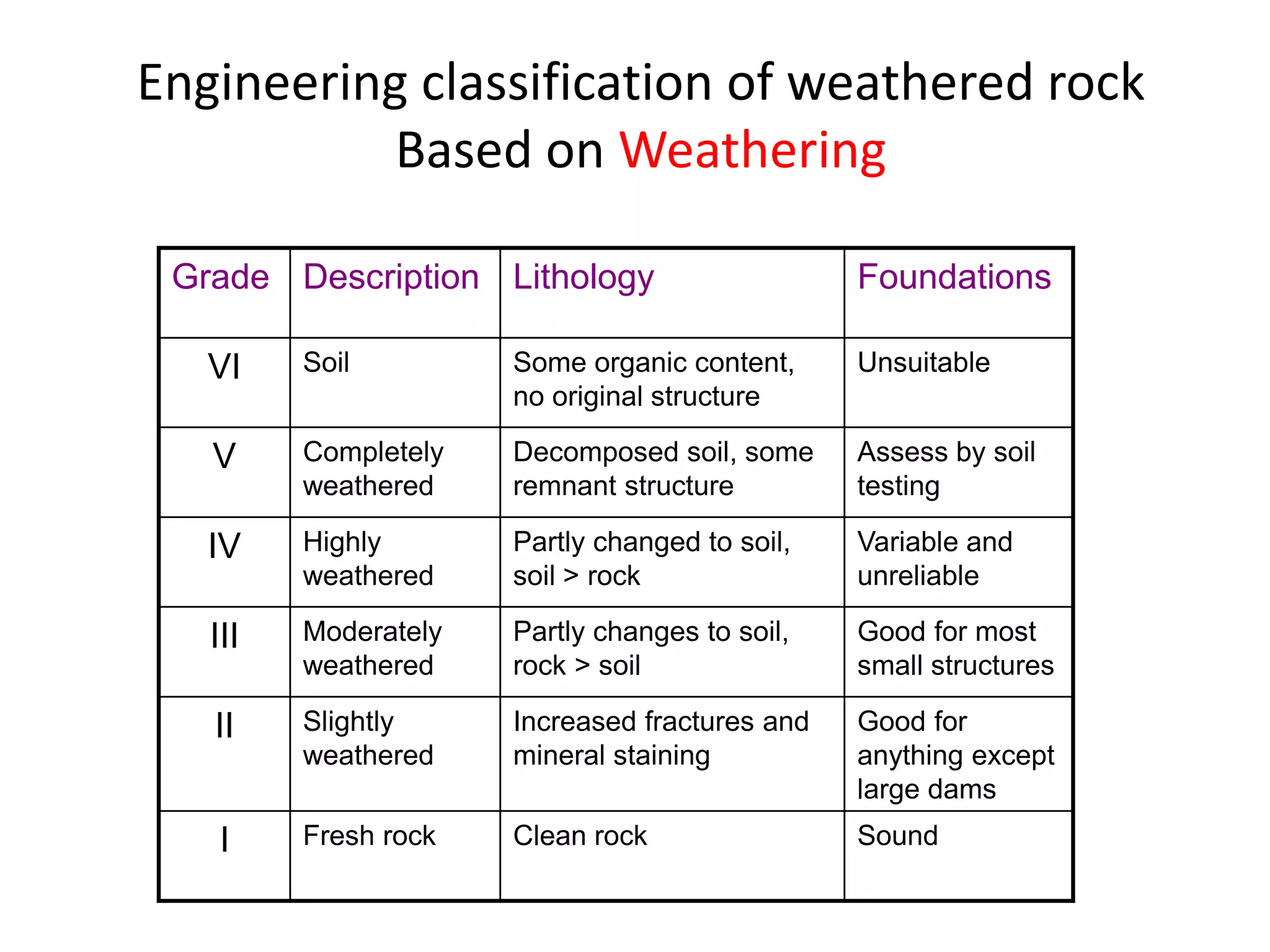
Grade Description Lithology Foundations
VI Soil Some organic content,
no original structure
Unsuitable
V Completely
weathered
Decomposed soil, some
remnant structure
Assess by soil
testing
IV Highly
weathered
Partly changed to soil,
soil > rock
Variable and
unreliable
III Moderately
weathered
Partly changes to soil,
rock > soil
Good for most
small structures
II Slightly
weathered
Increased fractures and
mineral staining
Good for
anything except
large dams
I Fresh rock Clean rock Sound
Engineering classification of weathered rock
Based on Weathering
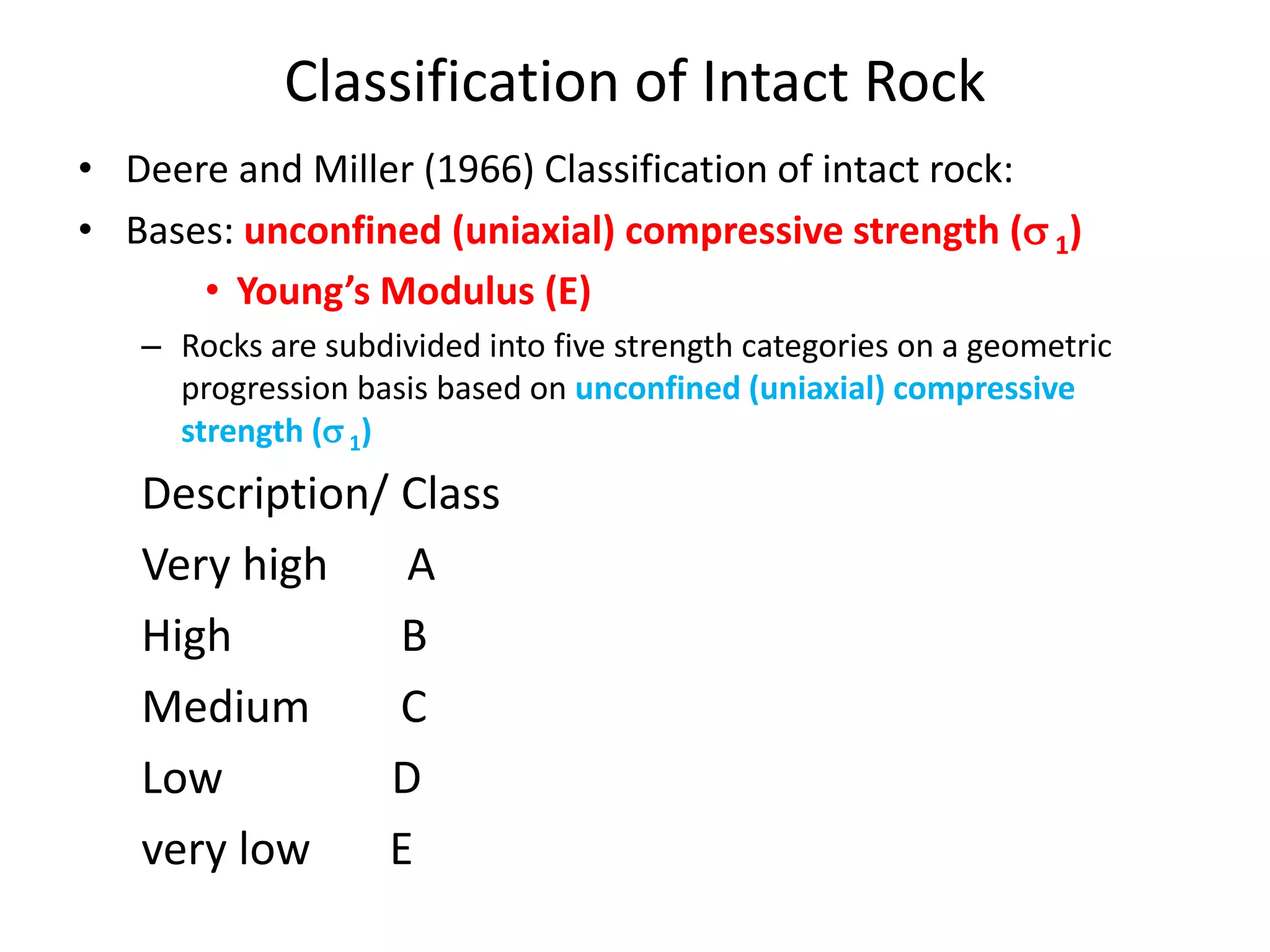
Classification of Intact Rock
• Deere and Miller (1966) Classification of intact rock:
• Bases: unconfined (uniaxial) compressive strength ( 1)
• Young’s Modulus (E)
– Rocks are subdivided into five strength categories on a geometric
progression basis based on unconfined (uniaxial) compressive
strength ( 1)
Description/ Class
Very high A
High B
Medium C
Low D
very low E
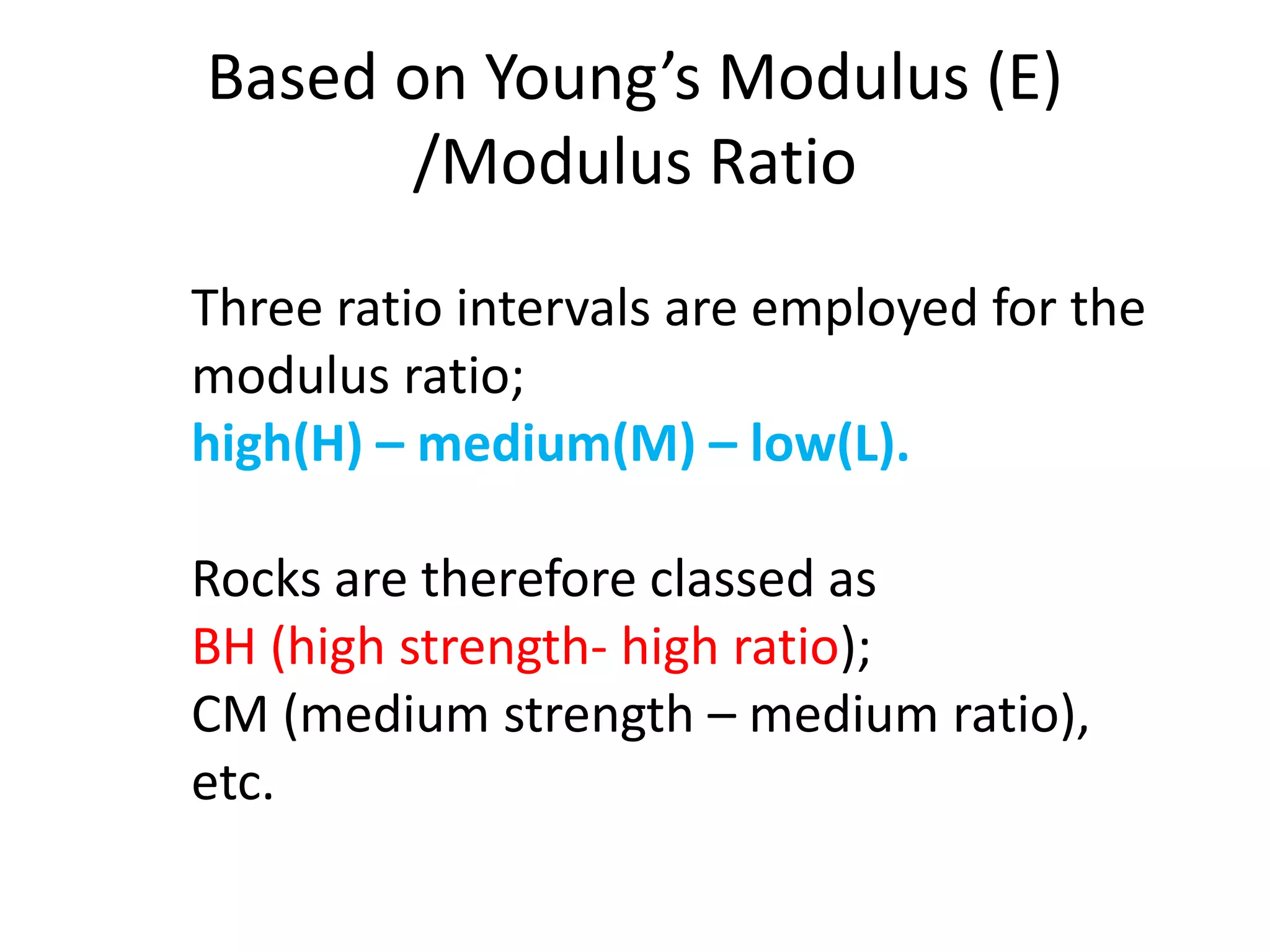
Based on Young’s Modulus (E)
/Modulus Ratio
Three ratio intervals are employed for the
modulus ratio;
high(H) – medium(M) – low(L).
Rocks are therefore classed as
BH (high strength- high ratio);
CM (medium strength – medium ratio),
etc.
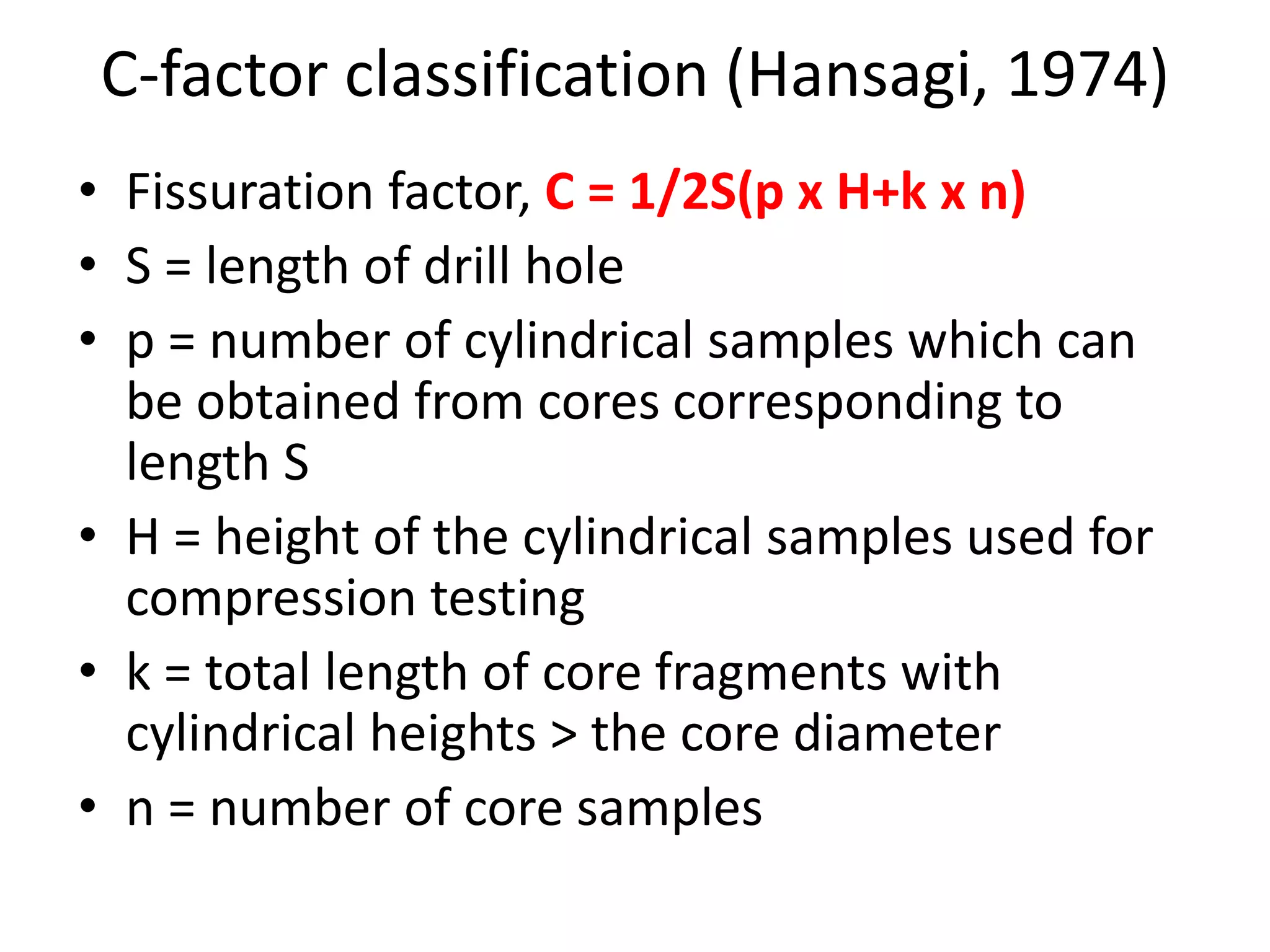
C-factor classification (Hansagi, 1974)
• Fissuration factor, C = 1/2S(p x H+k x n)
• S = length of drill hole
• p = number of cylindrical samples which can
be obtained from cores corresponding to
length S
• H = height of the cylindrical samples used for
compression testing
• k = total length of core fragments with
cylindrical heights > the core diameter
• n = number of core samples
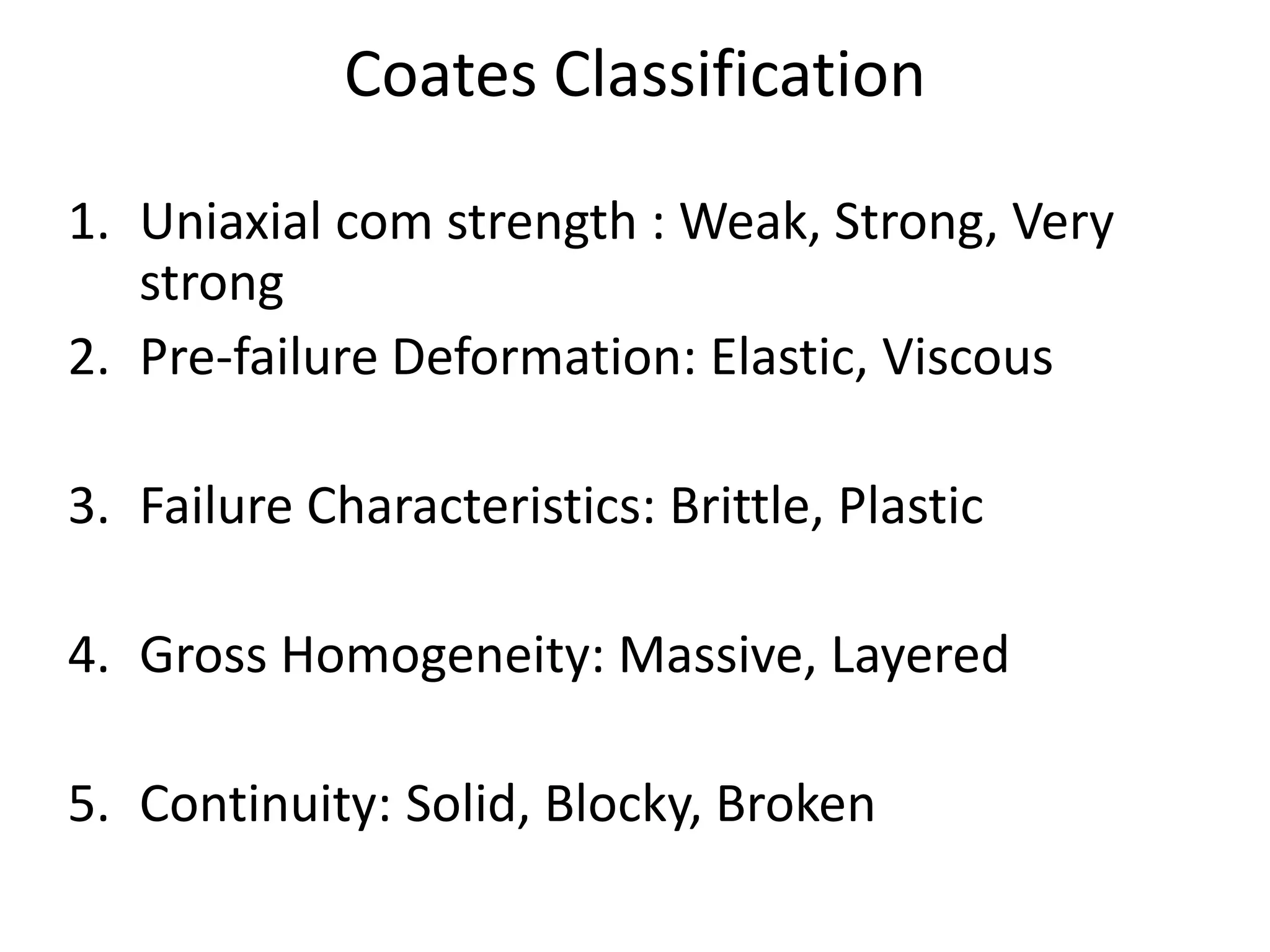
Coates Classification
1. Uniaxial com strength : Weak, Strong, Very
strong
2. Pre-failure Deformation: Elastic, Viscous
3. Failure Characteristics: Brittle, Plastic
4. Gross Homogeneity: Massive, Layered
5. Continuity: Solid, Blocky, Broken
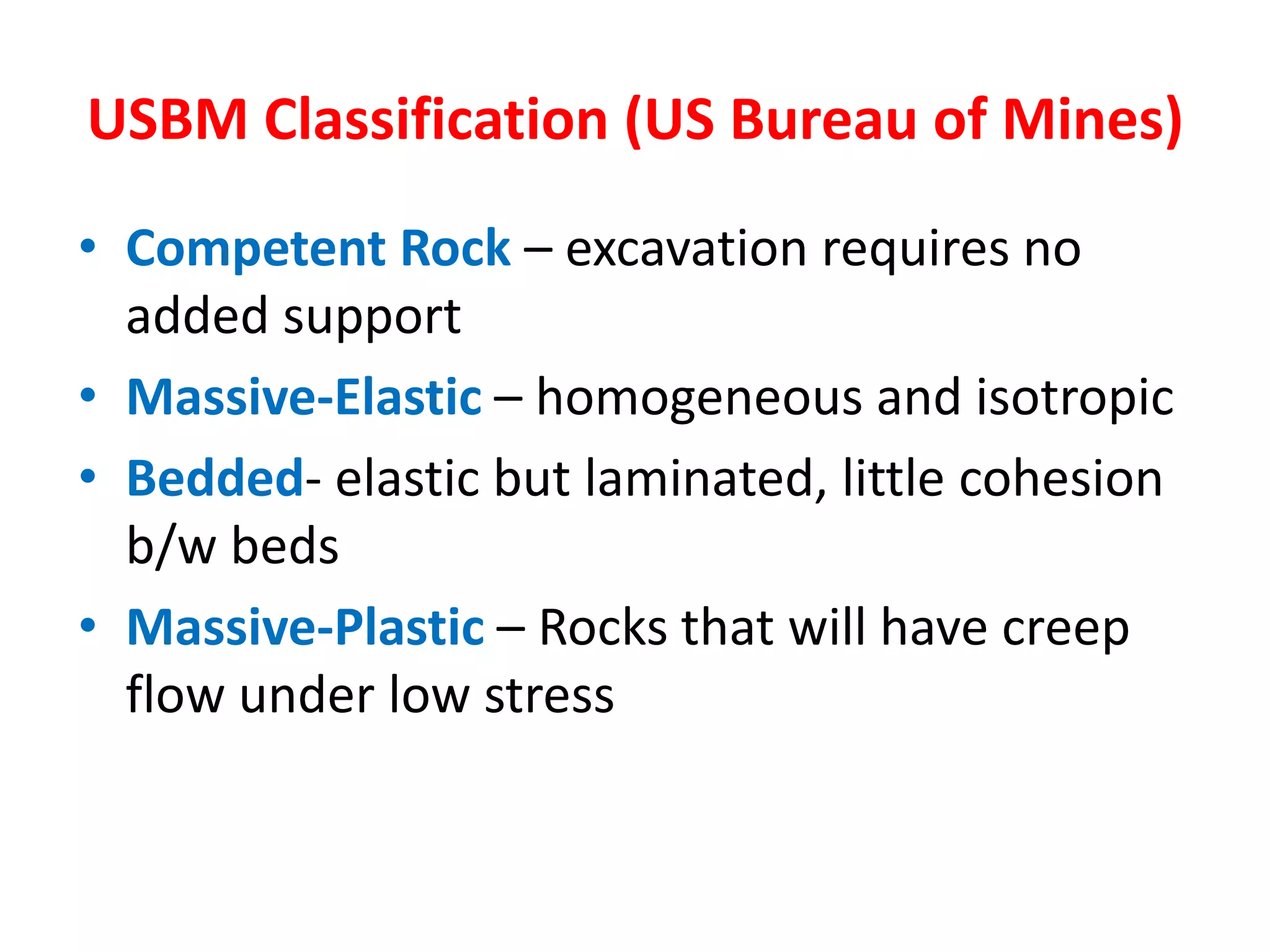
USBM Classification (US Bureau of Mines)
• Competent Rock – excavation requires no
added support
• Massive-Elastic – homogeneous and isotropic
• Bedded- elastic but laminated, little cohesion
b/w beds
• Massive-Plastic – Rocks that will have creep
flow under low stress
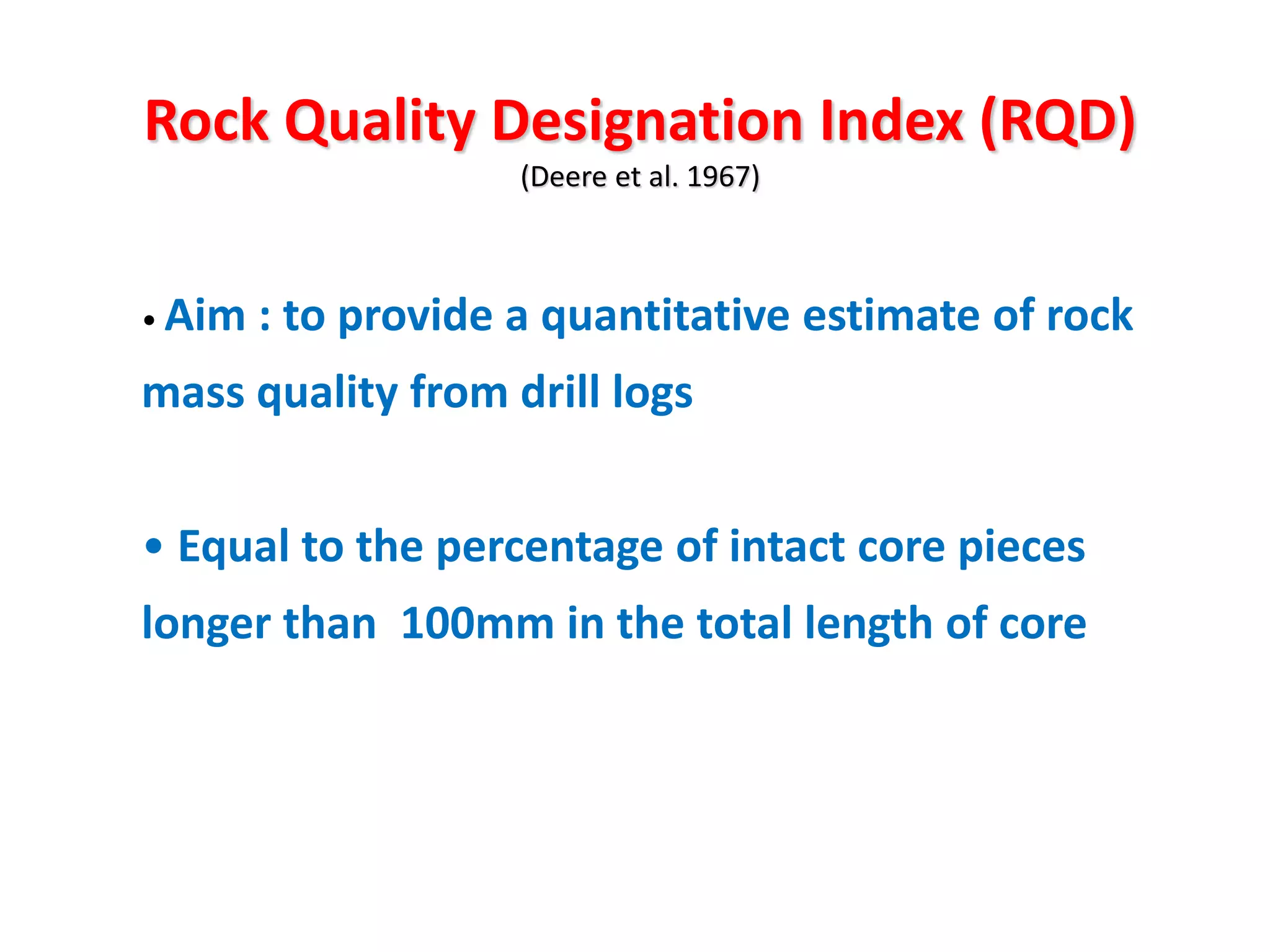
Rock Quality Designation Index (RQD)
(Deere et al. 1967)
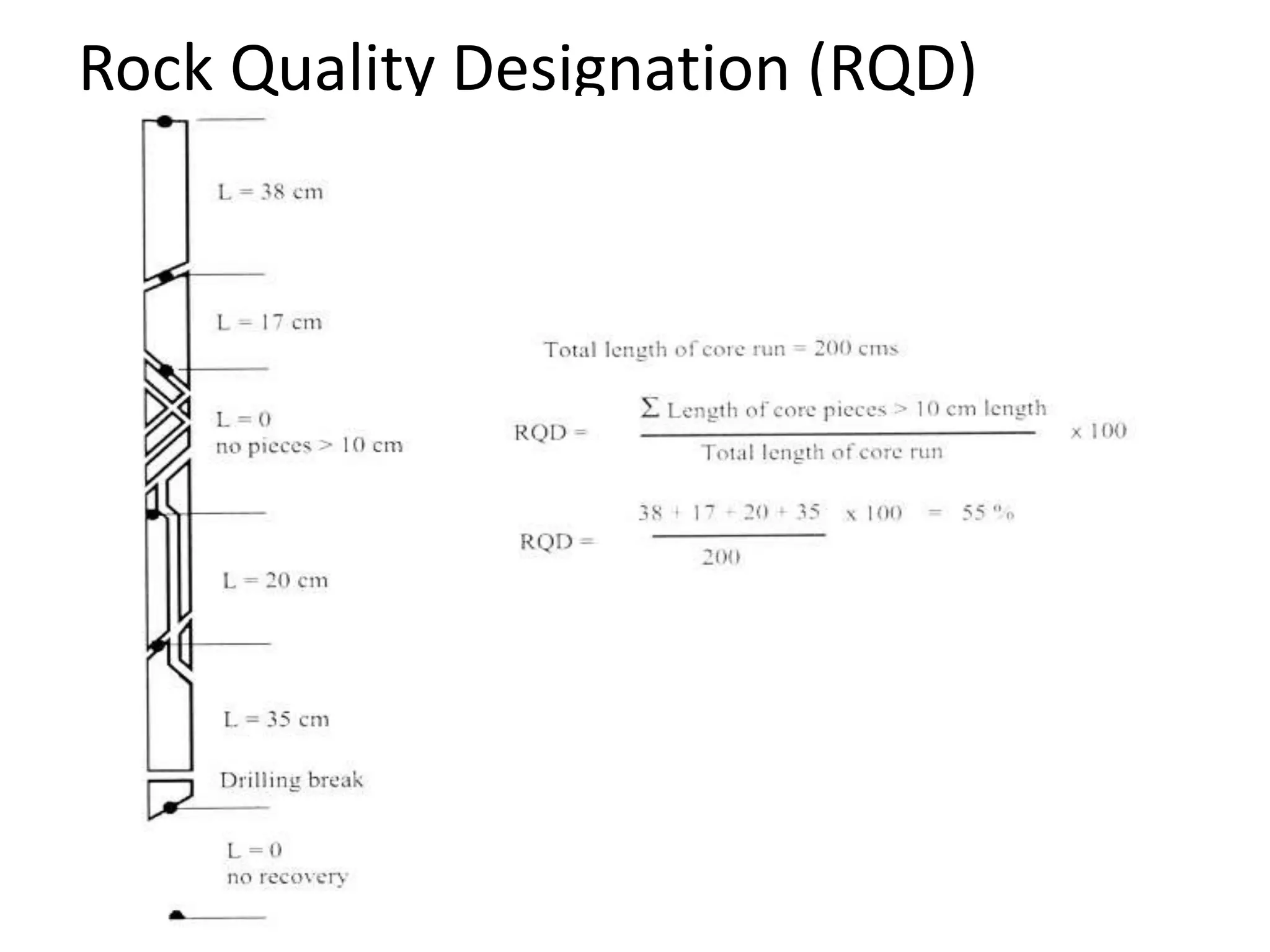
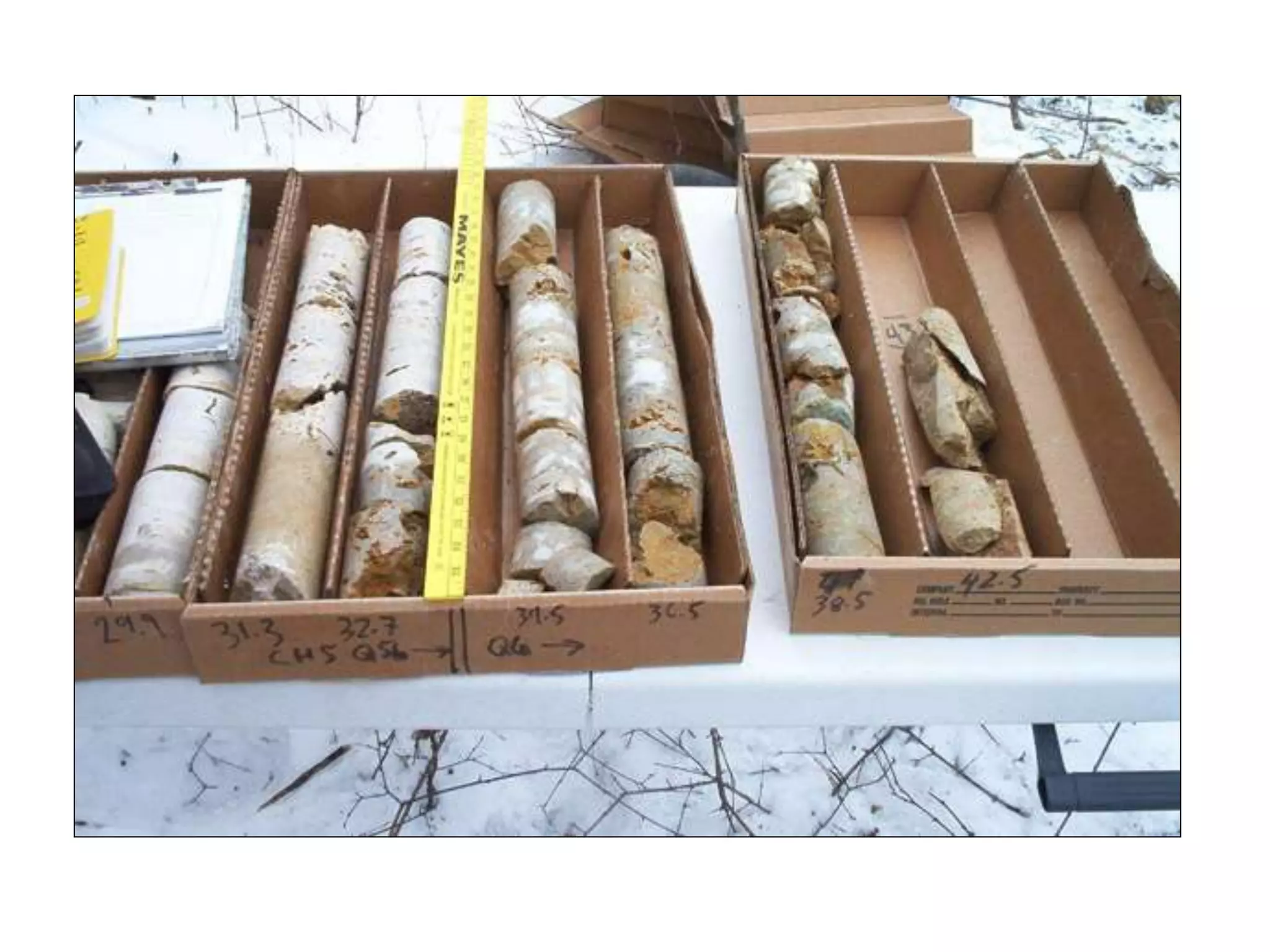
• Aim : to provide a quantitative estimate of rock
mass quality from drill logs
• Equal to the percentage of intact core pieces
longer than 100mm in the total length of core
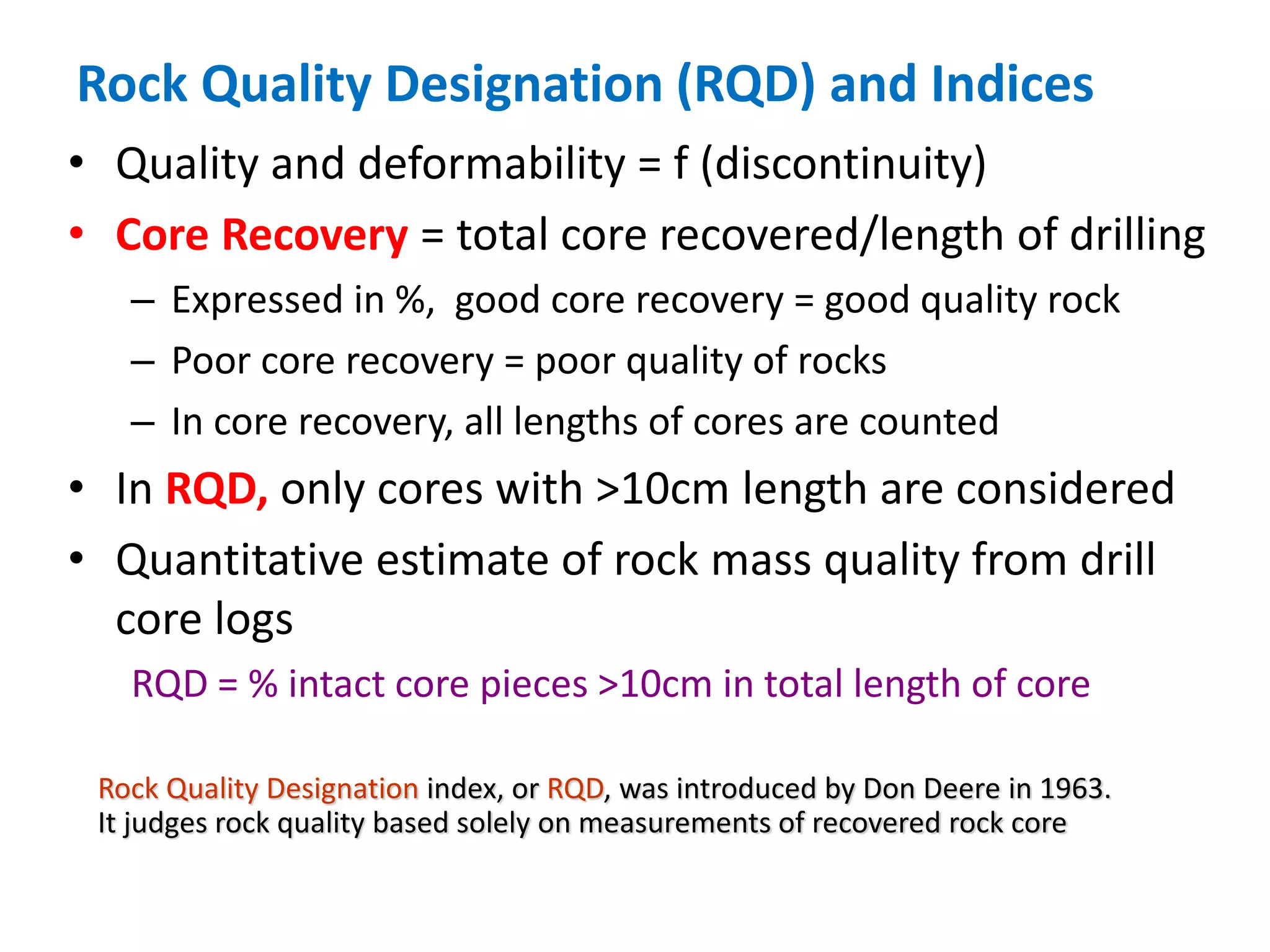
Rock Quality Designation (RQD) and Indices
• Quality and deformability = f (discontinuity)
• Core Recovery = total core recovered/length of drilling
– Expressed in %, good core recovery = good quality rock
– Poor core recovery = poor quality of rocks
– In core recovery, all lengths of cores are counted
• In RQD, only cores with >10cm length are considered
• Quantitative estimate of rock mass quality from drill
core logs
RQD = % intact core pieces >10cm in total length of core
Rock Quality Designation index, or RQD, was introduced by Don Deere in 1963.
It judges rock quality based solely on measurements of recovered rock core
Rock Quality Designation (RQD)
Natural joint surface vs core broken
during operation
• Mechanical breaking of cores caused by
drilling processes
• Natural joint surface
Broken cores
• Cores broken during handling or drilling =
fresh irregular breaks = can be fitted
• Natural Joint surface – broken surface smooth,
pieces cannot be fitted
• For RQD determination, International Society
for Rock Mechanics recommends a core size of
at least 54.7 mm (NX) diameter drilled with
double tube core barrels
RQD
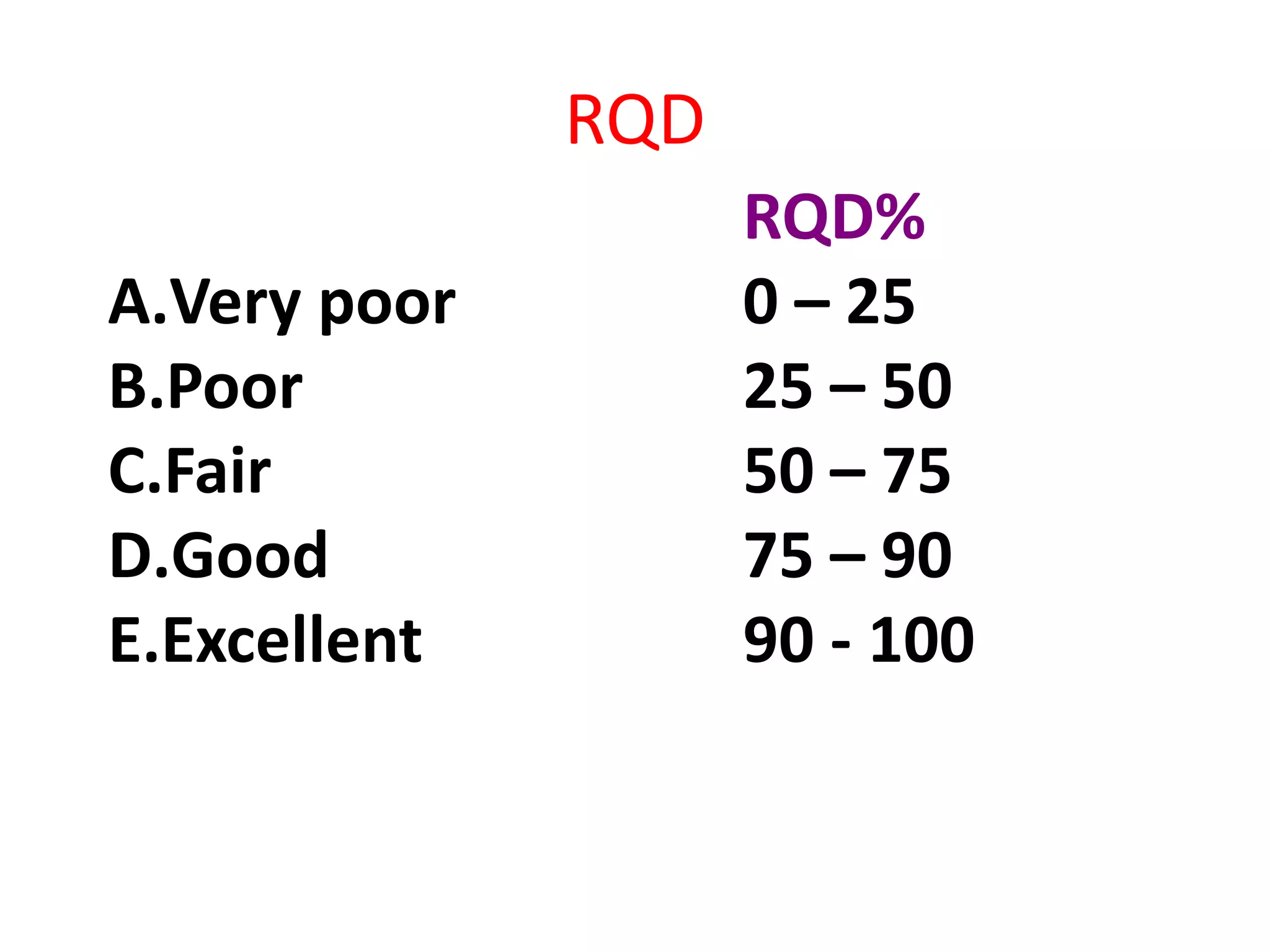
RQD%
A.Very poor 0 – 25
B.Poor 25 – 50
C.Fair 50 – 75
D.Good 75 – 90
E.Excellent 90 - 100
RQD : when core is unavailable
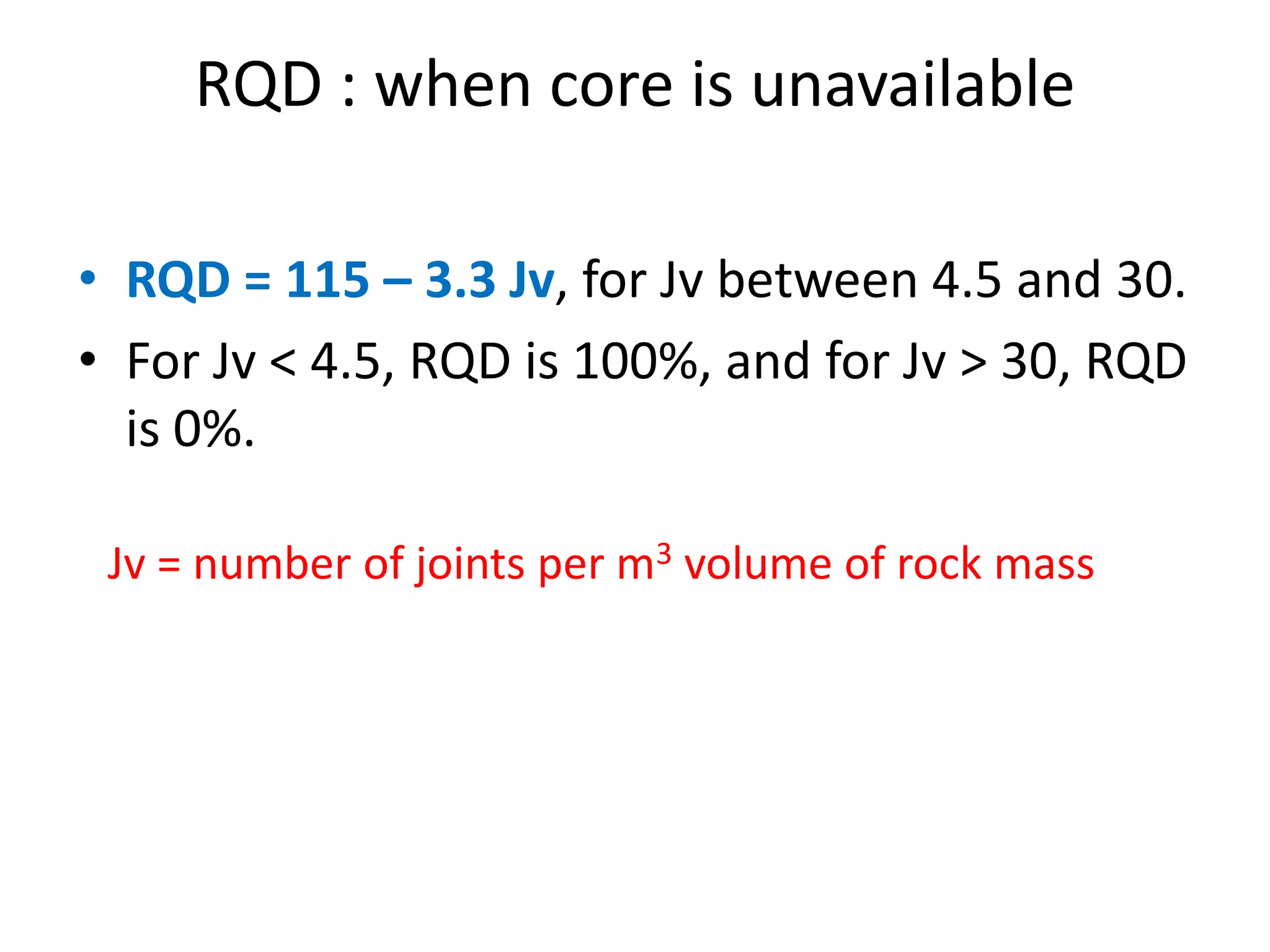
• RQD = 115 – 3.3 Jv, for Jv between 4.5 and 30.
• For Jv < 4.5, RQD is 100%, and for Jv > 30, RQD
is 0%.
Jv = number of joints per m3 volume of rock mass
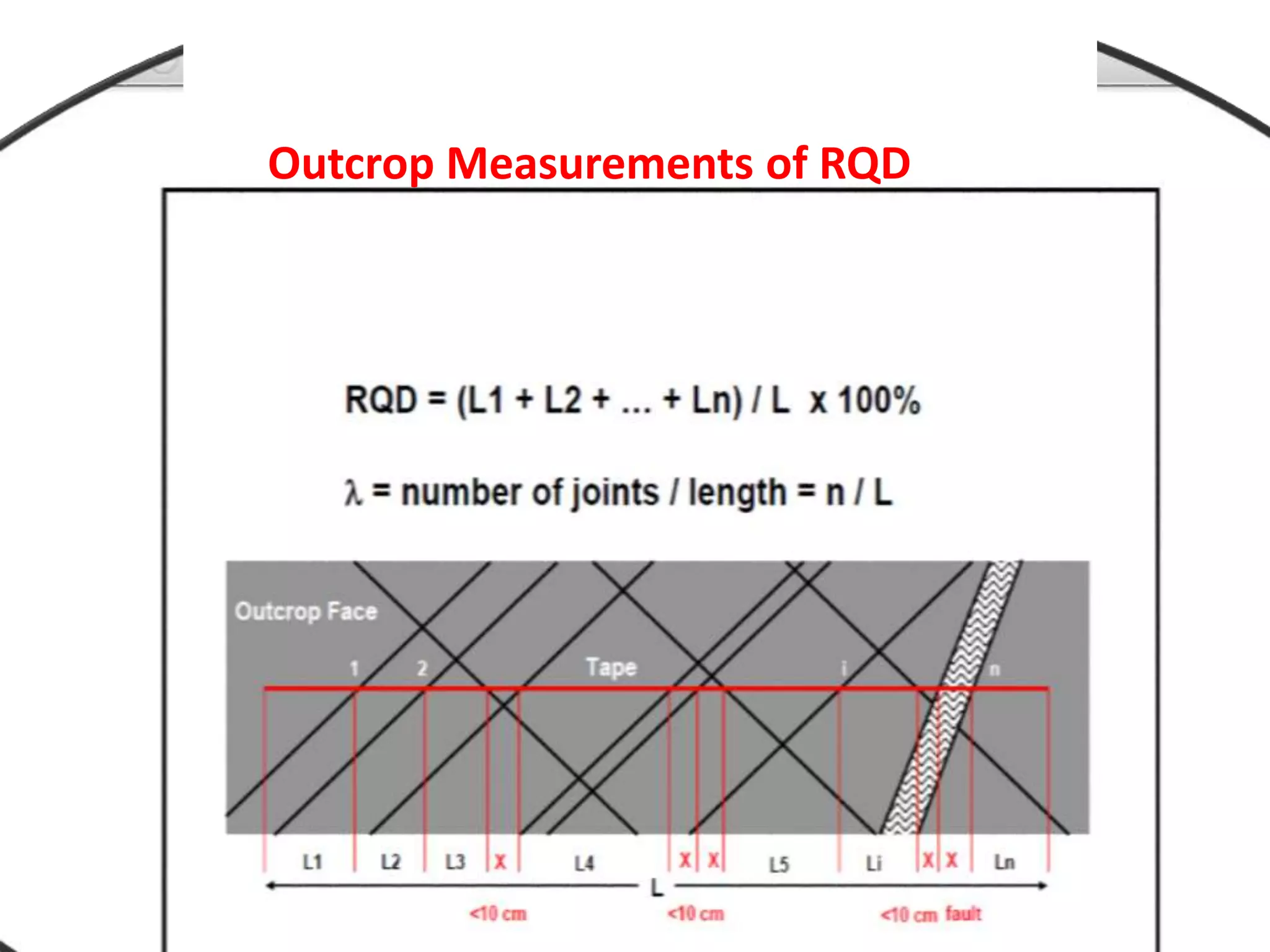
Outcrop Measurements of RQD
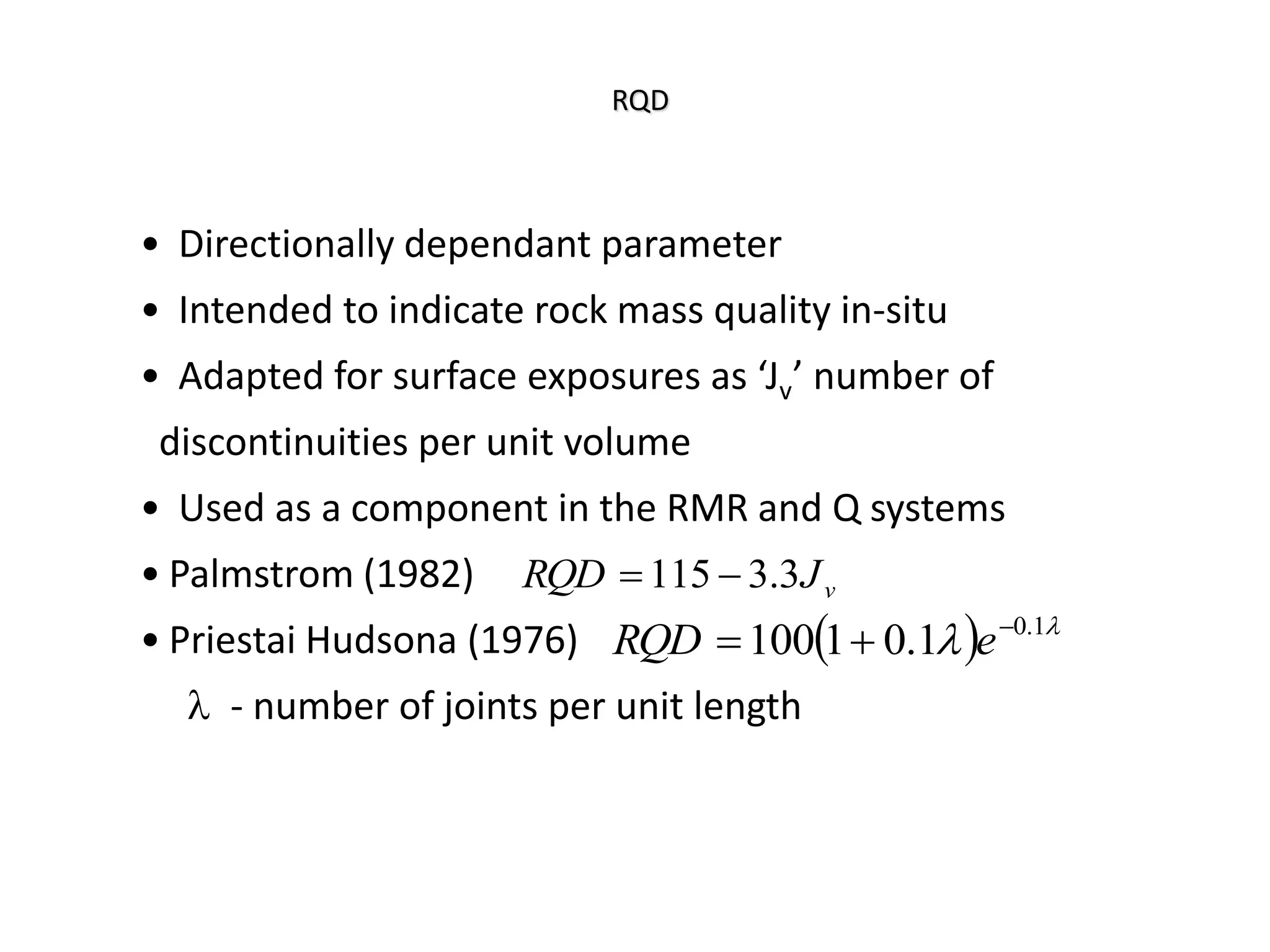
RQD
• Directionally dependant parameter
• Intended to indicate rock mass quality in-situ
• Adapted for surface exposures as ‘Jv’ number of
discontinuities per unit volume
• Used as a component in the RMR and Q systems
• Palmstrom (1982)
• Priestai Hudsona (1976)
l - number of joints per unit length
v
J
RQD 3
.
3
115 

  l
l 1
.
0
1
.
0
1
100 

 e
RQD
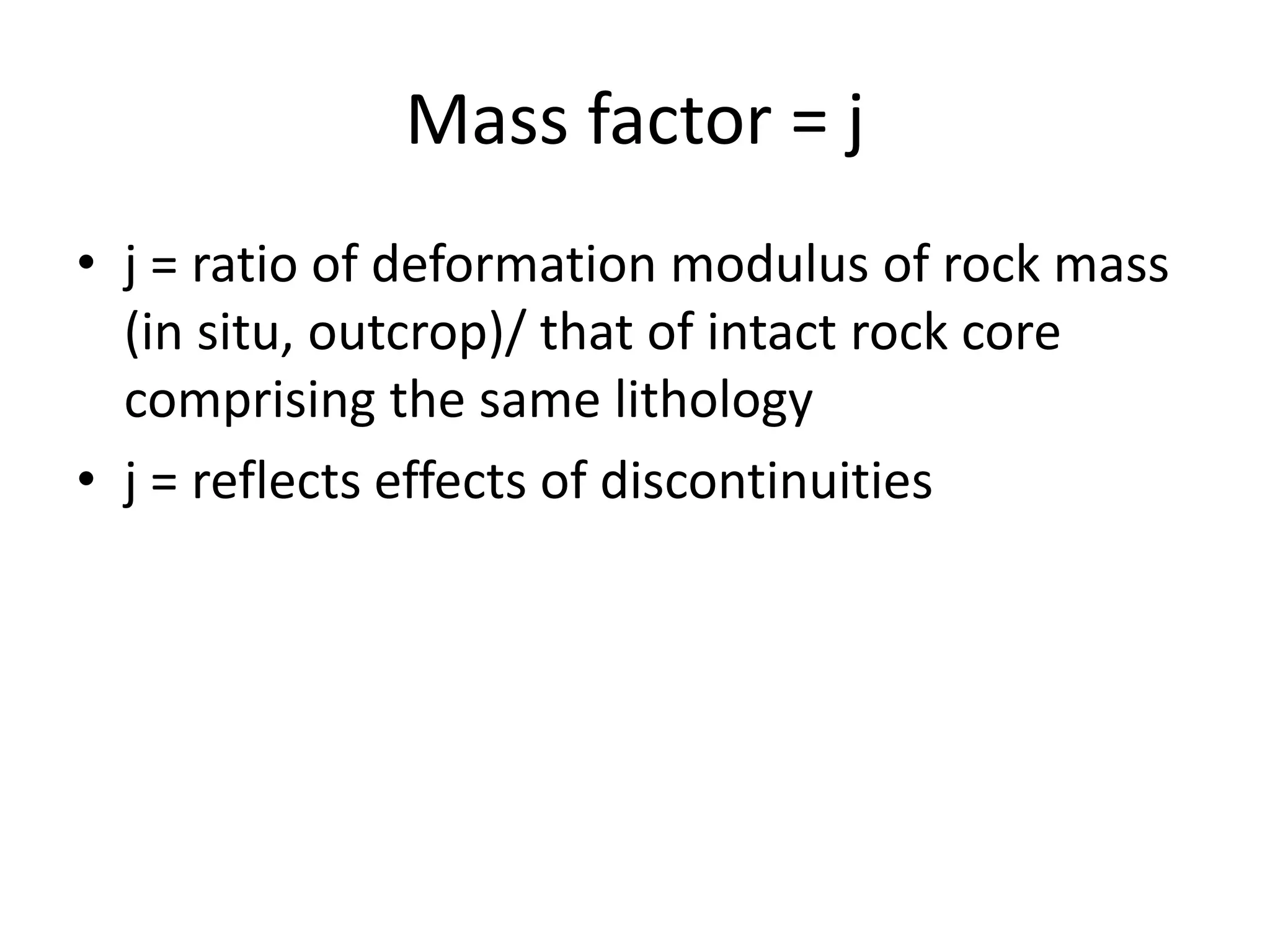
Mass factor = j
• j = ratio of deformation modulus of rock mass
(in situ, outcrop)/ that of intact rock core
comprising the same lithology
• j = reflects effects of discontinuities
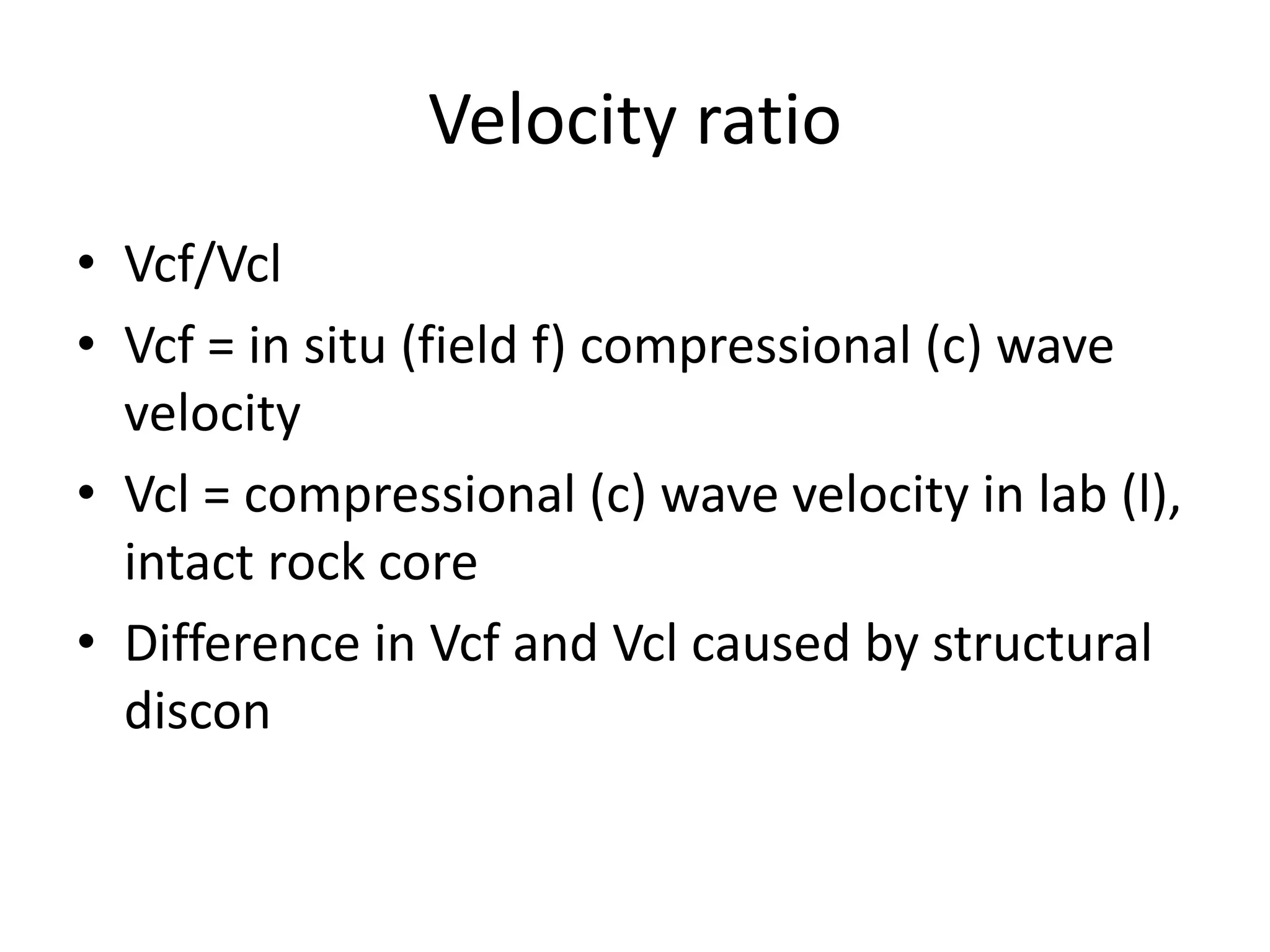
Velocity ratio
• Vcf/Vcl
• Vcf = in situ (field f) compressional (c) wave
velocity
• Vcl = compressional (c) wave velocity in lab (l),
intact rock core
• Difference in Vcf and Vcl caused by structural
discon
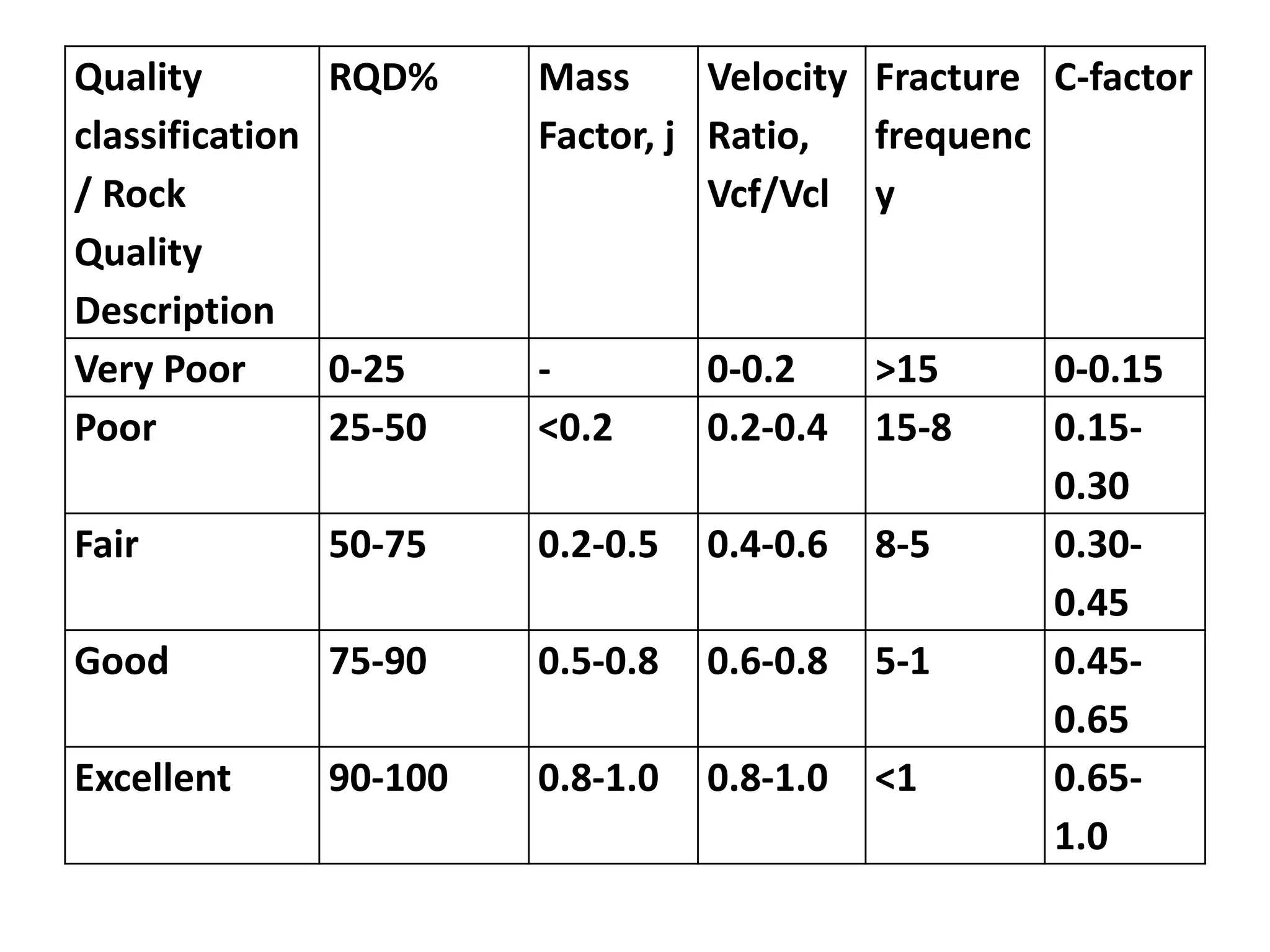
Quality
classification
/ Rock
Quality
Description
RQD% Mass
Factor, j
Velocity
Ratio,
Vcf/Vcl
Fracture
frequenc
y
C-factor
Very Poor 0-25 - 0-0.2 >15 0-0.15
Poor 25-50 <0.2 0.2-0.4 15-8 0.15-
0.30
Fair 50-75 0.2-0.5 0.4-0.6 8-5 0.30-
0.45
Good 75-90 0.5-0.8 0.6-0.8 5-1 0.45-
0.65
Excellent 90-100 0.8-1.0 0.8-1.0 <1 0.65-
1.0
Multi parameter Rock Mass Classification Schemes
• Rock Mass Structure Rating (RSR)
• Rock Mass Rating (RMR)
• Rock Tunnelling Quality Index (Q)
• Geological Strength Index (GSI)
Rock Mass Rating (RMR) /
Geomechanics Claasification
• Rating Concept
• Weightage
• Total Rating
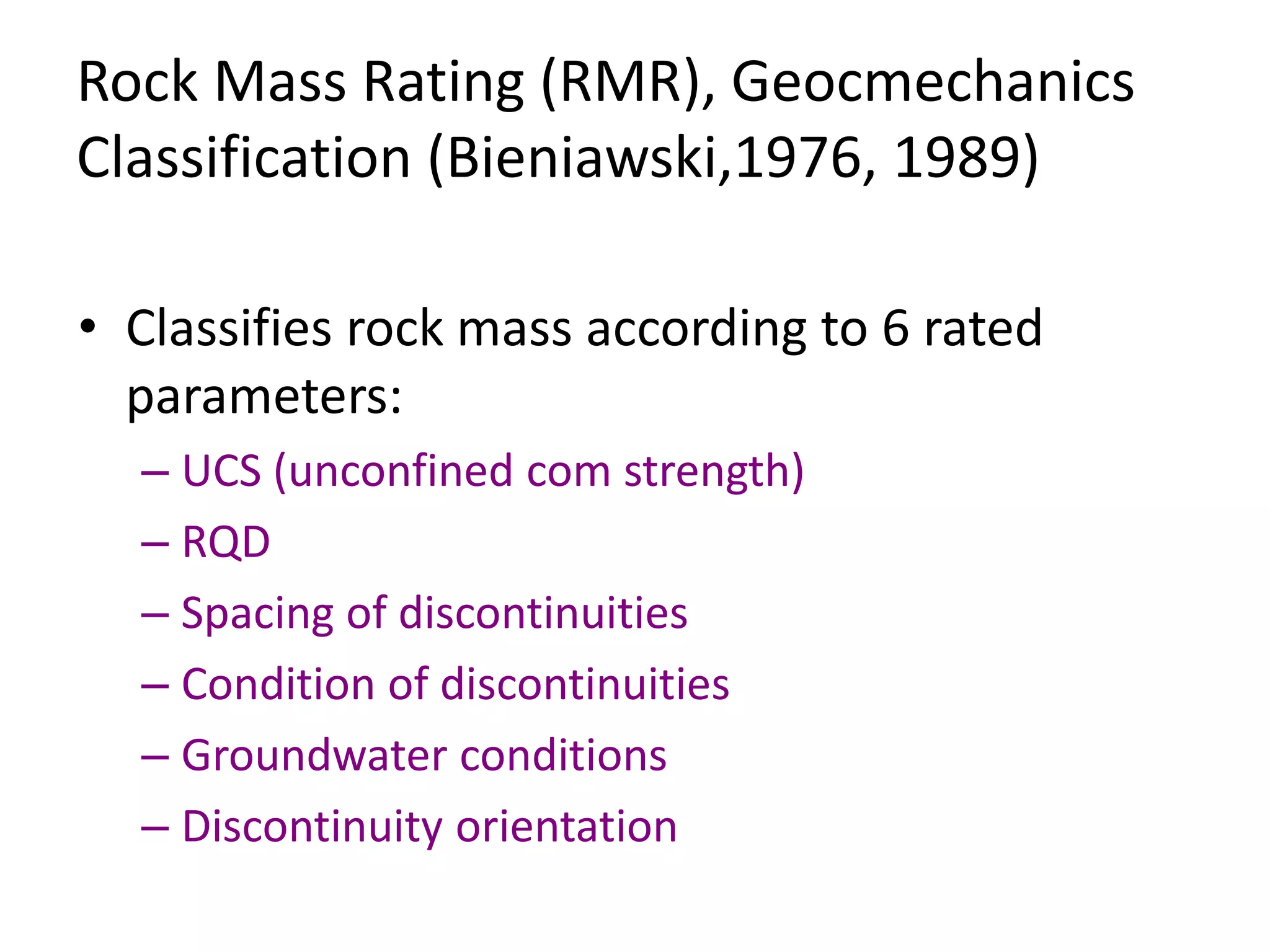
Rock Mass Rating (RMR), Geocmechanics
Classification (Bieniawski,1976, 1989)
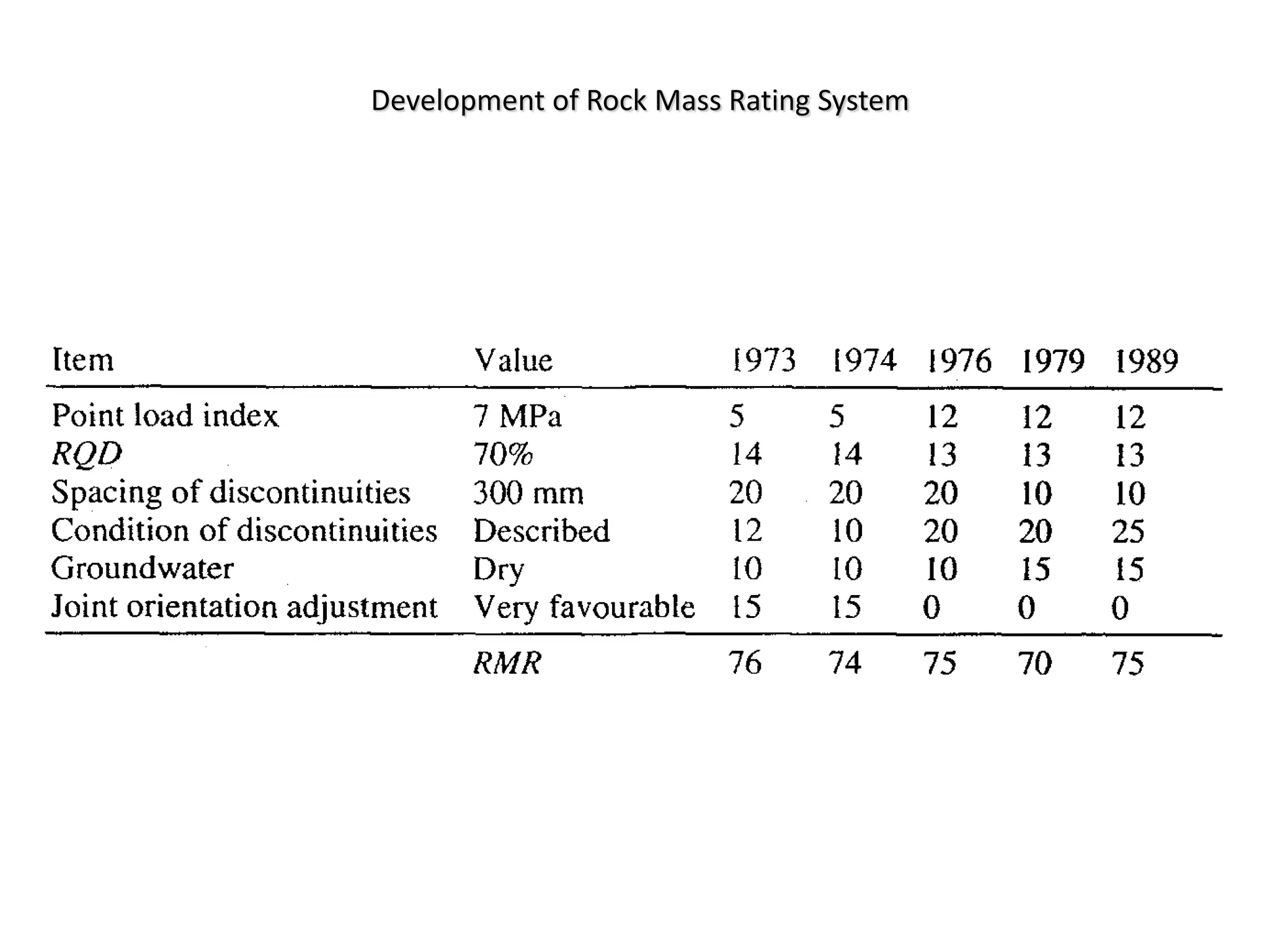
• Classifies rock mass according to 6 rated
parameters:
– UCS (unconfined com strength)
– RQD
– Spacing of discontinuities
– Condition of discontinuities
– Groundwater conditions
– Discontinuity orientation
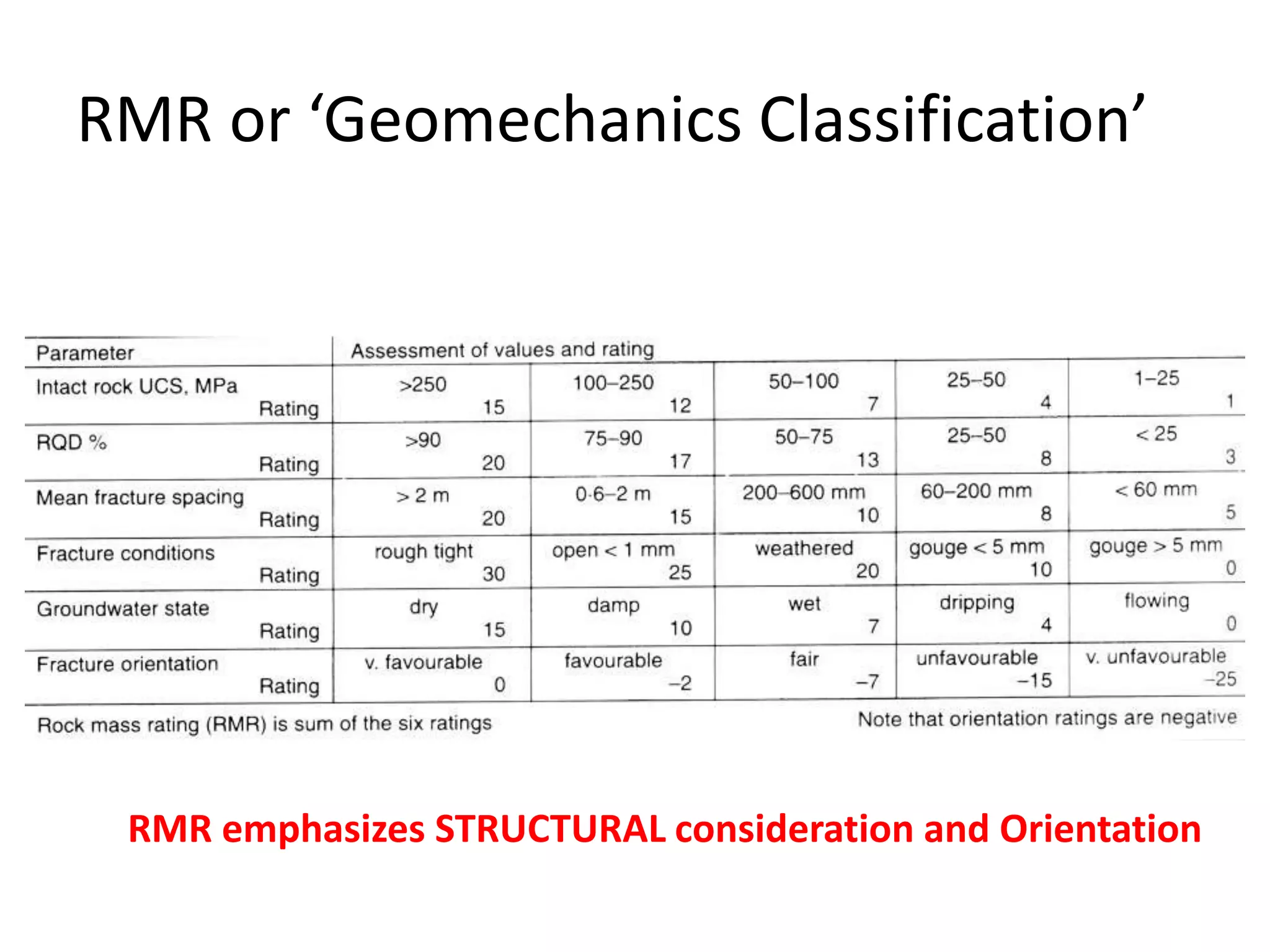
RMR or ‘Geomechanics Classification’
RMR emphasizes STRUCTURAL consideration and Orientation
Rock Mass Rating System
1976 to 1989 Bieniawski
• System refined by greater data
• Ratings for parameters changed
• Adapted by other workers for
different situations
• PROJECT SPECIFIC SYSTEMS
Development of Rock Mass Rating System
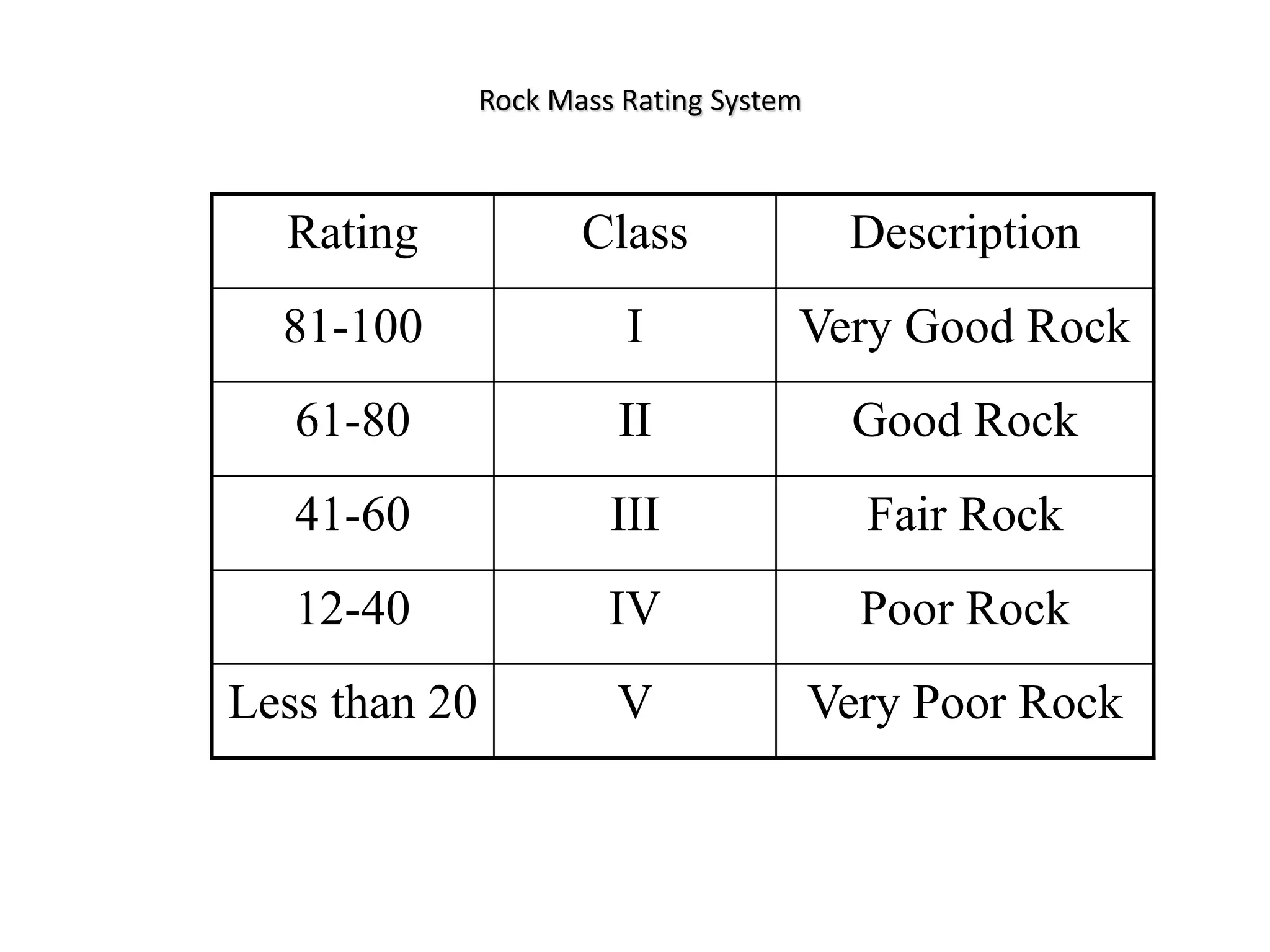
Rock Mass Rating System
Rating Class Description
81-100 I Very Good Rock
61-80 II Good Rock
41-60 III Fair Rock
12-40 IV Poor Rock
Less than 20 V Very Poor Rock
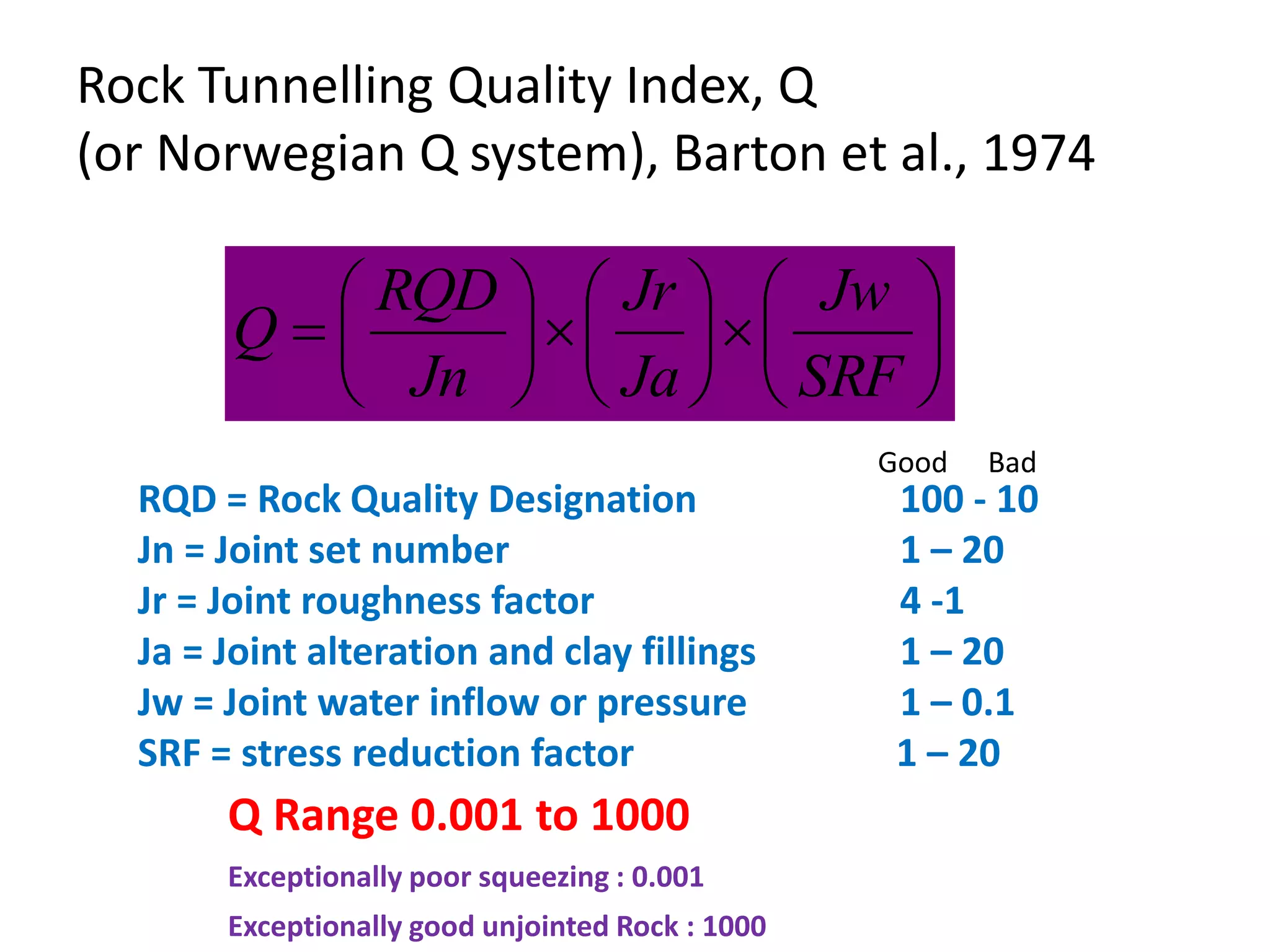
Rock Tunnelling Quality Index, Q
(or Norwegian Q system), Barton et al., 1974





















SRF
Jw
Ja
Jr
Jn
RQD
Q
RQD = Rock Quality Designation 100 - 10
Jn = Joint set number 1 – 20
Jr = Joint roughness factor 4 -1
Ja = Joint alteration and clay fillings 1 – 20
Jw = Joint water inflow or pressure 1 – 0.1
SRF = stress reduction factor 1 – 20
Good Bad
Q Range 0.001 to 1000
Exceptionally poor squeezing : 0.001
Exceptionally good unjointed Rock : 1000
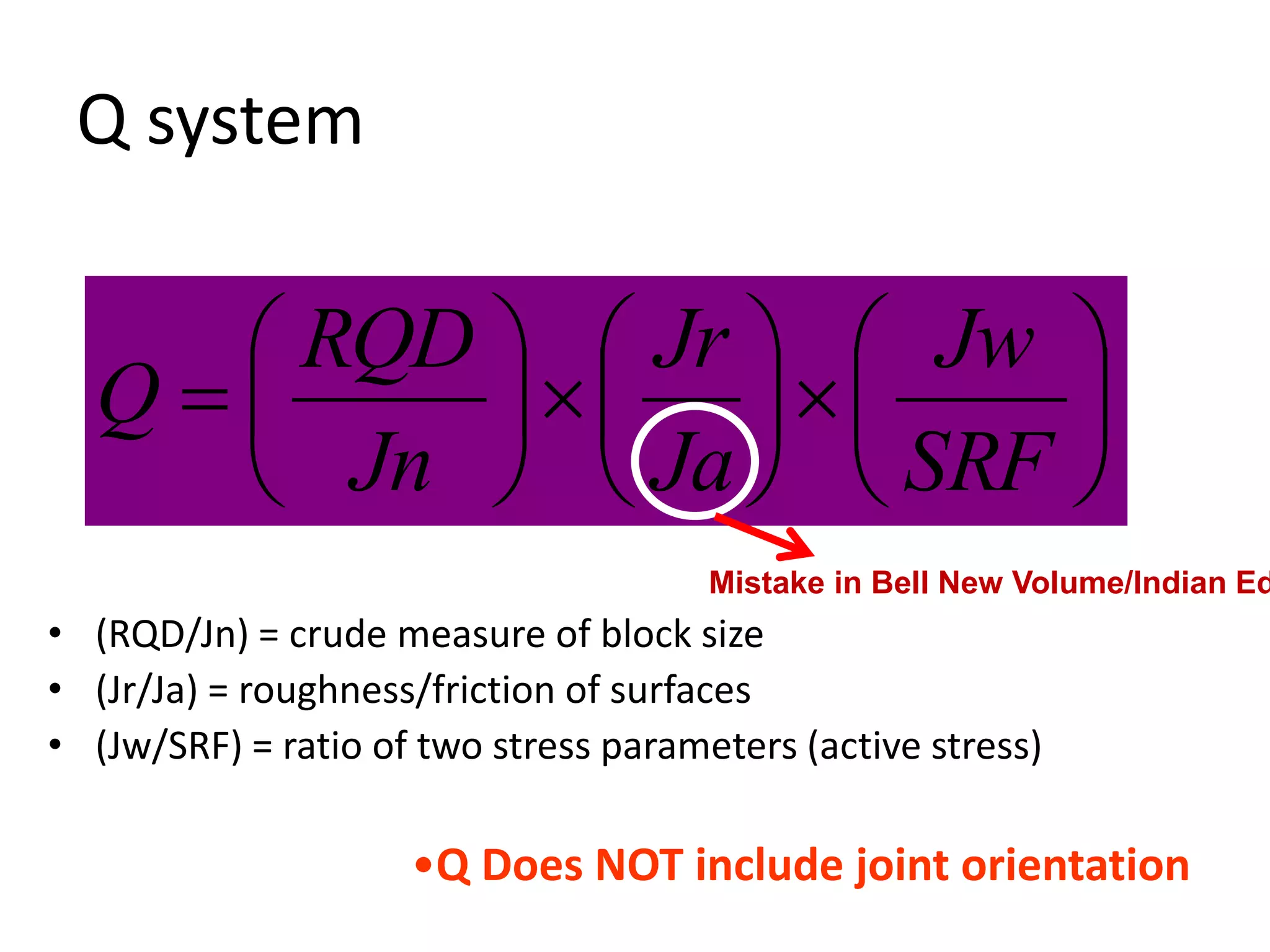
Q system
• (RQD/Jn) = crude measure of block size
• (Jr/Ja) = roughness/friction of surfaces
• (Jw/SRF) = ratio of two stress parameters (active stress)





















SRF
Jw
Ja
Jr
Jn
RQD
Q
•Q Does NOT include joint orientation
Mistake in Bell New Volume/Indian Ed
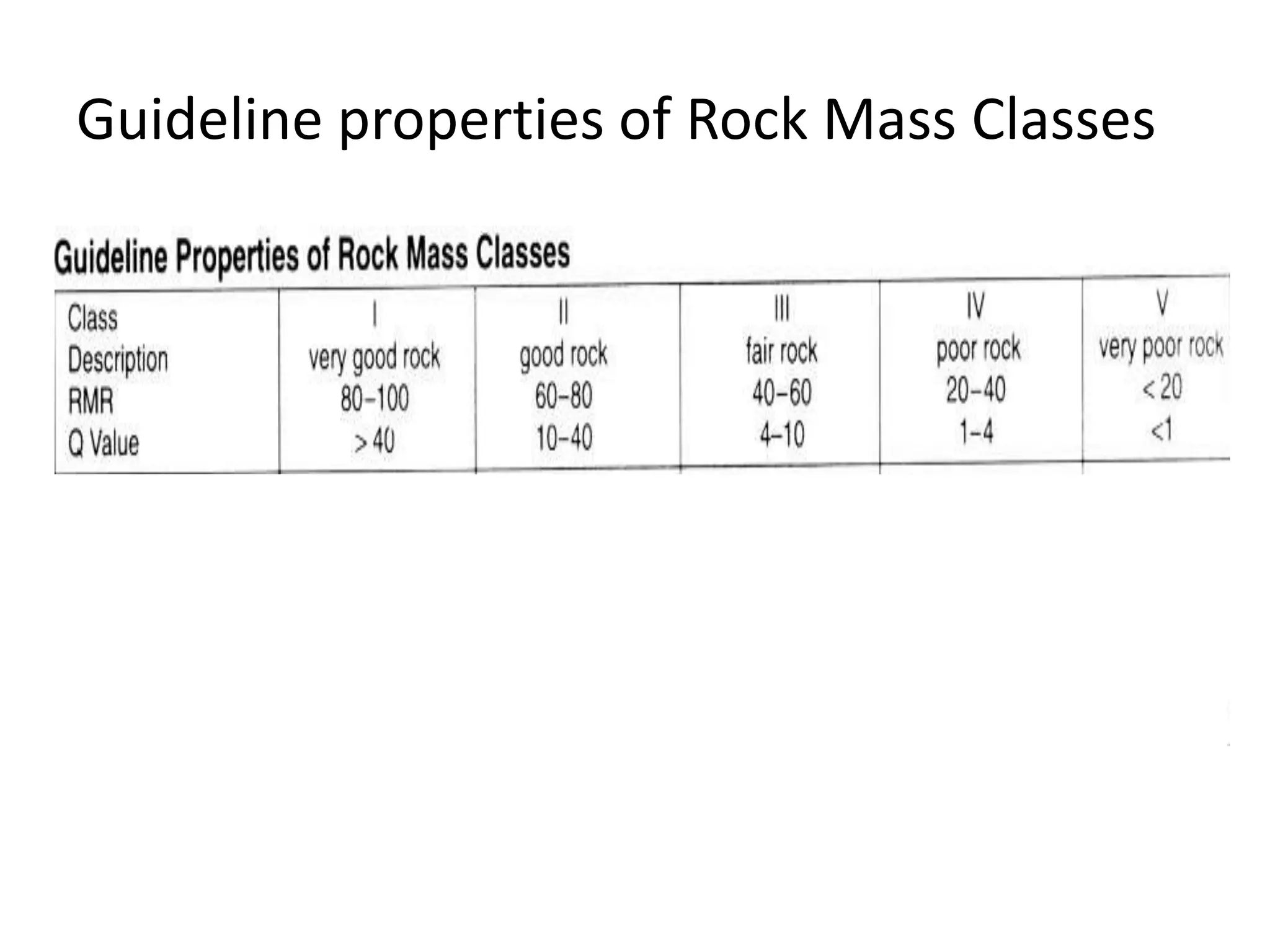
Guideline properties of Rock Mass Classes
Rock Mass Structure Rating (RSR) (1972)
• Introduced the concept of rating components to arrive
at a numerical value
• Demonstrates the logic in a quasi-quantitative rock
mass classification
• Has limitations as based on small tunnels supported
by steel sets only
RSR = A + B + C
Maximum value of RSR = 100
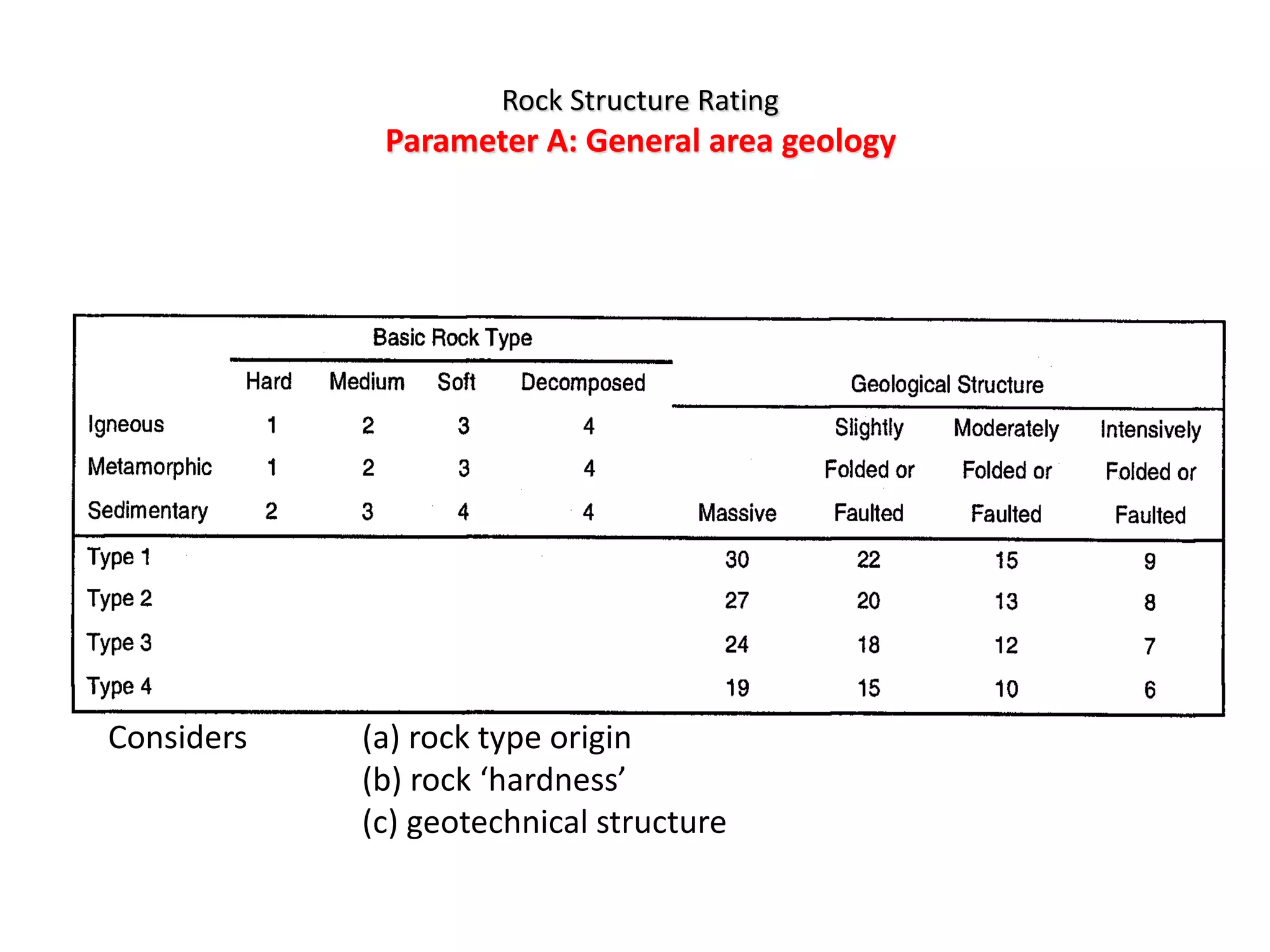
Rock Structure Rating
Parameter A: General area geology
Considers (a) rock type origin
(b) rock ‘hardness’
(c) geotechnical structure
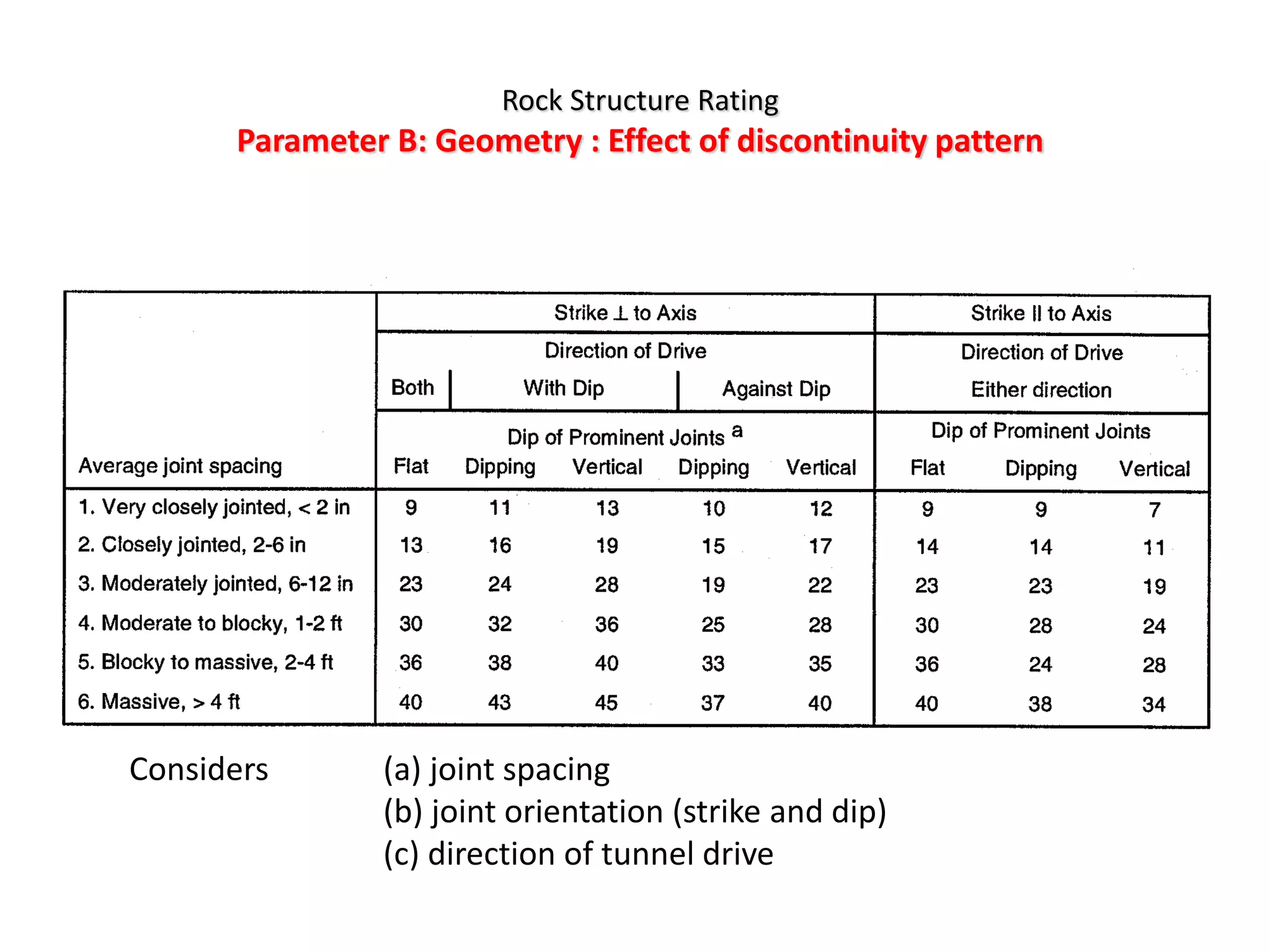
Considers (a) joint spacing
(b) joint orientation (strike and dip)
(c) direction of tunnel drive
Rock Structure Rating
Parameter B: Geometry : Effect of discontinuity pattern
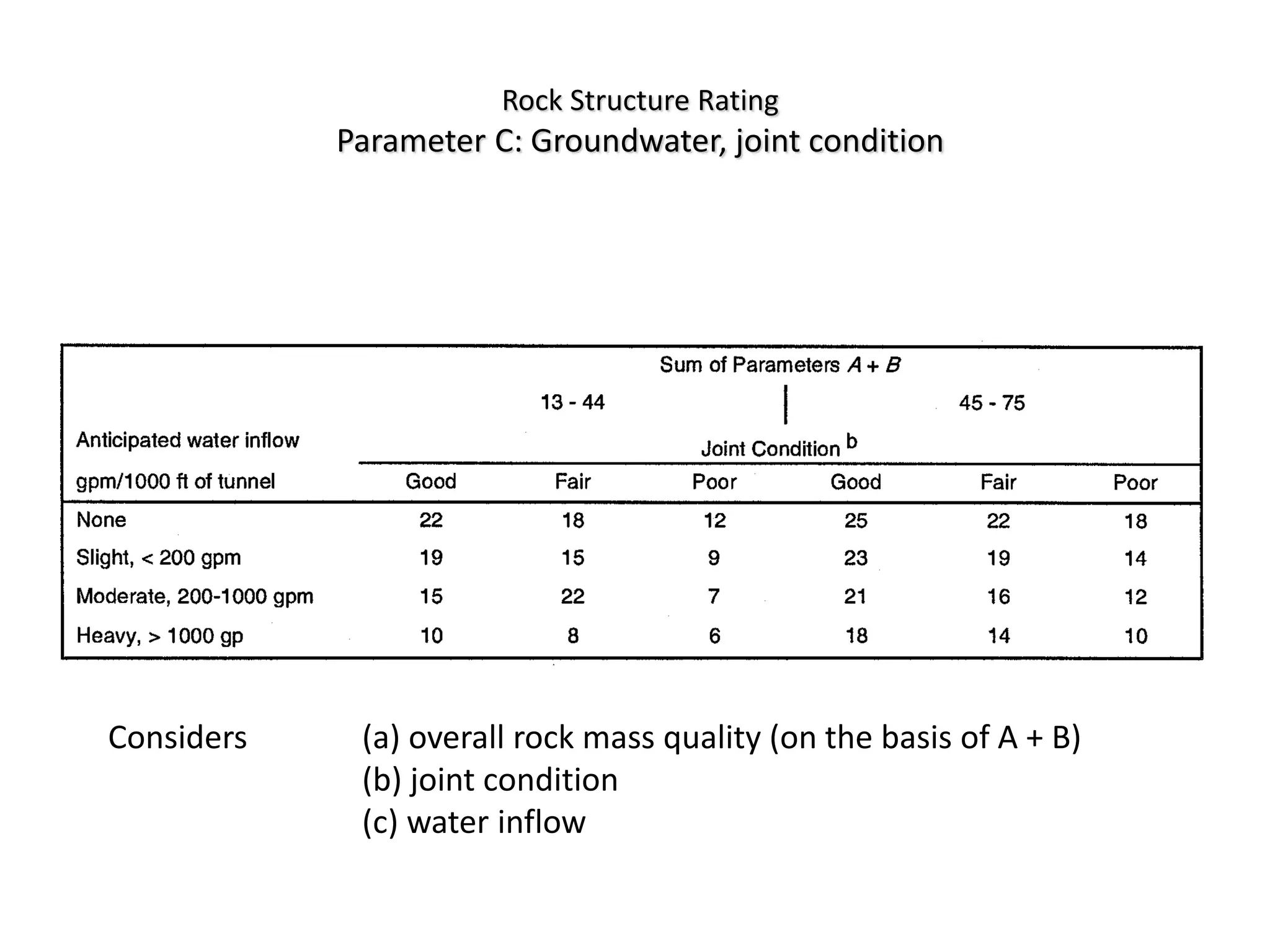
Considers (a) overall rock mass quality (on the basis of A + B)
(b) joint condition
(c) water inflow
Rock Structure Rating
Parameter C: Groundwater, joint condition
Using Rock Mass Classification Systems
• RMR and Q most widely used
• Both use similar parameters; difference in
weighting
• Q Does NOT include joint orientation
• RMR emphasizes STRUCTURAL consideration and
Orientation

Eng class rock.ppt

  • 1.
    Engineering Classification Systems forRocks INTACT ROCK ROCK MASS Rock mass refers to in situ rock with all its inherent geomechanical anisotropies
  • 2.
    Engg classification • Geologists:have a genetic bias, provide little information relating to engg behaviour • Tests which are used for engg classification are called Index Test • If right index tests are chosen, then rocks having similar index properties, irrespective of their origin, will probably exhibit similar engg performance • First Major classification by Terzaghi (1946) • After that, there have been many classification = some are oversimplified, misapplied = led to chaos, multiplicity • Last two decades = some effort done, to bring some order from the chaos
  • 3.
    Bases of EnggClassification • Lithology • Strength • Modulus of deformation • Discontinuities, Joint: spacing, inclination, orientation, roughness, groundwater flow • In situ stress
  • 4.
    Terzaghi’s Classification • Terzaghi: first to attempt classification • Bases : discontinuity, weathering Term / Description Intact = neither joints nor hair cracks Stratified = individual strata with little or no resistance against separation Moderately Jointed = blocks between joints are intimately interlocked Blocky and Seamy = rocks consists of chemically unweathered rock fragments which are entirely separated from each other Crushed = chemically unweathered, like crusher run material Squeezing = slowly advances into tunnel Swelling = expansion due to swelling capacity
  • 5.
    Disadvantage of Terzaghi’sClassification • Overlooked the properties of rocks • Granite, mudstone may belong to one group as per Terzaghi • But their mechanical properties differ significantly
  • 6.
    Grade Description LithologyFoundations VI Soil Some organic content, no original structure Unsuitable V Completely weathered Decomposed soil, some remnant structure Assess by soil testing IV Highly weathered Partly changed to soil, soil > rock Variable and unreliable III Moderately weathered Partly changes to soil, rock > soil Good for most small structures II Slightly weathered Increased fractures and mineral staining Good for anything except large dams I Fresh rock Clean rock Sound Engineering classification of weathered rock Based on Weathering
  • 7.
    Classification of IntactRock • Deere and Miller (1966) Classification of intact rock: • Bases: unconfined (uniaxial) compressive strength ( 1) • Young’s Modulus (E) – Rocks are subdivided into five strength categories on a geometric progression basis based on unconfined (uniaxial) compressive strength ( 1) Description/ Class Very high A High B Medium C Low D very low E
  • 8.
    Based on Young’sModulus (E) /Modulus Ratio Three ratio intervals are employed for the modulus ratio; high(H) – medium(M) – low(L). Rocks are therefore classed as BH (high strength- high ratio); CM (medium strength – medium ratio), etc.
  • 9.
    C-factor classification (Hansagi,1974) • Fissuration factor, C = 1/2S(p x H+k x n) • S = length of drill hole • p = number of cylindrical samples which can be obtained from cores corresponding to length S • H = height of the cylindrical samples used for compression testing • k = total length of core fragments with cylindrical heights > the core diameter • n = number of core samples
  • 10.
    Coates Classification 1. Uniaxialcom strength : Weak, Strong, Very strong 2. Pre-failure Deformation: Elastic, Viscous 3. Failure Characteristics: Brittle, Plastic 4. Gross Homogeneity: Massive, Layered 5. Continuity: Solid, Blocky, Broken
  • 11.
    USBM Classification (USBureau of Mines) • Competent Rock – excavation requires no added support • Massive-Elastic – homogeneous and isotropic • Bedded- elastic but laminated, little cohesion b/w beds • Massive-Plastic – Rocks that will have creep flow under low stress
  • 12.
    Rock Quality DesignationIndex (RQD) (Deere et al. 1967) • Aim : to provide a quantitative estimate of rock mass quality from drill logs • Equal to the percentage of intact core pieces longer than 100mm in the total length of core
  • 13.
    Rock Quality Designation(RQD) and Indices • Quality and deformability = f (discontinuity) • Core Recovery = total core recovered/length of drilling – Expressed in %, good core recovery = good quality rock – Poor core recovery = poor quality of rocks – In core recovery, all lengths of cores are counted • In RQD, only cores with >10cm length are considered • Quantitative estimate of rock mass quality from drill core logs RQD = % intact core pieces >10cm in total length of core Rock Quality Designation index, or RQD, was introduced by Don Deere in 1963. It judges rock quality based solely on measurements of recovered rock core
  • 14.
  • 15.
    Natural joint surfacevs core broken during operation • Mechanical breaking of cores caused by drilling processes • Natural joint surface
  • 16.
    Broken cores • Coresbroken during handling or drilling = fresh irregular breaks = can be fitted • Natural Joint surface – broken surface smooth, pieces cannot be fitted • For RQD determination, International Society for Rock Mechanics recommends a core size of at least 54.7 mm (NX) diameter drilled with double tube core barrels
  • 18.
    RQD RQD% A.Very poor 0– 25 B.Poor 25 – 50 C.Fair 50 – 75 D.Good 75 – 90 E.Excellent 90 - 100
  • 19.
    RQD : whencore is unavailable • RQD = 115 – 3.3 Jv, for Jv between 4.5 and 30. • For Jv < 4.5, RQD is 100%, and for Jv > 30, RQD is 0%. Jv = number of joints per m3 volume of rock mass
  • 20.
  • 21.
    RQD • Directionally dependantparameter • Intended to indicate rock mass quality in-situ • Adapted for surface exposures as ‘Jv’ number of discontinuities per unit volume • Used as a component in the RMR and Q systems • Palmstrom (1982) • Priestai Hudsona (1976) l - number of joints per unit length v J RQD 3 . 3 115     l l 1 . 0 1 . 0 1 100    e RQD
  • 22.
    Mass factor =j • j = ratio of deformation modulus of rock mass (in situ, outcrop)/ that of intact rock core comprising the same lithology • j = reflects effects of discontinuities
  • 23.
    Velocity ratio • Vcf/Vcl •Vcf = in situ (field f) compressional (c) wave velocity • Vcl = compressional (c) wave velocity in lab (l), intact rock core • Difference in Vcf and Vcl caused by structural discon
  • 24.
    Quality classification / Rock Quality Description RQD% Mass Factor,j Velocity Ratio, Vcf/Vcl Fracture frequenc y C-factor Very Poor 0-25 - 0-0.2 >15 0-0.15 Poor 25-50 <0.2 0.2-0.4 15-8 0.15- 0.30 Fair 50-75 0.2-0.5 0.4-0.6 8-5 0.30- 0.45 Good 75-90 0.5-0.8 0.6-0.8 5-1 0.45- 0.65 Excellent 90-100 0.8-1.0 0.8-1.0 <1 0.65- 1.0
  • 25.
    Multi parameter RockMass Classification Schemes • Rock Mass Structure Rating (RSR) • Rock Mass Rating (RMR) • Rock Tunnelling Quality Index (Q) • Geological Strength Index (GSI)
  • 26.
    Rock Mass Rating(RMR) / Geomechanics Claasification • Rating Concept • Weightage • Total Rating
  • 27.
    Rock Mass Rating(RMR), Geocmechanics Classification (Bieniawski,1976, 1989) • Classifies rock mass according to 6 rated parameters: – UCS (unconfined com strength) – RQD – Spacing of discontinuities – Condition of discontinuities – Groundwater conditions – Discontinuity orientation
  • 28.
    RMR or ‘GeomechanicsClassification’ RMR emphasizes STRUCTURAL consideration and Orientation
  • 29.
    Rock Mass RatingSystem 1976 to 1989 Bieniawski • System refined by greater data • Ratings for parameters changed • Adapted by other workers for different situations • PROJECT SPECIFIC SYSTEMS
  • 30.
    Development of RockMass Rating System
  • 31.
    Rock Mass RatingSystem Rating Class Description 81-100 I Very Good Rock 61-80 II Good Rock 41-60 III Fair Rock 12-40 IV Poor Rock Less than 20 V Very Poor Rock
  • 32.
    Rock Tunnelling QualityIndex, Q (or Norwegian Q system), Barton et al., 1974                      SRF Jw Ja Jr Jn RQD Q RQD = Rock Quality Designation 100 - 10 Jn = Joint set number 1 – 20 Jr = Joint roughness factor 4 -1 Ja = Joint alteration and clay fillings 1 – 20 Jw = Joint water inflow or pressure 1 – 0.1 SRF = stress reduction factor 1 – 20 Good Bad Q Range 0.001 to 1000 Exceptionally poor squeezing : 0.001 Exceptionally good unjointed Rock : 1000
  • 33.
    Q system • (RQD/Jn)= crude measure of block size • (Jr/Ja) = roughness/friction of surfaces • (Jw/SRF) = ratio of two stress parameters (active stress)                      SRF Jw Ja Jr Jn RQD Q •Q Does NOT include joint orientation Mistake in Bell New Volume/Indian Ed
  • 34.
    Guideline properties ofRock Mass Classes
  • 35.
    Rock Mass StructureRating (RSR) (1972) • Introduced the concept of rating components to arrive at a numerical value • Demonstrates the logic in a quasi-quantitative rock mass classification • Has limitations as based on small tunnels supported by steel sets only RSR = A + B + C Maximum value of RSR = 100
  • 36.
    Rock Structure Rating ParameterA: General area geology Considers (a) rock type origin (b) rock ‘hardness’ (c) geotechnical structure
  • 37.
    Considers (a) jointspacing (b) joint orientation (strike and dip) (c) direction of tunnel drive Rock Structure Rating Parameter B: Geometry : Effect of discontinuity pattern
  • 38.
    Considers (a) overallrock mass quality (on the basis of A + B) (b) joint condition (c) water inflow Rock Structure Rating Parameter C: Groundwater, joint condition
  • 39.
    Using Rock MassClassification Systems • RMR and Q most widely used • Both use similar parameters; difference in weighting • Q Does NOT include joint orientation • RMR emphasizes STRUCTURAL consideration and Orientation