Module-V
Geology of Dams and Reservoirs, Tunnels and
Bridges
• Preliminary geological survey, Influence of geological conditions on
location, alignment, Design and Type of a dam,
• Geological considerations in site selection for dams, Site improvement
techniques, dams on carbonate rocks, sedimentary.
• Rocks, folded strata and Deccan traps, favorable and unfavorable geological
conditions for reservoir site.
Prepared by-
Prof. Basweshwar S. J.
Geology of Dam Sites
• The Success of a dam is not only related to its own safety and
stability but also to the success of associated reservoirs.
• In other words, on construction, if a dam stands firmly but if its
reservoirs leaks liberally then such a dam is to be treated only as a
failure because the purpose for which it was constructed was not
served.
Prepared by-
Prof. Basweshwar S. J.
What is DAM?
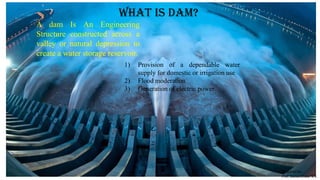
• A dam Is An Engineering Structure constructed across a valley or
natural depression to create a water storage reservoir.
• Such reservoirs are required for three main purposes-
1) Provision of a dependable water supply for domestic or irrigation
use
2) Flood moderation
3) Generation of electric power.
Prepared by-
Prof. Basweshwar S. J.
What is DAM?
A dam Is An Engineering
Structure constructed across a
valley or natural depression to
create a water storage reservoir.
1) Provision of a dependable water
supply for domestic or irrigation use
2) Flood moderation
3) Generation of electric power.
Prepared by-
Prof. Basweshwar S. J.
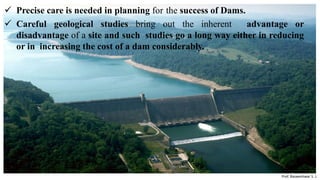
 Precise care is needed in planning for the success of Dams.
 Careful geological studies bring out the inherent advantage or
disadvantage of a site and such studies go a long way either in reducing
or in increasing the cost of a dam considerably.
Prepared by-
Prof. Basweshwar S. J.
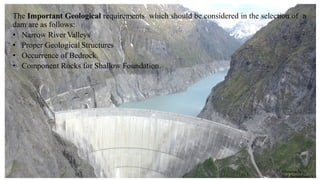
The Important Geological requirements which should be considered in the selection of a
dam are as follows:
• Narrow River Valleys
• Proper Geological Structures
• Occurrence of Bedrock.
• Component Rocks for Shallow Foundation.
Prepared by-
Prof. Basweshwar S. J.
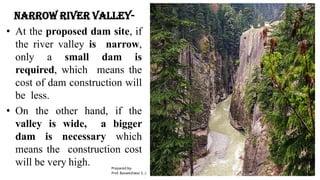
Narrow River Valley-
• At the proposed dam site, if
the river valley is narrow,
only a small dam is
required, which means the
cost of dam construction will
be less.
• On the other hand, if the
valley is wide, a bigger
dam is necessary which
means the construction cost
will be very high. Prepared by-
Prof. Basweshwar S. J.
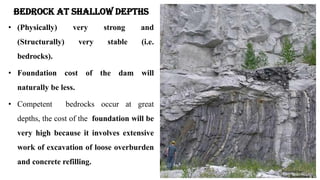
Bedrock at Shallow Depths
• (Physically) very strong and
(Structurally) very stable (i.e.
bedrocks).
• Foundation cost of the dam will
naturally be less.
• Competent bedrocks occur at great
depths, the cost of the foundation will be
very high because it involves extensive
work of excavation of loose overburden
and concrete refilling.
Prepared by-
Prof. Basweshwar S. J.
Competent Rocks for Safe
Foundation:
If Igneous rock occurs at the
selected dam site, they will offer a
safe basis, and weak sedimentary
rocks, particularly shale's, poorly
cemented sandstones and
limestone's shall naturally be
undesirable to serve as foundation
rocks. Prepared by-
Prof. Basweshwar S. J.
Factors Depends-
• The existing rock type at the dam site.
• The extent of weathering it has undergone.
• The occurrence of interruptions.
• The extent of fracturing.
• The extent of geological structures, the mode and number of rock types concerned.
Prepared by-
Prof. Basweshwar S. J.
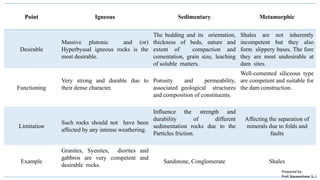
Point Igneous Sedimentary Metamorphic
Desirable
Massive plutonic and (or)
Hyperbyssal igneous rocks is the
most desirable.
The bedding and its orientation,
thickness of beds, nature and
extent of compaction and
cementation, grain size, leaching
of soluble matters.
Shales are not inherently
incompetent but they also
form slippery bases. The fore
they are most undesirable at
dam sites.
Functioning
Very strong and durable due to
their dense character.
Porosity and permeability,
associated geological structures
and composition of constituents.
Well-cemented siliceous type
are competent and suitable for
the dam construction.
Limitation
Such rocks should not have been
affected by any intense weathering.
Influence the strength and
durability of different
sedimentation rocks due to the
Particles friction.
Affecting the separation of
minerals due to folds and
faults
Example
Granites, Syenites, diorites and
gabbros are very competent and
desirable rocks.
Sandstone, Conglomerate Shales
Prepared by-
Prof. Basweshwar S. J.
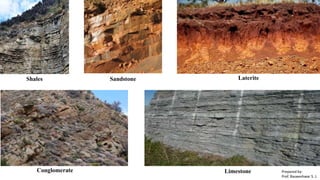
Shales Sandstone Laterite
Conglomerate Limestone Prepared by-
Prof. Basweshwar S. J.
Cases-
• Variations in their chemical and mineral composition.
• Finally it may be said that most of the igneous and
metamorphic rocks, when fresh and free from
structural defects, have enough strength to bear the
loads involved in dam of all sizes with surplus safety
factor too.
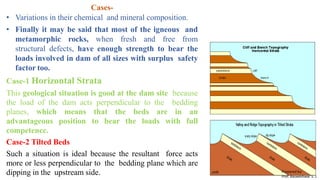
Case-1 Horizontal Strata
This geological situation is good at the dam site because
the load of the dam acts perpendicular to the bedding
planes, which means that the beds are in an
advantageous position to bear the loads with full
competence.
Case-2 Tilted Beds
Such a situation is ideal because the resultant force acts
more or less perpendicular to the bedding plane which are
dipping in the upstream side. Prepared by-
Prof. Basweshwar S. J.
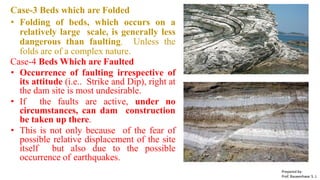
Case-3 Beds which are Folded
• Folding of beds, which occurs on a
relatively large scale, is generally less
dangerous than faulting. Unless the
folds are of a complex nature.
Case-4 Beds Which are Faulted
• Occurrence of faulting irrespective of
its attitude (i.e.. Strike and Dip), right at
the dam site is most undesirable.
• If the faults are active, under no
circumstances, can dam construction
be taken up there.
• This is not only because of the fear of
possible relative displacement of the site
itself but also due to the possible
occurrence of earthquakes.
Prepared by-
Prof. Basweshwar S. J.
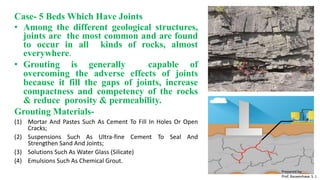
Case- 5 Beds Which Have Joints
• Among the different geological structures,
joints are the most common and are found
to occur in all kinds of rocks, almost
everywhere.
• Grouting is generally capable of
overcoming the adverse effects of joints
because it fill the gaps of joints, increase
compactness and competency of the rocks
& reduce porosity & permeability.
Grouting Materials-
(1) Mortar And Pastes Such As Cement To Fill In Holes Or Open
Cracks;
(2) Suspensions Such As Ultra-fine Cement To Seal And
Strengthen Sand And Joints;
(3) Solutions Such As Water Glass (Silicate)
(4) Emulsions Such As Chemical Grout.
Prepared by-
Prof. Basweshwar S. J.
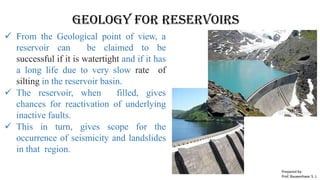
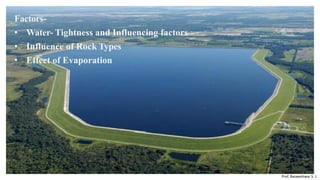
GEOLOGY FOR Reservoirs
 From the Geological point of view, a
reservoir can be claimed to be
successful if it is watertight and if it has
a long life due to very slow rate of
silting in the reservoir basin.
 The reservoir, when filled, gives
chances for reactivation of underlying
inactive faults.
 This in turn, gives scope for the
occurrence of seismicity and landslides
in that region.
Prepared by-
Prof. Basweshwar S. J.
Factors-
• Water- Tightness and Influencing factors
• Influence of Rock Types
• Effect of Evaporation
Prepared by-
Prof. Basweshwar S. J.
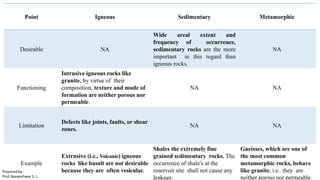
Point Igneous Sedimentary Metamorphic
Desirable NA
Wide areal extent and
frequency of occurrence,
sedimentary rocks are the more
important in this regard than
igneous rocks.
NA
Functioning
Intrusive igneous rocks like
granite, by virtue of their
composition, texture and mode of
formation are neither porous nor
permeable.
NA NA
Limitation
Defects like joints, faults, or shear
zones.
NA NA
Example
Extrusive (i.e.. Volcanic) igneous
rocks like basalt are not desirable
because they are often vesicular.
Shales the extremely fine
grained sedimentary rocks. The
occurrence of shale's at the
reservoir site shall not cause any
leakage.
Gneisses, which are one of
the most common
metamorphic rocks, behave
like granite, i.e.. they are
neither porous nor permeable.
Prepared by-
Prof. Basweshwar S. J.
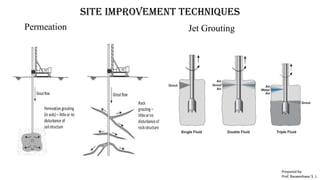
Site improvement techniques
Permeation Jet Grouting
Prepared by-
Prof. Basweshwar S. J.
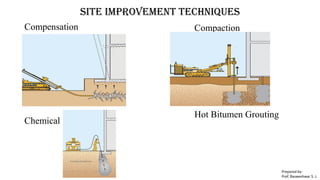
Site improvement techniques
Compensation
Chemical
Compaction
Hot Bitumen Grouting
Prepared by-
Prof. Basweshwar S. J.
Prepared by-
Prof. Basweshwar S. J.
Prepared by-
Prof. Basweshwar S. J.
GEOLOGYFORTunnels
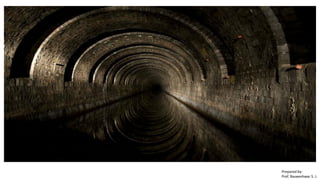
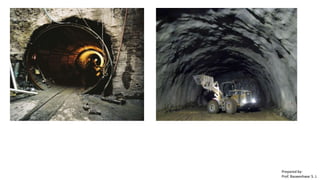
• Tunnels are underground passages or routes used for different purposes.
• They are made by excavation of rocks below the surface or through
the hills or mountains.
• Like dams, bridges and reservoirs, tunnels are also very important
civil engineering projects, but with some differences.
• Unlike other civil engineering constructions which lie on the surface,
generally, tunnels lie underground (i.e.. within the rocks). For this
reason, the needs for their safety and stability is much more important.
Prepared by-
Prof. Basweshwar S. J.
Effects Of Tunneling On The Ground
• The tunneling process deteriorates the physical conditions of the
ground.
• This happens because due to heavy and repeated blasting excavation,
the rocks gets shattered to great extent and develop numerous
cracks and fractures.
• This reduces the cohesiveness and compactness of rocks.
• In other words, rocks becomes loose and more fractured and
porous. This naturally adversely affects the competence of the
rocks concerned.
Prepared by-
Prof. Basweshwar S. J.
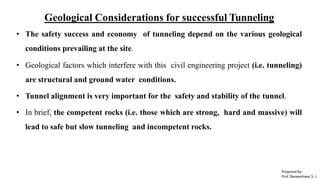
Geological Considerations for successful Tunneling
• The safety success and economy of tunneling depend on the various geological
conditions prevailing at the site.
• Geological factors which interfere with this civil engineering project (i.e. tunneling)
are structural and ground water conditions.
• Tunnel alignment is very important for the safety and stability of the tunnel.
• In brief, the competent rocks (i.e. those which are strong, hard and massive) will
lead to safe but slow tunneling and incompetent rocks.
Prepared by-
Prof. Basweshwar S. J.
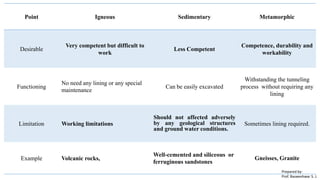
Point Igneous Sedimentary Metamorphic
Desirable
Very competent but difficult to
work
Less Competent
Competence, durability and
workability
Functioning
No need any lining or any special
maintenance
Can be easily excavated
Withstanding the tunneling
process without requiring any
lining
Limitation Working limitations
Should not affected adversely
by any geological structures
and ground water conditions.
Sometimes lining required.
Example Volcanic rocks,
Well-cemented and siliceous or
ferruginous sandstones
Gneisses, Granite
Prepared by-
Prof. Basweshwar S. J.
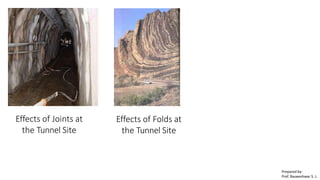
Effects of Joints at
the Tunnel Site
Effects of Folds at
the Tunnel Site
Prepared by-
Prof. Basweshwar S. J.
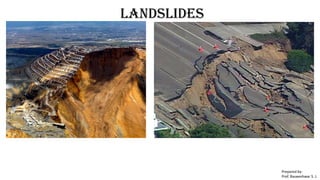
Landslides
Prepared by-
Prof. Basweshwar S. J.

MODULE 5 EG.pdf

  • 1.
  • 2.
    Geology of Damsand Reservoirs, Tunnels and Bridges • Preliminary geological survey, Influence of geological conditions on location, alignment, Design and Type of a dam, • Geological considerations in site selection for dams, Site improvement techniques, dams on carbonate rocks, sedimentary. • Rocks, folded strata and Deccan traps, favorable and unfavorable geological conditions for reservoir site. Prepared by- Prof. Basweshwar S. J.
  • 3.
    Geology of DamSites • The Success of a dam is not only related to its own safety and stability but also to the success of associated reservoirs. • In other words, on construction, if a dam stands firmly but if its reservoirs leaks liberally then such a dam is to be treated only as a failure because the purpose for which it was constructed was not served. Prepared by- Prof. Basweshwar S. J.
  • 4.
    What is DAM? •A dam Is An Engineering Structure constructed across a valley or natural depression to create a water storage reservoir. • Such reservoirs are required for three main purposes- 1) Provision of a dependable water supply for domestic or irrigation use 2) Flood moderation 3) Generation of electric power. Prepared by- Prof. Basweshwar S. J.
  • 5.
    What is DAM? Adam Is An Engineering Structure constructed across a valley or natural depression to create a water storage reservoir. 1) Provision of a dependable water supply for domestic or irrigation use 2) Flood moderation 3) Generation of electric power. Prepared by- Prof. Basweshwar S. J.
  • 6.
     Precise careis needed in planning for the success of Dams.  Careful geological studies bring out the inherent advantage or disadvantage of a site and such studies go a long way either in reducing or in increasing the cost of a dam considerably. Prepared by- Prof. Basweshwar S. J.
  • 7.
    The Important Geologicalrequirements which should be considered in the selection of a dam are as follows: • Narrow River Valleys • Proper Geological Structures • Occurrence of Bedrock. • Component Rocks for Shallow Foundation. Prepared by- Prof. Basweshwar S. J.
  • 8.
    Narrow River Valley- •At the proposed dam site, if the river valley is narrow, only a small dam is required, which means the cost of dam construction will be less. • On the other hand, if the valley is wide, a bigger dam is necessary which means the construction cost will be very high. Prepared by- Prof. Basweshwar S. J.
  • 9.
    Bedrock at ShallowDepths • (Physically) very strong and (Structurally) very stable (i.e. bedrocks). • Foundation cost of the dam will naturally be less. • Competent bedrocks occur at great depths, the cost of the foundation will be very high because it involves extensive work of excavation of loose overburden and concrete refilling. Prepared by- Prof. Basweshwar S. J.
  • 10.
    Competent Rocks forSafe Foundation: If Igneous rock occurs at the selected dam site, they will offer a safe basis, and weak sedimentary rocks, particularly shale's, poorly cemented sandstones and limestone's shall naturally be undesirable to serve as foundation rocks. Prepared by- Prof. Basweshwar S. J.
  • 11.
    Factors Depends- • Theexisting rock type at the dam site. • The extent of weathering it has undergone. • The occurrence of interruptions. • The extent of fracturing. • The extent of geological structures, the mode and number of rock types concerned. Prepared by- Prof. Basweshwar S. J.
  • 12.
    Point Igneous SedimentaryMetamorphic Desirable Massive plutonic and (or) Hyperbyssal igneous rocks is the most desirable. The bedding and its orientation, thickness of beds, nature and extent of compaction and cementation, grain size, leaching of soluble matters. Shales are not inherently incompetent but they also form slippery bases. The fore they are most undesirable at dam sites. Functioning Very strong and durable due to their dense character. Porosity and permeability, associated geological structures and composition of constituents. Well-cemented siliceous type are competent and suitable for the dam construction. Limitation Such rocks should not have been affected by any intense weathering. Influence the strength and durability of different sedimentation rocks due to the Particles friction. Affecting the separation of minerals due to folds and faults Example Granites, Syenites, diorites and gabbros are very competent and desirable rocks. Sandstone, Conglomerate Shales Prepared by- Prof. Basweshwar S. J.
  • 13.
    Shales Sandstone Laterite ConglomerateLimestone Prepared by- Prof. Basweshwar S. J.
  • 14.
    Cases- • Variations intheir chemical and mineral composition. • Finally it may be said that most of the igneous and metamorphic rocks, when fresh and free from structural defects, have enough strength to bear the loads involved in dam of all sizes with surplus safety factor too. Case-1 Horizontal Strata This geological situation is good at the dam site because the load of the dam acts perpendicular to the bedding planes, which means that the beds are in an advantageous position to bear the loads with full competence. Case-2 Tilted Beds Such a situation is ideal because the resultant force acts more or less perpendicular to the bedding plane which are dipping in the upstream side. Prepared by- Prof. Basweshwar S. J.
  • 15.
    Case-3 Beds whichare Folded • Folding of beds, which occurs on a relatively large scale, is generally less dangerous than faulting. Unless the folds are of a complex nature. Case-4 Beds Which are Faulted • Occurrence of faulting irrespective of its attitude (i.e.. Strike and Dip), right at the dam site is most undesirable. • If the faults are active, under no circumstances, can dam construction be taken up there. • This is not only because of the fear of possible relative displacement of the site itself but also due to the possible occurrence of earthquakes. Prepared by- Prof. Basweshwar S. J.
  • 16.
    Case- 5 BedsWhich Have Joints • Among the different geological structures, joints are the most common and are found to occur in all kinds of rocks, almost everywhere. • Grouting is generally capable of overcoming the adverse effects of joints because it fill the gaps of joints, increase compactness and competency of the rocks & reduce porosity & permeability. Grouting Materials- (1) Mortar And Pastes Such As Cement To Fill In Holes Or Open Cracks; (2) Suspensions Such As Ultra-fine Cement To Seal And Strengthen Sand And Joints; (3) Solutions Such As Water Glass (Silicate) (4) Emulsions Such As Chemical Grout. Prepared by- Prof. Basweshwar S. J.
  • 17.
    GEOLOGY FOR Reservoirs From the Geological point of view, a reservoir can be claimed to be successful if it is watertight and if it has a long life due to very slow rate of silting in the reservoir basin.  The reservoir, when filled, gives chances for reactivation of underlying inactive faults.  This in turn, gives scope for the occurrence of seismicity and landslides in that region. Prepared by- Prof. Basweshwar S. J.
  • 18.
    Factors- • Water- Tightnessand Influencing factors • Influence of Rock Types • Effect of Evaporation Prepared by- Prof. Basweshwar S. J.
  • 19.
    Point Igneous SedimentaryMetamorphic Desirable NA Wide areal extent and frequency of occurrence, sedimentary rocks are the more important in this regard than igneous rocks. NA Functioning Intrusive igneous rocks like granite, by virtue of their composition, texture and mode of formation are neither porous nor permeable. NA NA Limitation Defects like joints, faults, or shear zones. NA NA Example Extrusive (i.e.. Volcanic) igneous rocks like basalt are not desirable because they are often vesicular. Shales the extremely fine grained sedimentary rocks. The occurrence of shale's at the reservoir site shall not cause any leakage. Gneisses, which are one of the most common metamorphic rocks, behave like granite, i.e.. they are neither porous nor permeable. Prepared by- Prof. Basweshwar S. J.
  • 20.
    Site improvement techniques PermeationJet Grouting Prepared by- Prof. Basweshwar S. J.
  • 21.
    Site improvement techniques Compensation Chemical Compaction HotBitumen Grouting Prepared by- Prof. Basweshwar S. J.
  • 22.
  • 23.
  • 24.
    GEOLOGYFORTunnels • Tunnels areunderground passages or routes used for different purposes. • They are made by excavation of rocks below the surface or through the hills or mountains. • Like dams, bridges and reservoirs, tunnels are also very important civil engineering projects, but with some differences. • Unlike other civil engineering constructions which lie on the surface, generally, tunnels lie underground (i.e.. within the rocks). For this reason, the needs for their safety and stability is much more important. Prepared by- Prof. Basweshwar S. J.
  • 25.
    Effects Of TunnelingOn The Ground • The tunneling process deteriorates the physical conditions of the ground. • This happens because due to heavy and repeated blasting excavation, the rocks gets shattered to great extent and develop numerous cracks and fractures. • This reduces the cohesiveness and compactness of rocks. • In other words, rocks becomes loose and more fractured and porous. This naturally adversely affects the competence of the rocks concerned. Prepared by- Prof. Basweshwar S. J.
  • 26.
    Geological Considerations forsuccessful Tunneling • The safety success and economy of tunneling depend on the various geological conditions prevailing at the site. • Geological factors which interfere with this civil engineering project (i.e. tunneling) are structural and ground water conditions. • Tunnel alignment is very important for the safety and stability of the tunnel. • In brief, the competent rocks (i.e. those which are strong, hard and massive) will lead to safe but slow tunneling and incompetent rocks. Prepared by- Prof. Basweshwar S. J.
  • 27.
    Point Igneous SedimentaryMetamorphic Desirable Very competent but difficult to work Less Competent Competence, durability and workability Functioning No need any lining or any special maintenance Can be easily excavated Withstanding the tunneling process without requiring any lining Limitation Working limitations Should not affected adversely by any geological structures and ground water conditions. Sometimes lining required. Example Volcanic rocks, Well-cemented and siliceous or ferruginous sandstones Gneisses, Granite Prepared by- Prof. Basweshwar S. J.
  • 28.
    Effects of Jointsat the Tunnel Site Effects of Folds at the Tunnel Site Prepared by- Prof. Basweshwar S. J.
  • 29.