ASSIGNMENT 1 
EXPERIENTIAL LEARNING IN 
MATHEMATICS 
Submitted by, 
GANESH KRISHNAN G 
B.Ed MATHEMATICS 
Roll No. 122 
N.S.S. T.C PANDALAM
EXPERIENTIAL LEARNING 
Experiential learning means Learning based on experience. 
Experiential learning is the process of making meaning from 
direct experience. Knowledge is continuously gained thought 
both personal and environmental experiences. 
IMPORTANTS OF EXPERIENTIAL LEARNING 
 Learning by doing : In Experiential Learning , the 
Learns by being part of the experiential 
 Thoroughness of learning : Experiential learning 
helps the students to learn the concepts quite 
thoroughly .This is based on the principals : “ 
Practice makes humans perfect ” 
 Immediacy of learning: In experiential learning, 
the learning is quiet. This can be seen from the 
example of on the hands computer training 
where the skills are learnt quickly. 
 Retention: Experiential learning helps in good 
retention of the concepts. 
 Joy of learning: Experiential learning adds joy to 
the learning process. Students are actively 
involved in the experiential learning.
 Interactive Learning: Experiential learning leads 
to enthusiastic interaction among teachers and 
learners. This interaction adds value to the 
process of learning. 
 Creativity: Provide creativity of the learner. 
Role of the teacher 
1. To provide emotional help and support in fostering 
experiential learning. 
2. To set –up learning experience which encourages 
students to reflect upon their own feelings, ideas 
and values. 
3. Teacher should be creates learning opportunities. 
4. To inculcate the values of life like co- operation, live 
of justices, love of truths and appreciating the 
contributions of others. 
5. Providing a supportive social context for learning. 
6. To modify learning tasks in the right of pupil 
circumstances. 
7. Teacher should encourage interaction between the 
students. 
8. Teacher provides motivation to the students. 
9. Teacher creates a climate in which pupils can work 
with sense of security and self confidence.
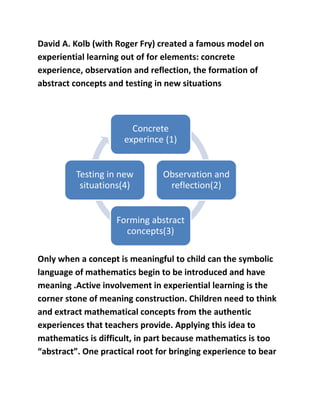
David A. Kolb (with Roger Fry) created a famous model on 
experiential learning out of for elements: concrete 
experience, observation and reflection, the formation of 
abstract concepts and testing in new situations 
Concrete 
experince (1) 
Observation and 
reflection(2) 
Testing in new 
situations(4) 
Forming abstract 
concepts(3) 
Only when a concept is meaningful to child can the symbolic 
language of mathematics begin to be introduced and have 
meaning .Active involvement in experiential learning is the 
corner stone of meaning construction. Children need to think 
and extract mathematical concepts from the authentic 
experiences that teachers provide. Applying this idea to 
mathematics is difficult, in part because mathematics is too 
“abstract”. One practical root for bringing experience to bear
on students mathematical understanding, is the use of 
manipulatives. 
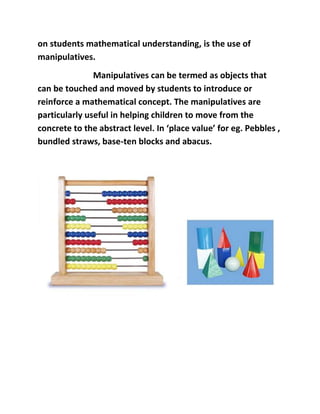
Manipulatives can be termed as objects that 
can be touched and moved by students to introduce or 
reinforce a mathematical concept. The manipulatives are 
particularly useful in helping children to move from the 
concrete to the abstract level. In ‘place value’ for eg. Pebbles , 
bundled straws, base-ten blocks and abacus.
Experiential Learning and Problem Solving 
Experiential learning involves observing the phenomenon and 
doing something meaningful with it through an active 
participation. it emphasizes learning in which the learner is 
directly in touch with the phenomenon being studied, rather 
than just watching it or reading, learning or thinking about it. 
Experience gives food for reflective thinking is the base for 
active problem solving. 
In a problematic situation knowledge is continuously 
gained through both personal and environmental experiences. 
In order to understand the problem well certain abilities 
are required; 
 The learner must be willing to be actively involved in the 
experience. 
 The learner must be reflect on the experience. 
 The learner must possess and use analytical skills to 
conceptualize the experience. 
 The learner must possess decision making and problem 
solving skills to use the new ideas gained from the 
experience.
CONCLUSION 
Experiential learning is subjective, concrete, interactive and 
complex. The primary focus of the concepts discussed are 
increasing the efficiency of learners in information and 
experience into learning, enhancing retentions of learning, 
enhancing transfer of knowledge and skills to new contents 
and situations, and helping students take greater 
responsibility for their own learning. As experiential learning 
is more of a teaching philosophy than a scientific theory, it is 
important for the educator to recognize that there is very 
little evidence from cognitive science that provide theoretical 
or objective conformation or denial of the key tenets of 
experiential learning.

Online assignment

  • 1.
    ASSIGNMENT 1 EXPERIENTIALLEARNING IN MATHEMATICS Submitted by, GANESH KRISHNAN G B.Ed MATHEMATICS Roll No. 122 N.S.S. T.C PANDALAM
  • 2.
    EXPERIENTIAL LEARNING Experientiallearning means Learning based on experience. Experiential learning is the process of making meaning from direct experience. Knowledge is continuously gained thought both personal and environmental experiences. IMPORTANTS OF EXPERIENTIAL LEARNING  Learning by doing : In Experiential Learning , the Learns by being part of the experiential  Thoroughness of learning : Experiential learning helps the students to learn the concepts quite thoroughly .This is based on the principals : “ Practice makes humans perfect ”  Immediacy of learning: In experiential learning, the learning is quiet. This can be seen from the example of on the hands computer training where the skills are learnt quickly.  Retention: Experiential learning helps in good retention of the concepts.  Joy of learning: Experiential learning adds joy to the learning process. Students are actively involved in the experiential learning.
  • 3.
     Interactive Learning:Experiential learning leads to enthusiastic interaction among teachers and learners. This interaction adds value to the process of learning.  Creativity: Provide creativity of the learner. Role of the teacher 1. To provide emotional help and support in fostering experiential learning. 2. To set –up learning experience which encourages students to reflect upon their own feelings, ideas and values. 3. Teacher should be creates learning opportunities. 4. To inculcate the values of life like co- operation, live of justices, love of truths and appreciating the contributions of others. 5. Providing a supportive social context for learning. 6. To modify learning tasks in the right of pupil circumstances. 7. Teacher should encourage interaction between the students. 8. Teacher provides motivation to the students. 9. Teacher creates a climate in which pupils can work with sense of security and self confidence.
  • 4.
    David A. Kolb(with Roger Fry) created a famous model on experiential learning out of for elements: concrete experience, observation and reflection, the formation of abstract concepts and testing in new situations Concrete experince (1) Observation and reflection(2) Testing in new situations(4) Forming abstract concepts(3) Only when a concept is meaningful to child can the symbolic language of mathematics begin to be introduced and have meaning .Active involvement in experiential learning is the corner stone of meaning construction. Children need to think and extract mathematical concepts from the authentic experiences that teachers provide. Applying this idea to mathematics is difficult, in part because mathematics is too “abstract”. One practical root for bringing experience to bear
  • 5.
    on students mathematicalunderstanding, is the use of manipulatives. Manipulatives can be termed as objects that can be touched and moved by students to introduce or reinforce a mathematical concept. The manipulatives are particularly useful in helping children to move from the concrete to the abstract level. In ‘place value’ for eg. Pebbles , bundled straws, base-ten blocks and abacus.
  • 6.
    Experiential Learning andProblem Solving Experiential learning involves observing the phenomenon and doing something meaningful with it through an active participation. it emphasizes learning in which the learner is directly in touch with the phenomenon being studied, rather than just watching it or reading, learning or thinking about it. Experience gives food for reflective thinking is the base for active problem solving. In a problematic situation knowledge is continuously gained through both personal and environmental experiences. In order to understand the problem well certain abilities are required;  The learner must be willing to be actively involved in the experience.  The learner must be reflect on the experience.  The learner must possess and use analytical skills to conceptualize the experience.  The learner must possess decision making and problem solving skills to use the new ideas gained from the experience.
  • 7.
    CONCLUSION Experiential learningis subjective, concrete, interactive and complex. The primary focus of the concepts discussed are increasing the efficiency of learners in information and experience into learning, enhancing retentions of learning, enhancing transfer of knowledge and skills to new contents and situations, and helping students take greater responsibility for their own learning. As experiential learning is more of a teaching philosophy than a scientific theory, it is important for the educator to recognize that there is very little evidence from cognitive science that provide theoretical or objective conformation or denial of the key tenets of experiential learning.