 Defined contrived experiences
 Example of contrived experiences
 Why do we use contrived experiences
 Purposes of simulation and games
 Learn to reflect and extend
knowledge
Contrived experiences
Are edited copies of reality and used as substitutes
for real things when it is not feasible to bring the
real thing to bring the real thing to the class.
These include models, mock ups, specimens,
objects, simulations and games.
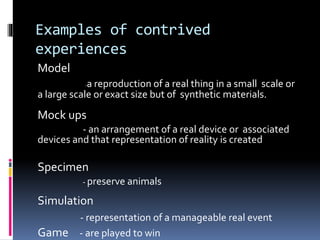
Examples of contrived
experiences
Model
-a reproduction of a real thing in a small scale or
a large scale or exact size but of synthetic materials.
Mock ups
- an arrangement of a real device or associated
devices and that representation of reality is created
Specimen
- preserve animals
Simulation
- representation of a manageable real event
Game - are played to win
why do we make use of
contrived experience
 Overcome limitation of space and time
 To edit reality for us to be be to focus on
parts or a process of a system that we intend
to study
 To overcome difficulties of size
 to understand the inaccessible
 Help the learners understand abstractions
Purposes of simulation and
games in education
 To develop changes in attitudes
 To change specific behaiviors
 To prepare participants
 To help individuals understanding their current
role
 To increase the student their current roles
 To reduce complex problems or situations to
manageable elements
 To illustrates roles that may effects ones life but
that one may never assume
 To motivate learners to develop analytical
processes
 To sensitize individuals to another person’s life
role
Purposes of games
 To practice and or to refined skills already
acquired
 To identify gaps or weaknesses in knowledge or
skills
 To serve as a summation
 To develop new relationships among concepts
and principles
Learn to reflect and extend
knowledge
 Actively engaging in instructor-student or
student-student conversations needed to
conduct a simulation
 Transfer knowledge to new problems and
situations.
 Understanding and refining their own though
processes
 Seeing social processes and social interactions in
action
IMPORTANCE OF CONTRIVED
EXPERIENCES?
Thank you
by: Precila G. Abon

Contrived experiences.pptx-new

  • 2.
     Defined contrivedexperiences  Example of contrived experiences  Why do we use contrived experiences  Purposes of simulation and games  Learn to reflect and extend knowledge
  • 3.
    Contrived experiences Are editedcopies of reality and used as substitutes for real things when it is not feasible to bring the real thing to bring the real thing to the class. These include models, mock ups, specimens, objects, simulations and games.
  • 4.
    Examples of contrived experiences Model -areproduction of a real thing in a small scale or a large scale or exact size but of synthetic materials. Mock ups - an arrangement of a real device or associated devices and that representation of reality is created Specimen - preserve animals Simulation - representation of a manageable real event Game - are played to win
  • 5.
    why do wemake use of contrived experience  Overcome limitation of space and time  To edit reality for us to be be to focus on parts or a process of a system that we intend to study  To overcome difficulties of size  to understand the inaccessible  Help the learners understand abstractions
  • 6.
    Purposes of simulationand games in education  To develop changes in attitudes  To change specific behaiviors  To prepare participants  To help individuals understanding their current role
  • 7.
     To increasethe student their current roles  To reduce complex problems or situations to manageable elements  To illustrates roles that may effects ones life but that one may never assume  To motivate learners to develop analytical processes  To sensitize individuals to another person’s life role
  • 8.
    Purposes of games To practice and or to refined skills already acquired  To identify gaps or weaknesses in knowledge or skills  To serve as a summation  To develop new relationships among concepts and principles
  • 9.
    Learn to reflectand extend knowledge  Actively engaging in instructor-student or student-student conversations needed to conduct a simulation  Transfer knowledge to new problems and situations.  Understanding and refining their own though processes  Seeing social processes and social interactions in action
  • 10.
  • 11.