 Active learning (AL) - popularized by Bonwell and Eison
 AL - instruction techniques that focus the responsibility of learning on
learners
 Advantage
 marriage of all there domains of learning
 engages learners in higher-order thinking tasks It also
 Helps remember better
 Class discussion
 Think-pair-share
 Learning cell
 Short written exercise
 Collaborative learning group
 Student debate
 Class game
 Role plays
 Learning by teaching
 Journal writing
 When shouldAL exercises be used during instruction
 Large classes (class management)
 Time constraint (preparation and class time)
 Limitations of fixed seating classrooms
 Slow learners
 How to cope with passive students
 Ensuring all students are engaged
 What are your objectives for the activity?
 Who will be interacting?Will students pair up with someone beside them
or someone sitting behind/in front of them? Should they pair up with
someone with a different background? Someone they don't know yet?
 When does the activity occur during the class? Beginning? Middle? End?
How much time are you willing to spend on it?
 Will students write down their answers/ideas/questions or just discuss
them?
 Will students turn in the responses or not? If they are asked to turn them
in, should they put their names on them?
 Will you give individuals a minute or so to reflect on the answer before
discussing it or will they just jump right into a discussion?
 Will you grade their responses or not?
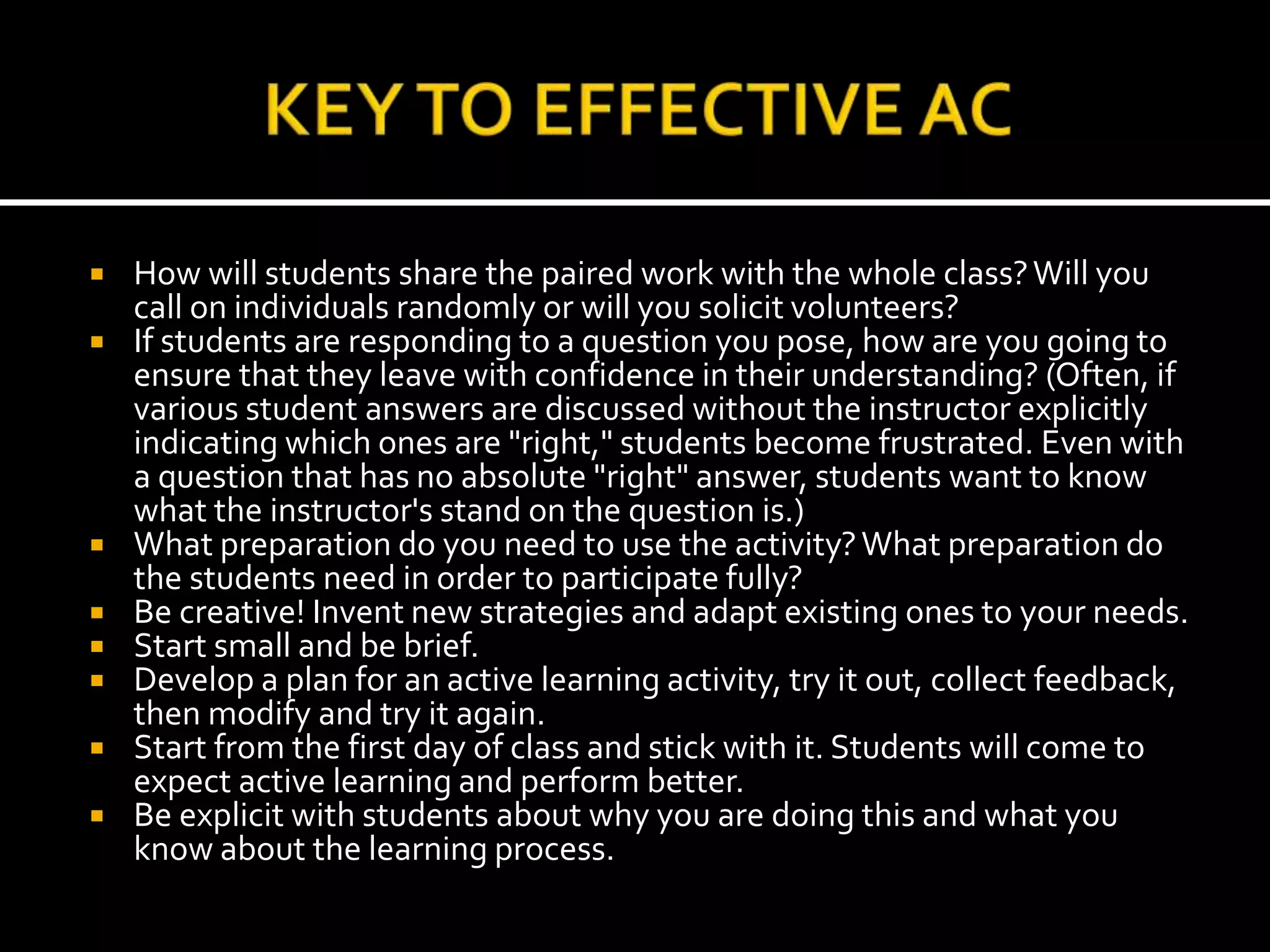
 How will students share the paired work with the whole class?Will you
call on individuals randomly or will you solicit volunteers?
 How will students share the paired work with the whole class?Will you
call on individuals randomly or will you solicit volunteers?
 If students are responding to a question you pose, how are you going to
ensure that they leave with confidence in their understanding? (Often, if
various student answers are discussed without the instructor explicitly
indicating which ones are "right," students become frustrated. Even with
a question that has no absolute "right" answer, students want to know
what the instructor's stand on the question is.)
 What preparation do you need to use the activity?What preparation do
the students need in order to participate fully?
 Be creative! Invent new strategies and adapt existing ones to your needs.
 Start small and be brief.
 Develop a plan for an active learning activity, try it out, collect feedback,
then modify and try it again.
 Start from the first day of class and stick with it. Students will come to
expect active learning and perform better.
 Be explicit with students about why you are doing this and what you
know about the learning process.
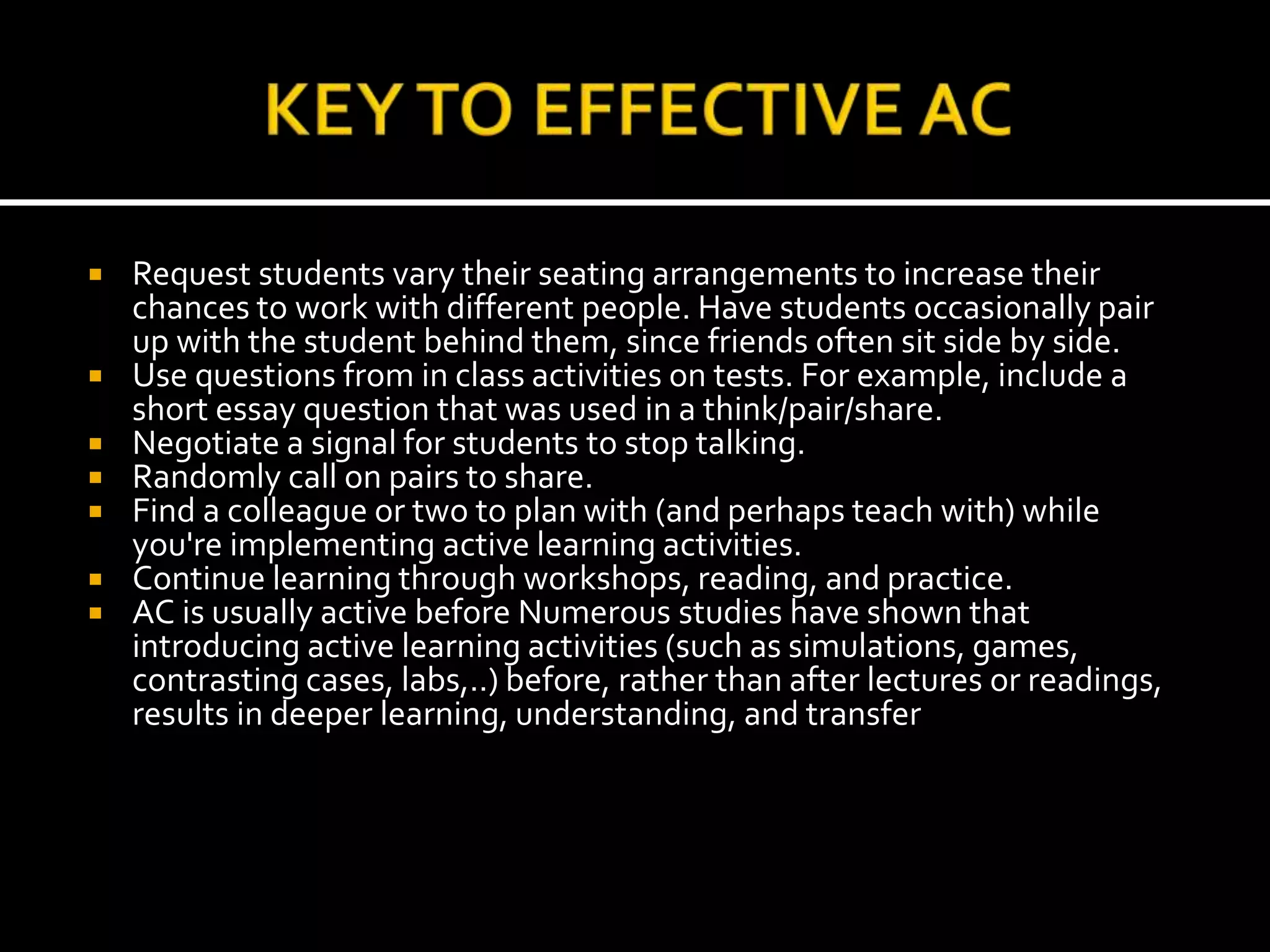
 Request students vary their seating arrangements to increase their
chances to work with different people. Have students occasionally pair
up with the student behind them, since friends often sit side by side.
 Use questions from in class activities on tests. For example, include a
short essay question that was used in a think/pair/share.
 Negotiate a signal for students to stop talking.
 Randomly call on pairs to share.
 Find a colleague or two to plan with (and perhaps teach with) while
you're implementing active learning activities.
 Continue learning through workshops, reading, and practice.
 AC is usually active before Numerous studies have shown that
introducing active learning activities (such as simulations, games,
contrasting cases, labs,..) before, rather than after lectures or readings,
results in deeper learning, understanding, and transfer

What is active learning

  • 1.
     Active learning(AL) - popularized by Bonwell and Eison  AL - instruction techniques that focus the responsibility of learning on learners  Advantage  marriage of all there domains of learning  engages learners in higher-order thinking tasks It also  Helps remember better
  • 2.
     Class discussion Think-pair-share  Learning cell  Short written exercise  Collaborative learning group  Student debate  Class game  Role plays  Learning by teaching  Journal writing
  • 3.
     When shouldALexercises be used during instruction  Large classes (class management)  Time constraint (preparation and class time)  Limitations of fixed seating classrooms  Slow learners  How to cope with passive students  Ensuring all students are engaged
  • 4.
     What areyour objectives for the activity?  Who will be interacting?Will students pair up with someone beside them or someone sitting behind/in front of them? Should they pair up with someone with a different background? Someone they don't know yet?  When does the activity occur during the class? Beginning? Middle? End? How much time are you willing to spend on it?  Will students write down their answers/ideas/questions or just discuss them?  Will students turn in the responses or not? If they are asked to turn them in, should they put their names on them?  Will you give individuals a minute or so to reflect on the answer before discussing it or will they just jump right into a discussion?  Will you grade their responses or not?  How will students share the paired work with the whole class?Will you call on individuals randomly or will you solicit volunteers?
  • 5.
     How willstudents share the paired work with the whole class?Will you call on individuals randomly or will you solicit volunteers?  If students are responding to a question you pose, how are you going to ensure that they leave with confidence in their understanding? (Often, if various student answers are discussed without the instructor explicitly indicating which ones are "right," students become frustrated. Even with a question that has no absolute "right" answer, students want to know what the instructor's stand on the question is.)  What preparation do you need to use the activity?What preparation do the students need in order to participate fully?  Be creative! Invent new strategies and adapt existing ones to your needs.  Start small and be brief.  Develop a plan for an active learning activity, try it out, collect feedback, then modify and try it again.  Start from the first day of class and stick with it. Students will come to expect active learning and perform better.  Be explicit with students about why you are doing this and what you know about the learning process.
  • 6.
     Request studentsvary their seating arrangements to increase their chances to work with different people. Have students occasionally pair up with the student behind them, since friends often sit side by side.  Use questions from in class activities on tests. For example, include a short essay question that was used in a think/pair/share.  Negotiate a signal for students to stop talking.  Randomly call on pairs to share.  Find a colleague or two to plan with (and perhaps teach with) while you're implementing active learning activities.  Continue learning through workshops, reading, and practice.  AC is usually active before Numerous studies have shown that introducing active learning activities (such as simulations, games, contrasting cases, labs,..) before, rather than after lectures or readings, results in deeper learning, understanding, and transfer