Maximizing Solar Power Plant Efficiency: The
Benefits of an IoT-Based Monitoring and Prevention
System
ABSTRACT
• To harness reliable energy efficiently, the photovoltaic panels system must
remain in its best condition. This requires continuous maintenance and
monitoring. However, in case of weather dependable energy yield change.
• This requires continuous maintenance and monitoring. However, in case of
weather dependable energy yield change.
• We proposed a novel real-time monitoring system utilizing a small but
efficient articial neural network that is adequate to run on a low-cost system
• To environmental conditions, or is not normal because of faulty, or shaded,
or dust-covered panel, an intelligent monitoring system is required.
• The presented PV monitoring system can identify if the photovoltaic panel
exhibit degradation due to fault conditions.
INTRODUCTION
• The fast-ever-growing energy demands and the global environmental issues
necessitate the use of renewable resources.
• Among renewable energy yielding technologies, Solar panels are of the
greatest future projection.
• An intelligent reference analytical module for real-time individual
photovoltaic panel monitoring based on the articial neural network.
• We discuss the system overall implementation, the mathematical module
behind its intelligent reference model, and its hardware implementation.
• The contribution of solar PV energy increased remarkably compared to the
previous four decades. Nowadays, PV energy represents the third-largest
source of renewable energy after wind and hydro
LITERATURE SURVEY
S.NO TITLE AUTHOR & YEAR DESCRIPTION
1 Evaluation of
renewable energy
sources in
peripheral areas
and renewable
energy-based rural
development
Jozsef Benedek,
Tihamer-Tibor
Sebestyen
2021
The renewable energy
potential maps, combined with
a multidimensional index
expressing the development
level of localities, are good
predictors of appropriate
locations for the development
of renewable energy source-
based facilities
2 Machine learning
for Internet of
Things data
analysis: A survey
Mohammad Saeid
Mahdavinejad,
Mohammadreza
Rezvan
2019
Intelligent processing and
analysis of this Big Data is the
key to developing smart IoT
applications. This article
assesses the different machine
learning methods that deal
with the challenges in IoT data
by considering smart cities as
the main use case.
3 Internet of Things:
Architectures,
Protocols, and
Applications
Pallavi Sethi and
Smruti R. Sarangi
2019
A novel taxonomy for IoT
technologies, highlights some of
the most important technologies,
and profiles some applications that
have the potential to make a
striking difference in human life,
especially for the differently abled
and the elderly.
4 Photovoltaic Model
With Mpp Tracker
For Standalone /
Grid Connected
Applications
E.M. Natsheh, A.
Albarbar
2020
The dynamic behaviour of the
proposed model has been validated
by using Sharp’s NUS0E3E and
Lorentz’ mono-crystalline modules
in different solar radiation and
temperature conditions.
5 Power Generation
of Solar PV
Systems in
Palestine
Emad Maher
Natsheh
2020
A renewable resource of power
generation for grid connected
applications in residential quarter
in north Palestine.
EXISTING SYSTEM
• A low-cost web server using ESP32 for real-time photovoltaic data
collection with manual monitoring from user.
• A system for collecting data from the photovoltaic parks. The data was
collected from the PV park devices, measurement systems in the region of
the park (weather stations) and from data sources accessible on the Internet.
PROPOSED SYSTEM
• Photovoltaic panels system is becoming a popular choice as an alternative
source of energy. To harness reliable energy efficiently, the photovoltaic panels
system must remain in its best condition.
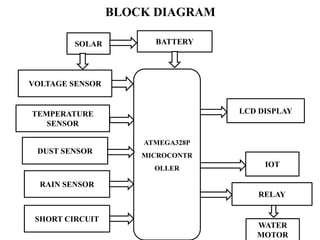
• This system consists of sensor like Temperature Sensor, Dust Sensor and Rain
Sensor. The voltage sensor sense the solar panel voltage value.
• Temperature sensor is used to measure the temperature value
• Dust sensor used for detecting the dust will be high, at same for Rain sensor is
used to measure the rain value and display on LCD Display. Short circuiting in
solar is detected alerted through IOT. The relay operate the water motor for the
motor condition.
• Measured all sensor information updated to IOT.
BLOCK DIAGRAM
ATMEGA328P
MICROCONTR
OLLER
TEMPERATURE
SENSOR
DUST SENSOR
RAIN SENSOR
LCD DISPLAY
IOT
BATTERY
SOLAR
WATER
MOTOR
SHORT CIRCUIT
VOLTAGE SENSOR
RELAY
CIRCUIT DIAGRAM
SOFTWARE REQUIREMENTS
• MC Programming Language :Embedded C
• Coding : Arduino IDE 1.8.3
• Simulation :PROTEUS
ARDUINO IDE
• The Arduino integrated development environment (IDE) is a cross-
platform application (for Windows, macOS, Linux) that is written in the
programming language Java. It is used to write and upload programs to
Arduino board.
• Arduino is an open-source electronics platform based on easy-to-use
hardware and software. Arduino boards are able to read inputs - light on a
sensor, a finger on a button, or a Twitter message - and turn it into an output
- activating a motor, turning on an LED, publishing something online. You
can tell your board what to do by sending a set of instructions to the
microcontroller on the board
PROTEUS
• Proteus is a simulation and design software tool developed by Labcenter
Electronics for Electrical and Electronic circuit design.
• Proteus's simulation feature. Many of the components in Proteus can be
simulated. There are two options for simulating: Run simulator and
advance frame by frame.
• The "Run simulator" option simulates the circuit in a normal speed (If the
circuit is not heavy). "Advance frame by frame" option advances to next
frame and waits till you click this button for the next time. This can be
useful for debugging digital circuits.
HARDWARE REQUIREMENTS
• ARDUINO UNO
• SOLAR PANEL
• BATTERY
• TEMPERATURE SENSOR
• DUST SENSOR
• RAIN SENSOR
• LCD DISPLAY
• IOT
• WATER MOTOR
BATTERY 12V1.5AH
• The rechargeable backup battery provides power to Finger Tec terminals when the
primary source of power is unavailable. With the right backup battery, your system
won’t have to be interrupted during a power failure.
• A battery charger is a device used to put energy into a cell or (rechargeable) battery
by forcing an electric current through it. Lead-acid battery chargers typically have
two tasks to accomplish. The first is to restore capacity, often as quickly as
practical. The second is to maintain capacity by compensating for self discharge.
ARDUINO
• Arduino is an open-source prototyping platform based on easy-to-
use hardware and software.
• Arduino boards are able to read inputs - light on a sensor, a finger
on a button, or a Twitter message - and turn it into an output -
activating a motor, turning on an LED, publishing something online.
• You can tell your board what to do by sending a set of instructions to
the microcontroller on the board.
• To do so you use the Arduino programming language (based on
Wiring), and the Arduino Software (IDE), based on Processing.
SOLAR PANEL
• A solar panel is a set of solar photovoltaic modules electrically
connected and mounted on a supporting structure. A
photovoltaic module is a packaged, connected assembly
of solar cells. The solar panel can be used as a component of a
larger photovoltaic system to generate and supply electricity in
commercial and residential applications.12v 3w panel.
TEMPERATURE SENSOR (DH11)
• A humidity sensor senses, measures and regularly reports the relative
humidity in the air. It measures both moisture and air temperature.
• Relative humidity, expressed as a percent, is the ratio of actual moisture in
the air to the highest amount of moisture air at that temperature can hold.
• The warmer the air is, the more moisture it can hold, so relative humidity
changes with fluctuations in temperature.
RAIN SENSOR
• This module allows you measure moisture via analog output
pins and it provides a digital output when a threshold of
moisture is exceeded.
• The module is based on the LM393 op amp. It includes the
electronics module and a printed circuit board that “collects”
the rain drops.
• As rain drops are collected on the circuit board, they create
paths of parallel resistance that are measured via the op amp.
• The lower the resistance (or the more water), the lower the
voltage output. Conversely, the less water is the greater the
output voltage on the analog pin.
DUST SENSOR
• Dust Sensor is a simple air monitoring module with onboard Sharp
GP2Y1010AU0F.
• It is capable of detecting fine particle larger than 0.8μm in diameter, even
like the cigarette smoke.
• Analog voltage output of the sensor is linear with dust density.
• The module has embedded voltage boost circuit to support wide range of
power supply.
•
2*16 LCD DISPLAY
 A liquid-crystal display (LCD) is a flat-panel display or
other electronic visual display that uses the light-modulating
properties of liquid crystals.
 Liquid crystals do not emit light directly.
LCD DISPLAY
WATER MOTOR
• A pump motor is a DC motor device that moves fluids.
• A DC motor converts direct current electrical power into mechanical
power.
• DC or direct current motor works on the principal, when a current carrying
conductor is placed in a magnetic field, it experiences a torque and has a
tendency to move.
• Pumps operate by some mechanism (typically reciprocating or rotary), and
consume energy to perform mechanical work by moving the fluid.
NODE MCU
• NodeMCU is the WiFi equivalent of ethernet module. It combines the
features of WiFi access point and station + microcontroller. These features
make the NodeMCU extremely powerful tool for WiFi networking. It can
be used as access point and/or station, host a web server or connect to
internet to fetch or upload data.
RESULTS
CONCLUSION
• Solar panels monitoring system is presented with high prediction accuracy.
The hardware design and implementation of the monitoring system on low
cost microcontroller was discussed.
• The monitoring system has the ability of identifying any individual PV
panel that requires maintenance
• The more PV panels are connected to the monitoring system, the lower is
the additional cost per PV panel.
• The monitoring system will a PV panel for maintenance if the predicted
output power for that PV panel, obtained from articial neural network
model.
• The actual output power of that PV panel, obtained from sensors, has a
percentage difference more than 10%.
REFERENCE
• [1] J. Benedek, T.-T. Sebestyén, and B. Bartók, ``Evaluation of renewable
energy sources in peripheral areas and renewable energy-based rural
development,'‘ Renew. Sustain. Energy Rev., vol. 90, no. 1, pp. 516535, 2018.
• [2] M. S. Mahdavinejad, M. Rezvan, M. Barekatain, P. Adibi, P. Barnaghi, and
A. P. Sheth, ``Machine learning for Internet of Things data analysis: A survey,''
Digit. Commun. Netw., vol. 4, no. 3, pp. 161175, 2018.
• [3] P. Sethi and S. R. Sarangi, ``Internet of Things: Architectures, protocols,
and applications,'' J. Elect. Comput. Eng., vol. 2017, Jan. 2017, Art. no.
9324035.
• [4] P. P. Ray, ``A survey of IoT cloud platforms,'' Future Comput. Inform. J.,
vol. 1, nos. 12, pp. 3546, 2016.

Solar panel project

  • 1.
    Maximizing Solar PowerPlant Efficiency: The Benefits of an IoT-Based Monitoring and Prevention System
  • 2.
    ABSTRACT • To harnessreliable energy efficiently, the photovoltaic panels system must remain in its best condition. This requires continuous maintenance and monitoring. However, in case of weather dependable energy yield change. • This requires continuous maintenance and monitoring. However, in case of weather dependable energy yield change. • We proposed a novel real-time monitoring system utilizing a small but efficient articial neural network that is adequate to run on a low-cost system • To environmental conditions, or is not normal because of faulty, or shaded, or dust-covered panel, an intelligent monitoring system is required. • The presented PV monitoring system can identify if the photovoltaic panel exhibit degradation due to fault conditions.
  • 3.
    INTRODUCTION • The fast-ever-growingenergy demands and the global environmental issues necessitate the use of renewable resources. • Among renewable energy yielding technologies, Solar panels are of the greatest future projection. • An intelligent reference analytical module for real-time individual photovoltaic panel monitoring based on the articial neural network. • We discuss the system overall implementation, the mathematical module behind its intelligent reference model, and its hardware implementation. • The contribution of solar PV energy increased remarkably compared to the previous four decades. Nowadays, PV energy represents the third-largest source of renewable energy after wind and hydro
  • 4.
  • 5.
    S.NO TITLE AUTHOR& YEAR DESCRIPTION 1 Evaluation of renewable energy sources in peripheral areas and renewable energy-based rural development Jozsef Benedek, Tihamer-Tibor Sebestyen 2021 The renewable energy potential maps, combined with a multidimensional index expressing the development level of localities, are good predictors of appropriate locations for the development of renewable energy source- based facilities 2 Machine learning for Internet of Things data analysis: A survey Mohammad Saeid Mahdavinejad, Mohammadreza Rezvan 2019 Intelligent processing and analysis of this Big Data is the key to developing smart IoT applications. This article assesses the different machine learning methods that deal with the challenges in IoT data by considering smart cities as the main use case.
  • 6.
    3 Internet ofThings: Architectures, Protocols, and Applications Pallavi Sethi and Smruti R. Sarangi 2019 A novel taxonomy for IoT technologies, highlights some of the most important technologies, and profiles some applications that have the potential to make a striking difference in human life, especially for the differently abled and the elderly. 4 Photovoltaic Model With Mpp Tracker For Standalone / Grid Connected Applications E.M. Natsheh, A. Albarbar 2020 The dynamic behaviour of the proposed model has been validated by using Sharp’s NUS0E3E and Lorentz’ mono-crystalline modules in different solar radiation and temperature conditions. 5 Power Generation of Solar PV Systems in Palestine Emad Maher Natsheh 2020 A renewable resource of power generation for grid connected applications in residential quarter in north Palestine.
  • 7.
    EXISTING SYSTEM • Alow-cost web server using ESP32 for real-time photovoltaic data collection with manual monitoring from user. • A system for collecting data from the photovoltaic parks. The data was collected from the PV park devices, measurement systems in the region of the park (weather stations) and from data sources accessible on the Internet.
  • 8.
    PROPOSED SYSTEM • Photovoltaicpanels system is becoming a popular choice as an alternative source of energy. To harness reliable energy efficiently, the photovoltaic panels system must remain in its best condition. • This system consists of sensor like Temperature Sensor, Dust Sensor and Rain Sensor. The voltage sensor sense the solar panel voltage value. • Temperature sensor is used to measure the temperature value • Dust sensor used for detecting the dust will be high, at same for Rain sensor is used to measure the rain value and display on LCD Display. Short circuiting in solar is detected alerted through IOT. The relay operate the water motor for the motor condition. • Measured all sensor information updated to IOT.
  • 9.
    BLOCK DIAGRAM ATMEGA328P MICROCONTR OLLER TEMPERATURE SENSOR DUST SENSOR RAINSENSOR LCD DISPLAY IOT BATTERY SOLAR WATER MOTOR SHORT CIRCUIT VOLTAGE SENSOR RELAY
  • 10.
  • 11.
    SOFTWARE REQUIREMENTS • MCProgramming Language :Embedded C • Coding : Arduino IDE 1.8.3 • Simulation :PROTEUS
  • 12.
    ARDUINO IDE • TheArduino integrated development environment (IDE) is a cross- platform application (for Windows, macOS, Linux) that is written in the programming language Java. It is used to write and upload programs to Arduino board. • Arduino is an open-source electronics platform based on easy-to-use hardware and software. Arduino boards are able to read inputs - light on a sensor, a finger on a button, or a Twitter message - and turn it into an output - activating a motor, turning on an LED, publishing something online. You can tell your board what to do by sending a set of instructions to the microcontroller on the board
  • 13.
    PROTEUS • Proteus isa simulation and design software tool developed by Labcenter Electronics for Electrical and Electronic circuit design. • Proteus's simulation feature. Many of the components in Proteus can be simulated. There are two options for simulating: Run simulator and advance frame by frame. • The "Run simulator" option simulates the circuit in a normal speed (If the circuit is not heavy). "Advance frame by frame" option advances to next frame and waits till you click this button for the next time. This can be useful for debugging digital circuits.
  • 14.
    HARDWARE REQUIREMENTS • ARDUINOUNO • SOLAR PANEL • BATTERY • TEMPERATURE SENSOR • DUST SENSOR • RAIN SENSOR • LCD DISPLAY • IOT • WATER MOTOR
  • 15.
    BATTERY 12V1.5AH • Therechargeable backup battery provides power to Finger Tec terminals when the primary source of power is unavailable. With the right backup battery, your system won’t have to be interrupted during a power failure. • A battery charger is a device used to put energy into a cell or (rechargeable) battery by forcing an electric current through it. Lead-acid battery chargers typically have two tasks to accomplish. The first is to restore capacity, often as quickly as practical. The second is to maintain capacity by compensating for self discharge.
  • 16.
    ARDUINO • Arduino isan open-source prototyping platform based on easy-to- use hardware and software. • Arduino boards are able to read inputs - light on a sensor, a finger on a button, or a Twitter message - and turn it into an output - activating a motor, turning on an LED, publishing something online. • You can tell your board what to do by sending a set of instructions to the microcontroller on the board. • To do so you use the Arduino programming language (based on Wiring), and the Arduino Software (IDE), based on Processing.
  • 18.
    SOLAR PANEL • Asolar panel is a set of solar photovoltaic modules electrically connected and mounted on a supporting structure. A photovoltaic module is a packaged, connected assembly of solar cells. The solar panel can be used as a component of a larger photovoltaic system to generate and supply electricity in commercial and residential applications.12v 3w panel.
  • 19.
    TEMPERATURE SENSOR (DH11) •A humidity sensor senses, measures and regularly reports the relative humidity in the air. It measures both moisture and air temperature. • Relative humidity, expressed as a percent, is the ratio of actual moisture in the air to the highest amount of moisture air at that temperature can hold. • The warmer the air is, the more moisture it can hold, so relative humidity changes with fluctuations in temperature.
  • 20.
    RAIN SENSOR • Thismodule allows you measure moisture via analog output pins and it provides a digital output when a threshold of moisture is exceeded. • The module is based on the LM393 op amp. It includes the electronics module and a printed circuit board that “collects” the rain drops. • As rain drops are collected on the circuit board, they create paths of parallel resistance that are measured via the op amp. • The lower the resistance (or the more water), the lower the voltage output. Conversely, the less water is the greater the output voltage on the analog pin.
  • 22.
    DUST SENSOR • DustSensor is a simple air monitoring module with onboard Sharp GP2Y1010AU0F. • It is capable of detecting fine particle larger than 0.8μm in diameter, even like the cigarette smoke. • Analog voltage output of the sensor is linear with dust density. • The module has embedded voltage boost circuit to support wide range of power supply. •
  • 23.
    2*16 LCD DISPLAY A liquid-crystal display (LCD) is a flat-panel display or other electronic visual display that uses the light-modulating properties of liquid crystals.  Liquid crystals do not emit light directly.
  • 24.
  • 25.
    WATER MOTOR • Apump motor is a DC motor device that moves fluids. • A DC motor converts direct current electrical power into mechanical power. • DC or direct current motor works on the principal, when a current carrying conductor is placed in a magnetic field, it experiences a torque and has a tendency to move. • Pumps operate by some mechanism (typically reciprocating or rotary), and consume energy to perform mechanical work by moving the fluid.
  • 26.
    NODE MCU • NodeMCUis the WiFi equivalent of ethernet module. It combines the features of WiFi access point and station + microcontroller. These features make the NodeMCU extremely powerful tool for WiFi networking. It can be used as access point and/or station, host a web server or connect to internet to fetch or upload data.
  • 27.
  • 29.
    CONCLUSION • Solar panelsmonitoring system is presented with high prediction accuracy. The hardware design and implementation of the monitoring system on low cost microcontroller was discussed. • The monitoring system has the ability of identifying any individual PV panel that requires maintenance • The more PV panels are connected to the monitoring system, the lower is the additional cost per PV panel. • The monitoring system will a PV panel for maintenance if the predicted output power for that PV panel, obtained from articial neural network model. • The actual output power of that PV panel, obtained from sensors, has a percentage difference more than 10%.
  • 30.
    REFERENCE • [1] J.Benedek, T.-T. Sebestyén, and B. Bartók, ``Evaluation of renewable energy sources in peripheral areas and renewable energy-based rural development,'‘ Renew. Sustain. Energy Rev., vol. 90, no. 1, pp. 516535, 2018. • [2] M. S. Mahdavinejad, M. Rezvan, M. Barekatain, P. Adibi, P. Barnaghi, and A. P. Sheth, ``Machine learning for Internet of Things data analysis: A survey,'' Digit. Commun. Netw., vol. 4, no. 3, pp. 161175, 2018. • [3] P. Sethi and S. R. Sarangi, ``Internet of Things: Architectures, protocols, and applications,'' J. Elect. Comput. Eng., vol. 2017, Jan. 2017, Art. no. 9324035. • [4] P. P. Ray, ``A survey of IoT cloud platforms,'' Future Comput. Inform. J., vol. 1, nos. 12, pp. 3546, 2016.