Financing Energy Efficiency
Projects
Energy Efficiency project characteristics
• EE projects range from simple and direct retrofits to complex
process changes through technology upgradation
• EE activities can be achieved through standard operational &
maintenance practices
• EE project activities are modular in nature and can be added on
demand
• EE projects are relatively small in size and most of them cost less
than INR 100 lakhs
• Most EE projects have short payback periods, generally one to
three years
• Risk of failure of EE projects is low if supported by well-established
technologies
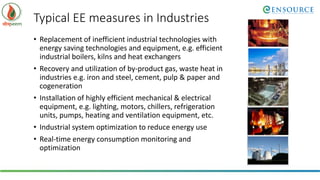
Typical EE measures in Industries
• Replacement of inefficient industrial technologies with
energy saving technologies and equipment, e.g. efficient
industrial boilers, kilns and heat exchangers
• Recovery and utilization of by-product gas, waste heat in
industries e.g. iron and steel, cement, pulp & paper and
cogeneration
• Installation of highly efficient mechanical & electrical
equipment, e.g. lighting, motors, chillers, refrigeration
units, pumps, heating and ventilation equipment, etc.
• Industrial system optimization to reduce energy use
• Real-time energy consumption monitoring and
optimization
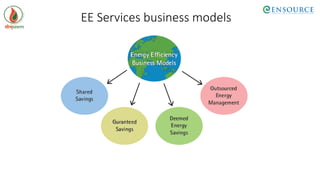
EE Services business models
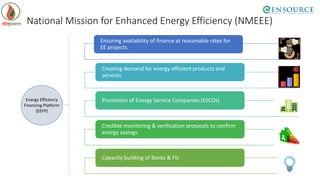
National Mission for Enhanced Energy Efficiency (NMEEE)
Ensuring availability of finance at reasonable rates for
EE projects
Creating demand for energy efficient products and
services
Promotion of Energy Service Companies (ESCOs)
Credible monitoring & verification protocols to confirm
energy savings
Capacity building of Banks & FIs
Energy Efficiency
Financing Platform
(EEFP)
Energy Efficiency Financing Platform (EEFP)
• National Mission for Enhanced Energy Efficiency (NMEEE)
initiative
• Provides platform to interact with Financial Institutions
(FIs) and project developers for implementation of energy
efficiency projects
• MoUs signed by BEE with PTC India, SIDBI, HSBC, Tata
Capital and IFCI to promote financing of energy efficiency
projects
• BEE signed MoU with Indian Banks Association for training
and capacity building of FIs (Banks & NBFCs) on Energy
Efficiency Financing, under Train-the-trainer model
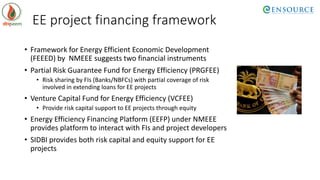
EE project financing framework
• Framework for Energy Efficient Economic Development
(FEEED) by NMEEE suggests two financial instruments
• Partial Risk Guarantee Fund for Energy Efficiency (PRGFEE)
• Risk sharing by FIs (Banks/NBFCs) with partial coverage of risk
involved in extending loans for EE projects
• Venture Capital Fund for Energy Efficiency (VCFEE)
• Provide risk capital support to EE projects through equity
• Energy Efficiency Financing Platform (EEFP) under NMEEE
provides platform to interact with FIs and project developers
• SIDBI provides both risk capital and equity support for EE
projects
Barriers of energy efficiency financing
• Lack of awareness amongst banks and FIs
on appraising risks and benefits of energy
efficiency projects
• FIs refrain from giving loans against the
promise of future energy savings
• Lack of standard models and security
structures to let FIs assess energy efficiency
projects in a more realistic manner.
Policy initiatives to encourage EE financing
• Perform, Achieve and Trade (PAT): Market instrument to enhance EE
improvements in energy-intensive industries with tradable energy savings
certificate
• Partial Risk Guarantee Fund for Energy Efficiency (PRGFEE): Risk-sharing
mechanism to provide commercial banks with partial coverage of risk involved in
extending loans for EE projects
• Venture Capital Fund for Energy Efficiency (VCFEE): Provides risk capital support to
energy efficiency investments in new technologies, goods and services.
• Energy audits of Buildings, Municipalities and SMEs: Build a bouquet of projects
for investors to take up for EE implementation
• Performance Contracting-based Demonstration projects: Encourage adoption of
EE projects through ESCOs, who assume the technical and performance risks
associated with project
• SME Program with SIDBI: BEE has signed MOU with SIDBI for financial support for
implementation of EE technologies for MSME, based on DPR assessment by BEE
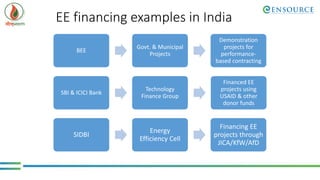
EE financing examples in India
BEE
Govt. & Municipal
Projects
Demonstration
projects for
performance-
based contracting
SIDBI
Energy
Efficiency Cell
Financing EE
projects through
JICA/KfW/AfD
SBI & ICICI Bank
Technology
Finance Group
Financed EE
projects using
USAID & other
donor funds
What needs to be done in EE financing
• Management commitment from Banks/ FIs to define business line and extend credit to EE projects
• EE financing must be a full-fledged business opportunity with clearly identified resources
• Banks/ FIs, through their research cells, can evaluate market potential w.r.t technology, industry and
region to understand target market for EE project financing
• Banks/ FIs need to establish EE cells with people from relevant background to assess technology
know-how, energy savings, pay-back period, debt-service coverage ratio, etc.
• Banks/ FIs need to build their capacity to understand different ESCO business models in EE financing,
achieved by interaction with ESCOs and industries who have implemented EE projects
• Banks/ FIs can identify government programs, donor incentive programs and subsidies which can link
with the EE financing
• Loan managers and risk officers should undergo training and capacity building for smooth EE project
appraisal and loan sanction.
• Banks/ FIs should have regular interaction with ESCOS to understand energy markets and pricing,
technology updates, business models and agreement structures for EE financing
Case Study
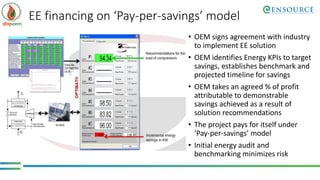
EE financing on ‘Pay-per-savings’ model
• OEM signs agreement with industry
to implement EE solution
• OEM identifies Energy KPIs to target
savings, establishes benchmark and
projected timeline for savings
• OEM takes an agreed % of profit
attributable to demonstrable
savings achieved as a result of
solution recommendations
• The project pays for itself under
‘Pay-per-savings’ model
• Initial energy audit and
benchmarking minimizes risk
About SEEM
• Society of Energy Engineers and
Managers (SEEM) is the national
professional body of Certified Energy
Managers, Auditors and energy
professionals in the country launched
in 2005 and registered under the
Charitable Societies Act 1955.
• SEEM is a not-for-profit organization
spread over 22 states and engaged in
delivering networking and skill
development opportunities to its
members, by organizing Energy
management training and workshops
SEEM objectives:
• Disseminate information on EE techniques,
tools, practices and processes through media,
exhibitions, technical services & documentation
• Encourage implementation of programs for
improvement of energy efficiency by
conducting energy audits and
recommendations
• Facilitate technical exchanges on energy
conservation
• Organise energy management training/ courses
and facilitate organized energy research
About Ensource
We are Energy Sustainability
professionals providing services in
consultancy, engineering, management
and implementation of:
• Energy Management Services - Energy audit,
Energy accounting and Distributed Energy
Resources management
• Renewable Energy solutions - Solar, Wind,
Waste-to-energy, Microgrid, Net metering,
Clean technologies, Data communications &
Industrial Cyber Security
• Energy & Water automation - Industrial IoT,
Energy analytics, Cloud-based remote asset
monitoring, Energy optimization and IT-OT
integration
We deliver clean and sustainable energy
solutions and services promising the
following benefits to our industrial and
commercial customers:
• Optimize distributed energy resources
• Optimize cost of energy consumption
• Reduce carbon footprint
• Remote monitoring of energy assets
• Improve energy efficiency in operations
• Conduct capacity building programs in energy
sustainability
Thank You
Jayant Sinha
Chief Executive Officer
E: jayant.sinha@ensource.in
M: 9920684271

Energy efficiency project financing in india

  • 1.
  • 2.
    Energy Efficiency projectcharacteristics • EE projects range from simple and direct retrofits to complex process changes through technology upgradation • EE activities can be achieved through standard operational & maintenance practices • EE project activities are modular in nature and can be added on demand • EE projects are relatively small in size and most of them cost less than INR 100 lakhs • Most EE projects have short payback periods, generally one to three years • Risk of failure of EE projects is low if supported by well-established technologies
  • 3.
    Typical EE measuresin Industries • Replacement of inefficient industrial technologies with energy saving technologies and equipment, e.g. efficient industrial boilers, kilns and heat exchangers • Recovery and utilization of by-product gas, waste heat in industries e.g. iron and steel, cement, pulp & paper and cogeneration • Installation of highly efficient mechanical & electrical equipment, e.g. lighting, motors, chillers, refrigeration units, pumps, heating and ventilation equipment, etc. • Industrial system optimization to reduce energy use • Real-time energy consumption monitoring and optimization
  • 4.
  • 5.
    National Mission forEnhanced Energy Efficiency (NMEEE) Ensuring availability of finance at reasonable rates for EE projects Creating demand for energy efficient products and services Promotion of Energy Service Companies (ESCOs) Credible monitoring & verification protocols to confirm energy savings Capacity building of Banks & FIs Energy Efficiency Financing Platform (EEFP)
  • 6.
    Energy Efficiency FinancingPlatform (EEFP) • National Mission for Enhanced Energy Efficiency (NMEEE) initiative • Provides platform to interact with Financial Institutions (FIs) and project developers for implementation of energy efficiency projects • MoUs signed by BEE with PTC India, SIDBI, HSBC, Tata Capital and IFCI to promote financing of energy efficiency projects • BEE signed MoU with Indian Banks Association for training and capacity building of FIs (Banks & NBFCs) on Energy Efficiency Financing, under Train-the-trainer model
  • 7.
    EE project financingframework • Framework for Energy Efficient Economic Development (FEEED) by NMEEE suggests two financial instruments • Partial Risk Guarantee Fund for Energy Efficiency (PRGFEE) • Risk sharing by FIs (Banks/NBFCs) with partial coverage of risk involved in extending loans for EE projects • Venture Capital Fund for Energy Efficiency (VCFEE) • Provide risk capital support to EE projects through equity • Energy Efficiency Financing Platform (EEFP) under NMEEE provides platform to interact with FIs and project developers • SIDBI provides both risk capital and equity support for EE projects
  • 8.
    Barriers of energyefficiency financing • Lack of awareness amongst banks and FIs on appraising risks and benefits of energy efficiency projects • FIs refrain from giving loans against the promise of future energy savings • Lack of standard models and security structures to let FIs assess energy efficiency projects in a more realistic manner.
  • 9.
    Policy initiatives toencourage EE financing • Perform, Achieve and Trade (PAT): Market instrument to enhance EE improvements in energy-intensive industries with tradable energy savings certificate • Partial Risk Guarantee Fund for Energy Efficiency (PRGFEE): Risk-sharing mechanism to provide commercial banks with partial coverage of risk involved in extending loans for EE projects • Venture Capital Fund for Energy Efficiency (VCFEE): Provides risk capital support to energy efficiency investments in new technologies, goods and services. • Energy audits of Buildings, Municipalities and SMEs: Build a bouquet of projects for investors to take up for EE implementation • Performance Contracting-based Demonstration projects: Encourage adoption of EE projects through ESCOs, who assume the technical and performance risks associated with project • SME Program with SIDBI: BEE has signed MOU with SIDBI for financial support for implementation of EE technologies for MSME, based on DPR assessment by BEE
  • 10.
    EE financing examplesin India BEE Govt. & Municipal Projects Demonstration projects for performance- based contracting SIDBI Energy Efficiency Cell Financing EE projects through JICA/KfW/AfD SBI & ICICI Bank Technology Finance Group Financed EE projects using USAID & other donor funds
  • 11.
    What needs tobe done in EE financing • Management commitment from Banks/ FIs to define business line and extend credit to EE projects • EE financing must be a full-fledged business opportunity with clearly identified resources • Banks/ FIs, through their research cells, can evaluate market potential w.r.t technology, industry and region to understand target market for EE project financing • Banks/ FIs need to establish EE cells with people from relevant background to assess technology know-how, energy savings, pay-back period, debt-service coverage ratio, etc. • Banks/ FIs need to build their capacity to understand different ESCO business models in EE financing, achieved by interaction with ESCOs and industries who have implemented EE projects • Banks/ FIs can identify government programs, donor incentive programs and subsidies which can link with the EE financing • Loan managers and risk officers should undergo training and capacity building for smooth EE project appraisal and loan sanction. • Banks/ FIs should have regular interaction with ESCOS to understand energy markets and pricing, technology updates, business models and agreement structures for EE financing
  • 12.
  • 13.
    EE financing on‘Pay-per-savings’ model • OEM signs agreement with industry to implement EE solution • OEM identifies Energy KPIs to target savings, establishes benchmark and projected timeline for savings • OEM takes an agreed % of profit attributable to demonstrable savings achieved as a result of solution recommendations • The project pays for itself under ‘Pay-per-savings’ model • Initial energy audit and benchmarking minimizes risk
  • 14.
    About SEEM • Societyof Energy Engineers and Managers (SEEM) is the national professional body of Certified Energy Managers, Auditors and energy professionals in the country launched in 2005 and registered under the Charitable Societies Act 1955. • SEEM is a not-for-profit organization spread over 22 states and engaged in delivering networking and skill development opportunities to its members, by organizing Energy management training and workshops SEEM objectives: • Disseminate information on EE techniques, tools, practices and processes through media, exhibitions, technical services & documentation • Encourage implementation of programs for improvement of energy efficiency by conducting energy audits and recommendations • Facilitate technical exchanges on energy conservation • Organise energy management training/ courses and facilitate organized energy research
  • 15.
    About Ensource We areEnergy Sustainability professionals providing services in consultancy, engineering, management and implementation of: • Energy Management Services - Energy audit, Energy accounting and Distributed Energy Resources management • Renewable Energy solutions - Solar, Wind, Waste-to-energy, Microgrid, Net metering, Clean technologies, Data communications & Industrial Cyber Security • Energy & Water automation - Industrial IoT, Energy analytics, Cloud-based remote asset monitoring, Energy optimization and IT-OT integration We deliver clean and sustainable energy solutions and services promising the following benefits to our industrial and commercial customers: • Optimize distributed energy resources • Optimize cost of energy consumption • Reduce carbon footprint • Remote monitoring of energy assets • Improve energy efficiency in operations • Conduct capacity building programs in energy sustainability
  • 16.
    Thank You Jayant Sinha ChiefExecutive Officer E: jayant.sinha@ensource.in M: 9920684271