THE MAGIC OF ENERGY
EFFICIENCY

STEVEN FAWKES


ECOSUMMIT   22nd March 2012
IMPORTANT NOTICE

This document is issued by Matrix Corporate Capital LLP (“Matrix”) which is authorised and regulated by the Financial Services Authority and is
a member of the London Stock Exchange. The contents are based upon sources of information believed to be reliable but no warranty or
representation, expressed or implied, is given as to their accuracy or completeness.

Matrix provides a number of services including Corporate Finance, Broking, Research, Trading and Market Making. All services are provided
only to Professional clients and Eligible counterparties (i.e. market professionals). Matrix does not provide services to Retail clients.

Any opinion expressed in these documents reflects our judgement at the date of publication and neither Matrix, nor any its affiliated or
associated companies, nor any of their partners, directors or employees accepts any responsibility in respect of the information or
recommendations contained herein which are subject to change without notice.

This is not an offer, nor solicitation, to buy or sell any investment referred to in this document. The material is general information intended for
recipients who understand the risks associated with investment. It does not take into account of whether an investment, course of action, or
associated risks are suitable for the recipient.

Matrix or its affiliated or associated companies and their partners, directors or employees may, as principal or as agent, make purchases, sales
and offers to purchase or sell in the open market or otherwise and may have positions in or options on any such investment(s). Matrix may
provide services (including corporate finance advice) where the flow of information is restricted by a Chinese Wall. Accordingly, information may
be available to Matrix that is not reflected in this document. Matrix or its affiliated or associated companies may have acted upon or used
research recommendations before they have been published.
20%
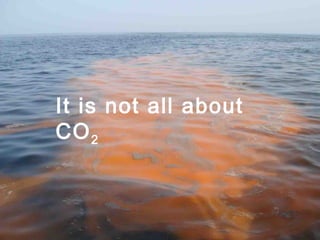
It is not all about
CO 2
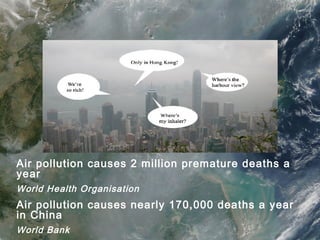
Air pollution causes 2 million premature deaths a
year
World Health Organisation
Air pollution causes nearly 170,000 deaths a year
in China
World Bank
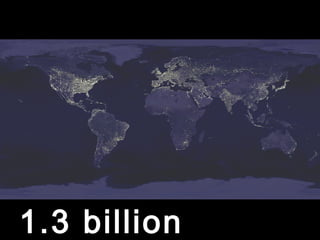
1.3 billion
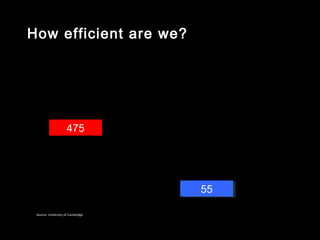
How efficient are we?


                  475


                                                                          55
                                                                          55

 Source: University of Cambridge
          Source: University       of Cambridge, global figures , in EJ
11
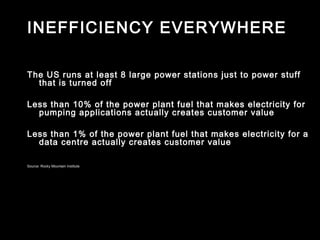
INEFFICIENCY EVERYWHERE

The US runs at least 8 large power stations just to power stuff
  that is turned off

Less than 10% of the power plant fuel that makes electricity for
  pumping applications actually creates customer value

Less than 1% of the power plant fuel that makes electricity for a
  data centre actually creates customer value

Source: Rocky Mountain Institute
Global potential for energy efficienc
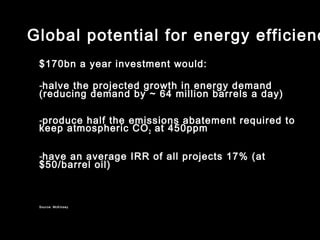
 $170bn a year investment would:

 -halve the projected growth in energy demand
 (reducing demand by ~ 64 million barrels a day)

 -produce half the emissions abatement required to
 keep atmospheric CO 2 at 450ppm

 -have an average IRR of all projects 17% (at
 $50/barrel oil)


 Source: McKinsey
barriers


14
15
Some of the money is nailed down

Many and various barriers to improving energy efficiency including;
- Supply side domination
- Low priority in many organizations
- Run by engineers / not strategic
- Split incentives – landlord / tenant problem
- Measurement of results
- Limited capacity – technical skill shortages
- Access to capital


-   The ribbon problem


                                                                      16
Conclusions

Energy is at the start of a technological revolution

The future will be:
-radically more efficient
-significantly cleaner
-more diverse
Some of the money is nailed down

Many and various barriers to improving energy efficiency including;
- Supply side domination
- Low priority in many organizations
- Run by engineers / not strategic
- Split incentives – landlord / tenant problem
- Measurement of results
- Limited capacity – technical skill shortages
- Access to capital


-   The ribbon problem


                                                                      19
Capital requirements

  • $170bn a year investment would half the projected
    growth in energy demand (reducing demand by ~
    64 million barrels a day)
  • up to half the emissions abatement required to
    keep atmospheric CO2 at 450ppm
  • average IRR of all projects 17% (at $50/barrel oil)
  • $83bn a year invested by 2020 would allow
    industrial sector to abate ~25 million barrels a day


  Source: McKinsey

                                                       20
Us real estate to 2050


$0.5 trillion invested

$1.4 trillion NPV
                         21
Source: Lovins
Investor appetite

“Institutional income investors are looking for an
   iconic investment in this area”
Fund Manager


Several investors have committed funds in
  principle but………….few examples


                                                     22
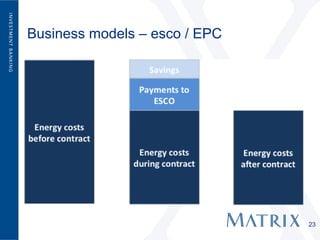
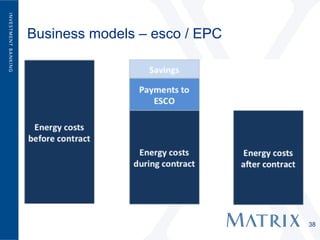
Business models – esco / EPC


                               23
Not a new idea

Boulton and Watt – 1770s
Associated Heat Services – 1966
Utility Management Company – 1982

US ESCO industry been very active
- 1,473 projects
- $2.3 billion investment
- 74% in public sector (MUSH)
- not really spread into commercial real estate
                                                  24
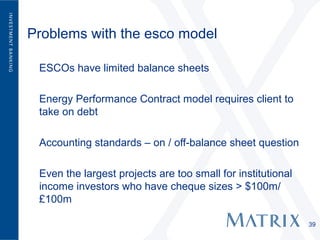
Problems with the esco model

 ESCOs have limited balance sheets

 Energy Performance Contract model requires client to
 take on debt

 Accounting standards – on / off-balance sheet question

 Even the largest projects are too small for institutional
 income investors who have cheque sizes > $100m/
 £100m

                                                             25
BUSINESS MODEL INNOVATION

Need to scale and structure projects in a way that allows
  institutional investors to invest at scale

Two innovations are emerging:

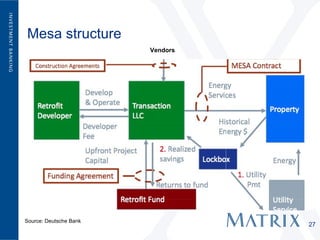
• Managed Energy Service Agreements
• Transaction vehicles


                                                            26
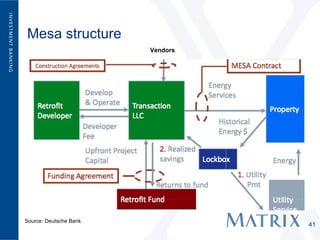
Mesa structure
                        Vendors


Source: Deutsche Bank
                                  27
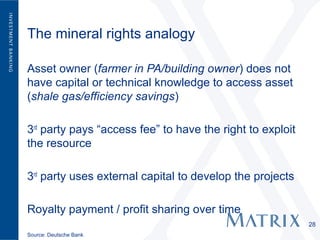
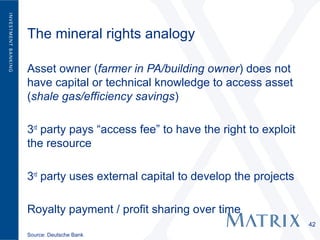
The mineral rights analogy

Asset owner (farmer in PA/building owner) does not
have capital or technical knowledge to access asset
(shale gas/efficiency savings)

3rd party pays “access fee” to have the right to exploit
the resource

3rd party uses external capital to develop the projects

Royalty payment / profit sharing over time
                                                           28
Source: Deutsche Bank
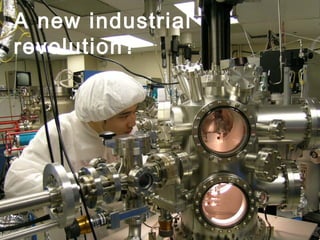
A new industrial
revolution?
contentS

•   Potential for energy efficiency
•   Barriers
•   Capital requirements
•   Business models
•   Summary


                                      31
Inefficiency is everywhere

Central power stations
Typically 30-40% efficient

Power amplifiers
Typically 15% efficient – 85% goes to heat

Buildings
US building stock consumes 2.5 x energy European building stock after
  correcting for climate

Data centres
Useful computing uses 2.5% of energy input


etc etc etc                                                             32
barriers


           33
Some of the money is nailed down

Many and various barriers to improving energy efficiency including;
- Supply side domination
- Low priority in many organizations
- Run by engineers / not strategic
- Split incentives – landlord / tenant problem
- Measurement of results
- Limited capacity – technical skill shortages
- Access to capital


-   The ribbon problem


                                                                      34
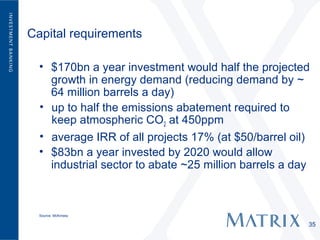
Capital requirements

  • $170bn a year investment would half the projected
    growth in energy demand (reducing demand by ~
    64 million barrels a day)
  • up to half the emissions abatement required to
    keep atmospheric CO2 at 450ppm
  • average IRR of all projects 17% (at $50/barrel oil)
  • $83bn a year invested by 2020 would allow
    industrial sector to abate ~25 million barrels a day


  Source: McKinsey

                                                       35
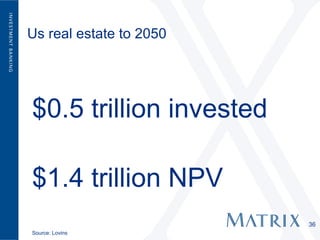
Us real estate to 2050


$0.5 trillion invested

$1.4 trillion NPV
                         36
Source: Lovins
Investor appetite

“Institutional income investors are looking for an
   iconic investment in this area”
Fund Manager


Several investors have committed funds in
  principle but………….few examples


                                                     37
Business models – esco / EPC


                               38
Problems with the esco model

 ESCOs have limited balance sheets

 Energy Performance Contract model requires client to
 take on debt

 Accounting standards – on / off-balance sheet question

 Even the largest projects are too small for institutional
 income investors who have cheque sizes > $100m/
 £100m

                                                             39
BUSINESS MODEL INNOVATION

Need to scale and structure projects in a way that allows
  institutional investors to invest at scale

Two innovations are emerging:

• Managed Energy Service Agreements
• Transaction vehicles


                                                            40
Mesa structure
                        Vendors


Source: Deutsche Bank
                                  41
The mineral rights analogy

Asset owner (farmer in PA/building owner) does not
have capital or technical knowledge to access asset
(shale gas/efficiency savings)

3rd party pays “access fee” to have the right to exploit
the resource

3rd party uses external capital to develop the projects

Royalty payment / profit sharing over time
                                                           42
Source: Deutsche Bank
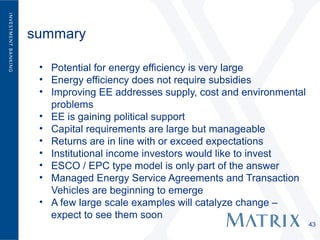
summary

 • Potential for energy efficiency is very large
 • Energy efficiency does not require subsidies
 • Improving EE addresses supply, cost and environmental
   problems
 • EE is gaining political support
 • Capital requirements are large but manageable
 • Returns are in line with or exceed expectations
 • Institutional income investors would like to invest
 • ESCO / EPC type model is only part of the answer
 • Managed Energy Service Agreements and Transaction
   Vehicles are beginning to emerge
 • A few large scale examples will catalyze change –
   expect to see them soon
                                                           43

GLTE San Francisco November 2011

  • 1.
    THE MAGIC OFENERGY EFFICIENCY STEVEN FAWKES ECOSUMMIT 22nd March 2012
  • 2.
    IMPORTANT NOTICE This documentis issued by Matrix Corporate Capital LLP (“Matrix”) which is authorised and regulated by the Financial Services Authority and is a member of the London Stock Exchange. The contents are based upon sources of information believed to be reliable but no warranty or representation, expressed or implied, is given as to their accuracy or completeness. Matrix provides a number of services including Corporate Finance, Broking, Research, Trading and Market Making. All services are provided only to Professional clients and Eligible counterparties (i.e. market professionals). Matrix does not provide services to Retail clients. Any opinion expressed in these documents reflects our judgement at the date of publication and neither Matrix, nor any its affiliated or associated companies, nor any of their partners, directors or employees accepts any responsibility in respect of the information or recommendations contained herein which are subject to change without notice. This is not an offer, nor solicitation, to buy or sell any investment referred to in this document. The material is general information intended for recipients who understand the risks associated with investment. It does not take into account of whether an investment, course of action, or associated risks are suitable for the recipient. Matrix or its affiliated or associated companies and their partners, directors or employees may, as principal or as agent, make purchases, sales and offers to purchase or sell in the open market or otherwise and may have positions in or options on any such investment(s). Matrix may provide services (including corporate finance advice) where the flow of information is restricted by a Chinese Wall. Accordingly, information may be available to Matrix that is not reflected in this document. Matrix or its affiliated or associated companies may have acted upon or used research recommendations before they have been published.
  • 4.
  • 5.
    It is notall about CO 2
  • 6.
    Air pollution causes2 million premature deaths a year World Health Organisation Air pollution causes nearly 170,000 deaths a year in China World Bank
  • 9.
  • 10.
    How efficient arewe? 475 55 55 Source: University of Cambridge Source: University of Cambridge, global figures , in EJ
  • 11.
  • 12.
    INEFFICIENCY EVERYWHERE The USruns at least 8 large power stations just to power stuff that is turned off Less than 10% of the power plant fuel that makes electricity for pumping applications actually creates customer value Less than 1% of the power plant fuel that makes electricity for a data centre actually creates customer value Source: Rocky Mountain Institute
  • 13.
    Global potential forenergy efficienc $170bn a year investment would: -halve the projected growth in energy demand (reducing demand by ~ 64 million barrels a day) -produce half the emissions abatement required to keep atmospheric CO 2 at 450ppm -have an average IRR of all projects 17% (at $50/barrel oil) Source: McKinsey
  • 14.
  • 15.
  • 16.
    Some of themoney is nailed down Many and various barriers to improving energy efficiency including; - Supply side domination - Low priority in many organizations - Run by engineers / not strategic - Split incentives – landlord / tenant problem - Measurement of results - Limited capacity – technical skill shortages - Access to capital - The ribbon problem 16
  • 18.
    Conclusions Energy is atthe start of a technological revolution The future will be: -radically more efficient -significantly cleaner -more diverse
  • 19.
    Some of themoney is nailed down Many and various barriers to improving energy efficiency including; - Supply side domination - Low priority in many organizations - Run by engineers / not strategic - Split incentives – landlord / tenant problem - Measurement of results - Limited capacity – technical skill shortages - Access to capital - The ribbon problem 19
  • 20.
    Capital requirements • $170bn a year investment would half the projected growth in energy demand (reducing demand by ~ 64 million barrels a day) • up to half the emissions abatement required to keep atmospheric CO2 at 450ppm • average IRR of all projects 17% (at $50/barrel oil) • $83bn a year invested by 2020 would allow industrial sector to abate ~25 million barrels a day Source: McKinsey 20
  • 21.
    Us real estateto 2050 $0.5 trillion invested $1.4 trillion NPV 21 Source: Lovins
  • 22.
    Investor appetite “Institutional incomeinvestors are looking for an iconic investment in this area” Fund Manager Several investors have committed funds in principle but………….few examples 22
  • 23.
    Business models –esco / EPC 23
  • 24.
    Not a newidea Boulton and Watt – 1770s Associated Heat Services – 1966 Utility Management Company – 1982 US ESCO industry been very active - 1,473 projects - $2.3 billion investment - 74% in public sector (MUSH) - not really spread into commercial real estate 24
  • 25.
    Problems with theesco model ESCOs have limited balance sheets Energy Performance Contract model requires client to take on debt Accounting standards – on / off-balance sheet question Even the largest projects are too small for institutional income investors who have cheque sizes > $100m/ £100m 25
  • 26.
    BUSINESS MODEL INNOVATION Needto scale and structure projects in a way that allows institutional investors to invest at scale Two innovations are emerging: • Managed Energy Service Agreements • Transaction vehicles 26
  • 27.
    Mesa structure Vendors Source: Deutsche Bank 27
  • 28.
    The mineral rightsanalogy Asset owner (farmer in PA/building owner) does not have capital or technical knowledge to access asset (shale gas/efficiency savings) 3rd party pays “access fee” to have the right to exploit the resource 3rd party uses external capital to develop the projects Royalty payment / profit sharing over time 28 Source: Deutsche Bank
  • 30.
  • 31.
    contentS • Potential for energy efficiency • Barriers • Capital requirements • Business models • Summary 31
  • 32.
    Inefficiency is everywhere Centralpower stations Typically 30-40% efficient Power amplifiers Typically 15% efficient – 85% goes to heat Buildings US building stock consumes 2.5 x energy European building stock after correcting for climate Data centres Useful computing uses 2.5% of energy input etc etc etc 32
  • 33.
  • 34.
    Some of themoney is nailed down Many and various barriers to improving energy efficiency including; - Supply side domination - Low priority in many organizations - Run by engineers / not strategic - Split incentives – landlord / tenant problem - Measurement of results - Limited capacity – technical skill shortages - Access to capital - The ribbon problem 34
  • 35.
    Capital requirements • $170bn a year investment would half the projected growth in energy demand (reducing demand by ~ 64 million barrels a day) • up to half the emissions abatement required to keep atmospheric CO2 at 450ppm • average IRR of all projects 17% (at $50/barrel oil) • $83bn a year invested by 2020 would allow industrial sector to abate ~25 million barrels a day Source: McKinsey 35
  • 36.
    Us real estateto 2050 $0.5 trillion invested $1.4 trillion NPV 36 Source: Lovins
  • 37.
    Investor appetite “Institutional incomeinvestors are looking for an iconic investment in this area” Fund Manager Several investors have committed funds in principle but………….few examples 37
  • 38.
    Business models –esco / EPC 38
  • 39.
    Problems with theesco model ESCOs have limited balance sheets Energy Performance Contract model requires client to take on debt Accounting standards – on / off-balance sheet question Even the largest projects are too small for institutional income investors who have cheque sizes > $100m/ £100m 39
  • 40.
    BUSINESS MODEL INNOVATION Needto scale and structure projects in a way that allows institutional investors to invest at scale Two innovations are emerging: • Managed Energy Service Agreements • Transaction vehicles 40
  • 41.
    Mesa structure Vendors Source: Deutsche Bank 41
  • 42.
    The mineral rightsanalogy Asset owner (farmer in PA/building owner) does not have capital or technical knowledge to access asset (shale gas/efficiency savings) 3rd party pays “access fee” to have the right to exploit the resource 3rd party uses external capital to develop the projects Royalty payment / profit sharing over time 42 Source: Deutsche Bank
  • 43.
    summary • Potentialfor energy efficiency is very large • Energy efficiency does not require subsidies • Improving EE addresses supply, cost and environmental problems • EE is gaining political support • Capital requirements are large but manageable • Returns are in line with or exceed expectations • Institutional income investors would like to invest • ESCO / EPC type model is only part of the answer • Managed Energy Service Agreements and Transaction Vehicles are beginning to emerge • A few large scale examples will catalyze change – expect to see them soon 43