Report On
‘ELASTICITY OF DEMAND IN POWER
INDUSTRY’
Submitted by:-
Shubham Rishav
SAP-500054572
MBA-Power Management (2016-18)
Date of Submission: September 7, 2016
ABSTRACT
Over a few decades the energy demand in India has been growing
at a very rapid rate. In the forth coming years the trends in
population growth, industrialization, urbanization, growth in
national income and energy consumption is expected to increase
substantially. This report attempts to study the historical pattern
of energy consumption, energy production and also calculates the
energy elasticity of India for 1970 to 2012
INTRODUCTION
Energy is one of the basic needs of mankind. The economic
development of a country significantly depends on the long-term
availability of energy from sources that are affordable, accessible
and environmentally friendly. The adverse effects on environment
caused by the production and consumption of energy have
resulted in severe environmental impacts across the globe. The
supply of energy is expected to remain adequate in coming years.
However, the energy consumption imbalance is prevalent around
the world. The consumption of energy is high in most developed
countries. On the other hand, the developing countries need to
consume more energy to ensure economic growth. The energy
consumption in developing countries is estimated to be only one-
tenth of that in the developed countries. The economic
development of every country depends on the “energy
production”.
ENERGY CONSUMPYION PATTERN IN INDIA
Among the largest energy consumers of the world, India stands
fifth. According to the US Energy Information Administration data,
India accounts around 4.05 percent of the world’s total energy
consumption. Its total primary energy demand was 595 Mtoe
(million tons of oil equivalent) in 2007 and the projected demand
for 2030 was 1287 Mtoe which shows this value is more than
double in 2007. Its primary commercial energy consumption in
2008 stood at 19.954 quadrillion Btus and involved coal, oil, gas,
and electricity generated from nuclear, hydroelectric, and
renewable sources. India’s commercial energy consumption is
expected to be more than double, i.e. 833mtoe in 2030. These
figures do not even include the energy that is consumed from
traditional sources by 66 percent of Indian households. Estimates
of energy use from traditional sources tend to be approximate,
but figures indicate that in 2002, 184 mtoe of energy came from
such sources as fuel wood, dung, crop residue, biogas, and waste
(while 354 Mtoe came from the sources mentioned above). This
use is expected to grow to 215 Mtoe by 2030, though as a
percentage of the total primary energy consumption, its share will
drop from 34 percent to 21 percent.
Per capita primary energy consumption is still fairly low in the
country, i.e 17.0 million Btus (0.429toe) which is less than a third
the world average. India’s energy intensity, however, is still fairly
high. This is particularly true of its oil intensity, which in 2004 was
double the world average.
The industrial sector in India is the major energy consumers
accounting for about 52 percent of commercial energy
consumption. Per capita energy consumption in India is one of the
lowest in the world. But, energy intensity, which is energy
consumption per unit of GDP, is comparable to other developed
and developing countries. During 2010 India’s energy intensity
(0.2 Koe/$05P) is double to U.K (0.1 Koe/$05P), slightly higher
than world average (0.19 Koe/$05P) and U.S (0.17 Koe/$05P) and
lower than Asia (0.22 Koe/$05P) and China (0.28 Koe/$05P) [6]
.Thus there is a huge scope for energy conservation in the
country. The Energy Consumption Pattern of India during the past
four decades are presented in Fig.1
Figure:1 Energy Consumption Pattern– India (1970-2012)
Source : Energy Statistics, 2013, CSO, Govt. of India.
From the above graph it was found that the per capita energy
consumption in India increases steadily. During 1970-71 the per
capita was around 1204.39 KWHr and increased to 4646.87 KWHr
in 2009-2010. The energy consumption per capita increased
around 2.85 fold (3442.48 KWHr) during the last four decades.
The energy intensity was 0.1284 KWHr / Rs during 1970-71 and it
increased to 0.1653 KWHr / Rs during 1985-86. There after it
decreases to 0.1224 KWHr / Rs during 2009-10.
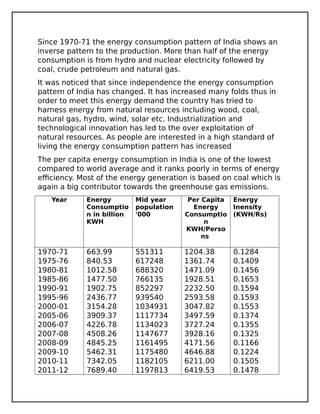
ENERGY MIX OF INDIA
The energy mix of India is coal dominant. Around half of the
primary commercial energy production depends on coal and
lignite. The Fig.2 and Fig. 3 shows the source wise percentage
production and consumption of energy in India since 1970-71.
India’s energy production data shows that around 50% of the
country’s energy production is dominated by coal. The second
major source of energy is electricity from hydro and nuclear
followed by crude oil and natural gas. During 2011-12, around
19.9 percent of total energy production is from coal, 57.6 per cent
from hydro and nuclear electricity, 3.8 percent from natural gas
and around 18.7 percent from crude petroleum.
Figure:2 India’s Energy Production, 1970-71 to 2011-12
Source : Energy Statistics, 2013, CSO, Govt. of India.
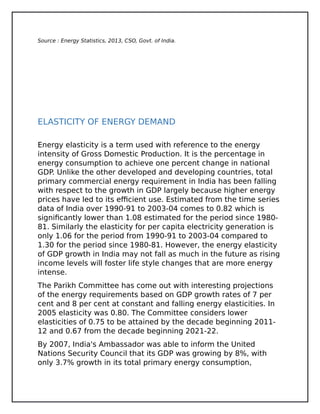
Since 1970-71 the energy consumption pattern of India shows an
inverse pattern to the production. More than half of the energy
consumption is from hydro and nuclear electricity followed by
coal, crude petroleum and natural gas.
It was noticed that since independence the energy consumption
pattern of India has changed. It has increased many folds thus in
order to meet this energy demand the country has tried to
harness energy from natural resources including wood, coal,
natural gas, hydro, wind, solar etc. Industrialization and
technological innovation has led to the over exploitation of
natural resources. As people are interested in a high standard of
living the energy consumption pattern has increased
The per capita energy consumption in India is one of the lowest
compared to world average and it ranks poorly in terms of energy
efficiency. Most of the energy generation is based on coal which is
again a big contributor towards the greenhouse gas emissions.
Year Energy
Consumptio
n in billion
KWH
Mid year
population
'000
Per Capita
Energy
Consumptio
n
KWH/Perso
ns
Energy
Inensity
(KWH/Rs)
1970-71
1975-76
1980-81
1985-86
1990-91
1995-96
2000-01
2005-06
2006-07
2007-08
2008-09
2009-10
2010-11
2011-12
663.99
840.53
1012.58
1477.50
1902.75
2436.77
3154.28
3909.37
4226.78
4508.26
4845.25
5462.31
7342.05
7689.40
551311
617248
688320
766135
852297
939540
1034931
1117734
1134023
1147677
1161495
1175480
1182105
1197813
1204.38
1361.74
1471.09
1928.51
2232.50
2593.58
3047.82
3497.59
3727.24
3928.16
4171.56
4646.88
6211.00
6419.53
0.1284
0.1409
0.1456
0.1653
0.1594
0.1593
0.1553
0.1374
0.1355
0.1325
0.1166
0.1224
0.1505
0.1478
Source : Energy Statistics, 2013, CSO, Govt. of India.
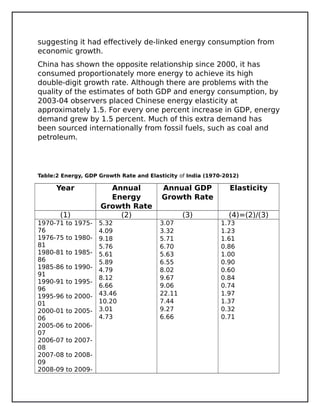
ELASTICITY OF ENERGY DEMAND
Energy elasticity is a term used with reference to the energy
intensity of Gross Domestic Production. It is the percentage in
energy consumption to achieve one percent change in national
GDP. Unlike the other developed and developing countries, total
primary commercial energy requirement in India has been falling
with respect to the growth in GDP largely because higher energy
prices have led to its efficient use. Estimated from the time series
data of India over 1990-91 to 2003-04 comes to 0.82 which is
significantly lower than 1.08 estimated for the period since 1980-
81. Similarly the elasticity for per capita electricity generation is
only 1.06 for the period from 1990-91 to 2003-04 compared to
1.30 for the period since 1980-81. However, the energy elasticity
of GDP growth in India may not fall as much in the future as rising
income levels will foster life style changes that are more energy
intense.
The Parikh Committee has come out with interesting projections
of the energy requirements based on GDP growth rates of 7 per
cent and 8 per cent at constant and falling energy elasticities. In
2005 elasticity was 0.80. The Committee considers lower
elasticities of 0.75 to be attained by the decade beginning 2011-
12 and 0.67 from the decade beginning 2021-22.
By 2007, India's Ambassador was able to inform the United
Nations Security Council that its GDP was growing by 8%, with
only 3.7% growth in its total primary energy consumption,
suggesting it had effectively de-linked energy consumption from
economic growth.
China has shown the opposite relationship since 2000, it has
consumed proportionately more energy to achieve its high
double-digit growth rate. Although there are problems with the
quality of the estimates of both GDP and energy consumption, by
2003-04 observers placed Chinese energy elasticity at
approximately 1.5. For every one percent increase in GDP, energy
demand grew by 1.5 percent. Much of this extra demand has
been sourced internationally from fossil fuels, such as coal and
petroleum.
Table:2 Energy, GDP Growth Rate and Elasticity of India (1970-2012)
Year Annual
Energy
Growth Rate
Annual GDP
Growth Rate
Elasticity
(1) (2) (3) (4)=(2)/(3)
1970-71 to 1975-
76
1976-75 to 1980-
81
1980-81 to 1985-
86
1985-86 to 1990-
91
1990-91 to 1995-
96
1995-96 to 2000-
01
2000-01 to 2005-
06
2005-06 to 2006-
07
2006-07 to 2007-
08
2007-08 to 2008-
09
2008-09 to 2009-
5.32
4.09
9.18
5.76
5.61
5.89
4.79
8.12
6.66
43.46
10.20
3.01
4.73
3.07
3.32
5.71
6.70
5.63
6.55
8.02
9.67
9.06
22.11
7.44
9.27
6.66
1.73
1.23
1.61
0.86
1.00
0.90
0.60
0.84
0.74
1.97
1.37
0.32
0.71
10
2009-10 to 2010-
11
2010-11 to 2011-
12
1970-71 to 2011-
12
8.99 7.94 1.07
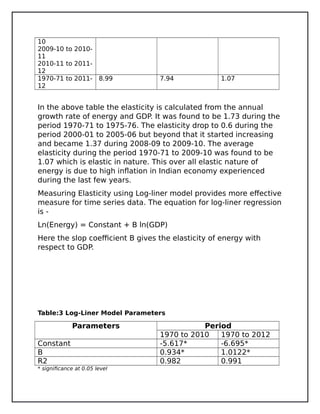
In the above table the elasticity is calculated from the annual
growth rate of energy and GDP. It was found to be 1.73 during the
period 1970-71 to 1975-76. The elasticity drop to 0.6 during the
period 2000-01 to 2005-06 but beyond that it started increasing
and became 1.37 during 2008-09 to 2009-10. The average
elasticity during the period 1970-71 to 2009-10 was found to be
1.07 which is elastic in nature. This over all elastic nature of
energy is due to high inflation in Indian economy experienced
during the last few years.
Measuring Elasticity using Log-liner model provides more effective
measure for time series data. The equation for log-liner regression
is -
Ln(Energy) = Constant + B ln(GDP)
Here the slop coefficient B gives the elasticity of energy with
respect to GDP.
Table:3 Log-Liner Model Parameters
Parameters Period
1970 to 2010 1970 to 2012
Constant -5.617* -6.695*
B 0.934* 1.0122*
R2 0.982 0.991
* significance at 0.05 level
ENERGY CHALLENGES FOR INDIA
Energy is the building block of life. Now the two most important
issues faced by India are the energy security and the
environmental concerns. Major portion of the Indian population
are still depend on biomass for their daily energy needs. With a
fast GDP growth rate of the two developing countries (ie India and
China) the energy demand has been increasing regularly and this
has created great amount of international imbalance with regard
to the energy supply and demand gap. India a fast developing
country has very low per capita energy consumption but at the
same time their energy intensity happens to be the highest due to
inefficiency and lack in technology. This inefficiency further results
in high amount of pollution and GHG emissions contributing to
global warming and climate change. India today happens to be
amongst the largest producers and consumers of energy in the
world. The energy use here is highly intensive and happens to be
amongst the highest, whereas the per capita consumption of
energy is lowest compared to the OECD countries and even most
of Asian countries. India is one of the fastest growing economies
in the world with brilliant performance in the 10th Five year plan.
The pace of growth unfortunately has not been able to match the
supply and demand and as such India is still a net importer of
energy. India today imports around 25% of its primary energy.
Around 70% of India’s petroleum needs are met from the Middle
East countries.
The commercial energy sector was totally regulated by the
government during the pre-reform period. Since 90s private
sector participated in the coal, oil, gas and electricity sectors in
India due to the economic reform and liberalization. In order to
meet certain socio-economic needs of the public India
government provided subsidies to the energy prices which has led
to distortion and inefficiency in the use of different sources of
energy. The government has taken serious steps to deregulate the
energy price from an Administered Price Mechanism (APM)
regime. The prices of all grades of coal and petroleum products
have already been deregulated. In the electricity sector, most of
the State Electricity Boards (SEBs) have started taking reform
measures and regulatory commissions have been set up to
determine tariffs based on economic rational. Since 2010
government took effort to deregulate the diesel and LPG prices as
a result the governments partially gave rights to the oil
companies to determine the diesel prices according to the
international market. In the case of LPG the government already
took initiative to direct supply subsidies to the utility instead of
bulk transfer of subsidies to the oil companies.
CONCLUSION AND RECOMMENDATIOS
The monetary inflation during the recent years and regulated
price of diesel, LPG, etc. has increased energy consumption
growth over national income growth since 2007-08 thus the
relation between energy and GDP became elastic in nature.
Necessary energy pricing mechanism can increase the efficiency
in energy consumption. Like other energy sector’s regulatory
authorizes an oil regulatory authority should be set up to control
the oil prices. Thus the energy pricing can be deregulated. With
deregulation the prices of oil may go up on the other hand it will
increases a competition among oil producing companies in
market. This will lead to better utilization of resources by
technological up gradation & effective cost control. At the same
time government can protect the need based population (low
income group) by providing energy subsidies to the utilities
directly. In other words with deregulation there is increase in
investment to fulfill the psychological need of population which is
the first and fore most step of a developing country like India to
strive toward a developed status.
REFERENCES
 http://www.eia.gov/countries/countrydata.cfm?fip s=IN
 International Energy Agency, World Energy Outlook, 2009
 I. P. Khosla, “Introduction,” in Energy and Diplomacy, edited by I. P.
Khosla (New Delhi: Konark Publishers, 2005).
 International Energy Agency, World Energy Outlook 2004.
 Expert Committee on Energy Policy, Draft Report of the Expert
Committee on Integrated Energy Policy.
 http://en.wikipedia.org/wiki/List_of_count ries _by_energy_intensity
 http://en.wikipedia.org/wiki/Energy_elast icity
 http://planningcommission.nic.in/sectors/index. php?sectors=energy

Elasticity report

  • 1.
    Report On ‘ELASTICITY OFDEMAND IN POWER INDUSTRY’ Submitted by:- Shubham Rishav SAP-500054572 MBA-Power Management (2016-18)
  • 2.
    Date of Submission:September 7, 2016 ABSTRACT Over a few decades the energy demand in India has been growing at a very rapid rate. In the forth coming years the trends in population growth, industrialization, urbanization, growth in national income and energy consumption is expected to increase substantially. This report attempts to study the historical pattern of energy consumption, energy production and also calculates the energy elasticity of India for 1970 to 2012 INTRODUCTION Energy is one of the basic needs of mankind. The economic development of a country significantly depends on the long-term availability of energy from sources that are affordable, accessible and environmentally friendly. The adverse effects on environment caused by the production and consumption of energy have resulted in severe environmental impacts across the globe. The supply of energy is expected to remain adequate in coming years. However, the energy consumption imbalance is prevalent around the world. The consumption of energy is high in most developed countries. On the other hand, the developing countries need to consume more energy to ensure economic growth. The energy consumption in developing countries is estimated to be only one- tenth of that in the developed countries. The economic development of every country depends on the “energy production”.
  • 3.
    ENERGY CONSUMPYION PATTERNIN INDIA Among the largest energy consumers of the world, India stands fifth. According to the US Energy Information Administration data, India accounts around 4.05 percent of the world’s total energy consumption. Its total primary energy demand was 595 Mtoe (million tons of oil equivalent) in 2007 and the projected demand for 2030 was 1287 Mtoe which shows this value is more than double in 2007. Its primary commercial energy consumption in 2008 stood at 19.954 quadrillion Btus and involved coal, oil, gas, and electricity generated from nuclear, hydroelectric, and renewable sources. India’s commercial energy consumption is expected to be more than double, i.e. 833mtoe in 2030. These figures do not even include the energy that is consumed from traditional sources by 66 percent of Indian households. Estimates of energy use from traditional sources tend to be approximate, but figures indicate that in 2002, 184 mtoe of energy came from such sources as fuel wood, dung, crop residue, biogas, and waste (while 354 Mtoe came from the sources mentioned above). This use is expected to grow to 215 Mtoe by 2030, though as a percentage of the total primary energy consumption, its share will drop from 34 percent to 21 percent. Per capita primary energy consumption is still fairly low in the country, i.e 17.0 million Btus (0.429toe) which is less than a third the world average. India’s energy intensity, however, is still fairly high. This is particularly true of its oil intensity, which in 2004 was double the world average. The industrial sector in India is the major energy consumers accounting for about 52 percent of commercial energy consumption. Per capita energy consumption in India is one of the lowest in the world. But, energy intensity, which is energy consumption per unit of GDP, is comparable to other developed and developing countries. During 2010 India’s energy intensity (0.2 Koe/$05P) is double to U.K (0.1 Koe/$05P), slightly higher than world average (0.19 Koe/$05P) and U.S (0.17 Koe/$05P) and
  • 4.
    lower than Asia(0.22 Koe/$05P) and China (0.28 Koe/$05P) [6] .Thus there is a huge scope for energy conservation in the country. The Energy Consumption Pattern of India during the past four decades are presented in Fig.1 Figure:1 Energy Consumption Pattern– India (1970-2012) Source : Energy Statistics, 2013, CSO, Govt. of India. From the above graph it was found that the per capita energy consumption in India increases steadily. During 1970-71 the per capita was around 1204.39 KWHr and increased to 4646.87 KWHr in 2009-2010. The energy consumption per capita increased around 2.85 fold (3442.48 KWHr) during the last four decades. The energy intensity was 0.1284 KWHr / Rs during 1970-71 and it increased to 0.1653 KWHr / Rs during 1985-86. There after it decreases to 0.1224 KWHr / Rs during 2009-10.
  • 5.
    ENERGY MIX OFINDIA The energy mix of India is coal dominant. Around half of the primary commercial energy production depends on coal and lignite. The Fig.2 and Fig. 3 shows the source wise percentage production and consumption of energy in India since 1970-71. India’s energy production data shows that around 50% of the country’s energy production is dominated by coal. The second major source of energy is electricity from hydro and nuclear followed by crude oil and natural gas. During 2011-12, around 19.9 percent of total energy production is from coal, 57.6 per cent from hydro and nuclear electricity, 3.8 percent from natural gas and around 18.7 percent from crude petroleum. Figure:2 India’s Energy Production, 1970-71 to 2011-12 Source : Energy Statistics, 2013, CSO, Govt. of India.
  • 6.
    Since 1970-71 theenergy consumption pattern of India shows an inverse pattern to the production. More than half of the energy consumption is from hydro and nuclear electricity followed by coal, crude petroleum and natural gas. It was noticed that since independence the energy consumption pattern of India has changed. It has increased many folds thus in order to meet this energy demand the country has tried to harness energy from natural resources including wood, coal, natural gas, hydro, wind, solar etc. Industrialization and technological innovation has led to the over exploitation of natural resources. As people are interested in a high standard of living the energy consumption pattern has increased The per capita energy consumption in India is one of the lowest compared to world average and it ranks poorly in terms of energy efficiency. Most of the energy generation is based on coal which is again a big contributor towards the greenhouse gas emissions. Year Energy Consumptio n in billion KWH Mid year population '000 Per Capita Energy Consumptio n KWH/Perso ns Energy Inensity (KWH/Rs) 1970-71 1975-76 1980-81 1985-86 1990-91 1995-96 2000-01 2005-06 2006-07 2007-08 2008-09 2009-10 2010-11 2011-12 663.99 840.53 1012.58 1477.50 1902.75 2436.77 3154.28 3909.37 4226.78 4508.26 4845.25 5462.31 7342.05 7689.40 551311 617248 688320 766135 852297 939540 1034931 1117734 1134023 1147677 1161495 1175480 1182105 1197813 1204.38 1361.74 1471.09 1928.51 2232.50 2593.58 3047.82 3497.59 3727.24 3928.16 4171.56 4646.88 6211.00 6419.53 0.1284 0.1409 0.1456 0.1653 0.1594 0.1593 0.1553 0.1374 0.1355 0.1325 0.1166 0.1224 0.1505 0.1478
  • 7.
    Source : EnergyStatistics, 2013, CSO, Govt. of India. ELASTICITY OF ENERGY DEMAND Energy elasticity is a term used with reference to the energy intensity of Gross Domestic Production. It is the percentage in energy consumption to achieve one percent change in national GDP. Unlike the other developed and developing countries, total primary commercial energy requirement in India has been falling with respect to the growth in GDP largely because higher energy prices have led to its efficient use. Estimated from the time series data of India over 1990-91 to 2003-04 comes to 0.82 which is significantly lower than 1.08 estimated for the period since 1980- 81. Similarly the elasticity for per capita electricity generation is only 1.06 for the period from 1990-91 to 2003-04 compared to 1.30 for the period since 1980-81. However, the energy elasticity of GDP growth in India may not fall as much in the future as rising income levels will foster life style changes that are more energy intense. The Parikh Committee has come out with interesting projections of the energy requirements based on GDP growth rates of 7 per cent and 8 per cent at constant and falling energy elasticities. In 2005 elasticity was 0.80. The Committee considers lower elasticities of 0.75 to be attained by the decade beginning 2011- 12 and 0.67 from the decade beginning 2021-22. By 2007, India's Ambassador was able to inform the United Nations Security Council that its GDP was growing by 8%, with only 3.7% growth in its total primary energy consumption,
  • 8.
    suggesting it hadeffectively de-linked energy consumption from economic growth. China has shown the opposite relationship since 2000, it has consumed proportionately more energy to achieve its high double-digit growth rate. Although there are problems with the quality of the estimates of both GDP and energy consumption, by 2003-04 observers placed Chinese energy elasticity at approximately 1.5. For every one percent increase in GDP, energy demand grew by 1.5 percent. Much of this extra demand has been sourced internationally from fossil fuels, such as coal and petroleum. Table:2 Energy, GDP Growth Rate and Elasticity of India (1970-2012) Year Annual Energy Growth Rate Annual GDP Growth Rate Elasticity (1) (2) (3) (4)=(2)/(3) 1970-71 to 1975- 76 1976-75 to 1980- 81 1980-81 to 1985- 86 1985-86 to 1990- 91 1990-91 to 1995- 96 1995-96 to 2000- 01 2000-01 to 2005- 06 2005-06 to 2006- 07 2006-07 to 2007- 08 2007-08 to 2008- 09 2008-09 to 2009- 5.32 4.09 9.18 5.76 5.61 5.89 4.79 8.12 6.66 43.46 10.20 3.01 4.73 3.07 3.32 5.71 6.70 5.63 6.55 8.02 9.67 9.06 22.11 7.44 9.27 6.66 1.73 1.23 1.61 0.86 1.00 0.90 0.60 0.84 0.74 1.97 1.37 0.32 0.71
  • 9.
    10 2009-10 to 2010- 11 2010-11to 2011- 12 1970-71 to 2011- 12 8.99 7.94 1.07 In the above table the elasticity is calculated from the annual growth rate of energy and GDP. It was found to be 1.73 during the period 1970-71 to 1975-76. The elasticity drop to 0.6 during the period 2000-01 to 2005-06 but beyond that it started increasing and became 1.37 during 2008-09 to 2009-10. The average elasticity during the period 1970-71 to 2009-10 was found to be 1.07 which is elastic in nature. This over all elastic nature of energy is due to high inflation in Indian economy experienced during the last few years. Measuring Elasticity using Log-liner model provides more effective measure for time series data. The equation for log-liner regression is - Ln(Energy) = Constant + B ln(GDP) Here the slop coefficient B gives the elasticity of energy with respect to GDP. Table:3 Log-Liner Model Parameters Parameters Period 1970 to 2010 1970 to 2012 Constant -5.617* -6.695* B 0.934* 1.0122* R2 0.982 0.991 * significance at 0.05 level
  • 10.
    ENERGY CHALLENGES FORINDIA Energy is the building block of life. Now the two most important issues faced by India are the energy security and the environmental concerns. Major portion of the Indian population are still depend on biomass for their daily energy needs. With a fast GDP growth rate of the two developing countries (ie India and China) the energy demand has been increasing regularly and this has created great amount of international imbalance with regard to the energy supply and demand gap. India a fast developing country has very low per capita energy consumption but at the same time their energy intensity happens to be the highest due to inefficiency and lack in technology. This inefficiency further results in high amount of pollution and GHG emissions contributing to global warming and climate change. India today happens to be amongst the largest producers and consumers of energy in the world. The energy use here is highly intensive and happens to be amongst the highest, whereas the per capita consumption of energy is lowest compared to the OECD countries and even most of Asian countries. India is one of the fastest growing economies in the world with brilliant performance in the 10th Five year plan. The pace of growth unfortunately has not been able to match the supply and demand and as such India is still a net importer of energy. India today imports around 25% of its primary energy. Around 70% of India’s petroleum needs are met from the Middle East countries. The commercial energy sector was totally regulated by the government during the pre-reform period. Since 90s private sector participated in the coal, oil, gas and electricity sectors in India due to the economic reform and liberalization. In order to meet certain socio-economic needs of the public India government provided subsidies to the energy prices which has led to distortion and inefficiency in the use of different sources of energy. The government has taken serious steps to deregulate the
  • 11.
    energy price froman Administered Price Mechanism (APM) regime. The prices of all grades of coal and petroleum products have already been deregulated. In the electricity sector, most of the State Electricity Boards (SEBs) have started taking reform measures and regulatory commissions have been set up to determine tariffs based on economic rational. Since 2010 government took effort to deregulate the diesel and LPG prices as a result the governments partially gave rights to the oil companies to determine the diesel prices according to the international market. In the case of LPG the government already took initiative to direct supply subsidies to the utility instead of bulk transfer of subsidies to the oil companies. CONCLUSION AND RECOMMENDATIOS The monetary inflation during the recent years and regulated price of diesel, LPG, etc. has increased energy consumption growth over national income growth since 2007-08 thus the relation between energy and GDP became elastic in nature. Necessary energy pricing mechanism can increase the efficiency in energy consumption. Like other energy sector’s regulatory authorizes an oil regulatory authority should be set up to control the oil prices. Thus the energy pricing can be deregulated. With deregulation the prices of oil may go up on the other hand it will increases a competition among oil producing companies in market. This will lead to better utilization of resources by technological up gradation & effective cost control. At the same time government can protect the need based population (low income group) by providing energy subsidies to the utilities directly. In other words with deregulation there is increase in investment to fulfill the psychological need of population which is the first and fore most step of a developing country like India to strive toward a developed status.
  • 12.
    REFERENCES  http://www.eia.gov/countries/countrydata.cfm?fip s=IN International Energy Agency, World Energy Outlook, 2009  I. P. Khosla, “Introduction,” in Energy and Diplomacy, edited by I. P. Khosla (New Delhi: Konark Publishers, 2005).  International Energy Agency, World Energy Outlook 2004.  Expert Committee on Energy Policy, Draft Report of the Expert Committee on Integrated Energy Policy.  http://en.wikipedia.org/wiki/List_of_count ries _by_energy_intensity  http://en.wikipedia.org/wiki/Energy_elast icity  http://planningcommission.nic.in/sectors/index. php?sectors=energy