Basic Scheme
and Application
of Energy
Conservation
Prepared By:-
Adesh Kumar Jain
UE-114003
B.E. EEE IV Year
ENERGY
 Energy can neither be created nor it can be
destroyed. It can only be converted from one form to
another.
 For example :
• In a room heater, electrical energy is converted to thermal
energy.
• Turbine converts mechanical energy stored in steam to
electrical energy.
TYPES OF ENERGY
Energy can be broadly divided into two
categories-
• Renewable energy
•Non-renewable energy
RENEWABLE ENERGY
Renewable energy can be generated
continuously practically without decay of source.
Example :
• Solar
• Wind
• Geothermal
• Hydro
• Biomass
• Tidal
SOLAR ENERGY
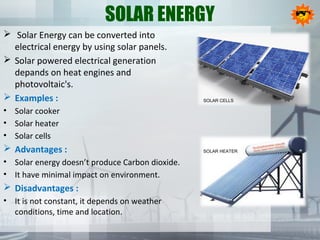
 Solar Energy can be converted into
electrical energy by using solar panels.
 Solar powered electrical generation
depands on heat engines and
photovoltaic's.
 Examples :
• Solar cooker
• Solar heater
• Solar cells
 Advantages :
• Solar energy doesn’t produce Carbon dioxide.
• It have minimal impact on environment.
 Disadvantages :
• It is not constant, it depends on weather
conditions, time and location.
SOLAR CELLS
SOLAR HEATER
WIND ENERGY
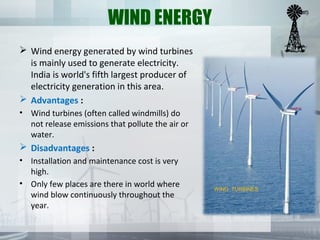
 Wind energy generated by wind turbines
is mainly used to generate electricity.
India is world's fifth largest producer of
electricity generation in this area.
 Advantages :
• Wind turbines (often called windmills) do
not release emissions that pollute the air or
water.
 Disadvantages :
• Installation and maintenance cost is very
high.
• Only few places are there in world where
wind blow continuously throughout the
year.
WIND TURBINES
GEOTHERMAL ENERGY
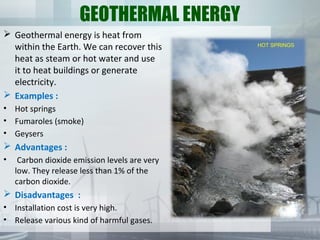
 Geothermal energy is heat from
within the Earth. We can recover this
heat as steam or hot water and use
it to heat buildings or generate
electricity.
 Examples :
• Hot springs
• Fumaroles (smoke)
• Geysers
 Advantages :
• Carbon dioxide emission levels are very
low. They release less than 1% of the
carbon dioxide.
 Disadvantages :
• Installation cost is very high.
• Release various kind of harmful gases.
HOT SPRINGS
HYDRO ENERGY
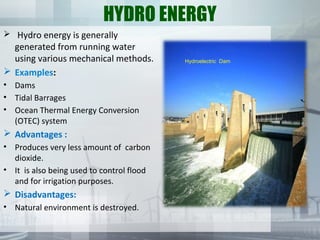
 Hydro energy is generally
generated from running water
using various mechanical methods.
 Examples:
• Dams
• Tidal Barrages
• Ocean Thermal Energy Conversion
(OTEC) system
 Advantages :
• Produces very less amount of carbon
dioxide.
• It is also being used to control flood
and for irrigation purposes.
 Disadvantages:
• Natural environment is destroyed.
Hydroelectric Dam
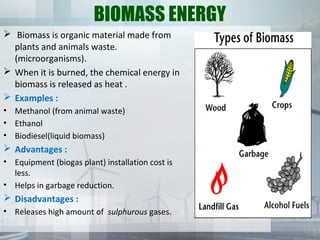
BIOMASS ENERGY
 Biomass is organic material made from
plants and animals waste.
(microorganisms).
 When it is burned, the chemical energy in
biomass is released as heat .
 Examples :
• Methanol (from animal waste)
• Ethanol
• Biodiesel(liquid biomass)
 Advantages :
• Equipment (biogas plant) installation cost is
less.
• Helps in garbage reduction.
 Disadvantages :
• Releases high amount of sulphurous gases.
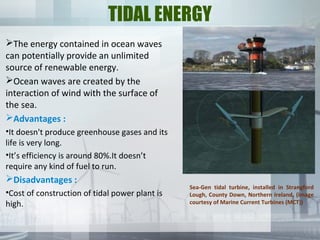
TIDAL ENERGY
The energy contained in ocean waves
can potentially provide an unlimited
source of renewable energy.
Ocean waves are created by the
interaction of wind with the surface of
the sea.
Advantages :
•It doesn't produce greenhouse gases and its
life is very long.
•It’s efficiency is around 80%.It doesn’t
require any kind of fuel to run.
Disadvantages :
•Cost of construction of tidal power plant is
high.
Sea-Gen tidal turbine, installed in Strangford
Lough, County Down, Northern Ireland, (image
courtesy of Marine Current Turbines (MCT))
NON-RENEWABLE ENERGY
Non renewable energy can’t be generated again
and again form the same source.
Examples:
 Petroleum products ( kerosene, petrol, diesel, etc )
 Coal
 Uranium
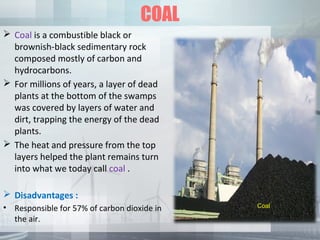
COAL
 Coal is a combustible black or
brownish-black sedimentary rock
composed mostly of carbon and
hydrocarbons.
 For millions of years, a layer of dead
plants at the bottom of the swamps
was covered by layers of water and
dirt, trapping the energy of the dead
plants.
 The heat and pressure from the top
layers helped the plant remains turn
into what we today call coal .
 Disadvantages :
• Responsible for 57% of carbon dioxide in
the air.
Coal
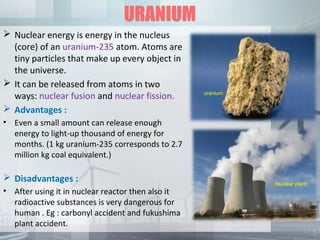
URANIUM
 Nuclear energy is energy in the nucleus
(core) of an uranium-235 atom. Atoms are
tiny particles that make up every object in
the universe.
 It can be released from atoms in two
ways: nuclear fusion and nuclear fission.
 Advantages :
• Even a small amount can release enough
energy to light-up thousand of energy for
months. (1 kg uranium-235 corresponds to 2.7
million kg coal equivalent.)
 Disadvantages :
• After using it in nuclear reactor then also it
radioactive substances is very dangerous for
human . Eg : carbonyl accident and fukushima
plant accident.
uranium
Nuclear plant
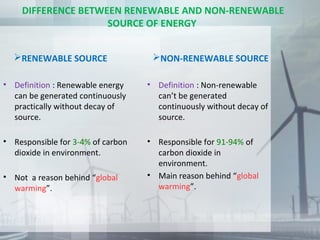
DIFFERENCE BETWEEN RENEWABLE AND NON-RENEWABLE
SOURCE OF ENERGY
RENEWABLE SOURCE
• Definition : Renewable energy
can be generated continuously
practically without decay of
source.
• Responsible for 3-4% of carbon
dioxide in environment.
• Not a reason behind “global
warming”.
NON-RENEWABLE SOURCE
• Definition : Non-renewable
can’t be generated
continuously without decay of
source.
• Responsible for 91-94% of
carbon dioxide in
environment.
• Main reason behind “global
warming”.
ENERGY CONSERVATION
 Energy conservation refers to efforts made to reduce energy
consumption.
 Energy conservation can be achieved through increased
efficient energy use or reduced consumption from non-
renewable energy sources.
 Energy conservation is often the most economical solution to
energy shortages.
WHY TO CONSERVE ?
 We have limited fuels available on earth.
 Our demand for energy is increasing day-by-day.
 It is possible that someday, most of fuels will be exhausted ,
and we will have to switch to alternate energy.
ENERGY CONSERVATION IN ‘INDIA’
 In India , government has passed “ energy conservation bill,
2001 ” for better utilization of energy and conservation of the
same.
 By this act, it is mandatory for energy intensive sectors to get
their “energy audit ” conducted by energy auditor.
 Bureau of energy efficiency : this body keeps watch on energy
consumption patterns, develops norm for appliances etc.
 Star ratings : BEE has also initiated “star rating system” for
electrical appliances e.g. - CFL’S , geysers, refrigerator, etc.
 About 70% of India's energy generation capacity is from fossil
fuels, with coal accounting for 40% of India's total energy
consumption followed by crude oil and natural gas at 24% and 6%
respectively.
 By 2030, India's dependence on energy imports is expected to
exceed 53% of the country's total energy consumption. In 2009-
10, the country imported 159.26 million tonnes of crude oil which
amount to 80% of its domestic crude oil consumption .
 In India 31% of the country's total imports are oil imports.
DATA RELATED TO ENERGY CONSUMPTION IN ‘INDIA’
What we can do ?
 Always switch off light and fans while going out of room.
 We should not open fridge frequently.
 While going to purchase new products eg. Geysers, television,
CFL, etc. insist for ratings ranging from 4-5 .
 Increase everyone's understanding of the benefits of energy
efficiency.
 RECYCLE waste materials into new products to prevent waste
of potentially useful materials.
 REPLACE old light bulbs with energy saving fluorescent bulbs.
They may cost more, but will save you much more in the long run.
What we can do ?
RECYCLING IS AN EXCELLENT WAY OF SAVING
ENERGY AND CONSERVING THE ENVIRONMENT.
Do you know that:
 1 recycled tin would save enough energy to power a
television for 3 hours.
 1 recycled glass bottle would save enough energy to power a
computer for 25 minutes.
 1 recycled plastic bottle would save enough energy to power
a 60-watt light bulb for 3 hours.
 70% less energy is required to recycle paper compared with
making it from raw materials.
THREE R’s
 The slogan reduce, reuse, recycle is widely used to raise
awareness against the use of non-renewable source of energy.
• Reduce consumption
• Reuse manufactured products
• Recycle raw materials
SAVE ENERGY, SAVE EARTH

Energy conservation ppt

  • 1.
    Basic Scheme and Application ofEnergy Conservation Prepared By:- Adesh Kumar Jain UE-114003 B.E. EEE IV Year
  • 2.
    ENERGY  Energy canneither be created nor it can be destroyed. It can only be converted from one form to another.  For example : • In a room heater, electrical energy is converted to thermal energy. • Turbine converts mechanical energy stored in steam to electrical energy.
  • 3.
    TYPES OF ENERGY Energycan be broadly divided into two categories- • Renewable energy •Non-renewable energy
  • 4.
    RENEWABLE ENERGY Renewable energycan be generated continuously practically without decay of source. Example : • Solar • Wind • Geothermal • Hydro • Biomass • Tidal
  • 5.
    SOLAR ENERGY  SolarEnergy can be converted into electrical energy by using solar panels.  Solar powered electrical generation depands on heat engines and photovoltaic's.  Examples : • Solar cooker • Solar heater • Solar cells  Advantages : • Solar energy doesn’t produce Carbon dioxide. • It have minimal impact on environment.  Disadvantages : • It is not constant, it depends on weather conditions, time and location. SOLAR CELLS SOLAR HEATER
  • 6.
    WIND ENERGY  Windenergy generated by wind turbines is mainly used to generate electricity. India is world's fifth largest producer of electricity generation in this area.  Advantages : • Wind turbines (often called windmills) do not release emissions that pollute the air or water.  Disadvantages : • Installation and maintenance cost is very high. • Only few places are there in world where wind blow continuously throughout the year. WIND TURBINES
  • 7.
    GEOTHERMAL ENERGY  Geothermalenergy is heat from within the Earth. We can recover this heat as steam or hot water and use it to heat buildings or generate electricity.  Examples : • Hot springs • Fumaroles (smoke) • Geysers  Advantages : • Carbon dioxide emission levels are very low. They release less than 1% of the carbon dioxide.  Disadvantages : • Installation cost is very high. • Release various kind of harmful gases. HOT SPRINGS
  • 8.
    HYDRO ENERGY  Hydroenergy is generally generated from running water using various mechanical methods.  Examples: • Dams • Tidal Barrages • Ocean Thermal Energy Conversion (OTEC) system  Advantages : • Produces very less amount of carbon dioxide. • It is also being used to control flood and for irrigation purposes.  Disadvantages: • Natural environment is destroyed. Hydroelectric Dam
  • 9.
    BIOMASS ENERGY  Biomassis organic material made from plants and animals waste. (microorganisms).  When it is burned, the chemical energy in biomass is released as heat .  Examples : • Methanol (from animal waste) • Ethanol • Biodiesel(liquid biomass)  Advantages : • Equipment (biogas plant) installation cost is less. • Helps in garbage reduction.  Disadvantages : • Releases high amount of sulphurous gases.
  • 10.
    TIDAL ENERGY The energycontained in ocean waves can potentially provide an unlimited source of renewable energy. Ocean waves are created by the interaction of wind with the surface of the sea. Advantages : •It doesn't produce greenhouse gases and its life is very long. •It’s efficiency is around 80%.It doesn’t require any kind of fuel to run. Disadvantages : •Cost of construction of tidal power plant is high. Sea-Gen tidal turbine, installed in Strangford Lough, County Down, Northern Ireland, (image courtesy of Marine Current Turbines (MCT))
  • 11.
    NON-RENEWABLE ENERGY Non renewableenergy can’t be generated again and again form the same source. Examples:  Petroleum products ( kerosene, petrol, diesel, etc )  Coal  Uranium
  • 12.
    COAL  Coal isa combustible black or brownish-black sedimentary rock composed mostly of carbon and hydrocarbons.  For millions of years, a layer of dead plants at the bottom of the swamps was covered by layers of water and dirt, trapping the energy of the dead plants.  The heat and pressure from the top layers helped the plant remains turn into what we today call coal .  Disadvantages : • Responsible for 57% of carbon dioxide in the air. Coal
  • 13.
    URANIUM  Nuclear energyis energy in the nucleus (core) of an uranium-235 atom. Atoms are tiny particles that make up every object in the universe.  It can be released from atoms in two ways: nuclear fusion and nuclear fission.  Advantages : • Even a small amount can release enough energy to light-up thousand of energy for months. (1 kg uranium-235 corresponds to 2.7 million kg coal equivalent.)  Disadvantages : • After using it in nuclear reactor then also it radioactive substances is very dangerous for human . Eg : carbonyl accident and fukushima plant accident. uranium Nuclear plant
  • 14.
    DIFFERENCE BETWEEN RENEWABLEAND NON-RENEWABLE SOURCE OF ENERGY RENEWABLE SOURCE • Definition : Renewable energy can be generated continuously practically without decay of source. • Responsible for 3-4% of carbon dioxide in environment. • Not a reason behind “global warming”. NON-RENEWABLE SOURCE • Definition : Non-renewable can’t be generated continuously without decay of source. • Responsible for 91-94% of carbon dioxide in environment. • Main reason behind “global warming”.
  • 15.
    ENERGY CONSERVATION  Energyconservation refers to efforts made to reduce energy consumption.  Energy conservation can be achieved through increased efficient energy use or reduced consumption from non- renewable energy sources.  Energy conservation is often the most economical solution to energy shortages.
  • 16.
    WHY TO CONSERVE?  We have limited fuels available on earth.  Our demand for energy is increasing day-by-day.  It is possible that someday, most of fuels will be exhausted , and we will have to switch to alternate energy.
  • 17.
    ENERGY CONSERVATION IN‘INDIA’  In India , government has passed “ energy conservation bill, 2001 ” for better utilization of energy and conservation of the same.  By this act, it is mandatory for energy intensive sectors to get their “energy audit ” conducted by energy auditor.  Bureau of energy efficiency : this body keeps watch on energy consumption patterns, develops norm for appliances etc.  Star ratings : BEE has also initiated “star rating system” for electrical appliances e.g. - CFL’S , geysers, refrigerator, etc.
  • 18.
     About 70%of India's energy generation capacity is from fossil fuels, with coal accounting for 40% of India's total energy consumption followed by crude oil and natural gas at 24% and 6% respectively.  By 2030, India's dependence on energy imports is expected to exceed 53% of the country's total energy consumption. In 2009- 10, the country imported 159.26 million tonnes of crude oil which amount to 80% of its domestic crude oil consumption .  In India 31% of the country's total imports are oil imports. DATA RELATED TO ENERGY CONSUMPTION IN ‘INDIA’
  • 19.
    What we cando ?  Always switch off light and fans while going out of room.  We should not open fridge frequently.  While going to purchase new products eg. Geysers, television, CFL, etc. insist for ratings ranging from 4-5 .  Increase everyone's understanding of the benefits of energy efficiency.
  • 20.
     RECYCLE wastematerials into new products to prevent waste of potentially useful materials.  REPLACE old light bulbs with energy saving fluorescent bulbs. They may cost more, but will save you much more in the long run. What we can do ?
  • 21.
    RECYCLING IS ANEXCELLENT WAY OF SAVING ENERGY AND CONSERVING THE ENVIRONMENT. Do you know that:  1 recycled tin would save enough energy to power a television for 3 hours.  1 recycled glass bottle would save enough energy to power a computer for 25 minutes.  1 recycled plastic bottle would save enough energy to power a 60-watt light bulb for 3 hours.  70% less energy is required to recycle paper compared with making it from raw materials.
  • 23.
    THREE R’s  Theslogan reduce, reuse, recycle is widely used to raise awareness against the use of non-renewable source of energy. • Reduce consumption • Reuse manufactured products • Recycle raw materials
  • 24.