





Soft computing approaches
for energy related problems
          Matteo De Felice
      <matteo.defelice@enea.it>
ENEA
ENEA

Italian Energy, New Technologies and Environment Agency
ENEA

Italian Energy, New Technologies and Environment Agency
ENEA’s mission is to support country’s competitiveness and
sustainable development
ENEA

Italian Energy, New Technologies and Environment Agency
ENEA’s mission is to support country’s competitiveness and
sustainable development
3.000 employers in 13 research centers in Italy
ENEA main topics
ENEA main topics

Environment and Sustainable Development
ENEA main topics

Environment and Sustainable Development
Biotechnology
ENEA main topics

Environment and Sustainable Development
Biotechnology
Nuclear energy
ENEA main topics

Environment and Sustainable Development
Biotechnology
Nuclear energy
New Materials
ENEA main topics

Environment and Sustainable Development
Biotechnology
Nuclear energy
New Materials
Energy Efficiency and Renewable Energies
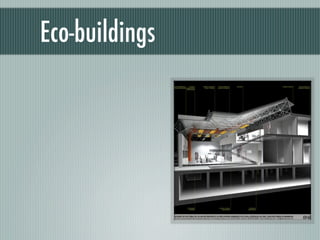
Eco-buildings
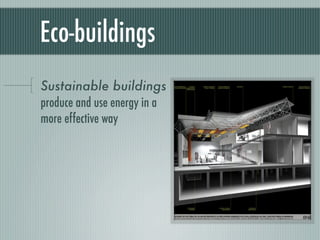
Eco-buildings
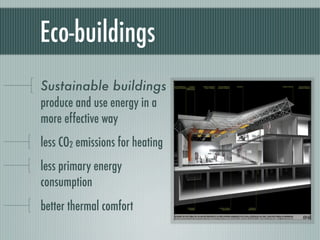
Sustainable buildings
produce and use energy in a
more effective way
Eco-buildings
Sustainable buildings
produce and use energy in a
more effective way
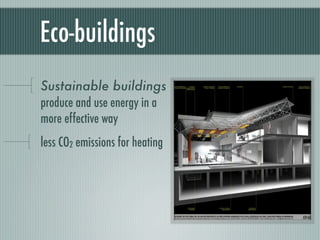
less CO2 emissions for heating
Eco-buildings
Sustainable buildings
produce and use energy in a
more effective way
less CO2 emissions for heating
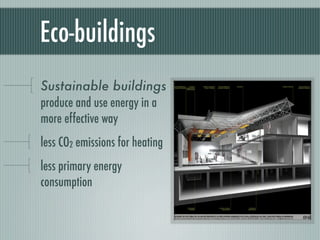
less primary energy
consumption
Eco-buildings
Sustainable buildings
produce and use energy in a
more effective way
less CO2 emissions for heating
less primary energy
consumption
better thermal comfort
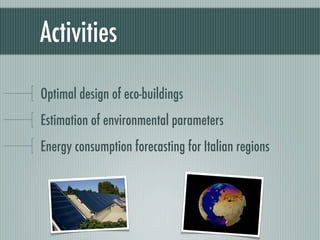
Activities
Activities

Optimal design of eco-buildings
Activities

Optimal design of eco-buildings
Estimation of environmental parameters
Activities

Optimal design of eco-buildings
Estimation of environmental parameters
Energy consumption forecasting for Italian regions
Optimal design of eco-buildings
In order to optimize:
Optimal design of eco-buildings
In order to optimize:
       energy consumptions
Optimal design of eco-buildings
In order to optimize:
       energy consumptions
       pollutant emissions
Optimal design of eco-buildings
In order to optimize:
       energy consumptions
       pollutant emissions
       thermal comfort
Optimal design of eco-buildings
In order to optimize:
       energy consumptions
       pollutant emissions
       thermal comfort
the selection of:
Optimal design of eco-buildings
In order to optimize:
       energy consumptions
       pollutant emissions
       thermal comfort
the selection of:
       generators typologies (solar panels, micro-turbines, etc etc)
Optimal design of eco-buildings
In order to optimize:
       energy consumptions
       pollutant emissions
       thermal comfort
the selection of:
       generators typologies (solar panels, micro-turbines, etc etc)
       energy generators size and parameters
Optimal design of eco-buildings
In order to optimize:
       energy consumptions
       pollutant emissions
       thermal comfort
the selection of:
       generators typologies (solar panels, micro-turbines, etc etc)
       energy generators size and parameters
                             is crucial
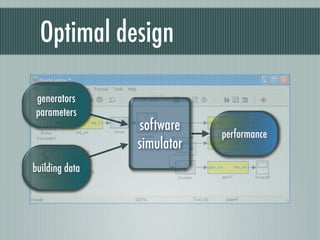
Optimal design

generators
parameters
                software
                            performance
                simulator
building data
Our Approach
Our Approach

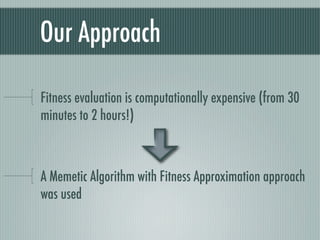
Fitness evaluation is computationally expensive (from 30
minutes to 2 hours!)
Our Approach

Fitness evaluation is computationally expensive (from 30
minutes to 2 hours!)


A Memetic Algorithm with Fitness Approximation approach
was used
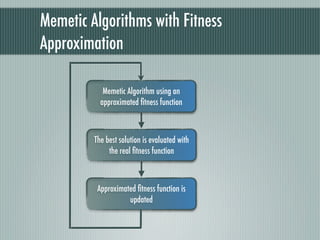
Memetic Algorithms with Fitness
Approximation

            Memetic Algorithm using an
           approximated fitness function


         The best solution is evaluated with
              the real fitness function


          Approximated fitness function is
                    updated
Future Works
Future Works

Multi-Objective Approach
Future Works

Multi-Objective Approach
In-depth examination of Fitness Approximation
methodologies
Future Works

Multi-Objective Approach
In-depth examination of Fitness Approximation
methodologies
Energy District Simulation
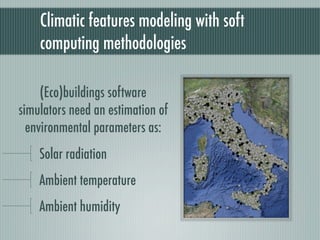
Climatic features modeling with soft
    computing methodologies

     (Eco)buildings software
simulators need an estimation of
  environmental parameters as:
    Solar radiation
    Ambient temperature
    Ambient humidity
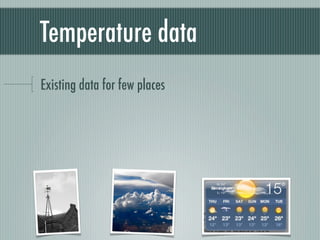
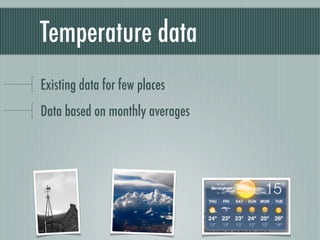
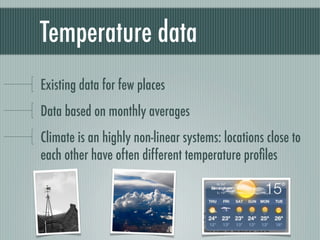
Temperature data
Temperature data
Existing data for few places
Temperature data
Existing data for few places
Data based on monthly averages
Temperature data
Existing data for few places
Data based on monthly averages
Climate is an highly non-linear systems: locations close to
each other have often different temperature profiles
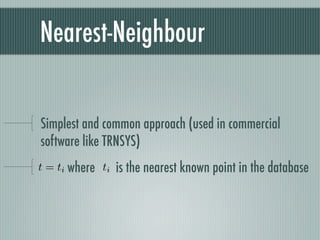
Nearest-Neighbour


Simplest and common approach (used in commercial
software like TRNSYS)
t = ti where ti   is the nearest known point in the database
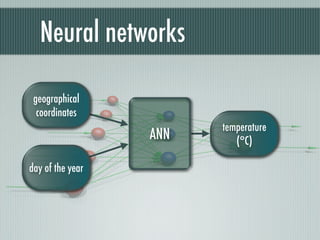
Neural networks

 geographical
  coordinates
                        temperature
                  ANN      (°C)

day of the year
Neural networks training

We compared different training methods:
Neural networks training

We compared different training methods:
Back-propagation (BP)
Neural networks training

We compared different training methods:
Back-propagation (BP)
Genetic Algorithms (GA)
Neural networks training

We compared different training methods:
Back-propagation (BP)
Genetic Algorithms (GA)
BP-GA Hybrid
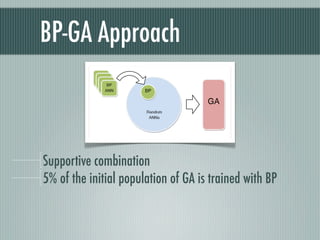
BP-GA Approach


Supportive combination
5% of the initial population of GA is trained with BP
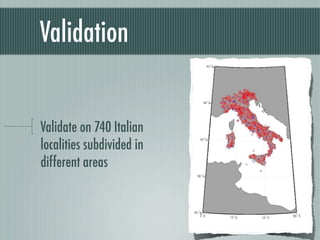
Validation


Validate on 740 Italian
localities subdivided in
different areas
Results
  5
              4.99


3.75
                                          3.78


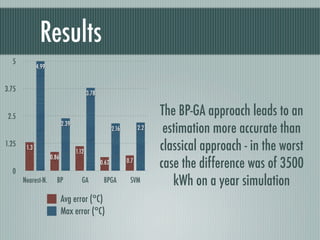
 2.5                                                                       The BP-GA approach leads to an
                            2.39
                                                        2.16         2.2    estimation more accurate than
1.25    1.3
                                   1.12
                                                                           classical approach - in the worst
                     0.86

  0
                                                 0.62          0.7
                                                                           case the difference was of 3500
       Nearest-N.       BP            GA          BPGA          SVM           kWh on a year simulation
                            Avg error (°C)
                            Max error (°C)
Next step...

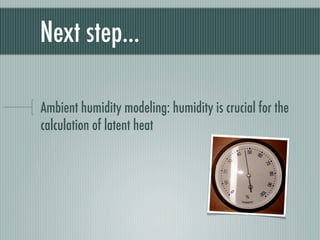
Ambient humidity modeling: humidity is crucial for the
calculation of latent heat
Regional energy consumption forecasting

Forecasting of yearly energy
consumption data of different
sectors
Italian regions need updated
estimations of energy
consumptions for their Strategic
Plans
Energy consumptions

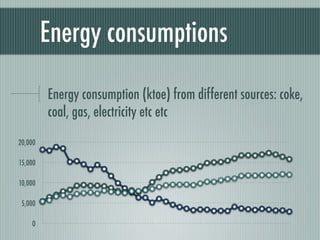
         Energy consumption (ktoe) from different sources: coke,
         coal, gas, electricity etc etc
20,000

15,000

10,000

 5,000

    0
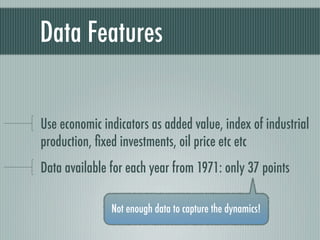
Data Features


Use economic indicators as added value, index of industrial
production, fixed investments, oil price etc etc
Data available for each year from 1971: only 37 points

               Not enough data to capture the dynamics!
Forecasting

22 variables (for 20 regions!)
10 economic indicators
Goal: 2-years forecast
To-Do List
Analysis of data: clustering, correlation coefficients
Dimensional analysis: PCA
Selection of a time-series forecasting model (regressive
model? black-box approach like NARX model? Neural
networks? Support Vector Regression?)
Validation on real data
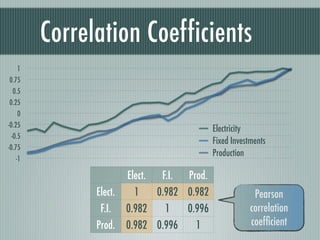
Correlation Coefficients
     1
 0.75
   0.5
 0.25
     0
-0.25
                                           Electricity
  -0.5
                                           Fixed Investments
-0.75
                                           Production
    -1

                      Elect. F.I. Prod.
               Elect.   1    0.982 0.982                Pearson
                F.I. 0.982     1   0.996               correlation
               Prod. 0.982 0.996     1                 coefficient
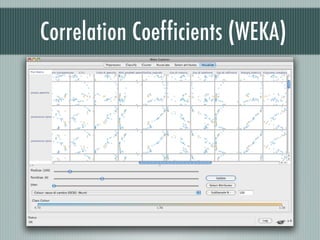
Correlation Coefficients (WEKA)
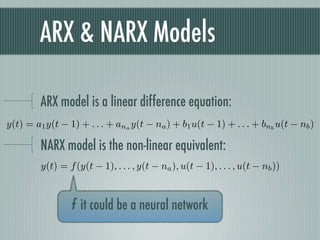
ARX & NARX Models

         ARX model is a linear difference equation:
y(t) = a1 y(t − 1) + . . . + ana y(t − na ) + b1 u(t − 1) + . . . + bnb u(t − nb )

         NARX model is the non-linear equivalent:
         y(t) = f (y(t − 1), . . . , y(t − na ), u(t − 1), . . . , u(t − nb ))


                 f it could be a neural network
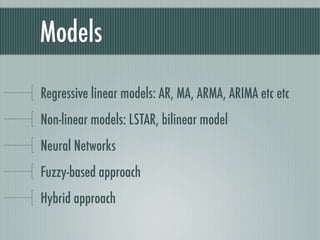
Models

Regressive linear models: AR, MA, ARMA, ARIMA etc etc
Non-linear models: LSTAR, bilinear model
Neural Networks
Fuzzy-based approach
Hybrid approach
to be continued...
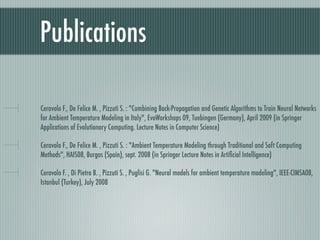
Publications

Ceravolo F., De Felice M. , Pizzuti S. : "Combining Back-Propagation and Genetic Algorithms to Train Neural Networks
for Ambient Temperature Modeling in Italy", EvoWorkshops 09, Tuebingen (Germany), April 2009 (in Springer
Applications of Evolutionary Computing. Lecture Notes in Computer Science)

Ceravolo F., De Felice M. , Pizzuti S. : "Ambient Temperature Modeling through Traditional and Soft Computing
Methods", HAIS08, Burgos (Spain), sept. 2008 (in Springer Lecture Notes in Artificial Intelligence)

Ceravolo F. , Di Pietra B. , Pizzuti S. , Puglisi G. "Neural models for ambient temperature modeling", IEEE-CIMSA08,
Istanbul (Turkey), July 2008

ENEA My Activities

Editor's Notes

  • #3 ENEA deals with several application fields, from material science to biotechnlogies from nuclear energy to renewable energy. In the Research Centre where I work, 20km from Rome, there are two working nuclear reactors and a solar plant of the Archimedes Project developed by the nobel prize Carlo Rubbia
  • #4 ENEA deals with several application fields, from material science to biotechnlogies from nuclear energy to renewable energy. In the Research Centre where I work, 20km from Rome, there are two working nuclear reactors and a solar plant of the Archimedes Project developed by the nobel prize Carlo Rubbia
  • #5 ENEA deals with several application fields, from material science to biotechnlogies from nuclear energy to renewable energy. In the Research Centre where I work, 20km from Rome, there are two working nuclear reactors and a solar plant of the Archimedes Project developed by the nobel prize Carlo Rubbia
  • #6 I work in the department of Renewable Energy Sources and Energy Saving Department
  • #7 I work in the department of Renewable Energy Sources and Energy Saving Department
  • #8 I work in the department of Renewable Energy Sources and Energy Saving Department
  • #9 I work in the department of Renewable Energy Sources and Energy Saving Department
  • #10 I work in the department of Renewable Energy Sources and Energy Saving Department
  • #11 Since about 2 years our work focused on building efficiency. An eco-building is a building designed with particular regard to energy consumption and polluting emissions and then often these building produce their own energy with solar panels, micro-turbines, geothermal heat pumps and so on... Ecobuildings can sell their surplus energy to the electric grid
  • #12 Since about 2 years our work focused on building efficiency. An eco-building is a building designed with particular regard to energy consumption and polluting emissions and then often these building produce their own energy with solar panels, micro-turbines, geothermal heat pumps and so on... Ecobuildings can sell their surplus energy to the electric grid
  • #13 Since about 2 years our work focused on building efficiency. An eco-building is a building designed with particular regard to energy consumption and polluting emissions and then often these building produce their own energy with solar panels, micro-turbines, geothermal heat pumps and so on... Ecobuildings can sell their surplus energy to the electric grid
  • #14 Since about 2 years our work focused on building efficiency. An eco-building is a building designed with particular regard to energy consumption and polluting emissions and then often these building produce their own energy with solar panels, micro-turbines, geothermal heat pumps and so on... Ecobuildings can sell their surplus energy to the electric grid
  • #15 These three are the activities I&amp;#x2019;m currently involved in. These activities are in collaboration with different italian universities, companies and Italian Economic Development Office.
  • #16 These three are the activities I&amp;#x2019;m currently involved in. These activities are in collaboration with different italian universities, companies and Italian Economic Development Office.
  • #17 These three are the activities I&amp;#x2019;m currently involved in. These activities are in collaboration with different italian universities, companies and Italian Economic Development Office.
  • #18 Classical design approach maybe doesn&amp;#x2019;t permit to obtain the optimization we need for eco-buildings. Because besides costs we have to consider other parameters like these three. Unlike classical buildings we need to optimize the energy sources
  • #19 Classical design approach maybe doesn&amp;#x2019;t permit to obtain the optimization we need for eco-buildings. Because besides costs we have to consider other parameters like these three. Unlike classical buildings we need to optimize the energy sources
  • #20 Classical design approach maybe doesn&amp;#x2019;t permit to obtain the optimization we need for eco-buildings. Because besides costs we have to consider other parameters like these three. Unlike classical buildings we need to optimize the energy sources
  • #21 Classical design approach maybe doesn&amp;#x2019;t permit to obtain the optimization we need for eco-buildings. Because besides costs we have to consider other parameters like these three. Unlike classical buildings we need to optimize the energy sources
  • #22 Classical design approach maybe doesn&amp;#x2019;t permit to obtain the optimization we need for eco-buildings. Because besides costs we have to consider other parameters like these three. Unlike classical buildings we need to optimize the energy sources
  • #23 Classical design approach maybe doesn&amp;#x2019;t permit to obtain the optimization we need for eco-buildings. Because besides costs we have to consider other parameters like these three. Unlike classical buildings we need to optimize the energy sources
  • #24 Classical design approach maybe doesn&amp;#x2019;t permit to obtain the optimization we need for eco-buildings. Because besides costs we have to consider other parameters like these three. Unlike classical buildings we need to optimize the energy sources
  • #25 Classical design approach maybe doesn&amp;#x2019;t permit to obtain the optimization we need for eco-buildings. Because besides costs we have to consider other parameters like these three. Unlike classical buildings we need to optimize the energy sources
  • #26 There are different types of software simulator, we are developing a dynamic simulator MATLAB based called ODESSE (Optimal Design for Smart Energy) which will be able in the future to simulate the so-called energy districts. Probably this diagram misses of a piece... software needs the knowledge of the national and international laws about standards and restrictions about emissions, temperature, materials and so on...
  • #29 A MA is an evolutionary algorithm with a local improvement procedure, like a local search.
  • #30 Currently we work with a single-objective approach but we&amp;#x2019;re studying a MO approach. The ED simulation is quite challenging: need to manage the energy policies of the building, an online optimization of the costs because the price of energy varying during the day...
  • #31 Currently we work with a single-objective approach but we&amp;#x2019;re studying a MO approach. The ED simulation is quite challenging: need to manage the energy policies of the building, an online optimization of the costs because the price of energy varying during the day...
  • #32 Currently we work with a single-objective approach but we&amp;#x2019;re studying a MO approach. The ED simulation is quite challenging: need to manage the energy policies of the building, an online optimization of the costs because the price of energy varying during the day...
  • #33 The second activity is about the modeling of environmental parameters for simulating purpose. We obtained good results with temperature and in few months we want to start with ambient humidity modeling, we&amp;#x2019;re currently collecting data
  • #34 Soft computing approaches are often used (survey?) We must work with official data, data which comes from government database. Climate is non-linear, a place 2km far from here could be show a different temperature profile, because temperature depends on mountains, wind, solar exposure and so on...
  • #35 Soft computing approaches are often used (survey?) We must work with official data, data which comes from government database. Climate is non-linear, a place 2km far from here could be show a different temperature profile, because temperature depends on mountains, wind, solar exposure and so on...
  • #36 Soft computing approaches are often used (survey?) We must work with official data, data which comes from government database. Climate is non-linear, a place 2km far from here could be show a different temperature profile, because temperature depends on mountains, wind, solar exposure and so on...
  • #37 TRNSYS (pronounced &apos;tran-sis&apos;), commercially available since 1975, is a flexible tool designed to simulate the transient performance of thermal energy systems
  • #38 NNs are a common tool for modeling problems
  • #39 we weren&amp;#x2019;t satisfied of BP performance