FORECASTING OF RENEWABLE ENERGY PRODUCTION BY USING GENETIC ALGORITHM (GA) FOR DETERMINING HYDROGEN PRODUCTION POTENTIAL University of Jyv äskylä Renewable Energy Master Programme   Reporter :  Lin Tzu Chao 24/11/2006
Outline Introduction Hybrid system : Wind and PV Forecasting Comparison Model and process Conclusion & future work Q&A
Introduction Why  Renewable Energy Production? Wind power & PV combination Unstable output  in electricity market Benefit of  optimum sizing  and forecasting Purpose Optimum sizing Forecasting of RE energy
Introduction  (cont.) Optimum Sizing Optimum sizing combination of a battery bank and PV array Used a stochastic analytical model to optimize a wind power plant Generation of unit sizing hybrid system Using GA to optimize renewable generating systems
Introduction  (cont.) Optimum forecasting A rtificial  N eural  N etwork (ANN) Applied neural network in prediction and identification Applied GA based ANN for short term load forecasting Applied ANN to identify wind energy output
Introduction  (cont.) Optimum forecasting F uzzy  L ogic (FL) Applied fuzzy in predicting chaotic time series Applied genetic Fuzzy predictor in forecasting time series problem
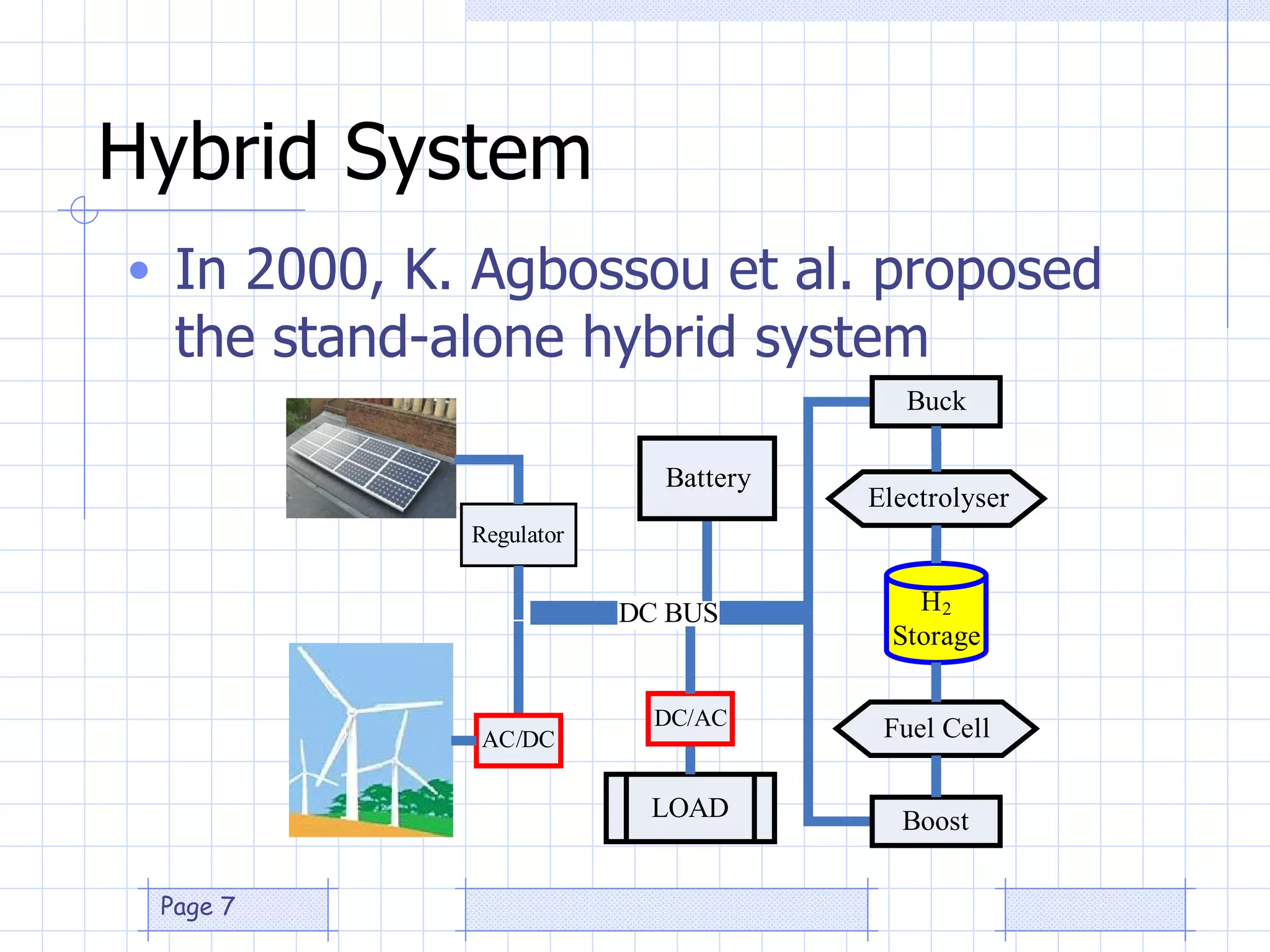
Hybrid System In 2000, K. Agbossou et al. proposed the stand-alone hybrid system
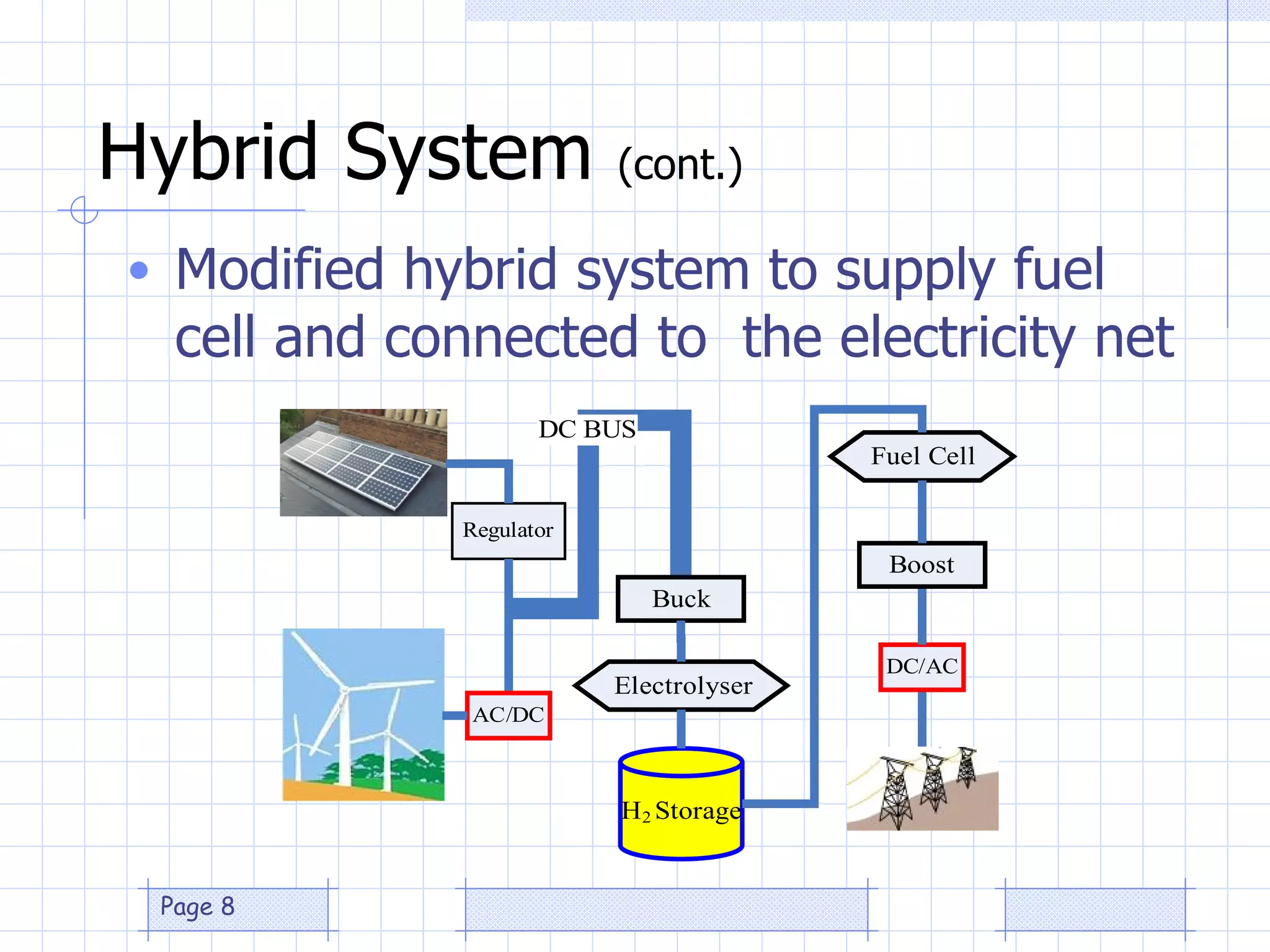
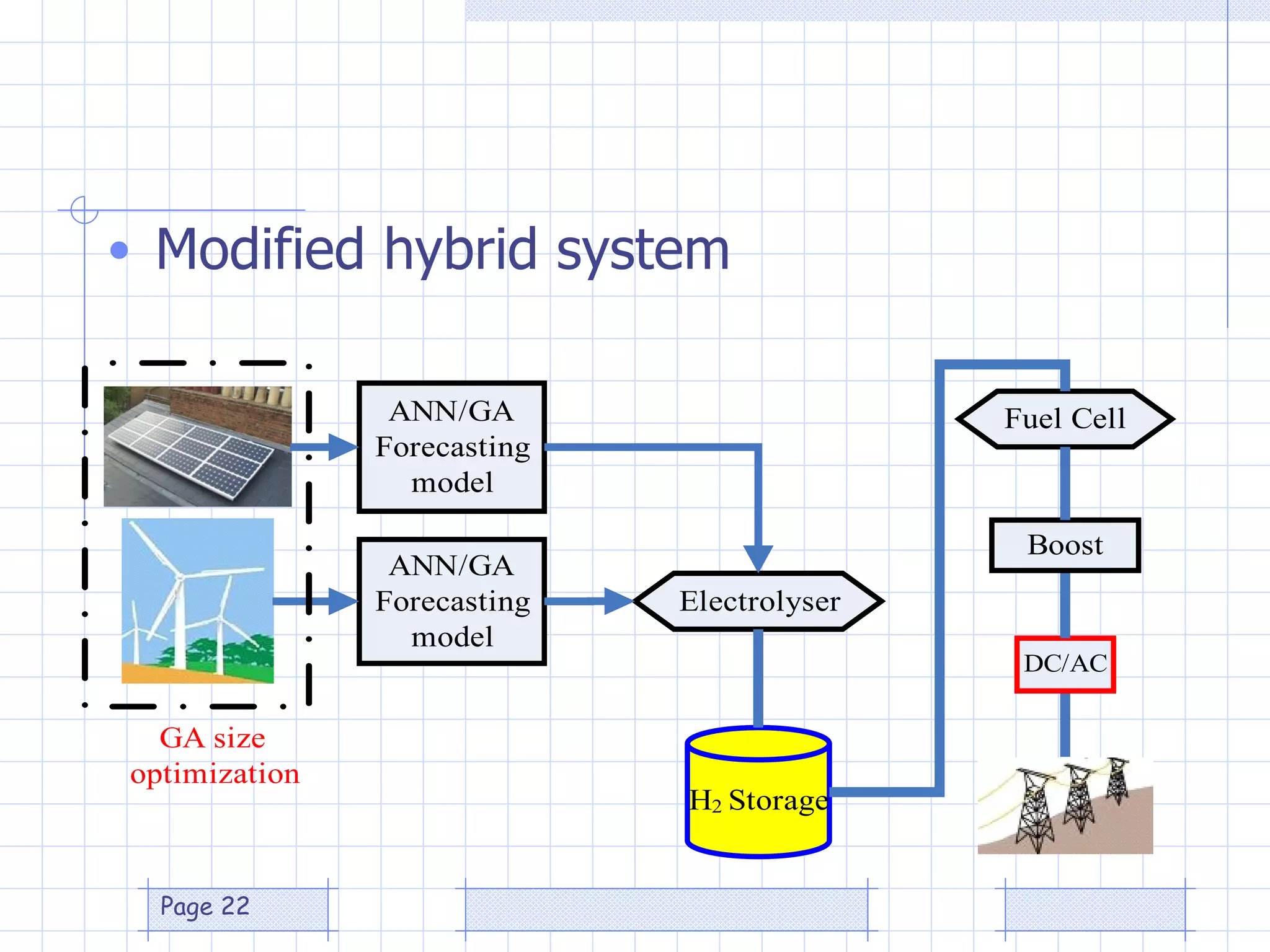
Hybrid System  (cont.) Modified hybrid system to supply fuel cell and connected to  the electricity net
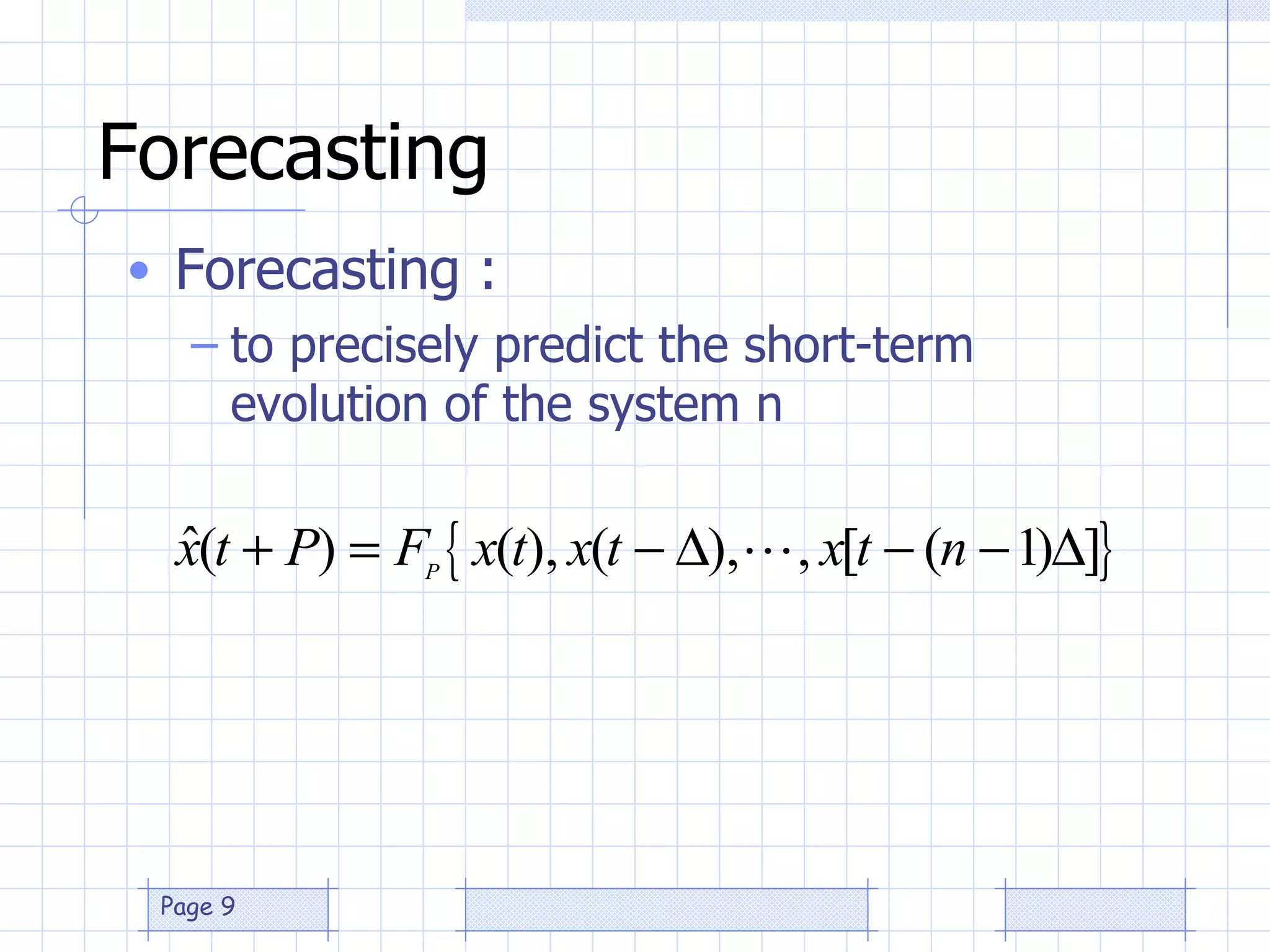
Forecasting Forecasting : to precisely predict the short-term evolution of the system n
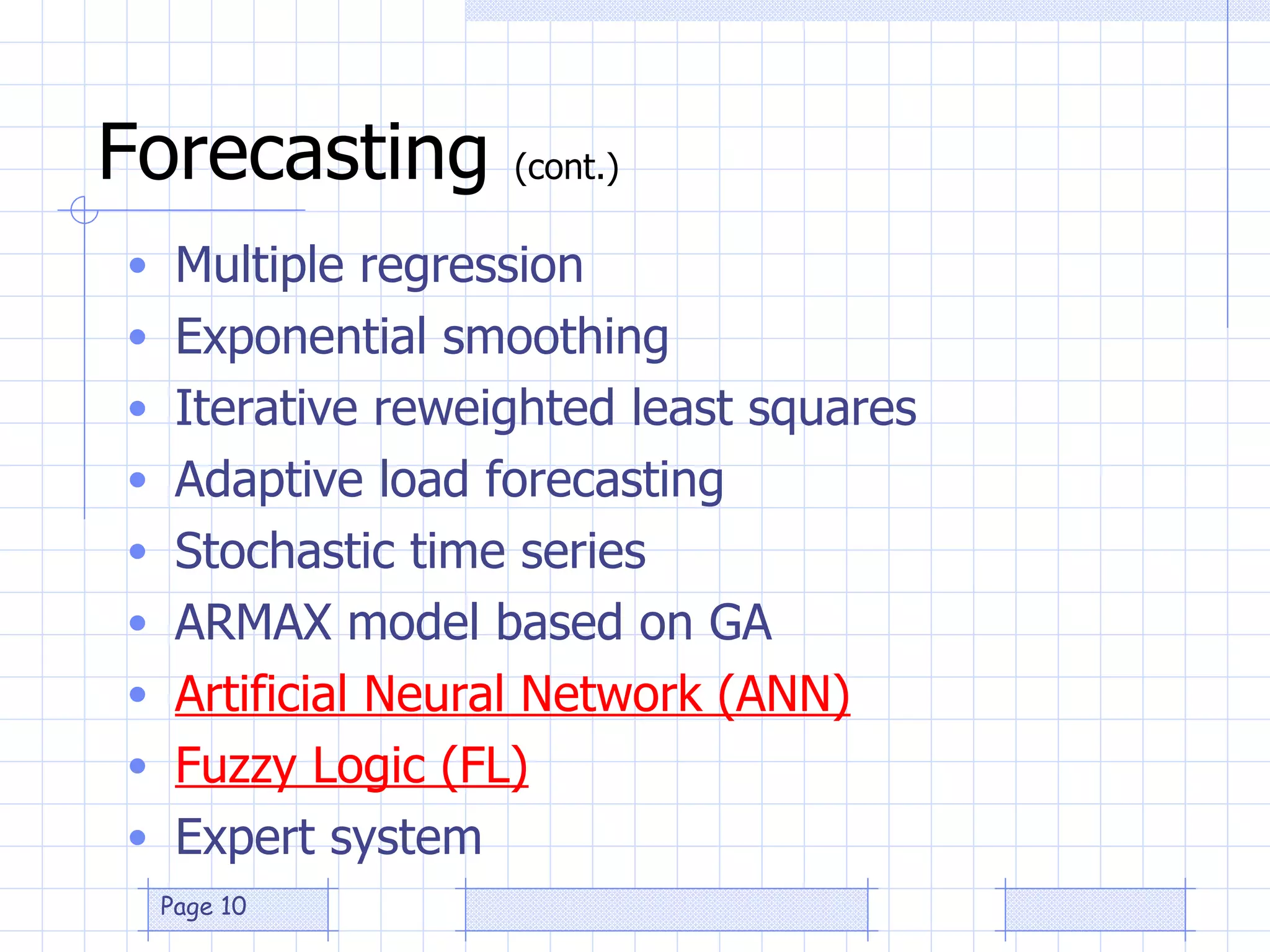
Forecasting  (cont.) Multiple regression Exponential smoothing Iterative reweighted least squares Adaptive load forecasting Stochastic time series ARMAX model based on GA Artificial Neural Network (ANN) Fuzzy Logic (FL) Expert system
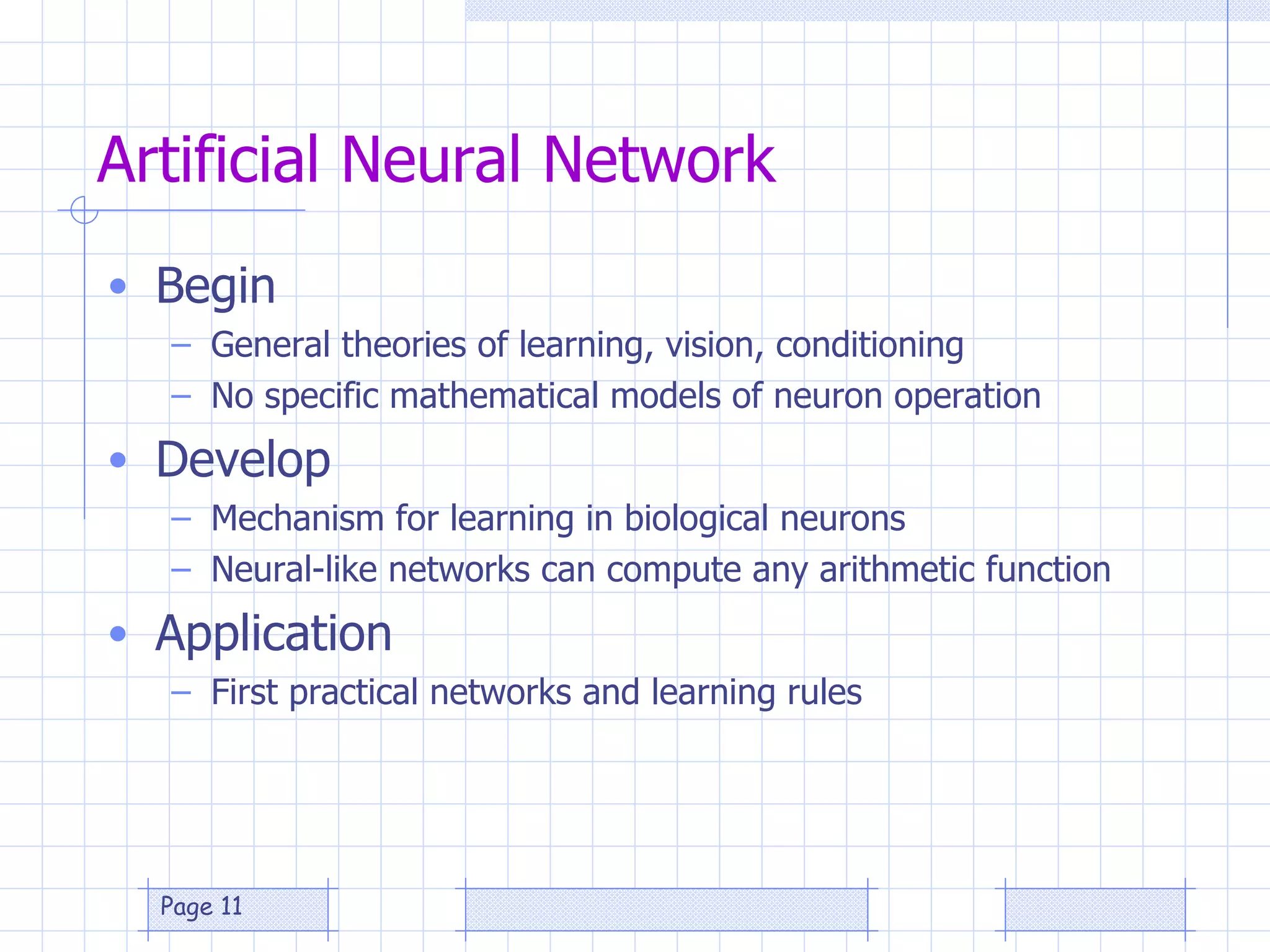
Begin General theories of learning, vision, conditioning No specific mathematical models of neuron operation Develop Mechanism for learning in biological neurons Neural-like networks can compute any arithmetic function Application First practical networks and learning rules Artificial Neural Network
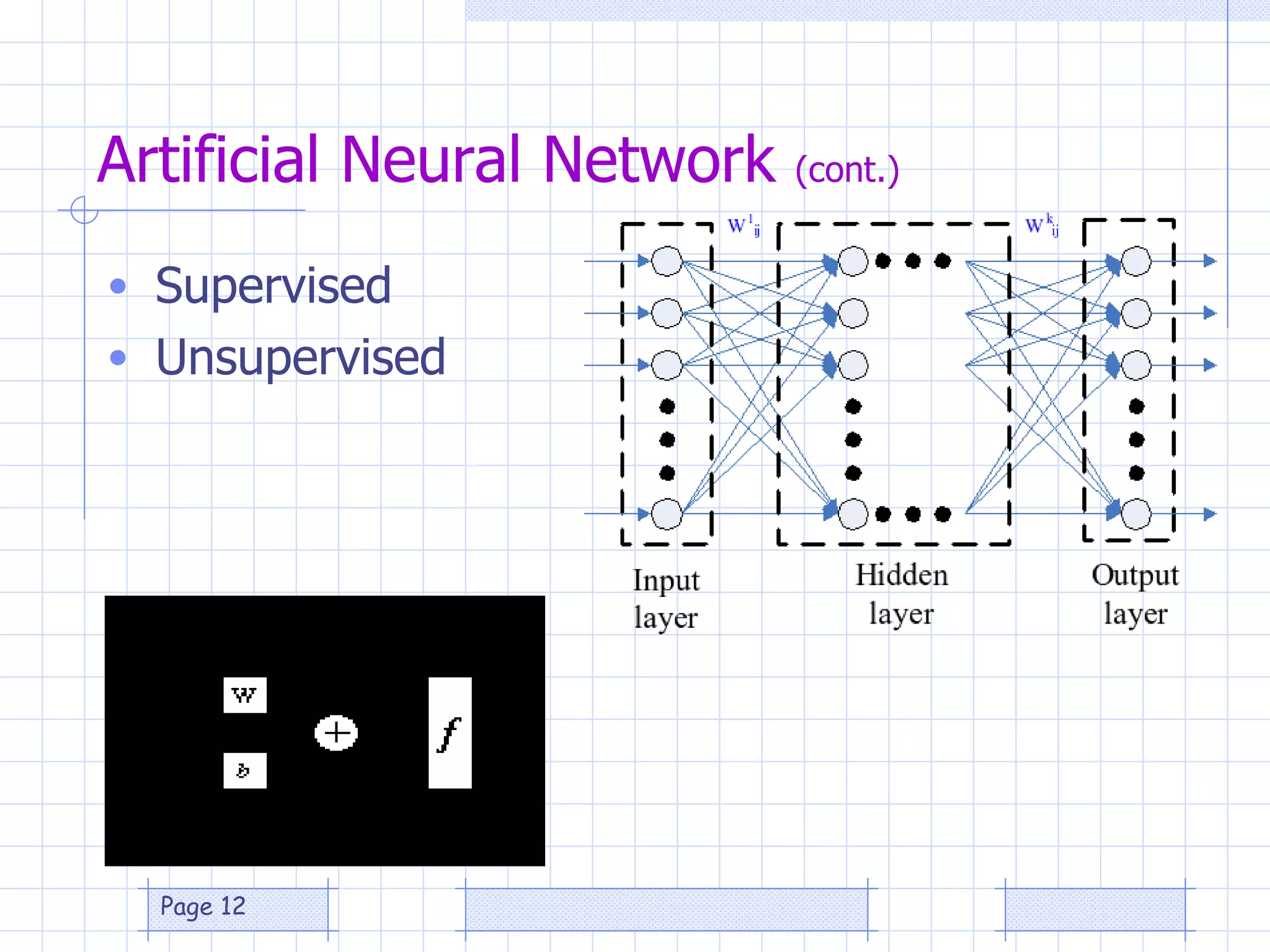
Artificial Neural Network  (cont.) Supervised Unsupervised
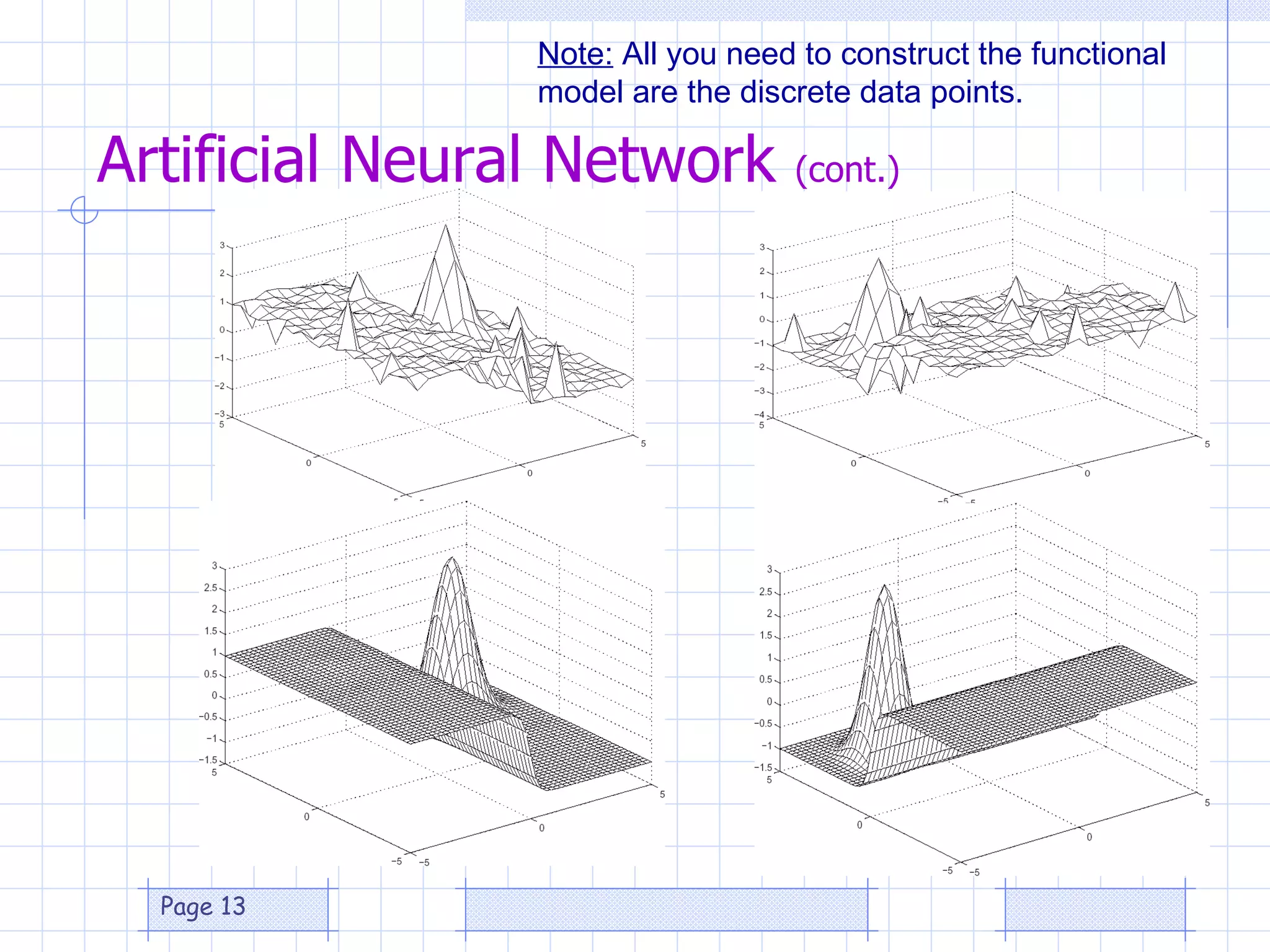
Note:  All you need to construct the functional model are the discrete data points. Artificial Neural Network  (cont.)
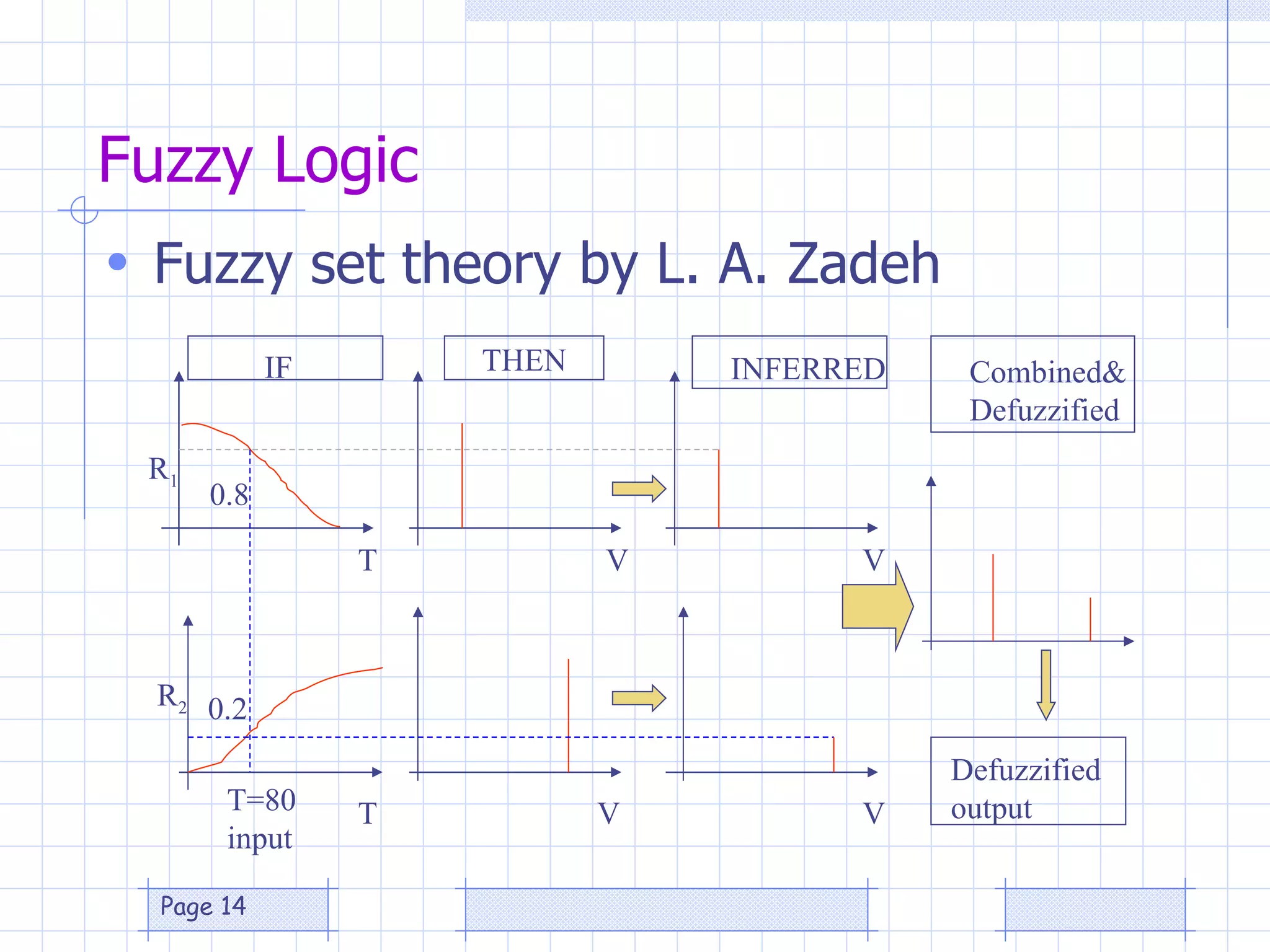
Fuzzy Logic Fuzzy set theory by L. A. Zadeh   IF THEN INFERRED Combined& Defuzzified T T V V V V 0.2 0.8 Defuzzified  output T=80  input R 1 R 2
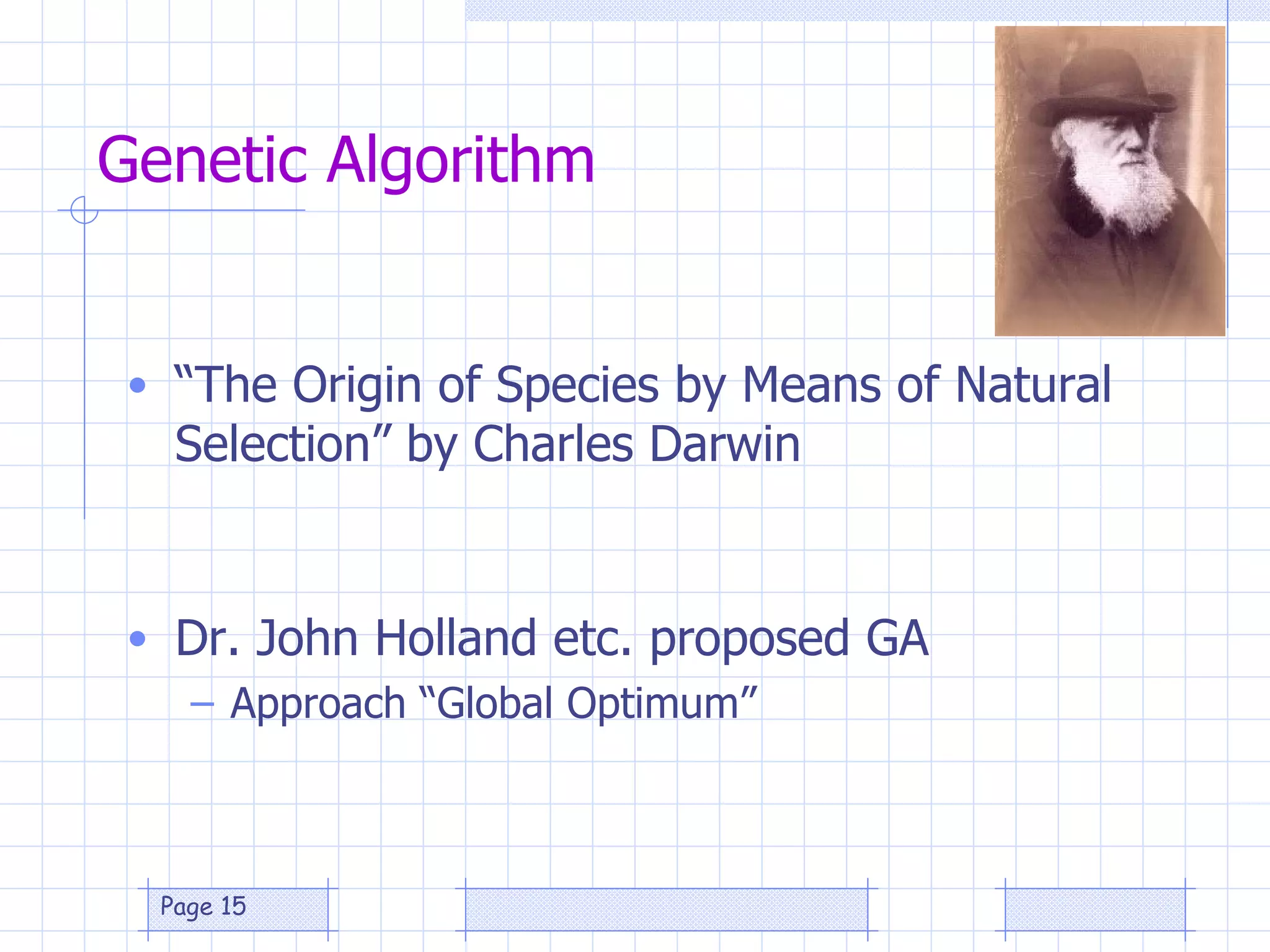
Genetic Algorithm “ The Origin of Species by Means of Natural Selection” by Charles Darwin  Dr. John Holland etc. proposed GA Approach “Global Optimum”
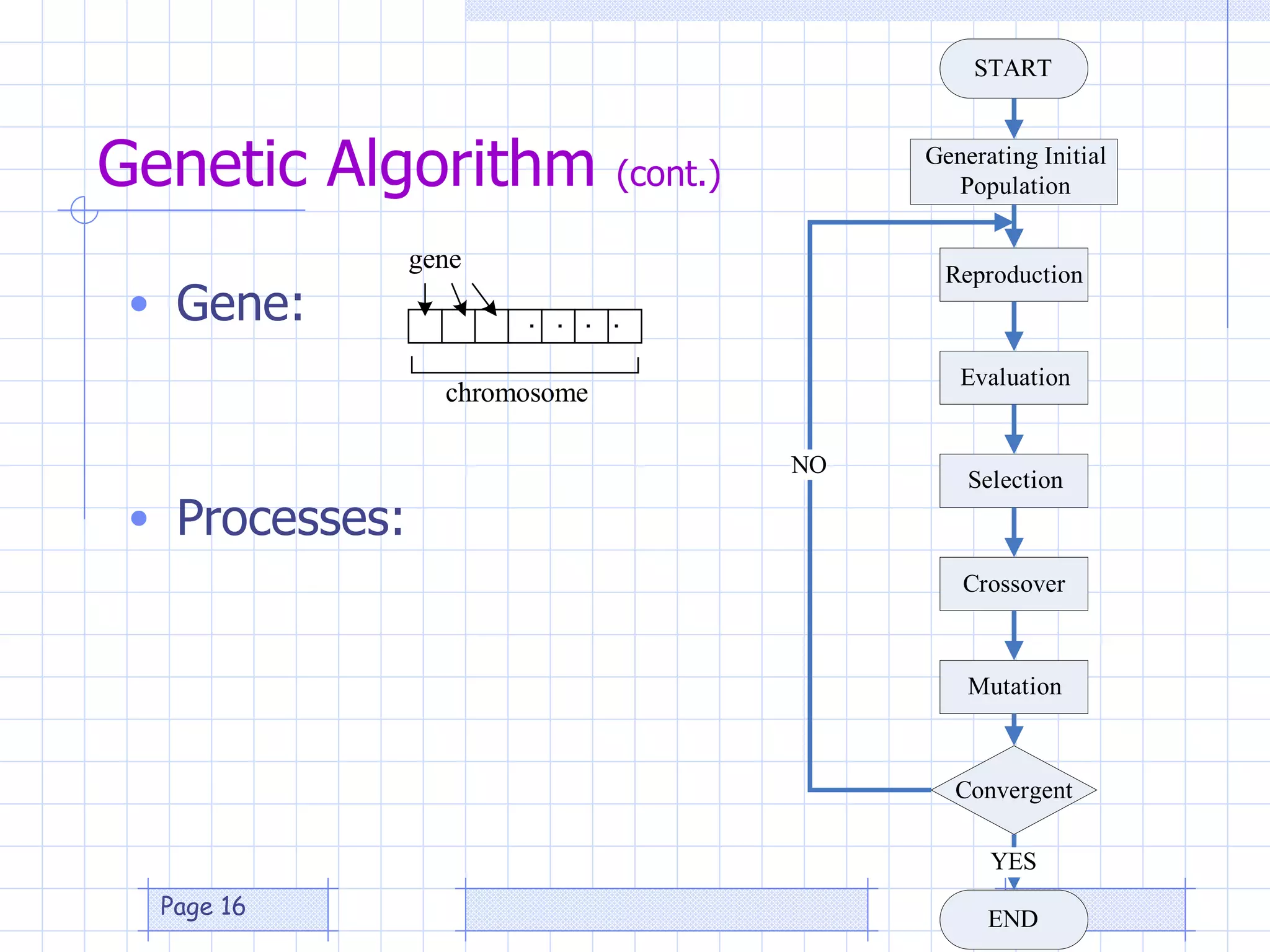
Genetic Algorithm  (cont.) Gene: Processes:
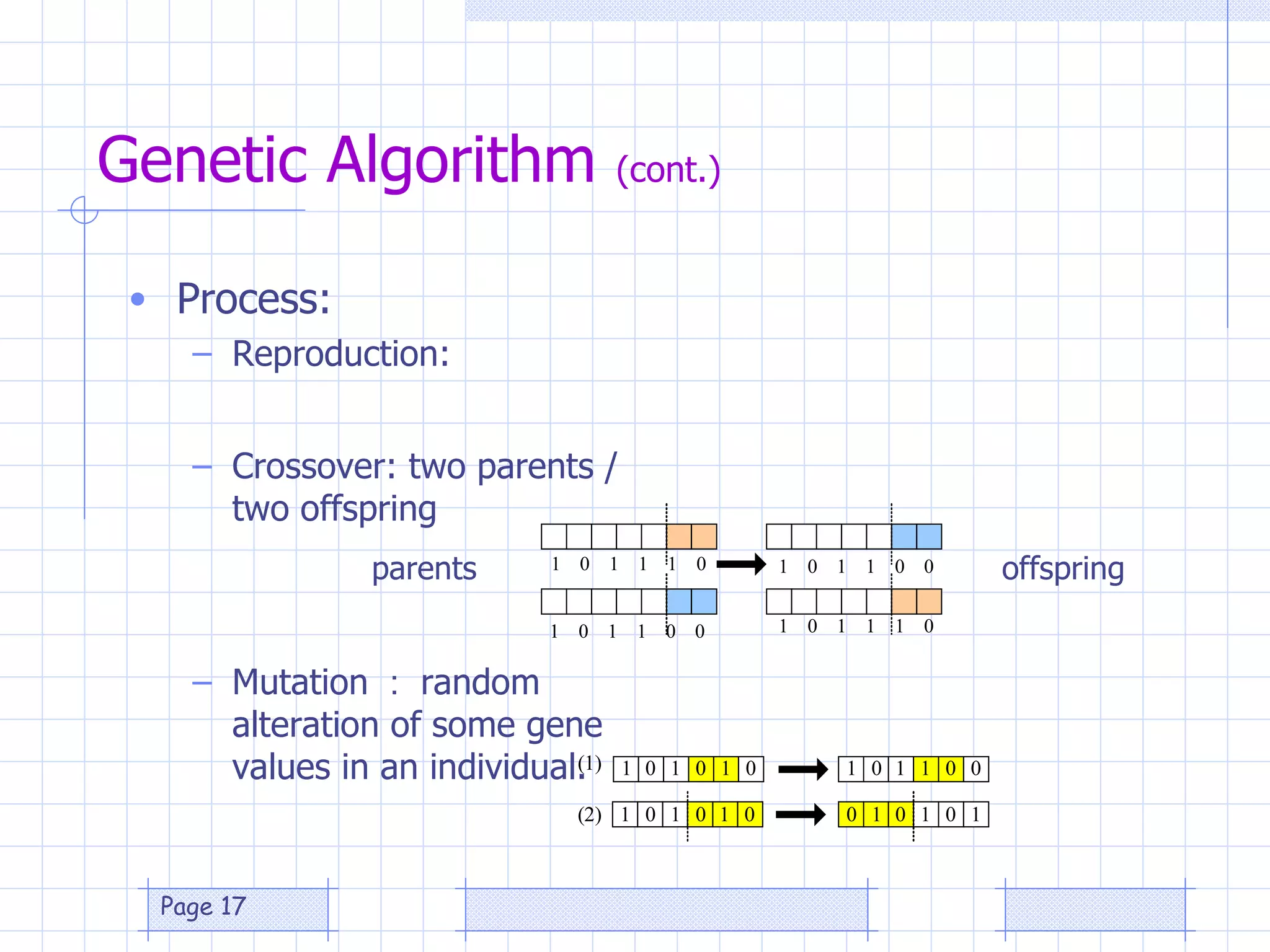
Genetic Algorithm  (cont.) Process: Reproduction: Crossover: two parents / two offspring Mutation : random alteration of some gene values in an individual. parents offspring
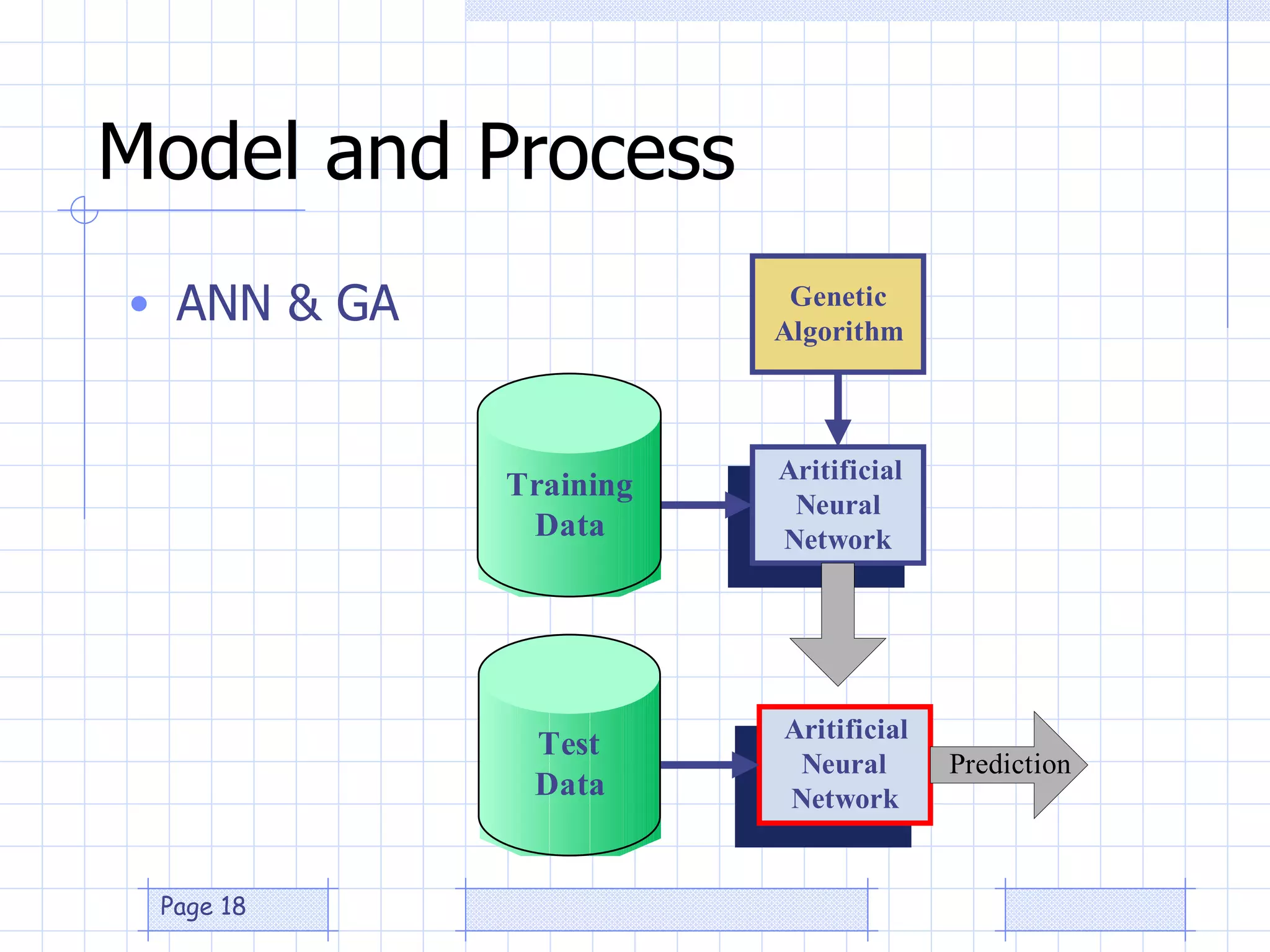
ANN & GA Model and Process
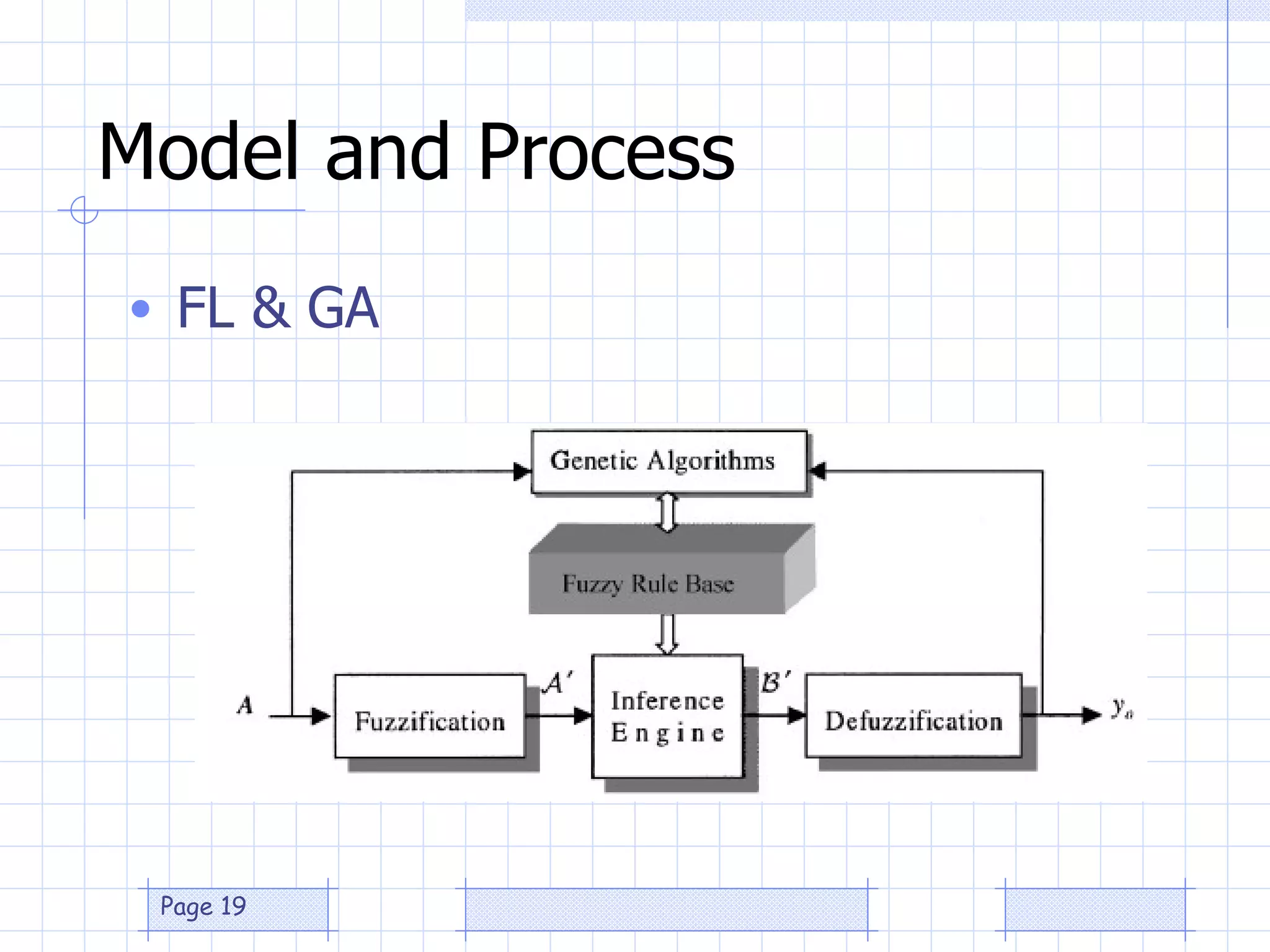
Model and Process FL & GA
Accuracy Comparison Mean square error of ANN prediction in [1]
Table 1. Comparison results of RMSE of various forecasting models [4] Efficiency Comparison  (cont.) 0.007 500 ANFIS 0.06 500 Cascade Correlation NN 0.55 500 Linear Predictive Method 0.0907 500 Product operator 0.09 500 Min operator 0.19 500 Auto Regressive Model 0.04 500 6th-order Polynomial 0.02 500 BP ANN 0.038011 (9 partition) 500 FL&GA Prediction Error (RMSE) Training Method
Modified hybrid system
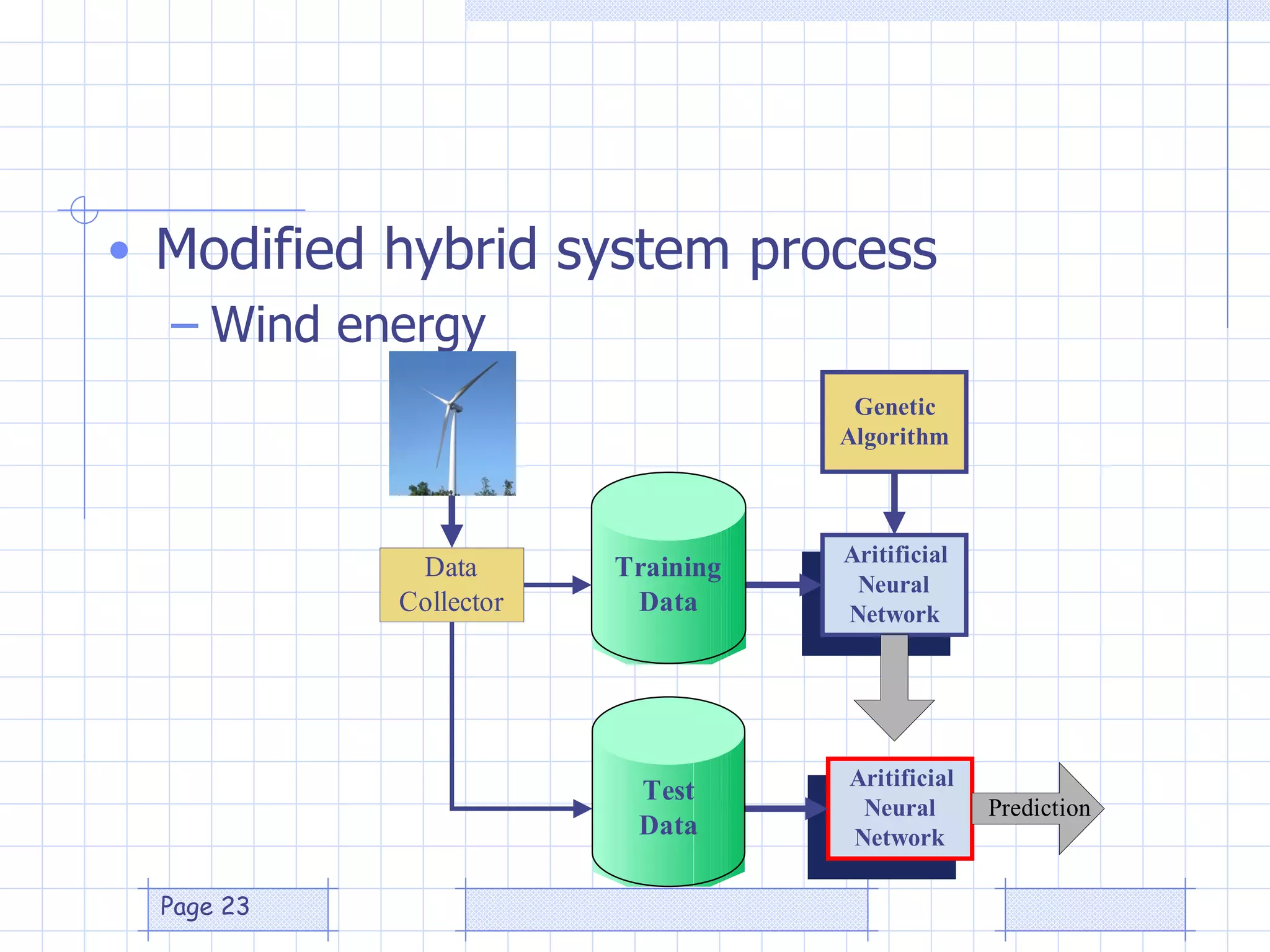
Modified hybrid system process Wind energy
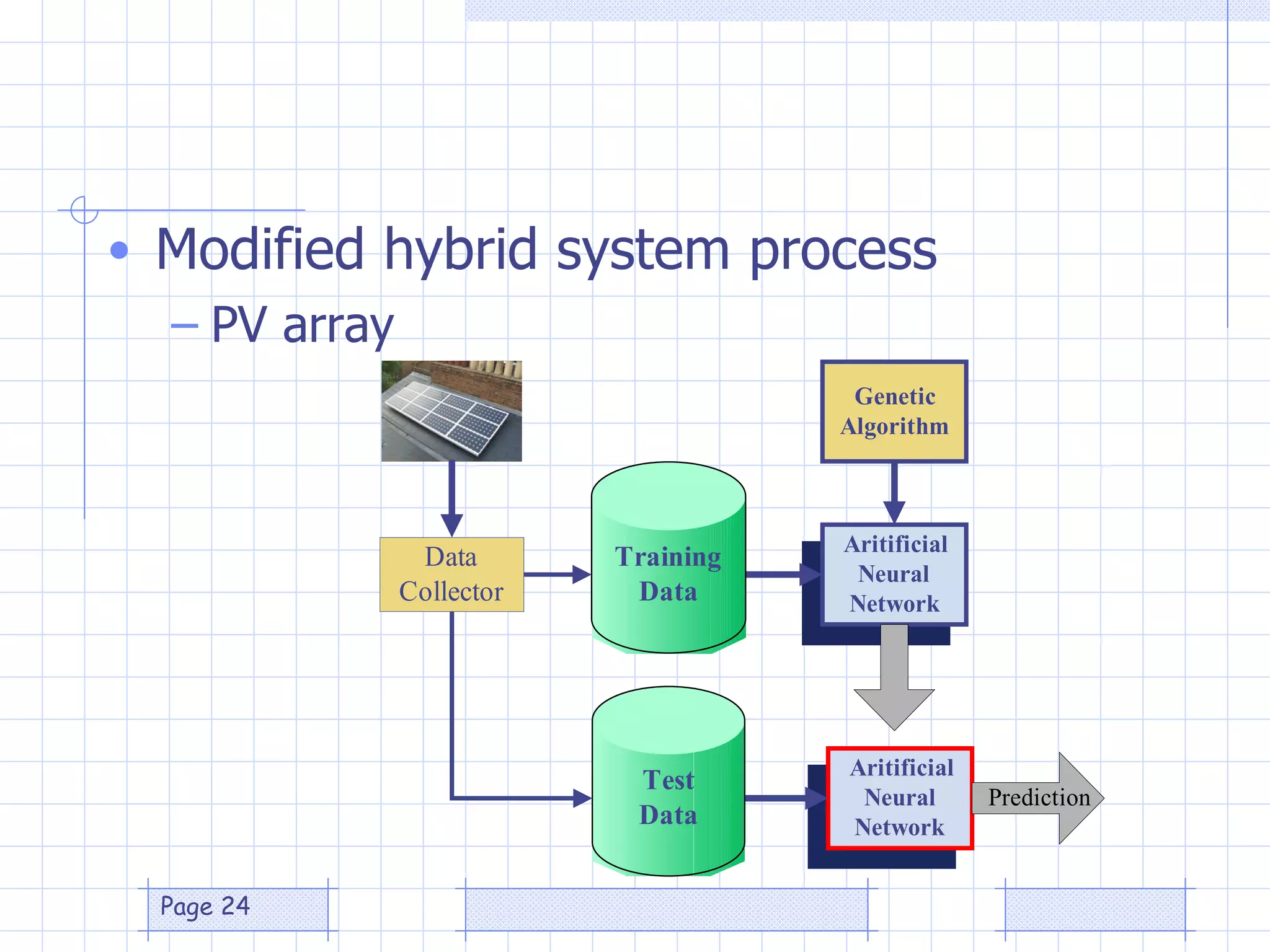
Modified hybrid system process PV array
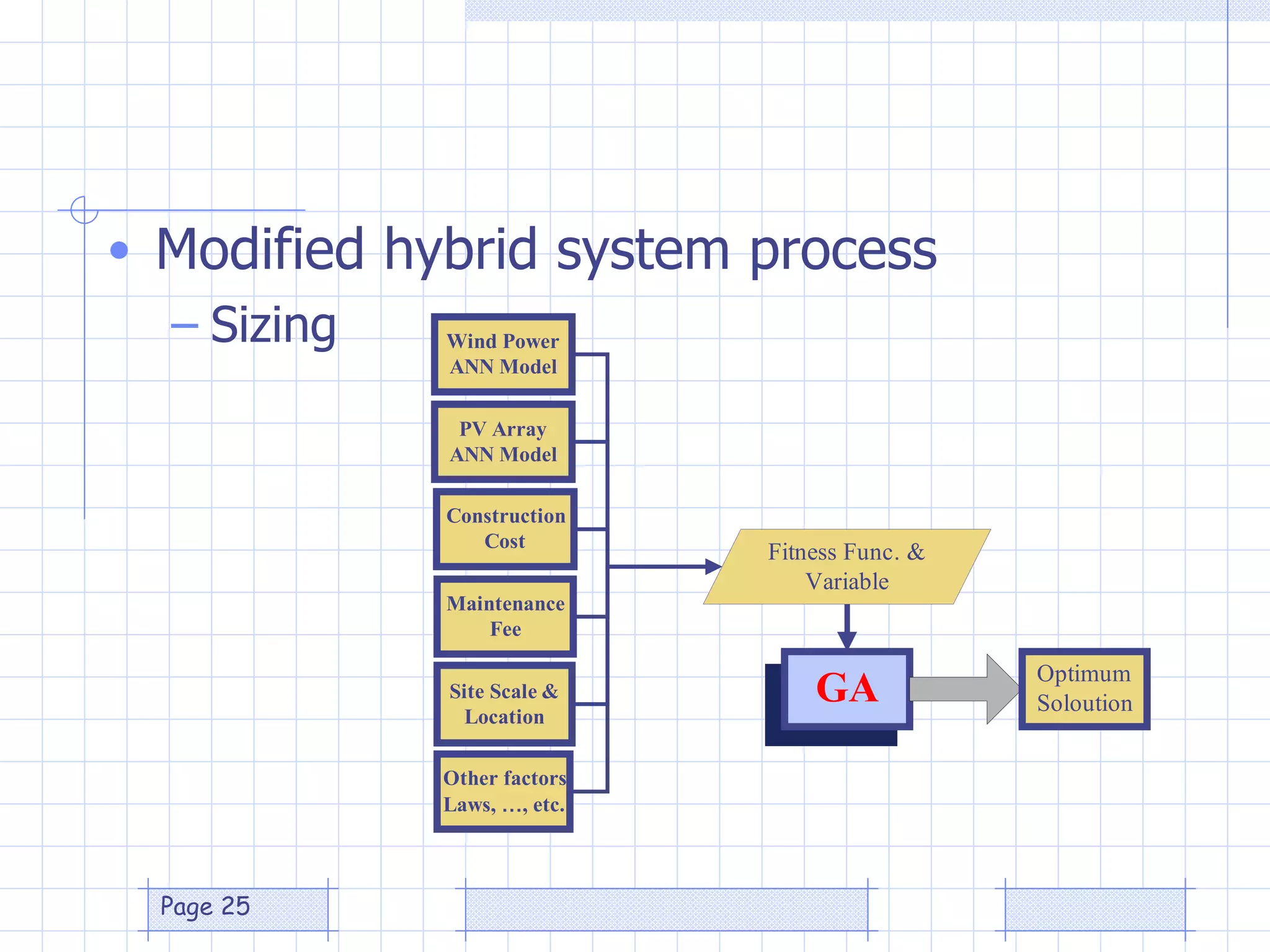
Modified hybrid system process Sizing
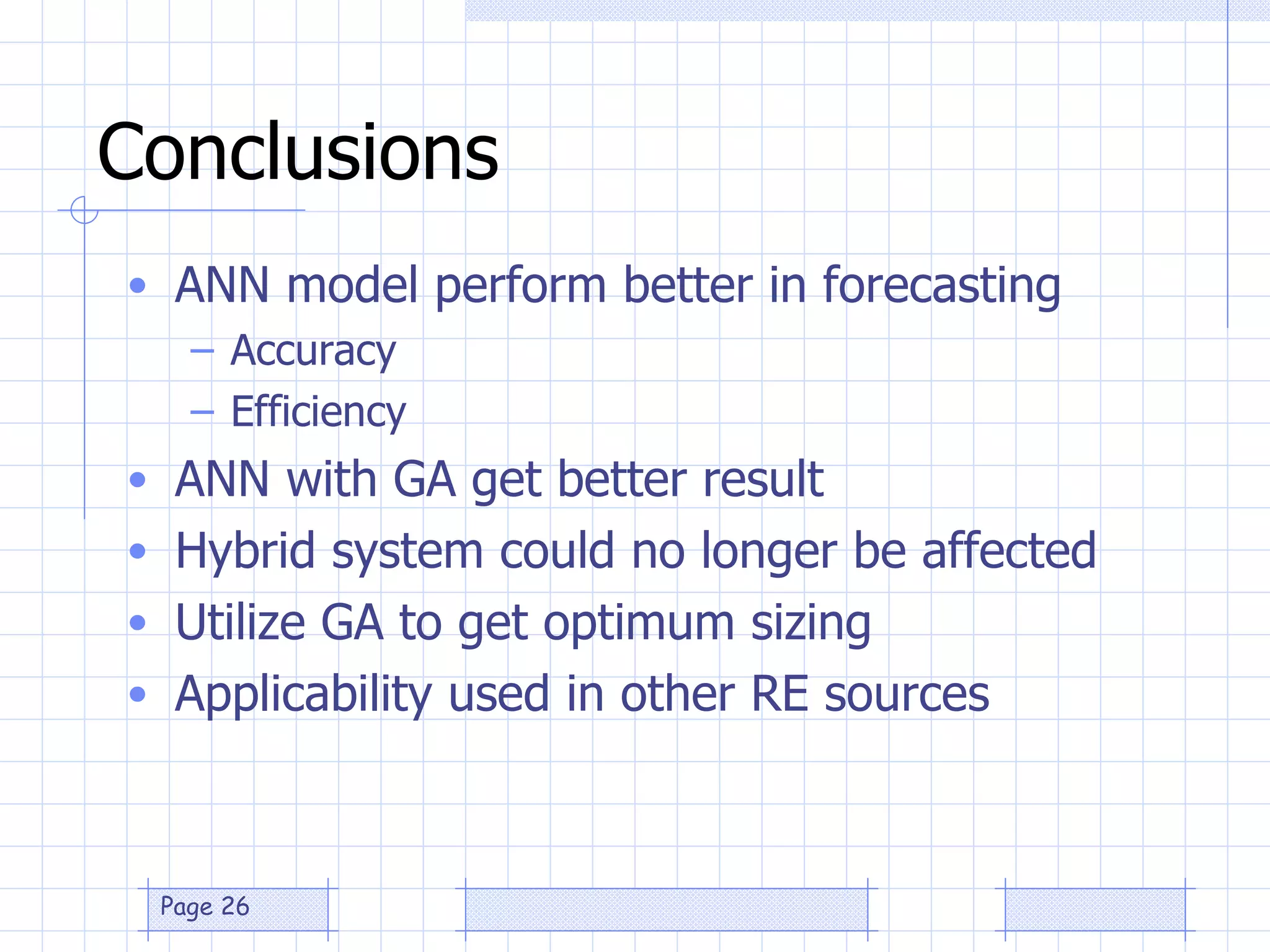
Conclusions ANN model perform better in forecasting Accuracy Efficiency ANN with GA get better result Hybrid system could no longer be affected  Utilize GA to get optimum sizing Applicability used in other RE sources
Q&A Thank you for your attention.

FORECASTING OF RENEWABLE ENERGY PRODUCTION BY USING GENETIC ALGORITHM (GA) FOR DETERMINING HYDROGEN PRODUCTION POTENTIAL

  • 1.
    FORECASTING OF RENEWABLEENERGY PRODUCTION BY USING GENETIC ALGORITHM (GA) FOR DETERMINING HYDROGEN PRODUCTION POTENTIAL University of Jyv äskylä Renewable Energy Master Programme Reporter : Lin Tzu Chao 24/11/2006
  • 2.
    Outline Introduction Hybridsystem : Wind and PV Forecasting Comparison Model and process Conclusion & future work Q&A
  • 3.
    Introduction Why Renewable Energy Production? Wind power & PV combination Unstable output in electricity market Benefit of optimum sizing and forecasting Purpose Optimum sizing Forecasting of RE energy
  • 4.
    Introduction (cont.)Optimum Sizing Optimum sizing combination of a battery bank and PV array Used a stochastic analytical model to optimize a wind power plant Generation of unit sizing hybrid system Using GA to optimize renewable generating systems
  • 5.
    Introduction (cont.)Optimum forecasting A rtificial N eural N etwork (ANN) Applied neural network in prediction and identification Applied GA based ANN for short term load forecasting Applied ANN to identify wind energy output
  • 6.
    Introduction (cont.)Optimum forecasting F uzzy L ogic (FL) Applied fuzzy in predicting chaotic time series Applied genetic Fuzzy predictor in forecasting time series problem
  • 7.
    Hybrid System In2000, K. Agbossou et al. proposed the stand-alone hybrid system
  • 8.
    Hybrid System (cont.) Modified hybrid system to supply fuel cell and connected to the electricity net
  • 9.
    Forecasting Forecasting :to precisely predict the short-term evolution of the system n
  • 10.
    Forecasting (cont.)Multiple regression Exponential smoothing Iterative reweighted least squares Adaptive load forecasting Stochastic time series ARMAX model based on GA Artificial Neural Network (ANN) Fuzzy Logic (FL) Expert system
  • 11.
    Begin General theoriesof learning, vision, conditioning No specific mathematical models of neuron operation Develop Mechanism for learning in biological neurons Neural-like networks can compute any arithmetic function Application First practical networks and learning rules Artificial Neural Network
  • 12.
    Artificial Neural Network (cont.) Supervised Unsupervised
  • 13.
    Note: Allyou need to construct the functional model are the discrete data points. Artificial Neural Network (cont.)
  • 14.
    Fuzzy Logic Fuzzyset theory by L. A. Zadeh IF THEN INFERRED Combined& Defuzzified T T V V V V 0.2 0.8 Defuzzified output T=80 input R 1 R 2
  • 15.
    Genetic Algorithm “The Origin of Species by Means of Natural Selection” by Charles Darwin Dr. John Holland etc. proposed GA Approach “Global Optimum”
  • 16.
    Genetic Algorithm (cont.) Gene: Processes:
  • 17.
    Genetic Algorithm (cont.) Process: Reproduction: Crossover: two parents / two offspring Mutation : random alteration of some gene values in an individual. parents offspring
  • 18.
    ANN & GAModel and Process
  • 19.
  • 20.
    Accuracy Comparison Meansquare error of ANN prediction in [1]
  • 21.
    Table 1. Comparisonresults of RMSE of various forecasting models [4] Efficiency Comparison (cont.) 0.007 500 ANFIS 0.06 500 Cascade Correlation NN 0.55 500 Linear Predictive Method 0.0907 500 Product operator 0.09 500 Min operator 0.19 500 Auto Regressive Model 0.04 500 6th-order Polynomial 0.02 500 BP ANN 0.038011 (9 partition) 500 FL&GA Prediction Error (RMSE) Training Method
  • 22.
  • 23.
    Modified hybrid systemprocess Wind energy
  • 24.
    Modified hybrid systemprocess PV array
  • 25.
    Modified hybrid systemprocess Sizing
  • 26.
    Conclusions ANN modelperform better in forecasting Accuracy Efficiency ANN with GA get better result Hybrid system could no longer be affected Utilize GA to get optimum sizing Applicability used in other RE sources
  • 27.
    Q&A Thank youfor your attention.