Boosting Optimization Standards


                       eArtius HMGE Algorithm Applied to
                         Optimization Tasks with 10,000
                                Design Variables
                                                          Vladimir Sevastyanov
                                                  eArtius, Inc., Irvine, CA 92614, USA
                                                          vladimir@eartius.com


©Copyright eArtius Inc 2012 All Rights Reserved                                          October 22, 2012
A number of algebraic models are designed
   at eArtius with the following properties:
          2 objective functions
          10,000 design variables
          Only a few hundred design variables are
           significant; all others are not significant
          Design space has a predetermined number of
           sub-areas (“craters”) where objective functions
           really depend on design variables;
          Each such a sub-area has own list of significant
           design variables

         The models are designed to test scalability of
          eArtius optimization algorithms


©Copyright eArtius Inc 2012 All Rights Reserved               October 22, 2012
Hybrid Multi-Gradient Explorer
                       (HMGE) Optimization Method


©Copyright eArtius Inc 2012 All Rights Reserved        October 22, 2012
How HMGE algorithm works:
          Basically, HMGE works as a Genetic Algorithm;
          Periodically HMGE evaluates gradients, and performs
           gradient-based steps, which improves convergence
           dramatically
 How gradient based steps are performed:
          Evaluate the model on 5-7 points generated in a small sub-
           region around current point;
          Recognize the most significant design variables, and build
           an approximation for each output variable;
          Estimate gradients based on the approximations;
          Determine a direction of simultaneous improvement for all
           objective functions;
          Perform a step in the direction


©Copyright eArtius Inc 2012 All Rights Reserved                     October 22, 2012
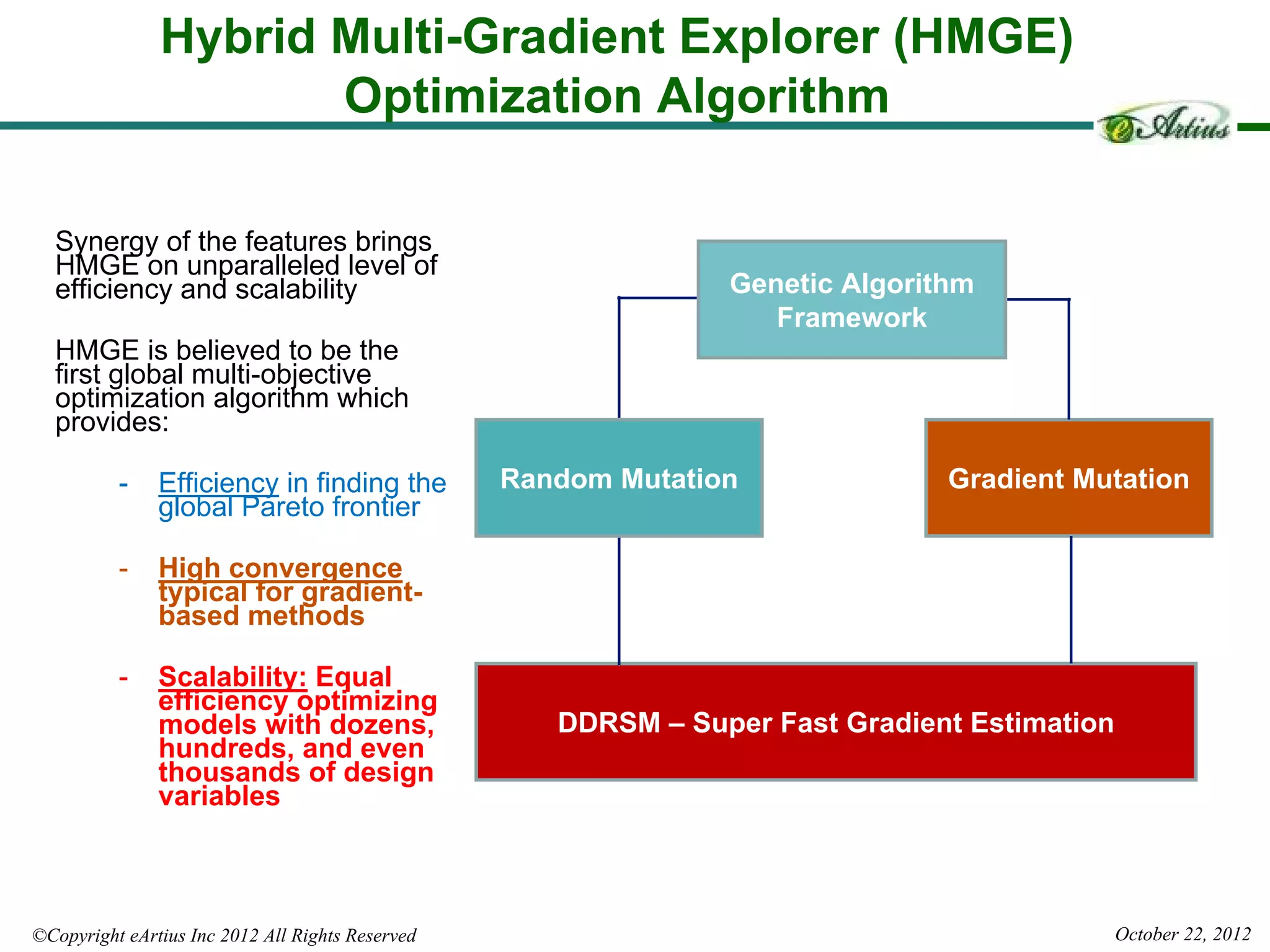
Hybrid Multi-Gradient Explorer (HMGE)
                      Optimization Algorithm

  Synergy of the features brings
  HMGE on unparalleled level of
  efficiency and scalability                                    Genetic Algorithm
                                                                   Framework
  HMGE is believed to be the
  first global multi-objective
  optimization algorithm which
  provides:

          -    Efficiency in finding the          Random Mutation              Gradient Mutation
               global Pareto frontier

          -    High convergence
               typical for gradient-
               based methods

          -    Scalability: Equal
               efficiency optimizing
               models with dozens,                   DDRSM – Super Fast Gradient Estimation
               hundreds, and even
               thousands of design
               variables


©Copyright eArtius Inc 2012 All Rights Reserved                                               October 22, 2012
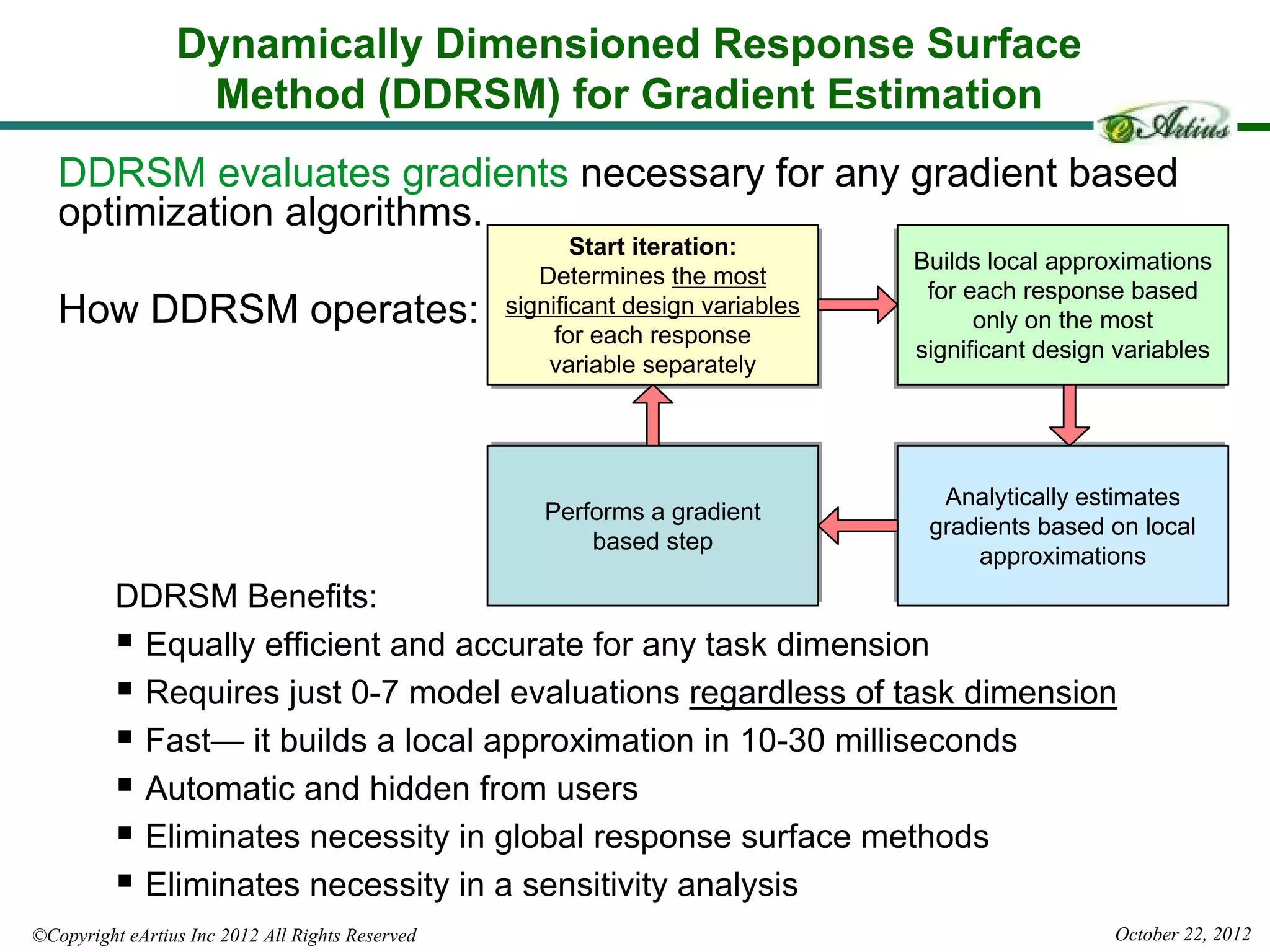
Dynamically Dimensioned Response Surface
                  Method (DDRSM) for Gradient Estimation
   DDRSM evaluates gradients necessary for any gradient based
   optimization algorithms.
                                                         Start iteration:
                                                          Start iteration:       Builds local approximations
                                                                                 Builds local approximations
                                                     Determines the most
                                                     Determines the most           for each response based
                                                                                  for each response based
   How DDRSM operates:                            significant design variables
                                                  significant design variables          only on the most
                                                                                       only on the most
                                                       for each response
                                                        for each response        significant design variables
                                                                                 significant design variables
                                                      variable separately
                                                      variable separately


                                                                                   Analytically estimates
                                                                                    Analytically estimates
                                                     Performs a gradient
                                                     Performs a gradient          gradients based on local
                                                                                  gradients based on local
                                                         based step
                                                         based step                   approximations
                                                                                       approximations
          DDRSM Benefits:
           Equally efficient and accurate for any task dimension
           Requires just 0-7 model evaluations regardless of task dimension
           Fast— it builds a local approximation in 10-30 milliseconds
           Automatic and hidden from users
           Eliminates necessity in global response surface methods
           Eliminates necessity in a sensitivity analysis
©Copyright eArtius Inc 2012 All Rights Reserved                                                    October 22, 2012
Optimization Results for Tasks with
                   10,000 design Variables


©Copyright eArtius Inc 2012 All Rights Reserved     October 22, 2012
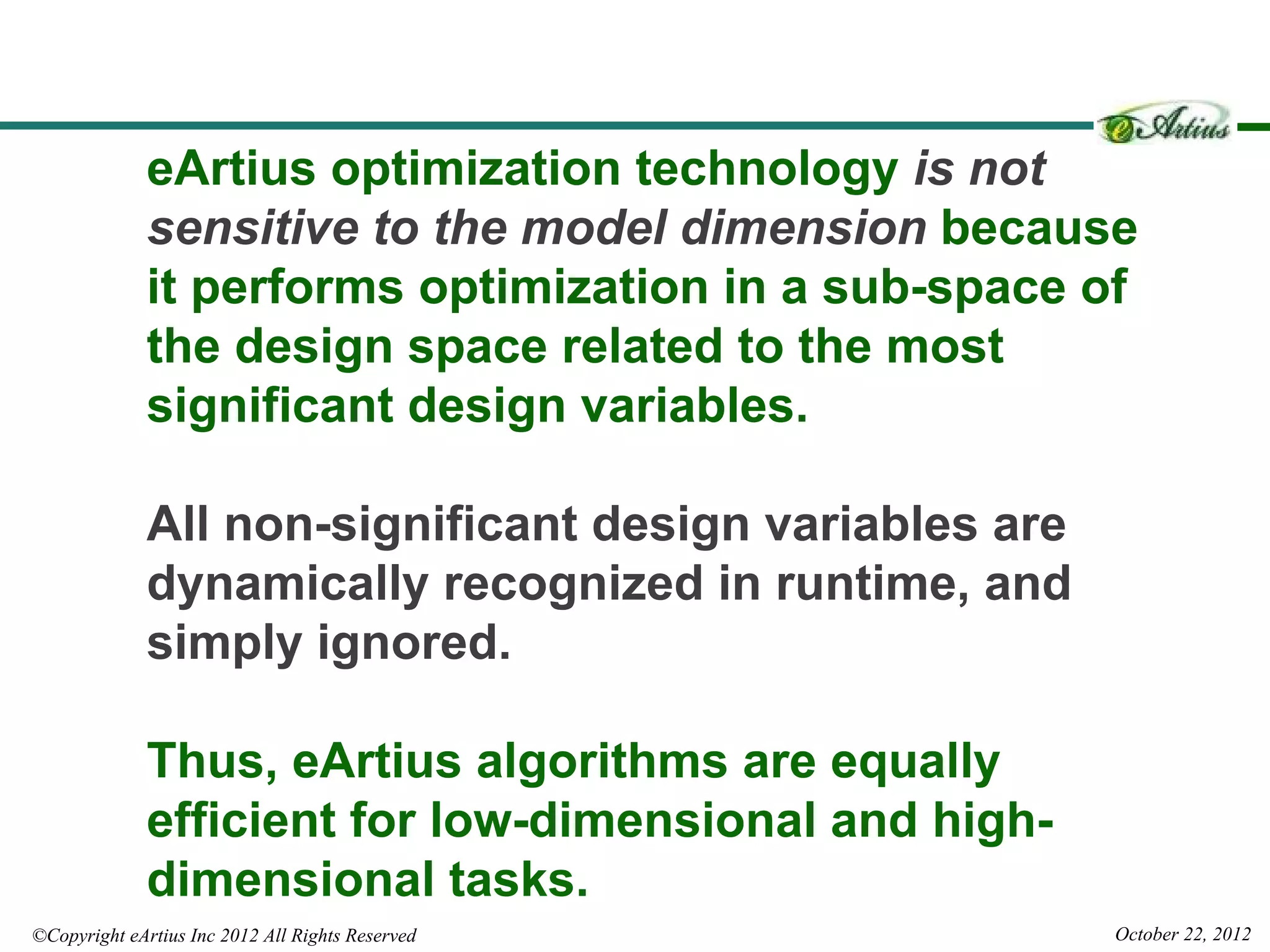
eArtius optimization technology is not
              sensitive to the model dimension because
              it performs optimization in a sub-space of
              the design space related to the most
              significant design variables.

              All non-significant design variables are
              dynamically recognized in runtime, and
              simply ignored.

              Thus, eArtius algorithms are equally
              efficient for low-dimensional and high-
              dimensional tasks.
©Copyright eArtius Inc 2012 All Rights Reserved          October 22, 2012
Algebraic Model Description
     eArtius has developed an algorithm
     which allows to generate algebraic
     models with a predetermined number
     of design variables, and a
     predetermined type of topology.

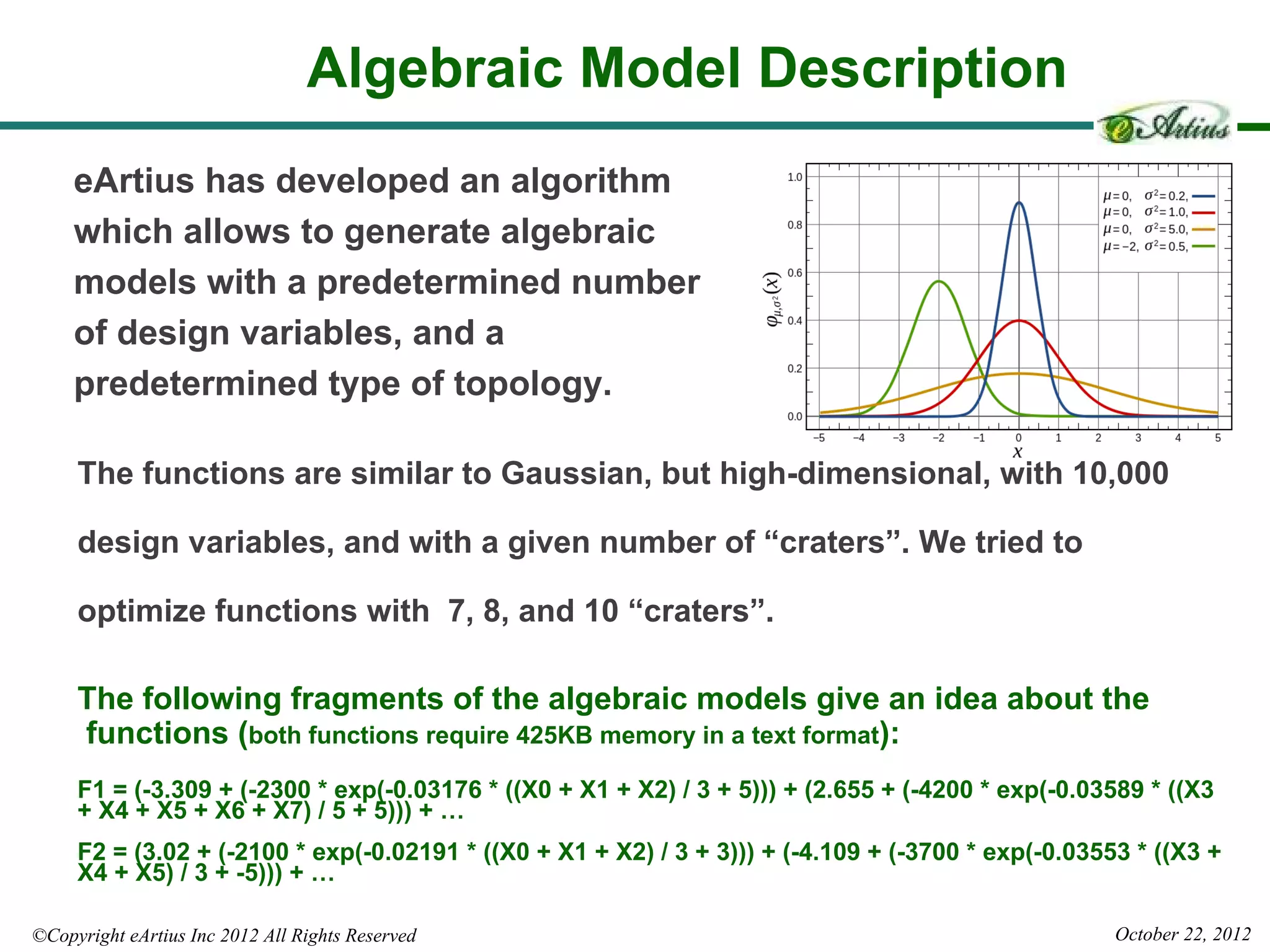
     The functions are similar to Gaussian, but high-dimensional, with 10,000

     design variables, and with a given number of “craters”. We tried to

     optimize functions with 7, 8, and 10 “craters”.

     The following fragments of the algebraic models give an idea about the
     functions (both functions require 425KB memory in a text format):
     F1 = (-3.309 + (-2300 * exp(-0.03176 * ((X0 + X1 + X2) / 3 + 5))) + (2.655 + (-4200 * exp(-0.03589 * ((X3
     + X4 + X5 + X6 + X7) / 5 + 5))) + …
     F2 = (3.02 + (-2100 * exp(-0.02191 * ((X0 + X1 + X2) / 3 + 3))) + (-4.109 + (-3700 * exp(-0.03553 * ((X3 +
     X4 + X5) / 3 + -5))) + …

©Copyright eArtius Inc 2012 All Rights Reserved                                                      October 22, 2012
Optimization Results for 7 “Craters”


                   –   2 objectives to be minimized
                   –   10,000 design variables with the range [-10, 10]
                   –   1000 model evaluations
                   –   53 Pareto optimal solutions

©Copyright eArtius Inc 2012 All Rights Reserved                       October 22, 2012
Optimization Results for 8 “Craters”


                   –   2 objectives to be minimized
                   –   10,000 design variables with the range [-10, 10]
                   –   1000 model evaluations
                   –   97 Pareto Optimal Points
©Copyright eArtius Inc 2012 All Rights Reserved                       October 22, 2012
Optimization Results for 10 “Craters”


                   –   2 objectives to be minimized
                   –   10,000 design variables with the range [-10, 10]
                   –   909 model evaluations
                   –   54 Pareto Optimal Points
©Copyright eArtius Inc 2012 All Rights Reserved                       October 22, 2012
An Engineering Example of an
              Optimization Task Solved by HMGE
               Optimization Method in ANSYS
                   Workbench Environment


©Copyright eArtius Inc 2012 All Rights Reserved   October 22, 2012
Multi-Physics Steady State
           Thermoelectric Simulation coupled with
            Solid Works Shape Optimization and
            Transient Radiative Heat Transfer for
                     Substrate Heat-up


                                                  left          substrate


                                                                     right


                                                         Design Modeler
                                                         (imports geometry parameters
                   Solid Works                           from Solid Works, modifies
                                                                                        Workbench+eArtius
                                                         model adding symmetry
©Copyright eArtius Inc 2012 All Rights Reserved                                                 October 22, 2012
Complex Multi Physics Problem
     Design Modeler Parametric     Steady State Thermo-     Transient Radiation
     Geometry interface with Solid Electric with Surface to with Surface to Surface
                                   Surface Radiation                                                 Project folders
     Works


                                                                           Optimization Method
                                                                              selection (MGE)


                                                                              WorkBench status Bar
                                                                                 (stop button)


            Optimization Messages updates (# of
              data points computed)

                               Optimization Log output

©Copyright eArtius Inc 2012 All Rights Reserved                                                                        October 22, 2012
Optimization Parameters
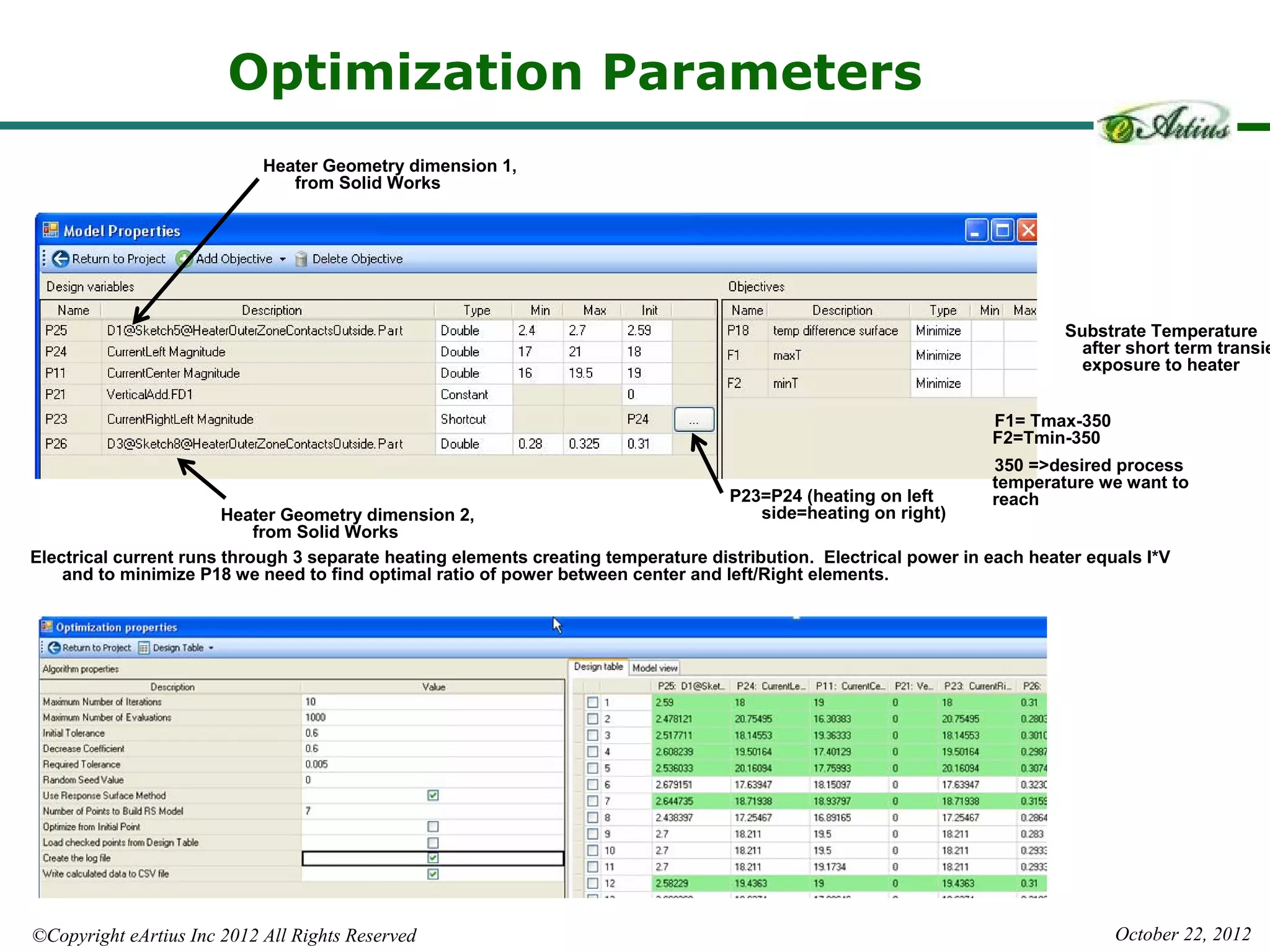
                            Heater Geometry dimension 1,
                               from Solid Works


                                                                                                                            Substrate Temperature
                                                                                                                              after short term transie
                                                                                                                              exposure to heater


                                                                                                                   F1= Tmax-350
                                                                                                                   F2=Tmin-350
                                                                                                                   350 =>desired process
                                                                                                                   temperature we want to
                                                                                   P23=P24 (heating on left        reach
                        Heater Geometry dimension 2,                                    side=heating on right)
                            from Solid Works
Electrical current runs through 3 separate heating elements creating temperature distribution. Electrical power in each heater equals I*V
    and to minimize P18 we need to find optimal ratio of power between center and left/Right elements.


©Copyright eArtius Inc 2012 All Rights Reserved                                                                                   October 22, 2012
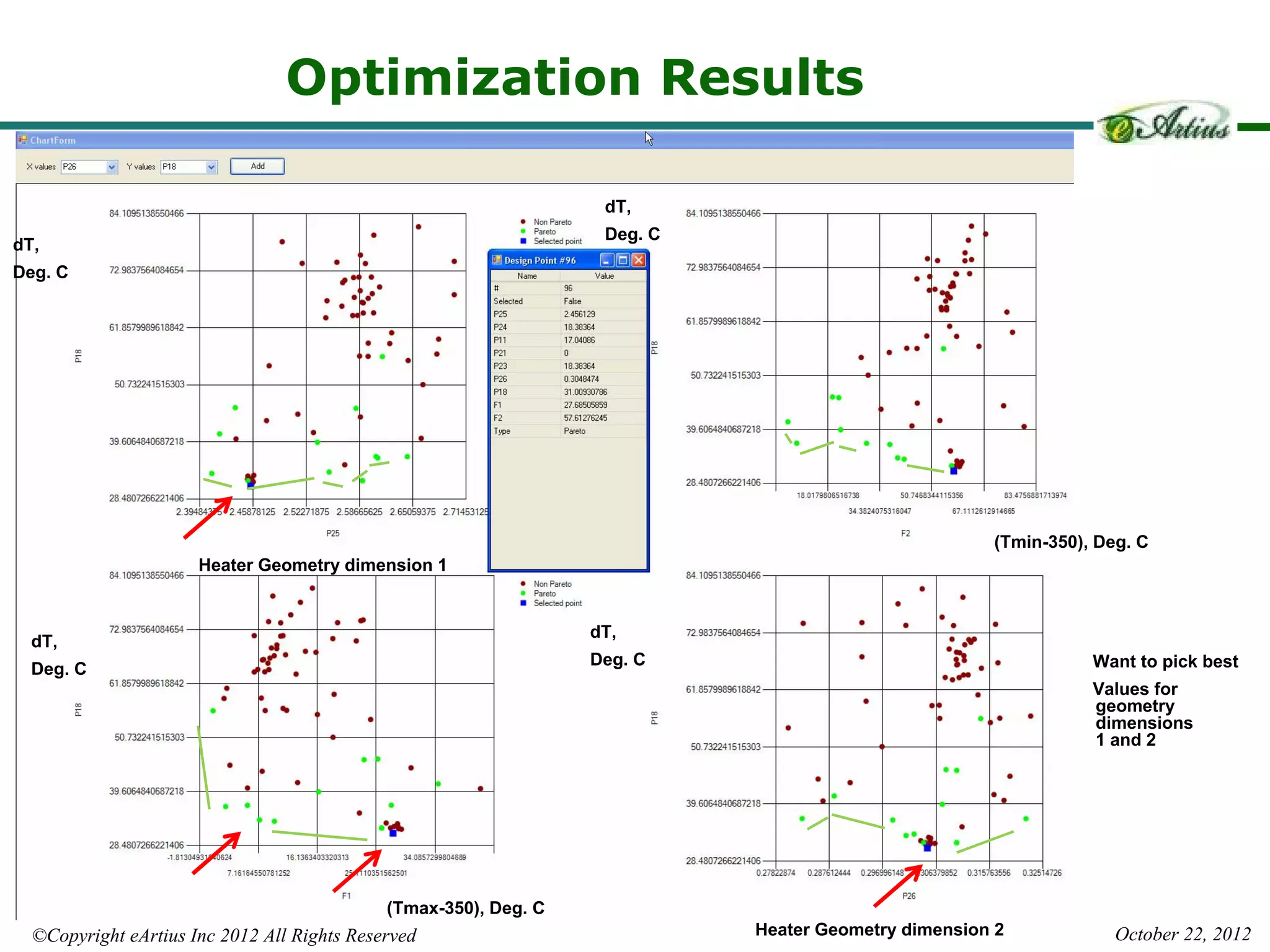
Optimization Results

                                                                   dT,
                                                                   Deg. C
dT,
Deg. C


                                                                                                     (Tmin-350), Deg. C
                      Heater Geometry dimension 1


                                                                  dT,
  dT,
                                                                  Deg. C                                        Want to pick best
  Deg. C
                                                                                                                Values for
                                                                                                                geometry
                                                                                                                dimensions
                                                                                                                1 and 2


                                             (Tmax-350), Deg. C
  ©Copyright eArtius Inc 2012 All Rights Reserved                           Heater Geometry dimension 2            October 22, 2012
Most Essential Result

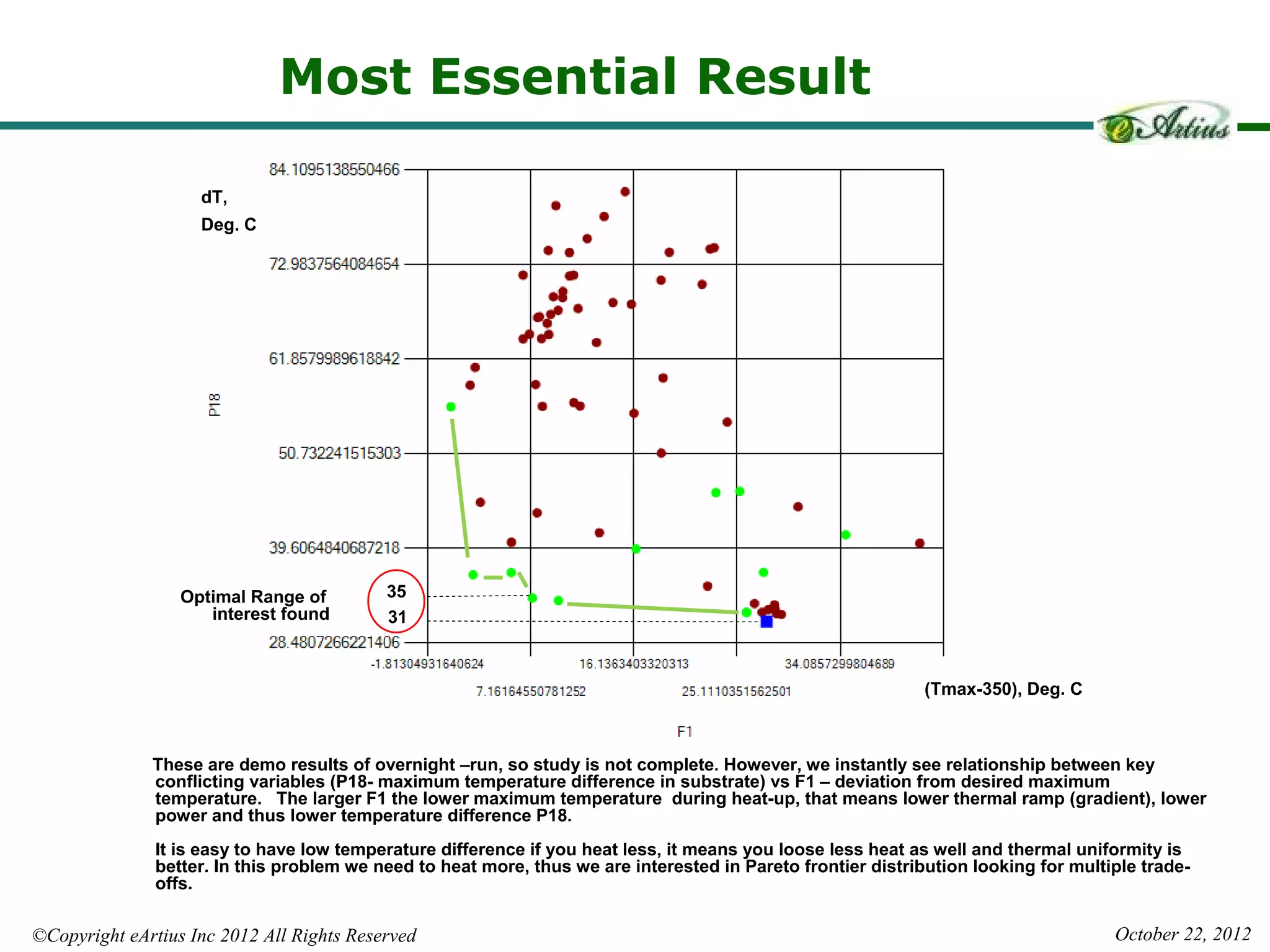
                    dT,
                    Deg. C


                  Optimal Range of         35
                     interest found        31


                                                                                                              (Tmax-350), Deg. C


              These are demo results of overnight –run, so study is not complete. However, we instantly see relationship between key
              conflicting variables (P18- maximum temperature difference in substrate) vs F1 – deviation from desired maximum
              temperature. The larger F1 the lower maximum temperature during heat-up, that means lower thermal ramp (gradient), lower
              power and thus lower temperature difference P18.
               It is easy to have low temperature difference if you heat less, it means you loose less heat as well and thermal uniformity is
               better. In this problem we need to heat more, thus we are interested in Pareto frontier distribution looking for multiple trade-
               offs.

©Copyright eArtius Inc 2012 All Rights Reserved                                                                                      October 22, 2012
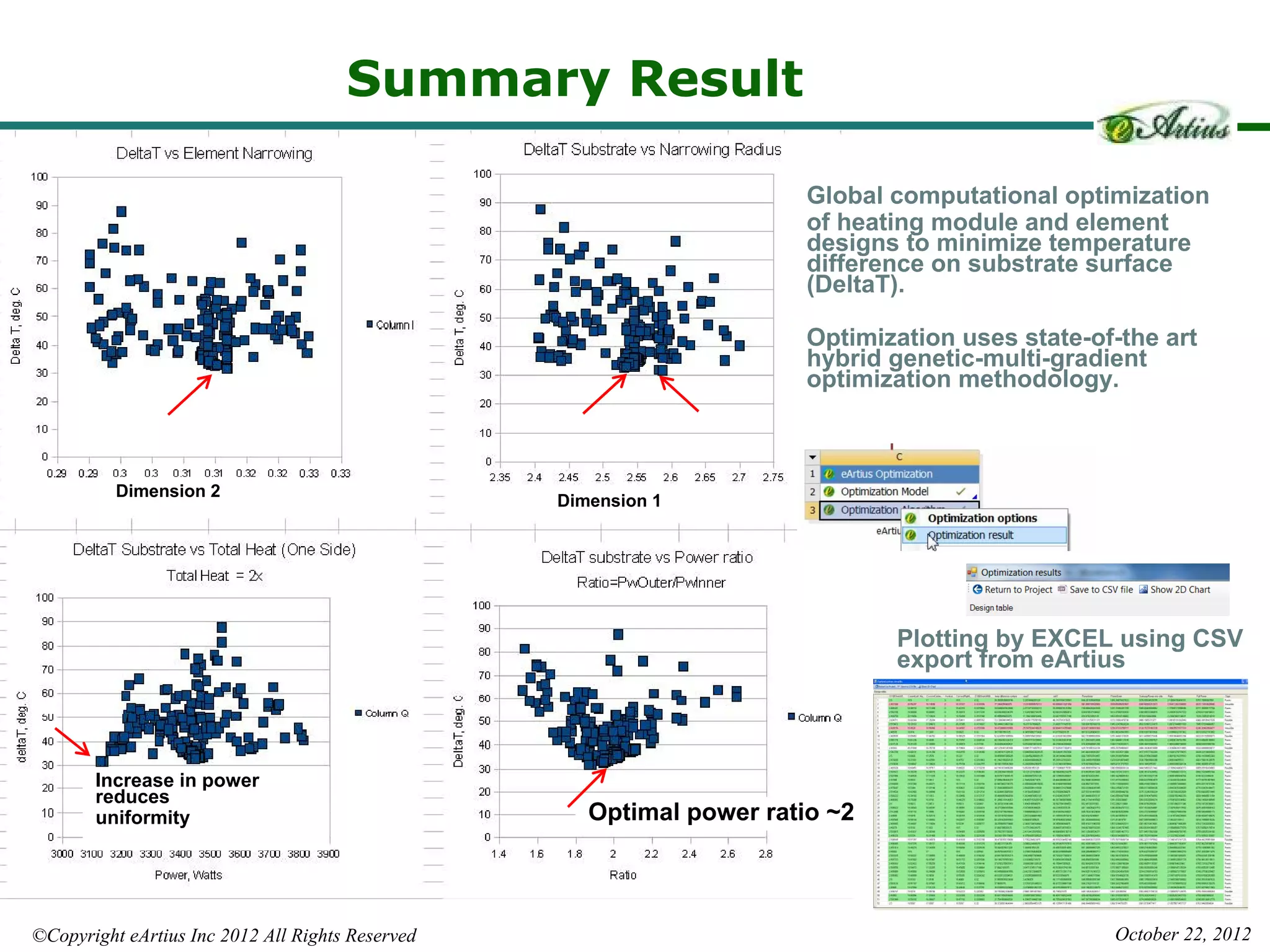
Summary Result

                                                                       Global computational optimization
                                                                       of heating module and element
                                                                       designs to minimize temperature
                                                                       difference on substrate surface
                                                                       (DeltaT).

                                                                       Optimization uses state-of-the art
                                                                       hybrid genetic-multi-gradient
                                                                       optimization methodology.


          Dimension 2
                                                  Dimension 1


                                                                              Plotting by EXCEL using CSV
                                                                              export from eArtius


       Increase in power
       reduces
       uniformity                                    Optimal power ratio ~2


©Copyright eArtius Inc 2012 All Rights Reserved                                                  October 22, 2012

eArtius HMGE Algorithm Applied to Optimization Tasks with 10,000 Design Variables

  • 1.
    Boosting Optimization Standards eArtius HMGE Algorithm Applied to Optimization Tasks with 10,000 Design Variables Vladimir Sevastyanov eArtius, Inc., Irvine, CA 92614, USA vladimir@eartius.com ©Copyright eArtius Inc 2012 All Rights Reserved October 22, 2012
  • 2.
    A number ofalgebraic models are designed at eArtius with the following properties:  2 objective functions  10,000 design variables  Only a few hundred design variables are significant; all others are not significant  Design space has a predetermined number of sub-areas (“craters”) where objective functions really depend on design variables;  Each such a sub-area has own list of significant design variables The models are designed to test scalability of eArtius optimization algorithms ©Copyright eArtius Inc 2012 All Rights Reserved October 22, 2012
  • 3.
    Hybrid Multi-Gradient Explorer (HMGE) Optimization Method ©Copyright eArtius Inc 2012 All Rights Reserved October 22, 2012
  • 4.
    How HMGE algorithmworks:  Basically, HMGE works as a Genetic Algorithm;  Periodically HMGE evaluates gradients, and performs gradient-based steps, which improves convergence dramatically How gradient based steps are performed:  Evaluate the model on 5-7 points generated in a small sub- region around current point;  Recognize the most significant design variables, and build an approximation for each output variable;  Estimate gradients based on the approximations;  Determine a direction of simultaneous improvement for all objective functions;  Perform a step in the direction ©Copyright eArtius Inc 2012 All Rights Reserved October 22, 2012
  • 5.
    Hybrid Multi-Gradient Explorer(HMGE) Optimization Algorithm Synergy of the features brings HMGE on unparalleled level of efficiency and scalability Genetic Algorithm Framework HMGE is believed to be the first global multi-objective optimization algorithm which provides: - Efficiency in finding the Random Mutation Gradient Mutation global Pareto frontier - High convergence typical for gradient- based methods - Scalability: Equal efficiency optimizing models with dozens, DDRSM – Super Fast Gradient Estimation hundreds, and even thousands of design variables ©Copyright eArtius Inc 2012 All Rights Reserved October 22, 2012
  • 6.
    Dynamically Dimensioned ResponseSurface Method (DDRSM) for Gradient Estimation DDRSM evaluates gradients necessary for any gradient based optimization algorithms. Start iteration: Start iteration: Builds local approximations Builds local approximations Determines the most Determines the most for each response based for each response based How DDRSM operates: significant design variables significant design variables only on the most only on the most for each response for each response significant design variables significant design variables variable separately variable separately Analytically estimates Analytically estimates Performs a gradient Performs a gradient gradients based on local gradients based on local based step based step approximations approximations DDRSM Benefits:  Equally efficient and accurate for any task dimension  Requires just 0-7 model evaluations regardless of task dimension  Fast— it builds a local approximation in 10-30 milliseconds  Automatic and hidden from users  Eliminates necessity in global response surface methods  Eliminates necessity in a sensitivity analysis ©Copyright eArtius Inc 2012 All Rights Reserved October 22, 2012
  • 7.
    Optimization Results forTasks with 10,000 design Variables ©Copyright eArtius Inc 2012 All Rights Reserved October 22, 2012
  • 8.
    eArtius optimization technologyis not sensitive to the model dimension because it performs optimization in a sub-space of the design space related to the most significant design variables. All non-significant design variables are dynamically recognized in runtime, and simply ignored. Thus, eArtius algorithms are equally efficient for low-dimensional and high- dimensional tasks. ©Copyright eArtius Inc 2012 All Rights Reserved October 22, 2012
  • 9.
    Algebraic Model Description eArtius has developed an algorithm which allows to generate algebraic models with a predetermined number of design variables, and a predetermined type of topology. The functions are similar to Gaussian, but high-dimensional, with 10,000 design variables, and with a given number of “craters”. We tried to optimize functions with 7, 8, and 10 “craters”. The following fragments of the algebraic models give an idea about the functions (both functions require 425KB memory in a text format): F1 = (-3.309 + (-2300 * exp(-0.03176 * ((X0 + X1 + X2) / 3 + 5))) + (2.655 + (-4200 * exp(-0.03589 * ((X3 + X4 + X5 + X6 + X7) / 5 + 5))) + … F2 = (3.02 + (-2100 * exp(-0.02191 * ((X0 + X1 + X2) / 3 + 3))) + (-4.109 + (-3700 * exp(-0.03553 * ((X3 + X4 + X5) / 3 + -5))) + … ©Copyright eArtius Inc 2012 All Rights Reserved October 22, 2012
  • 10.
    Optimization Results for7 “Craters” – 2 objectives to be minimized – 10,000 design variables with the range [-10, 10] – 1000 model evaluations – 53 Pareto optimal solutions ©Copyright eArtius Inc 2012 All Rights Reserved October 22, 2012
  • 11.
    Optimization Results for8 “Craters” – 2 objectives to be minimized – 10,000 design variables with the range [-10, 10] – 1000 model evaluations – 97 Pareto Optimal Points ©Copyright eArtius Inc 2012 All Rights Reserved October 22, 2012
  • 12.
    Optimization Results for10 “Craters” – 2 objectives to be minimized – 10,000 design variables with the range [-10, 10] – 909 model evaluations – 54 Pareto Optimal Points ©Copyright eArtius Inc 2012 All Rights Reserved October 22, 2012
  • 13.
    An Engineering Exampleof an Optimization Task Solved by HMGE Optimization Method in ANSYS Workbench Environment ©Copyright eArtius Inc 2012 All Rights Reserved October 22, 2012
  • 14.
    Multi-Physics Steady State Thermoelectric Simulation coupled with Solid Works Shape Optimization and Transient Radiative Heat Transfer for Substrate Heat-up left substrate right Design Modeler (imports geometry parameters Solid Works from Solid Works, modifies Workbench+eArtius model adding symmetry ©Copyright eArtius Inc 2012 All Rights Reserved October 22, 2012
  • 15.
    Complex Multi PhysicsProblem Design Modeler Parametric Steady State Thermo- Transient Radiation Geometry interface with Solid Electric with Surface to with Surface to Surface Surface Radiation Project folders Works Optimization Method selection (MGE) WorkBench status Bar (stop button) Optimization Messages updates (# of data points computed) Optimization Log output ©Copyright eArtius Inc 2012 All Rights Reserved October 22, 2012
  • 16.
    Optimization Parameters Heater Geometry dimension 1, from Solid Works Substrate Temperature after short term transie exposure to heater F1= Tmax-350 F2=Tmin-350 350 =>desired process temperature we want to P23=P24 (heating on left reach Heater Geometry dimension 2, side=heating on right) from Solid Works Electrical current runs through 3 separate heating elements creating temperature distribution. Electrical power in each heater equals I*V and to minimize P18 we need to find optimal ratio of power between center and left/Right elements. ©Copyright eArtius Inc 2012 All Rights Reserved October 22, 2012
  • 17.
    Optimization Results dT, Deg. C dT, Deg. C (Tmin-350), Deg. C Heater Geometry dimension 1 dT, dT, Deg. C Want to pick best Deg. C Values for geometry dimensions 1 and 2 (Tmax-350), Deg. C ©Copyright eArtius Inc 2012 All Rights Reserved Heater Geometry dimension 2 October 22, 2012
  • 18.
    Most Essential Result dT, Deg. C Optimal Range of 35 interest found 31 (Tmax-350), Deg. C These are demo results of overnight –run, so study is not complete. However, we instantly see relationship between key conflicting variables (P18- maximum temperature difference in substrate) vs F1 – deviation from desired maximum temperature. The larger F1 the lower maximum temperature during heat-up, that means lower thermal ramp (gradient), lower power and thus lower temperature difference P18. It is easy to have low temperature difference if you heat less, it means you loose less heat as well and thermal uniformity is better. In this problem we need to heat more, thus we are interested in Pareto frontier distribution looking for multiple trade- offs. ©Copyright eArtius Inc 2012 All Rights Reserved October 22, 2012
  • 19.
    Summary Result Global computational optimization of heating module and element designs to minimize temperature difference on substrate surface (DeltaT). Optimization uses state-of-the art hybrid genetic-multi-gradient optimization methodology. Dimension 2 Dimension 1 Plotting by EXCEL using CSV export from eArtius Increase in power reduces uniformity Optimal power ratio ~2 ©Copyright eArtius Inc 2012 All Rights Reserved October 22, 2012