KGMU COLLEGE OF NURSING
TOPIC-ENDOCRINE SYSTEM
Presented By:
Mr. Vishal Dubey
M.Sc. Nursing 1st Year (2023-2025)
KGMU College Of Nursing
KING GEORGE’S MEDICAL UNIVERSITY, LUCKNOW,U.P.
2
1. Define Endrocrine system.
2. Define Endocrine gland.
3. Explain types of Endocrine gland.
4. To explain the anatomy physiology of Hypothalamus and the functions of hormone.
5. To explain the anatomy physiology of Pituitary gland and the functions of hormone.
6. To explain the anatomy physiology of Pineal gland and the functions of hormone.
7. To explain the anatomy physiology of Thyroid gland and the functions of hormone.
8. To explain the anatomy physiology of Parathyroid gland and the functions of hormone.
9. To explain the anatomy physiology of Adrenal gland and the functions of hormone.
10. To explain the anatomy physiology of Pancreatic islets and the functions of hormone.
11. Elaborate Diagnostic evaluation of endocrine system.
OBJECTIVES
OBJECTIVES
ENDOCRINE SYSTEM
INTRODUCTION
• The endocrine system consists of glands widely
separated from each other with no physical
connections.
• The endocrine system is contrasted both to
exocrine glands and endocrine glands.
ENDOCRINE SYSTEM
ENDOCRINE GLANDS
• Endocrine glands are groups of secretory cells
surrounded by an extensive network of capillaries that
facilitates diffusion of hormones from the secretory cells
into the bloodstream.
• They are also referred to as ductless glands because
hormones diffuse directly into the bloodstream.
ENDOCRINE SYSTEM
The major glands of the endocrine system are
1. Hypothalamus
2. Pituitary gland
3. Pineal gland
4. Thyroid gland
5. Adrenal glands
6. Pancreatic islets
7. Ovaries
8. Testicles
ENDOCRINE GLANDS
ENDOCRINE SYSTEM
HYPOTHALAMUS
• The Hypothalamus is located
below the thalamus and it is a
part of limbic system.
• It is a size of almond.
• It is responsible for
regulating certain metabolic
process and other activities of
autonomic nervous system.
ENDOCRINE SYSTEM
• It synthesize and secretes
certain neurohormones called
releasing Hormones.
• Hypothalamus control body
temperature, hunger,thirst,
sleep etc.
HYPOTHALAMUS
ENDOCRINE SYSTEM
PITUITARY GLAND
• The pituitary gland lies in the
hypophyseal fossa of the
sphenoid bone below the
hypothalamus, to which it is
attached by a stalk.
• The pituitary gland sits in a
protective bony enclosure
called sella turcica.
• Acc. to weight Size- 500 mg
ENDOCRINE SYSTEM
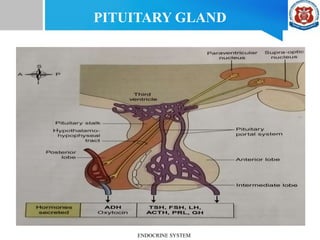
• Pituitary gland is composed of the Anterior pituitary
lobe, Posterior pituitary lobe, and the intermediate
lobe that joins them.
• The anterior pituitary (adenohypophysis) is an upgrowth
of glandular epithelium from the pharynx and the
posterior pituitary (neurohypophysis) a downgrowth of
nervous tissue from the brain.
• Hormones secreted by the anterior pituitary are called
Trophic hormones.
PITUITARY GLAND
ENDOCRINE SYSTEM
PITUITARY GLAND
ENDOCRINE SYSTEM
GROWTH HORMONE
• This is the most abundant hormone synthesised by the
anterior pituitary.
• It stimulate the growth and division of most body cells
but especially in the bones and skeletal muscles.
• Secretion of GH is greater at night during sleep and is
also stimulated by hypoglycemia, exercise, anxiety.
• Secretion peaks in adolescence and then decline with
age.
ENDOCRINE SYSTEM
THYROID STIMULATING
HORMONE
• The release of TSH is stimulated by TRH from the
hypothalamus.
• It stimulates growth and activity of the thyroid gland
which secretes the hormone T4 and T3.
• Release is lowest in the early morning and highest
during the night.
• When the blood level of thyroid hormones is high,
secretion of TSH is reduced, and vice versa.
ENDOCRINE SYSTEM
ADRENOCORTICOTROPHIC
HORMONE
• Corticotropin releasing hormone from the hypothalamus
promotes the synthesis and release of ACTH by the
anterior pituitary.
• ACTH levels are highest at about early in the morning
and fall to their lowest about midnight.
ENDOCRINE SYSTEM
PROLACTIN
• This hormone is secreted during pregnancy to prepare
the breast for lactation after childbirth.
• Suckling stimulates prolactin secretion and lactation.
ENDOCRINE SYSTEM
GONADOTROPIN
• Just before puberty two gonadotrophins (sex hormones)
are secreted by the anterior pituitary in response to
luteinising hormone releasing hormone (LHRH), also
known as gonadotrophin releasing hormone (GnRH).
In both males and females the hormones responsible
are:-
• Follicle stimulating hormone (FSH)
• Luteinising hormone (LH).
ENDOCRINE SYSTEM
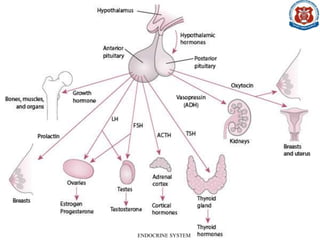
POSTERIOR PITUITARY
• The posterior pituitary is formed from nervous tissue
and consists of nerve cells surrounded by supporting
glial cells.
• These neurones have their cell bodies in the
supraoptic and paraventricular nuclei of the
hypothalamus and their axons form a bundle known a
the hypothalamohypophyseal tract.
ENDOCRINE SYSTEM
• Posterior pituitary mainly of neuronal projection of
magno cellular neurosecretory cells extending from
supraoptic and para ventricular cells of hypothalamus
Two regions of Posterior pituitary:-
1. Pars nervosa
2. Infundibulam stalk
POSTERIOR PITUITARY
ENDOCRINE SYSTEM
The hormone release from axon terminal within the
posterior pituitary are:-
• Oxytocin
• Antidiuretic hormone (ADH)
POSTERIOR PITUITARY
ENDOCRINE SYSTEM
OXYTOCIN
Oxytocin stimulates two target tissues during and
after childbirth (parturition):
• Uterine smooth muscle.
• The muscle cells of the lactating breast.
ENDOCRINE SYSTEM
ANTIDIURETIC HORMONE (ADH)
• The main effect of antidiuretic hormone is to reduce
urine output.
• ADH acts on the distal convoluted tubules and
collecting ducts of the nephrons of the kidneys.
• It increases their permeability to water and more of
the glomerular filtrate is reabsorbed.
ENDOCRINE SYSTEM
ENDOCRINE SYSTEM
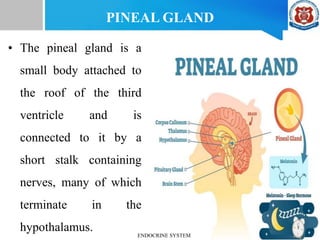
PINEAL GLAND
• The pineal gland is a
small body attached to
the roof of the third
ventricle and is
connected to it by a
short stalk containing
nerves, many of which
terminate in the
hypothalamus. ENDOCRINE SYSTEM
• The pineal gland is
about 10 mm long,
reddish brown in colour
and surrounded by a
capsule.
• The gland tends to
atrophy after puberty
and may become
calcified in later life.
PINEAL GLAND
ENDOCRINE SYSTEM
MELATONIN
Melatonin is the main hormone secreted by the
pineal gland.
• Secretion is controlled by daylight and darkness level
fluctuate during each 24-hour period, the being
highest at night and the lowest around midday.
• Secretion is also influenced by the number of daylight
hours.
ENDOCRINE SYSTEM
Melatonin is associated with:
• Coordination of the circadian and diurnal rhythms of
many tissues, possibly by influencing the
hypothalamus
• Inhibition of growth and development of the sex
organs before puberty, possibly by preventing
synthesis or release of gonadotrophins
MELATONIN
ENDOCRINE SYSTEM
THYROID GLAND
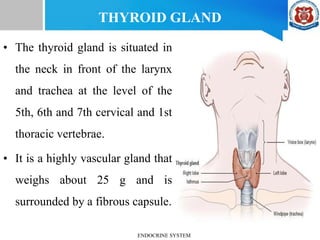
• The thyroid gland is situated in
the neck in front of the larynx
and trachea at the level of the
5th, 6th and 7th cervical and 1st
thoracic vertebrae.
• It is a highly vascular gland that
weighs about 25 g and is
surrounded by a fibrous capsule.
ENDOCRINE SYSTEM
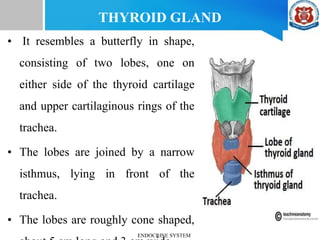
• It resembles a butterfly in shape,
consisting of two lobes, one on
either side of the thyroid cartilage
and upper cartilaginous rings of the
trachea.
• The lobes are joined by a narrow
isthmus, lying in front of the
trachea.
• The lobes are roughly cone shaped,
THYROID GLAND
ENDOCRINE SYSTEM
ENDOCRINE SYSTEM
T 3 - T4
Tri- iodothyronine T3 and Thyroxine T4
Secretion of T3 and T4 begins:
• Third month of fetal life and increases at puberty and in
women during the reproductive years, especially during
pregnancy.
T3 and T4 affect most cells of the body by:
• Increasing the basal metabolic rate and heat production.
• Regulating metabolism of carbohydrates, proteins and fats.
ENDOCRINE SYSTEM
CALCITONIN
• This hormone is secreted by the parafollicular or C-cells
in the thyroid gland.
• Calcitonin lowers raised blood calcium (Ca) levels.
It does this by acting on:-
• Bone cells promoting their storage of calcium
• Kidney tubules inhibiting the reabsorption of calcium
ENDOCRINE SYSTEM
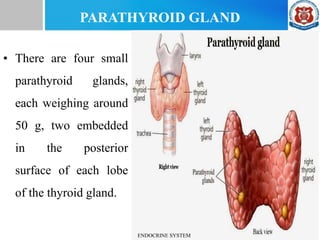
PARATHYROID GLAND
• There are four small
parathyroid glands,
each weighing around
50 g, two embedded
in the posterior
surface of each lobe
of the thyroid gland.
ENDOCRINE SYSTEM
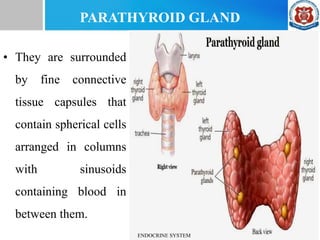
• They are surrounded
by fine connective
tissue capsules that
contain spherical cells
arranged in columns
with sinusoids
containing blood in
between them.
PARATHYROID GLAND
ENDOCRINE SYSTEM
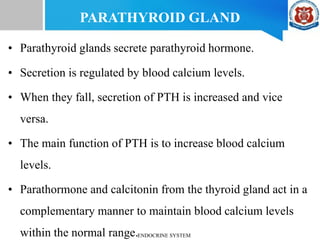
• Parathyroid glands secrete parathyroid hormone.
• Secretion is regulated by blood calcium levels.
• When they fall, secretion of PTH is increased and vice
versa.
• The main function of PTH is to increase blood calcium
levels.
• Parathormone and calcitonin from the thyroid gland act in a
complementary manner to maintain blood calcium levels
within the normal range.
PARATHYROID GLAND
ENDOCRINE SYSTEM
PARATHYROID HORMONE
This is needed for:
• Muscle contraction.
• Transmission of nerve impulses.
• Blood clotting.
• Normal action of many enzymes.
ENDOCRINE SYSTEM
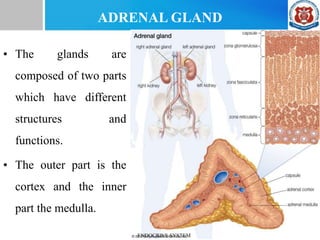
ADRENAL GLAND
• The two adrenal
(suprarenal) glands
are situated on the
upper pole of each
kidney enclosed
within the renal
fascia.
• They are about 4 cm
long and 3 cm thick.
ENDOCRINE SYSTEM
• The glands are
composed of two parts
which have different
structures and
functions.
• The outer part is the
cortex and the inner
part the medulla.
ADRENAL GLAND
ENDOCRINE SYSTEM
ADRENAL CORTEX
• The adrenal cortex produces three groups of steroid hormones
from cholesterol.
• Collectively called adrenocorticocoids (corticosteroids).
The groups are:
• Glucocorticoids- Homeostasis and adaptation to
environmental changes.
• Mineralocorticoids- Promotes sodium and potassium
transport.
• Sex hormones (androgens)- Male sexual and reproductive
function.
ENDOCRINE SYSTEM
ADRENAL MEDULLA
• The medulla is completely surrounded by the adrenal
cortex.
• It develops from nervous tissue in the embryo and is
part of the sympathetic nervous system.
• When stimulated by extensive sympathetic nerve
supply, the glands release the hormones adrenaline
(epinephrine, 80%) and noradrenaline
(norepinephrine, 20%).
ENDOCRINE SYSTEM
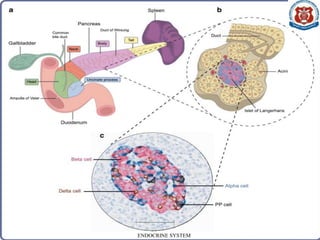
PANCREATIC ISLETS
• The endocrine pancreas consists of clusters of cells,
known as the pancreatic islets (islets of Langerhans).
• Scattered throughout the gland.
• Pancreatic hormones are secreted directly into the
bloodstream and circulate throughout the body.
ENDOCRINE SYSTEM
ENDOCRINE SYSTEM
• There are three main types of cells in the pancreatic
islets:
• α (alpha) cells- which secrete glucagon
• β (beta) cells- which are the most numerous secrete
insulin.
• δ (delta) cells- which secrete somatostatin/ Growth
Hormone Inhibiting Hormone (GHRIH)
PANCREATIC ISLETS
ENDOCRINE SYSTEM
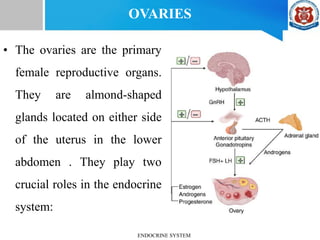
OVARIES
• The ovaries are the primary
female reproductive organs.
They are almond-shaped
glands located on either side
of the uterus in the lower
abdomen . They play two
crucial roles in the endocrine
system:
ENDOCRINE SYSTEM
• Estrogen: Estrogen is a group of hormones
responsible for stimulating the development of female
secondary sexual characteristics such as breasts, body
fat distribution, and regulation of the menstrual cycle.
• Progesterone: Progesterone works alongside
estrogen to regulate the menstrual cycle. It prepares
the lining of the uterus (endometrium) for
implantation of a fertilized egg and supports
pregnancy.
OVARIES
ENDOCRINE SYSTEM
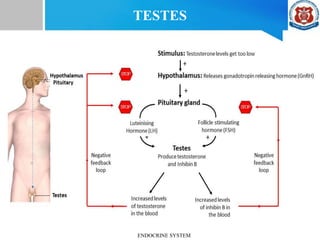
TESTES
• The testes are the male reproductive organs
located within the scrotum, a sac-like structure.
• The testes produce the primary male sex
hormone, testosterone.
• Testosterone is responsible for the development
of male secondary sexual characteristics such as
facial and body hair, muscle mass, and a deeper
voice.
ENDOCRINE SYSTEM
TESTES
ENDOCRINE SYSTEM
Blood tests are used to determine the levels of
• Circulating hormones.
• Presence of autoantibodies.
• Effect of a specific hormone (the effect of insulin on
blood glucose levels).
• The serum levels of a specific hormone may provide
information to determine the presence of hypofunction
or hyperfunction and the site of dysfunction.
DIAGNOSTIC EVALUATION
ENDOCRINE SYSTEM
Urine tests are used to measure
• Amount of hormones or the end products of hormones
excreted by the kidneys.
• One-time specimens or, in some disorders, 24-hour
urine specimens are collected to measure hormones or
their metabolites. For example, urinary levels of free
catecholamines (norepinephrine, epinephrine, and
dopamine) may be measured in patients with suspected
tumors of the adrenal medulla (pheochromocytoma).
DIAGNOSTIC EVALUATION
ENDOCRINE SYSTEM
Imaging tests:
• X-rays
• CT scans
• MRIs to visualize glands.
DIAGNOSTIC EVALUATION
ENDOCRINE SYSTEM
Noninvasive Endocrine Function Tests
1. Tests of Thyroid Structure and Function- MRI/CT
Scan,Fine Needles Aspiration.
2. Radioiodine Uptake.
3. Tests of Adrenal Structure and Function.
4. Tests of Pituitary Structure and Function.
5. Ultrasonogaphy
6. Radiography.
DIAGNOSTIC EVALUATION
ENDOCRINE SYSTEM
Invasive Endocrine Function Tests
1. Angiography-Visualization of arterial vessels.
2. Portal Pressure Measurement.-Normal 5-10mmHg
3. Biopsy-Aspirate a core of tissue via needle for histology
study
4. Paracentesis- Obtain fluid for culture.
5. Tests of Endocrine Pancreas Function- Blood glucose
level,HbA1c.
DIAGNOSTIC EVALUATION
ENDOCRINE SYSTEM
Invasive Endocrine Function Tests
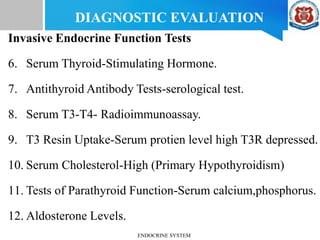
6. Serum Thyroid-Stimulating Hormone.
7. Antithyroid Antibody Tests-serological test.
8. Serum T3-T4- Radioimmunoassay.
9. T3 Resin Uptake-Serum protien level high T3R depressed.
10. Serum Cholesterol-High (Primary Hypothyroidism)
11. Tests of Parathyroid Function-Serum calcium,phosphorus.
12. Aldosterone Levels.
DIAGNOSTIC EVALUATION
ENDOCRINE SYSTEM
Invasive Endocrine Function Tests
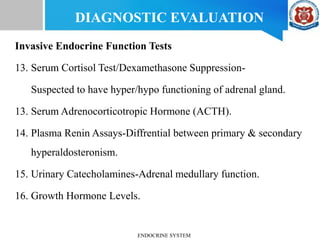
13. Serum Cortisol Test/Dexamethasone Suppression-
Suspected to have hyper/hypo functioning of adrenal gland.
13. Serum Adrenocorticotropic Hormone (ACTH).
14. Plasma Renin Assays-Diffrential between primary & secondary
hyperaldosteronism.
15. Urinary Catecholamines-Adrenal medullary function.
16. Growth Hormone Levels.
DIAGNOSTIC EVALUATION
ENDOCRINE SYSTEM
SUMMARY
To summarise, The Endocrine System: Balancing Act of the Body.
The endocrine system is a network of glands that produce hormones, chemical
messengers that travel through the bloodstream to target organs. Unlike the nervous
system, which transmits signals directly through nerves, the endocrine system's
influence is more widespread and long-lasting. Hormones act like tiny keys, unlocking
specific changes in target cells.
The major endocrine organs include:
Hypothalamus: Located at the base of the brain, the hypothalamus is the control center,
producing hormones that regulate other endocrine glands.
Pituitary gland: Often referred to as the "master gland," the pituitary gland sits just
below the hypothalamus and secretes hormones that influence growth, metabolism,
reproduction, and other essential functions.
Thyroid gland: Butterfly-shaped gland located in the neck, the thyroid gland produces
hormones that regulate metabolism and heart rate. ENDOCRINE SYSTEM
SUMMARY
Adrenal glands: Located on top of the kidneys, the adrenal glands produce several
hormones, including adrenaline (epinephrine) and cortisol, which help regulate blood
pressure, sugar metabolism, and immune system function.
Pancreas: Located behind the stomach, the pancreas is both an endocrine and exocrine
gland. As an endocrine gland, it produces insulin and glucagon, hormones that regulate
blood sugar levels.
Pineal gland: Located deep within the brain, the pineal gland produces melatonin, a
hormone that helps regulate sleep-wake cycles.
Physiology
The endocrine system plays a critical role in maintaining homeostasis, the body's internal
balance. Hormones regulate a wide range of physiological processes, including:
Metabolism: The conversion of food into energy
Growth and development: From childhood growth spurts to bone health
Mood and behavior: Influencing emotions, sleep, and appetite
Blood sugar control: Maintaining blood sugar levels within a healthy range
Electrolyte balance: Regulating the levels of electrolytes, such as sodium and potassium, in
the blood
Stress response: The body's "fight-or-flight" response
ENDOCRINE SYSTEM
SUMMARY
Diagnostic Evaluation
When a doctor suspects a hormonal imbalance, they may order a variety of tests to evaluate
the endocrine system. These tests may include:
Blood tests: To measure hormone levels
Urine test:To measure Amount of hormones or the end products of hormones excreted by
the kidneys.
Imaging tests: X-rays, CT scans, or MRIs to visualize glands
ENDOCRINE SYSTEM
CONCLUSION
The endocrine system is a complex and interconnected network that
plays a vital role in keeping our bodies functioning properly. By
understanding the anatomy, physiology, and diagnostic evaluation of
the endocrine system, we can appreciate its delicate balance and the
importance of maintaining hormonal health.

ENDOCRINE SYSTEM
1. Types of Endocrine gland?
2. Growth hormone synthesized by?
3. Thyroid gland situated in ?
4. Adrenal gland produces steroid hormones collectively called?
RECAPTUALISATION
ENDOCRINE SYSTEM
What are the function of hormones released from the posterior
pituitary gland ?
ASSIGNMENT
ENDOCRINE SYSTEM
BIBLIOGRAPHY
• Kumari Neelam, Textbook of community health nursing; Volume 1;
PV book Publications; 5th edition, 2017; Page no. 542-545.
• Prof. RP Saxena; Textbook of community health nursing Nursing;
lotus Publications; Volume 2; 3rd edition, 2020; Page No. 526-530.
• BT basvathapa, "Textbook of medical surgical nursing" third edition,
jaypee publication page no 765 to 769.
• Brunner and sudharth’s, Textbook of Medical Surgical Nursing,
2015 page no. 789-794
ENDOCRINE SYSTEM
ENDOCRINE SYSTEM

Endocrine system for nursing.pptx

  • 1.
    KGMU COLLEGE OFNURSING TOPIC-ENDOCRINE SYSTEM Presented By: Mr. Vishal Dubey M.Sc. Nursing 1st Year (2023-2025) KGMU College Of Nursing KING GEORGE’S MEDICAL UNIVERSITY, LUCKNOW,U.P.
  • 2.
    2 1. Define Endrocrinesystem. 2. Define Endocrine gland. 3. Explain types of Endocrine gland. 4. To explain the anatomy physiology of Hypothalamus and the functions of hormone. 5. To explain the anatomy physiology of Pituitary gland and the functions of hormone. 6. To explain the anatomy physiology of Pineal gland and the functions of hormone. 7. To explain the anatomy physiology of Thyroid gland and the functions of hormone. 8. To explain the anatomy physiology of Parathyroid gland and the functions of hormone. 9. To explain the anatomy physiology of Adrenal gland and the functions of hormone. 10. To explain the anatomy physiology of Pancreatic islets and the functions of hormone. 11. Elaborate Diagnostic evaluation of endocrine system. OBJECTIVES OBJECTIVES ENDOCRINE SYSTEM
  • 3.
    INTRODUCTION • The endocrinesystem consists of glands widely separated from each other with no physical connections. • The endocrine system is contrasted both to exocrine glands and endocrine glands. ENDOCRINE SYSTEM
  • 4.
    ENDOCRINE GLANDS • Endocrineglands are groups of secretory cells surrounded by an extensive network of capillaries that facilitates diffusion of hormones from the secretory cells into the bloodstream. • They are also referred to as ductless glands because hormones diffuse directly into the bloodstream. ENDOCRINE SYSTEM
  • 5.
    The major glandsof the endocrine system are 1. Hypothalamus 2. Pituitary gland 3. Pineal gland 4. Thyroid gland 5. Adrenal glands 6. Pancreatic islets 7. Ovaries 8. Testicles ENDOCRINE GLANDS ENDOCRINE SYSTEM
  • 6.
    HYPOTHALAMUS • The Hypothalamusis located below the thalamus and it is a part of limbic system. • It is a size of almond. • It is responsible for regulating certain metabolic process and other activities of autonomic nervous system. ENDOCRINE SYSTEM
  • 7.
    • It synthesizeand secretes certain neurohormones called releasing Hormones. • Hypothalamus control body temperature, hunger,thirst, sleep etc. HYPOTHALAMUS ENDOCRINE SYSTEM
  • 8.
    PITUITARY GLAND • Thepituitary gland lies in the hypophyseal fossa of the sphenoid bone below the hypothalamus, to which it is attached by a stalk. • The pituitary gland sits in a protective bony enclosure called sella turcica. • Acc. to weight Size- 500 mg ENDOCRINE SYSTEM
  • 9.
    • Pituitary glandis composed of the Anterior pituitary lobe, Posterior pituitary lobe, and the intermediate lobe that joins them. • The anterior pituitary (adenohypophysis) is an upgrowth of glandular epithelium from the pharynx and the posterior pituitary (neurohypophysis) a downgrowth of nervous tissue from the brain. • Hormones secreted by the anterior pituitary are called Trophic hormones. PITUITARY GLAND ENDOCRINE SYSTEM
  • 10.
  • 11.
    GROWTH HORMONE • Thisis the most abundant hormone synthesised by the anterior pituitary. • It stimulate the growth and division of most body cells but especially in the bones and skeletal muscles. • Secretion of GH is greater at night during sleep and is also stimulated by hypoglycemia, exercise, anxiety. • Secretion peaks in adolescence and then decline with age. ENDOCRINE SYSTEM
  • 12.
    THYROID STIMULATING HORMONE • Therelease of TSH is stimulated by TRH from the hypothalamus. • It stimulates growth and activity of the thyroid gland which secretes the hormone T4 and T3. • Release is lowest in the early morning and highest during the night. • When the blood level of thyroid hormones is high, secretion of TSH is reduced, and vice versa. ENDOCRINE SYSTEM
  • 13.
    ADRENOCORTICOTROPHIC HORMONE • Corticotropin releasinghormone from the hypothalamus promotes the synthesis and release of ACTH by the anterior pituitary. • ACTH levels are highest at about early in the morning and fall to their lowest about midnight. ENDOCRINE SYSTEM
  • 14.
    PROLACTIN • This hormoneis secreted during pregnancy to prepare the breast for lactation after childbirth. • Suckling stimulates prolactin secretion and lactation. ENDOCRINE SYSTEM
  • 15.
    GONADOTROPIN • Just beforepuberty two gonadotrophins (sex hormones) are secreted by the anterior pituitary in response to luteinising hormone releasing hormone (LHRH), also known as gonadotrophin releasing hormone (GnRH). In both males and females the hormones responsible are:- • Follicle stimulating hormone (FSH) • Luteinising hormone (LH). ENDOCRINE SYSTEM
  • 16.
    POSTERIOR PITUITARY • Theposterior pituitary is formed from nervous tissue and consists of nerve cells surrounded by supporting glial cells. • These neurones have their cell bodies in the supraoptic and paraventricular nuclei of the hypothalamus and their axons form a bundle known a the hypothalamohypophyseal tract. ENDOCRINE SYSTEM
  • 17.
    • Posterior pituitarymainly of neuronal projection of magno cellular neurosecretory cells extending from supraoptic and para ventricular cells of hypothalamus Two regions of Posterior pituitary:- 1. Pars nervosa 2. Infundibulam stalk POSTERIOR PITUITARY ENDOCRINE SYSTEM
  • 18.
    The hormone releasefrom axon terminal within the posterior pituitary are:- • Oxytocin • Antidiuretic hormone (ADH) POSTERIOR PITUITARY ENDOCRINE SYSTEM
  • 19.
    OXYTOCIN Oxytocin stimulates twotarget tissues during and after childbirth (parturition): • Uterine smooth muscle. • The muscle cells of the lactating breast. ENDOCRINE SYSTEM
  • 20.
    ANTIDIURETIC HORMONE (ADH) •The main effect of antidiuretic hormone is to reduce urine output. • ADH acts on the distal convoluted tubules and collecting ducts of the nephrons of the kidneys. • It increases their permeability to water and more of the glomerular filtrate is reabsorbed. ENDOCRINE SYSTEM
  • 21.
  • 22.
    PINEAL GLAND • Thepineal gland is a small body attached to the roof of the third ventricle and is connected to it by a short stalk containing nerves, many of which terminate in the hypothalamus. ENDOCRINE SYSTEM
  • 23.
    • The pinealgland is about 10 mm long, reddish brown in colour and surrounded by a capsule. • The gland tends to atrophy after puberty and may become calcified in later life. PINEAL GLAND ENDOCRINE SYSTEM
  • 24.
    MELATONIN Melatonin is themain hormone secreted by the pineal gland. • Secretion is controlled by daylight and darkness level fluctuate during each 24-hour period, the being highest at night and the lowest around midday. • Secretion is also influenced by the number of daylight hours. ENDOCRINE SYSTEM
  • 25.
    Melatonin is associatedwith: • Coordination of the circadian and diurnal rhythms of many tissues, possibly by influencing the hypothalamus • Inhibition of growth and development of the sex organs before puberty, possibly by preventing synthesis or release of gonadotrophins MELATONIN ENDOCRINE SYSTEM
  • 26.
    THYROID GLAND • Thethyroid gland is situated in the neck in front of the larynx and trachea at the level of the 5th, 6th and 7th cervical and 1st thoracic vertebrae. • It is a highly vascular gland that weighs about 25 g and is surrounded by a fibrous capsule. ENDOCRINE SYSTEM
  • 27.
    • It resemblesa butterfly in shape, consisting of two lobes, one on either side of the thyroid cartilage and upper cartilaginous rings of the trachea. • The lobes are joined by a narrow isthmus, lying in front of the trachea. • The lobes are roughly cone shaped, THYROID GLAND ENDOCRINE SYSTEM
  • 28.
  • 29.
    T 3 -T4 Tri- iodothyronine T3 and Thyroxine T4 Secretion of T3 and T4 begins: • Third month of fetal life and increases at puberty and in women during the reproductive years, especially during pregnancy. T3 and T4 affect most cells of the body by: • Increasing the basal metabolic rate and heat production. • Regulating metabolism of carbohydrates, proteins and fats. ENDOCRINE SYSTEM
  • 30.
    CALCITONIN • This hormoneis secreted by the parafollicular or C-cells in the thyroid gland. • Calcitonin lowers raised blood calcium (Ca) levels. It does this by acting on:- • Bone cells promoting their storage of calcium • Kidney tubules inhibiting the reabsorption of calcium ENDOCRINE SYSTEM
  • 31.
    PARATHYROID GLAND • Thereare four small parathyroid glands, each weighing around 50 g, two embedded in the posterior surface of each lobe of the thyroid gland. ENDOCRINE SYSTEM
  • 32.
    • They aresurrounded by fine connective tissue capsules that contain spherical cells arranged in columns with sinusoids containing blood in between them. PARATHYROID GLAND ENDOCRINE SYSTEM
  • 33.
    • Parathyroid glandssecrete parathyroid hormone. • Secretion is regulated by blood calcium levels. • When they fall, secretion of PTH is increased and vice versa. • The main function of PTH is to increase blood calcium levels. • Parathormone and calcitonin from the thyroid gland act in a complementary manner to maintain blood calcium levels within the normal range. PARATHYROID GLAND ENDOCRINE SYSTEM
  • 34.
    PARATHYROID HORMONE This isneeded for: • Muscle contraction. • Transmission of nerve impulses. • Blood clotting. • Normal action of many enzymes. ENDOCRINE SYSTEM
  • 35.
    ADRENAL GLAND • Thetwo adrenal (suprarenal) glands are situated on the upper pole of each kidney enclosed within the renal fascia. • They are about 4 cm long and 3 cm thick. ENDOCRINE SYSTEM
  • 36.
    • The glandsare composed of two parts which have different structures and functions. • The outer part is the cortex and the inner part the medulla. ADRENAL GLAND ENDOCRINE SYSTEM
  • 37.
    ADRENAL CORTEX • Theadrenal cortex produces three groups of steroid hormones from cholesterol. • Collectively called adrenocorticocoids (corticosteroids). The groups are: • Glucocorticoids- Homeostasis and adaptation to environmental changes. • Mineralocorticoids- Promotes sodium and potassium transport. • Sex hormones (androgens)- Male sexual and reproductive function. ENDOCRINE SYSTEM
  • 38.
    ADRENAL MEDULLA • Themedulla is completely surrounded by the adrenal cortex. • It develops from nervous tissue in the embryo and is part of the sympathetic nervous system. • When stimulated by extensive sympathetic nerve supply, the glands release the hormones adrenaline (epinephrine, 80%) and noradrenaline (norepinephrine, 20%). ENDOCRINE SYSTEM
  • 39.
    PANCREATIC ISLETS • Theendocrine pancreas consists of clusters of cells, known as the pancreatic islets (islets of Langerhans). • Scattered throughout the gland. • Pancreatic hormones are secreted directly into the bloodstream and circulate throughout the body. ENDOCRINE SYSTEM
  • 40.
  • 41.
    • There arethree main types of cells in the pancreatic islets: • α (alpha) cells- which secrete glucagon • β (beta) cells- which are the most numerous secrete insulin. • δ (delta) cells- which secrete somatostatin/ Growth Hormone Inhibiting Hormone (GHRIH) PANCREATIC ISLETS ENDOCRINE SYSTEM
  • 42.
    OVARIES • The ovariesare the primary female reproductive organs. They are almond-shaped glands located on either side of the uterus in the lower abdomen . They play two crucial roles in the endocrine system: ENDOCRINE SYSTEM
  • 43.
    • Estrogen: Estrogenis a group of hormones responsible for stimulating the development of female secondary sexual characteristics such as breasts, body fat distribution, and regulation of the menstrual cycle. • Progesterone: Progesterone works alongside estrogen to regulate the menstrual cycle. It prepares the lining of the uterus (endometrium) for implantation of a fertilized egg and supports pregnancy. OVARIES ENDOCRINE SYSTEM
  • 44.
    TESTES • The testesare the male reproductive organs located within the scrotum, a sac-like structure. • The testes produce the primary male sex hormone, testosterone. • Testosterone is responsible for the development of male secondary sexual characteristics such as facial and body hair, muscle mass, and a deeper voice. ENDOCRINE SYSTEM
  • 45.
  • 46.
    Blood tests areused to determine the levels of • Circulating hormones. • Presence of autoantibodies. • Effect of a specific hormone (the effect of insulin on blood glucose levels). • The serum levels of a specific hormone may provide information to determine the presence of hypofunction or hyperfunction and the site of dysfunction. DIAGNOSTIC EVALUATION ENDOCRINE SYSTEM
  • 47.
    Urine tests areused to measure • Amount of hormones or the end products of hormones excreted by the kidneys. • One-time specimens or, in some disorders, 24-hour urine specimens are collected to measure hormones or their metabolites. For example, urinary levels of free catecholamines (norepinephrine, epinephrine, and dopamine) may be measured in patients with suspected tumors of the adrenal medulla (pheochromocytoma). DIAGNOSTIC EVALUATION ENDOCRINE SYSTEM
  • 48.
    Imaging tests: • X-rays •CT scans • MRIs to visualize glands. DIAGNOSTIC EVALUATION ENDOCRINE SYSTEM
  • 49.
    Noninvasive Endocrine FunctionTests 1. Tests of Thyroid Structure and Function- MRI/CT Scan,Fine Needles Aspiration. 2. Radioiodine Uptake. 3. Tests of Adrenal Structure and Function. 4. Tests of Pituitary Structure and Function. 5. Ultrasonogaphy 6. Radiography. DIAGNOSTIC EVALUATION ENDOCRINE SYSTEM
  • 50.
    Invasive Endocrine FunctionTests 1. Angiography-Visualization of arterial vessels. 2. Portal Pressure Measurement.-Normal 5-10mmHg 3. Biopsy-Aspirate a core of tissue via needle for histology study 4. Paracentesis- Obtain fluid for culture. 5. Tests of Endocrine Pancreas Function- Blood glucose level,HbA1c. DIAGNOSTIC EVALUATION ENDOCRINE SYSTEM
  • 51.
    Invasive Endocrine FunctionTests 6. Serum Thyroid-Stimulating Hormone. 7. Antithyroid Antibody Tests-serological test. 8. Serum T3-T4- Radioimmunoassay. 9. T3 Resin Uptake-Serum protien level high T3R depressed. 10. Serum Cholesterol-High (Primary Hypothyroidism) 11. Tests of Parathyroid Function-Serum calcium,phosphorus. 12. Aldosterone Levels. DIAGNOSTIC EVALUATION ENDOCRINE SYSTEM
  • 52.
    Invasive Endocrine FunctionTests 13. Serum Cortisol Test/Dexamethasone Suppression- Suspected to have hyper/hypo functioning of adrenal gland. 13. Serum Adrenocorticotropic Hormone (ACTH). 14. Plasma Renin Assays-Diffrential between primary & secondary hyperaldosteronism. 15. Urinary Catecholamines-Adrenal medullary function. 16. Growth Hormone Levels. DIAGNOSTIC EVALUATION ENDOCRINE SYSTEM
  • 53.
    SUMMARY To summarise, TheEndocrine System: Balancing Act of the Body. The endocrine system is a network of glands that produce hormones, chemical messengers that travel through the bloodstream to target organs. Unlike the nervous system, which transmits signals directly through nerves, the endocrine system's influence is more widespread and long-lasting. Hormones act like tiny keys, unlocking specific changes in target cells. The major endocrine organs include: Hypothalamus: Located at the base of the brain, the hypothalamus is the control center, producing hormones that regulate other endocrine glands. Pituitary gland: Often referred to as the "master gland," the pituitary gland sits just below the hypothalamus and secretes hormones that influence growth, metabolism, reproduction, and other essential functions. Thyroid gland: Butterfly-shaped gland located in the neck, the thyroid gland produces hormones that regulate metabolism and heart rate. ENDOCRINE SYSTEM
  • 54.
    SUMMARY Adrenal glands: Locatedon top of the kidneys, the adrenal glands produce several hormones, including adrenaline (epinephrine) and cortisol, which help regulate blood pressure, sugar metabolism, and immune system function. Pancreas: Located behind the stomach, the pancreas is both an endocrine and exocrine gland. As an endocrine gland, it produces insulin and glucagon, hormones that regulate blood sugar levels. Pineal gland: Located deep within the brain, the pineal gland produces melatonin, a hormone that helps regulate sleep-wake cycles. Physiology The endocrine system plays a critical role in maintaining homeostasis, the body's internal balance. Hormones regulate a wide range of physiological processes, including: Metabolism: The conversion of food into energy Growth and development: From childhood growth spurts to bone health Mood and behavior: Influencing emotions, sleep, and appetite Blood sugar control: Maintaining blood sugar levels within a healthy range Electrolyte balance: Regulating the levels of electrolytes, such as sodium and potassium, in the blood Stress response: The body's "fight-or-flight" response ENDOCRINE SYSTEM
  • 55.
    SUMMARY Diagnostic Evaluation When adoctor suspects a hormonal imbalance, they may order a variety of tests to evaluate the endocrine system. These tests may include: Blood tests: To measure hormone levels Urine test:To measure Amount of hormones or the end products of hormones excreted by the kidneys. Imaging tests: X-rays, CT scans, or MRIs to visualize glands ENDOCRINE SYSTEM
  • 56.
    CONCLUSION The endocrine systemis a complex and interconnected network that plays a vital role in keeping our bodies functioning properly. By understanding the anatomy, physiology, and diagnostic evaluation of the endocrine system, we can appreciate its delicate balance and the importance of maintaining hormonal health. ENDOCRINE SYSTEM
  • 57.
    1. Types ofEndocrine gland? 2. Growth hormone synthesized by? 3. Thyroid gland situated in ? 4. Adrenal gland produces steroid hormones collectively called? RECAPTUALISATION ENDOCRINE SYSTEM
  • 58.
    What are thefunction of hormones released from the posterior pituitary gland ? ASSIGNMENT ENDOCRINE SYSTEM
  • 59.
    BIBLIOGRAPHY • Kumari Neelam,Textbook of community health nursing; Volume 1; PV book Publications; 5th edition, 2017; Page no. 542-545. • Prof. RP Saxena; Textbook of community health nursing Nursing; lotus Publications; Volume 2; 3rd edition, 2020; Page No. 526-530. • BT basvathapa, "Textbook of medical surgical nursing" third edition, jaypee publication page no 765 to 769. • Brunner and sudharth’s, Textbook of Medical Surgical Nursing, 2015 page no. 789-794 ENDOCRINE SYSTEM
  • 60.