Endocrine system
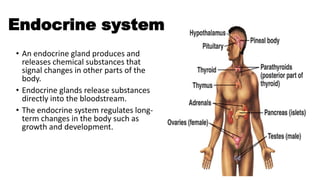
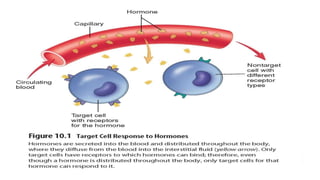
• An endocrine gland produces and
releases chemical substances that
signal changes in other parts of the
body.
• Endocrine glands release substances
directly into the bloodstream.
• The endocrine system regulates long-
term changes in the body such as
growth and development.
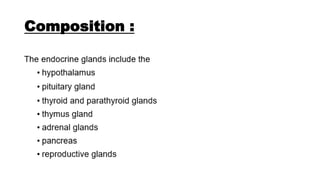
Composition :
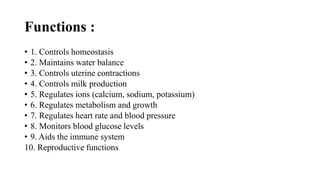
Functions :
• 1. Controls homeostasis
• 2. Maintains water balance
• 3. Controls uterine contractions
• 4. Controls milk production
• 5. Regulates ions (calcium, sodium, potassium)
• 6. Regulates metabolism and growth
• 7. Regulates heart rate and blood pressure
• 8. Monitors blood glucose levels
• 9. Aids the immune system
10. Reproductive functions
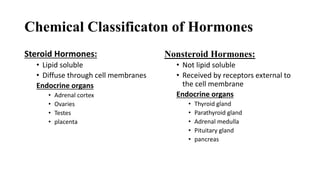
Chemical Classificaton of Hormones
Steroid Hormones:
• Lipid soluble
• Diffuse through cell membranes
Endocrine organs
• Adrenal cortex
• Ovaries
• Testes
• placenta
Nonsteroid Hormones:
• Not lipid soluble
• Received by receptors external to
the cell membrane
Endocrine organs
• Thyroid gland
• Parathyroid gland
• Adrenal medulla
• Pituitary gland
• pancreas
Hormone Actions
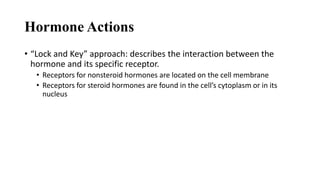
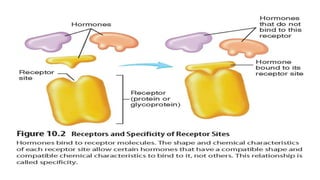
• “Lock and Key” approach: describes the interaction between the
hormone and its specific receptor.
• Receptors for nonsteroid hormones are located on the cell membrane
• Receptors for steroid hormones are found in the cell’s cytoplasm or in its
nucleus
Endocrine presentation by fatmah khan

Endocrine presentation by fatmah khan

  • 2.
    Endocrine system • Anendocrine gland produces and releases chemical substances that signal changes in other parts of the body. • Endocrine glands release substances directly into the bloodstream. • The endocrine system regulates long- term changes in the body such as growth and development.
  • 3.
  • 4.
    Functions : • 1.Controls homeostasis • 2. Maintains water balance • 3. Controls uterine contractions • 4. Controls milk production • 5. Regulates ions (calcium, sodium, potassium) • 6. Regulates metabolism and growth • 7. Regulates heart rate and blood pressure • 8. Monitors blood glucose levels • 9. Aids the immune system 10. Reproductive functions
  • 5.
    Chemical Classificaton ofHormones Steroid Hormones: • Lipid soluble • Diffuse through cell membranes Endocrine organs • Adrenal cortex • Ovaries • Testes • placenta Nonsteroid Hormones: • Not lipid soluble • Received by receptors external to the cell membrane Endocrine organs • Thyroid gland • Parathyroid gland • Adrenal medulla • Pituitary gland • pancreas
  • 6.
    Hormone Actions • “Lockand Key” approach: describes the interaction between the hormone and its specific receptor. • Receptors for nonsteroid hormones are located on the cell membrane • Receptors for steroid hormones are found in the cell’s cytoplasm or in its nucleus