ENDOCRINE
SYSTEM
STRUCTURE AND ITS
FUNCTIONS
What Is the Endocrine System?
• The endocrine system is made up of
glands that make hormones. Hormones
are the body's chemical messengers.
They carry information and instructions
from one set of cells to another.
What Is the Endocrine System?
•The endocrine system
influences almost every cell,
organ, and function of our
bodies.
What Does the Endocrine System Do?
•Endocrine glands release
hormones into the
bloodstream.
What Does the Endocrine System Do?
•The endocrine hormones help
control mood, growth and
development, the way our organs
work, metabolism , and reproduction
What Are the
Parts of the
Endocrine
System?
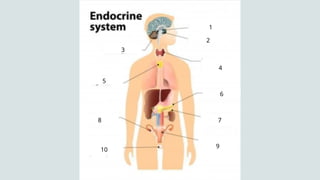
6
11
3
2
4
5
8
10
7
9
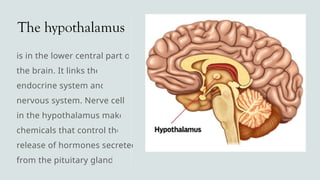
The hypothalamus
is in the lower central part of
the brain. It links the
endocrine system and
nervous system. Nerve cells
in the hypothalamus make
chemicals that control the
release of hormones secreted
from the pituitary gland.
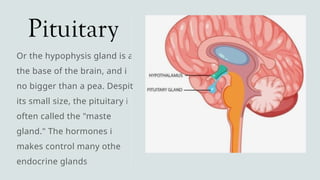
Pituitary
Or the hypophysis gland is at
the base of the brain, and is
no bigger than a pea. Despite
its small size, the pituitary is
often called the "master
gland." The hormones it
makes control many other
endocrine glands.
The pituitary gland makes many hormones, such as:
 GROWTH HORMONE or Somatotropin, which
stimulates the growth of bone and other body tissues
and plays a role in the body's handling of nutrients and
minerals
 PROLACTIN which activates milk production in women
who are breastfeeding
• Thyrotropin which stimulates the thyroid gland to make
thyroid hormones
• Corticotropin which stimulates the adrenal gland to make
certain hormones
• Antidiuretic hormone which helps control body water
balance through its effect on the kidneys
• Oxytocin which triggers the contractions of the uterus that
happen during labor
• The pituitary also secretes Endorphins chemicals that act on
the nervous system and reduce feelings of pain. The pituitary
also secretes hormones that signal the reproductive organs
to make sex hormones. The pituitary gland also controls
ovulation and the menstrual cycle in women.
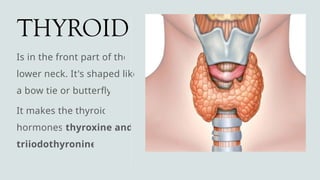
THYROID
Is in the front part of the
lower neck. It's shaped like
a bow tie or butterfly.
It makes the thyroid
hormones thyroxine and
triiodothyronine
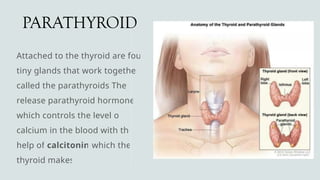
PARATHYROID
Attached to the thyroid are four
tiny glands that work together
called the parathyroids They
release parathyroid hormone,
which controls the level of
calcium in the blood with the
help of calcitonin which the
thyroid makes
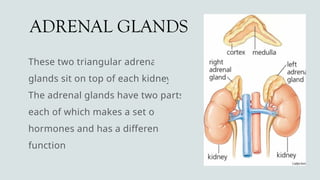
ADRENAL GLANDS
These two triangular adrenal
glands sit on top of each kidney.
The adrenal glands have two parts,
each of which makes a set of
hormones and has a different
function:
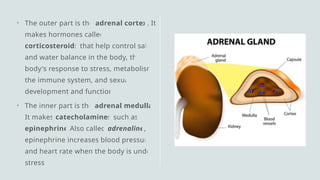
• The outer part is the adrenal cortex. It
makes hormones called
corticosteroids that help control salt
and water balance in the body, the
body's response to stress, metabolism,
the immune system, and sexual
development and function.
• The inner part is the adrenal medulla
It makes catecholamines such as
epinephrine Also called adrenaline,
epinephrine increases blood pressure
and heart rate when the body is under
stress.
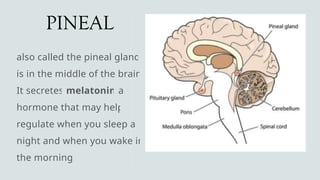
PINEAL
also called the pineal gland,
is in the middle of the brain.
It secretes melatonin a
hormone that may help
regulate when you sleep at
night and when you wake in
the morning.
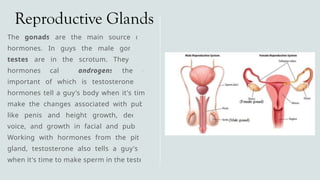
Reproductive Glands
The gonads are the main source of sex
hormones. In guys the male gonads, or
testes are in the scrotum. They secrete
hormones called androgens the most
important of which is testosterone These
hormones tell a guy's body when it's time to
make the changes associated with puberty,
like penis and height growth, deepening
voice, and growth in facial and pubic hair.
Working with hormones from the pituitary
gland, testosterone also tells a guy's body
when it's time to make sperm in the testes.
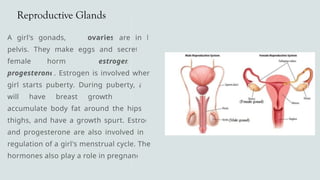
Reproductive Glands
A girl's gonads, the ovaries are in her
pelvis. They make eggs and secrete the
female hormones estrogen and
progesterone. Estrogen is involved when a
girl starts puberty. During puberty, a girl
will have breast growth, start to
accumulate body fat around the hips and
thighs, and have a growth spurt. Estrogen
and progesterone are also involved in the
regulation of a girl's menstrual cycle. These
hormones also play a role in pregnancy
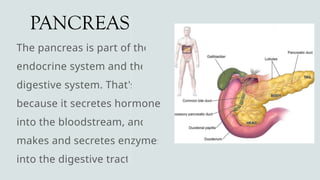
PANCREAS
The pancreas is part of the
endocrine system and the
digestive system. That's
because it secretes hormones
into the bloodstream, and
makes and secretes enzymes
into the digestive tract.
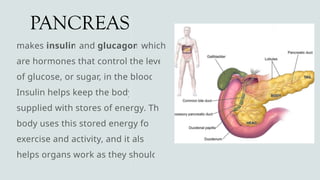
PANCREAS
makes insulin and glucagon which
are hormones that control the level
of glucose, or sugar, in the blood.
Insulin helps keep the body
supplied with stores of energy. The
body uses this stored energy for
exercise and activity, and it also
helps organs work as they should.

ENDOCRINE SYSTEM RHODNEY.pptxxxxxxxxxxxx

  • 1.
  • 2.
    What Is theEndocrine System? • The endocrine system is made up of glands that make hormones. Hormones are the body's chemical messengers. They carry information and instructions from one set of cells to another.
  • 3.
    What Is theEndocrine System? •The endocrine system influences almost every cell, organ, and function of our bodies.
  • 4.
    What Does theEndocrine System Do? •Endocrine glands release hormones into the bloodstream.
  • 5.
    What Does theEndocrine System Do? •The endocrine hormones help control mood, growth and development, the way our organs work, metabolism , and reproduction
  • 6.
    What Are the Partsof the Endocrine System?
  • 7.
  • 8.
    The hypothalamus is inthe lower central part of the brain. It links the endocrine system and nervous system. Nerve cells in the hypothalamus make chemicals that control the release of hormones secreted from the pituitary gland.
  • 9.
    Pituitary Or the hypophysisgland is at the base of the brain, and is no bigger than a pea. Despite its small size, the pituitary is often called the "master gland." The hormones it makes control many other endocrine glands.
  • 10.
    The pituitary glandmakes many hormones, such as:  GROWTH HORMONE or Somatotropin, which stimulates the growth of bone and other body tissues and plays a role in the body's handling of nutrients and minerals  PROLACTIN which activates milk production in women who are breastfeeding
  • 11.
    • Thyrotropin whichstimulates the thyroid gland to make thyroid hormones • Corticotropin which stimulates the adrenal gland to make certain hormones • Antidiuretic hormone which helps control body water balance through its effect on the kidneys • Oxytocin which triggers the contractions of the uterus that happen during labor • The pituitary also secretes Endorphins chemicals that act on the nervous system and reduce feelings of pain. The pituitary also secretes hormones that signal the reproductive organs to make sex hormones. The pituitary gland also controls ovulation and the menstrual cycle in women.
  • 12.
    THYROID Is in thefront part of the lower neck. It's shaped like a bow tie or butterfly. It makes the thyroid hormones thyroxine and triiodothyronine
  • 13.
    PARATHYROID Attached to thethyroid are four tiny glands that work together called the parathyroids They release parathyroid hormone, which controls the level of calcium in the blood with the help of calcitonin which the thyroid makes
  • 14.
    ADRENAL GLANDS These twotriangular adrenal glands sit on top of each kidney. The adrenal glands have two parts, each of which makes a set of hormones and has a different function:
  • 15.
    • The outerpart is the adrenal cortex. It makes hormones called corticosteroids that help control salt and water balance in the body, the body's response to stress, metabolism, the immune system, and sexual development and function. • The inner part is the adrenal medulla It makes catecholamines such as epinephrine Also called adrenaline, epinephrine increases blood pressure and heart rate when the body is under stress.
  • 16.
    PINEAL also called thepineal gland, is in the middle of the brain. It secretes melatonin a hormone that may help regulate when you sleep at night and when you wake in the morning.
  • 17.
    Reproductive Glands The gonadsare the main source of sex hormones. In guys the male gonads, or testes are in the scrotum. They secrete hormones called androgens the most important of which is testosterone These hormones tell a guy's body when it's time to make the changes associated with puberty, like penis and height growth, deepening voice, and growth in facial and pubic hair. Working with hormones from the pituitary gland, testosterone also tells a guy's body when it's time to make sperm in the testes.
  • 18.
    Reproductive Glands A girl'sgonads, the ovaries are in her pelvis. They make eggs and secrete the female hormones estrogen and progesterone. Estrogen is involved when a girl starts puberty. During puberty, a girl will have breast growth, start to accumulate body fat around the hips and thighs, and have a growth spurt. Estrogen and progesterone are also involved in the regulation of a girl's menstrual cycle. These hormones also play a role in pregnancy
  • 19.
    PANCREAS The pancreas ispart of the endocrine system and the digestive system. That's because it secretes hormones into the bloodstream, and makes and secretes enzymes into the digestive tract.
  • 20.
    PANCREAS makes insulin andglucagon which are hormones that control the level of glucose, or sugar, in the blood. Insulin helps keep the body supplied with stores of energy. The body uses this stored energy for exercise and activity, and it also helps organs work as they should.

Editor's Notes

  • #4 EXPLAIN HORMONES - This lets the hormones travel to cells in other parts of the body.
  • #5 EXPLAIN METABOLISM - The endocrine system regulates how much of each hormone is released. This can depend on levels of hormones already in the blood, or on levels of other substances in the blood, like calcium. Many things affect hormone levels, such as stress, infection, and changes in the balance of fluid and minerals in blood. Too much or too little of any hormone can harm the body. Medicines can treat many of these problems.
  • #8 The hypothalamus gathers information sensed by the brain (such as the surrounding temperature, light exposure, and feelings) and sends it to the pituitary. This information influences the hormones that the pituitary makes and releases.
  • #11 (pronounced: thy-ruh-TRO-pin), (pronounced: kor-tih-ko-TRO-pin, (pronounced: an-ty-dy-uh-REH-tik), (pronounced: ahk-see-TOE-sin), (pronounced: en-DOR-fins),
  • #12 (pronounced: thy-RAHK-sin), (pronounced: try-eye-oh-doe-THY-ruh-neen). These hormones control the rate at which cells burn fuels from food to make energy. The more thyroid hormone there is in the bloodstream, the faster chemical reactions happen in the body. Thyroid hormones are important because they help kids' and teens' bones grow and develop, and they also play a role in the development of the brain and nervous system.
  • #13 (pronounced: par-uh-THY-roydz). (pronounced: kal-suh-TOE-nin), Calcitonin is a hormone that plays a role in regulating the level of calcium in your blood by decreasing it. The C-cells in your thyroid gland produce calcitonin. Having abnormal levels of calcitonin in your body seems to have no direct negative side effects.
  • #14 (pronounced: uh-DREE-nul)
  • #15 (pronounced: kor-tih-ko-STER-oydz), (pronounced: muh-DUH-luh), (pronounced: kah-tuh-KO-luh-meenz), (pronounced: eh-puh-NEH-frun).
  • #16 he pineal (pronounced: pih-NEE-ul) body, (pronounced: meh-luh-TOE-nin),
  • #17 Most people don't realize it, but both guys and girls have gonads. (pronounced: TES-teez), androgens (pronounced: AN-druh-junz), (pronounced: tess-TOSS-tuh-rone).
  • #18 (pronounced: OH-vuh-reez), (pronounced: ESS-truh-jen), (pronounced: pro-JESS-tuh-rone)
  • #19 ancreas: The pancreas (pronounced: PAN-kree-us) , (pronounced: IN-suh-lin) , (pronounced: GLOO-kuh-gawn),
  • #20 ancreas: The pancreas (pronounced: PAN-kree-us) , (pronounced: IN-suh-lin) , (pronounced: GLOO-kuh-gawn),