
CONFIDENTIAL
© Copyright 2013. Aruba Networks, Inc.
All rights reserved 1 #airheadsconf#airheadsconf
Encryption, Authentication, and Access Control
Jon Green
Rich Langston
June 2013
CONFIDENTIAL
© Copyright 2013. Aruba Networks, Inc.
All rights reserved 2 #airheadsconf
•  Give a basic background in cryptography and
public key infrastructure
–  What is symmetric key crypto?
–  What is asymmetric key crypto?
–  What are certificates and PKI?
•  Show how to use public certs with our controller
•  Show how these two come together to create
802.1X
Today’s Goals
CONFIDENTIAL
© Copyright 2013. Aruba Networks, Inc.
All rights reserved 3 #airheadsconf#airheadsconf3
Cryptography Primer
CONFIDENTIAL
© Copyright 2013. Aruba Networks, Inc.
All rights reserved 4 #airheadsconf
•  Plain text is normal, unencrypted text
•  A Cipher is an encryption technique
•  Cipher Text is the unreadable output on the
Cypher
Terminology
CONFIDENTIAL
© Copyright 2013. Aruba Networks, Inc.
All rights reserved 5 #airheadsconf
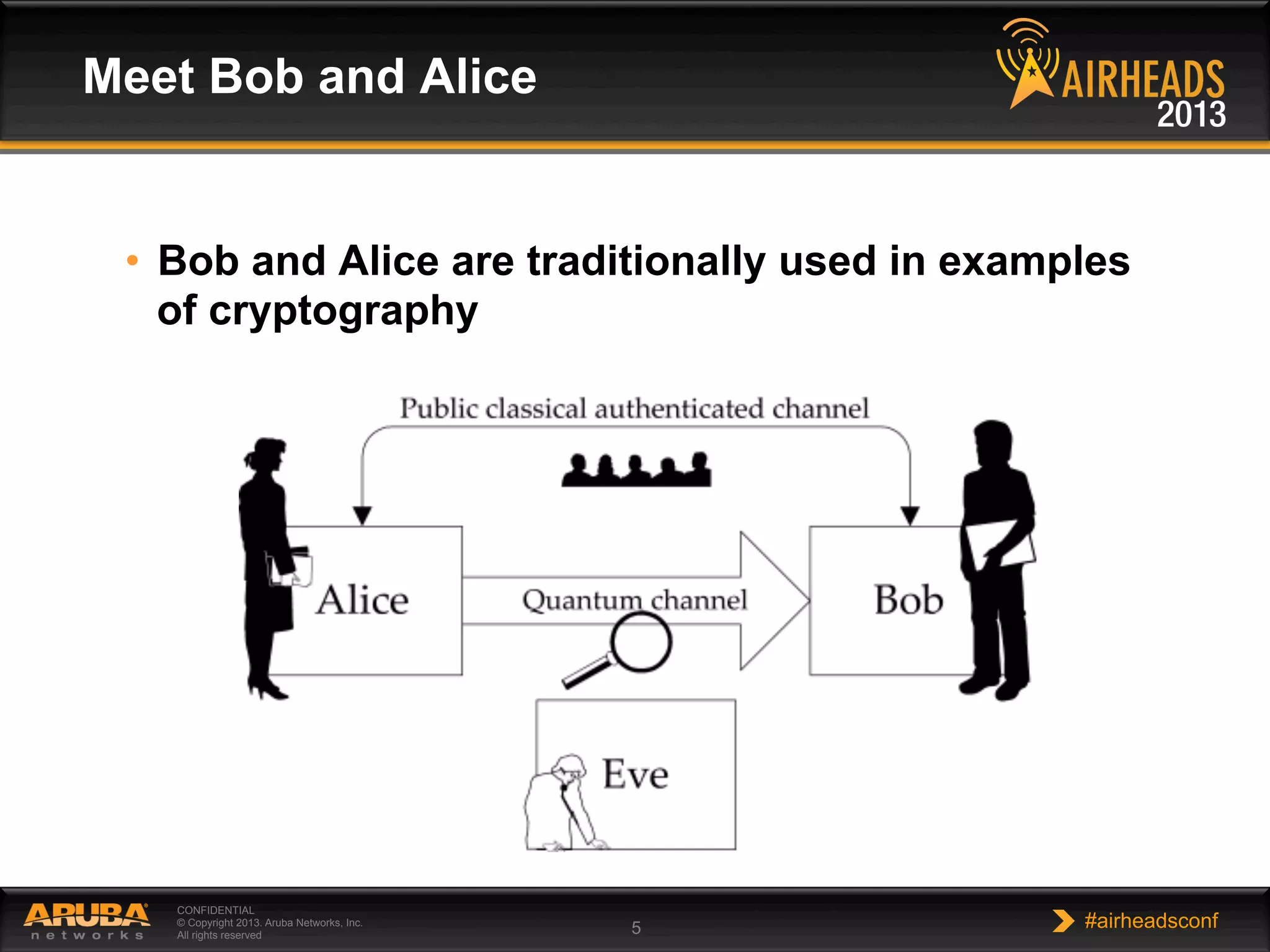
•  Bob and Alice are traditionally used in examples
of cryptography
Meet Bob and Alice
CONFIDENTIAL
© Copyright 2013. Aruba Networks, Inc.
All rights reserved 6 #airheadsconf
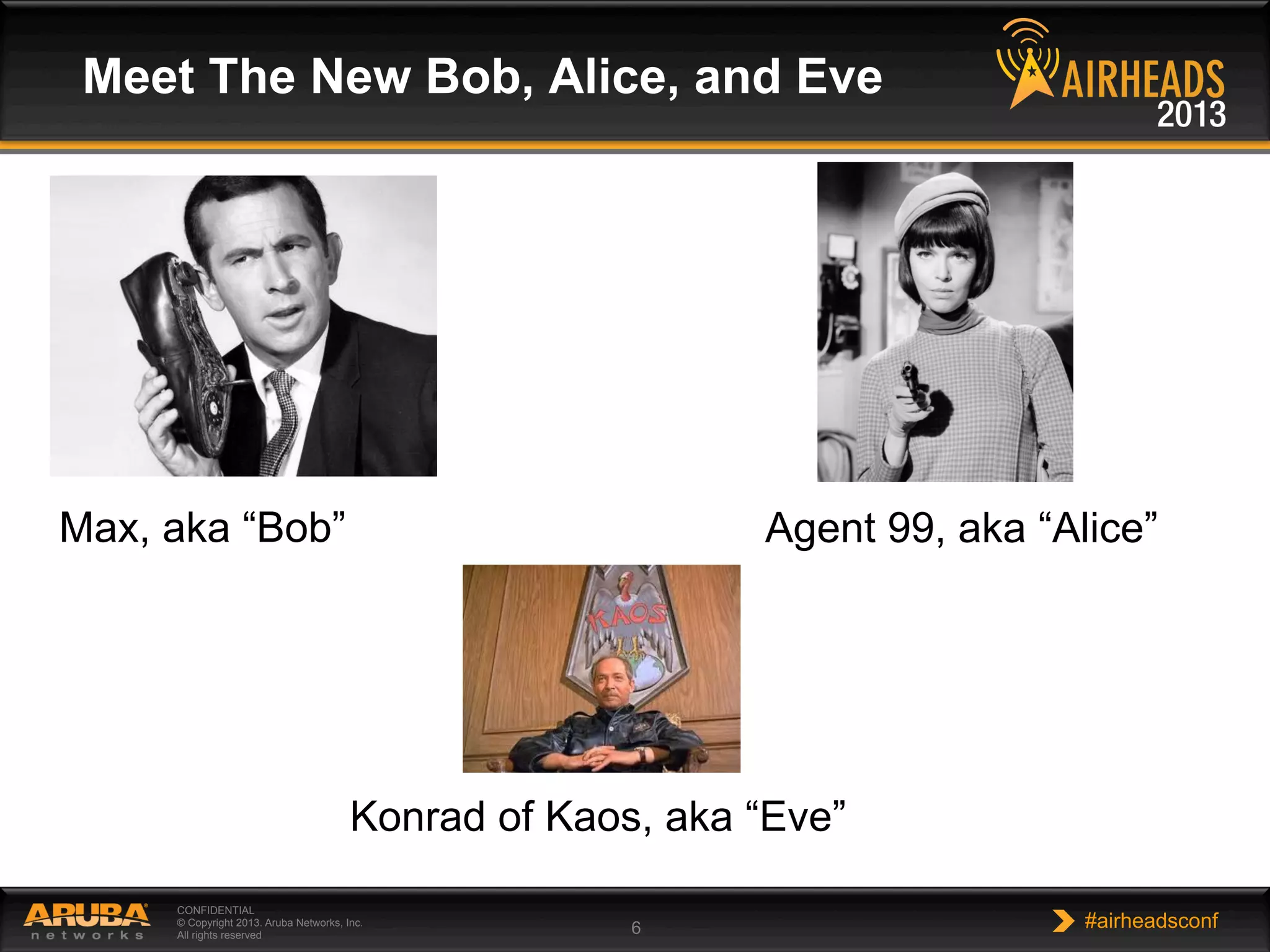
Meet The New Bob, Alice, and Eve
Max, aka “Bob” Agent 99, aka “Alice”
Konrad of Kaos, aka “Eve”
CONFIDENTIAL
© Copyright 2013. Aruba Networks, Inc.
All rights reserved 7 #airheadsconf
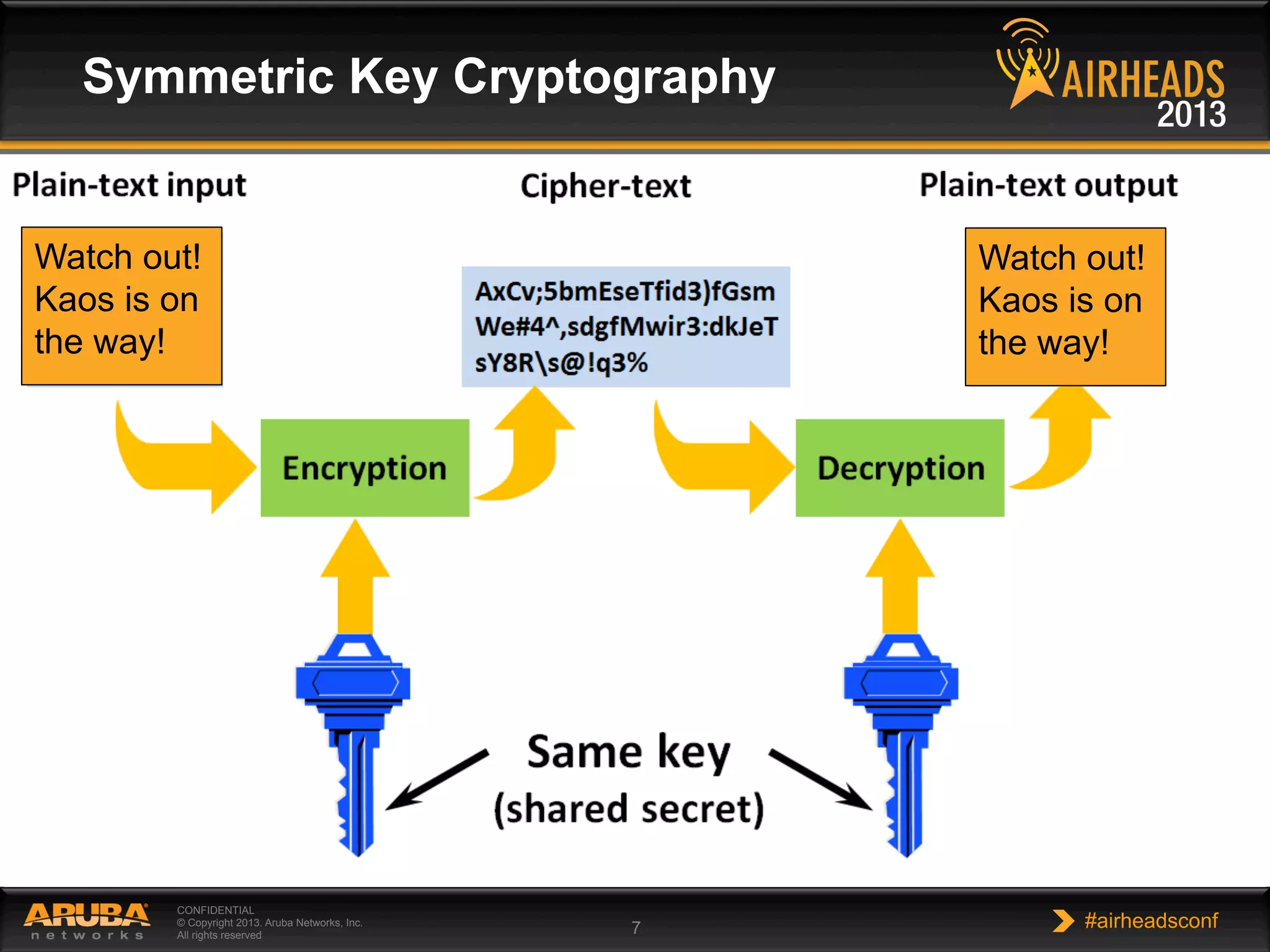
Symmetric Key Cryptography
Watch out!
Kaos is on
the way!
Watch out!
Kaos is on
the way!
CONFIDENTIAL
© Copyright 2013. Aruba Networks, Inc.
All rights reserved 8 #airheadsconf
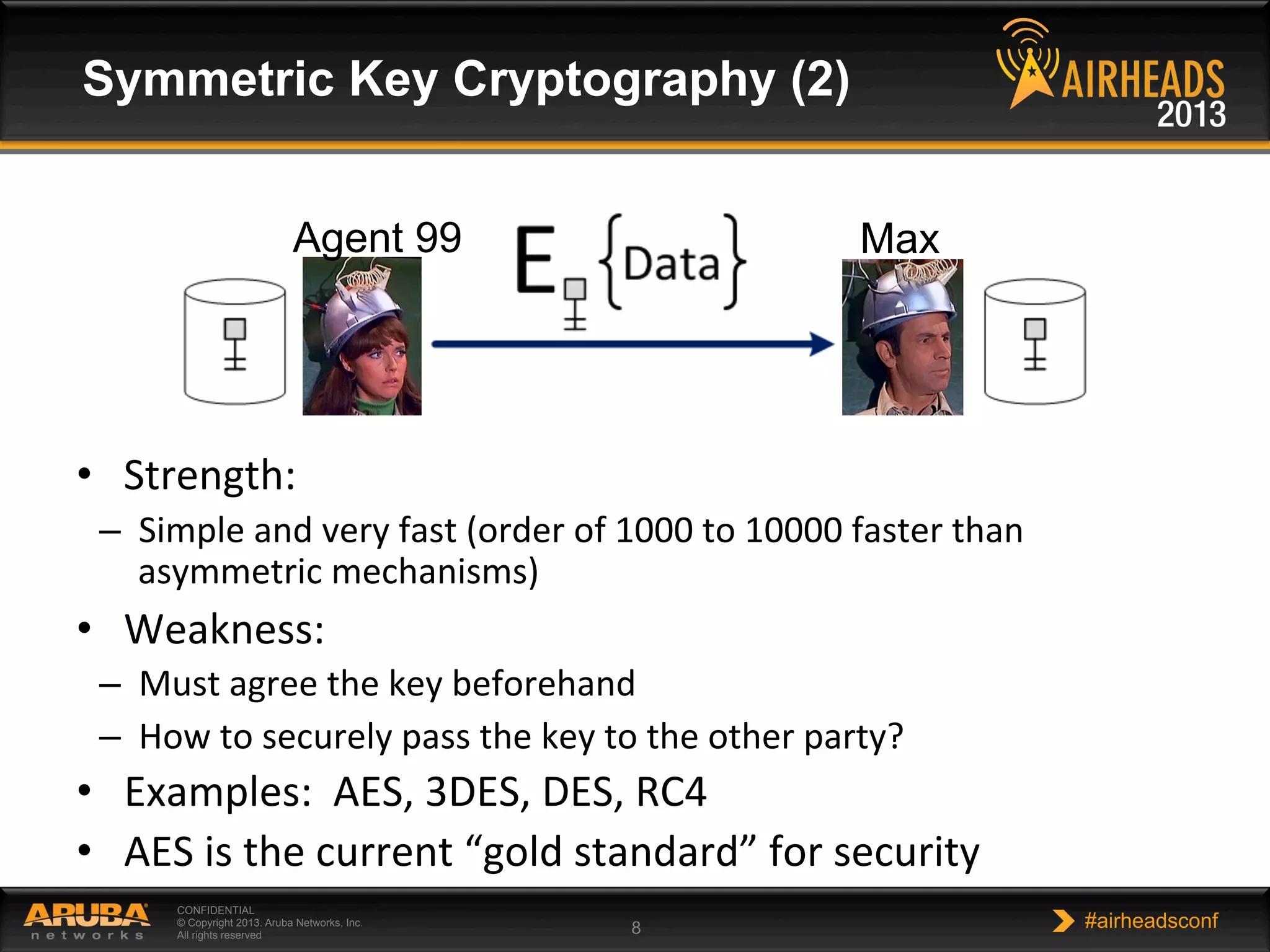
Symmetric Key Cryptography (2)
•  Strength:	
  
–  Simple	
  and	
  very	
  fast	
  (order	
  of	
  1000	
  to	
  10000	
  faster	
  than	
  
asymmetric	
  mechanisms)	
  
•  Weakness:	
  
–  Must	
  agree	
  the	
  key	
  beforehand	
  
–  How	
  to	
  securely	
  pass	
  the	
  key	
  to	
  the	
  other	
  party?	
  
•  Examples:	
  	
  AES,	
  3DES,	
  DES,	
  RC4	
  
•  AES	
  is	
  the	
  current	
  “gold	
  standard”	
  for	
  security	


Agent 99 Max
CONFIDENTIAL
© Copyright 2013. Aruba Networks, Inc.
All rights reserved 9 #airheadsconf
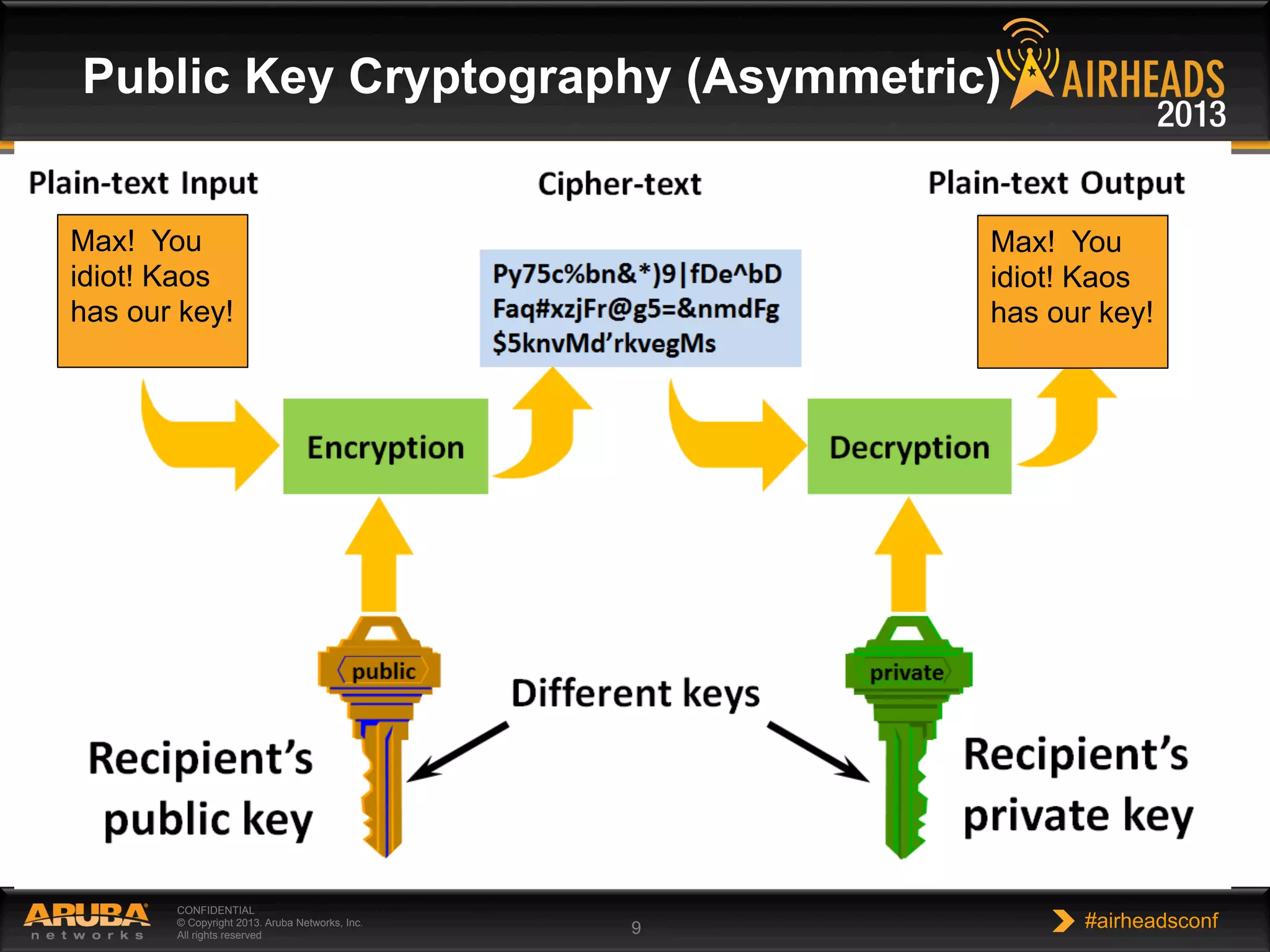
Public Key Cryptography (Asymmetric)
Max! You
idiot! Kaos
has our key!
Max! You
idiot! Kaos
has our key!
CONFIDENTIAL
© Copyright 2013. Aruba Networks, Inc.
All rights reserved 10 #airheadsconf
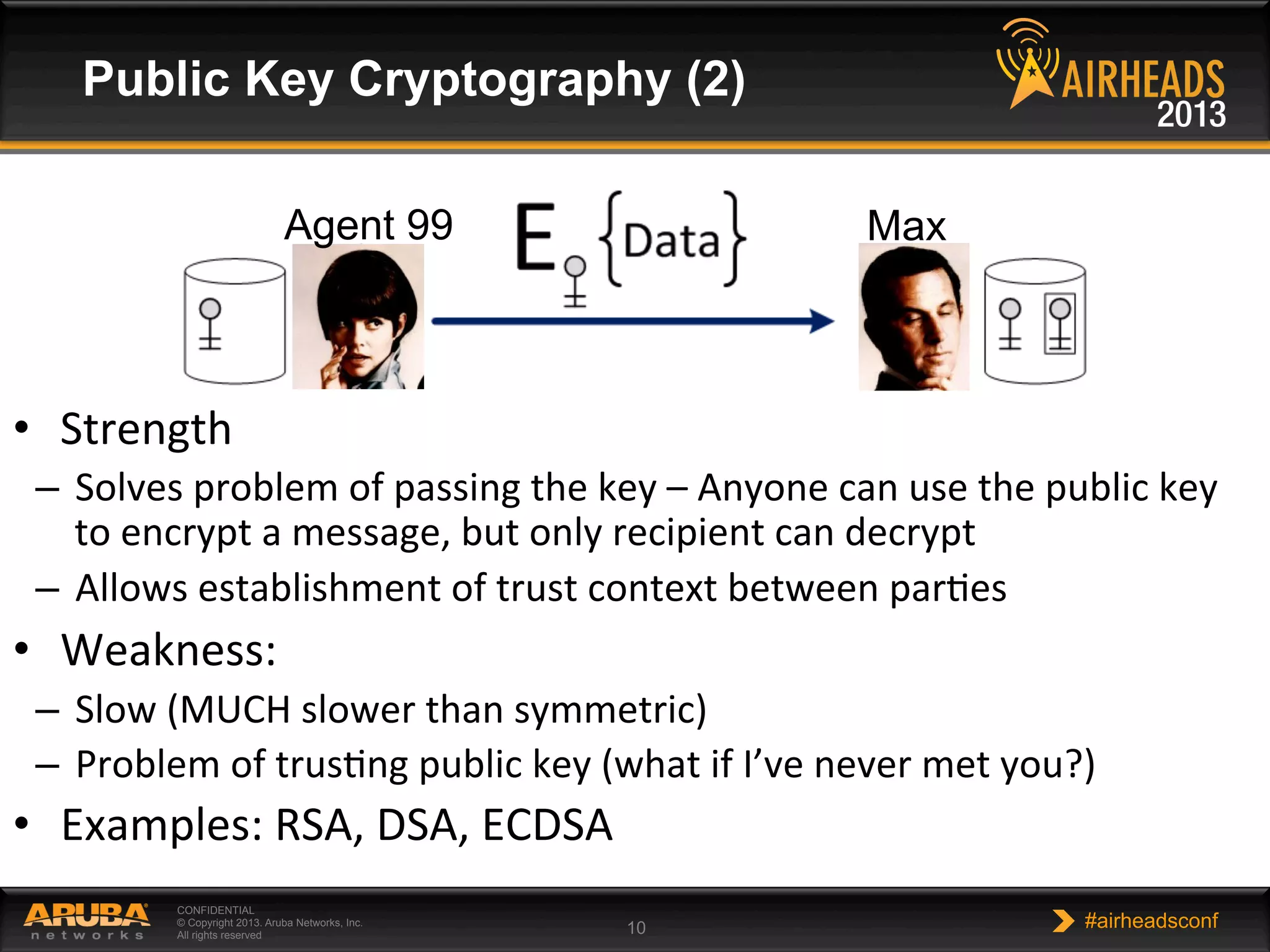
Public Key Cryptography (2)
•  Strength	
  
–  Solves	
  problem	
  of	
  passing	
  the	
  key	
  –	
  Anyone	
  can	
  use	
  the	
  public	
  key	
  
to	
  encrypt	
  a	
  message,	
  but	
  only	
  recipient	
  can	
  decrypt	
  
–  Allows	
  establishment	
  of	
  trust	
  context	
  between	
  parNes	
  
•  Weakness:	
  
–  Slow	
  (MUCH	
  slower	
  than	
  symmetric)	
  
–  Problem	
  of	
  trusNng	
  public	
  key	
  (what	
  if	
  I’ve	
  never	
  met	
  you?)	
  
•  Examples:	
  RSA,	
  DSA,	
  ECDSA	
  
Agent 99 Max
CONFIDENTIAL
© Copyright 2013. Aruba Networks, Inc.
All rights reserved 11 #airheadsconf
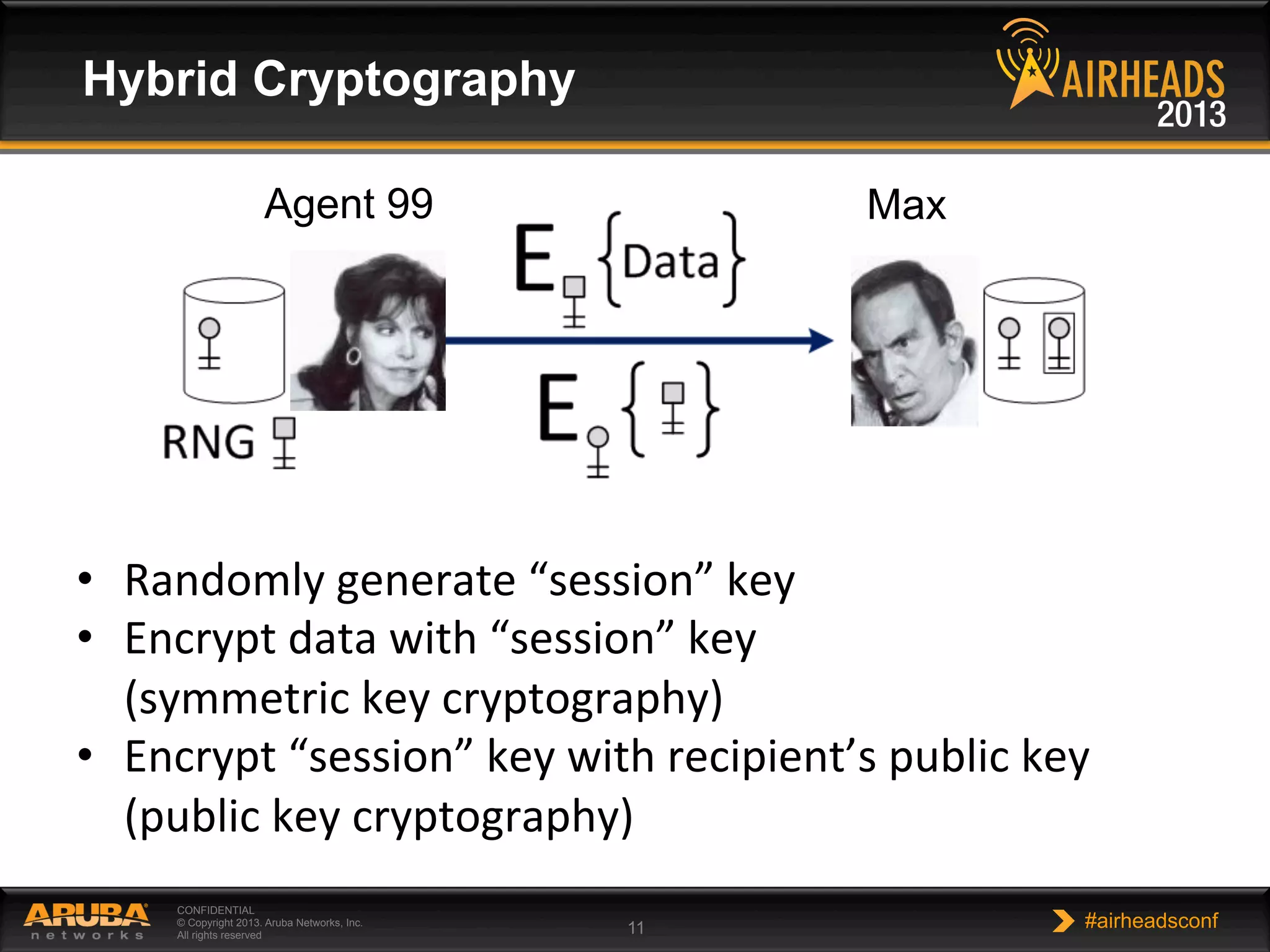
Hybrid Cryptography
•  Randomly	
  generate	
  “session”	
  key	
  
•  Encrypt	
  data	
  with	
  “session”	
  key	
  	
  
(symmetric	
  key	
  cryptography)	
  
•  Encrypt	
  “session”	
  key	
  with	
  recipient’s	
  public	
  key	
  
(public	
  key	
  cryptography)	


Agent 99 Max
CONFIDENTIAL
© Copyright 2013. Aruba Networks, Inc.
All rights reserved 12 #airheadsconf
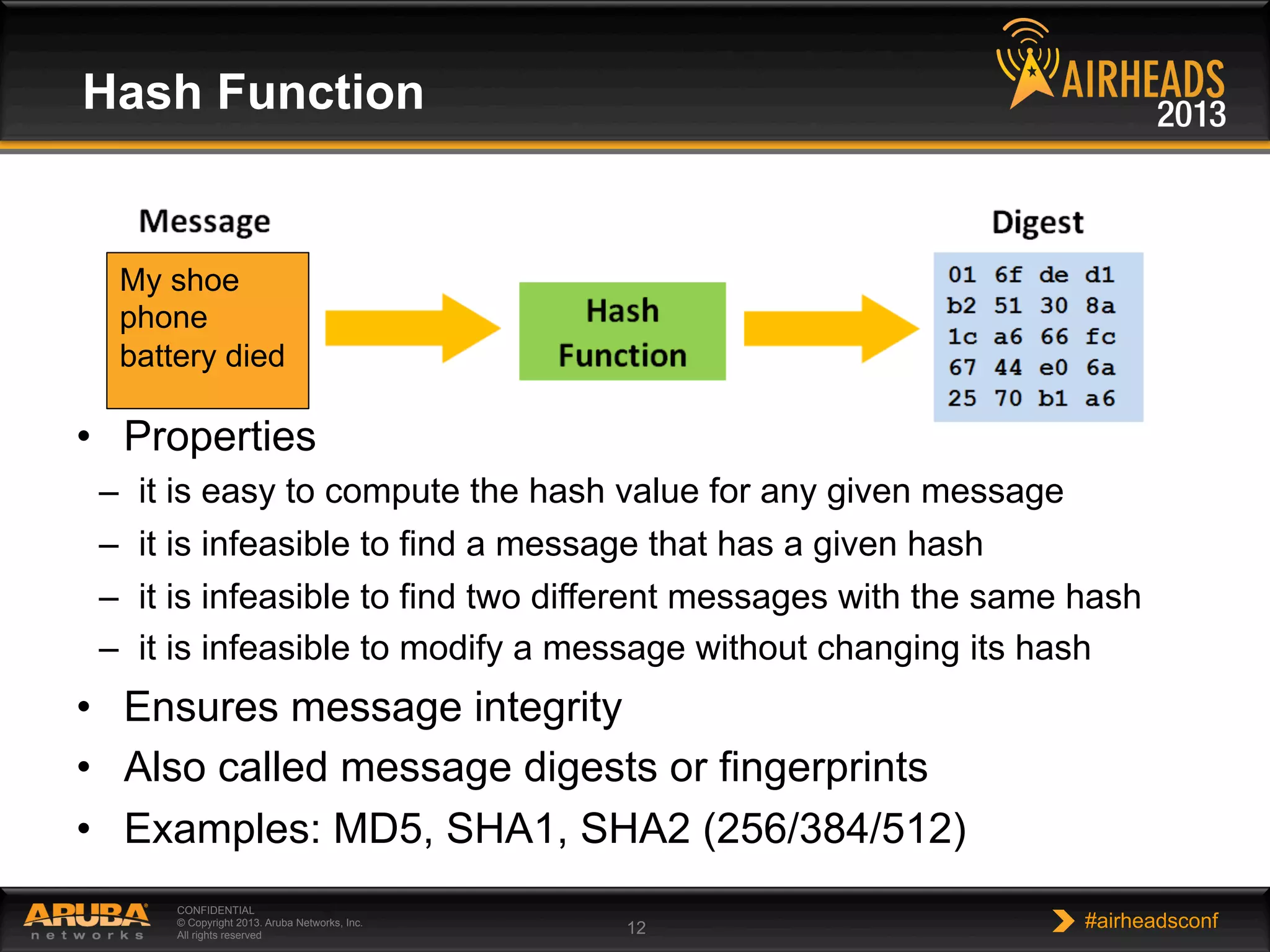
Hash Function
My shoe
phone
battery died
•  Properties
–  it is easy to compute the hash value for any given message
–  it is infeasible to find a message that has a given hash
–  it is infeasible to find two different messages with the same hash
–  it is infeasible to modify a message without changing its hash
•  Ensures message integrity
•  Also called message digests or fingerprints
•  Examples: MD5, SHA1, SHA2 (256/384/512)
CONFIDENTIAL
© Copyright 2013. Aruba Networks, Inc.
All rights reserved 13 #airheadsconf
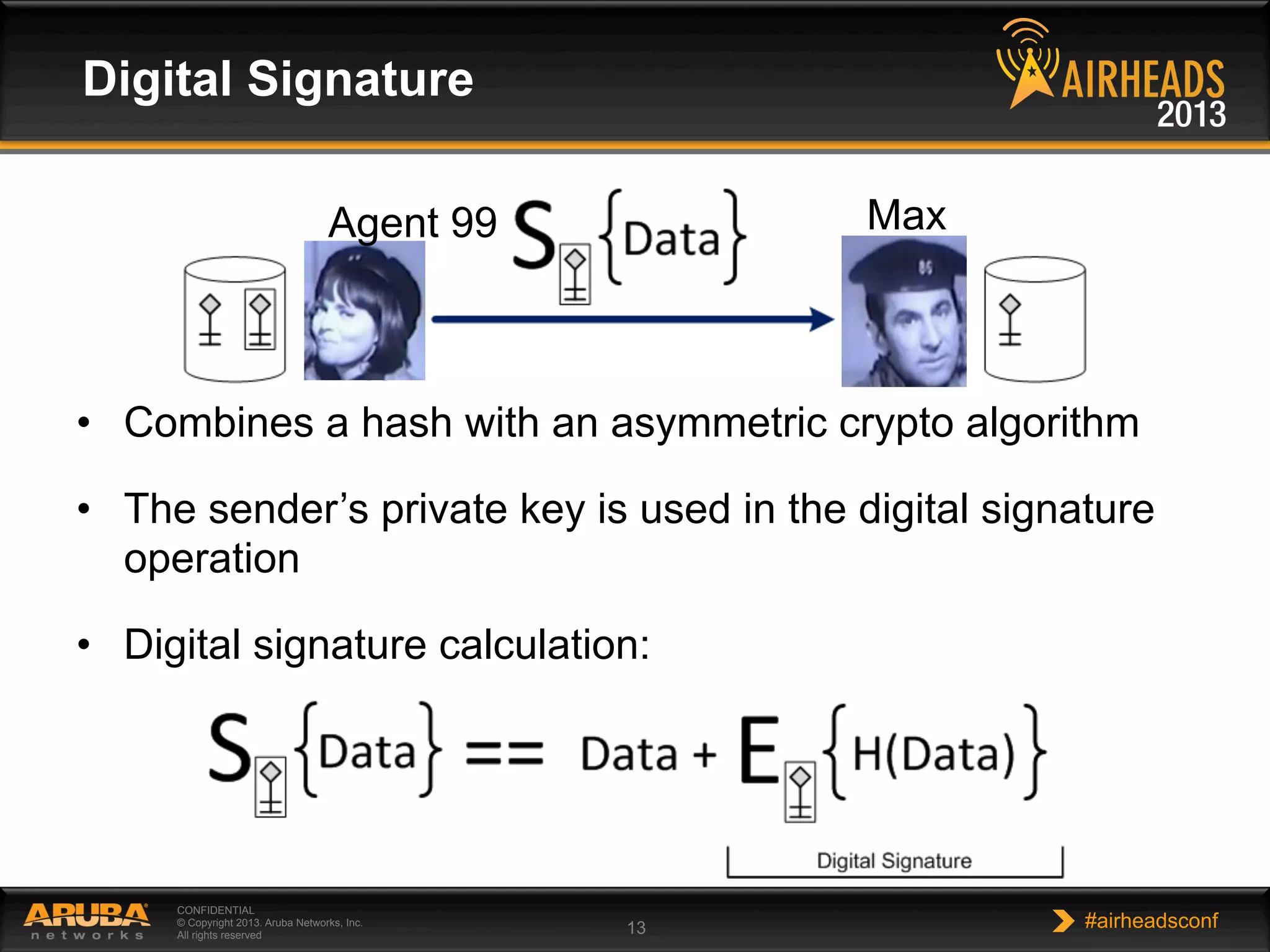
Digital Signature
•  Combines a hash with an asymmetric crypto algorithm
•  The sender’s private key is used in the digital signature
operation
•  Digital signature calculation:
Agent 99 Max
CONFIDENTIAL
© Copyright 2013. Aruba Networks, Inc.
All rights reserved 14 #airheadsconf
•  Encryption provides
–  confidentiality, can provide authentication and integrity protection
•  Checksums/hash algorithms provide
–  integrity protection, can provide authentication
•  Digital signatures provide
–  authentication, integrity protection, and non-repudiation
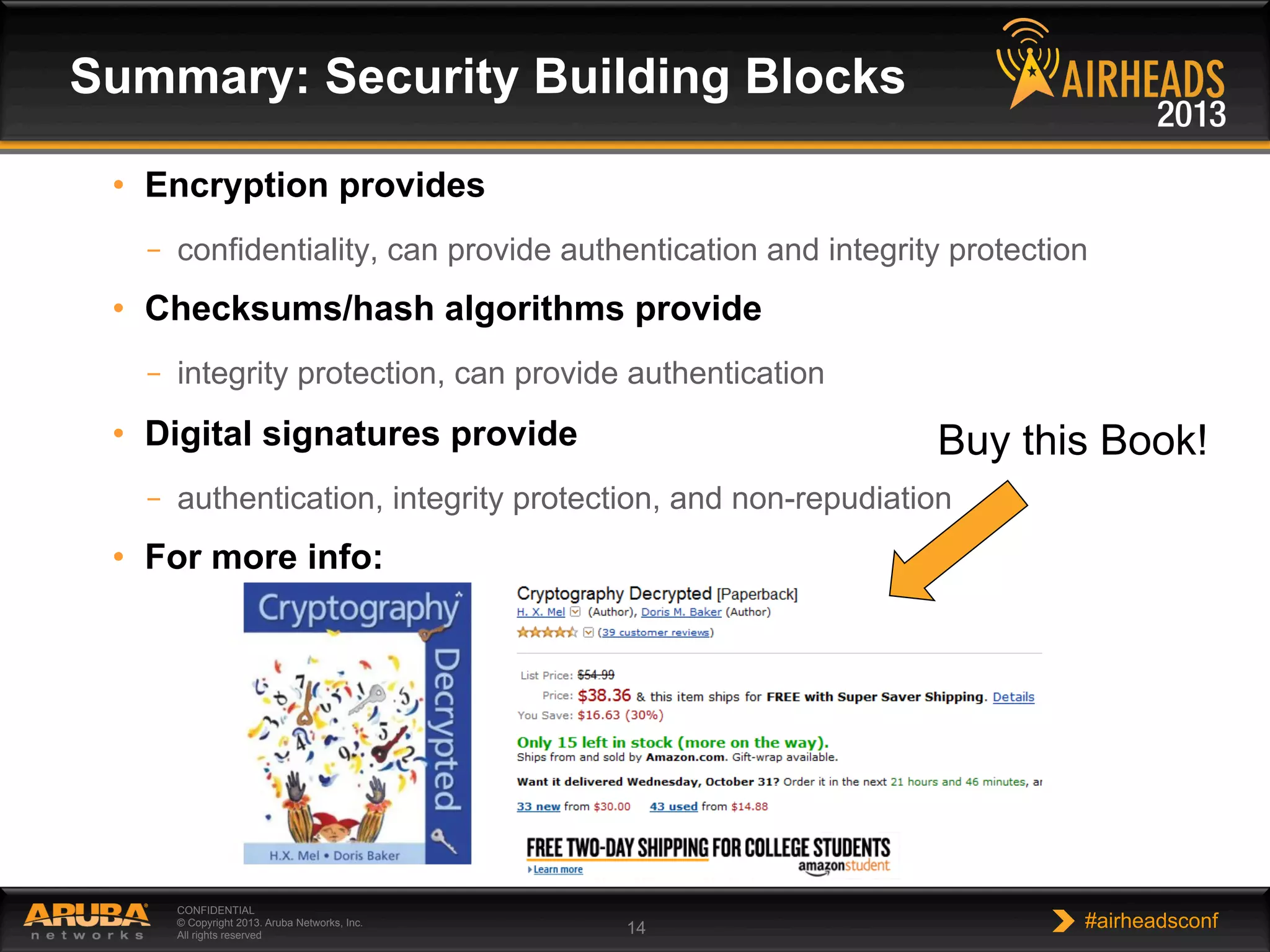
•  For more info:
Summary: Security Building Blocks
Buy this Book!
CONFIDENTIAL
© Copyright 2013. Aruba Networks, Inc.
All rights reserved 15 #airheadsconf#airheadsconf15
You	
  have	
  to	
  decide	
  who	
  you	
  trust	
  before	
  you	
  decide	
  what	
  to	
  believe	
  
Cer$ficates,	
  Trust	
  &	
  PKI
CONFIDENTIAL
© Copyright 2013. Aruba Networks, Inc.
All rights reserved 16 #airheadsconf
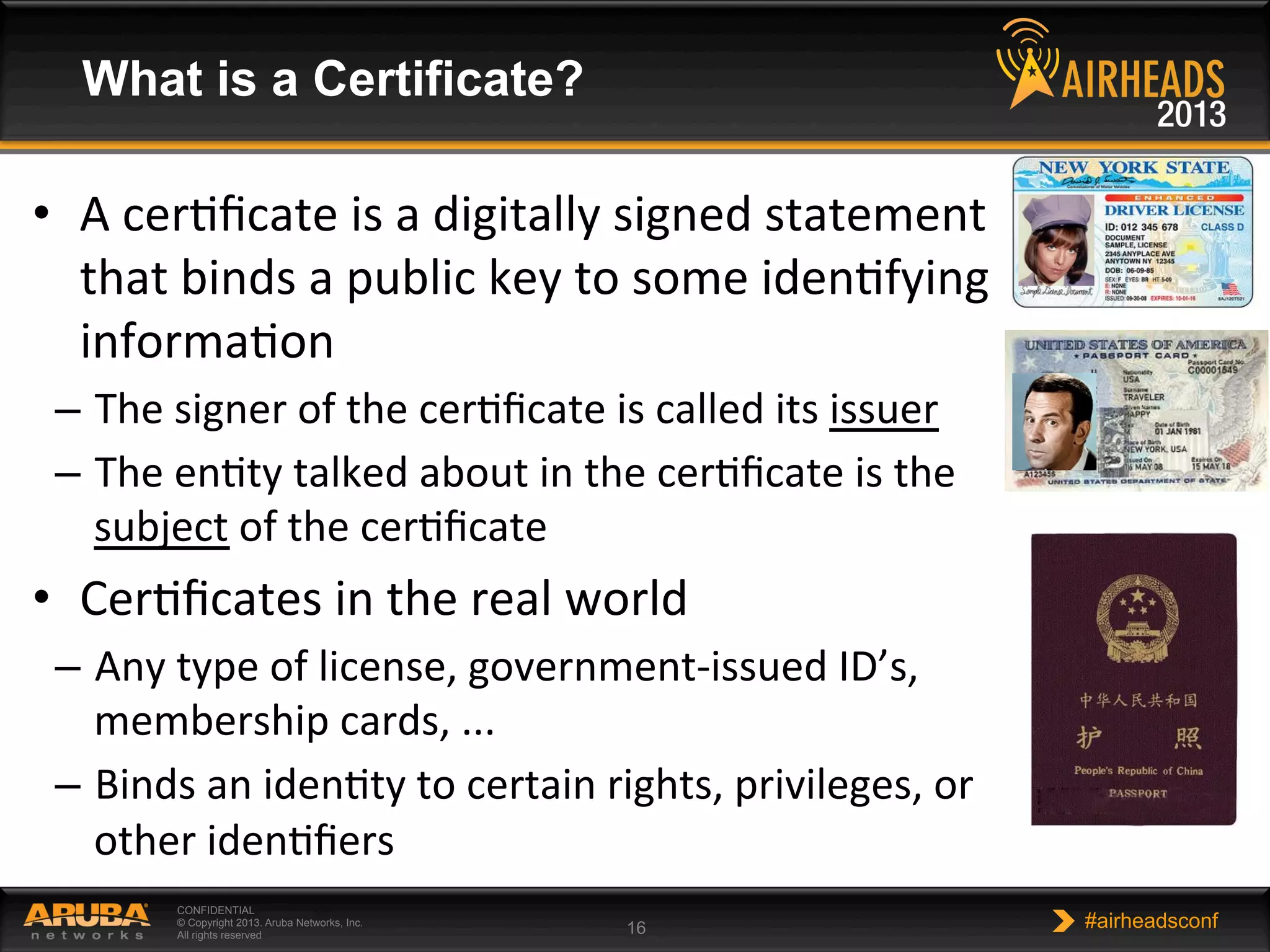
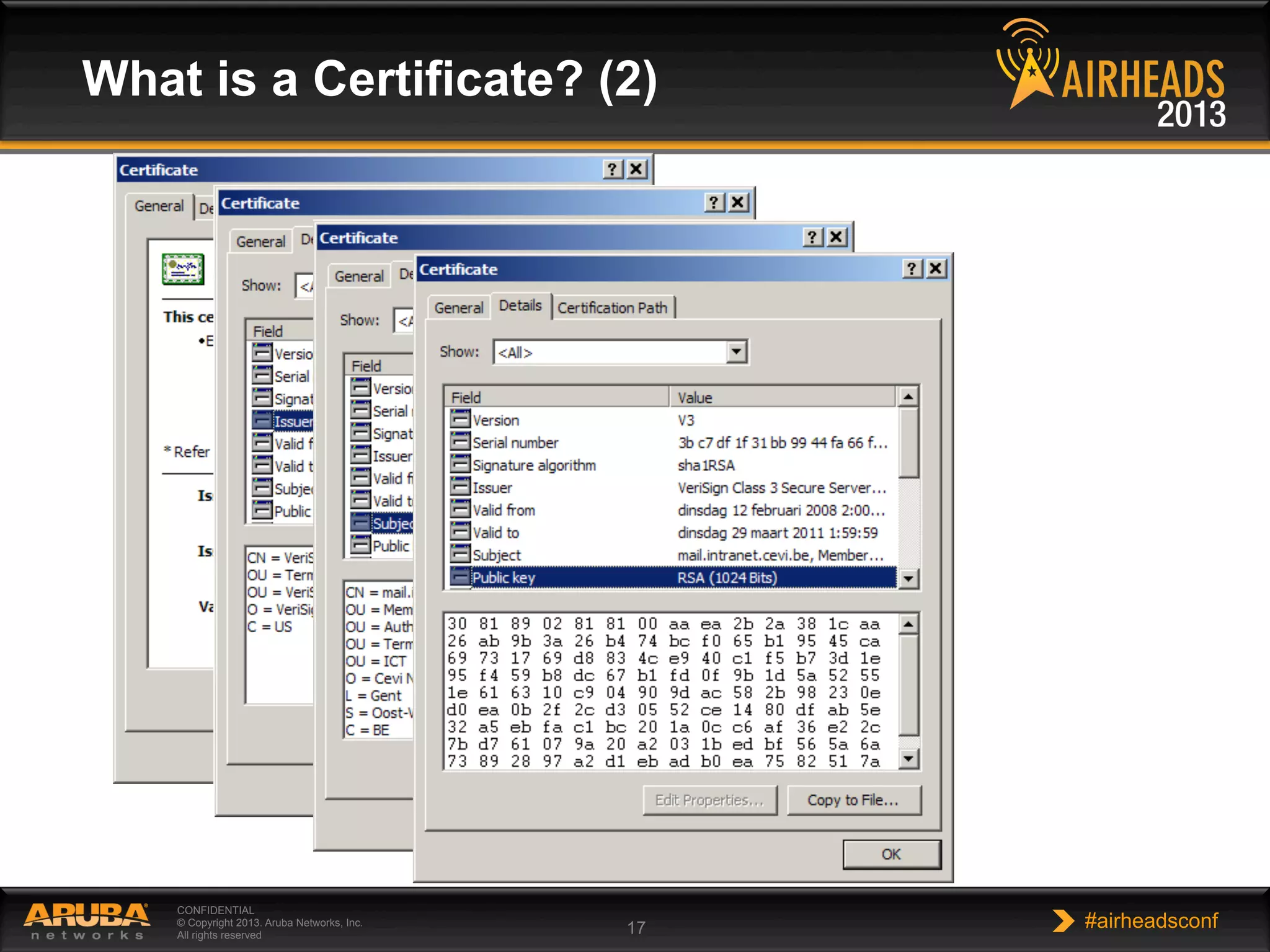
What is a Certificate?
•  A	
  cerNficate	
  is	
  a	
  digitally	
  signed	
  statement	
  
that	
  binds	
  a	
  public	
  key	
  to	
  some	
  idenNfying	
  
informaNon	
  
–  The	
  signer	
  of	
  the	
  cerNficate	
  is	
  called	
  its	
  issuer	
  
–  The	
  enNty	
  talked	
  about	
  in	
  the	
  cerNficate	
  is	
  the	
  
subject	
  of	
  the	
  cerNficate	
  
•  CerNficates	
  in	
  the	
  real	
  world	
  
–  Any	
  type	
  of	
  license,	
  government-­‐issued	
  ID’s,	
  
membership	
  cards,	
  ...	
  
–  Binds	
  an	
  idenNty	
  to	
  certain	
  rights,	
  privileges,	
  or	
  
other	
  idenNfiers	
  
CONFIDENTIAL
© Copyright 2013. Aruba Networks, Inc.
All rights reserved 17 #airheadsconf
What is a Certificate? (2)
CONFIDENTIAL
© Copyright 2013. Aruba Networks, Inc.
All rights reserved 18 #airheadsconf
Trust Model
•  Agent	
  99	
  will	
  believe	
  Max’s	
  public	
  key	
  belongs	
  to	
  
Max	
  if	
  Agent	
  99	
  trusts	
  the	
  issuer	
  of	
  Max’s	
  
cerNficate	
  to	
  make	
  key-­‐name	
  binding	
  statements	
  
•  How	
  can	
  we	
  convince	
  Agent	
  99	
  to	
  trust	
  the	
  issuer	
  
of	
  Max’s	
  cerNficate?	
  
•  SoluNon:	
  Agent	
  99	
  must	
  implicitly	
  trust	
  some	
  set	
  
of	
  public	
  keys	
  
–  Once	
  she	
  does	
  that,	
  those	
  public	
  keys	
  can	
  introduce	
  
other	
  public	
  keys	
  to	
  her	
  (hierarchical	
  model)	
  
CONFIDENTIAL
© Copyright 2013. Aruba Networks, Inc.
All rights reserved 19 #airheadsconf
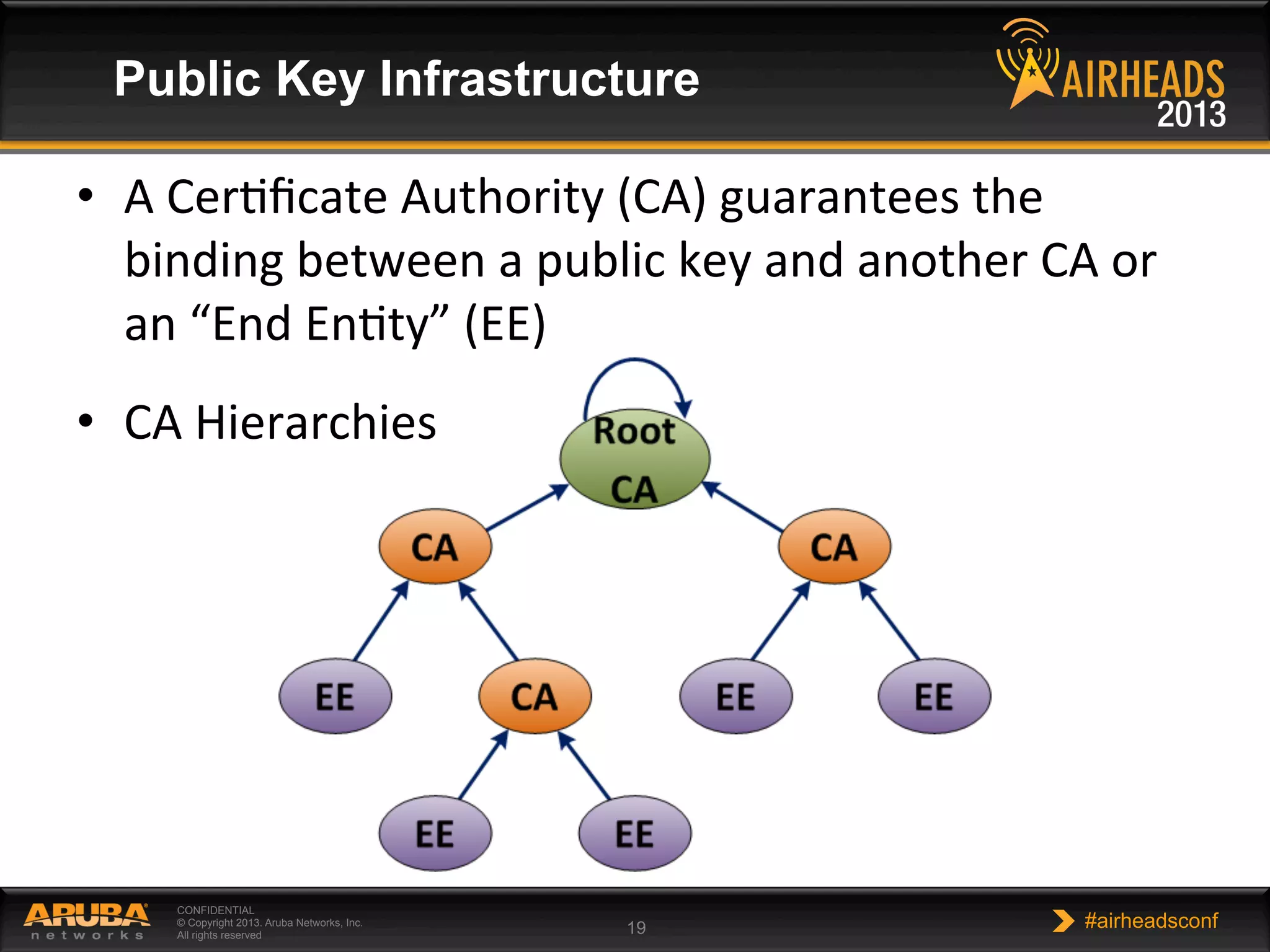
Public Key Infrastructure
•  A	
  CerNficate	
  Authority	
  (CA)	
  guarantees	
  the	
  
binding	
  between	
  a	
  public	
  key	
  and	
  another	
  CA	
  or	
  
an	
  “End	
  EnNty”	
  (EE)	
  
•  CA	
  Hierarchies	
  
CONFIDENTIAL
© Copyright 2013. Aruba Networks, Inc.
All rights reserved 20 #airheadsconf
•  Normally, self-signed root CAs are created, then
these create subordinate CAs
•  Once subordinate CAs have been created, the
root is taken offline
–  If the root is compromised, the trust model is broken and the
bad guys can fool you into trusting a cert that is bogus
Certificate Authority Best Practice
CONFIDENTIAL
© Copyright 2013. Aruba Networks, Inc.
All rights reserved 21 #airheadsconf
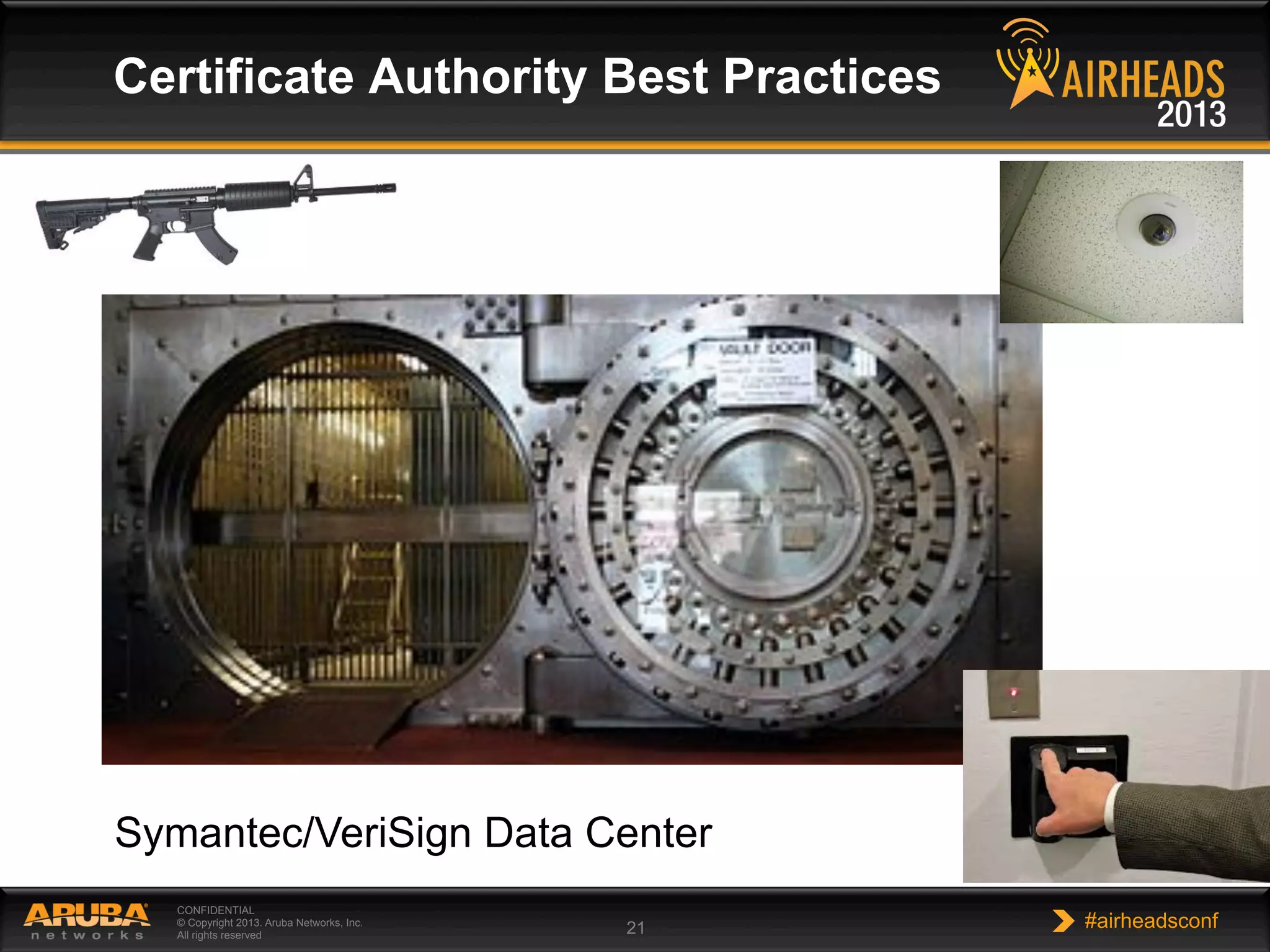
Certificate Authority Best Practices
Symantec/VeriSign Data Center
CONFIDENTIAL
© Copyright 2013. Aruba Networks, Inc.
All rights reserved 22 #airheadsconf
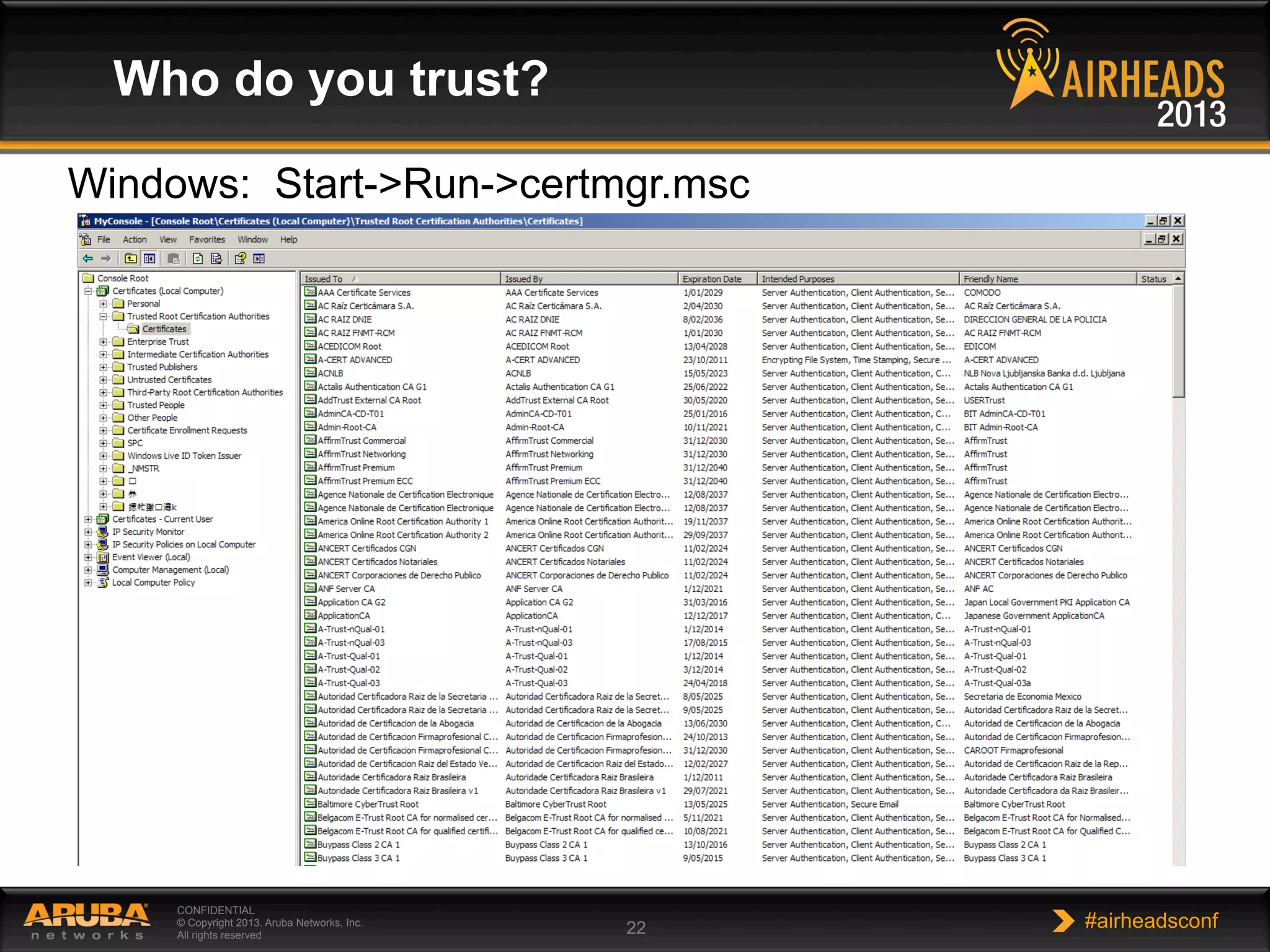
Who do you trust?
Windows: Start->Run->certmgr.msc
CONFIDENTIAL
© Copyright 2013. Aruba Networks, Inc.
All rights reserved 23 #airheadsconf
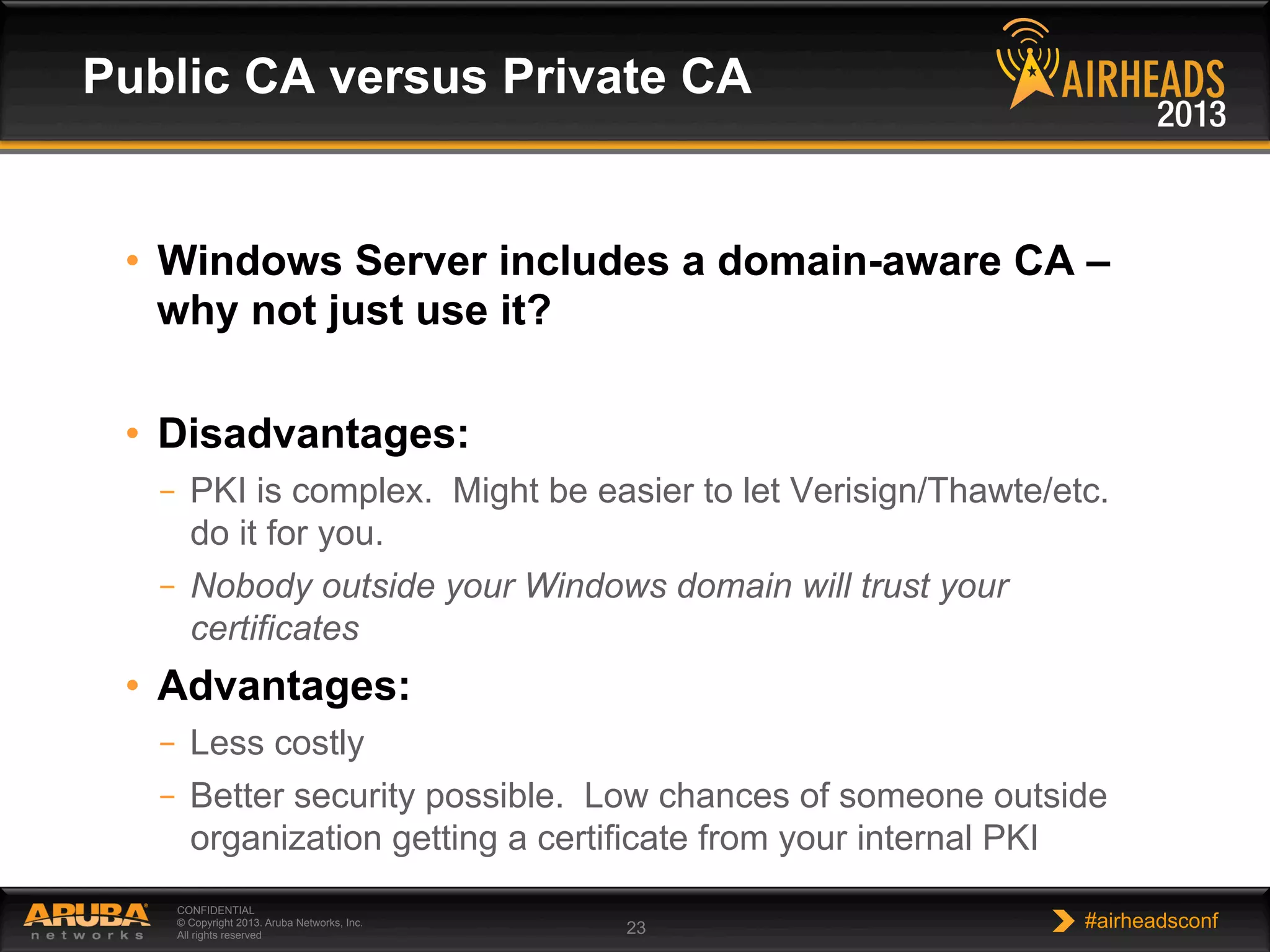
•  Windows Server includes a domain-aware CA –
why not just use it?
•  Disadvantages:
–  PKI is complex. Might be easier to let Verisign/Thawte/etc.
do it for you.
–  Nobody outside your Windows domain will trust your
certificates
•  Advantages:
–  Less costly
–  Better security possible. Low chances of someone outside
organization getting a certificate from your internal PKI
Public CA versus Private CA
CONFIDENTIAL
© Copyright 2013. Aruba Networks, Inc.
All rights reserved 24 #airheadsconf
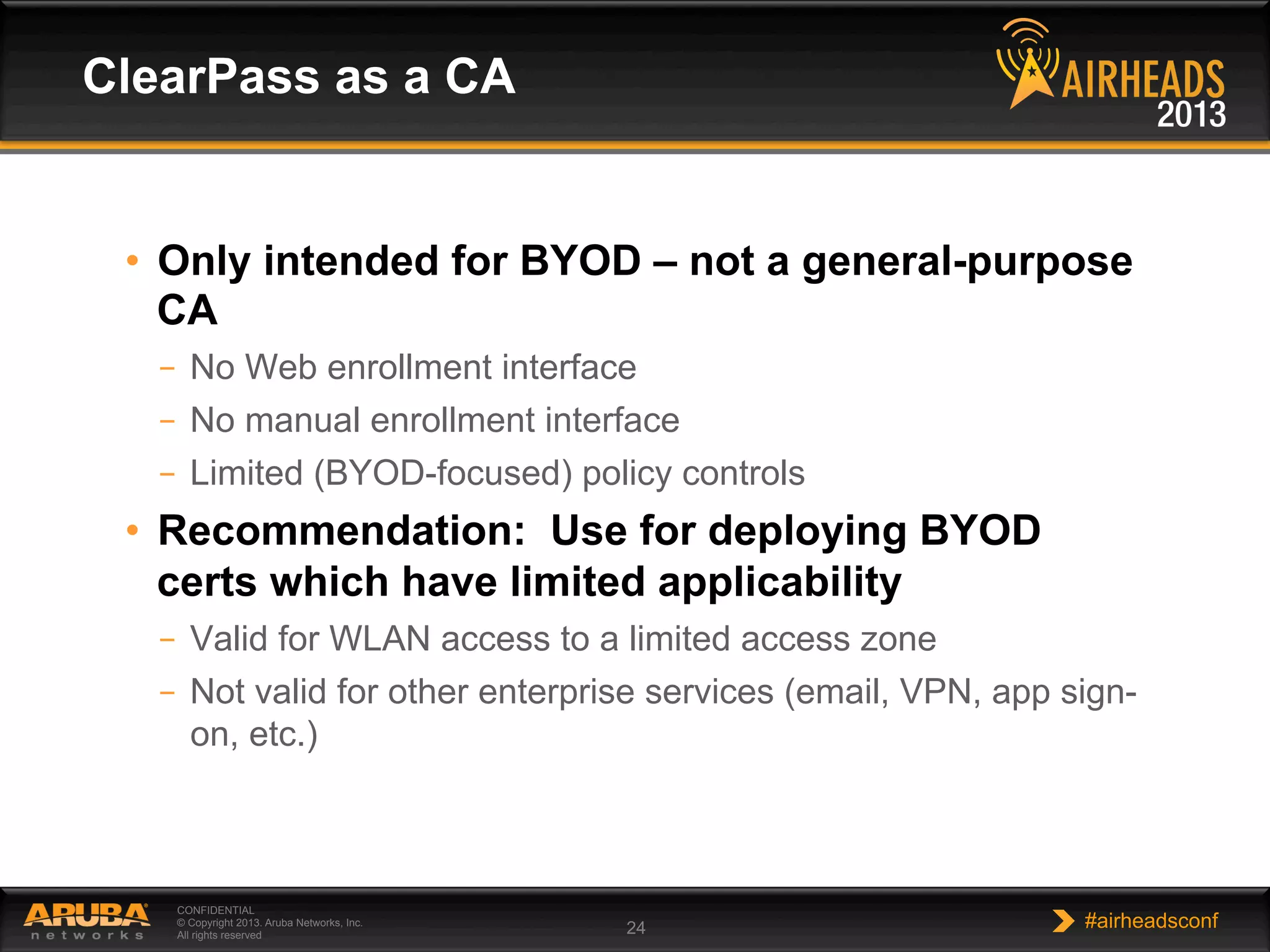
•  Only intended for BYOD – not a general-purpose
CA
–  No Web enrollment interface
–  No manual enrollment interface
–  Limited (BYOD-focused) policy controls
•  Recommendation: Use for deploying BYOD
certs which have limited applicability
–  Valid for WLAN access to a limited access zone
–  Not valid for other enterprise services (email, VPN, app sign-
on, etc.)
ClearPass as a CA
CONFIDENTIAL
© Copyright 2013. Aruba Networks, Inc.
All rights reserved 25 #airheadsconf
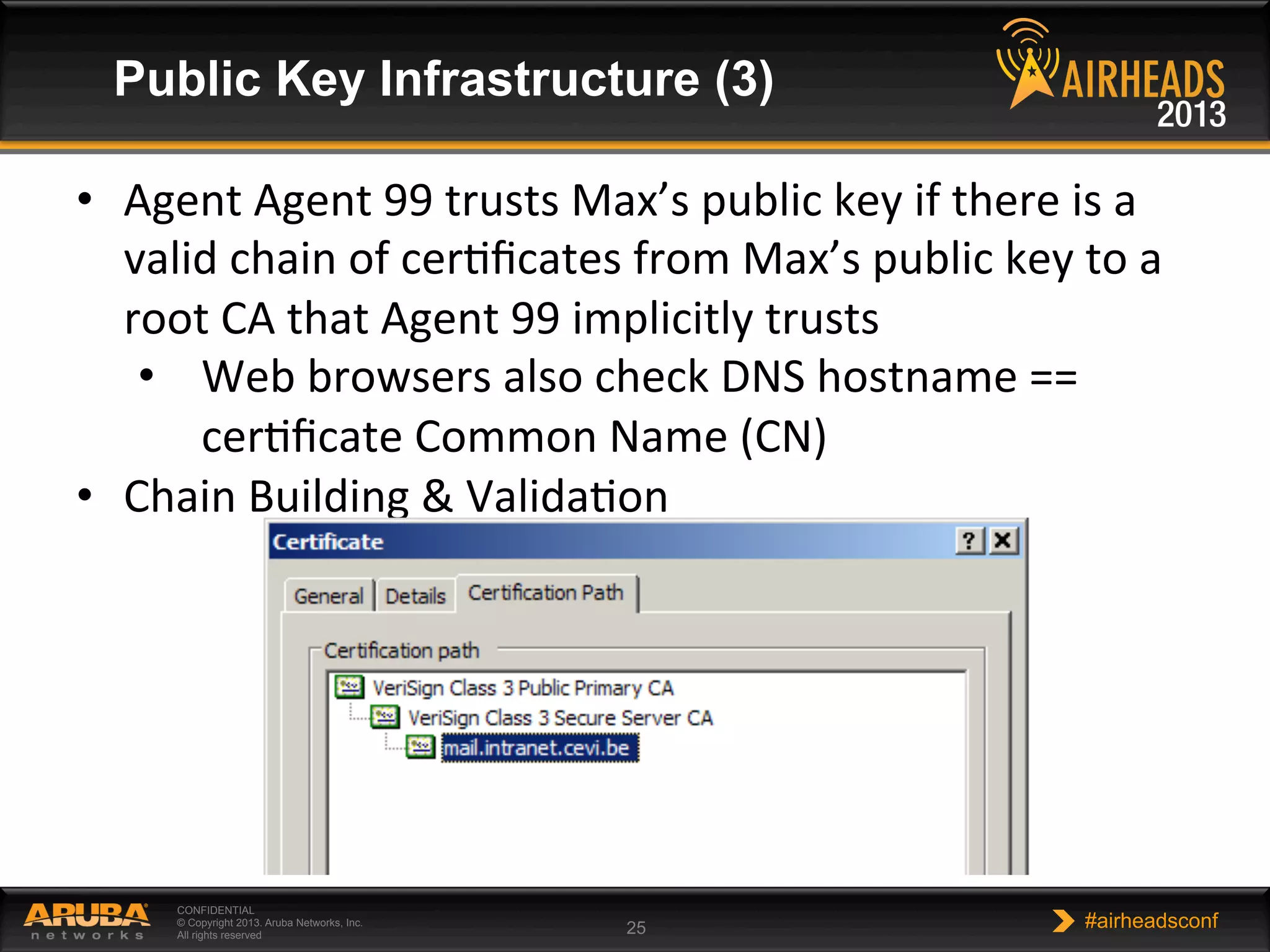
Public Key Infrastructure (3)
•  Agent	
  Agent	
  99	
  trusts	
  Max’s	
  public	
  key	
  if	
  there	
  is	
  a	
  
valid	
  chain	
  of	
  cerNficates	
  from	
  Max’s	
  public	
  key	
  to	
  a	
  
root	
  CA	
  that	
  Agent	
  99	
  implicitly	
  trusts	
  
•  Web	
  browsers	
  also	
  check	
  DNS	
  hostname	
  ==	
  
cerNficate	
  Common	
  Name	
  (CN)	
  
•  Chain	
  Building	
  &	
  ValidaNon	
  
CONFIDENTIAL
© Copyright 2013. Aruba Networks, Inc.
All rights reserved 26 #airheadsconf
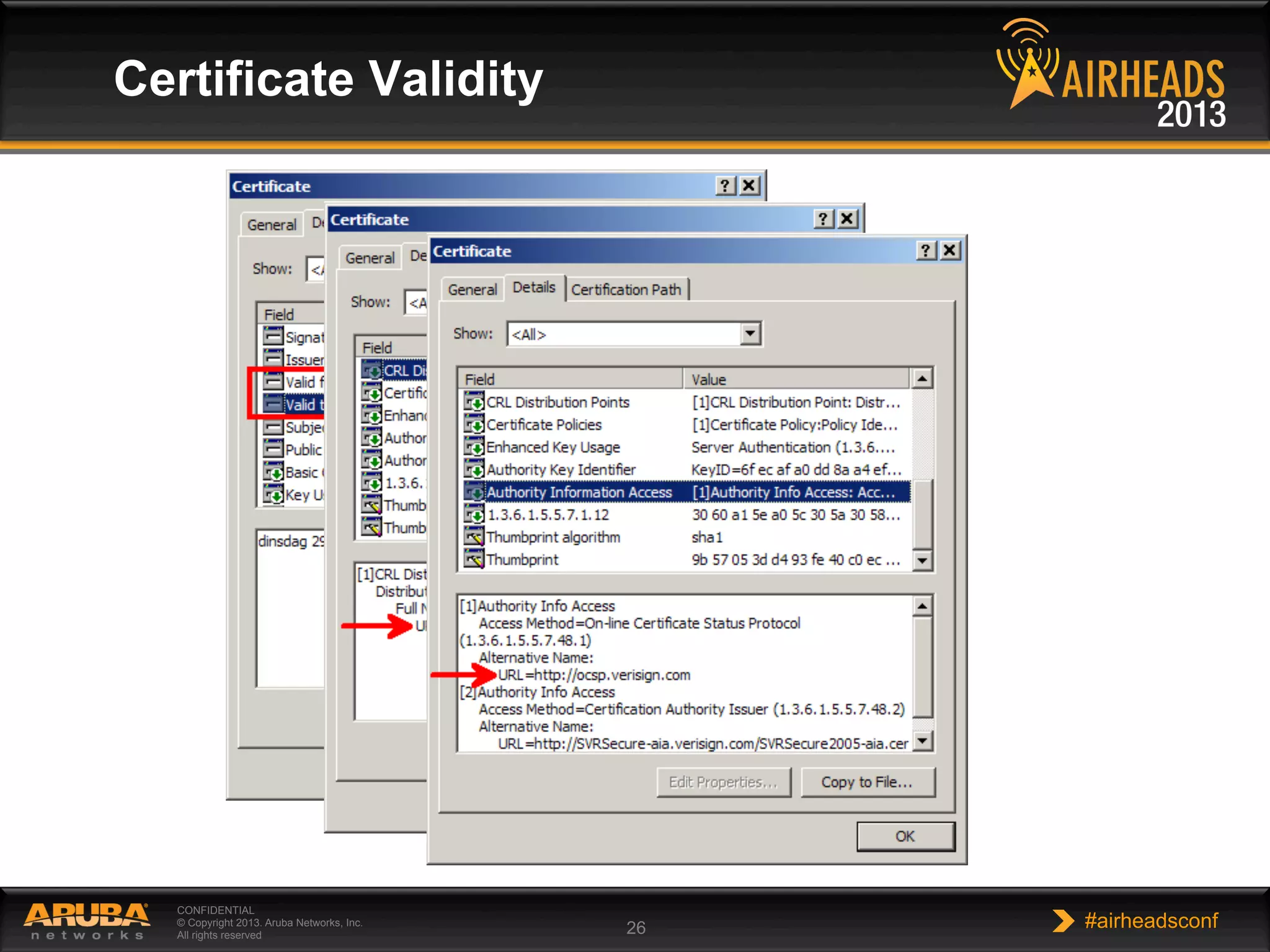
Certificate Validity
CONFIDENTIAL
© Copyright 2013. Aruba Networks, Inc.
All rights reserved 27 #airheadsconf
•  With the latest version of Apple TV iOS, WPA2
Enterprise can be used
•  However, the Apple TV does not have a clock
•  So when it is rebooted, it thinks it is January,
1970, aka the “epoch”
•  It will not authenticate successfully because it
will not trust the network’s cert is valid
•  NTP must complete first to fix the time
Good to Know: Apple TV
CONFIDENTIAL
© Copyright 2013. Aruba Networks, Inc.
All rights reserved 28 #airheadsconf
•  Can be used by the client (e.g. web browser) to
verify server’s certificate validity
–  OCSP URL is read from server certificate’s AIA field
•  Can be used by the server (e.g. mobility
controller) to verify client’s certificate validity
–  OCSP URL is most often configured on the server to point to
specific OCSP responders
•  OCSP transactions use HTTP for transport
protocol
•  Important: Nonce Extension required for replay
prevention
–  Some public CAs don’t like this…
OCSP
CONFIDENTIAL
© Copyright 2013. Aruba Networks, Inc.
All rights reserved 29 #airheadsconf
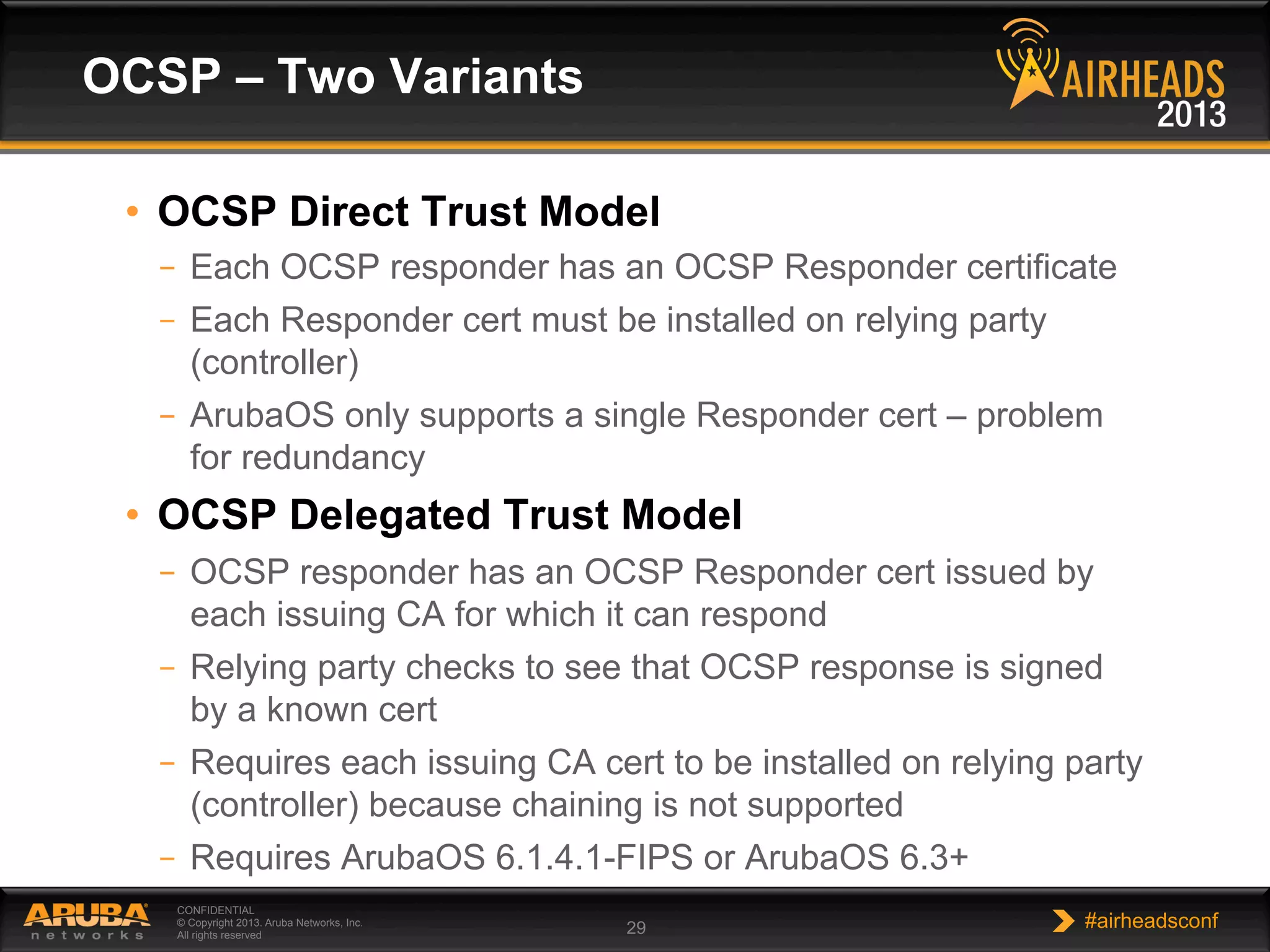
•  OCSP Direct Trust Model
–  Each OCSP responder has an OCSP Responder certificate
–  Each Responder cert must be installed on relying party
(controller)
–  ArubaOS only supports a single Responder cert – problem
for redundancy
•  OCSP Delegated Trust Model
–  OCSP responder has an OCSP Responder cert issued by
each issuing CA for which it can respond
–  Relying party checks to see that OCSP response is signed
by a known cert
–  Requires each issuing CA cert to be installed on relying party
(controller) because chaining is not supported
–  Requires ArubaOS 6.1.4.1-FIPS or ArubaOS 6.3+
OCSP – Two Variants
CONFIDENTIAL
© Copyright 2013. Aruba Networks, Inc.
All rights reserved 30 #airheadsconf
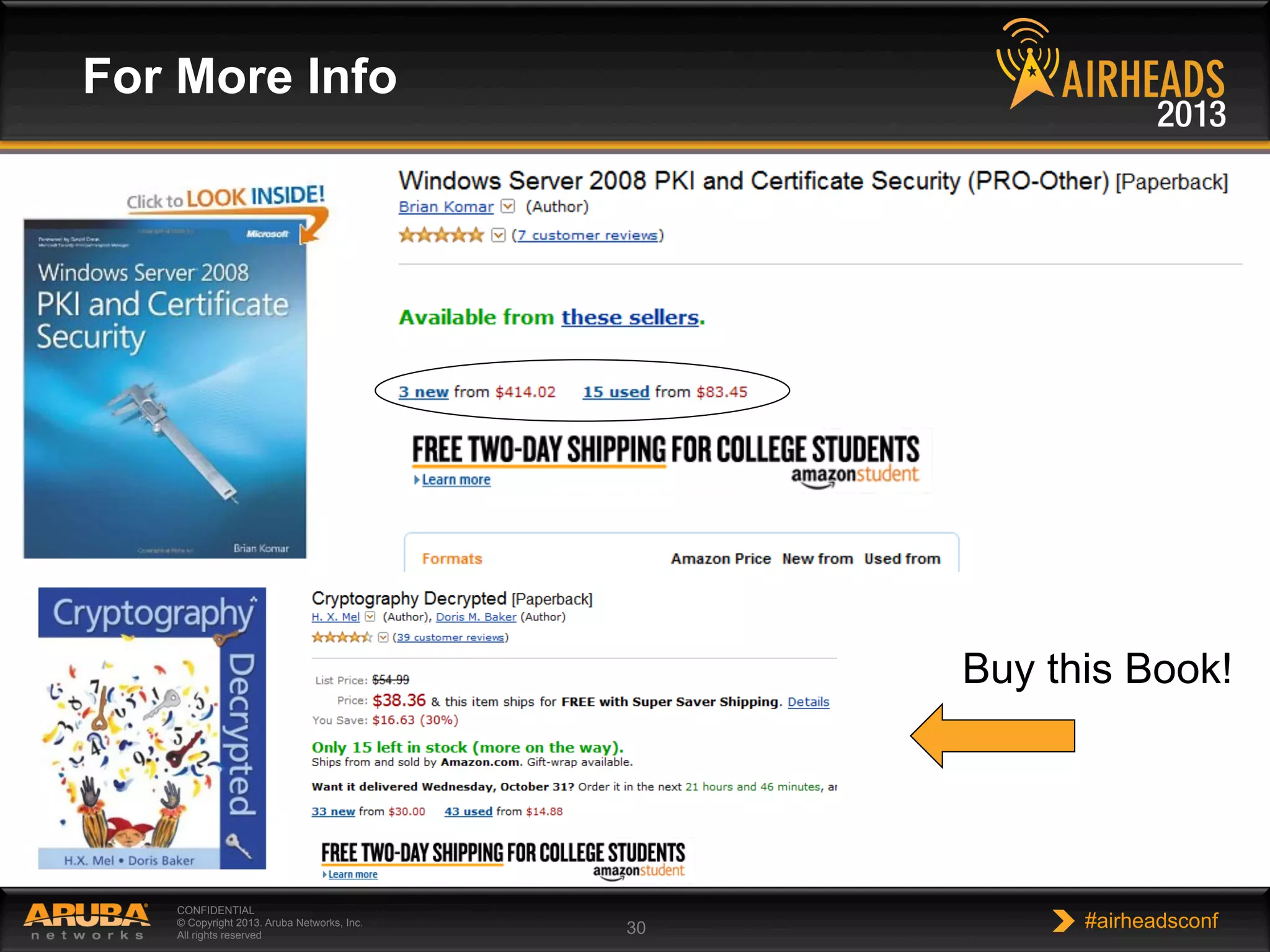
For More Info
Buy this Book!
CONFIDENTIAL
© Copyright 2013. Aruba Networks, Inc.
All rights reserved 31 #airheadsconf#airheadsconf31
Aruba Certificate Operations
CONFIDENTIAL
© Copyright 2013. Aruba Networks, Inc.
All rights reserved 32 #airheadsconf
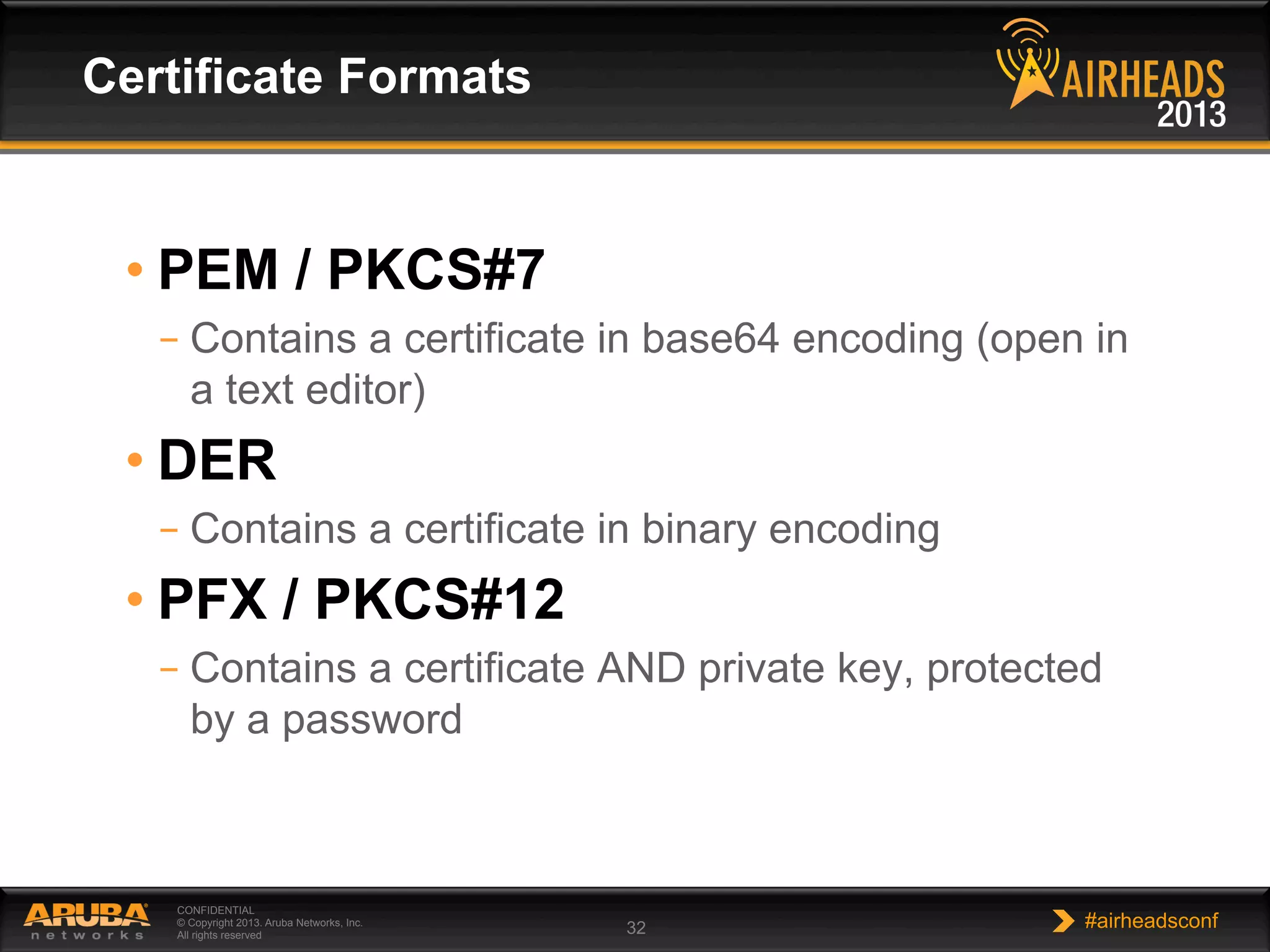
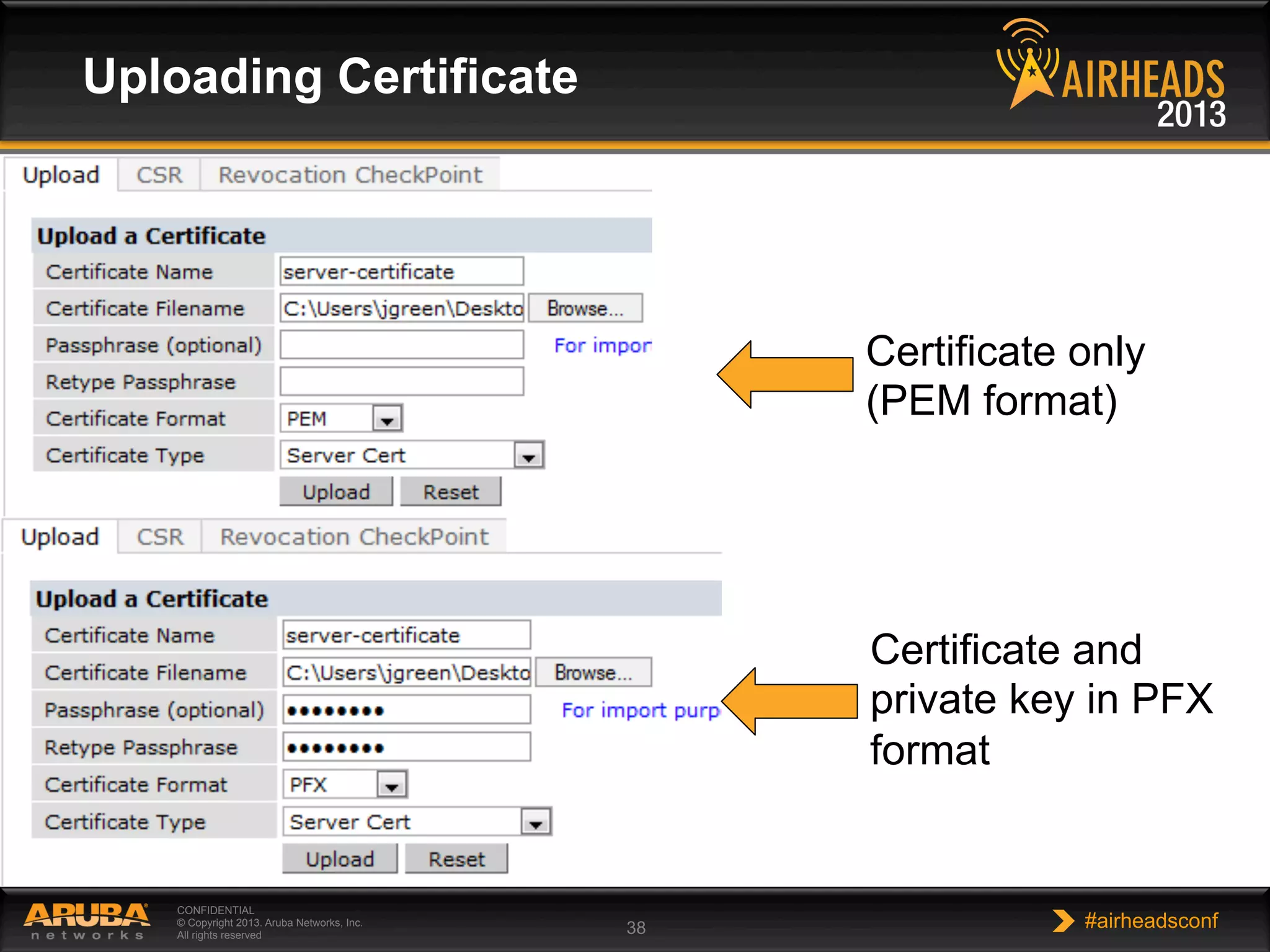
• PEM / PKCS#7
– Contains a certificate in base64 encoding (open in
a text editor)
• DER
– Contains a certificate in binary encoding
• PFX / PKCS#12
– Contains a certificate AND private key, protected
by a password
Certificate Formats
CONFIDENTIAL
© Copyright 2013. Aruba Networks, Inc.
All rights reserved 33 #airheadsconf
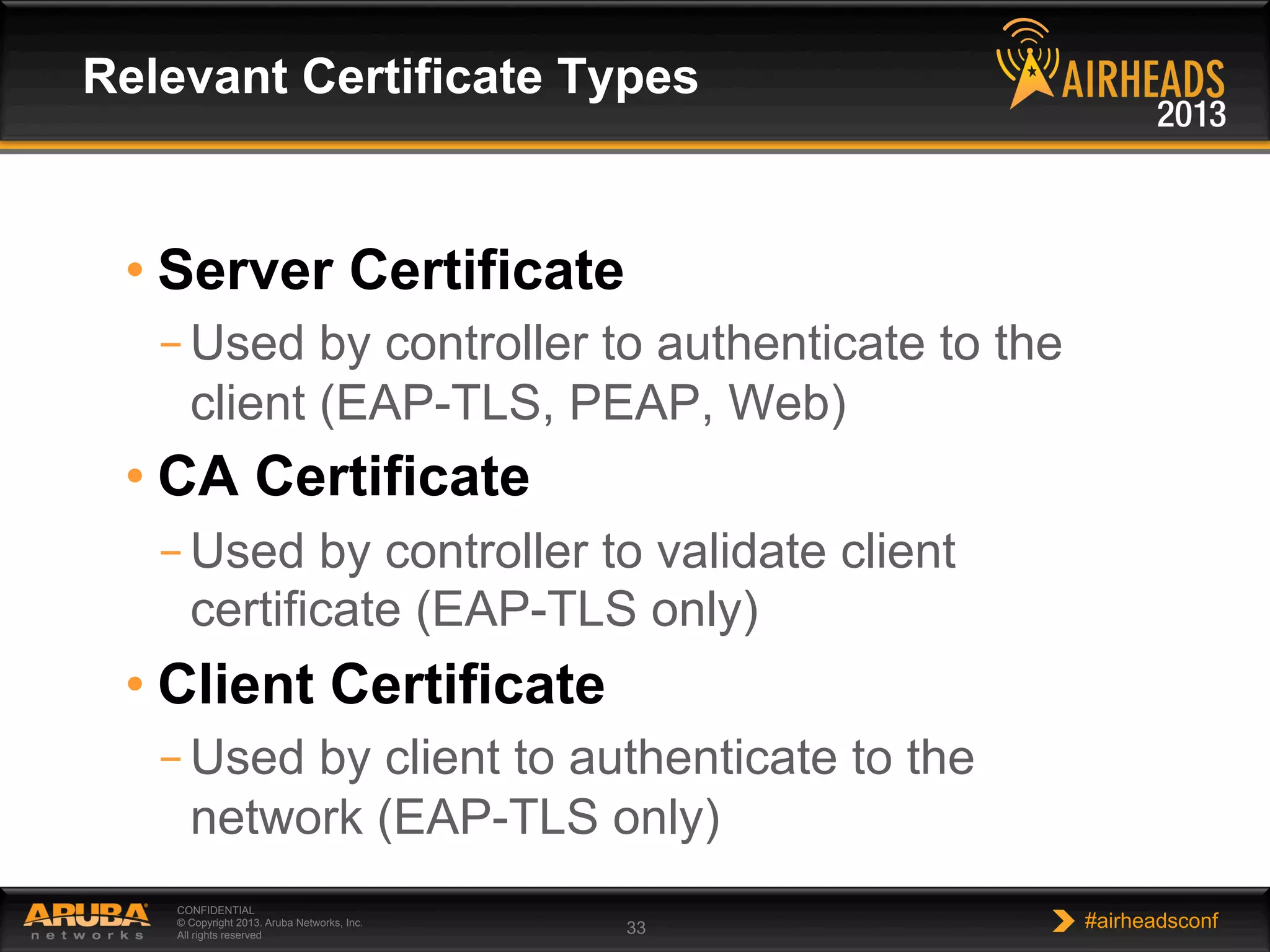
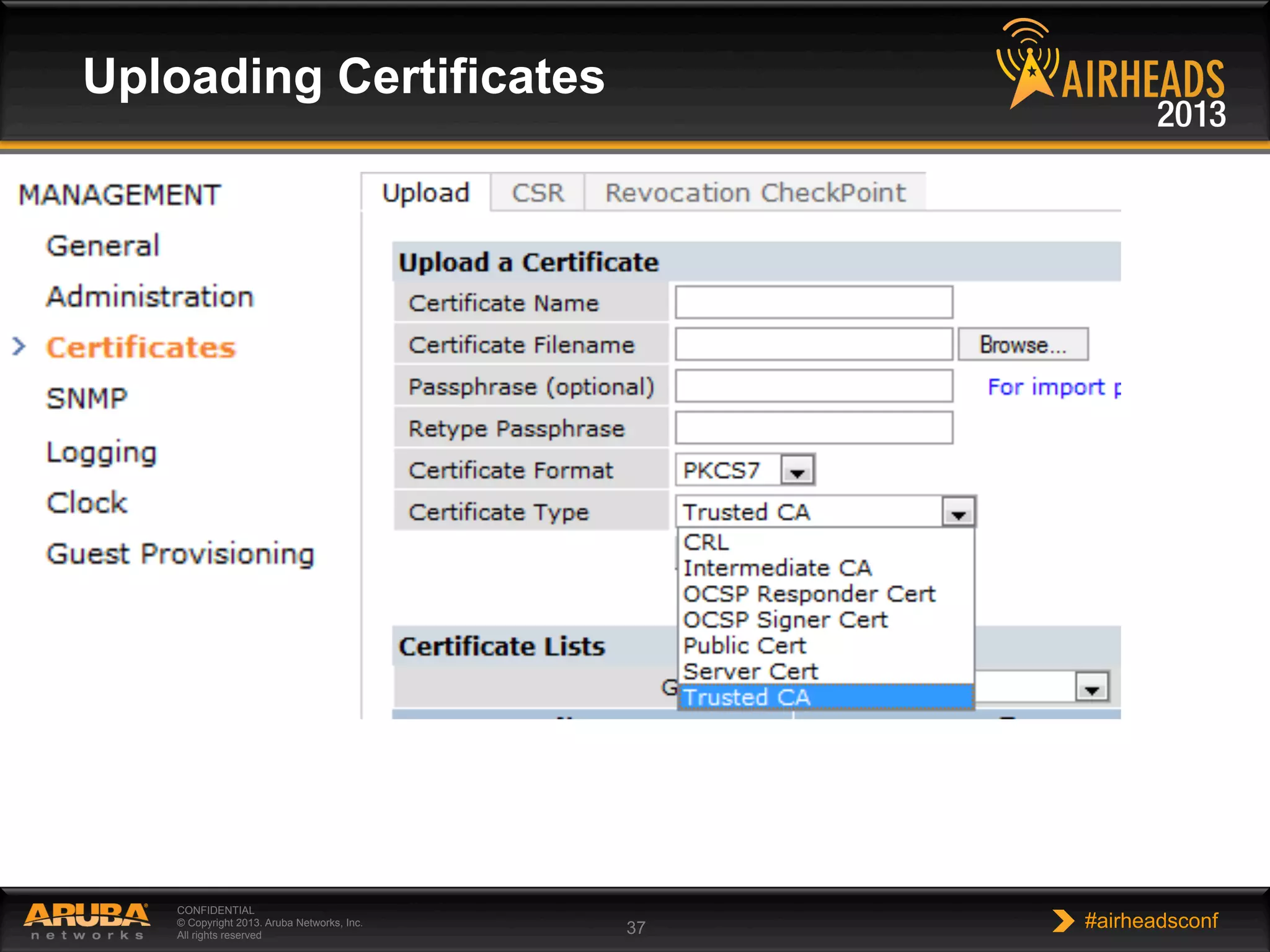
• Server Certificate
– Used by controller to authenticate to the
client (EAP-TLS, PEAP, Web)
• CA Certificate
– Used by controller to validate client
certificate (EAP-TLS only)
• Client Certificate
– Used by client to authenticate to the
network (EAP-TLS only)
Relevant Certificate Types
CONFIDENTIAL
© Copyright 2013. Aruba Networks, Inc.
All rights reserved 34 #airheadsconf
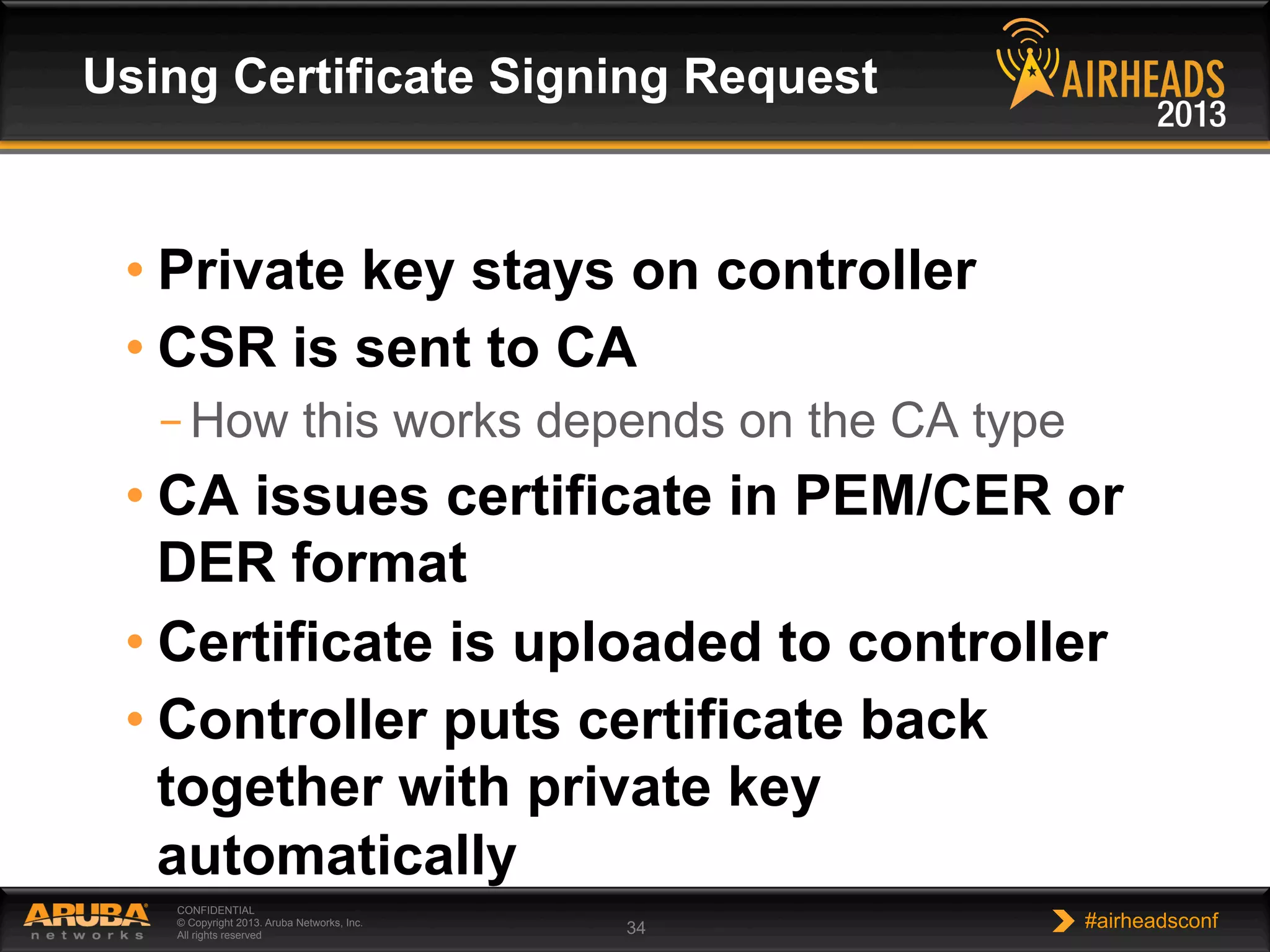
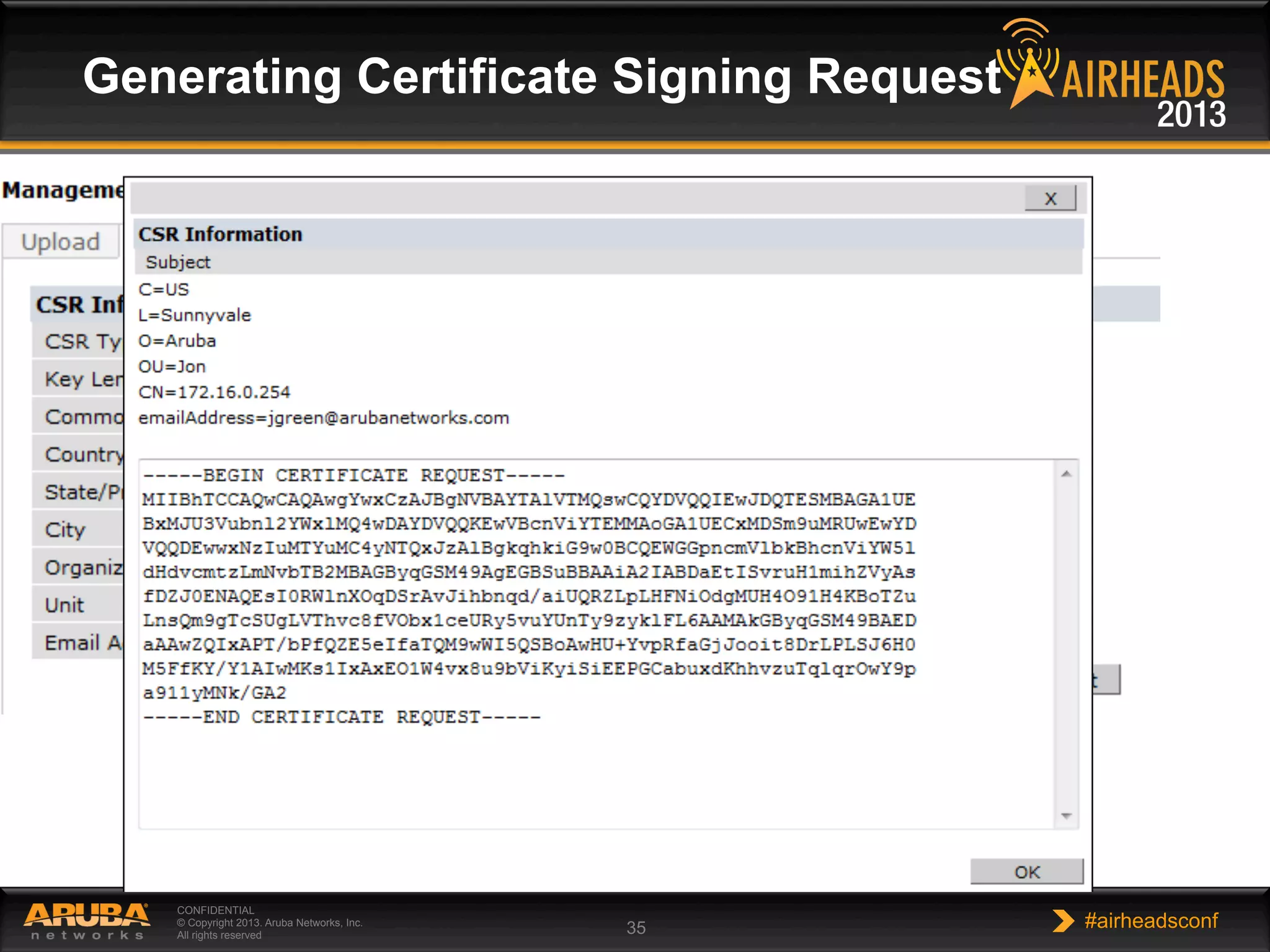
• Private key stays on controller
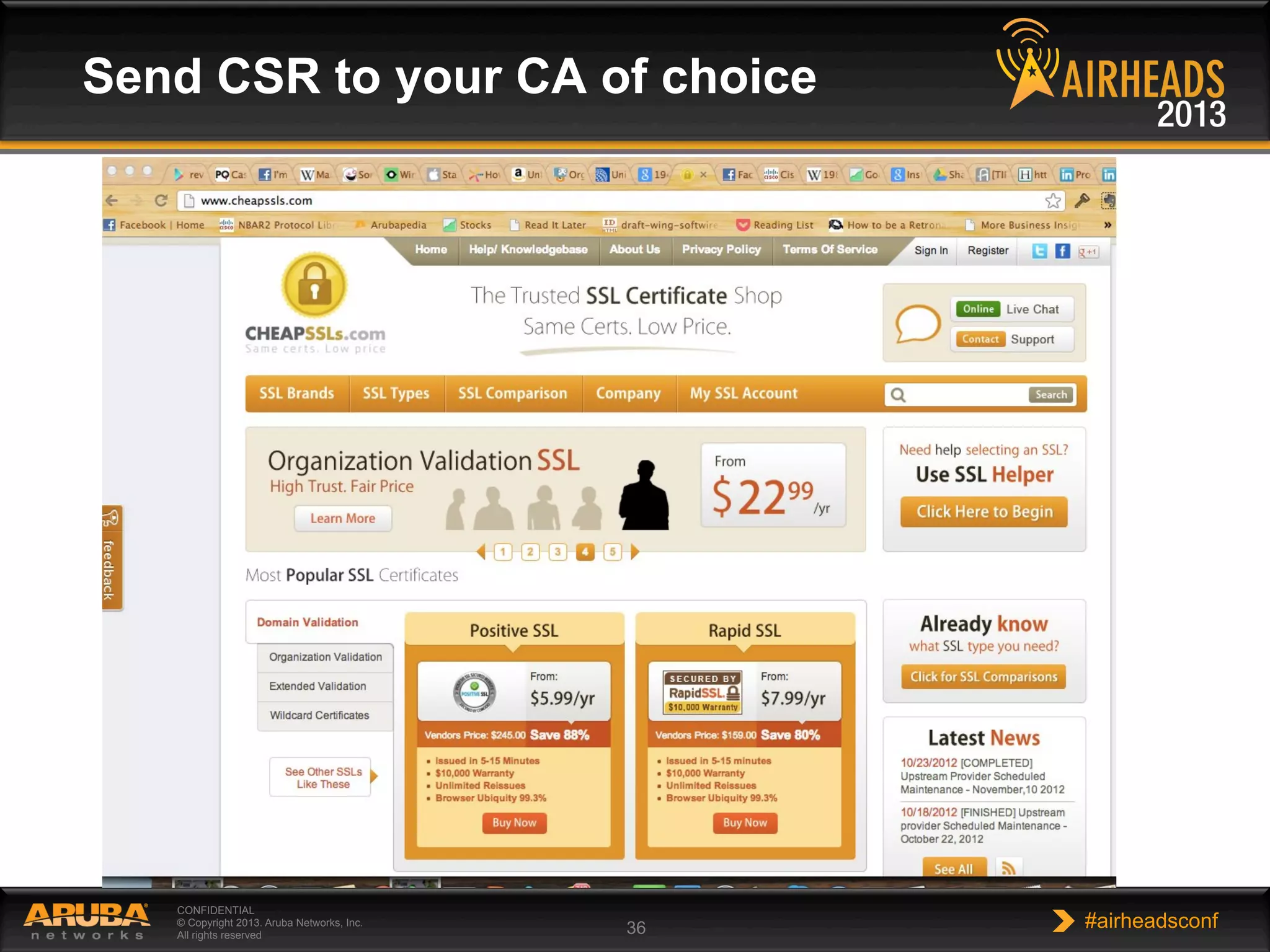
• CSR is sent to CA
– How this works depends on the CA type
• CA issues certificate in PEM/CER or
DER format
• Certificate is uploaded to controller
• Controller puts certificate back
together with private key
automatically
Using Certificate Signing Request
CONFIDENTIAL
© Copyright 2013. Aruba Networks, Inc.
All rights reserved 35 #airheadsconf
Generating Certificate Signing Request
CONFIDENTIAL
© Copyright 2013. Aruba Networks, Inc.
All rights reserved 36 #airheadsconf
Send CSR to your CA of choice
CONFIDENTIAL
© Copyright 2013. Aruba Networks, Inc.
All rights reserved 37 #airheadsconf
Uploading Certificates
CONFIDENTIAL
© Copyright 2013. Aruba Networks, Inc.
All rights reserved 38 #airheadsconf
Uploading Certificate
Certificate only
(PEM format)
Certificate and
private key in PFX
format
CONFIDENTIAL
© Copyright 2013. Aruba Networks, Inc.
All rights reserved 39 #airheadsconf#airheadsconf39
Putting it all together: 802.1X
CONFIDENTIAL
© Copyright 2013. Aruba Networks, Inc.
All rights reserved 40 #airheadsconf
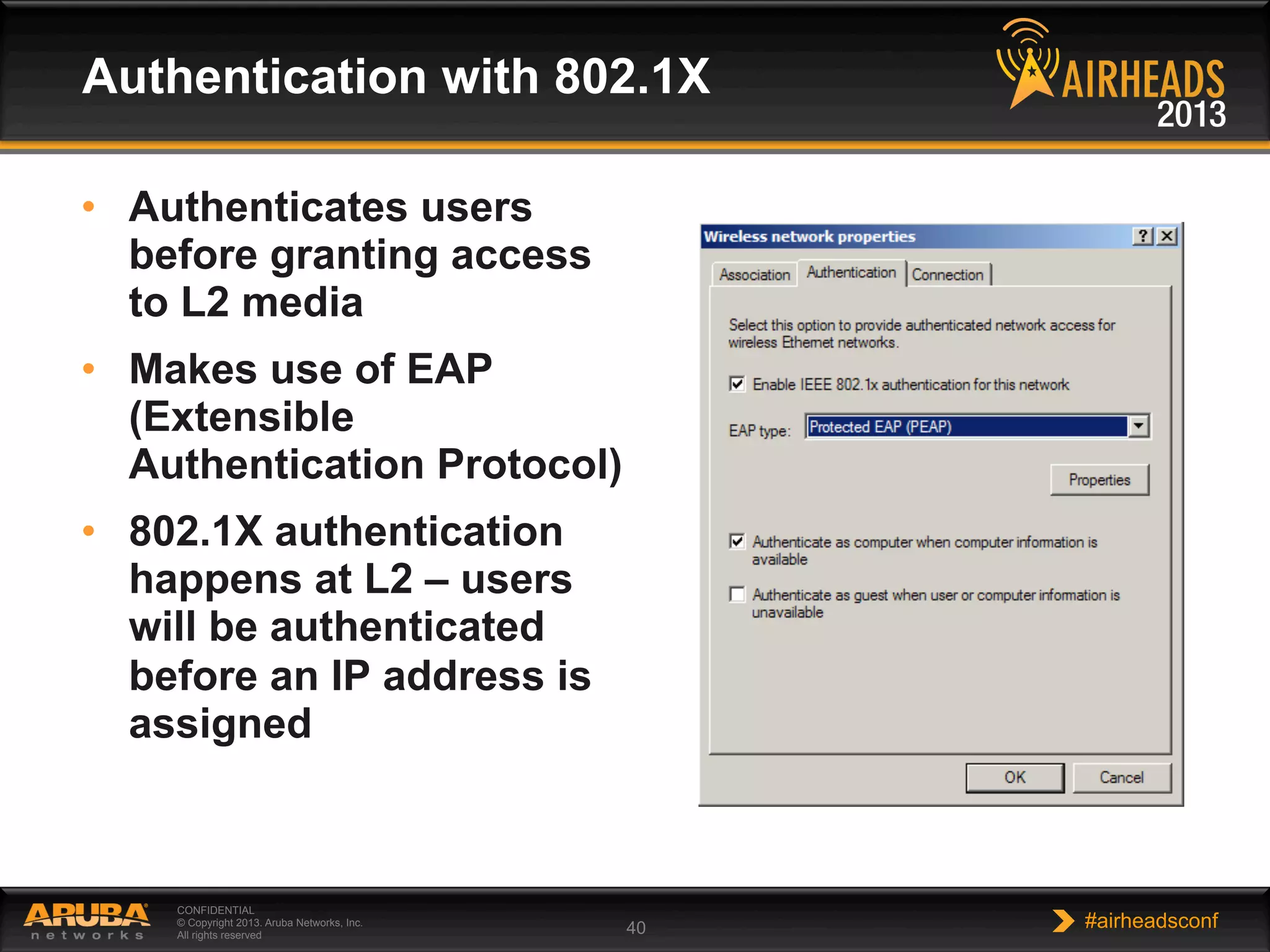
Authentication with 802.1X
•  Authenticates users
before granting access
to L2 media
•  Makes use of EAP
(Extensible
Authentication Protocol)
•  802.1X authentication
happens at L2 – users
will be authenticated
before an IP address is
assigned
CONFIDENTIAL
© Copyright 2013. Aruba Networks, Inc.
All rights reserved 41 #airheadsconf
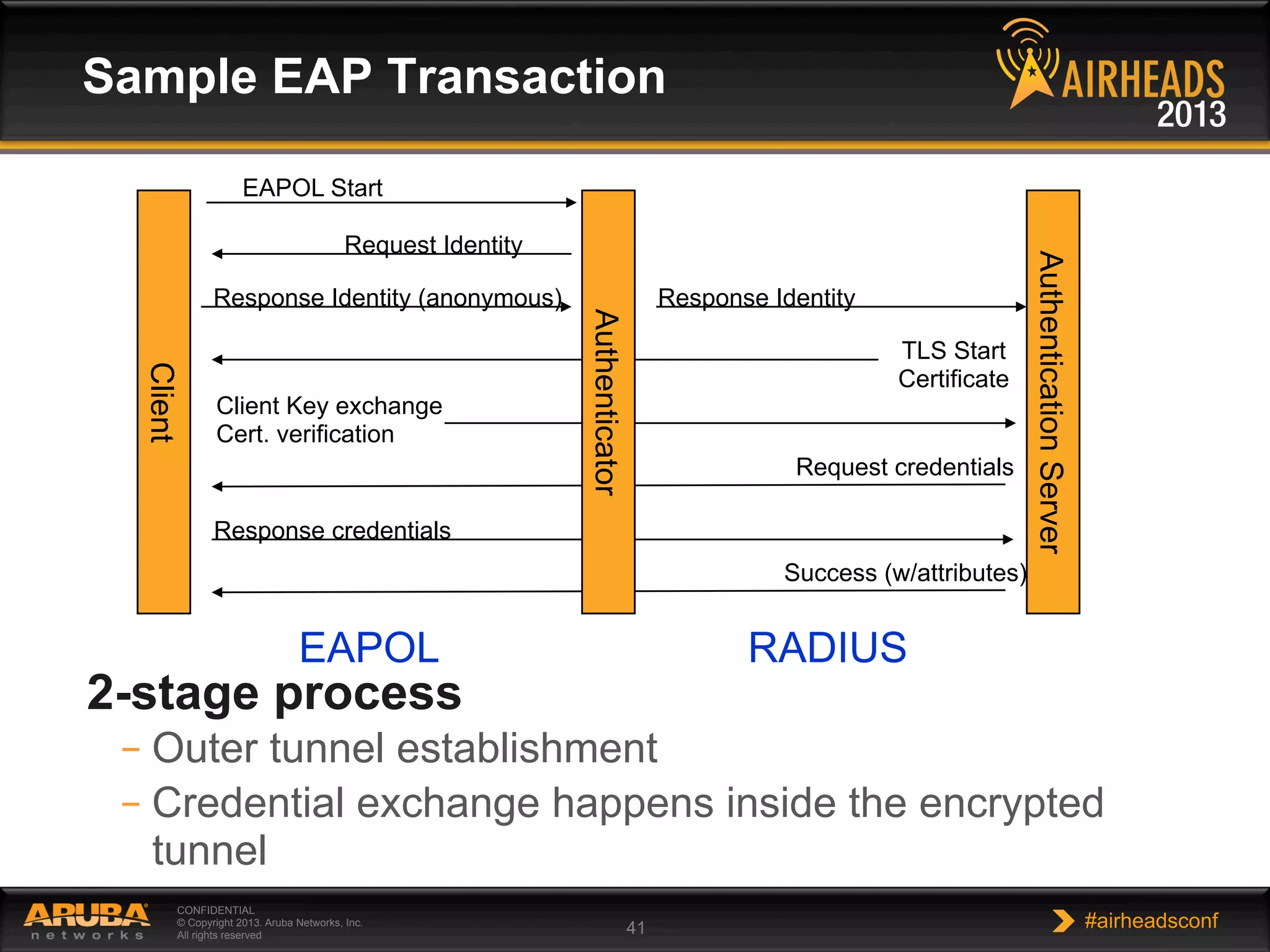
Sample EAP Transaction
2-stage process
– Outer tunnel establishment
– Credential exchange happens inside the encrypted
tunnel
Client
AuthenticationServer
Request Identity
Response Identity (anonymous) Response Identity
TLS Start
Certificate
Client Key exchange
Cert. verification
Request credentials
Response credentials
Success (w/attributes)
EAPOL RADIUS
Authenticator
EAPOL Start
CONFIDENTIAL
© Copyright 2013. Aruba Networks, Inc.
All rights reserved 42 #airheadsconf
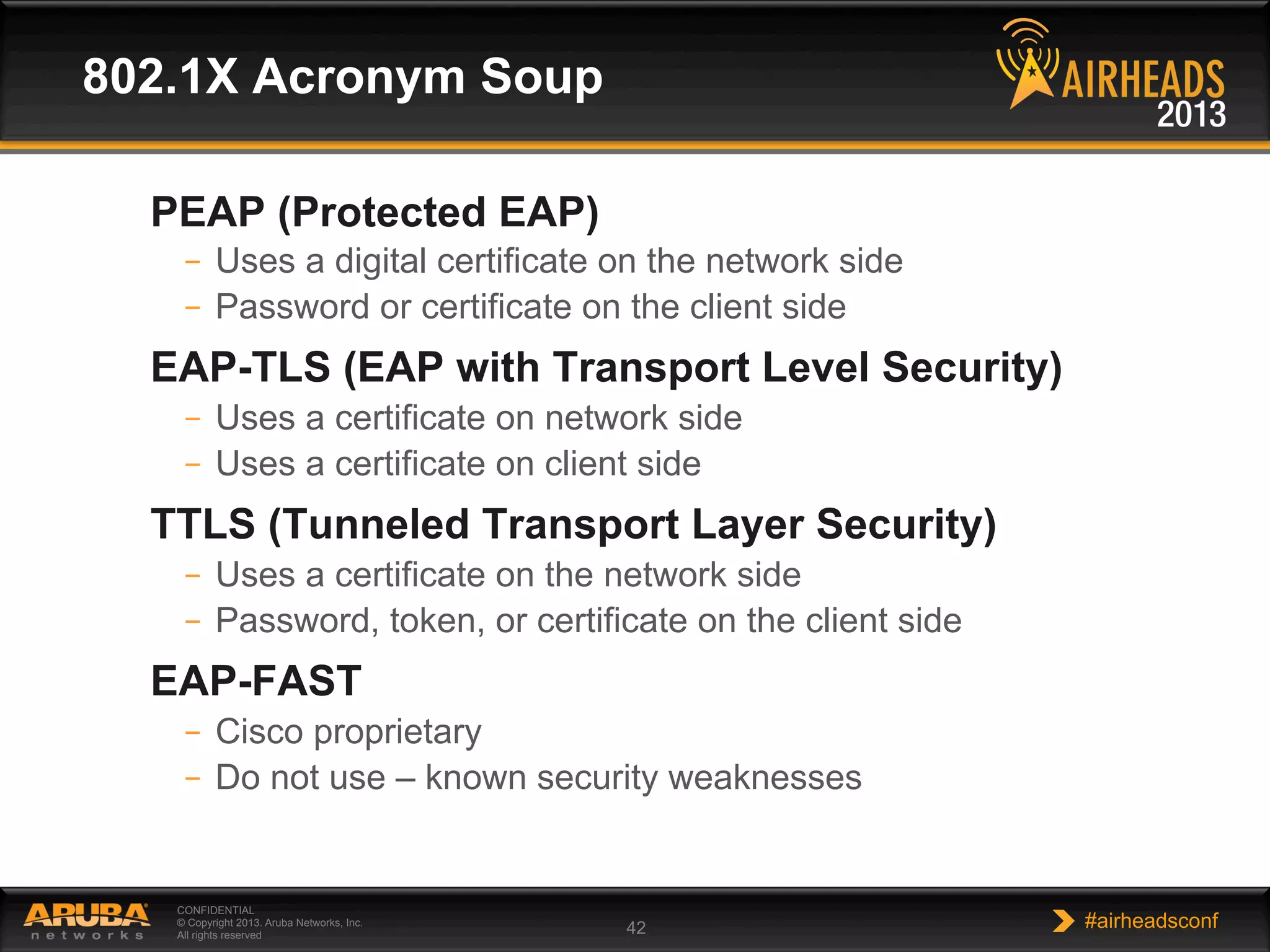
802.1X Acronym Soup
PEAP (Protected EAP)
–  Uses a digital certificate on the network side
–  Password or certificate on the client side
EAP-TLS (EAP with Transport Level Security)
–  Uses a certificate on network side
–  Uses a certificate on client side
TTLS (Tunneled Transport Layer Security)
–  Uses a certificate on the network side
–  Password, token, or certificate on the client side
EAP-FAST
–  Cisco proprietary
–  Do not use – known security weaknesses
CONFIDENTIAL
© Copyright 2013. Aruba Networks, Inc.
All rights reserved 43 #airheadsconf
CONFIDENTIAL
© Copyright 2013. Aruba Networks, Inc.
All rights reserved 44 #airheadsconf
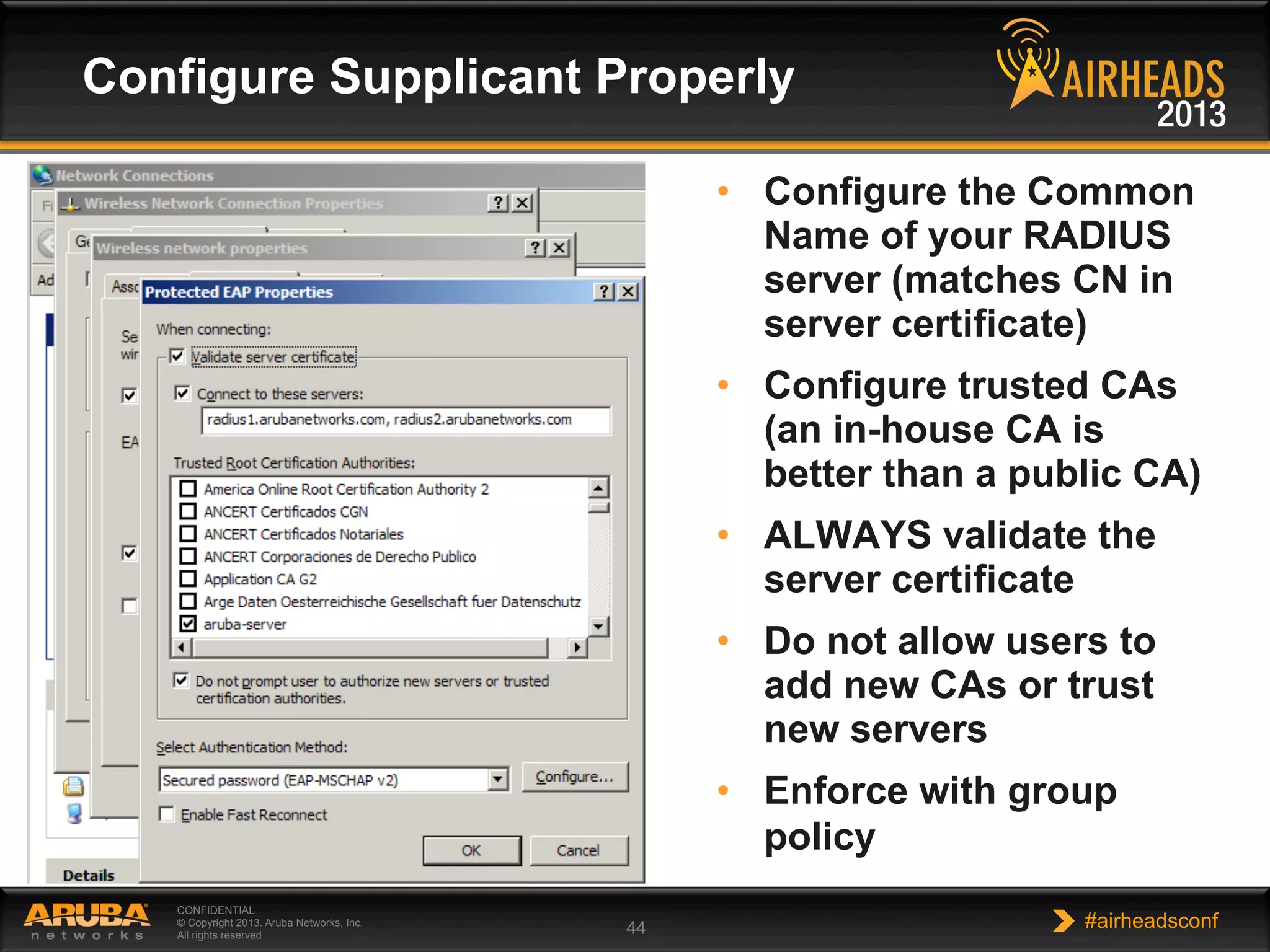
Configure Supplicant Properly
•  Configure the Common
Name of your RADIUS
server (matches CN in
server certificate)
•  Configure trusted CAs
(an in-house CA is
better than a public CA)
•  ALWAYS validate the
server certificate
•  Do not allow users to
add new CAs or trust
new servers
•  Enforce with group
policy
CONFIDENTIAL
© Copyright 2013. Aruba Networks, Inc.
All rights reserved 45 #airheadsconf
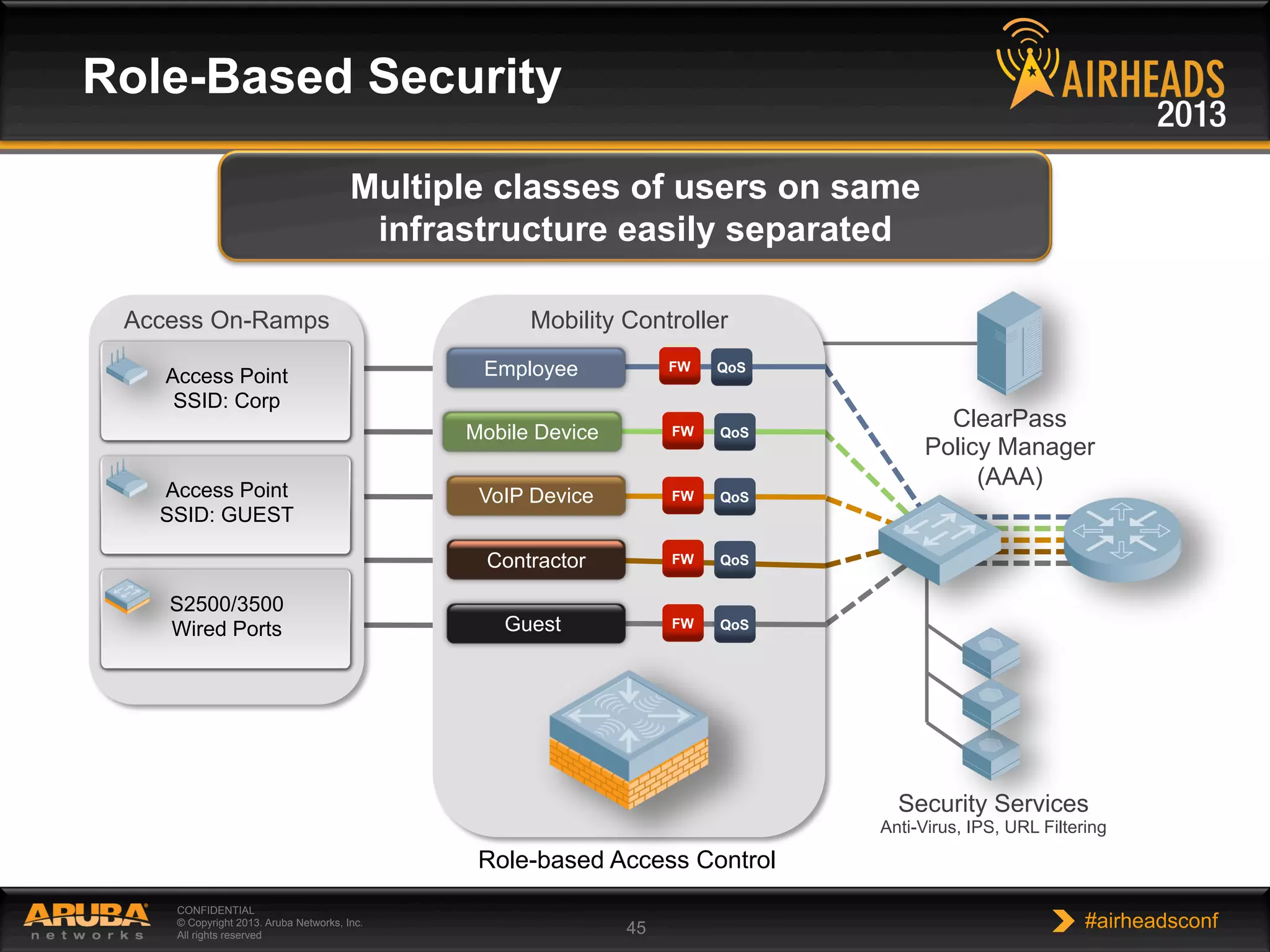
Multiple classes of users on same
infrastructure easily separated
ClearPass
Policy Manager
(AAA)
Security Services
Anti-Virus, IPS, URL Filtering
Access On-Ramps
Access Point
SSID: Corp
Access Point
SSID: GUEST
S2500/3500
Wired Ports
Mobility Controller
QoSFW
QoSFW
QoSFW
QoSFW
QoSFWGuest
Mobile Device
VoIP Device
Contractor
Employee
Role-based Access Control
Role-Based Security
CONFIDENTIAL
© Copyright 2013. Aruba Networks, Inc.
All rights reserved 46 #airheadsconf
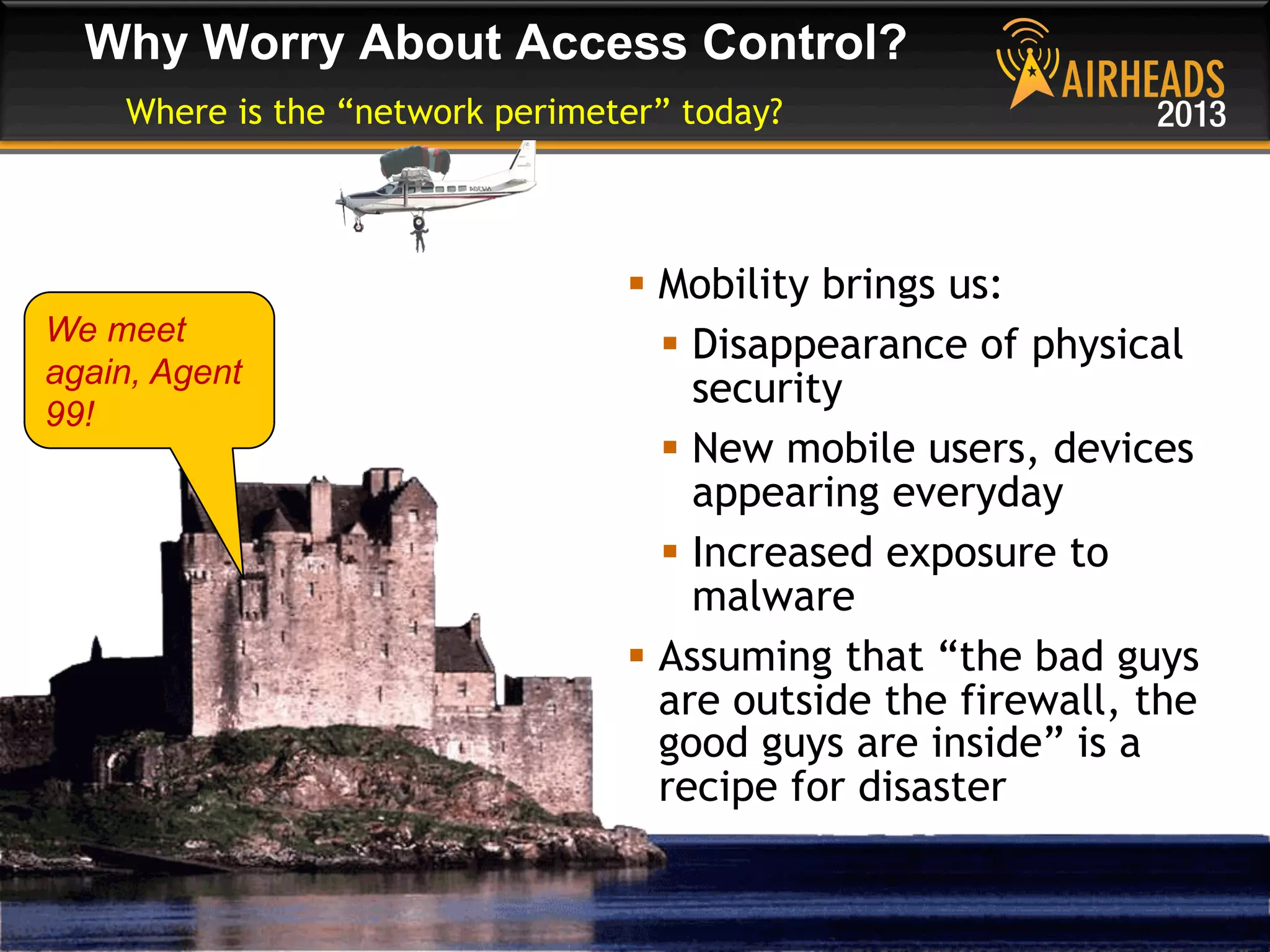
Why Worry About Access Control?
Where is the “network perimeter” today?
§  Mobility brings us:
§  Disappearance of physical
security
§  New mobile users, devices
appearing everyday
§  Increased exposure to
malware
§  Assuming that “the bad guys
are outside the firewall, the
good guys are inside” is a
recipe for disaster
We meet
again, Agent
99!
CONFIDENTIAL
© Copyright 2013. Aruba Networks, Inc.
All rights reserved 47 #airheadsconf
•  Sequenced authentication
–  Machine credential followed by user credential
–  Sequencing must be tracked by auth server (CPPM)
–  Supported in Windows domain environment…. but nowhere else
–  Timing / user behavior dependencies
•  Hardware tokens
–  Viable option, but users don’t like them…
–  Use EAP-GTC, EAP-POTP
–  RSA supplicant available
•  Stacked authentication
–  Machine and user credential in same EAP transaction
–  Theoretically possible, but not supported by any known
supplicant (Aruba is developing one for Windows…)
Multi-Factor 802.1X Authentication?
CONFIDENTIAL
© Copyright 2013. Aruba Networks, Inc.
All rights reserved 48 #airheadsconf
•  Short answer: Yes – because of things like
rainbow tables, distributed cracking, fast GPUs,
etc.
•  This is why we use MSCHAPv2 inside a TLS
tunnel for Wi-Fi
•  Still using PPTP for VPN? Watch out…
Isn’t MSCHAPv2 broken?
CONFIDENTIAL
© Copyright 2013. Aruba Networks, Inc.
All rights reserved 49 #airheadsconf
•  The problem: Today’s password-based auth
exposes password hashes to a possibly
unknown entity
•  Goal of PWD: Mutual authentication using a
password
•  Both sides prove they possess the password
without actually exposing the password or a
password derivative
•  Developed by Dan Harkins of Aruba Networks –
standardized in RFC5931
Future directions: EAP-PWD
CONFIDENTIAL
© Copyright 2013. Aruba Networks, Inc.
All rights reserved 50 #airheadsconf
•  Some slides stolen from:
http://cevi-users.cevi.be/Portals/ceviusers/
images/default/Userdag-20101125-Certs.pptx
•  Some others stolen from:
http://acs.lbl.gov/~mrt/talks/secPrimer.ppt
•  Get Smart images used without permission
Credits
CONFIDENTIAL
© Copyright 2013. Aruba Networks, Inc.
All rights reserved 51 #airheadsconf#airheadsconf51

Encryption authentication access_control_jon green

  • 1.
    CONFIDENTIAL © Copyright 2013.Aruba Networks, Inc. All rights reserved 1 #airheadsconf#airheadsconf Encryption, Authentication, and Access Control Jon Green Rich Langston June 2013
  • 2.
    CONFIDENTIAL © Copyright 2013.Aruba Networks, Inc. All rights reserved 2 #airheadsconf •  Give a basic background in cryptography and public key infrastructure –  What is symmetric key crypto? –  What is asymmetric key crypto? –  What are certificates and PKI? •  Show how to use public certs with our controller •  Show how these two come together to create 802.1X Today’s Goals
  • 3.
    CONFIDENTIAL © Copyright 2013.Aruba Networks, Inc. All rights reserved 3 #airheadsconf#airheadsconf3 Cryptography Primer
  • 4.
    CONFIDENTIAL © Copyright 2013.Aruba Networks, Inc. All rights reserved 4 #airheadsconf •  Plain text is normal, unencrypted text •  A Cipher is an encryption technique •  Cipher Text is the unreadable output on the Cypher Terminology
  • 5.
    CONFIDENTIAL © Copyright 2013.Aruba Networks, Inc. All rights reserved 5 #airheadsconf •  Bob and Alice are traditionally used in examples of cryptography Meet Bob and Alice
  • 6.
    CONFIDENTIAL © Copyright 2013.Aruba Networks, Inc. All rights reserved 6 #airheadsconf Meet The New Bob, Alice, and Eve Max, aka “Bob” Agent 99, aka “Alice” Konrad of Kaos, aka “Eve”
  • 7.
    CONFIDENTIAL © Copyright 2013.Aruba Networks, Inc. All rights reserved 7 #airheadsconf Symmetric Key Cryptography Watch out! Kaos is on the way! Watch out! Kaos is on the way!
  • 8.
    CONFIDENTIAL © Copyright 2013.Aruba Networks, Inc. All rights reserved 8 #airheadsconf Symmetric Key Cryptography (2) •  Strength:   –  Simple  and  very  fast  (order  of  1000  to  10000  faster  than   asymmetric  mechanisms)   •  Weakness:   –  Must  agree  the  key  beforehand   –  How  to  securely  pass  the  key  to  the  other  party?   •  Examples:    AES,  3DES,  DES,  RC4   •  AES  is  the  current  “gold  standard”  for  security     Agent 99 Max
  • 9.
    CONFIDENTIAL © Copyright 2013.Aruba Networks, Inc. All rights reserved 9 #airheadsconf Public Key Cryptography (Asymmetric) Max! You idiot! Kaos has our key! Max! You idiot! Kaos has our key!
  • 10.
    CONFIDENTIAL © Copyright 2013.Aruba Networks, Inc. All rights reserved 10 #airheadsconf Public Key Cryptography (2) •  Strength   –  Solves  problem  of  passing  the  key  –  Anyone  can  use  the  public  key   to  encrypt  a  message,  but  only  recipient  can  decrypt   –  Allows  establishment  of  trust  context  between  parNes   •  Weakness:   –  Slow  (MUCH  slower  than  symmetric)   –  Problem  of  trusNng  public  key  (what  if  I’ve  never  met  you?)   •  Examples:  RSA,  DSA,  ECDSA   Agent 99 Max
  • 11.
    CONFIDENTIAL © Copyright 2013.Aruba Networks, Inc. All rights reserved 11 #airheadsconf Hybrid Cryptography •  Randomly  generate  “session”  key   •  Encrypt  data  with  “session”  key     (symmetric  key  cryptography)   •  Encrypt  “session”  key  with  recipient’s  public  key   (public  key  cryptography)     Agent 99 Max
  • 12.
    CONFIDENTIAL © Copyright 2013.Aruba Networks, Inc. All rights reserved 12 #airheadsconf Hash Function My shoe phone battery died •  Properties –  it is easy to compute the hash value for any given message –  it is infeasible to find a message that has a given hash –  it is infeasible to find two different messages with the same hash –  it is infeasible to modify a message without changing its hash •  Ensures message integrity •  Also called message digests or fingerprints •  Examples: MD5, SHA1, SHA2 (256/384/512)
  • 13.
    CONFIDENTIAL © Copyright 2013.Aruba Networks, Inc. All rights reserved 13 #airheadsconf Digital Signature •  Combines a hash with an asymmetric crypto algorithm •  The sender’s private key is used in the digital signature operation •  Digital signature calculation: Agent 99 Max
  • 14.
    CONFIDENTIAL © Copyright 2013.Aruba Networks, Inc. All rights reserved 14 #airheadsconf •  Encryption provides –  confidentiality, can provide authentication and integrity protection •  Checksums/hash algorithms provide –  integrity protection, can provide authentication •  Digital signatures provide –  authentication, integrity protection, and non-repudiation •  For more info: Summary: Security Building Blocks Buy this Book!
  • 15.
    CONFIDENTIAL © Copyright 2013.Aruba Networks, Inc. All rights reserved 15 #airheadsconf#airheadsconf15 You  have  to  decide  who  you  trust  before  you  decide  what  to  believe   Cer$ficates,  Trust  &  PKI
  • 16.
    CONFIDENTIAL © Copyright 2013.Aruba Networks, Inc. All rights reserved 16 #airheadsconf What is a Certificate? •  A  cerNficate  is  a  digitally  signed  statement   that  binds  a  public  key  to  some  idenNfying   informaNon   –  The  signer  of  the  cerNficate  is  called  its  issuer   –  The  enNty  talked  about  in  the  cerNficate  is  the   subject  of  the  cerNficate   •  CerNficates  in  the  real  world   –  Any  type  of  license,  government-­‐issued  ID’s,   membership  cards,  ...   –  Binds  an  idenNty  to  certain  rights,  privileges,  or   other  idenNfiers  
  • 17.
    CONFIDENTIAL © Copyright 2013.Aruba Networks, Inc. All rights reserved 17 #airheadsconf What is a Certificate? (2)
  • 18.
    CONFIDENTIAL © Copyright 2013.Aruba Networks, Inc. All rights reserved 18 #airheadsconf Trust Model •  Agent  99  will  believe  Max’s  public  key  belongs  to   Max  if  Agent  99  trusts  the  issuer  of  Max’s   cerNficate  to  make  key-­‐name  binding  statements   •  How  can  we  convince  Agent  99  to  trust  the  issuer   of  Max’s  cerNficate?   •  SoluNon:  Agent  99  must  implicitly  trust  some  set   of  public  keys   –  Once  she  does  that,  those  public  keys  can  introduce   other  public  keys  to  her  (hierarchical  model)  
  • 19.
    CONFIDENTIAL © Copyright 2013.Aruba Networks, Inc. All rights reserved 19 #airheadsconf Public Key Infrastructure •  A  CerNficate  Authority  (CA)  guarantees  the   binding  between  a  public  key  and  another  CA  or   an  “End  EnNty”  (EE)   •  CA  Hierarchies  
  • 20.
    CONFIDENTIAL © Copyright 2013.Aruba Networks, Inc. All rights reserved 20 #airheadsconf •  Normally, self-signed root CAs are created, then these create subordinate CAs •  Once subordinate CAs have been created, the root is taken offline –  If the root is compromised, the trust model is broken and the bad guys can fool you into trusting a cert that is bogus Certificate Authority Best Practice
  • 21.
    CONFIDENTIAL © Copyright 2013.Aruba Networks, Inc. All rights reserved 21 #airheadsconf Certificate Authority Best Practices Symantec/VeriSign Data Center
  • 22.
    CONFIDENTIAL © Copyright 2013.Aruba Networks, Inc. All rights reserved 22 #airheadsconf Who do you trust? Windows: Start->Run->certmgr.msc
  • 23.
    CONFIDENTIAL © Copyright 2013.Aruba Networks, Inc. All rights reserved 23 #airheadsconf •  Windows Server includes a domain-aware CA – why not just use it? •  Disadvantages: –  PKI is complex. Might be easier to let Verisign/Thawte/etc. do it for you. –  Nobody outside your Windows domain will trust your certificates •  Advantages: –  Less costly –  Better security possible. Low chances of someone outside organization getting a certificate from your internal PKI Public CA versus Private CA
  • 24.
    CONFIDENTIAL © Copyright 2013.Aruba Networks, Inc. All rights reserved 24 #airheadsconf •  Only intended for BYOD – not a general-purpose CA –  No Web enrollment interface –  No manual enrollment interface –  Limited (BYOD-focused) policy controls •  Recommendation: Use for deploying BYOD certs which have limited applicability –  Valid for WLAN access to a limited access zone –  Not valid for other enterprise services (email, VPN, app sign- on, etc.) ClearPass as a CA
  • 25.
    CONFIDENTIAL © Copyright 2013.Aruba Networks, Inc. All rights reserved 25 #airheadsconf Public Key Infrastructure (3) •  Agent  Agent  99  trusts  Max’s  public  key  if  there  is  a   valid  chain  of  cerNficates  from  Max’s  public  key  to  a   root  CA  that  Agent  99  implicitly  trusts   •  Web  browsers  also  check  DNS  hostname  ==   cerNficate  Common  Name  (CN)   •  Chain  Building  &  ValidaNon  
  • 26.
    CONFIDENTIAL © Copyright 2013.Aruba Networks, Inc. All rights reserved 26 #airheadsconf Certificate Validity
  • 27.
    CONFIDENTIAL © Copyright 2013.Aruba Networks, Inc. All rights reserved 27 #airheadsconf •  With the latest version of Apple TV iOS, WPA2 Enterprise can be used •  However, the Apple TV does not have a clock •  So when it is rebooted, it thinks it is January, 1970, aka the “epoch” •  It will not authenticate successfully because it will not trust the network’s cert is valid •  NTP must complete first to fix the time Good to Know: Apple TV
  • 28.
    CONFIDENTIAL © Copyright 2013.Aruba Networks, Inc. All rights reserved 28 #airheadsconf •  Can be used by the client (e.g. web browser) to verify server’s certificate validity –  OCSP URL is read from server certificate’s AIA field •  Can be used by the server (e.g. mobility controller) to verify client’s certificate validity –  OCSP URL is most often configured on the server to point to specific OCSP responders •  OCSP transactions use HTTP for transport protocol •  Important: Nonce Extension required for replay prevention –  Some public CAs don’t like this… OCSP
  • 29.
    CONFIDENTIAL © Copyright 2013.Aruba Networks, Inc. All rights reserved 29 #airheadsconf •  OCSP Direct Trust Model –  Each OCSP responder has an OCSP Responder certificate –  Each Responder cert must be installed on relying party (controller) –  ArubaOS only supports a single Responder cert – problem for redundancy •  OCSP Delegated Trust Model –  OCSP responder has an OCSP Responder cert issued by each issuing CA for which it can respond –  Relying party checks to see that OCSP response is signed by a known cert –  Requires each issuing CA cert to be installed on relying party (controller) because chaining is not supported –  Requires ArubaOS 6.1.4.1-FIPS or ArubaOS 6.3+ OCSP – Two Variants
  • 30.
    CONFIDENTIAL © Copyright 2013.Aruba Networks, Inc. All rights reserved 30 #airheadsconf For More Info Buy this Book!
  • 31.
    CONFIDENTIAL © Copyright 2013.Aruba Networks, Inc. All rights reserved 31 #airheadsconf#airheadsconf31 Aruba Certificate Operations
  • 32.
    CONFIDENTIAL © Copyright 2013.Aruba Networks, Inc. All rights reserved 32 #airheadsconf • PEM / PKCS#7 – Contains a certificate in base64 encoding (open in a text editor) • DER – Contains a certificate in binary encoding • PFX / PKCS#12 – Contains a certificate AND private key, protected by a password Certificate Formats
  • 33.
    CONFIDENTIAL © Copyright 2013.Aruba Networks, Inc. All rights reserved 33 #airheadsconf • Server Certificate – Used by controller to authenticate to the client (EAP-TLS, PEAP, Web) • CA Certificate – Used by controller to validate client certificate (EAP-TLS only) • Client Certificate – Used by client to authenticate to the network (EAP-TLS only) Relevant Certificate Types
  • 34.
    CONFIDENTIAL © Copyright 2013.Aruba Networks, Inc. All rights reserved 34 #airheadsconf • Private key stays on controller • CSR is sent to CA – How this works depends on the CA type • CA issues certificate in PEM/CER or DER format • Certificate is uploaded to controller • Controller puts certificate back together with private key automatically Using Certificate Signing Request
  • 35.
    CONFIDENTIAL © Copyright 2013.Aruba Networks, Inc. All rights reserved 35 #airheadsconf Generating Certificate Signing Request
  • 36.
    CONFIDENTIAL © Copyright 2013.Aruba Networks, Inc. All rights reserved 36 #airheadsconf Send CSR to your CA of choice
  • 37.
    CONFIDENTIAL © Copyright 2013.Aruba Networks, Inc. All rights reserved 37 #airheadsconf Uploading Certificates
  • 38.
    CONFIDENTIAL © Copyright 2013.Aruba Networks, Inc. All rights reserved 38 #airheadsconf Uploading Certificate Certificate only (PEM format) Certificate and private key in PFX format
  • 39.
    CONFIDENTIAL © Copyright 2013.Aruba Networks, Inc. All rights reserved 39 #airheadsconf#airheadsconf39 Putting it all together: 802.1X
  • 40.
    CONFIDENTIAL © Copyright 2013.Aruba Networks, Inc. All rights reserved 40 #airheadsconf Authentication with 802.1X •  Authenticates users before granting access to L2 media •  Makes use of EAP (Extensible Authentication Protocol) •  802.1X authentication happens at L2 – users will be authenticated before an IP address is assigned
  • 41.
    CONFIDENTIAL © Copyright 2013.Aruba Networks, Inc. All rights reserved 41 #airheadsconf Sample EAP Transaction 2-stage process – Outer tunnel establishment – Credential exchange happens inside the encrypted tunnel Client AuthenticationServer Request Identity Response Identity (anonymous) Response Identity TLS Start Certificate Client Key exchange Cert. verification Request credentials Response credentials Success (w/attributes) EAPOL RADIUS Authenticator EAPOL Start
  • 42.
    CONFIDENTIAL © Copyright 2013.Aruba Networks, Inc. All rights reserved 42 #airheadsconf 802.1X Acronym Soup PEAP (Protected EAP) –  Uses a digital certificate on the network side –  Password or certificate on the client side EAP-TLS (EAP with Transport Level Security) –  Uses a certificate on network side –  Uses a certificate on client side TTLS (Tunneled Transport Layer Security) –  Uses a certificate on the network side –  Password, token, or certificate on the client side EAP-FAST –  Cisco proprietary –  Do not use – known security weaknesses
  • 43.
    CONFIDENTIAL © Copyright 2013.Aruba Networks, Inc. All rights reserved 43 #airheadsconf
  • 44.
    CONFIDENTIAL © Copyright 2013.Aruba Networks, Inc. All rights reserved 44 #airheadsconf Configure Supplicant Properly •  Configure the Common Name of your RADIUS server (matches CN in server certificate) •  Configure trusted CAs (an in-house CA is better than a public CA) •  ALWAYS validate the server certificate •  Do not allow users to add new CAs or trust new servers •  Enforce with group policy
  • 45.
    CONFIDENTIAL © Copyright 2013.Aruba Networks, Inc. All rights reserved 45 #airheadsconf Multiple classes of users on same infrastructure easily separated ClearPass Policy Manager (AAA) Security Services Anti-Virus, IPS, URL Filtering Access On-Ramps Access Point SSID: Corp Access Point SSID: GUEST S2500/3500 Wired Ports Mobility Controller QoSFW QoSFW QoSFW QoSFW QoSFWGuest Mobile Device VoIP Device Contractor Employee Role-based Access Control Role-Based Security
  • 46.
    CONFIDENTIAL © Copyright 2013.Aruba Networks, Inc. All rights reserved 46 #airheadsconf Why Worry About Access Control? Where is the “network perimeter” today? §  Mobility brings us: §  Disappearance of physical security §  New mobile users, devices appearing everyday §  Increased exposure to malware §  Assuming that “the bad guys are outside the firewall, the good guys are inside” is a recipe for disaster We meet again, Agent 99!
  • 47.
    CONFIDENTIAL © Copyright 2013.Aruba Networks, Inc. All rights reserved 47 #airheadsconf •  Sequenced authentication –  Machine credential followed by user credential –  Sequencing must be tracked by auth server (CPPM) –  Supported in Windows domain environment…. but nowhere else –  Timing / user behavior dependencies •  Hardware tokens –  Viable option, but users don’t like them… –  Use EAP-GTC, EAP-POTP –  RSA supplicant available •  Stacked authentication –  Machine and user credential in same EAP transaction –  Theoretically possible, but not supported by any known supplicant (Aruba is developing one for Windows…) Multi-Factor 802.1X Authentication?
  • 48.
    CONFIDENTIAL © Copyright 2013.Aruba Networks, Inc. All rights reserved 48 #airheadsconf •  Short answer: Yes – because of things like rainbow tables, distributed cracking, fast GPUs, etc. •  This is why we use MSCHAPv2 inside a TLS tunnel for Wi-Fi •  Still using PPTP for VPN? Watch out… Isn’t MSCHAPv2 broken?
  • 49.
    CONFIDENTIAL © Copyright 2013.Aruba Networks, Inc. All rights reserved 49 #airheadsconf •  The problem: Today’s password-based auth exposes password hashes to a possibly unknown entity •  Goal of PWD: Mutual authentication using a password •  Both sides prove they possess the password without actually exposing the password or a password derivative •  Developed by Dan Harkins of Aruba Networks – standardized in RFC5931 Future directions: EAP-PWD
  • 50.
    CONFIDENTIAL © Copyright 2013.Aruba Networks, Inc. All rights reserved 50 #airheadsconf •  Some slides stolen from: http://cevi-users.cevi.be/Portals/ceviusers/ images/default/Userdag-20101125-Certs.pptx •  Some others stolen from: http://acs.lbl.gov/~mrt/talks/secPrimer.ppt •  Get Smart images used without permission Credits
  • 51.
    CONFIDENTIAL © Copyright 2013.Aruba Networks, Inc. All rights reserved 51 #airheadsconf#airheadsconf51