>
Enabling TPM 2.0 on coreboot based
devices
European Coreboot Conference 2017
Piotr Król and Kamil Wcisło
1 / 32
Piotr Król Kamil Wcisło
@pietrushnic
piotr.krol@3mdeb.com
linkedin.com/in/krolpiotr
facebook.com/piotr.krol.756859
@mek_xgt
kamil.wcislo@3mdeb.com
linkedin.com/in/kamil-wcisło-86a83189
facebook.com/mek.xgt
Intro
2 / 32
European Coreboot Conference 2017
piotr.krol@3mdeb.com, kamil.wcislo@3mdeb.com
Why?
security is important
in times of IoT devices have to be hardened against attacks
devices have to have some kind of proof they run good software
Resoning
3 / 32
European Coreboot Conference 2017
piotr.krol@3mdeb.com, kamil.wcislo@3mdeb.com
Why?
security is important
in times of IoT devices have to be hardened against attacks
devices have to have some kind of proof they run good software
What we want to show?
some of our struggles and conclusions when trying to enable secure boot in
open firmware device
Resoning
3 / 32
European Coreboot Conference 2017
piotr.krol@3mdeb.com, kamil.wcislo@3mdeb.com
Why?
security is important
in times of IoT devices have to be hardened against attacks
devices have to have some kind of proof they run good software
What we want to show?
some of our struggles and conclusions when trying to enable secure boot in
open firmware device
Some comments...
this is still WIP, there are many things to be done
we're just the beginners in this area
Resoning
3 / 32
European Coreboot Conference 2017
piotr.krol@3mdeb.com, kamil.wcislo@3mdeb.com
Security concepts overview
Introduction to TPM 2.0
TPM hardware
State of support in UEFI and SeaBIOS
State of Linux kernel and user space tools
Verified boot in coreboot
Conclusions
Agenda
4 / 32
European Coreboot Conference 2017
piotr.krol@3mdeb.com, kamil.wcislo@3mdeb.com
The CIA triad
Confidentiality
Integrity
Authorization
Security concepts
5 / 32
European Coreboot Conference 2017
piotr.krol@3mdeb.com, kamil.wcislo@3mdeb.com
The CIA triad
Confidentiality
Integrity
Authorization
and...
Availability
Non-repudation
Security concepts
5 / 32
European Coreboot Conference 2017
piotr.krol@3mdeb.com, kamil.wcislo@3mdeb.com
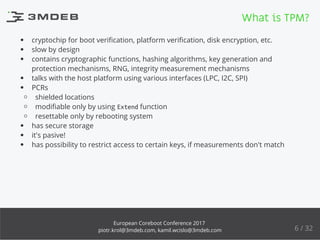
cryptochip for boot verification, platform verification, disk encryption, etc.
slow by design
contains cryptographic functions, hashing algorithms, key generation and
protection mechanisms, RNG, integrity measurement mechanisms
talks with the host platform using various interfaces (LPC, I2C, SPI)
PCRs
shielded locations
modifiable only by using Extend function
resettable only by rebooting system
has secure storage
it's pasive!
has possibility to restrict access to certain keys, if measurements don't match
What is TPM?
6 / 32
European Coreboot Conference 2017
piotr.krol@3mdeb.com, kamil.wcislo@3mdeb.com
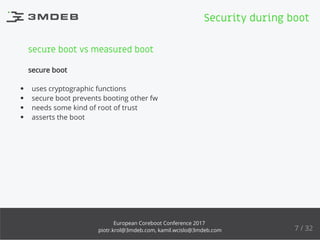
secure boot vs measured boot
secure boot
uses cryptographic functions
secure boot prevents booting other fw
needs some kind of root of trust
asserts the boot
Security during boot
7 / 32
European Coreboot Conference 2017
piotr.krol@3mdeb.com, kamil.wcislo@3mdeb.com
secure boot vs measured boot
secure boot
uses cryptographic functions
secure boot prevents booting other fw
needs some kind of root of trust
asserts the boot
measured (trusted) boot
uses hashes (cryptographic hashes)
measured boot notifies about compromised fw
TPM is needed (extend PCRs) to be secure
proves the boot
could be used to certify that system is in expected state
Security during boot
7 / 32
European Coreboot Conference 2017
piotr.krol@3mdeb.com, kamil.wcislo@3mdeb.com
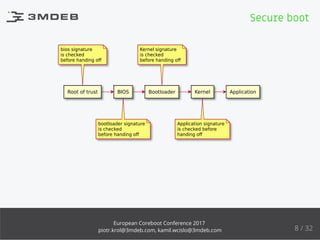
Root of trust BIOS Bootloader Kernel Application
bios signature
is checked
before handing off
bootloader signature
is checked
before handing off
Kernel signature
is checked
before handing off
Application signature
is checked before
handing off
Secure boot
8 / 32
European Coreboot Conference 2017
piotr.krol@3mdeb.com, kamil.wcislo@3mdeb.com
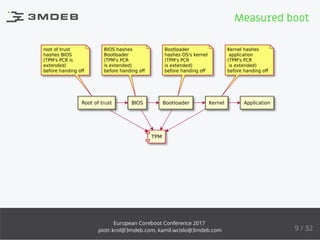
Root of trust BIOS Bootloader Kernel Application
TPM
root of trust
hashes BIOS
(TPM's PCR is
extended)
before handing off
BIOS hashes
Bootloader
(TPM's PCR
is extended)
before handing off
Bootloader
hashes OS's kernel
(TPM's PCR
is extended)
before handing off
Kernel hashes
application
(TPM's PCR
is extended)
before handing off
Measured boot
9 / 32
European Coreboot Conference 2017
piotr.krol@3mdeb.com, kamil.wcislo@3mdeb.com
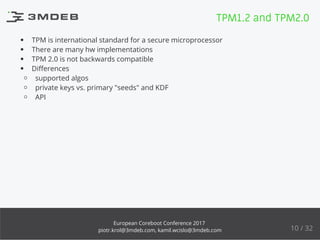
TPM is international standard for a secure microprocessor
There are many hw implementations
TPM 2.0 is not backwards compatible
Differences
supported algos
private keys vs. primary "seeds" and KDF
API
TPM1.2 and TPM2.0
10 / 32
European Coreboot Conference 2017
piotr.krol@3mdeb.com, kamil.wcislo@3mdeb.com
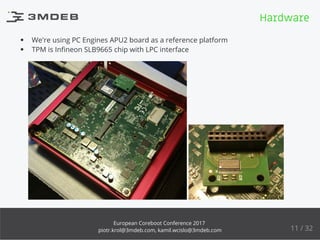
We're using PC Engines APU2 board as a reference platform
TPM is Infineon SLB9665 chip with LPC interface
Hardware
11 / 32
European Coreboot Conference 2017
piotr.krol@3mdeb.com, kamil.wcislo@3mdeb.com
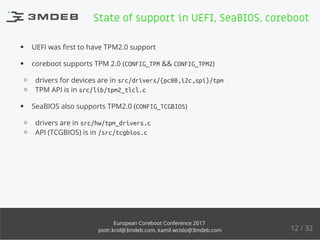
UEFI was first to have TPM2.0 support
coreboot supports TPM 2.0 (CONFIG_TPM && CONFIG_TPM2)
drivers for devices are in src/drivers/{pc80,i2c,spi}/tpm
TPM API is in src/lib/tpm2_tlcl.c
SeaBIOS also supports TPM2.0 (CONFIG_TCGBIOS)
drivers are in src/hw/tpm_drivers.c
API (TCGBIOS) is in /src/tcgbios.c
State of support in UEFI, SeaBIOS, coreboot
12 / 32
European Coreboot Conference 2017
piotr.krol@3mdeb.com, kamil.wcislo@3mdeb.com
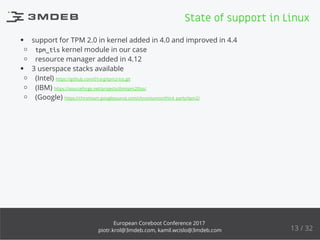
support for TPM 2.0 in kernel added in 4.0 and improved in 4.4
tpm_tis kernel module in our case
resource manager added in 4.12
3 userspace stacks available
(Intel) https://github.com/01org/tpm2-tss.git
(IBM) https://sourceforge.net/projects/ibmtpm20tss/
(Google) https://chromium.googlesource.com/chromiumos/third_party/tpm2/
State of support in Linux
13 / 32
European Coreboot Conference 2017
piotr.krol@3mdeb.com, kamil.wcislo@3mdeb.com
After changing the board's Kconfig to select CONFIG_TPM2 and
CONFIG_MAINBOARD_HAS_TPM2 board booted, but Linux had problems initializing
the module.
In Liunx, we had to insert the tpm_tis module manually:
$ modprobe tpm_tis interrupts=0 force=1
[ 29.203243] tpm_tis tpm_tis: 2.0 TPM (device-id 0x1A, rev-id 16)
[ 29.237198] tpm tpm0: A TPM error (256) occurred continue selftest
[ 29.243596] tpm tpm0: starting up the TPM manually
After this, the device was somewhat usable, but not in the full potential.
tpm2-tss and tpm2-tools (Intel's TPM2.0 stack) was able to communicate with
the device.
It's seems that TPM is not getting initialized correctly in the firmware.
Initial boot
14 / 32
European Coreboot Conference 2017
piotr.krol@3mdeb.com, kamil.wcislo@3mdeb.com
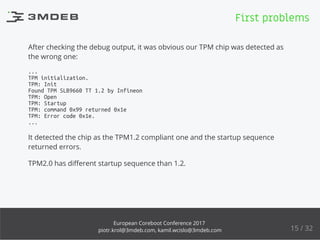
After checking the debug output, it was obvious our TPM chip was detected as
the wrong one:
...
TPM initialization.
TPM: Init
Found TPM SLB9660 TT 1.2 by Infineon
TPM: Open
TPM: Startup
TPM: command 0x99 returned 0x1e
TPM: Error code 0x1e.
...
It detected the chip as the TPM1.2 compliant one and the startup sequence
returned errors.
TPM2.0 has different startup sequence than 1.2.
First problems
15 / 32
European Coreboot Conference 2017
piotr.krol@3mdeb.com, kamil.wcislo@3mdeb.com
TPM2.0 spec is not easily readeable, despite having code examples.
In 4.13, Linux has quite good support for TPM 2.0.
Also contains TPM 2.0 starting sequence.
drivers/char/tpm is the pretty good source of knowledge now.
Looking at the Linux code
16 / 32
European Coreboot Conference 2017
piotr.krol@3mdeb.com, kamil.wcislo@3mdeb.com
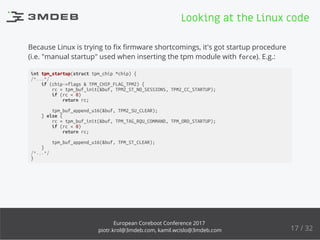
Because Linux is trying to fix firmware shortcomings, it's got startup procedure
(i.e. "manual startup" used when inserting the tpm module with force). E.g.:
int tpm_startup(struct tpm_chip *chip) {
/*...*/
if (chip->flags & TPM_CHIP_FLAG_TPM2) {
rc = tpm_buf_init(&buf, TPM2_ST_NO_SESSIONS, TPM2_CC_STARTUP);
if (rc < 0)
return rc;
tpm_buf_append_u16(&buf, TPM2_SU_CLEAR);
} else {
rc = tpm_buf_init(&buf, TPM_TAG_RQU_COMMAND, TPM_ORD_STARTUP);
if (rc < 0)
return rc;
tpm_buf_append_u16(&buf, TPM_ST_CLEAR);
}
/*...*/
}
Looking at the Linux code
17 / 32
European Coreboot Conference 2017
piotr.krol@3mdeb.com, kamil.wcislo@3mdeb.com
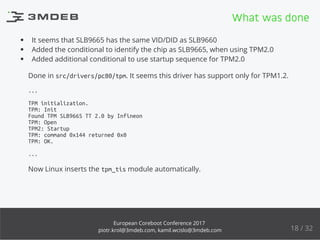
It seems that SLB9665 has the same VID/DID as SLB9660
Added the conditional to identify the chip as SLB9665, when using TPM2.0
Added additional conditional to use startup sequence for TPM2.0
Done in src/drivers/pc80/tpm. It seems this driver has support only for TPM1.2.
...
TPM initialization.
TPM: Init
Found TPM SLB9665 TT 2.0 by Infineon
TPM: Open
TPM2: Startup
TPM: command 0x144 returned 0x0
TPM: OK.
...
Now Linux inserts the tpm_tis module automatically.
What was done
18 / 32
European Coreboot Conference 2017
piotr.krol@3mdeb.com, kamil.wcislo@3mdeb.com
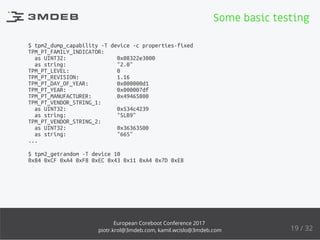
$ tpm2_dump_capability -T device -c properties-fixed
TPM_PT_FAMILY_INDICATOR:
as UINT32: 0x08322e3000
as string: "2.0"
TPM_PT_LEVEL: 0
TPM_PT_REVISION: 1.16
TPM_PT_DAY_OF_YEAR: 0x000000d1
TPM_PT_YEAR: 0x000007df
TPM_PT_MANUFACTURER: 0x49465800
TPM_PT_VENDOR_STRING_1:
as UINT32: 0x534c4239
as string: "SLB9"
TPM_PT_VENDOR_STRING_2:
as UINT32: 0x36363500
as string: "665"
...
$ tpm2_getrandom -T device 10
0x84 0xCF 0xA4 0xF8 0xEC 0x43 0x11 0xA4 0x7D 0xE8
Some basic testing
19 / 32
European Coreboot Conference 2017
piotr.krol@3mdeb.com, kamil.wcislo@3mdeb.com
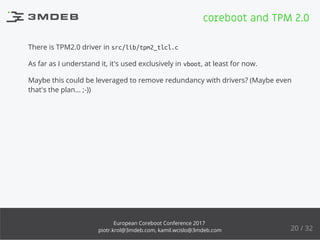
There is TPM2.0 driver in src/lib/tpm2_tlcl.c
As far as I understand it, it's used exclusively in vboot, at least for now.
Maybe this could be leveraged to remove redundancy with drivers? (Maybe even
that's the plan... ;-))
coreboot and TPM 2.0
20 / 32
European Coreboot Conference 2017
piotr.krol@3mdeb.com, kamil.wcislo@3mdeb.com
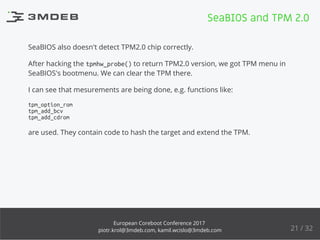
SeaBIOS also doesn't detect TPM2.0 chip correctly.
After hacking the tpmhw_probe() to return TPM2.0 version, we got TPM menu in
SeaBIOS's bootmenu. We can clear the TPM there.
I can see that mesurements are being done, e.g. functions like:
tpm_option_rom
tpm_add_bcv
tpm_add_cdrom
are used. They contain code to hash the target and extend the TPM.
SeaBIOS and TPM 2.0
21 / 32
European Coreboot Conference 2017
piotr.krol@3mdeb.com, kamil.wcislo@3mdeb.com
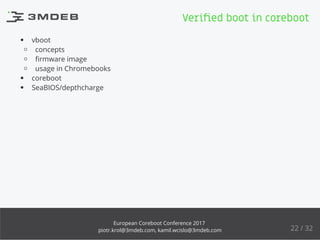
vboot
concepts
firmware image
usage in Chromebooks
coreboot
SeaBIOS/depthcharge
Verified boot in coreboot
22 / 32
European Coreboot Conference 2017
piotr.krol@3mdeb.com, kamil.wcislo@3mdeb.com
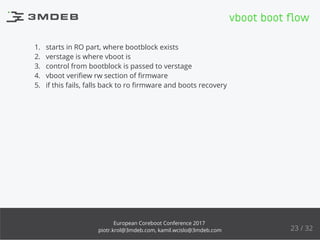
1. starts in RO part, where bootblock exists
2. verstage is where vboot is
3. control from bootblock is passed to verstage
4. vboot verifiew rw section of firmware
5. if this fails, falls back to ro firmware and boots recovery
vboot boot flow
23 / 32
European Coreboot Conference 2017
piotr.krol@3mdeb.com, kamil.wcislo@3mdeb.com
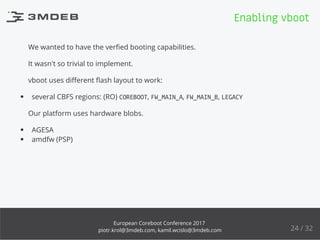
We wanted to have the verfied booting capabilities.
It wasn't so trivial to implement.
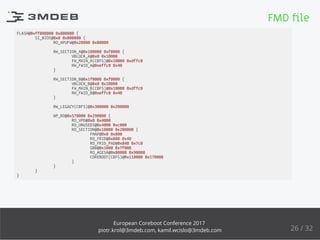
vboot uses different flash layout to work:
several CBFS regions: (RO) COREBOOT, FW_MAIN_A, FW_MAIN_B, LEGACY
Our platform uses hardware blobs.
AGESA
amdfw (PSP)
Enabling vboot
24 / 32
European Coreboot Conference 2017
piotr.krol@3mdeb.com, kamil.wcislo@3mdeb.com
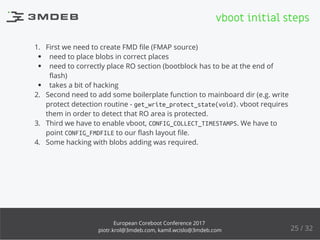
1. First we need to create FMD file (FMAP source)
need to place blobs in correct places
need to correctly place RO section (bootblock has to be at the end of
flash)
takes a bit of hacking
2. Second need to add some boilerplate function to mainboard dir (e.g. write
protect detection routine - get_write_protect_state(void). vboot requires
them in order to detect that RO area is protected.
3. Third we have to enable vboot, CONFIG_COLLECT_TIMESTAMPS. We have to
point CONFIG_FMDFILE to our flash layout file.
4. Some hacking with blobs adding was required.
vboot initial steps
25 / 32
European Coreboot Conference 2017
piotr.krol@3mdeb.com, kamil.wcislo@3mdeb.com
FLASH@0xff800000 0x800000 {
SI_BIOS@0x0 0x800000 {
RO_APUFW@0x20000 0x80000
RW_SECTION_A@0x100000 0xf0000 {
VBLOCK_A@0x0 0x10000
FW_MAIN_A(CBFS)@0x10000 0xdffc0
RW_FWID_A@0xeffc0 0x40
}
RW_SECTION_B@0x1f0000 0xf0000 {
VBLOCK_B@0x0 0x10000
FW_MAIN_B(CBFS)@0x10000 0xdffc0
RW_FWID_B@0xeffc0 0x40
}
RW_LEGACY(CBFS)@0x300000 0x200000
WP_RO@0x570000 0x290000 {
RO_VPD@0x0 0x4000
RO_UNUSED3@0x4000 0xc000
RO_SECTION@0x10000 0x280000 {
FMAP@0x0 0x800
RO_FRID@0x800 0x40
RO_FRID_PAD@0x840 0x7c0
GBB@0x1000 0x7f000
RO_AGESA@0x80000 0x90000
COREBOOT(CBFS)@0x110000 0x170000
}
}
}
}
FMD file
26 / 32
European Coreboot Conference 2017
piotr.krol@3mdeb.com, kamil.wcislo@3mdeb.com
...
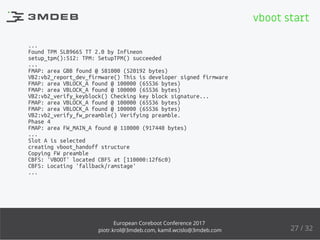
Found TPM SLB9665 TT 2.0 by Infineon
setup_tpm():512: TPM: SetupTPM() succeeded
...
FMAP: area GBB found @ 581000 (520192 bytes)
VB2:vb2_report_dev_firmware() This is developer signed firmware
FMAP: area VBLOCK_A found @ 100000 (65536 bytes)
VB2:vb2_verify_keyblock() Checking key block signature...
FMAP: area VBLOCK_A found @ 100000 (65536 bytes)
VB2:vb2_verify_fw_preamble() Verifying preamble.
Phase 4
FMAP: area FW_MAIN_A found @ 110000 (917440 bytes)
...
Slot A is selected
creating vboot_handoff structure
Copying FW preamble
CBFS: 'VBOOT' located CBFS at [110000:12f6c0)
CBFS: Locating 'fallback/ramstage'
...
vboot start
27 / 32
European Coreboot Conference 2017
piotr.krol@3mdeb.com, kamil.wcislo@3mdeb.com
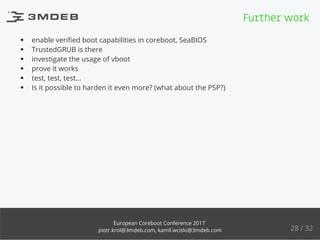
enable verified boot capabilities in coreboot, SeaBIOS
TrustedGRUB is there
investigate the usage of vboot
prove it works
test, test, test...
Is it possible to harden it even more? (what about the PSP?)
Further work
28 / 32
European Coreboot Conference 2017
piotr.krol@3mdeb.com, kamil.wcislo@3mdeb.com
Adding new chip in coreboot is quite easy. TPM support is there.
Using the source brings better results than using the huge spec.
Understanding the platform boot process and blob placement is crucial, when
trying to enable vboot.
One can have verified boot capabilities on custom coreboot platform.
Conclusions
29 / 32
European Coreboot Conference 2017
piotr.krol@3mdeb.com, kamil.wcislo@3mdeb.com
recent news - vulnerable RSA key generated by Infineon's hardware
can decode RSA private key from public key
if the RSA primes are generated as truly random numbers attack is not viable
ECC keys are not affected
key test tools available: https://crocs.fi.muni.cz/public/papers/rsa_ccs17
ROCA attack
30 / 32
European Coreboot Conference 2017
piotr.krol@3mdeb.com, kamil.wcislo@3mdeb.com
Linux and coreboot (obvious ;)) source code
https://danielmiessler.com/study/infosecconcepts/
https://forums.juniper.net/t5/Security-Now/What-s-the-Difference-between-Secure-Boot-and-Measured-Boot/ba-p/281251
https://blog.hansenpartnership.com/tpm2-and-linux/
https://firmwaresecurity.com/2016/01/15/seabios-gets-tpm2-security/
https://www.coreboot.org/git-docs/Intel/vboot.html
https://www.coreboot.org/images/f/f1/Tpm_-_Philipp.pdf
https://elinux.org/images/6/6e/ELC2017_TPM2-and-TSS_Tricca.pdf
Sources
31 / 32
European Coreboot Conference 2017
piotr.krol@3mdeb.com, kamil.wcislo@3mdeb.com
Thanks!
32 / 32
European Coreboot Conference 2017
piotr.krol@3mdeb.com, kamil.wcislo@3mdeb.com
Thanks!
Q/A
32 / 32
European Coreboot Conference 2017
piotr.krol@3mdeb.com, kamil.wcislo@3mdeb.com

Enabling TPM 2.0 on coreboot based devices

  • 1.
    > Enabling TPM 2.0on coreboot based devices European Coreboot Conference 2017 Piotr Król and Kamil Wcisło 1 / 32
  • 3.
    Piotr Król KamilWcisło @pietrushnic piotr.krol@3mdeb.com linkedin.com/in/krolpiotr facebook.com/piotr.krol.756859 @mek_xgt kamil.wcislo@3mdeb.com linkedin.com/in/kamil-wcisło-86a83189 facebook.com/mek.xgt Intro 2 / 32 European Coreboot Conference 2017 piotr.krol@3mdeb.com, kamil.wcislo@3mdeb.com
  • 4.
    Why? security is important intimes of IoT devices have to be hardened against attacks devices have to have some kind of proof they run good software Resoning 3 / 32 European Coreboot Conference 2017 piotr.krol@3mdeb.com, kamil.wcislo@3mdeb.com
  • 5.
    Why? security is important intimes of IoT devices have to be hardened against attacks devices have to have some kind of proof they run good software What we want to show? some of our struggles and conclusions when trying to enable secure boot in open firmware device Resoning 3 / 32 European Coreboot Conference 2017 piotr.krol@3mdeb.com, kamil.wcislo@3mdeb.com
  • 6.
    Why? security is important intimes of IoT devices have to be hardened against attacks devices have to have some kind of proof they run good software What we want to show? some of our struggles and conclusions when trying to enable secure boot in open firmware device Some comments... this is still WIP, there are many things to be done we're just the beginners in this area Resoning 3 / 32 European Coreboot Conference 2017 piotr.krol@3mdeb.com, kamil.wcislo@3mdeb.com
  • 7.
    Security concepts overview Introductionto TPM 2.0 TPM hardware State of support in UEFI and SeaBIOS State of Linux kernel and user space tools Verified boot in coreboot Conclusions Agenda 4 / 32 European Coreboot Conference 2017 piotr.krol@3mdeb.com, kamil.wcislo@3mdeb.com
  • 8.
    The CIA triad Confidentiality Integrity Authorization Securityconcepts 5 / 32 European Coreboot Conference 2017 piotr.krol@3mdeb.com, kamil.wcislo@3mdeb.com
  • 9.
    The CIA triad Confidentiality Integrity Authorization and... Availability Non-repudation Securityconcepts 5 / 32 European Coreboot Conference 2017 piotr.krol@3mdeb.com, kamil.wcislo@3mdeb.com
  • 10.
    cryptochip for bootverification, platform verification, disk encryption, etc. slow by design contains cryptographic functions, hashing algorithms, key generation and protection mechanisms, RNG, integrity measurement mechanisms talks with the host platform using various interfaces (LPC, I2C, SPI) PCRs shielded locations modifiable only by using Extend function resettable only by rebooting system has secure storage it's pasive! has possibility to restrict access to certain keys, if measurements don't match What is TPM? 6 / 32 European Coreboot Conference 2017 piotr.krol@3mdeb.com, kamil.wcislo@3mdeb.com
  • 11.
    secure boot vsmeasured boot secure boot uses cryptographic functions secure boot prevents booting other fw needs some kind of root of trust asserts the boot Security during boot 7 / 32 European Coreboot Conference 2017 piotr.krol@3mdeb.com, kamil.wcislo@3mdeb.com
  • 12.
    secure boot vsmeasured boot secure boot uses cryptographic functions secure boot prevents booting other fw needs some kind of root of trust asserts the boot measured (trusted) boot uses hashes (cryptographic hashes) measured boot notifies about compromised fw TPM is needed (extend PCRs) to be secure proves the boot could be used to certify that system is in expected state Security during boot 7 / 32 European Coreboot Conference 2017 piotr.krol@3mdeb.com, kamil.wcislo@3mdeb.com
  • 13.
    Root of trustBIOS Bootloader Kernel Application bios signature is checked before handing off bootloader signature is checked before handing off Kernel signature is checked before handing off Application signature is checked before handing off Secure boot 8 / 32 European Coreboot Conference 2017 piotr.krol@3mdeb.com, kamil.wcislo@3mdeb.com
  • 14.
    Root of trustBIOS Bootloader Kernel Application TPM root of trust hashes BIOS (TPM's PCR is extended) before handing off BIOS hashes Bootloader (TPM's PCR is extended) before handing off Bootloader hashes OS's kernel (TPM's PCR is extended) before handing off Kernel hashes application (TPM's PCR is extended) before handing off Measured boot 9 / 32 European Coreboot Conference 2017 piotr.krol@3mdeb.com, kamil.wcislo@3mdeb.com
  • 15.
    TPM is internationalstandard for a secure microprocessor There are many hw implementations TPM 2.0 is not backwards compatible Differences supported algos private keys vs. primary "seeds" and KDF API TPM1.2 and TPM2.0 10 / 32 European Coreboot Conference 2017 piotr.krol@3mdeb.com, kamil.wcislo@3mdeb.com
  • 16.
    We're using PCEngines APU2 board as a reference platform TPM is Infineon SLB9665 chip with LPC interface Hardware 11 / 32 European Coreboot Conference 2017 piotr.krol@3mdeb.com, kamil.wcislo@3mdeb.com
  • 17.
    UEFI was firstto have TPM2.0 support coreboot supports TPM 2.0 (CONFIG_TPM && CONFIG_TPM2) drivers for devices are in src/drivers/{pc80,i2c,spi}/tpm TPM API is in src/lib/tpm2_tlcl.c SeaBIOS also supports TPM2.0 (CONFIG_TCGBIOS) drivers are in src/hw/tpm_drivers.c API (TCGBIOS) is in /src/tcgbios.c State of support in UEFI, SeaBIOS, coreboot 12 / 32 European Coreboot Conference 2017 piotr.krol@3mdeb.com, kamil.wcislo@3mdeb.com
  • 18.
    support for TPM2.0 in kernel added in 4.0 and improved in 4.4 tpm_tis kernel module in our case resource manager added in 4.12 3 userspace stacks available (Intel) https://github.com/01org/tpm2-tss.git (IBM) https://sourceforge.net/projects/ibmtpm20tss/ (Google) https://chromium.googlesource.com/chromiumos/third_party/tpm2/ State of support in Linux 13 / 32 European Coreboot Conference 2017 piotr.krol@3mdeb.com, kamil.wcislo@3mdeb.com
  • 19.
    After changing theboard's Kconfig to select CONFIG_TPM2 and CONFIG_MAINBOARD_HAS_TPM2 board booted, but Linux had problems initializing the module. In Liunx, we had to insert the tpm_tis module manually: $ modprobe tpm_tis interrupts=0 force=1 [ 29.203243] tpm_tis tpm_tis: 2.0 TPM (device-id 0x1A, rev-id 16) [ 29.237198] tpm tpm0: A TPM error (256) occurred continue selftest [ 29.243596] tpm tpm0: starting up the TPM manually After this, the device was somewhat usable, but not in the full potential. tpm2-tss and tpm2-tools (Intel's TPM2.0 stack) was able to communicate with the device. It's seems that TPM is not getting initialized correctly in the firmware. Initial boot 14 / 32 European Coreboot Conference 2017 piotr.krol@3mdeb.com, kamil.wcislo@3mdeb.com
  • 20.
    After checking thedebug output, it was obvious our TPM chip was detected as the wrong one: ... TPM initialization. TPM: Init Found TPM SLB9660 TT 1.2 by Infineon TPM: Open TPM: Startup TPM: command 0x99 returned 0x1e TPM: Error code 0x1e. ... It detected the chip as the TPM1.2 compliant one and the startup sequence returned errors. TPM2.0 has different startup sequence than 1.2. First problems 15 / 32 European Coreboot Conference 2017 piotr.krol@3mdeb.com, kamil.wcislo@3mdeb.com
  • 21.
    TPM2.0 spec isnot easily readeable, despite having code examples. In 4.13, Linux has quite good support for TPM 2.0. Also contains TPM 2.0 starting sequence. drivers/char/tpm is the pretty good source of knowledge now. Looking at the Linux code 16 / 32 European Coreboot Conference 2017 piotr.krol@3mdeb.com, kamil.wcislo@3mdeb.com
  • 22.
    Because Linux istrying to fix firmware shortcomings, it's got startup procedure (i.e. "manual startup" used when inserting the tpm module with force). E.g.: int tpm_startup(struct tpm_chip *chip) { /*...*/ if (chip->flags & TPM_CHIP_FLAG_TPM2) { rc = tpm_buf_init(&buf, TPM2_ST_NO_SESSIONS, TPM2_CC_STARTUP); if (rc < 0) return rc; tpm_buf_append_u16(&buf, TPM2_SU_CLEAR); } else { rc = tpm_buf_init(&buf, TPM_TAG_RQU_COMMAND, TPM_ORD_STARTUP); if (rc < 0) return rc; tpm_buf_append_u16(&buf, TPM_ST_CLEAR); } /*...*/ } Looking at the Linux code 17 / 32 European Coreboot Conference 2017 piotr.krol@3mdeb.com, kamil.wcislo@3mdeb.com
  • 23.
    It seems thatSLB9665 has the same VID/DID as SLB9660 Added the conditional to identify the chip as SLB9665, when using TPM2.0 Added additional conditional to use startup sequence for TPM2.0 Done in src/drivers/pc80/tpm. It seems this driver has support only for TPM1.2. ... TPM initialization. TPM: Init Found TPM SLB9665 TT 2.0 by Infineon TPM: Open TPM2: Startup TPM: command 0x144 returned 0x0 TPM: OK. ... Now Linux inserts the tpm_tis module automatically. What was done 18 / 32 European Coreboot Conference 2017 piotr.krol@3mdeb.com, kamil.wcislo@3mdeb.com
  • 24.
    $ tpm2_dump_capability -Tdevice -c properties-fixed TPM_PT_FAMILY_INDICATOR: as UINT32: 0x08322e3000 as string: "2.0" TPM_PT_LEVEL: 0 TPM_PT_REVISION: 1.16 TPM_PT_DAY_OF_YEAR: 0x000000d1 TPM_PT_YEAR: 0x000007df TPM_PT_MANUFACTURER: 0x49465800 TPM_PT_VENDOR_STRING_1: as UINT32: 0x534c4239 as string: "SLB9" TPM_PT_VENDOR_STRING_2: as UINT32: 0x36363500 as string: "665" ... $ tpm2_getrandom -T device 10 0x84 0xCF 0xA4 0xF8 0xEC 0x43 0x11 0xA4 0x7D 0xE8 Some basic testing 19 / 32 European Coreboot Conference 2017 piotr.krol@3mdeb.com, kamil.wcislo@3mdeb.com
  • 25.
    There is TPM2.0driver in src/lib/tpm2_tlcl.c As far as I understand it, it's used exclusively in vboot, at least for now. Maybe this could be leveraged to remove redundancy with drivers? (Maybe even that's the plan... ;-)) coreboot and TPM 2.0 20 / 32 European Coreboot Conference 2017 piotr.krol@3mdeb.com, kamil.wcislo@3mdeb.com
  • 26.
    SeaBIOS also doesn'tdetect TPM2.0 chip correctly. After hacking the tpmhw_probe() to return TPM2.0 version, we got TPM menu in SeaBIOS's bootmenu. We can clear the TPM there. I can see that mesurements are being done, e.g. functions like: tpm_option_rom tpm_add_bcv tpm_add_cdrom are used. They contain code to hash the target and extend the TPM. SeaBIOS and TPM 2.0 21 / 32 European Coreboot Conference 2017 piotr.krol@3mdeb.com, kamil.wcislo@3mdeb.com
  • 27.
    vboot concepts firmware image usage inChromebooks coreboot SeaBIOS/depthcharge Verified boot in coreboot 22 / 32 European Coreboot Conference 2017 piotr.krol@3mdeb.com, kamil.wcislo@3mdeb.com
  • 28.
    1. starts inRO part, where bootblock exists 2. verstage is where vboot is 3. control from bootblock is passed to verstage 4. vboot verifiew rw section of firmware 5. if this fails, falls back to ro firmware and boots recovery vboot boot flow 23 / 32 European Coreboot Conference 2017 piotr.krol@3mdeb.com, kamil.wcislo@3mdeb.com
  • 29.
    We wanted tohave the verfied booting capabilities. It wasn't so trivial to implement. vboot uses different flash layout to work: several CBFS regions: (RO) COREBOOT, FW_MAIN_A, FW_MAIN_B, LEGACY Our platform uses hardware blobs. AGESA amdfw (PSP) Enabling vboot 24 / 32 European Coreboot Conference 2017 piotr.krol@3mdeb.com, kamil.wcislo@3mdeb.com
  • 30.
    1. First weneed to create FMD file (FMAP source) need to place blobs in correct places need to correctly place RO section (bootblock has to be at the end of flash) takes a bit of hacking 2. Second need to add some boilerplate function to mainboard dir (e.g. write protect detection routine - get_write_protect_state(void). vboot requires them in order to detect that RO area is protected. 3. Third we have to enable vboot, CONFIG_COLLECT_TIMESTAMPS. We have to point CONFIG_FMDFILE to our flash layout file. 4. Some hacking with blobs adding was required. vboot initial steps 25 / 32 European Coreboot Conference 2017 piotr.krol@3mdeb.com, kamil.wcislo@3mdeb.com
  • 31.
    FLASH@0xff800000 0x800000 { SI_BIOS@0x00x800000 { RO_APUFW@0x20000 0x80000 RW_SECTION_A@0x100000 0xf0000 { VBLOCK_A@0x0 0x10000 FW_MAIN_A(CBFS)@0x10000 0xdffc0 RW_FWID_A@0xeffc0 0x40 } RW_SECTION_B@0x1f0000 0xf0000 { VBLOCK_B@0x0 0x10000 FW_MAIN_B(CBFS)@0x10000 0xdffc0 RW_FWID_B@0xeffc0 0x40 } RW_LEGACY(CBFS)@0x300000 0x200000 WP_RO@0x570000 0x290000 { RO_VPD@0x0 0x4000 RO_UNUSED3@0x4000 0xc000 RO_SECTION@0x10000 0x280000 { FMAP@0x0 0x800 RO_FRID@0x800 0x40 RO_FRID_PAD@0x840 0x7c0 GBB@0x1000 0x7f000 RO_AGESA@0x80000 0x90000 COREBOOT(CBFS)@0x110000 0x170000 } } } } FMD file 26 / 32 European Coreboot Conference 2017 piotr.krol@3mdeb.com, kamil.wcislo@3mdeb.com
  • 32.
    ... Found TPM SLB9665TT 2.0 by Infineon setup_tpm():512: TPM: SetupTPM() succeeded ... FMAP: area GBB found @ 581000 (520192 bytes) VB2:vb2_report_dev_firmware() This is developer signed firmware FMAP: area VBLOCK_A found @ 100000 (65536 bytes) FMAP: area VBLOCK_A found @ 100000 (65536 bytes) VB2:vb2_verify_keyblock() Checking key block signature... FMAP: area VBLOCK_A found @ 100000 (65536 bytes) FMAP: area VBLOCK_A found @ 100000 (65536 bytes) VB2:vb2_verify_fw_preamble() Verifying preamble. Phase 4 FMAP: area FW_MAIN_A found @ 110000 (917440 bytes) ... Slot A is selected creating vboot_handoff structure Copying FW preamble CBFS: 'VBOOT' located CBFS at [110000:12f6c0) CBFS: Locating 'fallback/ramstage' ... vboot start 27 / 32 European Coreboot Conference 2017 piotr.krol@3mdeb.com, kamil.wcislo@3mdeb.com
  • 33.
    enable verified bootcapabilities in coreboot, SeaBIOS TrustedGRUB is there investigate the usage of vboot prove it works test, test, test... Is it possible to harden it even more? (what about the PSP?) Further work 28 / 32 European Coreboot Conference 2017 piotr.krol@3mdeb.com, kamil.wcislo@3mdeb.com
  • 34.
    Adding new chipin coreboot is quite easy. TPM support is there. Using the source brings better results than using the huge spec. Understanding the platform boot process and blob placement is crucial, when trying to enable vboot. One can have verified boot capabilities on custom coreboot platform. Conclusions 29 / 32 European Coreboot Conference 2017 piotr.krol@3mdeb.com, kamil.wcislo@3mdeb.com
  • 35.
    recent news -vulnerable RSA key generated by Infineon's hardware can decode RSA private key from public key if the RSA primes are generated as truly random numbers attack is not viable ECC keys are not affected key test tools available: https://crocs.fi.muni.cz/public/papers/rsa_ccs17 ROCA attack 30 / 32 European Coreboot Conference 2017 piotr.krol@3mdeb.com, kamil.wcislo@3mdeb.com
  • 36.
    Linux and coreboot(obvious ;)) source code https://danielmiessler.com/study/infosecconcepts/ https://forums.juniper.net/t5/Security-Now/What-s-the-Difference-between-Secure-Boot-and-Measured-Boot/ba-p/281251 https://blog.hansenpartnership.com/tpm2-and-linux/ https://firmwaresecurity.com/2016/01/15/seabios-gets-tpm2-security/ https://www.coreboot.org/git-docs/Intel/vboot.html https://www.coreboot.org/images/f/f1/Tpm_-_Philipp.pdf https://elinux.org/images/6/6e/ELC2017_TPM2-and-TSS_Tricca.pdf Sources 31 / 32 European Coreboot Conference 2017 piotr.krol@3mdeb.com, kamil.wcislo@3mdeb.com
  • 37.
    Thanks! 32 / 32 EuropeanCoreboot Conference 2017 piotr.krol@3mdeb.com, kamil.wcislo@3mdeb.com
  • 38.
    Thanks! Q/A 32 / 32 EuropeanCoreboot Conference 2017 piotr.krol@3mdeb.com, kamil.wcislo@3mdeb.com