Lesson 8:
Basic Web Page
Creation
What does Web Page
mean?
Web Page
A Web page is a document for the
World Wide Web that can be
accessed and displayed on a
monitor or smartphone using any
web browser.
Web Page
Web pages are made up of Hypertext
Markup Language (HTML) and can be
created and modified by using basic
application like Notepad and
professional HTML editors.
❖ HTML is Easy to Learn and Use
❖ HTML is Free
❖ Online Website Builder - Easy Use of
Drag-And-Drop Interface
WYSIWYG
❖ What You See Is What You Get
❖ Whatever you will type, insert, draw,
place, rearrange, or whatever you do on
a web page is what the audience will
see
HTML
❖ HTML stands for Hyper Text Markup
Language
❖ HTML describes the structure of a web page
❖ HTML consists of a series of elements
❖ HTML elements tell the browser how to
display the content
HTML
❖HTML elements are represented by TAGS
❖ HTML TAGS label pieces of content such as
“heading”, “paragraph”, “table” and so on...
❖ Browsers do not display the HTML tags, but
use them to render the content of the page
Requirements in creating a web
page using the html
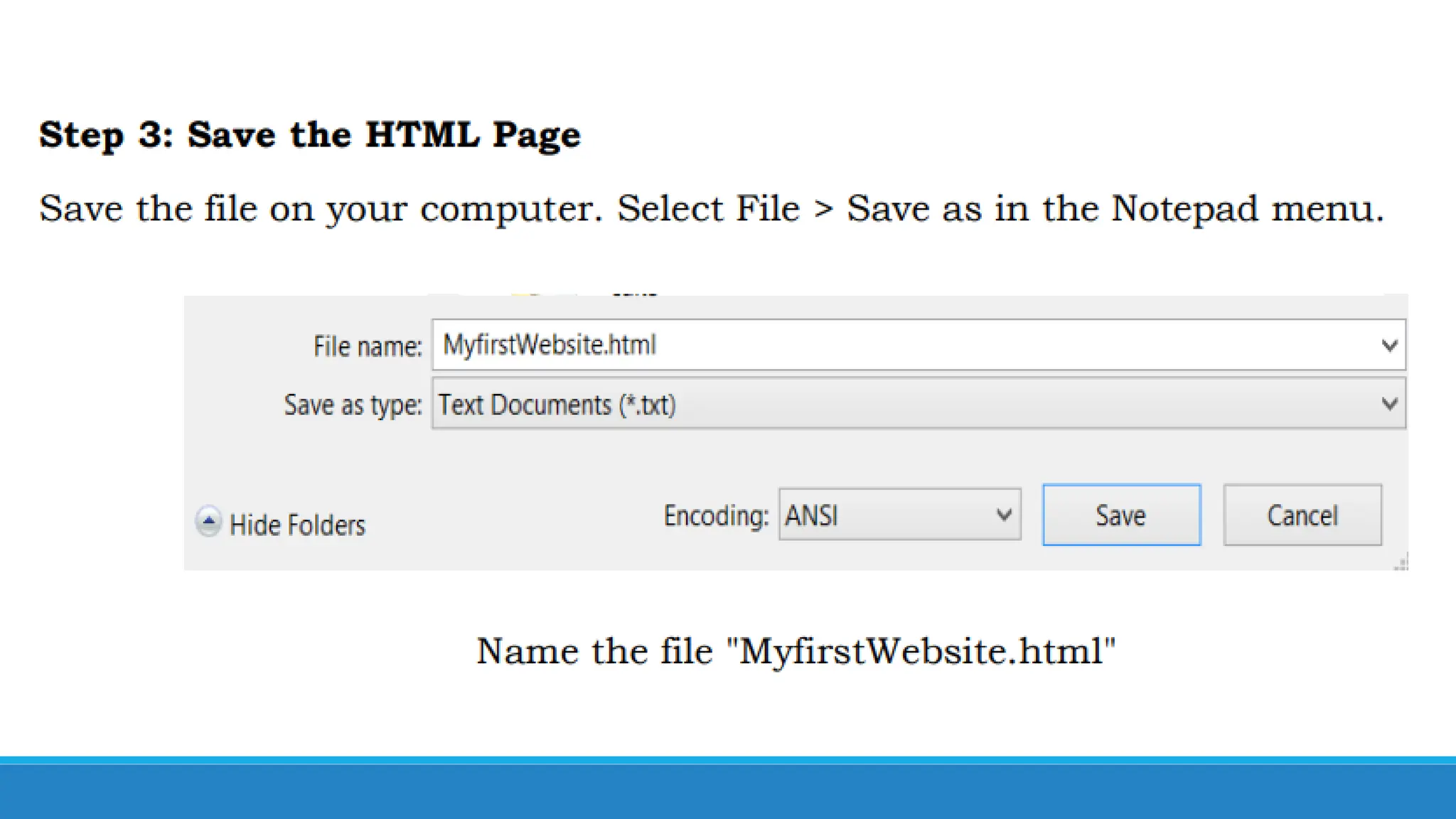
1. Editor – using the Notepad (source code)
in text and extension name - .html or .htm.
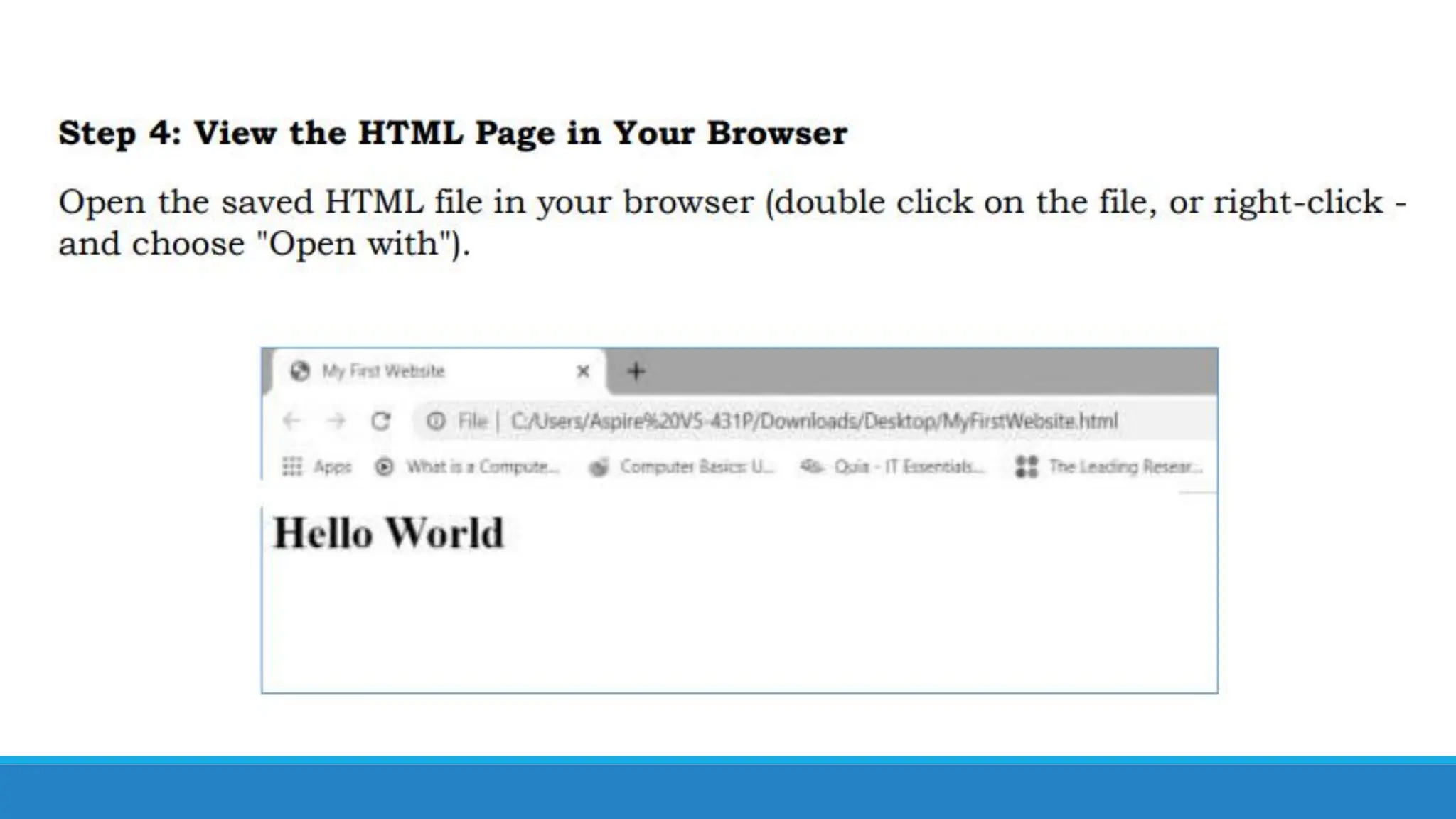
2. Browser – responsible for reading HTML
instructions and displaying the web page
output. (ex. Internet Explorer, Mozilla
Firefox, Google Chrome)
Creating a Website Using
Notepad
Web pages can be created and modified using
professional HTML editors. However, in learning
HTML, it is better to use a simple text editor like
Notepad.
Follow the steps to create your first web page
with Notepad.
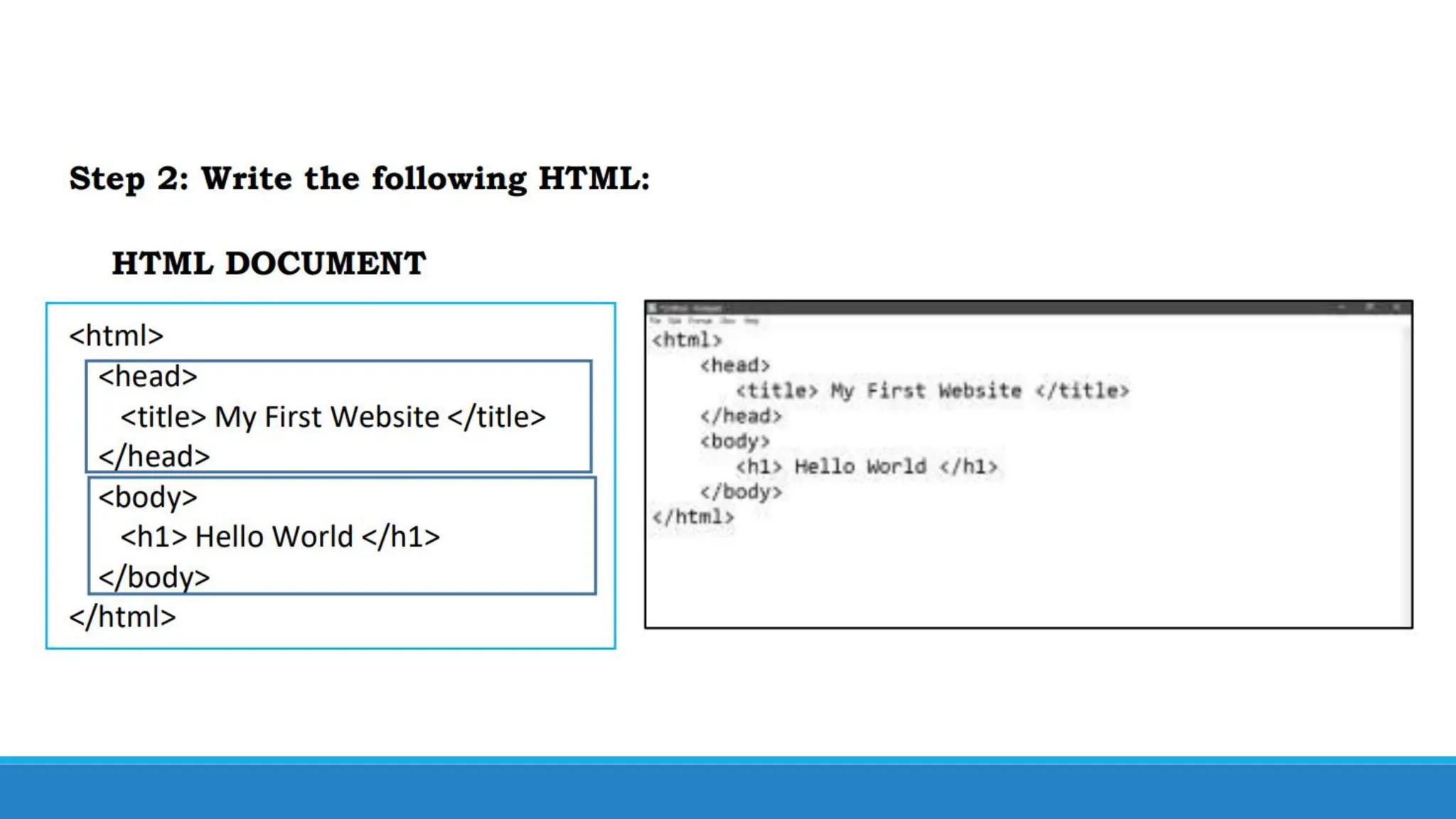
HTML document is divided into two main sections
the head and the body. Each section contains
specific information. The head section contains
information about the documents like title, search
engine or keywords but is not visible to the
reader. The body section contains the information
or content that you want to appear on the web
page.
EmpTech Lesson 8 - Basic Web Page Creation

EmpTech Lesson 8 - Basic Web Page Creation

  • 1.
    Lesson 8: Basic WebPage Creation
  • 2.
    What does WebPage mean?
  • 3.
    Web Page A Webpage is a document for the World Wide Web that can be accessed and displayed on a monitor or smartphone using any web browser.
  • 4.
    Web Page Web pagesare made up of Hypertext Markup Language (HTML) and can be created and modified by using basic application like Notepad and professional HTML editors.
  • 5.
    ❖ HTML isEasy to Learn and Use ❖ HTML is Free ❖ Online Website Builder - Easy Use of Drag-And-Drop Interface
  • 6.
    WYSIWYG ❖ What YouSee Is What You Get ❖ Whatever you will type, insert, draw, place, rearrange, or whatever you do on a web page is what the audience will see
  • 7.
    HTML ❖ HTML standsfor Hyper Text Markup Language ❖ HTML describes the structure of a web page ❖ HTML consists of a series of elements ❖ HTML elements tell the browser how to display the content
  • 8.
    HTML ❖HTML elements arerepresented by TAGS ❖ HTML TAGS label pieces of content such as “heading”, “paragraph”, “table” and so on... ❖ Browsers do not display the HTML tags, but use them to render the content of the page
  • 9.
    Requirements in creatinga web page using the html 1. Editor – using the Notepad (source code) in text and extension name - .html or .htm. 2. Browser – responsible for reading HTML instructions and displaying the web page output. (ex. Internet Explorer, Mozilla Firefox, Google Chrome)
  • 10.
    Creating a WebsiteUsing Notepad Web pages can be created and modified using professional HTML editors. However, in learning HTML, it is better to use a simple text editor like Notepad. Follow the steps to create your first web page with Notepad.
  • 13.
    HTML document isdivided into two main sections the head and the body. Each section contains specific information. The head section contains information about the documents like title, search engine or keywords but is not visible to the reader. The body section contains the information or content that you want to appear on the web page.