Lesson 10:
Collaborative
Development of
ICT Content
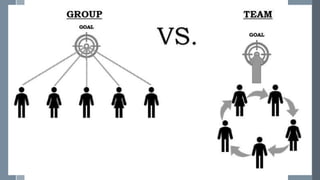
A Group involves people
who work independently to
achieve its goals,
while a Team works
interdependently where
each member has a specific
role or function.
A. Team
Structure and
Dynamics for
ICT Content
Team Structure
Team Structure refers to the
creation of an individual
team or the creation of a
multi-system. It is an
essential component of the
teamwork process.
Collaboration means
individuals work together to
produce/create a well-
defined content to achieve a
common business purpose.
Online collaboration is a
work process where people
are interacting in real-time
over the internet.
Four (4) Parts of
Collaboration in a Flow
Process while
interacting with team
members:
S.U.R.E
• Sharing: documenting
explicit knowledge
• Understanding: adopting
the process knowledge
• Reflection: analyzing or
interpreting shared
information
• Expression: the process of
making known ones thought
or feelings
Team Members
An effective team structure
is composed of efficient
team members who have
specific roles and
responsibilities. These team
members include:
Project Manager:
An individual who has
general accountability for
the successful initiation,
planning, design, execution,
monitoring, controlling, and
closure of a project.
Data Analyst:
Someone who gathers,
processes, and performs
statistical analyses of Data.
A person who is accountable
in collecting the data for ICT
content.
Content Writer and
Editor:
A person responsible for
reviewing the data and
finalizes a complete of
information.
The Web Designer:
A person responsible for
creating the appearance,
layout, and elements of a
website. The job involves
understanding both graphic
design and computer
programming.
The Web Developer:
The person technically
develops the overall
functionalities of a web
page.
B. Online
Collaborative
Tools
•Facebook Groups
•G Suite
•Google Chat/ Hangouts
•Google Docs, Sheets, and
Slides
•Google Drive
•Microsoft Teams
•Microsoft Yammer
•MS Office 365
•Prezi
• Trello
•Zoom
•Skype/Viber/Kakao
Talk/WeChat/Line
Online
Platforms for
Hosting ICT
Content
•Presentation/
Visualization
(Prezi, Soho, Slideshare,
MindMeister)
•Cloud computing
(Google Apps)
•Social Media
(Facebook Pages, Tumblr)
•Web Page Creation
(Wix, Weebly)
•Blog sites
(Blogger, Wordpress,
Livejournal, Issuu)
Characteristics
of Good
Collaborative
Tools and
Platforms
•The tool must be user-
friendly.
•The tool has elements that
are appropriate for the
team's goal.
•The tool prioritizes security
and privacy.
C. Project
Management for
ICT Content
Five Phases of
Project
Management
• Initiating - An overview
of the objectives of the
project, needs, and the
problem is identified.
• (Project Manager)
• Planning - The team
brainstorms the ICT theme to
be published, together with the
collaborative tools and online
platforms to be used.
• (Project Manager and Project
Team)
• Executing - Executing
the project plan once the
project plan has been
constructed.
• (Content writers and
editors)
• Monitoring and
Controlling - Project
manager monitors and
controls the work for a time,
cost, scope, quality, risk,
and other factors while the
project is being executed.
• Closing- Ensure that all
the work has been finished,
completed, and approved.
D. Curating
Existing Content
for Use on the
Web
Content curation is the
process of publicly
gathering, organizing,
adding value, and openly
sharing digital information
artifacts on a specific topic
or area of audience interest.
Content curation is the
process of publicly
gathering, organizing,
adding value, and openly
sharing digital information
artifacts on a specific topic
or area of audience interest.
Steps in
Creating and
Choosing
Valuable ICT
Content.
1. Define your objectives
2. Research and analyze
3. Organize the structure of
your article
4. Summarize and
proofread
Three (3)
Rules in
Creating Quality
Content
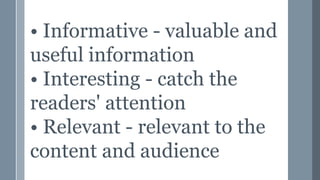
• Informative - valuable and
useful information
• Interesting - catch the
readers' attention
• Relevant - relevant to the
content and audience

EmpTech Lesson 10-Collaborative Development of ICT Content.pptx