Human Resources Planning

       = Resources
Definition :
s process by which an organisation
 ensures that it has the right number &
 kind of people at the right place and at
 the right time, capable of effectively
 and efficiently completing those tasks
 that help the organisation achieve its
 overall objectives..
Importance
    1) Each Organisation needs personnel with
    necessary qualifications, skills, knowledge,
    experience & aptitude .
   2) Need for Replacement of Personnel -                  Replacing old,
    retired or disabled personnel.
    3) Meet manpower shortages due to labour
    turnover - Indian Airlines, Gas Authority of India headless for 10
    months.
    4) Meet needs of expansion / downsizing
    programmes - As a result of expansion of IT companies the
    demand for IT professionals are increasing. PSU’s offering VRS to
    employees to retrench staff and labour costs. DOT.COMs firing staff.
    5) Cater to Future Personnel Needs - Avoid surplus
    or deficiency of labour.
          75% of organisations are overstaffed. Redeployment of staff to
    other units.


    6) Nature of present workforce in relation with
    Changing Environment - helps to cope with changes
    in competitive forces, markets, technology, products
    and government regulations.
          Shift in demand from ERP to internet programming has increased
    internet programmers demand at Wipro, Infosys etc. ITI retrained its
    existing workforce in the new electronic telephone system.
Other uses
i) quantify job for producing product / service
       ii) quantify people & positions required
              ii) determine future staff-mix
 iii) assess staffing levels to avoid unnecessary
                          costs
       iv) reduce delays in procuring staff
        v) prevent shortage / excess of staff
           vi) comply with legal requirements
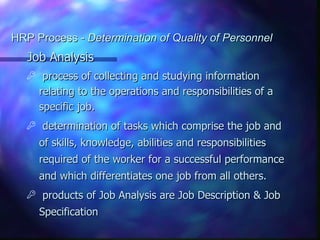
HRP Process - Determination of Quality of Personnel
   Job Analysis
       process of collecting and studying information
       relating to the operations and responsibilities of a
       specific job.
      determination of tasks which comprise the job and
       of skills, knowledge, abilities and responsibilities
       required of the worker for a successful performance
       and which differentiates one job from all others.
      products of Job Analysis are Job Description & Job
       Specification
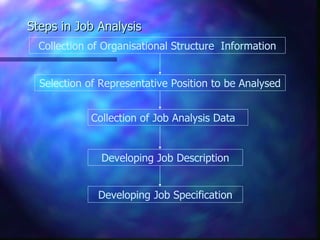
Steps in Job Analysis
  Collection of Organisational Structure Information


  Selection of Representative Position to be Analysed


             Collection of Job Analysis Data


               Developing Job Description


              Developing Job Specification
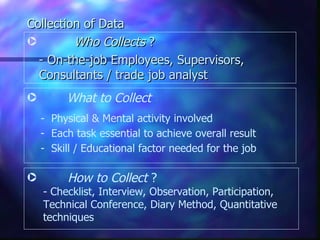
Collection of Data
·        Who Collects ?
  - On-the-job Employees, Supervisors,
  Consultants / trade job analyst
·        What to Collect
    - Physical & Mental activity involved
    - Each task essential to achieve overall result
    - Skill / Educational factor needed for the job

·        How to Collect ?
    - Checklist, Interview, Observation, Participation,
    Technical Conference, Diary Method, Quantitative
    techniques
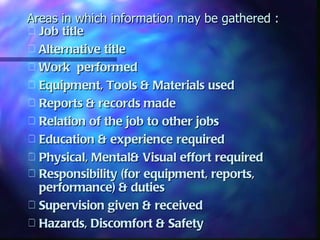
Areas in which information may be gathered :
 Job title
 Alternative title
 Work performed
 Equipment, Tools & Materials used
 Reports & records made
 Relation of the job to other jobs
 Education & experience required
 Physical, Mental& Visual effort required
 Responsibility (for equipment, reports,
  performance) & duties
 Supervision given & received
 Hazards, Discomfort & Safety
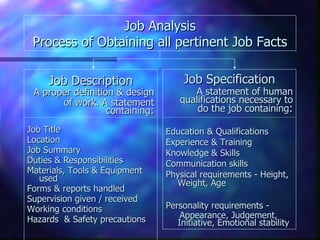
Job Analysis
 Process of Obtaining all pertinent Job Facts

     Job Description                 Job Specification
 A proper definition & design          A statement of human
       of work. A statement         qualifications necessary to
                   containing:          do the job containing:

Job Title                        Education & Qualifications
Location                         Experience & Training
Job Summary                      Knowledge & Skills
Duties & Responsibilities        Communication skills
Materials, Tools & Equipment     Physical requirements - Height,
   used
                                    Weight, Age
Forms & reports handled
Supervision given / received
Working conditions               Personality requirements -
Hazards & Safety precautions         Appearance, Judgement,
                                    Initiative, Emotional stability
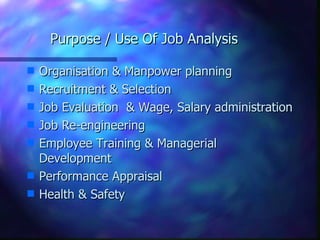
Purpose / Use Of Job Analysis

s   Organisation & Manpower planning
s   Recruitment & Selection
s   Job Evaluation & Wage, Salary administration
s   Job Re-engineering
s   Employee Training & Managerial
    Development
s   Performance Appraisal
s   Health & Safety
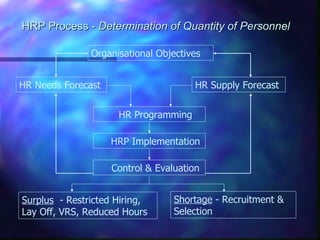
HRP Process - Determination of Quantity of Personnel

               Organisational Objectives


HR Needs Forecast                      HR Supply Forecast


                     HR Programming

                    HRP Implementation

                    Control & Evaluation


Surplus - Restricted Hiring,      Shortage - Recruitment &
Lay Off, VRS, Reduced Hours       Selection
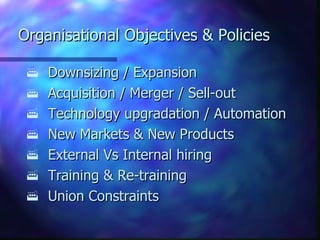
Organisational Objectives & Policies

    Downsizing / Expansion
    Acquisition / Merger / Sell-out
    Technology upgradation / Automation
    New Markets & New Products
    External Vs Internal hiring
    Training & Re-training
    Union Constraints
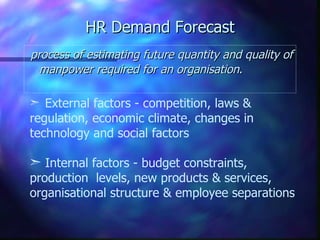
HR Demand Forecast
process of estimating future quantity and quality of
  manpower required for an organisation.

¢ External factors - competition, laws &
regulation, economic climate, changes in
technology and social factors

¢ Internal factors - budget constraints,
production levels, new products & services,
organisational structure & employee separations
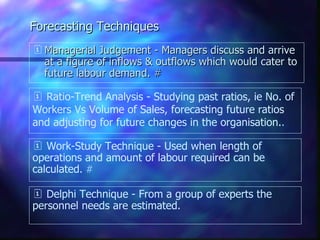
Forecasting Techniques
 Managerial Judgement - Managers discuss and arrive
  at a figure of inflows & outflows which would cater to
  future labour demand. #

 Ratio-Trend Analysis - Studying past ratios, ie No. of
Workers Vs Volume of Sales, forecasting future ratios
and adjusting for future changes in the organisation..

 Work-Study Technique - Used when length of
operations and amount of labour required can be
calculated. #

 Delphi Technique - From a group of experts the
personnel needs are estimated.
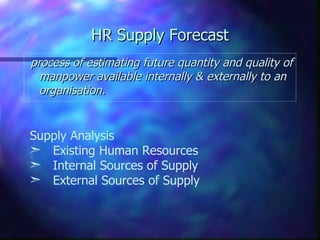
HR Supply Forecast
process of estimating future quantity and quality of
  manpower available internally & externally to an
  organisation.


Supply Analysis
¢ Existing Human Resources
¢ Internal Sources of Supply
¢ External Sources of Supply
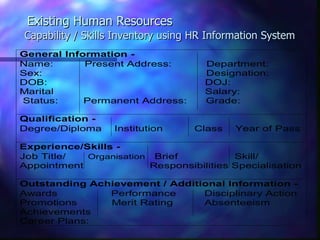
Existing Human Resources
Capability / Skills Inventory using HR Information System
General Information -
Name:       Present Address:         Department:
Sex:                                 Designation:
DOB:                                 DOJ:
Marital                              Salary:
Status:     Permanent Address:       Grade:

Qualification -
Degree/Diploma    Institution      Class    Year of Pass

Experience/Skills -
Job Title/  Organisation Brief           Skill/
Appointment             Responsibilities Specialisation

Outstanding Achievement / Additional Information -
Awards         Performance      Disciplinary Action
Promotions     Merit Rating     Absenteeism
Achievements
Career Plans:
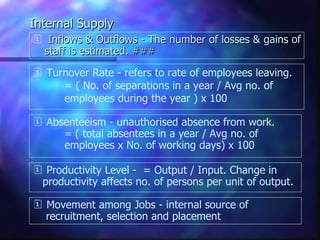
Internal Supply
 Inflows & Outflows - The number of losses & gains of
 staff is estimated. ###
 Turnover Rate - refers to rate of employees leaving.
     = ( No. of separations in a year / Avg no. of
     employees during the year ) x 100

 Absenteeism - unauthorised absence from work.
     = ( total absentees in a year / Avg no. of
     employees x No. of working days) x 100

 Productivity Level - = Output / Input. Change in
 productivity affects no. of persons per unit of output.

 Movement among Jobs - internal source of
  recruitment, selection and placement
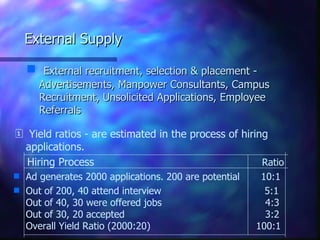
External Supply

    s External recruitment, selection & placement -
     Advertisements, Manpower Consultants, Campus
     Recruitment, Unsolicited Applications, Employee
     Referrals

 Yield ratios - are estimated in the process of hiring
 applications.
  Hiring Process                                      Ratio
s   Ad generates 2000 applications. 200 are potential    10:1
s   Out of 200, 40 attend interview                       5:1
    Out of 40, 30 were offered jobs                       4:3
    Out of 30, 20 accepted                                3:2
    Overall Yield Ratio (2000:20)                       100:1
HR Programming


    Balancing Demand and Supply


Vacancies filled in by the right employee at
the right time
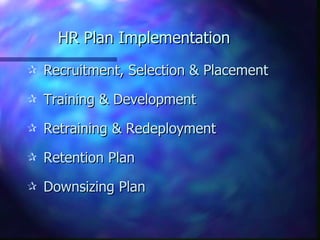
HR Plan Implementation
C   Recruitment, Selection & Placement
C   Training & Development
C   Retraining & Redeployment
C   Retention Plan
C   Downsizing Plan
Control & Evaluation

   Are Budgets, Targets & Standards met?
   Responsibilities for Implementation &
    Control
   Reports for Monitoring HR Plan

EmpowerPPT

  • 1.
  • 2.
    Definition : s processby which an organisation ensures that it has the right number & kind of people at the right place and at the right time, capable of effectively and efficiently completing those tasks that help the organisation achieve its overall objectives..
  • 3.
    Importance  1) Each Organisation needs personnel with necessary qualifications, skills, knowledge, experience & aptitude .  2) Need for Replacement of Personnel - Replacing old, retired or disabled personnel.  3) Meet manpower shortages due to labour turnover - Indian Airlines, Gas Authority of India headless for 10 months.  4) Meet needs of expansion / downsizing programmes - As a result of expansion of IT companies the demand for IT professionals are increasing. PSU’s offering VRS to employees to retrench staff and labour costs. DOT.COMs firing staff.
  • 4.
    5) Cater to Future Personnel Needs - Avoid surplus or deficiency of labour. 75% of organisations are overstaffed. Redeployment of staff to other units.  6) Nature of present workforce in relation with Changing Environment - helps to cope with changes in competitive forces, markets, technology, products and government regulations. Shift in demand from ERP to internet programming has increased internet programmers demand at Wipro, Infosys etc. ITI retrained its existing workforce in the new electronic telephone system.
  • 5.
    Other uses i) quantifyjob for producing product / service ii) quantify people & positions required ii) determine future staff-mix iii) assess staffing levels to avoid unnecessary costs iv) reduce delays in procuring staff v) prevent shortage / excess of staff vi) comply with legal requirements
  • 6.
    HRP Process -Determination of Quality of Personnel Job Analysis  process of collecting and studying information relating to the operations and responsibilities of a specific job.  determination of tasks which comprise the job and of skills, knowledge, abilities and responsibilities required of the worker for a successful performance and which differentiates one job from all others.  products of Job Analysis are Job Description & Job Specification
  • 7.
    Steps in JobAnalysis Collection of Organisational Structure Information Selection of Representative Position to be Analysed Collection of Job Analysis Data Developing Job Description Developing Job Specification
  • 8.
    Collection of Data · Who Collects ? - On-the-job Employees, Supervisors, Consultants / trade job analyst · What to Collect - Physical & Mental activity involved - Each task essential to achieve overall result - Skill / Educational factor needed for the job · How to Collect ? - Checklist, Interview, Observation, Participation, Technical Conference, Diary Method, Quantitative techniques
  • 9.
    Areas in whichinformation may be gathered :  Job title  Alternative title  Work performed  Equipment, Tools & Materials used  Reports & records made  Relation of the job to other jobs  Education & experience required  Physical, Mental& Visual effort required  Responsibility (for equipment, reports, performance) & duties  Supervision given & received  Hazards, Discomfort & Safety
  • 10.
    Job Analysis Processof Obtaining all pertinent Job Facts Job Description Job Specification A proper definition & design A statement of human of work. A statement qualifications necessary to containing: do the job containing: Job Title Education & Qualifications Location Experience & Training Job Summary Knowledge & Skills Duties & Responsibilities Communication skills Materials, Tools & Equipment Physical requirements - Height, used Weight, Age Forms & reports handled Supervision given / received Working conditions Personality requirements - Hazards & Safety precautions Appearance, Judgement, Initiative, Emotional stability
  • 11.
    Purpose / UseOf Job Analysis s Organisation & Manpower planning s Recruitment & Selection s Job Evaluation & Wage, Salary administration s Job Re-engineering s Employee Training & Managerial Development s Performance Appraisal s Health & Safety
  • 12.
    HRP Process -Determination of Quantity of Personnel Organisational Objectives HR Needs Forecast HR Supply Forecast HR Programming HRP Implementation Control & Evaluation Surplus - Restricted Hiring, Shortage - Recruitment & Lay Off, VRS, Reduced Hours Selection
  • 13.
    Organisational Objectives &Policies  Downsizing / Expansion  Acquisition / Merger / Sell-out  Technology upgradation / Automation  New Markets & New Products  External Vs Internal hiring  Training & Re-training  Union Constraints
  • 14.
    HR Demand Forecast processof estimating future quantity and quality of manpower required for an organisation. ¢ External factors - competition, laws & regulation, economic climate, changes in technology and social factors ¢ Internal factors - budget constraints, production levels, new products & services, organisational structure & employee separations
  • 15.
    Forecasting Techniques  ManagerialJudgement - Managers discuss and arrive at a figure of inflows & outflows which would cater to future labour demand. #  Ratio-Trend Analysis - Studying past ratios, ie No. of Workers Vs Volume of Sales, forecasting future ratios and adjusting for future changes in the organisation..  Work-Study Technique - Used when length of operations and amount of labour required can be calculated. #  Delphi Technique - From a group of experts the personnel needs are estimated.
  • 16.
    HR Supply Forecast processof estimating future quantity and quality of manpower available internally & externally to an organisation. Supply Analysis ¢ Existing Human Resources ¢ Internal Sources of Supply ¢ External Sources of Supply
  • 17.
    Existing Human Resources Capability/ Skills Inventory using HR Information System General Information - Name: Present Address: Department: Sex: Designation: DOB: DOJ: Marital Salary: Status: Permanent Address: Grade: Qualification - Degree/Diploma Institution Class Year of Pass Experience/Skills - Job Title/ Organisation Brief Skill/ Appointment Responsibilities Specialisation Outstanding Achievement / Additional Information - Awards Performance Disciplinary Action Promotions Merit Rating Absenteeism Achievements Career Plans:
  • 18.
    Internal Supply  Inflows& Outflows - The number of losses & gains of staff is estimated. ###  Turnover Rate - refers to rate of employees leaving. = ( No. of separations in a year / Avg no. of employees during the year ) x 100  Absenteeism - unauthorised absence from work. = ( total absentees in a year / Avg no. of employees x No. of working days) x 100  Productivity Level - = Output / Input. Change in productivity affects no. of persons per unit of output.  Movement among Jobs - internal source of recruitment, selection and placement
  • 19.
    External Supply s External recruitment, selection & placement - Advertisements, Manpower Consultants, Campus Recruitment, Unsolicited Applications, Employee Referrals  Yield ratios - are estimated in the process of hiring applications. Hiring Process Ratio s Ad generates 2000 applications. 200 are potential 10:1 s Out of 200, 40 attend interview 5:1 Out of 40, 30 were offered jobs 4:3 Out of 30, 20 accepted 3:2 Overall Yield Ratio (2000:20) 100:1
  • 20.
    HR Programming Balancing Demand and Supply Vacancies filled in by the right employee at the right time
  • 21.
    HR Plan Implementation C Recruitment, Selection & Placement C Training & Development C Retraining & Redeployment C Retention Plan C Downsizing Plan
  • 22.
    Control & Evaluation  Are Budgets, Targets & Standards met?  Responsibilities for Implementation & Control  Reports for Monitoring HR Plan