Employee Training and Development 7th Edition Noe Solutions Manual
Employee Training and Development 7th Edition Noe Solutions Manual
Employee Training and Development 7th Edition Noe Solutions Manual
Employee Training and Development 7th Edition Noe Solutions Manual
Employee Training and Development 7th Edition Noe Solutions Manual
1.
Employee Training andDevelopment 7th Edition
Noe Solutions Manual download
https://testbankfan.com/product/employee-training-and-
development-7th-edition-noe-solutions-manual/
Visit testbankfan.com today to download the complete set of
test bank or solution manual
2.
We have selectedsome products that you may be interested in
Click the link to download now or visit testbankfan.com
for more options!.
Employee Training and Development 7th Edition Noe Test
Bank
https://testbankfan.com/product/employee-training-and-development-7th-
edition-noe-test-bank/
Employee Training and Development 6th Edition Noe
Solutions Manual
https://testbankfan.com/product/employee-training-and-development-6th-
edition-noe-solutions-manual/
Employee Training And Development 5th Edition Noe Test
Bank
https://testbankfan.com/product/employee-training-and-development-5th-
edition-noe-test-bank/
Canadian Politics Critical Approaches 7th Edition Dyck
Test Bank
https://testbankfan.com/product/canadian-politics-critical-
approaches-7th-edition-dyck-test-bank/
3.
Anthology of WorldScriptures 9th Edition Voorst Test Bank
https://testbankfan.com/product/anthology-of-world-scriptures-9th-
edition-voorst-test-bank/
Introduction to Geographic Information Systems 8th Edition
Karl Solutions Manual
https://testbankfan.com/product/introduction-to-geographic-
information-systems-8th-edition-karl-solutions-manual/
Optical Fiber Communications 4th Edition Keiser Solutions
Manual
https://testbankfan.com/product/optical-fiber-communications-4th-
edition-keiser-solutions-manual/
Accounting for Corporate Combinations and Associations
Australian 7th Edition Arthur Solutions Manual
https://testbankfan.com/product/accounting-for-corporate-combinations-
and-associations-australian-7th-edition-arthur-solutions-manual/
Industrial Relations in Canada 3rd Edition Hebdon
Solutions Manual
https://testbankfan.com/product/industrial-relations-in-canada-3rd-
edition-hebdon-solutions-manual/
4.
Economics Principles andPolicy 13th Edition Baumol Test
Bank
https://testbankfan.com/product/economics-principles-and-policy-13th-
edition-baumol-test-bank/
receiving any answer,I thought everything was well and that I could
go ahead. I did not think this would happen. There is only one thing
that you can do. You must go and have yourself baptized in the
orthodox faith, or else you can receive neither your certificate nor
your appointment, and your career is at an end.’
“‘But how about this evening’s affair?’ I said, and the whole world
seemed reeling about me. ‘Am I not to receive my certificate? Am I
not to deliver my valedictory?’
“‘Strictly speaking, you should not be permitted to do either,’ said
the General, and his voice sounded even more sympathetic than
before; ‘but I should be sorry to see you suffer public humiliation. I
will tell you what I can do. If you will promise me that to-morrow you
will go and be baptized, I will accept your word of honor and you
shall receive your certificate and deliver your address. But you must
answer me at once,’ and he glanced at his watch, ‘for the hour is
growing late and the proceedings must soon begin.’
“My brain seemed to become paralyzed and to lose all power of
thought as I listened to the General’s words, kindly spoken, but, oh,
so bitter to me. My heart struck at my breast as though it would burst
its confines. I longed to give the answer the General desired, but the
figure of my dying father, lying outstretched upon his couch of
suffering, rose suddenly before me; again I saw his pale face and
blood-stained bandages, and again I heard his faint voice saying,
‘Above all, my son, never forget that you are a Jew, and never permit
anything to swerve you from your faithfulness to the holy traditions
of our religion and people’—and I could not.
“‘I cannot give you that promise now, your Excellency,’ I said, in a
broken voice, whose agonized groaning was perceptible even to me. ‘I
must have time to think over the matter.’
“‘In that case,’ said the General, and his voice sounded distinctly
harder, ‘I must ask you to leave the hall, where your presence has
become improper; and any time you are ready to take the necessary
steps you can notify me, and I will see to it that you receive your
certificate and appointment.’
“I saluted and retired. I went to my seat, took my military cap, and,
without saying a word to my fellow-students, at once left the hall,
though I could not fail to notice the buzz of astonishment from both
19.
cadets and audienceas I strode through the aisle toward the door.
That night on my couch I fought a fiercer battle than any in which I
could ever have taken part had I been privileged to enter upon my
projected career. Two opposing forces were arrayed against each
other and contended fiercely—on the one side self-interest and the
disappointment, naturally intense, at seeing an ardently desired
career thus cruelly cut off, nipped not even in the bud; on the other
side filial devotion and a newly awakened sense of racial and
religious loyalty. The one said: ‘Why ruin yourself? What does
Judaism concern you? You have never observed its precepts. Let
them sprinkle the three drops over you. It is only the ticket of
admission to your future. Inwardly you can remain as you are.’ The
other said little. It was only the pale face of my dying father and his
faint voice speaking: ‘Above all, my son, never forget that you are a
Jew, and never permit anything to swerve you from your faithfulness
to the holy traditions of our religion and people.’
“All night long the battle raged, while I tossed on my weary couch
and never closed an eye; but when the early morning light stole
through my lattice, my father had won the victory. I rose, hastily
made my toilet, and wrote a letter to the General, informing him that
my decision had been made to remain loyal to my faith, even at the
cost of my career. On the same day I packed together my belongings
and left forever that Russia that had grown hateful to me. I sailed at
once for America, the land where men are free and where the State
does not ask what is a man’s descent or religion before permitting
him to consecrate his services to it. In New York I found that my
talents and knowledge did not avail in securing a position. Every
place seemed filled and there was no lack of people of education
looking unsuccessfully for work. But, fortunately, I understood the
art of sharpening and tempering steel blades, and thus I became a
knife-sharpener and scissors-grinder, and manage to support myself.
Now you know why I am in New York, a scissors-grinder and a Jew,
instead of being in Russia, a captain of engineers and a Christian.
Can I sharpen anything else for you to-day? No, next time; all right,
good-bye.”
And the scissors-grinder went forth in search of other customers,
merrily whistling the while and leaving Mendel Greenberger behind,
plunged in deep reflection.
20.
THE SHLEMIHL.
Novo-Kaidansk wasa most shlemihlig sort of place, and
Yerachmiel Sendorowitz was the most shlemihlig of all its
inhabitants. Indeed, his character as such was so pronounced and
universally known that he was seldom referred to by his proper
cognomen, but usually spoken of as “Yerachmiel Shlemihl,” or, in
shorter form, “the Shlemihl.” For the benefit of those of my readers
who are not familiar with the Judæo-German idiom, I will explain
that the noun “Shlemihl” is generally supposed to be a corruption of
the first name of Shelumiel ben Zuri-shaddai, one of the princes of
Israel in the wilderness, of whom Heine has sung, and who,
according to Jewish tradition, was a most awkward sort of fellow,
who was continually getting into all sorts of scrapes. The noun
“Schlemihl,” accordingly, signifies an aggravated sort of ne’er-do-
well, a hopeless incapable; and the adjective derived therefrom is
synonymous with all that is utterly unprogressive and wretched.
21.
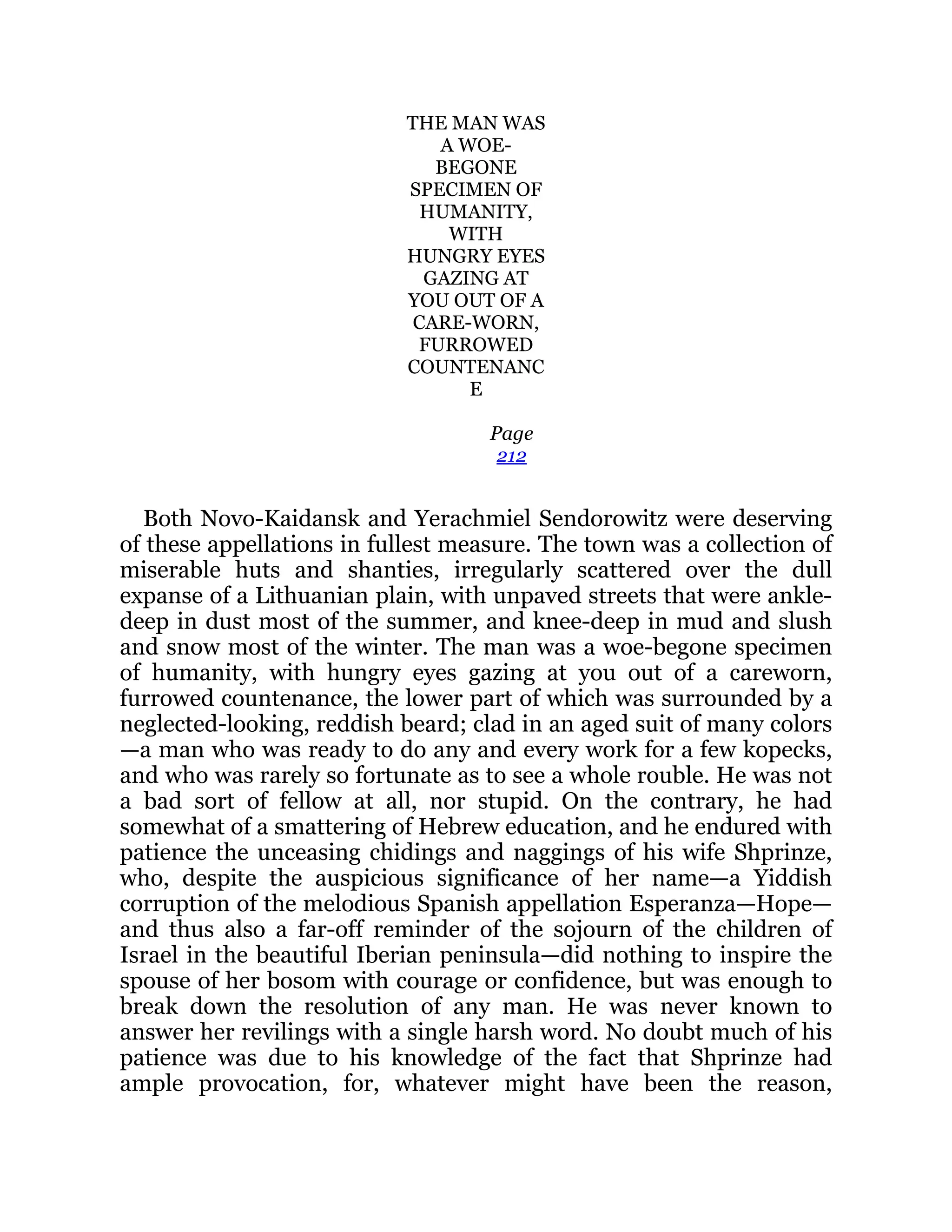
THE MAN WAS
AWOE-
BEGONE
SPECIMEN OF
HUMANITY,
WITH
HUNGRY EYES
GAZING AT
YOU OUT OF A
CARE-WORN,
FURROWED
COUNTENANC
E
Page
212
Both Novo-Kaidansk and Yerachmiel Sendorowitz were deserving
of these appellations in fullest measure. The town was a collection of
miserable huts and shanties, irregularly scattered over the dull
expanse of a Lithuanian plain, with unpaved streets that were ankle-
deep in dust most of the summer, and knee-deep in mud and slush
and snow most of the winter. The man was a woe-begone specimen
of humanity, with hungry eyes gazing at you out of a careworn,
furrowed countenance, the lower part of which was surrounded by a
neglected-looking, reddish beard; clad in an aged suit of many colors
—a man who was ready to do any and every work for a few kopecks,
and who was rarely so fortunate as to see a whole rouble. He was not
a bad sort of fellow at all, nor stupid. On the contrary, he had
somewhat of a smattering of Hebrew education, and he endured with
patience the unceasing chidings and naggings of his wife Shprinze,
who, despite the auspicious significance of her name—a Yiddish
corruption of the melodious Spanish appellation Esperanza—Hope—
and thus also a far-off reminder of the sojourn of the children of
Israel in the beautiful Iberian peninsula—did nothing to inspire the
spouse of her bosom with courage or confidence, but was enough to
break down the resolution of any man. He was never known to
answer her revilings with a single harsh word. No doubt much of his
patience was due to his knowledge of the fact that Shprinze had
ample provocation, for, whatever might have been the reason,
22.
Yerachmiel simply couldnot earn a living. But, though Shprinze had
provocation for her ill-temper, justification she had none.
Yerachmiel did the very best he could, and it was not his fault but
only the cruelty of unfeeling fate which prevented him from
extracting even “bread of adversity and water of affliction” from the
world. He tried to earn a little by being a porter or burden-bearer for
one of the merchants of the town at very scanty wages, but just as he
was about to get the place, along came a younger and stronger man
and offered to do the work for even less. Needless to say, the latter
was selected. He thought he could earn his livelihood by being a
Mithassek, that is to say, one who watches at the bed of the dead and
performs the funeral ablutions and rites; but it was provokingly
healthy that season. No one died for a long time; and when at last the
angel of death did claim one of the Hebrew residents of Novo-
Kaidansk—a wealthy Baal Ha-Bayith he was, too, whose family
always paid liberally for all services rendered to any of its members—
it just happened that they had a poor relative, an aged man of greater
learning and stricter piety than Yerachmiel; and so, of course, he was
preferred, and Yerachmiel was not considered at all. At one time he
dealt in fruit, purchasing a small stock with a sum of money which a
pitying philanthropist had given him in order to set him up in
business; but the demand for fruit was very slack just then, and in a
short time Yerachmiel decided to retire from that line of commerce
with the capital which he had originally possessed, that is to say,
nothing. He made a dozen other attempts to coax the unwilling world
into providing him with sustenance, but each attempt ended with the
same result—failure, and caused him to sink appreciably lower in the
estimation of Shprinze, whose temper grew bitterer and whose
tongue sharper with every new proof of her husband’s
Shlemihligkeit. In fact, the term Shlemihl no longer harmonized with
her conception of her husband’s worthlessness; it was too mild, too
utterly inadequate. She began to address him by no other term than
Shlamazzalnik, that is, one doomed and predestined to perpetual
misfortune; and soon the neighbors and the other townspeople, and
even the children on the streets, took up the cry, and “Yerachmiel
Shlamazzalnik” resounded from one end to the other of the dusty
highways of Novo-Kaidansk whenever the poor fellow made his
appearance. Poor Yerachmiel! He used to console himself by saying
that he was the equal in some respects of the great Ibn Ezra, the
23.
renowned Hebrew exegeteand poet of the Middle Ages, for the latter
was also an incurable Shlemihl and Shlamazzalnik. Yerachmiel used
to think he was reading of his own experiences when he read the
complaint of Ibn Ezra:
“Were I to deal in candles,
The sun would shine alway;
And if ’twere shrouds I’d handle,
Then death would pass away.”
But poetry, though it may be a good consoler, is a poor substitute
for substantial food and the other requisites of a comfortable life;
and so Yerachmiel was not entirely satisfied with his lot, even though
the great Ibn Ezra was a companion in misfortune. Finding that his
attempts to earn a living by work were not crowned with success,
Yerachmiel did what other unsuccessful persons have done under
similar circumstances—he took to religion. He became an assiduous
attendant at the local Beth Hammidrash, was present at all services,
morning, afternoon, and evening, and remained in the sacred edifice
during the greater part of the day and night. He would pray with
great fervor, particularly the “prayer for sustenance” at the end of the
morning service, would listen attentively to the rabbi or the other
learned Talmudists expounding the Holy Law, and would sometimes
try to learn a little himself from some of the bulky tomes. He was, no
doubt, sincere in his new-found fervor, but candor impels the
statement that one of the motives of his fondness for the sacred place
was a desire to have a refuge in which the sharp tongue of Shprinze
could not reach him; and another was a desire to participate in the
doles which were distributed on certain occasions, such as the
beginnings of months or the memorial days of the death of the
parents of well-to-do members to the poor persons who regularly
attended. In this way he managed to exist in a precarious fashion, at
least without being a burden to his wife; for whenever he had a little
money he gave it to her, and when he had none he simply did not eat.
It is true, he was sometimes obliged to go without food or with next
to none for several days at a time; but, like all other things, semi-
starvation becomes a habit, and Yerachmiel was so used to it he did
not even complain.
24.
One afternoon hewas poring over one of the volumes of the
Talmud, trying to interest himself in a particularly intricate
disputation between Abaye and Raba, and thus forget the
unidealistic fact that he had not eaten a substantial meal in three
days, and that there were no visible prospects of obtaining any in the
near future. He had fallen into a light doze, and was just dreaming
that he had been invited by the Parnass to take dinner with him on
the Sabbath, and that the Sabbath goose, juicy and savory and
appetizing, had just been carried to the table, when he was aroused
by a hearty whack on his shoulders and a loud voice exclaiming, in
boisterous though friendly tones, “Wake up, old Chaver! What are
you doing here?” Yerachmiel awoke with a start. The vision of savory
goose disappeared into thin air, and he was about to protest angrily
against the rude disturbance of his entrancing dream when he
recognized that the man who stood before him with a broad smile
upon his countenance was none other than Shmulke Aronowitz, his
old-time friend and boyhood comrade. It was Shmulke, sure enough,
but strangely altered. He was dressed in an elegant suit of foreign
make; his hair and beard were closely trimmed, and his whole
appearance, including his ruddy countenance and his cheerful smile,
indicated prosperity. All of these characteristics were strange enough
in Novo-Kaidansk, heaven knows, but they were hardly to be
wondered at in Shmulke, who had emigrated to America some
twenty years previously and had amassed wealth in the liquor
business in the classic vicinity of Baxter Street, New York. He had
Americanized his cognomen into Samuel Aarons, and had
incidentally acquired local fame by pugilistic ability so that he was
sometimes referred to as “Sam, the Hebrew slugger.” He was now on
a visit to his native town, where his parents still resided, and was
unfeignedly glad to see Yerachmiel, who had been a real chum to him
in boyhood days. The latter sat gazing dazedly at his old friend for a
few moments, utterly unable to speak, so overwhelmed was he by the
unexpected sight and also by the manifest contrast between his own
condition and that of his friend.
Shmulke recalled him to himself. “Come, come, old comrade,” he
said with good-humored impatience. “Don’t sit staring at me as
though I were a curiosity in a circus. Speak out and tell me how you
are getting on.” Thus encouraged, Yerachmiel lost no time in pouring
his sad story into the ears of his friend. Shmulke listened attentively
25.
until the talewas all told, including the present hunger and the
dream goose, and then said: “That is too bad, Yerachmiel. I am really
sorry that you are so unfortunate. Come with me now to the inn of
Reb Yankele, where, if you can’t get the roast goose of which I
deprived you, at least you can get something to eat, and there we can
consult as to what can be done for you.” Yerachmiel complied with
alacrity.
Reb Yankele was more than surprised at the unexpected
apparition of Yerachmiel the Shlemihl, who had never in all his life
been rich enough to be a guest at the Kretchm, although he had been
glad to get an occasional meal or drink there in return for odd jobs,
boldly entering his establishment as the companion of a manifestly
prosperous Deitch. He stepped forward with an obsequious bow and
a deferential “What do the gentlemen wish?”
“The best your house has of food and drink,” answered Shmulke,
“and be quick about it. A rouble or two more or less makes no
difference.”
Thus encouraged the innkeeper performed his task with alacrity;
and in a few minutes Shmulke and Yerachmiel were sitting down
before a very fair meal, consisting of beet soup, roast chicken, boiled
potatoes, black bread, onions sliced in vinegar, and a large bottle of
vodka. Yerachmiel almost imagined himself in Gan Eden, and was
convinced that if dreams were not prophetic, they were certainly
closely akin to prophecy. The roast chicken, if not equal in quality to
the dream goose, was not much inferior; and the vodka, while
undoubtedly not as good as the wine which is stored up for the
righteous since creation’s dawn, was yet abundantly satisfying to a
poor sinner in the cheerless present.
Shmulke watched Yerachmiel’s enjoyment of the meal with a quiet
smile of satisfaction, and said to him: “What is the best way to
provide you with a permanent parnoso?” Yerachmiel did not exactly
know. He suggested half a dozen different sorts of business, from
banker to butcher, but was most inclined to favor the occupation of
innkeeper, of whose delights he had just had emphatic
demonstration.
Shmulke rejected all these propositions with scorn. “To tell you the
truth,” he said, “I don’t believe you could succeed at anything in
Russia. You are too much of a Shlemihl, and you could never get
26.
along without someone to look after you. What do you say to going
with me to America? I would set you up in business and help you
along with my advice.”
The magnificence, as well as the unexpectedness, of this proposal
fairly took Yerachmiel’s breath away. Indeed, it made him feel a little
faint. He did not really want to go to America. He admired America
as a land of extraordinary and incomprehensible prosperity; but he
also feared it as a land which corrupted Jewish piety, and made the
holy people faithless to their ancient heritage. He would rather have
remained in his native place and continued to live in his accustomed
manner could he have been assured of even the most modest
sustenance. But in his heart he knew that Shmulke had spoken the
truth; that he was too much of a Shlemihl to succeed without friendly
aid and sympathetic guidance, and that he could not expect to
receive those from any one except the old friend of his youth. He
therefore murmured a confused assent, adding, however, faintly that
he was afraid Shprinze might not be willing to have her husband
leave her and go to so distant a land.
“Don’t worry about that, old friend,” said Shmulke, with a broad
smile. “I’ll guarantee that she will not put any obstacles in the way of
her own prosperity. And now that you have agreed, we will go and
see her at once.”
Shmulke was right. Shprinze assented at once to Shmulke’s
proposition, which was that he would take Yerachmiel to America
and assist him to become self-supporting, that he would provide her
with sufficient money to maintain her for several months until
Yerachmiel would probably be able to send her of his own earnings;
and that if Yerachmiel proved unable to adapt himself to the
conditions of America and find his way in his new home, at the end
of three years he, Shmulke, would send him back to his native place
with a substantial gift. Indeed, her assent was so willing, and given
with such manifest pleasure, that it jarred disagreeably upon
Yerachmiel, and was not altogether pleasing even to Shmulke.
Thus did Yerachmiel Sendorowitz become a resident and a
respected citizen of the metropolis of America. It is not necessary to
enter into the details of his career in the New World, which did not
differ essentially from that of many of his Russian Jewish
compatriots. At first he was a peddler, Shmulke providing him with
27.
suitable goods andinitiating him into the mysteries of the
profession. He did not fail. The mysterious something in the
American atmosphere which confers energy and shrewdness and
practical sense seemed to be even more potent than usual in his case.
This may have been due to the fact that the Shlemihligkeit, which
had hitherto been his distinguishing characteristic, had been more
apparent than real, and that he had really possessed innate qualities
of courage and astuteness which only had lacked the opportunity of
manifesting themselves. However that may have been, he certainly
became a different man under the invigorating influence of America.
He toiled early and late with untiring assiduity and industry; he
purchased his little articles of merchandise wisely and sold
prudently. In six months he had developed into a customer peddler,
and no longer wandered through the streets with a pack upon his
back, but went with samples only to the numerous customers whose
friendship and trade he had gained, and received their orders. A year
later he had given this up also, and was the proud and happy
possessor of a peddler’s supply store in one of the little streets which
abut on the main thoroughfare of the Jewish East Side, Canal Street,
and had purchased a tenement house. Success even affected his
personal appearance favorably. The old slouchy, unkempt, ne’er-do-
well, with the hungry eyes and hopeless air, had disappeared forever,
and in his stead had come a bright, alert, neat, active man.
Yerachmiel the Shlemihl had given way to Mr. Sendorowitz, the
prosperous wholesale merchant and real-estate owner. Nor had he
failed to keep his promises to Shprinze. He wrote to her regularly,
every week, telling her in detail and with great pride about his doings
and his successes, not failing either to give due credit to Shmulke for
the large share which the latter had had in bringing about these
gratifying results, and always inquiring solicitously about her health
and welfare. Once a month he sent her money, at first only a few
roubles, afterward larger sums, but always sufficient to enable her to
live in proper comfort in the little Russian town of her residence. He
often wrote her, too, of his intention to go out and take her to his new
home as soon as business would permit, she having expressed a
strong aversion to crossing “the great sea” alone. In all this he was
thoroughly sincere, for he was naturally the soul of honor, and really
loved his wife in a simple, unreflecting way, despite the slight cause
she had ever given him for affection. Besides, his Talmudic studies
28.
had given hima clear conviction that a Jewish husband was under
many obligations to his wife; but his ideas of the counter duties of
wife to husband were much less distinct. Despite the slight demands
which he made upon the conjugal sentiment of his life partner, he
had, however, to confess to himself that the letters of Shprinze were
not satisfactory. They were excessively brief, not very frequent,
expressed very little interest in his personal welfare or his doings,
and invariably contained a demand for a larger amount of money.
Yerachmiel tried to obey the rabbinical precept, “Judge every one
leniently,” and to find excuses for Shprinze’s unsympathetic
demeanor. He told himself that women are naturally inclined to
scold, and that Shprinze was merely following the rule of her sex;
that she did not put full faith in his tales of prosperity, and was
demanding money as a test of their truth; that women are naturally
less expressive of the affection they feel than are men, and a half-
dozen other excuses for her apparent coldness and mercenariness.
But none of these excuses seemed really adequate, and gradually
Yerachmiel found a great dissatisfaction with the conduct of his wife
toward him rising in his breast. Finally, a most painful question
began to torture him. “Did Shprinze love him at all, or was her
interest in him purely mercenary, and limited to the material
benefits which she could derive from him?”
Simple-minded as Yerachmiel was in worldly things, untutored in
romantic concepts and affairs of the heart, his whole nature revolted
against the idea of marital relations with a woman in whose soul
burned no flame of love for him as her husband. But how could he
ascertain the truth; how find out whether his wife really loved him or
not? Gradually a plan matured in his mind. He did not permit
Shprinze to have any inkling of the doubts and the conflicting
emotions by which he was agitated. He wrote her as frequently and
regularly as hitherto, and sent her monthly remittances of money
with unfailing punctuality. After some five years of absence he wrote
her that he had found it at last possible to withdraw his constant
personal attention from business for a few months, and that he
would come out and take her with him to his new home in America.
When Shprinze received this letter it did not fill her with the joy
which the prospect of reunion with a beloved and long-absent
husband might be expected to inspire in the heart of an affectionate
and devoted wife. She would have preferred the indefinite
29.
continuance of thecondition which had now lasted upward of five
years, and which she had found very agreeable. It had been very
pleasant to receive constant remittances of money, to live in comfort
and ease, and to be looked up to on all sides as the fortunate and
happy one. When she had entered the women’s gallery in the
synagogue all the women had hastened to make way for her with the
utmost deference; and many a highly esteemed Baal Ha-bayis had
looked upon her with favor, and would not have spurned to ask her
hand in marriage if her incumbrance on the other side of the Atlantic
would only have been good enough to make a polite exit for a better
world, leaving her a substantial fortune in American dollars. And
now all this was to cease; and she must leave her native place for a
strange land, and live again with one whom in her heart she still
despised as a Shlemihl, despite his unexpected good fortune in the
New World. Besides, she had a dim presentiment of evil, a feeling
that the advent of Yerachmiel meant some undesirable change in her
tide of fortune, why or what she could not think. At last a despatch
came from Yerachmiel, informing her that he was in Hamburg, and
would reach Novo-Kaidansk with the train due at such and such an
hour. At the appointed hour she was at the station, accompanied by
quite a throng of Jewish townsfolk bent on giving their long-absent
townsman a hearty welcome. Speculation was rife as to his
appearance. Some thought that his long absence in a foreign land
would have removed his Jewish looks; that he would have shaved off
his beard and assumed in every way the appearance of the Gentile.
Others thought such a thing impossible of Yerachmiel Sendorowitz;
that he was far too pious and God-fearing to fall away so utterly from
Jewish ways, and that the only change probable was that he would be
elegantly attired in fine clothing, and would show in his prosperous
and beaming aspect the possession of much America-gained wealth.
The grimy train, drawn by the ugly, soot-covered locomotive, swept
into the low-roofed Russian station. The swarm of passengers, of all
kinds and degrees, flowed from the narrow openings of the cars; and
then a shock came over the waiting throng. From amidst the crowd
of passengers emerged one who was unmistakably Yerachmiel; and,
horrible to relate, the Yerachmiel of old, Yerachmiel the Schlemihl.
To be sure, he was not exactly the same in appearance as of old, for
the hat and suit that he wore were of American make; but they were
shabby and dusty, and ill suited to a prosperous man. His hair and
30.
beard were unkemptand neglected, and his face bore an expression
of anxiety and care. All were surprised and shocked; but the most
pitiably shocked of all was Shprinze. Yerachmiel at once recognized
his townsmen and his wife, and advanced with a sort of wan smile to
greet them. The former, of course, returned his greetings, and
inquired how he had fared in America; but their embarrassment was
only too manifest, and cutting short his answers to them, Yerachmiel
turned to his wife, who had been standing all the while as if petrified,
and said: “Come, Shprinze, let us go home.” Mechanically she led
him to her home. Hardly had the door of the little dwelling closed
behind them when all the animation and energy which had left
Shprinze when she beheld her spouse in such unexpected and
unwelcome guise suddenly returned.
“What is the meaning of all this?” she demanded fiercely, while
flames of wrath blazed from her piercing eyes. “Why do you come to
me from America looking like a beggar and a ragged saint fresh from
the benches of the Beth-Hammidrash instead of a prosperous New
York merchant, as you had made us all believe you had become? Was
it all a lie, your oft-repeated tale of your success in business and your
progress? Did you steal the money you sent me, and have you fled
from the officers of the law, who, perhaps, are after you now? Oh,
you are still the same old Shlemihl, the same old goodfor-nothing!
Why did the Most High curse me by making me your wife?”
“My dear Shprinze, do not rave so!” expostulated Yerachmiel.
“How can you say such things before you have heard any explanation
from me? I am not a liar nor a Shlemihl. Whatever I wrote you about
my business success in America was strictly true; and the money I
sent you was my own, and all honestly earned. I have come to take
you with me to America; and I already have the steamship tickets for
us both, and plenty of money for railroad fare and necessary
expenses.”
“Then why are you dressed so shabbily?” continued Shprinze, with
undiminished fierceness; “and why do you look so down-hearted? Is
that the appearance and the bearing suitable to a wealthy merchant,
such as you have claimed to be?”
“I suppose I am not very particular about my appearance,”
answered Yerachmiel; “and then, I admit, I have had considerable
trouble and losses in business lately, and that may have given me a
31.
worried look. Butwhat need that concern you? I have learned the art
of getting on in America, and I do not fear but that I shall soon be
able to recover whatever I have lost. In the mean while I am here. I
am your husband, and I ask you to come and make your home with
me.”
“You are mechulleh,” said Shprinze, suspicion gazing out of every
line of her excited countenance. “I can understand from what you
admit that you have lost all you had, and you want me to share your
poverty, or perhaps to give you the money that I have saved from
what you sent me! I shall not do it! I do not want to go with you! Give
me a Get. I do not want to be the wife of such a Shlemihl.”
Yerachmiel’s pale face became fiery red when he heard these harsh
and heartless words; but again he endeavored to bring his wife to a
better frame of mind. “Shprinze,” he said in appealing tones that
might have melted a heart of stone, “is this my welcome home? Have
I deserved this of you? Have I not always been faithful to you, even
when I was a poor Shlemihl in this town, and did I not give you every
kopeck I earned? Did I not send you money abundantly from
America? You may trust me. I still have the means to support my
wife, and therefore I again ask you to come with me to my home, as
beseems a good and true wife in Israel.”
“I will believe you are not mechulleh,” said Shprinze, in a tone of
calculating shrewdness, “if you will give me a thousand roubles now.
If you do that I will go with you.”
“That I shall not do,” said Yerachmiel, a manly anger getting the
better of his usual extreme mildness. “I do not need to buy my wife.
Have you no love for me at all? I ask you to go with me because I can
support you; and as a wife you can ask no more.”
“Then I see you are mechulleh,” answered Shprinze, “and I will not
go. Divorce me, I say; give me a Get. I want none of you or your
money. All I want is a Get.”
Again and again did Yerachmiel appeal to Shprinze’s better nature.
It was of no avail. She persisted in her demand and could not be
induced to alter it. Seeing that her determination was unalterable
and that her one wish was to be separated from him, Yerachmiel,
although according to the Jewish religious law he could have refused
to consent to the desired divorce and thus have effectually baffled
32.
any other matrimonialplans that Shprinze might have entertained,
decided to accede to her wishes. “I shall do as you ask, hard-hearted
and ungrateful woman,” he said; “for even now that you treat me
thus cruelly I wish you no evil. But one thing I must tell you. In order
to show that this divorce is not in accordance with my wish, I shall
pay neither the rabbi, nor the scribe, nor any of the other expenses.
Whatever outlay there is you must defray. Thus shall all know that
you are the one who seeks to undo the bond that has bound us
together these many years, but that I am satisfied to keep you as my
lawful, wedded wife.”
Shprinze eagerly agreed to this; and having further agreed that
they should meet on the morrow in the house of Rabbi Israel, the
spiritual guide of the Jewish community of the town, they separated,
Yerachmiel leaving the house without word of farewell.
Great was the surprise of Reb Yankele, the innkeeper, when
Yerachmiel, whom he had assisted in welcoming at the railroad
station a few hours previously, entered the inn and gloomily inquired
whether he could be accommodated with food and lodging for the
night. He wondered greatly why Yerachmiel was not staying in his
own home on the first night after his arrival from a distant land; but
the latter volunteered no explanation, and Reb Yankele did not
venture to ask for any. However, he did not need to remain long in
ignorance. No sooner had Yerachmiel left his wife’s house than
Shprinze rushed to the nearest female neighbor and told her the
news, adding many dreadful details about the repulsiveness of
Yerachmiel’s appearance, his poverty, and his hopeless
Shlemihligkeit; adding, however, that in spite of all she must be
grateful to him for his willingness to grant her the divorce she
craved, and assuring her (the neighbor) of her unutterable joy at the
prospect of being at last free from an incurable Shlemihl and
Shlamazzalnik. The neighbor, of course, had no more imperative
duty to perform than to put her shawl over her head and rush to
communicate to her nearest neighbor the news, still fresh and hot, of
the impending divorce of Yerachmiel and Shprinze Sendorowitz. In
this way not two hours had passed before the whole Kehillah of
Novo-Kaidansk had learned the news. Reb Yankele had learned why
Yerachmiel was his guest; and even Rabbi Israel had been informed,
33.
at evening servicein the synagogue, of the function which he was to
be asked to perform on the morrow.
At nine the next morning Yerachmiel and Shprinze were in the
large front room in the rabbi’s dwelling, which served as his office,
and whither repaired whosoever in Novo-Kaidansk had a religious
question to ask or a ceremony to be performed, or that was in need of
spiritual counsel or guidance of any kind. Shprinze was gayly attired,
and chattered constantly with a group of female acquaintances by
whom she was surrounded. She was in high spirits, and cast
occasional contemptuous glances at Yerachmiel, who sat, moody and
abstracted, in a corner and spoke to no one. Besides these the room
was crowded with the most notable members of the congregation,
drawn hither by the exceptional interest which this extraordinary
case had aroused. The side door opened, and a hush fell upon the
assembly as the venerable Rabbi Israel, accompanied by two
coadjutor rabbis and several other persons who were to take part in
the solemn function of pronouncing the divorce, entered and took
their places in seats which had been reserved for their occupancy,
behind long tables at the head of the room. The Shammas then asked
in a loud voice whether there was any one present who desired to
consult the Beth Din on any matter. At this Yerachmiel arose, and,
addressing Rabbi Israel, said: “Venerable rabbi, I desire to divorce
my wife, Shprinze, daughter of Moses; and I request of you to ordain
the issuing of such a divorce, according to the law of Moses and
Israel.”
“I hear your request with sorrow,” said the rabbi, while an
expression of pain passed over his venerable features. “Is it the desire
of your wife also that your marriage be dissolved?”
Yerachmiel bent his head in assent; and the Shammas, in response
to a motion of the rabbi’s hand, called in a loud voice: “Shprinze,
daughter of Moses, step forward.” Shprinze did so, and the rabbi put
to her the question whether she consented to the dissolution of her
marriage to Yerachmiel, son of Isaac, to which she responded with a
loud and distinct “Yes.” Summoning them both before him, the rabbi
now addressed to them a long and earnest plea to give up their
intention of divorce. He pointed out to them that, although the holy
Torah permitted the dissolution of a marriage which had been
polluted and desecrated by gross and abominable sin, or which had
34.
grown utterly intolerableto either or both parties, and left it to their
decision whether it should be dissolved; yet it did not approve, but,
on the contrary, severely condemned, the tearing asunder of the holy
bonds of wedlock, and that in the words of the sages the altar shed
tears over husband and wife who became recreant to the covenant of
their youth. He therefore entreated them most earnestly to become
reconciled to each other, and to remain faithful to the pledges which
they had once taken upon each other. To this touching plea they
returned no answer. Yerachmiel gazed at the floor, his face
alternately flushed and ashy pale. Shprinze gazed at the rabbi with
firm eyes and shook her head in the negative. Seeing that his efforts
at reconciliation were useless, the rabbi then announced “the giving
of the Get must, therefore, take place.”
These words were the signal for the commencement of the divorce
ceremonial, which was now performed with all the solemn and
impressive formalities with which it has been carried out since time
immemorial in Israel. The rabbi appointed an expert and skilful
scribe to write the bill of divorce, which must be written in strict
accordance with many minute and detailed rules, the neglect or
violation of any of which would render it invalid. He also designated
two pious and trustworthy men, both proficient in the art of writing
the square Hebrew script, to act as the official witnesses to the
document. The scribe seated himself at his desk and produced his
paper, quill pen, and ink, all of them specially prepared, in
accordance with fixed rules, for this purpose. To him Yerachmiel,
acting under the instruction of the rabbi, now spoke and directed
him to write a bill of divorce for his wife, Shprinze, daughter of
Moses. Amidst breathless silence the scribe now began to write the
document which was to sunder two lives hitherto joined. The writing
lasted a considerable time; and during all its continuance not a
sound, save the steady scratching of the scribe’s pen, was heard, for it
is strictly forbidden to make a noise of any kind while a Get is being
written, lest the sound disturb the Sopher and cause him to err in
some particular, thus necessitating the rewriting of the document. At
last the bill of divorce was finished and the two witnesses appended
their signatures, written in the square Hebrew script, and without
title of any kind. The rabbi then designated two other men of
religious standing and good repute to be the official witnesses of the
delivery of the Get. Summoning Shprinze, the rabbi bade her uncover
35.
her face, whichhitherto during the proceedings had been covered
with a heavy veil, and said to her in solemn tones: “Shprinze,
daughter of Moses, art thou willing to accept a bill of divorce from
thy husband, Yerachmiel, son of Isaac?” Shprinze responded with a
firm “Yes.” Turning to Yerachmiel, the rabbi asked him whether he
still desired to divorce his wife, to which Yerachmiel answered in the
affirmative. Turning again to the woman, the rabbi said in a stern
voice: “Give me thy Ketubah. Thou no longer hast any use for it.” At
this, the most feared part in the divorce ceremony, Shprinze’s face
grew slightly pale; but she drew forth her marriage certificate, which
she had brought along for this purpose, and gave it to the rabbi, who
laid it aside, to be destroyed immediately after the completion of the
divorce proceedings. The rabbi then bade her remove her marriage
ring and extend her hands to receive her bill of divorce. Yerachmiel
then took the bill of divorce, placed it in the outstretched hands of
Shprinze, and said: “Behold, this is thy bill of divorce. Accept thy bill
of divorce, and by it thou art released and divorced from me, and free
to contract lawful marriage with any other man.” With a few earnest
words from the rabbi pointing out the duty of living their separate
lives in peace and righteousness, and of avoiding in the future the
sins which had led to this sorrow, the ceremony was concluded.
Yerachmiel and Shprinze were no longer man and wife. At once a
clamorous buzz of conversation arose all over the room. The
excitement which had been suppressed so long now burst the bonds
of enforced silence and found relief in vociferous exclamations of
wonderment and emphatic expressions of approval and disapproval.
Some of the women congratulated Shprinze; others held aloof. The
men were unanimous in their condemnation of the hard-hearted
woman who had taken her husband’s money for years and then
induced him, when grown poor, to give her a divorce.
The excitement was at its height, when suddenly a tremendous rap
on the table drew the startled gaze of all toward the spot whence the
sound had proceeded. What they saw caused a hush to fall over the
assemblage. Yerachmiel stood at the side of one of the tables, his
cheeks ashy pale, his eyes blazing with a furious light that no one had
ever seen in them before, fiercely rapping with his cane in an effort to
procure silence. As soon as his voice could be heard he began to
speak.
36.
“Jewish brethren andsisters of Novo-Kaidansk,” he said, with
painfully labored yet distinct utterance. “You have come here to see
Yerachmiel the Shlemihl give divorce to his wife, Shprinze. I know
most of you are good people and have pitied me for being such a
Shlemihl that I could not keep either my money or my wife. But,
perhaps, I am not such a Shlemihl after all. I have not desired nor
sought this divorce, but I have tried to find out the truth about an old
wrong and to right it; and I believe I have succeeded as well as some
who are considered wiser and cleverer than I. Shlemihl though I may
be, I have always tried to do my duty toward my wife. Even before I
went to America, when poverty and wretchedness were my lot in this
town, I gave Shprinze every kopeck that I earned. From America,
where God blessed me and made me prosperous, I sent her regularly
all that she could properly require. But in return for this I asked
wifely love. I knew that a husband must honor, cherish, and maintain
his wife; and that a wife must, in true marriage, return love for love,
affection for affection. Shprinze never showed the least trace of love
for me. My soul hungered and thirsted for love. Shprinze gave me, at
worst, bitter revilings and beratings, tongue-stabbings that pierced
my soul like the thrusts of a sword; at best, cold indifference. In the
beginning, when I could not, because of poverty, properly support
her, I excused her. I said to myself that I deserved nothing better. But
when from America I sent abundance of gold and loving words, and
showed in every way I could that I was a true and loving husband,
and when, in return for all this, I could not get an affectionate word,
a loving sentence, I resolved that I would find out whether in
Shprinze’s heart dwelt a spark of love for me, or whether it was only
my gold she loved. The rest you know. I came here, dressed in
shabby clothing, looking the olden Shlemihl. Her evil heart made her
quickly conclude that I had lost my all, and without questioning me
or offering, like a true wife, to share my lot, she demanded a divorce.
I saw that she loved me not, that she had never been to me more
than a wife in name, and to-day I have granted her wish. But let me
assure her and you, friends, that she is mistaken in thinking that she
has now got rid of a Shlemihl, of a poor, never succeeding
unfortunate. She has freed herself of a successful, of a wealthy man;
she has deprived herself of a splendid home in the greatest city of
free America; she has deprived herself of luxury and riches, and,
what is more, of the love of a man who was deeply attached to her,
37.
and who wouldhave given his all for a kind word or a loving kiss
from her lips. See, here are the presents I had brought here for her,
and would have given her had she treated me rightly.” So speaking,
he drew forth a magnificent diamond necklace and a beautiful, richly
ornamented gold watch and chain. “And here is the proof that I am a
man of means and no deceiver—a letter of credit on a Berlin
banking-house for ten thousand marks”—and here he drew from his
wallet the precious document and flourished it triumphantly yet
sorrowfully before the eyes of his hearers. “As for me,” he continued,
“I thank the All-Merciful that He has opened my eyes to the truth,
and that He has freed me from a serpent that would only have
devoured my substance, and with its icy touch have frozen my heart.
Now farewell, friends, and farewell, false and heartless woman. I go
to my home beyond the sea, where I shall try to forget this long, sad
dream of misplaced love and cruel ingratitude and heartlessness.”
Having thus spoken, he turned and left the room. None ventured
to detain him or to restrain his departure. As he went out of the door,
Shprinze, who had been listening with strained attention to his
words, and whose countenance had alternately flushed and paled as
he spoke, rushed forward as if she would have held him back, then
paused, uttered a piercing, heartrending shriek, and fell in a deathly
swoon to the floor. The cry reached the ears of Yerachmiel as he
strode down the dusty street. An expression of pain crossed his
features as he heard it, but he did not turn and he came not back.
38.
A VICTIM OFPREJUDICE.
Franz Friedrich Levy sat on his high stool before his desk in the
office of the Second Secretariat of the Anhalt-Diesterburg-
Rickershofen State Railroad and reflected discontentedly on his lot.
He had rather an important position, it is true, that of chief
bookkeeper of the Second Secretariat, an important subdivision in
the management of the railway, which was a prosperous
governmental institution, binding together a rich and beautiful
stretch of country in middle Germany. He was in receipt of a very fair
salary, occupied a comfortable house in the suburbs of the town, and
was wedded to a rather good-looking wife, with quite a store of
fashionable though useless accomplishments, but still he was not
happy. The cause of his unhappiness was a grievance which he had
against the Ober-Direction or supreme management of the railway, a
grievance for which he thought—and his wife agreed with him in this
opinion—there could be only one explanation. He believed that his
promotion was unduly slow. He had entered the service of the
railroad in his twentieth year as clerk, and now in his forty-fifth,
when his once raven black locks were already heavily streaked with
gray and more than a suspicion of baldness was showing itself on the
top of his poll, he was only chief bookkeeper of one of the numerous
subdivisions of the great concern. He thought that by length of
service and capacity he was fitted to be general manager of the road;
but while admitting that he had no right to aspire to that exalted
position, he considered that by this time he should have attained at
the very least to the post of division chief or superintendent.
“Why is it that I do not advance?” he asked himself as he sat
gloomily revolving on the high stool. “Am I incapable? Have I been
idle, negligent, or inattentive to my duties? Do I not know all the
details of the business from beginning to end? Do I not know by
39.
heart all thestatistics of the road, the number of passengers and the
weight of freight carried, the condition of every station, the receipts
and the expenditures to a pfennig? No, the fault is not mine. It is
owing to rishus, to anti-Semitic prejudice. My only fault, as far as I
can discover, is that I am a Jew. To that I owe all my misfortune. This
accursed accident of my birth prevents my talents being appreciated,
prevents my attaining the success which I should naturally reach;
and, I suppose, as long as I am marked with this badge of disgrace
and social inferiority I shall always remain an unimportant,
insignificant individual. That Ober-Director von Meinken, he is, I am
sure, the chief cause of keeping me down. He always looks at me with
such a dark, unfriendly glance whenever I have to enter his office. He
is the very picture of a Rosho, although he talks smoothly enough. I
don’t doubt but he would be glad enough to get rid of me altogether if
he only knew how to bring it about.”
“Aha, friend Levy, why are you plunged in such deep thought?”
suddenly said a deep, hearty voice at his side. “I have been standing
here a whole minute and you have never even noticed my presence,
so absorbed were you in your reflections. Did I not know that you
were a married man of virtuous principles I would say that you were
in love. But then the expression of your face shows that you have not
been dreaming sweet dreams of love delights. If I am any judge of
physiognomy at all, your thoughts have been disagreeable ones. May
I ask what they were?”
Levy turned around with a startled jerk of the high stool. It was the
Herr Ober-Director, Baron Adalbert von Meinken himself with a
good-humored smile on his broad, handsome, Teutonic face, the
lower part of which was covered with a neatly trimmed brown full
beard. Levy blushed guiltily. He felt as though the keen blue eyes of
his superior were gazing into his very soul and reading the thoughts
that had just occupied him. He stammered forth a half apology.
“The Herr Ober-Director will pardon my preoccupation,” he said,
“but I can assure you that I was not thinking of any outside matter. I
never permit myself to think of outside matters in business hours. I
was thinking of a method of reducing the expenses of the station
Weizenhofen on the Blauberg-Schoenthal branch. That place costs a
great deal more than it ought to, considering the small amount of
business done at that point, and I hope soon to be able to lay a
40.
project before yourExcellency which will materially reduce the cost
of maintenance of the station.”
“Ah,” said the Ober-Director, with a pleased expression, “I might
have known that you, Levy, were not wasting your employer’s time in
idle ruminations. You have always been a faithful, industrious
worker, devoted heart and soul to the interests of the road. I shall be
glad to receive your proposal in the Weizenhofen matter and I shall
give it full consideration.”
And the Ober-Director passed on and entered his private office.
Levy bent over his books as soon as his chief had passed, and was
careful not to fall into another fit of reflection that afternoon. The
words of the Ober-Director had pleased him but he did not
altogether trust them. He feared that he was under close
surveillance, and that all his actions were being rigidly scrutinized,
with a view to finding some flaw in his conduct. He devoted himself,
therefore, with redoubled assiduity to his routine work until the
welcome sound of the bell, announcing the closing hour, relieved
him from further labor for the day. He put on his hat, exchanged his
light office jacket for his street coat, and with a pleasant word of
farewell to his fellow-clerks sallied forth into the street. As he
sauntered down the beautiful Kaiser Strasse, the finest thoroughfare
of the town, through which he always walked both in his daily
journeyings to and from the office and on his Sunday and holiday
promenades, he was greeted by so many friends and acquaintances
that his hand was continually busy raising his hat in response to their
salutations. His social equals, both Christian and Jewish, saluted him
with easy and unaffected cordiality, his humbler acquaintances with
great deference. These manifestations of friendship and respect,
instead of pleasing him, added to his discontent and his resentment
against the authorities of the railroad. He said to himself that it was a
crying shame, indeed an outrage, that a man so generally esteemed
and honored by his fellow-townsmen should be kept in a subordinate
position because of the religious prejudices of his superiors; and
should be prevented by such a reason, so repugnant to the culture
and civilization of the century, from attaining to the rank and
emoluments to which he was clearly entitled. In this frame of mind
he reached his handsome dwelling, which was charmingly situated in
the Schoenberger Allee, a new and fashionable street in the suburbs
41.
of the town.To the effusive greetings of the spouse of his bosom,
Frau Ottilie, née Kahn, he returned a curt answer and threw himself,
in an attitude of utter disgust and weariness, upon the sofa.
Frau Ottilie Levy was a worthy counterpart of her partner in life. If
harmony in marriage is secured by similarity in tastes and
disposition, theirs should have been an ideal union, for their
characters and views were almost exactly alike. Like her husband,
Frau Levy was intensely ambitious. Her sole aim in life was to secure
the greatest possible measure of wealth and social prestige. She
shared her husband’s grievance to the fullest extent; but, womanlike,
she was inclined to put the blame on him for his failure to advance,
and continually nagged and pestered him with her complaints, and
the expression of her discontent at not being able to shine as much as
Frau Geheimräthin So-and-So or Frau Commerzienräthin Somebody
Else. Seeing the discomposure under which her husband was
evidently laboring, her woman’s instinct told her that now was not
the time to nag and scold, but to sympathize and console. She
therefore relinquished, or rather postponed to a more favorable
opportunity, the caustic lecture combined with a demand for a larger
allowance which she had been preparing all day for the special
benefit of her life partner, and began inquiring, with great solicitude,
concerning the cause of his disturbed condition.
“What is the matter, Franz dear?” she asked, in the same tone of
winning gentleness which she had lately so greatly admired in the
celebrated stage heroine, Adele de Pompadour, as played by Madame
Graetzinger, the renowned Erste Dame of the Stadt Theater. “Why
are you so upset? I trust that nothing serious has happened.”
“Yes and no,” answered Franz dejectedly; “that old Von Meinken
caught me to-day, when I was thinking about the shameful slowness
of my promotion, or rather my lack of any promotion, and was
neglecting my work. I was so absorbed in thought that I never
noticed him, although, as he told me, he stood by my desk over a
minute. Of course I gave him as good an excuse as I could get up in a
hurry to account for my absent-mindedness; but how can I tell
whether the old fox believed what I said or not? Confound him, he’s
always sure to be around when he isn’t wanted. You can rely on it
that I worked extra hard all the rest of the afternoon.”
42.
“You don’t thinkthat can hurt you any, do you?” asked Otillie,
dropping her theatrical manner, and with just a shade of anxiety in
her voice. “What harm is it if an old, trustworthy employee like you is
idle for a minute or two in the day?”
“It oughtn’t to be any harm,” answered Franz. “But then you know
how stiff and exacting these Prussian officials are. They think men
are nothing but machines, and they make no allowances for
anything. A number of men have been discharged of late, and then,
you know, there is so much anti-Semitism nowadays. I, as a Jew,
have to be particularly careful.”
“There’s the root of the whole matter,” said Frau Ottilie, pouncing
with avidity upon her favorite argument. “It’s only because you’re a
Jew that you have any trouble. Don’t tell me that an experienced,
faithful official like you, if he were a Christian, would be trembling
with fear of losing his place because he had been thinking of
something for a moment or two. No such trivial thing would have
been of any consequence in his case. It is only we Jews who must be
continually alarmed, continually alert lest we commit the slightest
error; because, in our case, any fault, sometimes even only
imaginary, means ruin. Yes, Heine was right when he said: ‘Judaism
is not a religion; it is a misfortune.’ It certainly is your misfortune,
and therefore mine. As long as you are a Jew you will never advance.
You might as well try to jump over the moon as to overcome the
deep-seated prejudices of Christians against Jews. You simply cannot
do it.”
43.
IT’S ONLY BECAUSE
YOU’REA JEW THAT
YOU HAVE ANY
TROUBLE
Page 252
“But, my dear,” said Levy, who had heard this sort of talk very
frequently, and was rather weary of it, “what is the use of telling me
all that again and again. I know as well as you that being a Jew is the
chief hindrance to my progress. But what is the use of continually
harping on it. I cannot change what I am; so why kick in vain against
the unalterable?”
“But it is not unalterable,” said Frau Ottilie, with even more
acerbity than the sense of her old and keenly felt grievance usually
aroused. “You talk as though to be a Jew was the same as being a
negro, or a Chinaman, or blind, or lame. The negro cannot make his
black skin white, nor the Chinaman his complexion or his features
resemble those of the Caucasian; neither can the blind nor the lame
alter their physical deformities. But the Jew needs only to speak a
meaningless formula and permit three drops of water to be sprinkled
upon him and presto, change, he has ceased to be a Jew and become
a Christian. All his former blemishes and shortcomings are forgotten,
and he is received with open arms into Christian society. Instead of
being an outcast and a pariah, an individual barely and unwillingly
44.
tolerated, he becomesa beloved brother. Then, why stupidly submit
to a load of inherited, unnecessary trouble? Why not rather take the
one bold step which will make an end of them all at once and
forever?”
“But, my dear Ottilie,” said Franz, who, though used to this line of
argument, was surprised by his wife’s unusual bitterness. “What is
the purpose of all this? You don’t want me to be baptized, to be a
meshummad, do you?”
“That is just what I do want,” answered Ottilie, vehemently. “I
want you to cease being a stupid martyr and begin to be sensible, and
I want to be sensible with you, too. I am not afraid of the word
meshummad. That is only a harmless term which stupid and
fanatical Jews use to condemn people who are more sensible than
they. Baptism will not hurt you. It is only the key which will unlock
before you the gates of prosperity and happiness in life. Besides, if
you look honestly into your heart you are no Jew. A Jew must have a
faith, must believe in Judaism, and practise a lot of senseless
ceremonies. You do not care a straw for the whole Jewish religion,
nor bother your head about the Sabbath or the dietary laws, or any of
the other absurdities which they call religious practices in Judaism. I
don’t believe you have been inside of a synagogue in ten years. I am
just as little of a Jewess as you are of a Jew. Yet, by keeping up the
name of Jew, without any real reason except a blind clinging to you
know not what, you expose yourself and me and our only son to all
the trouble and disadvantages which result from connection with a
despised and hated people. Again, I say, be sensible. Pay the price of
admission to civilized society, that is, accept baptism and be done
with it.”
Thus did Ottilie reason and plead with her husband to renounce
his ancestral faith. The argument, thus seriously begun, lasted long,
and was carried on with intense earnestness on both sides. The
thought of accepting Christianity was no new one to Franz. His wife’s
constant perusal of that theme had made it familiar to him, but he
had never yet seriously contemplated the step. The memory of pious
parents and of the religious zeal and piety of youthful days, though
long since discarded, had had force enough to render the thought of
apostasy utterly repugnant and prevent its serious consideration. But
Ottilie’s nature was stronger than his; her’s was the masterful
45.
character, his thesubordinate. Before the evening was over, her
persistence and adroit reasoning had overpowered his feeble and
illogical resistance. They retired for the night with the understanding
that on the morrow Franz was to inform Herr Ober-Director von
Meinken of his determination to seek salvation in the arms of the
church, and to request the Herr Ober-Director to act as his godfather
at the solemn rite of baptism.
The following morning Franz awoke in a state of high exhilaration.
Now that he had made up his mind he was thoroughly content, and
wondered a little how he had ever been able to pass so many years
with the awful burden of Judaism resting upon him, hindering and
impeding his progress, which he now pictured to himself as rapid
and uninterrupted, bringing him from step to step to the highest
rank in his vocation. Ottilie was even more jubilant than her
husband. She rejoiced that her influence over her husband was so
great as to induce him to take so important and decisive a step, and
she rejoiced particularly when she thought how grandly she would
enter the salons of her distinguished acquaintances, no longer the
merely tolerated Jewess, but the equal and co-religionist of them all.
She pictured to herself with especial delight how solemnly she would
enter the beautiful church, only two squares from their home, which
was so holy and so fashionable; and what a sensation she would
create with her reverent demeanor and her Paris gowns!
As soon as Franz reached the office he inquired whether the Herr
Director had arrived. As he had anticipated, the Herr Director had
not yet arrived. He did not usually come until about eleven o’clock,
and this morning was no exception. Franz waited with great
impatience the arrival of the great man. He thought it rather
inconsiderate of him to stay away so long when he, Franz Friedrich
Levy, desired to make him so important an announcement. At last,
about a quarter of an hour later than usual, the Herr Ober-Director
put in his appearance and went at once to his private office. He had
not been in his sanctum five minutes when a somewhat diffident
knock at the door was heard, and upon his deep-voiced “Herein!”
Franz entered. “Ah, is it you, Levy?” said Herr von Meinken, with a
pleasant smile. “I think I can imagine the reason of your call this
morning. It is, I presume, in reference to that Station Weizenhofen
matter you spoke of the other day.” Franz hesitated. Now that the
46.
decisive moment hadcome, he grew a little uncertain in his
conviction of the spiritual beauties and material advantages of
Christianity, and would have more than half liked another chance to
think over the matter. But only for a moment.
“No, your Excellency,” he answered. “It is not in reference to the
Weizenhofen matter that I have taken the liberty to request a brief
interview with you this morning. I am still engaged in working out
that matter, but I am not as yet prepared to make any definite
proposition on the subject. The cause that has brought me before
your Excellency this morning is of an entirely personal nature, but of
the highest importance to me, and I trust that I shall have the benefit
of your Excellency’s kindness and courteous sympathy in connection
therewith.”
Herr von Meinken’s eyebrows rose slightly and his lips tightened
just a little when he heard these words. He did not answer, but
continued to eye Franz with the somewhat cold and dubious gaze of
one who expects to be importuned for a favor and does not feel
inclined to grant it. “What I desire and would respectfully request,”
continued Franz, “is that your Excellency might kindly consent to act
as godfather at my baptism, and that the highly honored baroness
might graciously deign to act in the same capacity for my wife. I do
not doubt that you are somewhat surprised,” he added, noticing the
expression of genuine astonishment upon the Herr Ober-Director’s
face, “at this request but the fact is, my wife and I have contemplated
this step for some time. We are no longer in sympathy with the faith
in which we were born. We have come to recognize that it is a
presumption for an insignificant, retrograde minority to cling to a
religion different from that of the great, cultured majority. Our tastes
and views are all in close accord with those of the Christian people of
the land. In a word, we feel that our place is in the church rather than
in the synagogue, and, therefore, we have finally determined to seek
our true spiritual home, the church, and to request most respectfully
your Excellency and your Excellency’s worthy lady kindly to assist at
the solemn rite which joins us with our fellow-citizens in the close
brotherhood of religion, as we have always been joined to them in the
brotherhood of patriotism and love of the fatherland.”
The Herr Ober-Director was surprised. There could be no doubt of
that. The expression of his countenance showed it plainly. But
47.
another emotion ofa less definite nature was also suggested on his
features. It seemed something like amusement; but one could not be
sure, for he did not explain it. He answered Franz very graciously,
congratulated him on his resolution, which did equal credit to his
head and heart, assured him that the true unity of citizens could only
be found in their adherence to a common faith, and wound up by
accepting, in the kindliest and most condescending manner possible,
for himself and the Frau Baronin the honorable functions of
godfather and godmother to Franz and Ottilie.
Flustered and confused by the extraordinary courtesy of the Herr
Ober-Director and overwhelmed with happiness, Franz retired from
the august presence. The baptism took place, with all due formality,
about a week later. The minister of the fashionable Erlöser Kirche,
which Ottilie so greatly admired, Pastor Boecker, had been more
than satisfied with the intelligent and modest manner in which Franz
and Ottilie had applied for baptism, and had seen no reason to refuse
their request for a speedy performance of the ceremony. At the rite
itself, which took place in the presence of a small but select group of
Christian acquaintances, Franz and Ottilie conducted themselves
with due humility and reverence; and the Herr Ober-Director and
spouse performed their parts with perfect dignity and solemnity,
while the Herr Pastor showed, by the unusual impressiveness of his
address, that he considered the act one of exceptional importance.
After the ceremony there was a charming little supper in a private
room of the Hotel zum Blauen Adler. Never before had the Herr
Ober-Director shown himself so affable. He proposed the health of
their newly-made Christian brother and sister in the warmest and
most eloquent terms, alluded in words of sincere appreciation to
Franz’s many years of useful service to the Anhalt Diesterburg-
Rickershofen State Railroad, presaged for him a still more
distinguished career in the future, and wound up by extending to
him, metaphorically, of course, the hand of friendship and
brotherhood. As for the Frau Baronin, she was as charming as she
could be to Ottilie, whose right-hand neighbor at table she was. Our
newly-made Christians were touched to the heart by all the kindness
and sympathy that were shown them, and could hardly refrain from
open manifestation of their joy. When the delightful feast was over
and Franz and Ottilie had reached their home, they gave full vent to
their exultation.
48.
Welcome to ourwebsite – the perfect destination for book lovers and
knowledge seekers. We believe that every book holds a new world,
offering opportunities for learning, discovery, and personal growth.
That’s why we are dedicated to bringing you a diverse collection of
books, ranging from classic literature and specialized publications to
self-development guides and children's books.
More than just a book-buying platform, we strive to be a bridge
connecting you with timeless cultural and intellectual values. With an
elegant, user-friendly interface and a smart search system, you can
quickly find the books that best suit your interests. Additionally,
our special promotions and home delivery services help you save time
and fully enjoy the joy of reading.
Join us on a journey of knowledge exploration, passion nurturing, and
personal growth every day!
testbankfan.com