Employee Training and Development 7th Edition Noe Solutions Manual
Employee Training and Development 7th Edition Noe Solutions Manual
Employee Training and Development 7th Edition Noe Solutions Manual
Employee Training and Development 7th Edition Noe Solutions Manual
Employee Training and Development 7th Edition Noe Solutions Manual
1.
Employee Training andDevelopment 7th Edition
Noe Solutions Manual download
https://testbankdeal.com/product/employee-training-and-
development-7th-edition-noe-solutions-manual/
Find test banks or solution manuals at testbankdeal.com today!
2.
Here are somerecommended products for you. Click the link to
download, or explore more at testbankdeal.com
Employee Training and Development 7th Edition Noe Test
Bank
https://testbankdeal.com/product/employee-training-and-
development-7th-edition-noe-test-bank/
Employee Training and Development 6th Edition Noe
Solutions Manual
https://testbankdeal.com/product/employee-training-and-
development-6th-edition-noe-solutions-manual/
Employee Training And Development 5th Edition Noe Test
Bank
https://testbankdeal.com/product/employee-training-and-
development-5th-edition-noe-test-bank/
Macroeconomics Canadian 6th Edition Abel Test Bank
https://testbankdeal.com/product/macroeconomics-canadian-6th-edition-
abel-test-bank/
3.
Neonatal and PediatricRespiratory Care A Patient Case
Method 1st Edition Perretta Test Bank
https://testbankdeal.com/product/neonatal-and-pediatric-respiratory-
care-a-patient-case-method-1st-edition-perretta-test-bank/
Robbins and Cotran Pathologic Basis of Disease 9th Edition
Kumar Test Bank
https://testbankdeal.com/product/robbins-and-cotran-pathologic-basis-
of-disease-9th-edition-kumar-test-bank/
Operations Management 12th Edition Stevenson Test Bank
https://testbankdeal.com/product/operations-management-12th-edition-
stevenson-test-bank/
Human Anatomy and Physiology 10th Edition Marieb Test Bank
https://testbankdeal.com/product/human-anatomy-and-physiology-10th-
edition-marieb-test-bank/
Organizational Behavior Emerging Knowledge Global Reality
6th Edition McShane Test Bank
https://testbankdeal.com/product/organizational-behavior-emerging-
knowledge-global-reality-6th-edition-mcshane-test-bank/
4.
Campbell Biology 11thEdition Urry Test Bank
https://testbankdeal.com/product/campbell-biology-11th-edition-urry-
test-bank/
himself of thesebonds of poverty? He swore that he would be free
even though he should kill himself with work.
23.
CHAPTER VIII
THE ENDOF THE GUITAR
One effort and then another, and little by little Phil freed himself.
So far his health could stand it. He had glimpses of better days.
Along with his will his talent also grew strong. His progress was
rapid; step by step he mounted upward; and the horizon grew wider
before him.
The day when it was certain that Phil would have his Salon
medal, Socrate drank off his absinthe savagely and declared:
“That fellow is lost!”
In a few words he put the case before the comrades.
Phil, the Phil they had known as such a “seeker,” with so much
personality, was knuckling down! He was turning bourgeois—he was
going to have his medal! In other words, he was down on his knees
to tickle the soles of the feet of the old bonzes of the Academy!
“That’s no artist! not what I call an artist!” Socrate went on. And
it was plain from the fashion in which Socrate ordered another
absinthe that he, at least, would never come to terms! Good old
Poufaille was dumb with admiration.
“What a pity Phil’s not here!” he thought.
24.
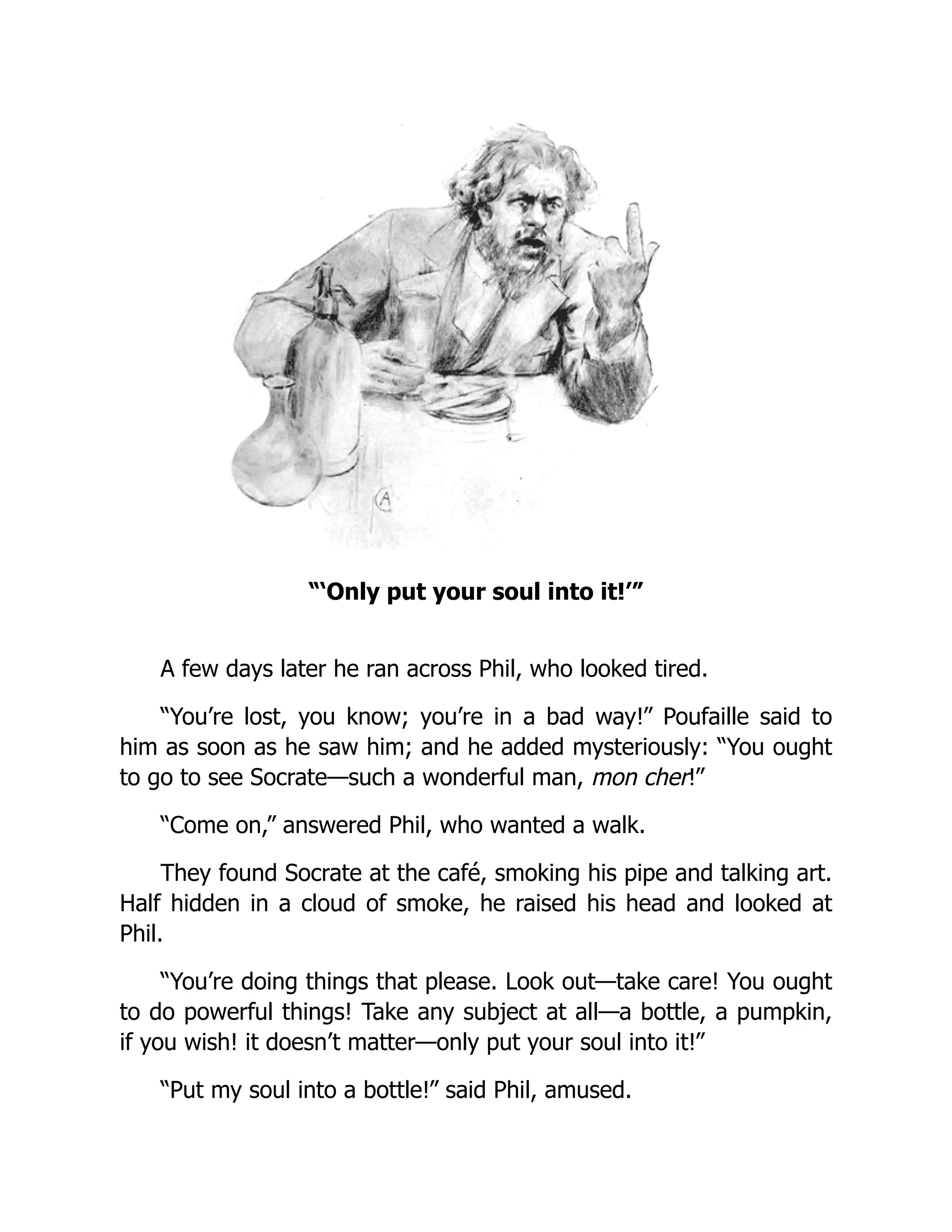
“‘Only put yoursoul into it!’”
A few days later he ran across Phil, who looked tired.
“You’re lost, you know; you’re in a bad way!” Poufaille said to
him as soon as he saw him; and he added mysteriously: “You ought
to go to see Socrate—such a wonderful man, mon cher!”
“Come on,” answered Phil, who wanted a walk.
They found Socrate at the café, smoking his pipe and talking art.
Half hidden in a cloud of smoke, he raised his head and looked at
Phil.
“You’re doing things that please. Look out—take care! You ought
to do powerful things! Take any subject at all—a bottle, a pumpkin,
if you wish! it doesn’t matter—only put your soul into it!”
“Put my soul into a bottle!” said Phil, amused.
25.
Socrate did notadmit any discussion of his pronouncements,
and struck Phil dumb with a glance.
“I tell you, you must paint with your soul!”
“But I always do my best!” Phil said.
“Peuh! your best!” Socrate had an expression of unspeakable
pity for Phil’s best.
Caracal now and then put in a brief appearance at the Deux
Magots, looking from Phil to Socrate and laughing to himself.
“Socrate is right; you ought to do high art! It would be very
funny—you who are lucky enough to be the lover—”
“What?” cried Phil.
“—of an acrobat! There’s inspiration for you! The trapeze is high
art; it soars—very high!”
“Another word and I’ll knock you down!” was Phil’s answer.
“Calm yourself, mon cher! calm yourself!”
But Phil meanwhile was changing visibly. The life he had been
leading for some time had worn him out. He now worked less and
less, and came more and more under the influence of Socrate. He
expended his energy at the café, and in his turn traced out
masterpieces on the table. He explained his ideas to Socrate, and
discussed them until the landlord turned out the gas and wiped off
the masterpieces with his napkin.
“Phil will go far!” Socrate said as he clapped him on the shoulder,
adding like a truly superior man:
“You haven’t twenty francs about you?”
26.
One day Socratebrought with him, wrapped up in a newspaper,
an object which he laid on the bench.
“My guitar,” he said.
Socrate’s guitar! Every one was acquainted with it. Socrate,
painter-poet-philosopher, was a musician as well. He “heard colors”
and “saw sounds.” He had undertaken a gigantic work—to set the
Louvre to music and make colors perceptible to the ear.
He took notes on the spot, colored photographs, and then came
home and played them on his guitar with the hand of a genius.
Violet was si; he made sol out of blue; green was a fa—and so on up
to red, which was do.
Phil looked at the guitar with respect; and Socrate had an idea.
“Tiens!” he said with a noble air; “take my guitar. It has sounded
the ‘Mona Lisa’—it has played Rubens and Raphael! It has thrilled
with beauty; it contains the Louvre! My soul has vibrated within it!
Do a masterpiece with it! Show on your canvas all that it holds! Take
it! Carry it away with you!”
And Phil had taken away the guitar.
“All right,” he said the next day, “I will do a masterpiece. They
shall see if I am an artist or a pork-packer.”
He resolved to “hatch a masterpiece” from this guitar which had
thrilled with the soul of Socrate. From that time he went out no
longer. He passed whole days in his room, distracted only by the
cackling of the chicken in its corner, that brought him back to the
realities of life.
“Ah, ha! You’re hungry, are you?” he said, as he threw the
chicken some crumbs. Then he looked at the guitar as if he would
say: “We’ll have it out together!”
27.
Phil struggled. Hedreamed and pondered, and hunted all sorts
of material for his sketches. He went to the Louvre to study pictures
that had guitars in them.
“The old masters knew nothing about guitars,” Phil said one
evening at the café. Even the comrades laughed at this.
“How’s the guitar? Does it go?” they asked him.
They spoke only of guitars—guitar this and guitar that—as if all
the estudiantinas of all the Spains had met together at the Deux
Magots.
“It will drive me crazy!” said Phil.
“You will produce a masterpiece,” replied Socrate.
One evening Phil came in radiant. “I have it!” he cried.
He explained his idea. Women had been painted in the
moonlight, in the sunlight, and in the light of flames. Eh bien! he,
Phil, would light his woman with reflections from a guitar!
“You see, I have a woman’s head in shadow,” Phil explained to
Socrate, as he made lines with his pencil on the table; “and the
guitar itself is lighted up by a ray from heaven—do you understand?
Music, an echo of heaven, enlightens our sad humanity!”
“Bravo!” exclaimed Socrate.
Poufaille, in his emotion, pressed Phil’s hand.
“I’ll give you a write-up!” said Caracal; “something really good.”
But he added to himself: “So you’re painting echoes from heaven,
pork-packer that you are!”
Phil, under the guidance of Socrate, began his picture. It was
hard to set himself again to real work after so many months of doing
28.
nothing. He exhaustedhis strength and spirits over his canvas. He
ate next to nothing and grew thin visibly; he lived merely a life of
the brain.
“Oh, if I could only have a great success and get rich,” he said to
himself, “I would have Helia come back!”
He wrote long letters to her. Helia’s replies breathed love and the
lofty confidence she had in him. At the bottom of the page there was
always a circle traced with a pen, and to this he touched his lips.
It was Helia whom he was painting in the background of his
picture—a Helia illuminated by a strange light like a vision.
But Phil, worn out and bloodless, no longer had the strength to
fix her features on canvas. He was all the time beginning over again,
floundering in his powerlessness.
Every now and then Socrate came to see him and borrowed his
last piece of money: “You haven’t five francs about you?—and this
old overcoat, lend it to me till to-morrow!
“Tiens! a chicken!” Socrate went on, continuing his inspection;
and he winked at Phil and made a gesture of wringing the fowl’s
neck—“like that! couïc!” Then he looked at the picture.
“It doesn’t go,” Socrate said, rubbing his hands.
At other times the picture seemed to go better.
“Look out! You’re going too fast!” Socrate said, in a fright at the
idea that his guitar might be brought back to him and that he might
no longer have a pretext to come and borrow five francs or an
overcoat. Suzanne also paid Phil visits. He often spoke to her of
Helia.
29.
“You’re always thinkingabout her!” Suzanne said, as she lighted
a cigarette, taking two or three puffs and throwing it away with a
pouah!
“Well, you must be in love with Helia!” she continued. “I had no
idea of it! It won’t last, mon cher!”
She looked at him with mocking eyes.
“What do you mean by that?” Phil asked.
“Oh, I don’t mean to offend you, Monsieur Phil. I believe you’re
sincere!”
“You think I’m sincere!”
“My dear Phil, I’ve seen men dragging themselves at my knees,
—do you hear? dragging themselves at my knees with tears in their
eyes,—men who wouldn’t look at me now!”
“I’m not that kind,” said Phil.
“So much the better!” said Suzanne, becoming suddenly grave.
“I’m happy for Helia’s sake—very happy, because she thinks so, too!”
Phil took up his palette; but Suzanne could not stay quiet.
“Say, Monsieur Phil, how good you are, all the same!”
“I? Why?”
“You don’t see they’re making fun of you?”
“Who?”
“Why, Caracal’s set—Socrate among the rest,” Suzanne
answered.
30.
“I don’t believeit,” Phil said. “Socrate is an enthusiast, but he’s a
real artist!”
“Penses-tu, bébé!” Suzanne murmured to herself. Then, passing
before the glass, with a twist of her finger she put a lock of hair in
place and went out.
Phil seldom had such visits. For the most part of the time he was
alone in front of his picture which did not go. There was no end to
his fumbling efforts. There were always parts to be done over—and
he never succeeded in doing them right.
Socrate arrived one fine evening with his hands in his pockets.
“I’m coming to live with you!” he said. “Landlords are idiots, on
my word! Talent and thought never count with them. It’s dough they
want. If it weren’t for you I’d have to sleep out of doors!”
He sat down on a chair and added: “You’re willing?”
“Certainly,” Phil said, as he drew a mattress near the stove. “You
can sleep there for the present. We’ll see later on.”
From that day an infernal life began for Phil. Socrate, stretched
out by the stove, worried him with advice and made him begin the
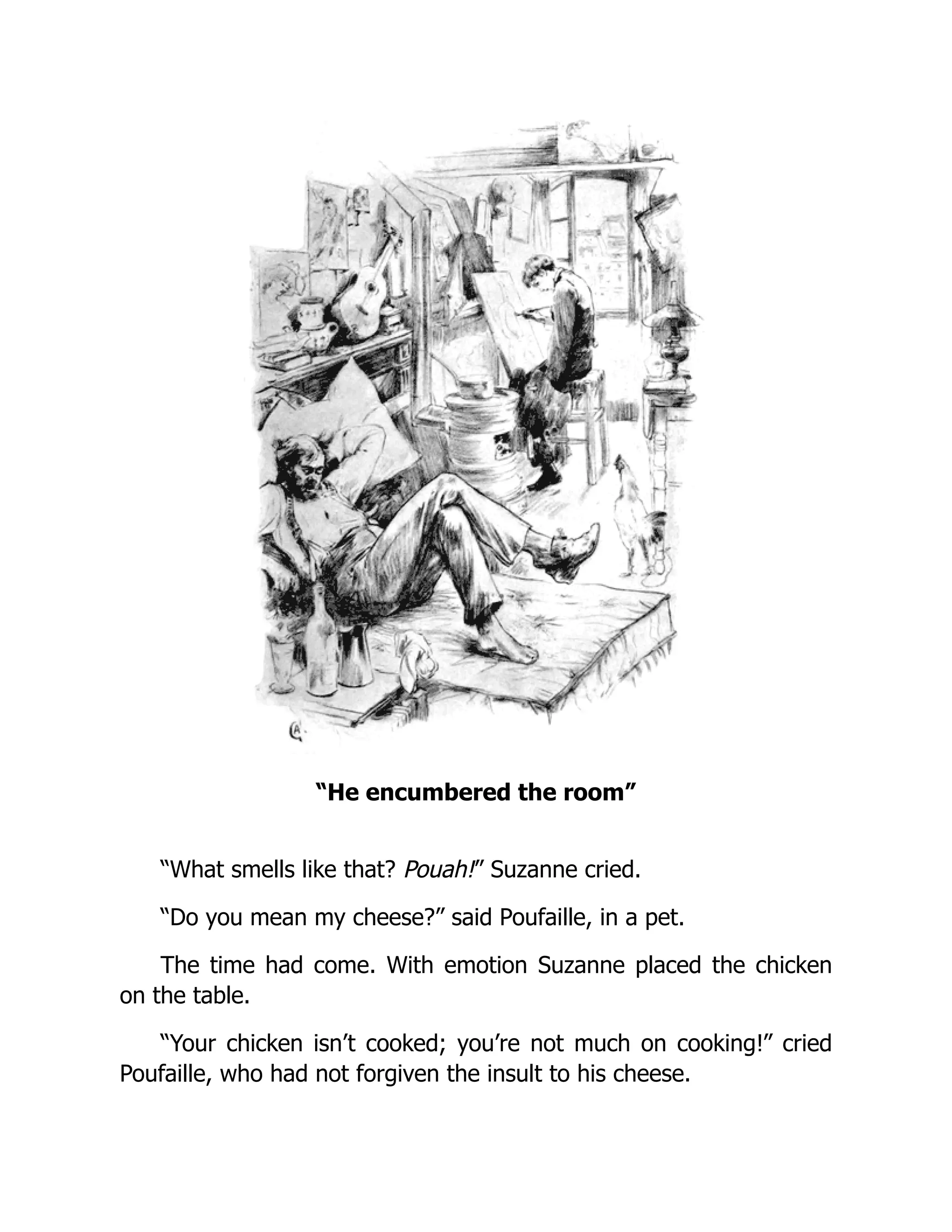
same thing twenty times over; he encumbered the room, smoking
like a locomotive or sleeping until noon. When the thinker’s ferocious
snoring quite deafened Phil, he would whistle gently to stop it. But a
steamer’s siren would not have awakened Socrate. Then Phil, in his
exasperation, would shake him by the shoulder.
“Let me be! I am thinking of something—hum—something,”
Socrate would stammer; and the sleeper would begin “thinking”
again. It was a continual torture. Phil, moreover, was so weak that
he could not even get angry.
31.
One morning Suzannecame in with her arms loaded down with
mistletoe and packages. “My friends, to-morrow is Christmas day,”
she said, as she entered.
“Ah!” Phil answered.
“What—ah?” Suzanne took him up. “Didn’t you know it, then?”
“No,” said Phil, who was now only a shadow of himself, living on
mechanically from day to day.
“But didn’t you see,” asked Suzanne, “this pretty Christmas card
that Helia sent you from London?”
“Ah, yes!” said Phil; “true!”
“Phil is sick,” thought Suzanne, “and very sick! He’s losing his
memory. It’s high time that Helia came back!”
“Let me prepare the feast,” she said next day. “You’ll see what it
will be! Men don’t understand such things! Phil, let me do it, will
you? I’ve invited Poufaille. We shall be four at table. There is a fork
for each of us!”
“I don’t eat much,” Phil answered.
“Socrate will eat for you, Monsieur Phil,” said Suzanne. She
added: “I have a favor to ask you first: I don’t want you to kill the
chicken!”
“But we shall have nothing else for the meal,” said Phil.
“Oh, Monsieur Phil, let her live! She’s so amusing! She would
follow me in the street, and people would take her for a dog. But
wouldn’t they laugh!”
“What a child you are!” Phil said.
32.
“And then I’lllike you so much for it, and I’ll make you a nice
salad,” Suzanne went on, “and I’ll get four sous’ worth of fried
potatoes.”
“Granted!”
Just then they heard a couïc, and Socrate threw the chicken with
its neck wrung at the feet of Suzanne.
“Enough sentimentality,” he said.
Seeing the turn things were taking, Socrate, who was not willing
to miss his meal, had slyly stretched out his hand, seized the
chicken, and put an end to it.
“Oh, you wretch!” cried Suzanne.
“Bah! the chicken had to end by being eaten,” Phil said; “let’s not
quarrel for that!”
Suzanne made everything ready. She cleared the table of paints
and palette, spread the cloth and dishes deftly, and sang as she did
the cooking. Poufaille came in, bringing a cheese made of goat’s milk
and garlic which he had received that morning from his village.
33.
“He encumbered theroom”
“What smells like that? Pouah!” Suzanne cried.
“Do you mean my cheese?” said Poufaille, in a pet.
The time had come. With emotion Suzanne placed the chicken
on the table.
“Your chicken isn’t cooked; you’re not much on cooking!” cried
Poufaille, who had not forgiven the insult to his cheese.
34.
“I don’t knowhow to cook, don’t I?” Suzanne exclaimed; “and I
don’t understand salads, either? No, perhaps, hein!”
Socrate, with his nose in his plate, ate like an ogre, disdainful of
idle quarrels.
“The salad?” Phil said, to keep up the gaiety. “Your salad has a
little too much vinegar.”
“My salad spoiled—oh, insolents! It’s worth while taking trouble
to please you!” And Suzanne began weeping, or a pretense of
weeping. But, suddenly losing her temper, she seized the frying-pan
with a “Tiens! tiens, donc! et aïe donc! This will teach you!” and
while chicken and salad flew across the floor, bang! she threw the
pan full tilt into the painted guitar. Phil’s picture was rent in twain.
“Oh, forgive me!” Suzanne cried.
All had passed as quick as lightning. Suzanne was at Phil’s
knees, weeping, begging pardon—oh! how could she have done it,
she who knew all the trouble he had taken? And she kept on
repeating in her despair: “Oh, Phil, forgive me!”
Phil said not a word; he was pale as death. Poufaille had fallen
backward, and, sitting on his cheese, which had fallen under him,
looked in turn at Phil and Suzanne. Socrate was thunderstruck.
“Oh, forgive me, Phil, forgive me!” Suzanne went on repeating.
But she did not finish. To her terror, she saw Phil arise, turn, and
fall headlong.
35.
CHAPTER IX
ALAS! POORHELIA!
Phil had been struck down by a rush of blood to the brain. For a
long time he had been living as in a dream. His fits of absent-
mindedness had already amazed Suzanne. Too artificial a life,
constant exasperation, his fierce persistence at work which was
beyond his present strength, and the ravages of a fixed idea had
prepared him for brain-fever. The ruin of his guitar picture was the
last blow.
Suzanne quickly drove Socrate out of the room, and took the
mattress which was lying on the floor and put it back in its place.
She hastily made the bed, and then, with the help of Poufaille,
placed Phil on it. He was still without motion, pale and bloodless, like
a dead man.
Suzanne ran to the Charité Hôpital. She was acquainted with
some of the young hospital doctors, and she explained the case as
well as she could. One of them followed her to Phil’s studio and
made a long examination of him. As soon as he entered the
disordered room with its tale of want, the young doctor understood
all; he had already cared for victims like this of the ideal.
Phil came back to life and moaned feebly.
“He is not dead!” Suzanne said.
“People don’t die like that!” the doctor replied, continuing his
examination. “Tell me how it happened.”
Suzanne told the doctor everything.
36.
“It is asI thought,” he said. “We’ll pull him out of it. But, first of
all, take away all those canvases—put the room in order; and those
portraits of a young girl, always the same one, there along the wall
—take them all away! You must deliver him from that vision when he
comes back to himself!”
“But he can’t live without her,” Suzanne said.
The doctor smiled sadly.
“If he only remembers her!” he murmured. “No lesion; long
overdoing followed by anemia, too strong emotion, and doubtless
some fixed idea,” the young doctor rambled on as he looked at the
portraits of Helia which Poufaille was taking down. “It’s a kind of
intoxication of the nervous system—a railway brain, as it were; we’ll
give him things to build him up, and rest and silence in the
meantime.”
“Doc—doctor!” Poufaille stammered, livid with fear, “is the
disease catching?”
“No fear!” the doctor answered, as he glanced at the hairy face
of Poufaille, with its crimson health. “It only comes from
exaggerated intellectual functions.”
“Oh, I’m better already!” said Poufaille, reassured.
Phil was delirious for a week.
His mind, sunk in abysses of sleep, made obscure efforts to
come back to the light of day. Sometimes an ocean of forgetfulness
rolled him in its waves. Sometimes great flashes of light illuminated
his consciousness in its least details and gave to his dreams the hard
relief of marble.
Oftenest he simply wandered, mingling Helia and Suzanne,
seeing in his nightmare guitars, yellow on one side and blue on the
37.
other, like worldslighted up at once by sun and moon—a whole
skyful of guitars, amid which, motionless, the skull of the poet-
painter-sculptor-musician thought constantly, never sleeping—until
the thought burned like a red-hot iron, and then Phil put his hand to
his own burning forehead and asked for something to drink.
But there was some one to anticipate his wish. A gentle hand
raised his head on the pillow and an anxious face bent over him,
seeking to read his eyes, now dulled, and now brilliant with the light
of fever.
“Is it Helia?” Phil asked.
“It is I!” Helia answered. “Don’t speak—rest! You must rest!”
Yes, Helia had come back. Suzanne, in her belief that Phil was
on the point of dying, had not been able to resist the impulse to
write to her. It did not occur to Helia to ask if the disease was
catching. She gave up everything. She paid her forfeit, took her
leave of absence, her own good money going to pay another
attraction as a substitute. Nearly all her savings went in this way—
but she heeded it not. Nothing in the world would have held her
back. She had to be with Phil. She alone had the right to tend him.
Another with her own betrothed in time of danger? No!
Helia nursed him night and day. Suzanne helped her, and
Poufaille did the errands, going for food to Mère Michel’s and for
scuttles of coal to the charbonnier. From morning to night his heavy
shoes shook the staircase.
“Why don’t you give him wine?” he said, as he looked at the sick
man.
“Why not goat’s-milk cheese?” retorted Suzanne. “Will you keep
silence, grand nigaud? Go and get some wood!”
38.
“And the moneyto buy it with?”
“Here!” Helia said.
With what joy Helia watched Phil’s progress toward health!
“Dear, dear friend, my little Saint John,” Phil said to her. “How
can I ever thank you for all you are doing for me!”
He kissed her hand or put it to his burning forehead. Once he
rose up and looked around the room saying: “Who is there?”
“It is I—Helia!”
“Who is Helia?”
“Helia, your friend—your Helia; I am here with Suzanne!”
“Out, wretches!” And he fell back exhausted.
“Leave him alone,” said the young doctor. “In a fortnight he will
be on his feet and I’ll send him to the country.”
Helia, who was forced to depart, went away. Her leave was over.
Besides, she had no more money. Phil grew better and better. At first
he was surprised to find his room so changed.
“Where are my pictures?” he asked. “What have you done with
them?”
“We’ve put them one side—you can see them later,” answered
Suzanne.
“What were they about?” inquired Phil. “Anyway, it’s all the same
to me!”
The young doctor, with the good-fellowship that binds students
together, accompanied him to a public sanatorium not far from Paris.
From that moment Phil changed visibly. He who had been so anemic
39.
in the vitiatedatmosphere of his studio, with his nose always over
his oils and colors, and his eyes fixed on the canvas, in Socrate’s
company, had now abundance of pure air and walks through the
open fields. He felt himself reborn, although his head was a little
empty and his body stiff and sore like one just taken from the
torture-rack. But good food and quiet did wonders for him. He had
an excellent constitution, made for work and struggle, and it came
up again.
With a beefsteak an idea would arrive; and with a glass of wine
joy entered his heart. His blood, renewed, gave him new feelings.
He had again become a man, after the illness in which his youth had
been shipwrecked.
Helia, anxious to see him, came back one day. How difficult it
had been for her—slave to her profession as she was, and still bound
to it for many months! Never mind—she came! Phil was better, Phil
was cured. She would have his first smile; he would be her Phil in
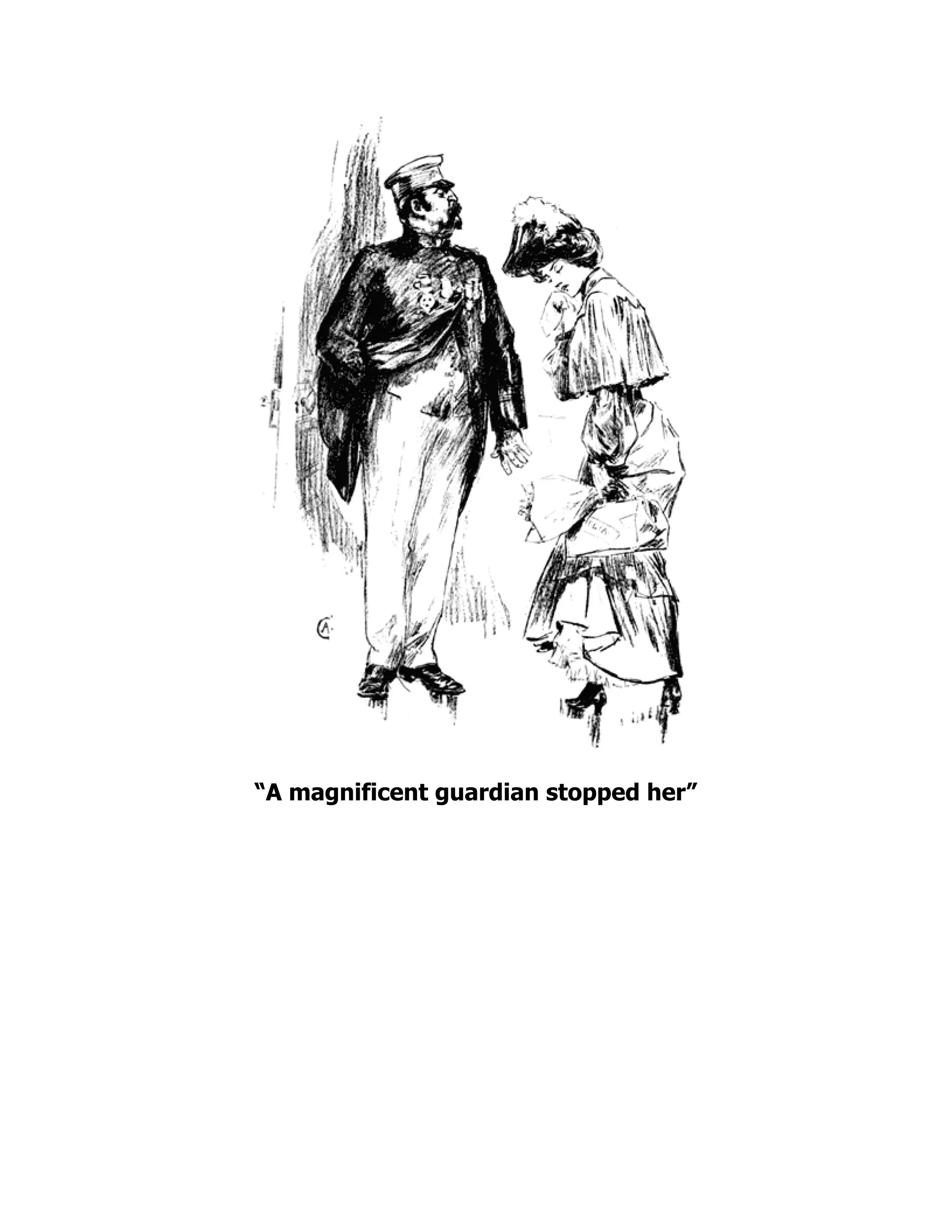
health as in sickness. But at the gate of the sanatorium a
magnificent guardian, adorned with brass buttons and a gilt-banded
cap, stopped her. It was society closing its doors to the intrusion of
vagabonds. This man of law and order asked Helia why, how, in
whose name, by what right, she wished to see Phil, and he refused
the favor to her, the mountebank who—had one ever seen the like?
—pretended to be his betrothed!
Phil came back to Paris cured. Strength and the daring of
courage returned with him. His long rest seemed to have increased
his energy tenfold. He went forth from his past as one escapes from
a prison, without even looking backward. The young doctor had
guessed only too truly: Phil had forgotten many things!
40.
Phil, who hadreceived some unexpected money from his uncle
in Virginia, now changed his quartier, and set himself up in better
style; and the Salon medal gave him his start. His professor made
him acquainted with the Duke of Morgania, who ordered from him
the great decorative picture of Morgana. The Comtesse de Donjeon
asked his aid for her charity sale.
One effort and then another, and this time Phil would reach the
goal. He had one of those happy dispositions which attract luck as
the magnet attracts iron filings. He was ready; life was open before
him like slack water at sea; there was only wanting to him a good
breeze to swell his sail.
From what side was it to blow?
CHAPTER X
MISS ETHELROWRER OF CHICAGO
The breeze blew from the West.
Miss Ethel Rowrer, daughter of the great Redmount Rowrer, had
just arrived in Paris. She was preceded by the fame of her father, the
famous Chicagoan, a business Napoleon. From his office, the center
of a network of telegraph and telephone lines, he communicated
with the financial universe; and his tremendous toil was building up
a world-wide fortune. He thought himself poor, for he had not yet
reached the billion mark; but his fame grew. Ethel adored this father.
She was proud that men spoke of him. She felt herself a part in his
glory; but, really, she could have wished people should pay less
attention to herself. Every day the society papers devoted space to
her.
“Yesterday evening, Miss Ethel Rowrer, daughter of the famous
milliardaire, was present at the opera”—and so forth; and there
followed a description of her dress.
“To-morrow, Miss Ethel Rowrer, daughter of the famous
milliardaire, accompanied by her grandmother, will be present at the
horse show.”
They told how she passed her day; people learned that she had
tried on gowns at Paquin’s, chosen a hat at Stagg’s, eaten
chocolates at Marquis’s—while in reality she had stayed at home
with “grandma.”
43.
All this gossipannoyed her. One day, however, she laughed
heartily. She learned from a paper her intention of buying the tomb
of Richard the Lion-hearted to make a bench of it in her hall at
Chicago. This earned for Ethel a newspaper article, grave and
patriotic.
“Foreigners, touch not our illustrious dead!” was the journalist’s
conclusion in the evening “Tocsin.”
Richard the Lion-hearted went the rounds of the head-lines of
the Paris yellow press. Then, one fine day, the papers spoke of an
interview of the ex-Empress Eugénie with Miss Ethel Rowrer,
daughter of the famous milliardaire, R. K. Rowrer. Vieillecloche, in his
“Tocsin,” had seen and heard everything. He accused America of
mixing itself up with French politics. Miss Ethel did not read the
article, otherwise she might have gathered that the “Tocsin” was
very ill-informed. That she had seen the empress was true, but there
had been no word of politics.
The empress was making a short stay in Paris, as she did every
year. Her sorrows had given the former sovereign the love of
retirement. She passed her days by her window at the hotel,
sometimes looking sadly toward the empty place where the Tuileries
had been.
“I see by the paper that Miss Ethel Rowrer is in Paris,” the
empress said one day to her dame de compagnie. “Is it the
granddaughter of the Rowrer I knew? The emperor had great
esteem for him; I remember him well. Mr. Rowrer was charged by
the government at Washington with a report on the Exposition of
1867. My husband loved to look into everything himself. Social
questions were near to his heart, and it happened that in the
evenings he would receive Mr. Rowrer in his private cabinet. The
extreme simplicity and moral robustness of the man struck the
44.
emperor. He foundhim full of new ideas which he would have
wished to apply in France. I was present at one of their
conversations. My little son was playing around them. Ma chère
ami,” Eugénie continued, “I remember it as if it were yesterday. I
beg of you to find out if Miss Rowrer is the granddaughter of that
man.” The next day she learned that this was the fact.
“I should have been astonished if it were not so,” said Eugénie.
“The emperor foresaw the success of Mr. Rowrer; he knew men.”
She at once made known to Miss Rowrer that she would be happy to
receive her; and Ethel came. Entering, she saw but one thing: in an
arm-chair by the window a lady, with her head covered by a black
mantilla, sat in the clear sunlight like a dark figure of sorrow.
“Madame,” said the lady in waiting, “I present to you Miss Ethel
Rowrer.”
Ethel saw the dark figure rise from the chair.
“Thank you for coming!” Eugénie said. “I am glad when people
come to see me,” and she held out her hand.
Ethel bore the hand to her lips and bowed with a grace which
charmed Eugénie.
“Be seated, Miss Rowrer,” said the empress; “here, beside me,”
and she pointed with the slender hand of an aged woman to a seat.
Ethel sat down. She was in the presence of Eugénie de Guzman
and Porto-Carrero, Countess of Teba, Marquise of Mopa and
Kirkpatrick, Empress of the French—Eugénie the beautiful, the
beloved; and it was an old lady warming herself in the sun and
looking around timidly.
“How happy I am, madame,” said Ethel, “to thank you for the
kindnesses shown long ago to my grandfather! His Majesty the
45.
Emperor loaded himwith favors.”
The empress was greatly touched by the sincere accents of Ethel
and her faithful remembrance. No one thanked her, now that she
was nothing; and this daughter of a milliardaire had not forgotten
slight kindnesses done long ago to her grandfather.
“I thank you,” she said. “The emperor had great esteem for your
grandfather; he liked to talk with him. Mr. Rowrer was a remarkable
man—rather, he was a man!” added the empress, who had seen so
many who were not men.
Ethel blushed with pleasure. Newspaper head-lines constantly
made sport of her family, and here was the one-time arbitress of
Europe glorifying her grandfather and saying to her “I thank you!”
Then they chatted for a while. Eugénie admired this young girl in
her simple elegance and superb health. At the court itself she had
never seen a figure more princess-like and radiant.
“When I was a little girl,” Ethel said, “my grandfather often
spoke to us of those days of glory.”
At the word “glory” Eugénie interrupted her.
46.
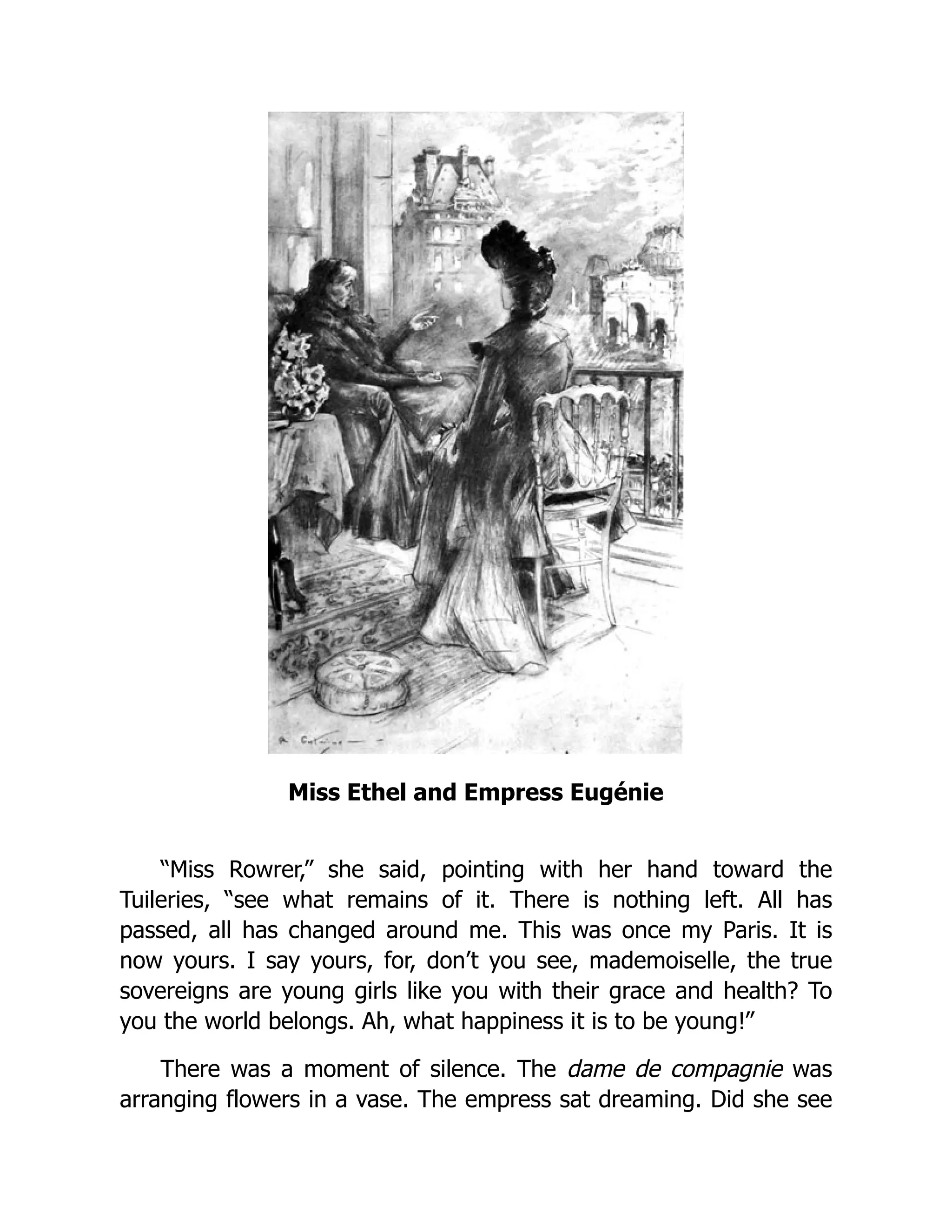
Miss Ethel andEmpress Eugénie
“Miss Rowrer,” she said, pointing with her hand toward the
Tuileries, “see what remains of it. There is nothing left. All has
passed, all has changed around me. This was once my Paris. It is
now yours. I say yours, for, don’t you see, mademoiselle, the true
sovereigns are young girls like you with their grace and health? To
you the world belongs. Ah, what happiness it is to be young!”
There was a moment of silence. The dame de compagnie was
arranging flowers in a vase. The empress sat dreaming. Did she see
47.
Welcome to ourwebsite – the perfect destination for book lovers and
knowledge seekers. We believe that every book holds a new world,
offering opportunities for learning, discovery, and personal growth.
That’s why we are dedicated to bringing you a diverse collection of
books, ranging from classic literature and specialized publications to
self-development guides and children's books.
More than just a book-buying platform, we strive to be a bridge
connecting you with timeless cultural and intellectual values. With an
elegant, user-friendly interface and a smart search system, you can
quickly find the books that best suit your interests. Additionally,
our special promotions and home delivery services help you save time
and fully enjoy the joy of reading.
Join us on a journey of knowledge exploration, passion nurturing, and
personal growth every day!
testbankdeal.com