Human Resource
Management
1

ELEVENTH EDITION

GARY DESSLER

Part 5 | Employee Relations

Chapter
16

Employee Safety and Health
© 2008 Prentice Hall, Inc.
All rights reserved.

PowerPoint Presentation by Charlie Cook
The University of West Alabama
After studying this chapter, you should be able to:
1. Explain the basic facts about OSHA.
2. Explain the supervisor’s role in safety.
3. Minimize unsafe acts by employees.
4. Explain how to deal with important occupational health
problems.

© 2008 Prentice Hall, Inc. All
rights reserved.

16–2
Occupational Safety Law
• Occupational Safety and Health Act
 The law passed by Congress in 1970 “to assure so

far as possible every working man and woman in the
nation safe and healthful working conditions and to
preserve our human resources.”

• Occupational Safety and Health Administration
(OSHA)
 The agency created within the Department of Labor

to set safety and health standards for almost all
workers in the United States.
© 2008 Prentice Hall, Inc. All
rights reserved.

16–3
Inspection Guidelines
• Initial Contact
 Refer inspector to the company’s OSHA coordinator.
 Check inspector’s credentials.
 Ask inspector why he or she is inspecting the

workplace: Complaint? Regular scheduled visit?
Fatality or accident follow-up? Imminent danger?
 If the inspection stems from a complaint, you are

entitled to know whether the person is a current
employee, though not the person’s name.
 Notify your counsel.

© 2008 Prentice Hall, Inc. All
rights reserved.

16–4
Inspection Guidelines (cont’d)
• Opening Conference
 Establish focus and scope of the planned inspection.
 Discuss procedures for protecting trade secret areas.
 Show inspector that you have safety programs in

place. He or she may not go to the work floor if
paperwork is complete and up to date.

© 2008 Prentice Hall, Inc. All
rights reserved.

16–5
Inspection Guidelines (cont’d)
• Walk-Around Inspection
 Accompany the inspector and take detailed notes.
 If inspector takes a photo or video, you should, too.
 Ask for duplicates of all physical samples and copies

of all test results.
 Be helpful and cooperative, but don’t volunteer

information.
 To the extent possible, immediately correct any

violation the inspector identifies.
© 2008 Prentice Hall, Inc. All
rights reserved.

16–6
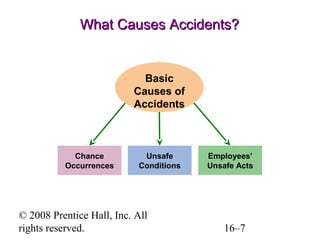
What Causes Accidents?

Basic
Causes of
Accidents

Chance
Occurrences

Unsafe
Conditions

© 2008 Prentice Hall, Inc. All
rights reserved.

Employees’
Unsafe Acts

16–7
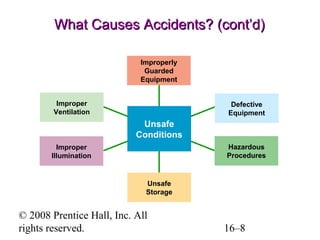
What Causes Accidents? (cont’d)
Improperly
Guarded
Equipment
Improper
Ventilation

Defective
Equipment

Unsafe
Conditions
Hazardous
Procedures

Improper
Illumination

Unsafe
Storage

© 2008 Prentice Hall, Inc. All
rights reserved.

16–8
Controlling Workers’ Compensation Costs
• Before the Accident
 Communicate written safety and substance abuse

policies to workers and then strictly enforce policies.

• After the Accident
 Be proactive in providing first aid, and make sure the

worker gets quick medical attention.
 Make it clear that you are interested in the injured

worker and his or her fears and questions.
 Document the accident; file required reports.
 Encourage a speedy return to work.

© 2008 Prentice Hall, Inc. All
rights reserved.

16–9
Workplace Exposure Hazards
• Chemicals and other hazardous materials.
• Excessive noise and vibrations.
• Temperature extremes.
• Biohazards including those that are normally
occurring and manmade.
• Ergonomic hazards of poorly designed
equipment that forces workers to do jobs while
contorted in unnatural positions.
• Slippery floors and blocked passageways.
© 2008 Prentice Hall, Inc. All
rights reserved.

16–10
Dealing with Substance Abuse

Disciplining

Referral to an
Outside Agency

When an
Employee Tests
Positive

Discharge

In-house
Counseling

© 2008 Prentice Hall, Inc. All
rights reserved.

16–11
Violence at Work
• Steps to Reduce Workplace Violence:
 Institute heightened security measures
 Improve employee screening
 Provide workplace violence training
 Provide organizational justice
 Pay enhanced attention to employee

retention/dismissal
 Take care when dismissing violent employees
 Deal promptly with angry employees
 Understand the legal constraints on reducing
workplace violence
© 2008 Prentice Hall, Inc. All
rights reserved.

16–12
Evacuation Plans
• Evacuation contingency plans should contain:
 Methods for early detection of a problem.
 Methods for communicating the emergency

externally.
 Communications plans for initiating an evacuation.
 Communications plans for those the employer wants

to evacuate that provide specific information about
the emergency, and let them know what action they
should take next.
© 2008 Prentice Hall, Inc. All
rights reserved.

16–13
KEY TERMS
Occupational Safety and Health Act
Occupational Safety and Health Administration (OSHA)
occupational illness
citation
unsafe conditions
behavior-based safety
material safety data sheets (MSDS)
burnout
natural security
mechanical security
organizational security

© 2008 Prentice Hall, Inc. All
rights reserved.

16–14

HRM Dessler CH# 16

  • 1.
    Human Resource Management 1 ELEVENTH EDITION GARYDESSLER Part 5 | Employee Relations Chapter 16 Employee Safety and Health © 2008 Prentice Hall, Inc. All rights reserved. PowerPoint Presentation by Charlie Cook The University of West Alabama
  • 2.
    After studying thischapter, you should be able to: 1. Explain the basic facts about OSHA. 2. Explain the supervisor’s role in safety. 3. Minimize unsafe acts by employees. 4. Explain how to deal with important occupational health problems. © 2008 Prentice Hall, Inc. All rights reserved. 16–2
  • 3.
    Occupational Safety Law •Occupational Safety and Health Act  The law passed by Congress in 1970 “to assure so far as possible every working man and woman in the nation safe and healthful working conditions and to preserve our human resources.” • Occupational Safety and Health Administration (OSHA)  The agency created within the Department of Labor to set safety and health standards for almost all workers in the United States. © 2008 Prentice Hall, Inc. All rights reserved. 16–3
  • 4.
    Inspection Guidelines • InitialContact  Refer inspector to the company’s OSHA coordinator.  Check inspector’s credentials.  Ask inspector why he or she is inspecting the workplace: Complaint? Regular scheduled visit? Fatality or accident follow-up? Imminent danger?  If the inspection stems from a complaint, you are entitled to know whether the person is a current employee, though not the person’s name.  Notify your counsel. © 2008 Prentice Hall, Inc. All rights reserved. 16–4
  • 5.
    Inspection Guidelines (cont’d) •Opening Conference  Establish focus and scope of the planned inspection.  Discuss procedures for protecting trade secret areas.  Show inspector that you have safety programs in place. He or she may not go to the work floor if paperwork is complete and up to date. © 2008 Prentice Hall, Inc. All rights reserved. 16–5
  • 6.
    Inspection Guidelines (cont’d) •Walk-Around Inspection  Accompany the inspector and take detailed notes.  If inspector takes a photo or video, you should, too.  Ask for duplicates of all physical samples and copies of all test results.  Be helpful and cooperative, but don’t volunteer information.  To the extent possible, immediately correct any violation the inspector identifies. © 2008 Prentice Hall, Inc. All rights reserved. 16–6
  • 7.
    What Causes Accidents? Basic Causesof Accidents Chance Occurrences Unsafe Conditions © 2008 Prentice Hall, Inc. All rights reserved. Employees’ Unsafe Acts 16–7
  • 8.
    What Causes Accidents?(cont’d) Improperly Guarded Equipment Improper Ventilation Defective Equipment Unsafe Conditions Hazardous Procedures Improper Illumination Unsafe Storage © 2008 Prentice Hall, Inc. All rights reserved. 16–8
  • 9.
    Controlling Workers’ CompensationCosts • Before the Accident  Communicate written safety and substance abuse policies to workers and then strictly enforce policies. • After the Accident  Be proactive in providing first aid, and make sure the worker gets quick medical attention.  Make it clear that you are interested in the injured worker and his or her fears and questions.  Document the accident; file required reports.  Encourage a speedy return to work. © 2008 Prentice Hall, Inc. All rights reserved. 16–9
  • 10.
    Workplace Exposure Hazards •Chemicals and other hazardous materials. • Excessive noise and vibrations. • Temperature extremes. • Biohazards including those that are normally occurring and manmade. • Ergonomic hazards of poorly designed equipment that forces workers to do jobs while contorted in unnatural positions. • Slippery floors and blocked passageways. © 2008 Prentice Hall, Inc. All rights reserved. 16–10
  • 11.
    Dealing with SubstanceAbuse Disciplining Referral to an Outside Agency When an Employee Tests Positive Discharge In-house Counseling © 2008 Prentice Hall, Inc. All rights reserved. 16–11
  • 12.
    Violence at Work •Steps to Reduce Workplace Violence:  Institute heightened security measures  Improve employee screening  Provide workplace violence training  Provide organizational justice  Pay enhanced attention to employee retention/dismissal  Take care when dismissing violent employees  Deal promptly with angry employees  Understand the legal constraints on reducing workplace violence © 2008 Prentice Hall, Inc. All rights reserved. 16–12
  • 13.
    Evacuation Plans • Evacuationcontingency plans should contain:  Methods for early detection of a problem.  Methods for communicating the emergency externally.  Communications plans for initiating an evacuation.  Communications plans for those the employer wants to evacuate that provide specific information about the emergency, and let them know what action they should take next. © 2008 Prentice Hall, Inc. All rights reserved. 16–13
  • 14.
    KEY TERMS Occupational Safetyand Health Act Occupational Safety and Health Administration (OSHA) occupational illness citation unsafe conditions behavior-based safety material safety data sheets (MSDS) burnout natural security mechanical security organizational security © 2008 Prentice Hall, Inc. All rights reserved. 16–14