

Empirical Network
Classification through Network
Metrics
Colleen M. Farrelly
BACKGROUND AND
SIMULATIONS
Problem Overview
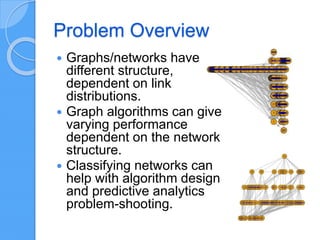
 Graphs/networks have
different structure,
dependent on link
distributions.
 Graph algorithms can give
varying performance
dependent on the network
structure.
 Classifying networks can
help with algorithm design
and predictive analytics
problem-shooting.
Network Simulations and
Observations
Simulation
Number
Network Type
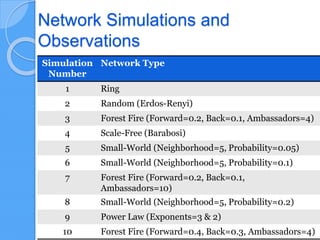
1 Ring
2 Random (Erdos-Renyi)
3 Forest Fire (Forward=0.2, Back=0.1, Ambassadors=4)
4 Scale-Free (Barabosi)
5 Small-World (Neighborhood=5, Probability=0.05)
6 Small-World (Neighborhood=5, Probability=0.1)
7 Forest Fire (Forward=0.2, Back=0.1,
Ambassadors=10)
8 Small-World (Neighborhood=5, Probability=0.2)
9 Power Law (Exponents=3 & 2)
10 Forest Fire (Forward=0.4, Back=0.3, Ambassadors=4)
Small-World Network
Subtypes
Simulation
Number
Network Parameters Network
Properties
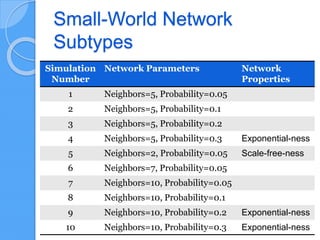
1 Neighbors=5, Probability=0.05
2 Neighbors=5, Probability=0.1
3 Neighbors=5, Probability=0.2
4 Neighbors=5, Probability=0.3 Exponential-ness
5 Neighbors=2, Probability=0.05 Scale-free-ness
6 Neighbors=7, Probability=0.05
7 Neighbors=10, Probability=0.05
8 Neighbors=10, Probability=0.1
9 Neighbors=10, Probability=0.2 Exponential-ness
10 Neighbors=10, Probability=0.3 Exponential-ness
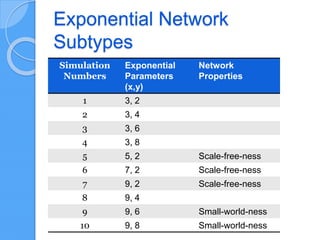
Exponential Network
Subtypes
Simulation
Numbers
Exponential
Parameters
(x,y)
Network
Properties
1 3, 2
2 3, 4
3 3, 6
4 3, 8
5 5, 2 Scale-free-ness
6 7, 2 Scale-free-ness
7 9, 2 Scale-free-ness
8 9, 4
9 9, 6 Small-world-ness
10 9, 8 Small-world-ness
RESULTS EXEGESIS
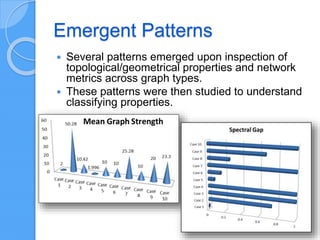
Emergent Patterns
 Several patterns emerged upon inspection of
topological/geometrical properties and network
metrics across graph types.
 These patterns were then studied to understand
classifying properties.
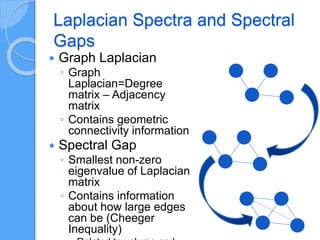
Laplacian Spectra and Spectral
Gaps
 Graph Laplacian
◦ Graph
Laplacian=Degree
matrix – Adjacency
matrix
◦ Contains geometric
connectivity information
 Spectral Gap
◦ Smallest non-zero
eigenvalue of Laplacian
matrix
◦ Contains information
about how large edges
can be (Cheeger
Inequality)
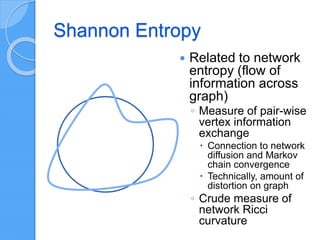
Shannon Entropy
 Related to network
entropy (flow of
information across
graph)
◦ Measure of pair-wise
vertex information
exchange
 Connection to network
diffusion and Markov
chain convergence
 Technically, amount of
distortion on graph
◦ Crude measure of
network Ricci
curvature
Graph Volume
 Related to
curvature
◦ Curvature
defines
deviation of
volume from
that of a
standard
shape.
 Area of
stretched circle
greater than
Simplicial Complex Euler
Characteristic
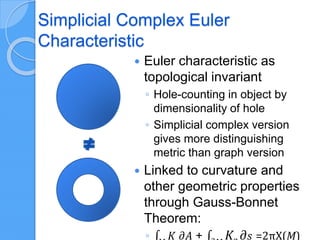
 Euler characteristic as
topological invariant
◦ Hole-counting in object by
dimensionality of hole
◦ Simplicial complex version
gives more distinguishing
metric than graph version
 Linked to curvature and
other geometric properties
through Gauss-Bonnet
Theorem:
◦ 𝐾 𝜕𝐴 + K 𝜕 𝑠 =2πΧ(M)
Graph Strength
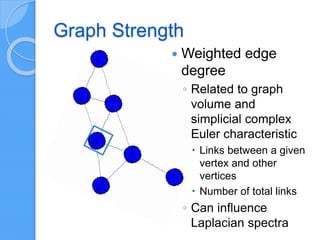
 Weighted edge
degree
◦ Related to graph
volume and
simplicial complex
Euler characteristic
 Links between a given
vertex and other
vertices
 Number of total links
◦ Can influence
Laplacian spectra
Graph Strength Range
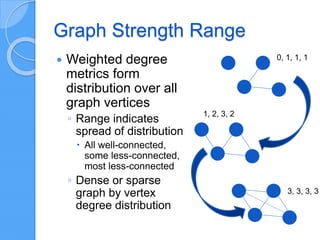
 Weighted degree
metrics form
distribution over all
graph vertices
◦ Range indicates
spread of distribution
 All well-connected,
some less-connected,
most less-connected
◦ Dense or sparse
graph by vertex
degree distribution
0, 1, 1, 1
1, 2, 3, 2
3, 3, 3, 3
Betweenness
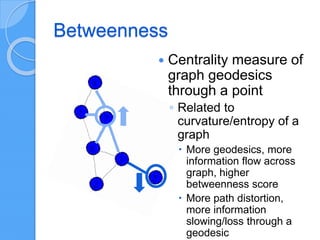
 Centrality measure of
graph geodesics
through a point
◦ Related to
curvature/entropy of a
graph
 More geodesics, more
information flow across
graph, higher
betweenness score
 More path distortion,
more information
slowing/loss through a
geodesic
CLASSIFYING METRICS
AND NETWORK
ASYMPTOTICS
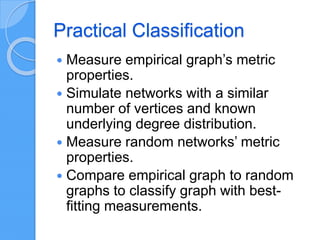
Practical Classification
 Measure empirical graph’s metric
properties.
 Simulate networks with a similar
number of vertices and known
underlying degree distribution.
 Measure random networks’ metric
properties.
 Compare empirical graph to random
graphs to classify graph with best-
fitting measurements.
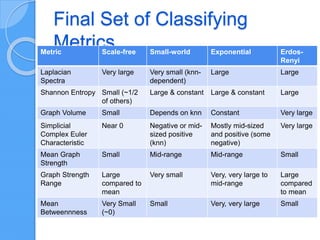
Final Set of Classifying
MetricsMetric Scale-free Small-world Exponential Erdos-
Renyi
Laplacian
Spectra
Very large Very small (knn-
dependent)
Large Large
Shannon Entropy Small (~1/2
of others)
Large & constant Large & constant Large
Graph Volume Small Depends on knn Constant Very large
Simplicial
Complex Euler
Characteristic
Near 0 Negative or mid-
sized positive
(knn)
Mostly mid-sized
and positive (some
negative)
Very large
Mean Graph
Strength
Small Mid-range Mid-range Small
Graph Strength
Range
Large
compared to
mean
Very small Very, very large to
mid-range
Large
compared
to mean
Mean
Betweennness
Very Small
(~0)
Small Very, very large Small
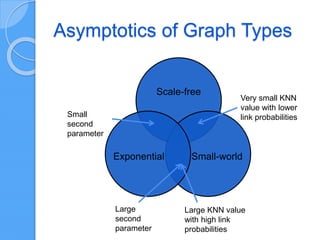
Asymptotics of Graph Types
Very small KNN
value with lower
link probabilities
Large KNN value
with high link
probabilities
Large
second
parameter
Small
second
parameter
Scale-free
Small-worldExponential
CONCLUSIONS
Conclusions
 A small set of computationally-efficient
topological metrics can distinguish
among graphs generated by different
network types.
 Using these metrics, it is possible to
classify an unknown network as one of
these network types based on its
measured topological metrics.

Empirical Network Classification

  • 1.
    Empirical Network Classification throughNetwork Metrics Colleen M. Farrelly
  • 2.
  • 3.
    Problem Overview  Graphs/networkshave different structure, dependent on link distributions.  Graph algorithms can give varying performance dependent on the network structure.  Classifying networks can help with algorithm design and predictive analytics problem-shooting.
  • 4.
    Network Simulations and Observations Simulation Number NetworkType 1 Ring 2 Random (Erdos-Renyi) 3 Forest Fire (Forward=0.2, Back=0.1, Ambassadors=4) 4 Scale-Free (Barabosi) 5 Small-World (Neighborhood=5, Probability=0.05) 6 Small-World (Neighborhood=5, Probability=0.1) 7 Forest Fire (Forward=0.2, Back=0.1, Ambassadors=10) 8 Small-World (Neighborhood=5, Probability=0.2) 9 Power Law (Exponents=3 & 2) 10 Forest Fire (Forward=0.4, Back=0.3, Ambassadors=4)
  • 5.
    Small-World Network Subtypes Simulation Number Network ParametersNetwork Properties 1 Neighbors=5, Probability=0.05 2 Neighbors=5, Probability=0.1 3 Neighbors=5, Probability=0.2 4 Neighbors=5, Probability=0.3 Exponential-ness 5 Neighbors=2, Probability=0.05 Scale-free-ness 6 Neighbors=7, Probability=0.05 7 Neighbors=10, Probability=0.05 8 Neighbors=10, Probability=0.1 9 Neighbors=10, Probability=0.2 Exponential-ness 10 Neighbors=10, Probability=0.3 Exponential-ness
  • 6.
    Exponential Network Subtypes Simulation Numbers Exponential Parameters (x,y) Network Properties 1 3,2 2 3, 4 3 3, 6 4 3, 8 5 5, 2 Scale-free-ness 6 7, 2 Scale-free-ness 7 9, 2 Scale-free-ness 8 9, 4 9 9, 6 Small-world-ness 10 9, 8 Small-world-ness
  • 7.
  • 8.
    Emergent Patterns  Severalpatterns emerged upon inspection of topological/geometrical properties and network metrics across graph types.  These patterns were then studied to understand classifying properties.
  • 9.
    Laplacian Spectra andSpectral Gaps  Graph Laplacian ◦ Graph Laplacian=Degree matrix – Adjacency matrix ◦ Contains geometric connectivity information  Spectral Gap ◦ Smallest non-zero eigenvalue of Laplacian matrix ◦ Contains information about how large edges can be (Cheeger Inequality)
  • 10.
    Shannon Entropy  Relatedto network entropy (flow of information across graph) ◦ Measure of pair-wise vertex information exchange  Connection to network diffusion and Markov chain convergence  Technically, amount of distortion on graph ◦ Crude measure of network Ricci curvature
  • 11.
    Graph Volume  Relatedto curvature ◦ Curvature defines deviation of volume from that of a standard shape.  Area of stretched circle greater than
  • 12.
    Simplicial Complex Euler Characteristic Euler characteristic as topological invariant ◦ Hole-counting in object by dimensionality of hole ◦ Simplicial complex version gives more distinguishing metric than graph version  Linked to curvature and other geometric properties through Gauss-Bonnet Theorem: ◦ 𝐾 𝜕𝐴 + K 𝜕 𝑠 =2πΧ(M)
  • 13.
    Graph Strength  Weightededge degree ◦ Related to graph volume and simplicial complex Euler characteristic  Links between a given vertex and other vertices  Number of total links ◦ Can influence Laplacian spectra
  • 14.
    Graph Strength Range Weighted degree metrics form distribution over all graph vertices ◦ Range indicates spread of distribution  All well-connected, some less-connected, most less-connected ◦ Dense or sparse graph by vertex degree distribution 0, 1, 1, 1 1, 2, 3, 2 3, 3, 3, 3
  • 15.
    Betweenness  Centrality measureof graph geodesics through a point ◦ Related to curvature/entropy of a graph  More geodesics, more information flow across graph, higher betweenness score  More path distortion, more information slowing/loss through a geodesic
  • 16.
  • 17.
    Practical Classification  Measureempirical graph’s metric properties.  Simulate networks with a similar number of vertices and known underlying degree distribution.  Measure random networks’ metric properties.  Compare empirical graph to random graphs to classify graph with best- fitting measurements.
  • 18.
    Final Set ofClassifying MetricsMetric Scale-free Small-world Exponential Erdos- Renyi Laplacian Spectra Very large Very small (knn- dependent) Large Large Shannon Entropy Small (~1/2 of others) Large & constant Large & constant Large Graph Volume Small Depends on knn Constant Very large Simplicial Complex Euler Characteristic Near 0 Negative or mid- sized positive (knn) Mostly mid-sized and positive (some negative) Very large Mean Graph Strength Small Mid-range Mid-range Small Graph Strength Range Large compared to mean Very small Very, very large to mid-range Large compared to mean Mean Betweennness Very Small (~0) Small Very, very large Small
  • 19.
    Asymptotics of GraphTypes Very small KNN value with lower link probabilities Large KNN value with high link probabilities Large second parameter Small second parameter Scale-free Small-worldExponential
  • 20.
  • 21.
    Conclusions  A smallset of computationally-efficient topological metrics can distinguish among graphs generated by different network types.  Using these metrics, it is possible to classify an unknown network as one of these network types based on its measured topological metrics.