Brianna Campbell
Introduction
 Leo III also known as Leo the Isaurian was born
somewhere between 675 & 680 in Germanicia,
Commagene, Syria. He became an attendant to Emperor
Justinian II after assisting him in the recovery of his
throne in 705. Leo became Emperor on March 25, 717.
Leo’s first task as emperor was the organization of the
defense of Constantinople against the Arab troops
under Maslamah ibn ʿAbd al-Malik. Leo was a very
strategic military ruler and very energetic. Leo’s wife,
Maria, bore him a son, Constantine, whom he crowned in
720. An able diplomat, Leo married Constantine in 733
to a daughter of the Khagan of the Khazars; the marriage
brought Leo a valuable military alliance with the Khazars
in the trans-Caucasus against the Arabs.
The Empire
 Iconoclastic crisis occurred during Leo III reign. Leo prioritized
keeping Islam from influencing his Empire. Forceful resettlement of
many Christians of the East was a result of a deal struck between the
Byzantines and the Arabs. That happened because large numbers of
the Christian zealots were removed and dispersed around the
Byzantine Empire, away from the boarders between the Byzantine
Empire and the Arabs. These Christians were originally supported by
the Byzantines themselves but got scapegoated for politics. That was
accomplished through an hefty payoff-agreement between the
Emperor and the Umayyad Caliph. These Christians were what is
known as the Jarjamites, the Maronites/Maradaites, Jacobites and
others. They were a thorn in the side of the invading Arabs because
they refused to convert to Islam and did not accept the Arab cause
célèbre. Leo helped prevent the extinction of the Byzantine Empire.
Government
 Leo defended Constantinople against the last
Arab siege (717–18), and although he had to
contend with Arab attacks in Asia Minor, he
succeeded in ending serious Arab threats for
nearly two centuries and reorganized the military
provinces ( themes ) of the empire for greater
efficiency. His civil code, the Ecloga, written in
Greek rather than in Latin, was a practical
handbook that had considerable influence in
Byzantium. He is also credited with issuing
military, maritime, and rural codes.
Art
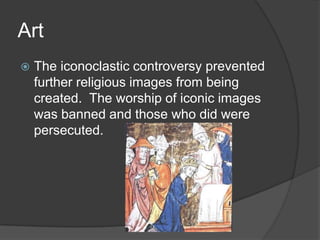
 The iconoclastic controversy prevented
further religious images from being
created. The worship of iconic images
was banned and those who did were
persecuted.
Architecture
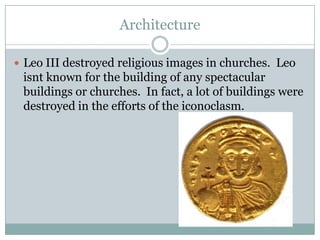
 Leo III destroyed religious images in churches. Leo
isnt known for the building of any spectacular
buildings or churches. In fact, a lot of buildings were
destroyed in the efforts of the iconoclasm.
 In January 730, following the deposition of the
Patriarch who refused to adopt the new religious
policies, the Emperor promulgated an edict
ordering the destruction of all holy icons. The
Imperial edict had deep consequences for the
Byzantine Empire. Besides the divisions in society
brought about by it, it also hurt relations with
Rome. The new Pope, Gregory III, condemned in a
Council the Iconoclastic policies of the Emperor.
The latter, to punish Rome, wrested from the
Pope's jurisdiction and ceded to the patriarchate
of Constantinople the Greek provinces of
southern Italy as well as Sicily and the Prefecture
of Illyricum.
 Leo's attack (726) on devotion to holy images began the long struggle
over iconoclasm. Riots often broke out in Greece and Sicily and Leo
would attack these riots which upset pope Gregory II and Gregory III.
Leo had help from countries like Bulgaria when it came to fighting the
Arabs. Leo didn’t want Islam to be influenced in his empire. After a 12
month siege of the Arabs, the Arabs withdrew in August 718. The Arabs'
menace to the empire did not end altogether; during the 720s and 730s
they resumed their offensive into Asia Minor. Leo devoted further efforts
against them, and in 740 he won a great victory at Akroinon which
further crippled the Arabs' position, enabling his son and successor to
take the offensive against them. Not only was the capital freed from
danger, but the safety of Asia Minor, the empire's greatest source of
manpower and revenue, was secured. Further, Leo advanced the
system of the themes (administrative divisions of the empire) to a
significant extent. He reconsolidated the system by dividing the original
themes into smaller units and reorganizing them; he had learned from his
own success how easy it was for a commander of a large territory to
seize the throne.
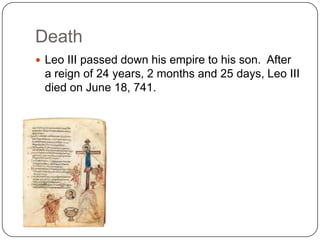
Death
 Leo III passed down his empire to his son. After
a reign of 24 years, 2 months and 25 days, Leo III
died on June 18, 741.
 name. "Leo III (Byzantine emperor) -- Encyclopedia Britannica." Encyclopedia
Britannica. N.p., n.d. Web. 23 June 2013.
<http://www.britannica.com/EBchecked/topic/336200/Leo-III>.
 Emperors, zantium:. "Leo III, Byzantine emperor | Infoplease.com." Infoplease:
Encyclopedia, Almanac, Atlas, Biographies, Dictionary, Thesaurus. Free online
reference, research & homework help. | Infoplease.com. N.p., n.d. Web. 23 June
2013. <http://www.infoplease.com/encyclopedia/people/leo-iii-byzantine-
emperor.html>.
 Moslem, zantine navy succeded in destroying the Arab vessels. Meanwhile the. " The
Iconoclastic Period (711-843) ." Hellenic Electronic Center. N.p., n.d. Web. 23 June
2013. <http://www.greece.org/romiosini/iconoclas
 "Leo III, Byzantine Emperor who was one of us, and so was his dynasty of
emperors." Phoenician Encyclopedia: A Bequest Unearthed, Phoenicia and the
Phoenicians, Punic, Canaanites -- Encyclopedia Phoeniciana. N.p., n.d. Web. 23
June 2013. <http://phoenicia.org/leo.html>.
 "Iconoclasm." Boundless. N.p., n.d. Web. 22 June 2013.
<https://www.boundless.com/art-history/the-byzantines/early-byzantine-art/icons-
and-iconoclasm/>.
 zantine. "Iconoclasm - Smarthistory."Smarthistory: a multimedia web-book about art
and art history. N.p., n.d. Web. 23 June 2013.
<http://smarthistory.khanacademy.org/ico
 Forschungen, zantinische. "Roman Emperors - DIR Leo III."RomanEmperors - DIR--De
Imperatoribus Romanis Roman History Roman RomanEmpire Imperator Basileus De
Imperatoribus Romanis EncyclopediaByzantine. N.p., n.d. Web. 23 June 2013.
<http://www.roman-emperors.org/leoiii.htm>.

Emperor leo iii (1)

  • 1.
  • 2.
    Introduction  Leo IIIalso known as Leo the Isaurian was born somewhere between 675 & 680 in Germanicia, Commagene, Syria. He became an attendant to Emperor Justinian II after assisting him in the recovery of his throne in 705. Leo became Emperor on March 25, 717. Leo’s first task as emperor was the organization of the defense of Constantinople against the Arab troops under Maslamah ibn ʿAbd al-Malik. Leo was a very strategic military ruler and very energetic. Leo’s wife, Maria, bore him a son, Constantine, whom he crowned in 720. An able diplomat, Leo married Constantine in 733 to a daughter of the Khagan of the Khazars; the marriage brought Leo a valuable military alliance with the Khazars in the trans-Caucasus against the Arabs.
  • 3.
    The Empire  Iconoclasticcrisis occurred during Leo III reign. Leo prioritized keeping Islam from influencing his Empire. Forceful resettlement of many Christians of the East was a result of a deal struck between the Byzantines and the Arabs. That happened because large numbers of the Christian zealots were removed and dispersed around the Byzantine Empire, away from the boarders between the Byzantine Empire and the Arabs. These Christians were originally supported by the Byzantines themselves but got scapegoated for politics. That was accomplished through an hefty payoff-agreement between the Emperor and the Umayyad Caliph. These Christians were what is known as the Jarjamites, the Maronites/Maradaites, Jacobites and others. They were a thorn in the side of the invading Arabs because they refused to convert to Islam and did not accept the Arab cause célèbre. Leo helped prevent the extinction of the Byzantine Empire.
  • 4.
    Government  Leo defendedConstantinople against the last Arab siege (717–18), and although he had to contend with Arab attacks in Asia Minor, he succeeded in ending serious Arab threats for nearly two centuries and reorganized the military provinces ( themes ) of the empire for greater efficiency. His civil code, the Ecloga, written in Greek rather than in Latin, was a practical handbook that had considerable influence in Byzantium. He is also credited with issuing military, maritime, and rural codes.
  • 5.
    Art  The iconoclasticcontroversy prevented further religious images from being created. The worship of iconic images was banned and those who did were persecuted.
  • 6.
    Architecture  Leo IIIdestroyed religious images in churches. Leo isnt known for the building of any spectacular buildings or churches. In fact, a lot of buildings were destroyed in the efforts of the iconoclasm.
  • 7.
     In January730, following the deposition of the Patriarch who refused to adopt the new religious policies, the Emperor promulgated an edict ordering the destruction of all holy icons. The Imperial edict had deep consequences for the Byzantine Empire. Besides the divisions in society brought about by it, it also hurt relations with Rome. The new Pope, Gregory III, condemned in a Council the Iconoclastic policies of the Emperor. The latter, to punish Rome, wrested from the Pope's jurisdiction and ceded to the patriarchate of Constantinople the Greek provinces of southern Italy as well as Sicily and the Prefecture of Illyricum.
  • 8.
     Leo's attack(726) on devotion to holy images began the long struggle over iconoclasm. Riots often broke out in Greece and Sicily and Leo would attack these riots which upset pope Gregory II and Gregory III. Leo had help from countries like Bulgaria when it came to fighting the Arabs. Leo didn’t want Islam to be influenced in his empire. After a 12 month siege of the Arabs, the Arabs withdrew in August 718. The Arabs' menace to the empire did not end altogether; during the 720s and 730s they resumed their offensive into Asia Minor. Leo devoted further efforts against them, and in 740 he won a great victory at Akroinon which further crippled the Arabs' position, enabling his son and successor to take the offensive against them. Not only was the capital freed from danger, but the safety of Asia Minor, the empire's greatest source of manpower and revenue, was secured. Further, Leo advanced the system of the themes (administrative divisions of the empire) to a significant extent. He reconsolidated the system by dividing the original themes into smaller units and reorganizing them; he had learned from his own success how easy it was for a commander of a large territory to seize the throne.
  • 9.
    Death  Leo IIIpassed down his empire to his son. After a reign of 24 years, 2 months and 25 days, Leo III died on June 18, 741.
  • 10.
     name. "LeoIII (Byzantine emperor) -- Encyclopedia Britannica." Encyclopedia Britannica. N.p., n.d. Web. 23 June 2013. <http://www.britannica.com/EBchecked/topic/336200/Leo-III>.  Emperors, zantium:. "Leo III, Byzantine emperor | Infoplease.com." Infoplease: Encyclopedia, Almanac, Atlas, Biographies, Dictionary, Thesaurus. Free online reference, research & homework help. | Infoplease.com. N.p., n.d. Web. 23 June 2013. <http://www.infoplease.com/encyclopedia/people/leo-iii-byzantine- emperor.html>.  Moslem, zantine navy succeded in destroying the Arab vessels. Meanwhile the. " The Iconoclastic Period (711-843) ." Hellenic Electronic Center. N.p., n.d. Web. 23 June 2013. <http://www.greece.org/romiosini/iconoclas  "Leo III, Byzantine Emperor who was one of us, and so was his dynasty of emperors." Phoenician Encyclopedia: A Bequest Unearthed, Phoenicia and the Phoenicians, Punic, Canaanites -- Encyclopedia Phoeniciana. N.p., n.d. Web. 23 June 2013. <http://phoenicia.org/leo.html>.  "Iconoclasm." Boundless. N.p., n.d. Web. 22 June 2013. <https://www.boundless.com/art-history/the-byzantines/early-byzantine-art/icons- and-iconoclasm/>.  zantine. "Iconoclasm - Smarthistory."Smarthistory: a multimedia web-book about art and art history. N.p., n.d. Web. 23 June 2013. <http://smarthistory.khanacademy.org/ico  Forschungen, zantinische. "Roman Emperors - DIR Leo III."RomanEmperors - DIR--De Imperatoribus Romanis Roman History Roman RomanEmpire Imperator Basileus De Imperatoribus Romanis EncyclopediaByzantine. N.p., n.d. Web. 23 June 2013. <http://www.roman-emperors.org/leoiii.htm>.