Emotional Intelligence
Why does the most intelligent child in the class not end up most successful in life? Why do some people remain bouyant even in the face of problems? What qualities of mind and spirit determine success?
Feelings are indispensable for rational decision making.  They are like a compass, they guide us in the right direction.    - Dr. Damasio, Iowa College of Medicine
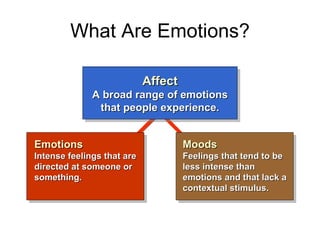
What Are Emotions? Moods Feelings that tend to be less intense than emotions and that lack a contextual stimulus. Emotions Intense feelings that are directed at someone or something. Affect A broad range of emotions that people experience.
Felt versus Displayed Emotions
Emotion Dimensions Variety of emotions Positive Negative Intensity of emotions Personality Job Requirements Frequency and duration of emotions How often emotions are exhibited. How long emotions are displayed.
Facial Expressions Convey Emotions E X H I B I T 4-5
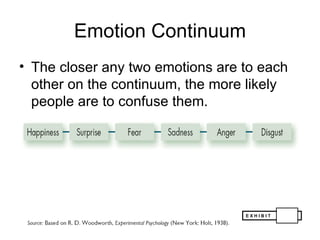
Emotion Continuum The closer any two emotions are to each other on the continuum, the more likely people are to confuse them. E X H I B I T 4-6
Gender and Emotions Women Can show greater emotional expression. Experience emotions more intensely. Display emotions more frequently. Are more comfortable in expressing emotions. Are better at reading others’ emotions.
Gender and Emotions Men Believe that displaying emotions is inconsistent with the male image. Are innately less able to read and to identify with others’ emotions. Have less need to seek social approval by showing positive emotions.
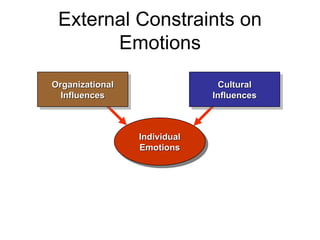
External Constraints on Emotions Organizational Influences Cultural Influences Individual Emotions
Three Competency Domains Technical Skills Cognitive Abilities EI Abilities
Studies *  show: For all levels of jobs, EI competencies are twice as effective as IQ in determining an individual’s success rate. The higher the level of a position in an organization, the more EI seems to matter, Executive Leaders show an  85%  correlation between EI competency and success. * Goleman 1998,  Spencer & Spencer 1993
Self-awareness Self-management Self-motivation Empathy Social skills
Self Awareness Emotional Self-Awareness  – Recognize your own inner signals, note how decisions and values match Accurate Self-Assessment  –  Know your real limits and strengths, be graceful in learning, know when to ask for help Realistic Self-Confidence  – Be willing and able to play to your strengths, admit you have them!
Emotional Self-Control  –   Manage your own disturbing emotions, stay calm and clear-headed Transparency  –   Live your values, admit mistakes, never turn a blind eye Adaptability  – Flexible, nimble, fluid, comfortable with ambiguity Self Management
Self   Motivation Optimism  – Roll with the punches, expect the best of everyone. Innovation  – Seize opportunities, or create them Achievement  – Continually learning – and teaching– ways to do things better
Empathy Ability to sense other’s emotions Showing people that you care Knowing how your words and actions will make others feel
Social   Skills Inspirational  – Embody what you ask of others Influence  – Be persuasive and engaging Developing Others  – Cultivate people’s abilities Change Catalyst  – Recognize the need for change, challenge the status quo Conflict Management  – acknowledge and redirect Building Bonds  – Cultivate the web of relationships Teamwork & Collaboration  – Be a model of respect, helpfulness and cooperation
A __________ B__________ C__________ D__________ E__________ F__________ A   B C D   E   F 6 5 4 3 2 1
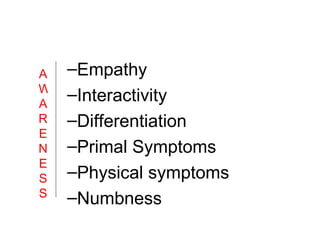
Empathy Interactivity Differentiation Primal Symptoms Physical symptoms Numbness A W A R E N E S S

Emotions

  • 1.
  • 2.
    Why does themost intelligent child in the class not end up most successful in life? Why do some people remain bouyant even in the face of problems? What qualities of mind and spirit determine success?
  • 3.
    Feelings are indispensablefor rational decision making. They are like a compass, they guide us in the right direction. - Dr. Damasio, Iowa College of Medicine
  • 4.
    What Are Emotions?Moods Feelings that tend to be less intense than emotions and that lack a contextual stimulus. Emotions Intense feelings that are directed at someone or something. Affect A broad range of emotions that people experience.
  • 5.
  • 6.
    Emotion Dimensions Varietyof emotions Positive Negative Intensity of emotions Personality Job Requirements Frequency and duration of emotions How often emotions are exhibited. How long emotions are displayed.
  • 7.
    Facial Expressions ConveyEmotions E X H I B I T 4-5
  • 8.
    Emotion Continuum Thecloser any two emotions are to each other on the continuum, the more likely people are to confuse them. E X H I B I T 4-6
  • 9.
    Gender and EmotionsWomen Can show greater emotional expression. Experience emotions more intensely. Display emotions more frequently. Are more comfortable in expressing emotions. Are better at reading others’ emotions.
  • 10.
    Gender and EmotionsMen Believe that displaying emotions is inconsistent with the male image. Are innately less able to read and to identify with others’ emotions. Have less need to seek social approval by showing positive emotions.
  • 11.
    External Constraints onEmotions Organizational Influences Cultural Influences Individual Emotions
  • 12.
    Three Competency DomainsTechnical Skills Cognitive Abilities EI Abilities
  • 13.
    Studies * show: For all levels of jobs, EI competencies are twice as effective as IQ in determining an individual’s success rate. The higher the level of a position in an organization, the more EI seems to matter, Executive Leaders show an 85% correlation between EI competency and success. * Goleman 1998, Spencer & Spencer 1993
  • 14.
  • 15.
    Self Awareness EmotionalSelf-Awareness – Recognize your own inner signals, note how decisions and values match Accurate Self-Assessment – Know your real limits and strengths, be graceful in learning, know when to ask for help Realistic Self-Confidence – Be willing and able to play to your strengths, admit you have them!
  • 16.
    Emotional Self-Control – Manage your own disturbing emotions, stay calm and clear-headed Transparency – Live your values, admit mistakes, never turn a blind eye Adaptability – Flexible, nimble, fluid, comfortable with ambiguity Self Management
  • 17.
    Self Motivation Optimism – Roll with the punches, expect the best of everyone. Innovation – Seize opportunities, or create them Achievement – Continually learning – and teaching– ways to do things better
  • 18.
    Empathy Ability tosense other’s emotions Showing people that you care Knowing how your words and actions will make others feel
  • 19.
    Social Skills Inspirational – Embody what you ask of others Influence – Be persuasive and engaging Developing Others – Cultivate people’s abilities Change Catalyst – Recognize the need for change, challenge the status quo Conflict Management – acknowledge and redirect Building Bonds – Cultivate the web of relationships Teamwork & Collaboration – Be a model of respect, helpfulness and cooperation
  • 20.
    A __________ B__________C__________ D__________ E__________ F__________ A B C D E F 6 5 4 3 2 1
  • 21.
    Empathy Interactivity DifferentiationPrimal Symptoms Physical symptoms Numbness A W A R E N E S S