Supplemental Self-Study Presentation
Emotional Intelligence
A Scientifically Proven Method for Developing the Skills of
Success
Emotional Intelligence: A Scientifically Proven Method for Developing the Skills of Success
Overview
Emotional Intelligence: A Scientifically Proven Method for Developing the Skills of Success
Motivated business professionals are looking for every edge to be successful in the workplace.
Naturally, many develop expertise in technical or task-oriented skills in order to enhance their
careers. However, those who have a high level of awareness and control over their emotions, and
use their emotions to connect with others and develop positive relationships, will find even
greater success in the workplace.
This soft skill is known as emotional intelligence, and
it is an essential element in the business world,
especially in high-stress environments. If you are
unable to control your emotions, they can preoccupy
your thoughts and interfere with your ability to
evaluate a situation objectively. On the contrary,
knowing what triggers your emotional responses and
understanding how to exercise self-control over them
enables you to confront difficult issues and manage
change with clarity and composure.
Introduction
Emotional Intelligence: A Scientifically Proven Method for Developing the Skills of Success
This program is designed to provide you with the
knowledge and tools to develop your emotional
intelligence. You’ll learn how to avoid self-sabotaging
outcomes by altering how you perceive and respond to
emotionally-charged situations. In addition, you’ll improve
your ability to resolve conflict constructively, create a
productive work environment, build and mend
relationships, and bounce back from setbacks and
disappointment.
Introduction Part 2
“No doubt emotional intelligence is more rare than book smarts, but my experience
says it is actually more important in the making of a leader. You just can’t ignore it.”
—Jack Welch, former CEO of General Electric
Emotional Intelligence: A Scientifically Proven Method for Developing the Skills of Success
The concept of emotional intelligence was popularized by Daniel Goleman in his 1995 book,
Emotional Intelligence: Why It Can Matter More than IQ. His book was based primarily on the
work of two psychologists, John Mayer, PhD, and Peter Salovey, PhD.
Since then, many books, articles, and studies have emerged
and much research has been done on the topic, resulting in
many different definitions and descriptions of emotional
intelligence. For this program, we will use the following
definition, developed by Mayer and Salovey in 1990:
“Emotional intelligence (EI) is the ability to monitor one’s
own and others’ feelings and emotions, to discriminate
among them and to use this information to guide one’s
thinking and actions”. i
Definition of Emotional Intelligence
Emotional Intelligence: A Scientifically Proven Method for Developing the Skills of Success
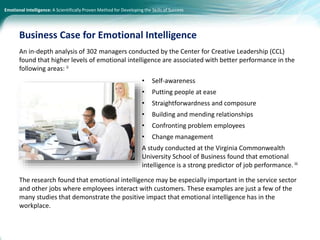
An in-depth analysis of 302 managers conducted by the Center for Creative Leadership (CCL)
found that higher levels of emotional intelligence are associated with better performance in the
following areas: ii
The research found that emotional intelligence may be especially important in the service sector
and other jobs where employees interact with customers. These examples are just a few of the
many studies that demonstrate the positive impact that emotional intelligence has in the
workplace.
Business Case for Emotional Intelligence
• Self-awareness
• Putting people at ease
• Straightforwardness and composure
• Building and mending relationships
• Confronting problem employees
• Change management
A study conducted at the Virginia Commonwealth
University School of Business found that emotional
intelligence is a strong predictor of job performance. iii
Emotional Intelligence: A Scientifically Proven Method for Developing the Skills of Success
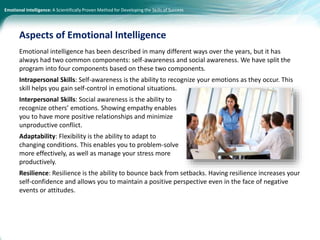
Emotional intelligence has been described in many different ways over the years, but it has
always had two common components: self-awareness and social awareness. We have split the
program into four components based on these two components.
Intrapersonal Skills: Self-awareness is the ability to recognize your emotions as they occur. This
skill helps you gain self-control in emotional situations.
Interpersonal Skills: Social awareness is the ability to
recognize others’ emotions. Showing empathy enables
you to have more positive relationships and minimize
unproductive conflict.
Adaptability: Flexibility is the ability to adapt to
changing conditions. This enables you to problem-solve
more effectively, as well as manage your stress more
productively.
Resilience: Resilience is the ability to bounce back from setbacks. Having resilience increases your
self-confidence and allows you to maintain a positive perspective even in the face of negative
events or attitudes.
Aspects of Emotional Intelligence
Emotional Intelligence: A Scientifically Proven Method for Developing the Skills of Success
Module 1:
Intrapersonal Skills
Emotional Intelligence: A Scientifically Proven Method for Developing the Skills of Success
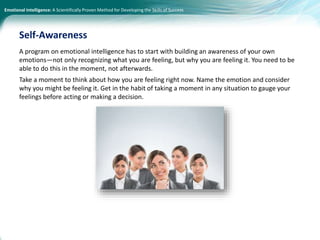
A program on emotional intelligence has to start with building an awareness of your own
emotions—not only recognizing what you are feeling, but why you are feeling it. You need to be
able to do this in the moment, not afterwards.
Take a moment to think about how you are feeling right now. Name the emotion and consider
why you might be feeling it. Get in the habit of taking a moment in any situation to gauge your
feelings before acting or making a decision.
Self-Awareness
Emotional Intelligence: A Scientifically Proven Method for Developing the Skills of Success
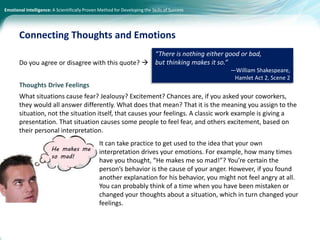
Do you agree or disagree with this quote? 
Thoughts Drive Feelings
What situations cause fear? Jealousy? Excitement? Chances are, if you asked your coworkers,
they would all answer differently. What does that mean? That it is the meaning you assign to the
situation, not the situation itself, that causes your feelings. A classic work example is giving a
presentation. That situation causes some people to feel fear, and others excitement, based on
their personal interpretation.
It can take practice to get used to the idea that your own
interpretation drives your emotions. For example, how many times
have you thought, “He makes me so mad!”? You’re certain the
person’s behavior is the cause of your anger. However, if you found
another explanation for his behavior, you might not feel angry at all.
You can probably think of a time when you have been mistaken or
changed your thoughts about a situation, which in turn changed your
feelings.
Connecting Thoughts and Emotions
He makes me
so mad!
“There is nothing either good or bad,
but thinking makes it so.”
—William Shakespeare,
Hamlet Act 2, Scene 2
Emotional Intelligence: A Scientifically Proven Method for Developing the Skills of Success
Once you get in the habit of identifying your emotions and the thoughts
behind them, you need to decide if your thoughts and feelings are
reasonable. Use the “reasonable person” standard—defined by the Free
Dictionary as a legal standard referring to “a hypothetical person in society
who exercises average care, skill, and judgment in conduct.” iv It reflects
how a typical person should behave in a particular situation.
Your goal is to prevent “emotional hijacking”—what happens when you act
or make decisions based on an emotional reaction that you haven’t
stopped to analyze.
This doesn’t mean that all emotions are irrational. What you feel about a
situation is what you feel; emotions are a natural human response. It does
mean that the thoughts that led you to feel that particular emotion may be
irrational—and that’s what you want to monitor and adjust.
Note: “Emotional hijacking” is a variation of “amygdala hijacking” – a term coined by Daniel Goleman in his 1996 book Emotional Intelligence:
Why It Can Matter More than IQ.
Making Judgments about Your Emotions
Emotional Intelligence: A Scientifically Proven Method for Developing the Skills of Success
Another important way to recognize your emotions and take time before you act is to identify
your physical cues associated with particular emotions. Recognizing the signals that occur as
emotions arise can help you avoid being “emotionally hijacked.”
A classic example of managing your emotions is when you’re in a heated discussion with
someone and the phone rings. You probably answer the call in a pleasant tone of voice, unrelated
to the feelings you were just experiencing.
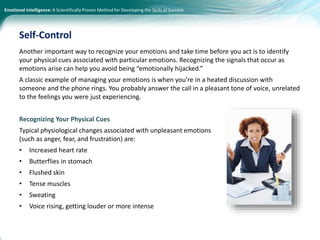
Recognizing Your Physical Cues
Typical physiological changes associated with unpleasant emotions
(such as anger, fear, and frustration) are:
• Increased heart rate
• Butterflies in stomach
• Flushed skin
• Tense muscles
• Sweating
• Voice rising, getting louder or more intense
Self-Control
Emotional Intelligence: A Scientifically Proven Method for Developing the Skills of Success
An emotional hijacking may hinder you from choosing an effective response, action, or decision.
To prevent this, you must take some time to recognize the cues that your emotions are taking
over.
• Take a deep breath.
• Silently count to ten. An oldie, but goodie!
• Train yourself to use a gesture to remind yourself to pause and breathe. For example, when
you feel your emotions rising, tap your leg.
• Close your eyes and visualize a scene that is pleasant and calming to you.
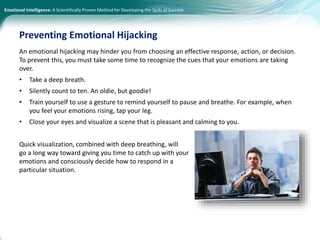
Quick visualization, combined with deep breathing, will
go a long way toward giving you time to catch up with your
emotions and consciously decide how to respond in a
particular situation.
Preventing Emotional Hijacking
Emotional Intelligence: A Scientifically Proven Method for Developing the Skills of Success
Read the question, then click on the answer.
Which of the following is an accurate statement about your emotions?
Test Your Knowledge
A. How others behave triggers your emotions.
B. Once it begins, you cannot stop being “emotionally hijacked.”
C. Your interpretation of a situation, not the situation itself, causes your feelings.
D. All emotions are irrational.
Emotional Intelligence: A Scientifically Proven Method for Developing the Skills of Success
Module 2:
Interpersonal Skills
Emotional Intelligence: A Scientifically Proven Method for Developing the Skills of Success
In addition to recognizing and managing your own emotions, another goal of emotional
intelligence is to develop more positive relationships with others at work. One of the primary
ways to do that is to increase your empathy. Connecting with another person on an emotional
level allows you to develop a meaningful, trusting relationship.
The definition of empathy is the ability to recognize the emotions that another person is
experiencing; it is the ability to “walk a mile in another person’s shoes.” Get in the habit of
consciously tuning in to others’ emotions.
How to Recognize Others’ Emotions
• Get to know the other person. A one-time observation isn’t as likely
to be as accurate as observations made over time.
• Pay special attention to the upper part of the face. According to Calin
Prodan, a professor of neurology at the University of Oklahoma
Health Sciences Center, “primary” or true emotions are expressed in
the upper half of the face.v
Increasing Your Empathy
Emotional Intelligence: A Scientifically Proven Method for Developing the Skills of Success
• Ask for feedback. Find out whether your perceptions are correct. For instance, “It sounds like
you’re worried about the upcoming budget review. Is that how you’re feeling?”
• Be expressive yourself. People are more likely to let their guard down and share their true
emotions if you are willing to disclose your own.
How to Demonstrate Empathy
Follow these tips to proactively show others that you care about them.
• Don’t offer advice, judge them, or tell them they shouldn’t be feeling what they’re feeling.
You don’t necessarily have to agree or fully understand their situation to be empathetic.
• Listen. Ask open-ended questions that allow the other person to talk. Respond without
judging. Validate their feelings as real to them (even if they don’t make sense to you).
• Use words and gestures to show you care. Make eye contact, smile or nod, give a light touch,
or perhaps a hug (if appropriate). Finally, ask if there is anything you can do to help. Offer
advice only if they ask for it.
Increasing Your Empathy Part 2
Emotional Intelligence: A Scientifically Proven Method for Developing the Skills of Success
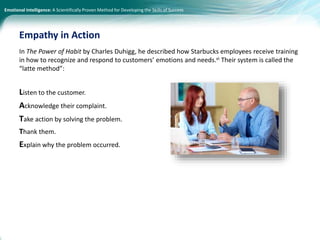
In The Power of Habit by Charles Duhigg, he described how Starbucks employees receive training
in how to recognize and respond to customers’ emotions and needs.vi Their system is called the
“latte method”:
Listen to the customer.
Acknowledge their complaint.
Take action by solving the problem.
Thank them.
Explain why the problem occurred.
Empathy in Action
Emotional Intelligence: A Scientifically Proven Method for Developing the Skills of Success
Connecting and Communicating
Improve your interactions with others by tuning into their thoughts, feelings, and needs.
• Meet them where they are.
o If the other person is communicating at a “just the facts” level, start there as well. They
probably aren’t ready to disclose information that would make them feel vulnerable. Once
you’ve connected with them at their level, use self-disclosure and open-ended questions to
seek out their feelings and needs.
o If they’re already sharing their thoughts and feelings, be receptive and accepting, not
judgmental and critical.
• Watch for non-verbal cues that communicate emotions—facial expressions, eye contact, body
language and gestures, tone of voice, volume, pace, etc.
• If you have negative or unpleasant information to share, prepare them for it instead of
surprising them. Example: “I have the report on customer satisfaction, and it isn’t good.”
Empathy in Action Part 2
Emotional Intelligence: A Scientifically Proven Method for Developing the Skills of Success
Assertiveness is the ability to communicate your feelings and needs clearly to another person
while remaining respectful of that person’s feelings and needs. It is the middle ground between
passiveness—ignoring your own feelings and needs—and aggressiveness—ignoring the other
person’s feelings and needs. Empathy and assertiveness may seem incompatible on the surface,
but as we’ll see, assertiveness takes into consideration the other person’s feelings and needs—in
other words, being empathetic.
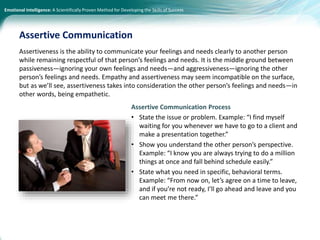
Assertive Communication Process
• State the issue or problem. Example: “I find myself
waiting for you whenever we have to go to a client and
make a presentation together.”
• Show you understand the other person’s perspective.
Example: “I know you are always trying to do a million
things at once and fall behind schedule easily.”
• State what you need in specific, behavioral terms.
Example: “From now on, let’s agree on a time to leave,
and if you’re not ready, I’ll go ahead and leave and you
can meet me there.”
Assertive Communication
Emotional Intelligence: A Scientifically Proven Method for Developing the Skills of Success
Assertive Communication Techniques
• Use “I” messages. This keeps the focus on your own feelings and needs, rather than blaming
or accusing the other person. Example: “I get frustrated when I have to wait for you and
worry about being late for our appointment.”
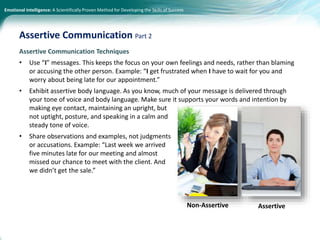
• Exhibit assertive body language. As you know, much of your message is delivered through
your tone of voice and body language. Make sure it supports your words and intention by
making eye contact, maintaining an upright, but
not uptight, posture, and speaking in a calm and
steady tone of voice.
• Share observations and examples, not judgments
or accusations. Example: “Last week we arrived
five minutes late for our meeting and almost
missed our chance to meet with the client. And
we didn’t get the sale.”
Assertive Communication Part 2
Non-Assertive Assertive
Emotional Intelligence: A Scientifically Proven Method for Developing the Skills of Success
When You Don’t Get the Response You Want
If you have used assertive communication techniques, yet are not getting your desired outcome,
try these strategies:
• Persevere. You may have to repeat yourself and remind the other person of the agreement or
consequence you established.
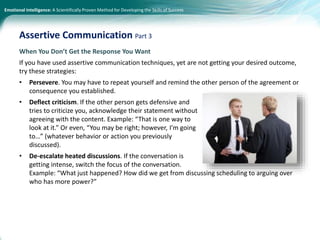
• Deflect criticism. If the other person gets defensive and
tries to criticize you, acknowledge their statement without
agreeing with the content. Example: “That is one way to
look at it.” Or even, “You may be right; however, I’m going
to…” (whatever behavior or action you previously
discussed).
• De-escalate heated discussions. If the conversation is
getting intense, switch the focus of the conversation.
Example: “What just happened? How did we get from discussing scheduling to arguing over
who has more power?”
Assertive Communication Part 3
Emotional Intelligence: A Scientifically Proven Method for Developing the Skills of Success
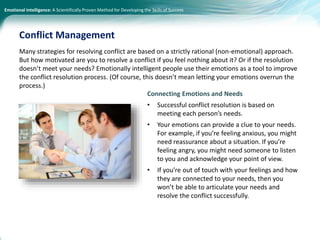
Many strategies for resolving conflict are based on a strictly rational (non-emotional) approach.
But how motivated are you to resolve a conflict if you feel nothing about it? Or if the resolution
doesn’t meet your needs? Emotionally intelligent people use their emotions as a tool to improve
the conflict resolution process. (Of course, this doesn’t mean letting your emotions overrun the
process.)
Conflict Management
Connecting Emotions and Needs
• Successful conflict resolution is based on
meeting each person’s needs.
• Your emotions can provide a clue to your needs.
For example, if you’re feeling anxious, you might
need reassurance about a situation. If you’re
feeling angry, you might need someone to listen
to you and acknowledge your point of view.
• If you’re out of touch with your feelings and how
they are connected to your needs, then you
won’t be able to articulate your needs and
resolve the conflict successfully.
Emotional Intelligence: A Scientifically Proven Method for Developing the Skills of Success
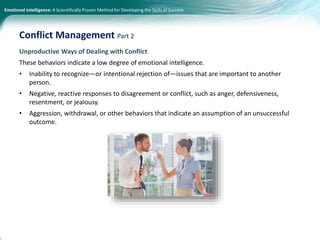
Unproductive Ways of Dealing with Conflict
These behaviors indicate a low degree of emotional intelligence.
• Inability to recognize—or intentional rejection of—issues that are important to another
person.
• Negative, reactive responses to disagreement or conflict, such as anger, defensiveness,
resentment, or jealousy.
• Aggression, withdrawal, or other behaviors that indicate an assumption of an unsuccessful
outcome.
Conflict Management Part 2
Emotional Intelligence: A Scientifically Proven Method for Developing the Skills of Success
Elements of Successful Conflict Resolution
Follow these tips to help ensure that the conflict is resolved productively.
• Be aware of your emotions while remaining composed—manage your emotions and behavior.
• Be aware of the other person’s emotions.
• Communicate your needs clearly and respectfully. Communication includes body language.
• Make sure your priority is to meet the other person’s needs as well as your own rather than
“winning.”
Conflict Management Part 3
“Anybody can become angry—that is easy, but to be angry with the right
person and to the right degree and at the right time and for the right purpose,
and in the right way—that is not within everybody’s power and is not easy.”
—Aristotle
Emotional Intelligence: A Scientifically Proven Method for Developing the Skills of Success
Elements of Successful Conflict Resolution (continued)
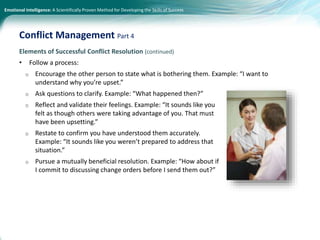
• Follow a process:
o Encourage the other person to state what is bothering them. Example: “I want to
understand why you’re upset.”
o Ask questions to clarify. Example: “What happened then?”
o Reflect and validate their feelings. Example: “It sounds like you
felt as though others were taking advantage of you. That must
have been upsetting.”
o Restate to confirm you have understood them accurately.
Example: “It sounds like you weren’t prepared to address that
situation.”
o Pursue a mutually beneficial resolution. Example: “How about if
I commit to discussing change orders before I send them out?”
Conflict Management Part 4
Emotional Intelligence: A Scientifically Proven Method for Developing the Skills of Success
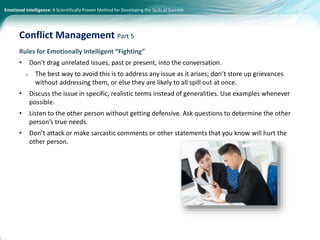
Rules for Emotionally Intelligent “Fighting”
• Don’t drag unrelated issues, past or present, into the conversation.
o The best way to avoid this is to address any issue as it arises; don’t store up grievances
without addressing them, or else they are likely to all spill out at once.
• Discuss the issue in specific, realistic terms instead of generalities. Use examples whenever
possible.
• Listen to the other person without getting defensive. Ask questions to determine the other
person’s true needs.
• Don’t attack or make sarcastic comments or other statements that you know will hurt the
other person.
Conflict Management Part 5
Emotional Intelligence: A Scientifically Proven Method for Developing the Skills of Success
D. Tell them their feelings are off-base to help them “get a grip” on their emotions.
Read the question, then click on the answer.
Which of the following is the best way to demonstrate empathy for another person?
Test Your Knowledge
A. Listen and respond without judging.
B. Tell them what to do so they don’t make a mistake.
C. Try to avoid displaying any emotion so they know you are concentrating on them.
Emotional Intelligence: A Scientifically Proven Method for Developing the Skills of Success
Module 3:
Adaptability
Emotional Intelligence: A Scientifically Proven Method for Developing the Skills of Success
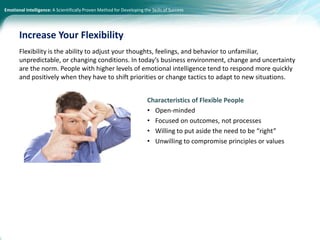
Flexibility is the ability to adjust your thoughts, feelings, and behavior to unfamiliar,
unpredictable, or changing conditions. In today’s business environment, change and uncertainty
are the norm. People with higher levels of emotional intelligence tend to respond more quickly
and positively when they have to shift priorities or change tactics to adapt to new situations.
Characteristics of Flexible People
• Open-minded
• Focused on outcomes, not processes
• Willing to put aside the need to be “right”
• Unwilling to compromise principles or values
Increase Your Flexibility
Emotional Intelligence: A Scientifically Proven Method for Developing the Skills of Success
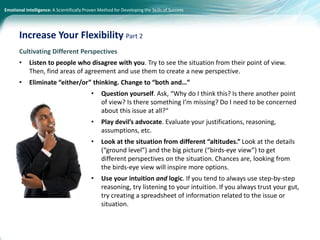
Cultivating Different Perspectives
• Listen to people who disagree with you. Try to see the situation from their point of view.
Then, find areas of agreement and use them to create a new perspective.
• Eliminate “either/or” thinking. Change to “both and…”
• Question yourself. Ask, “Why do I think this? Is there another point
of view? Is there something I’m missing? Do I need to be concerned
about this issue at all?“
• Play devil’s advocate. Evaluate your justifications, reasoning,
assumptions, etc.
• Look at the situation from different “altitudes.” Look at the details
(“ground level”) and the big picture (“birds-eye view”) to get
different perspectives on the situation. Chances are, looking from
the birds-eye view will inspire more options.
• Use your intuition and logic. If you tend to always use step-by-step
reasoning, try listening to your intuition. If you always trust your gut,
try creating a spreadsheet of information related to the issue or
situation.
Increase Your Flexibility Part 2
Emotional Intelligence: A Scientifically Proven Method for Developing the Skills of Success
People with high levels of emotional intelligence have a greater ability to keep their composure
and stay focused in stressful or high-pressure situations.
How to Handle Stress Effectively
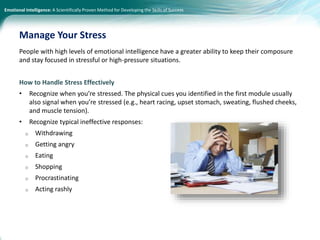
• Recognize when you’re stressed. The physical cues you identified in the first module usually
also signal when you’re stressed (e.g., heart racing, upset stomach, sweating, flushed cheeks,
and muscle tension).
• Recognize typical ineffective responses:
o Withdrawing
o Getting angry
o Eating
o Shopping
o Procrastinating
o Acting rashly
Manage Your Stress
Emotional Intelligence: A Scientifically Proven Method for Developing the Skills of Success
How to Handle Stress Effectively (continued)
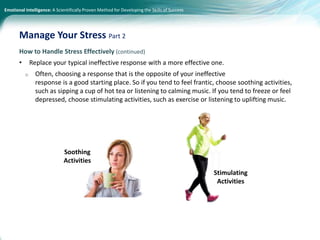
• Replace your typical ineffective response with a more effective one.
o Often, choosing a response that is the opposite of your ineffective
response is a good starting place. So if you tend to feel frantic, choose soothing activities,
such as sipping a cup of hot tea or listening to calming music. If you tend to freeze or feel
depressed, choose stimulating activities, such as exercise or listening to uplifting music.
Manage Your Stress Part 2
Soothing
Activities
Stimulating
Activities
Emotional Intelligence: A Scientifically Proven Method for Developing the Skills of Success
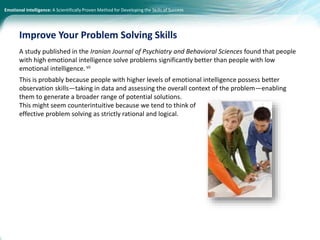
A study published in the Iranian Journal of Psychiatry and Behavioral Sciences found that people
with high emotional intelligence solve problems significantly better than people with low
emotional intelligence.vii
This is probably because people with higher levels of emotional intelligence possess better
observation skills—taking in data and assessing the overall context of the problem—enabling
them to generate a broader range of potential solutions.
This might seem counterintuitive because we tend to think of
effective problem solving as strictly rational and logical.
Improve Your Problem Solving Skills
Emotional Intelligence: A Scientifically Proven Method for Developing the Skills of Success
Basic Problem Solving Process
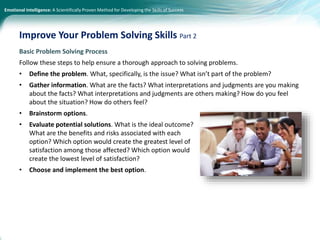
Follow these steps to help ensure a thorough approach to solving problems.
• Define the problem. What, specifically, is the issue? What isn’t part of the problem?
• Gather information. What are the facts? What interpretations and judgments are you making
about the facts? What interpretations and judgments are others making? How do you feel
about the situation? How do others feel?
• Brainstorm options.
• Evaluate potential solutions. What is the ideal outcome?
What are the benefits and risks associated with each
option? Which option would create the greatest level of
satisfaction among those affected? Which option would
create the lowest level of satisfaction?
• Choose and implement the best option.
Improve Your Problem Solving Skills Part 2
Emotional Intelligence: A Scientifically Proven Method for Developing the Skills of Success
Read the question, then click on the answer.
The ability to keep your composure and stay focused in stressful situations is a sign of emotional
intelligence. Which of the following is an effective way to manage stress?
Test Your Knowledge
A. Allow yourself to blow off steam immediately to get it out of your system.
B. Tell yourself to quit feeling stressed.
C. Indulge in your favorite activity, whatever it is.
D. Engage in an activity that is the opposite of your typical stress response.
Emotional Intelligence: A Scientifically Proven Method for Developing the Skills of Success
Module 4:
Resilience
Emotional Intelligence: A Scientifically Proven Method for Developing the Skills of Success
Perhaps the greatest strength of emotionally intelligent people is their ability to avoid distorted
thinking, change their perspective, and bounce back from setbacks—this is how we define
resilience. Resilient people are able to find a silver lining and see a hopeful future despite their
current circumstances.
Analyze Your Thinking
The first aspect of resilience that we’ll look at is gaining an accurate perspective. To do this, assess
your negative feelings to determine if they are working for or against you.
When you have negative feelings, stop and analyze why you’re having them.
• Picture a stop sign to consciously stop and evaluate your thinking.
• Then, ask yourself three questions:
o What am I feeling?
o What do I want to feel?
o What do I need to feel that way?
Gaining an Accurate Perspective
Emotional Intelligence: A Scientifically Proven Method for Developing the Skills of Success
Practice Analyzing Your Thinking
Think of a situation that you have had negative thoughts about. Answer the three questions:
What am I feeling? What do I want to feel? What do I need to feel that way? The last question
will probably be the most difficult to answer. Use the following formula to help you answer the
question.
“I’m feeling _____________________ because ___________________________. I want to feel
__________________________. I can use my strengths doing ________________ and count on
the support of _______________________________________ to help me feel that way.”
Example: “I’m feeling anxious because my boss wants me to make a presentation to upper
management. I want to feel calm and confident. I can use my strengths doing lots of practice and
remembering the successful presentation I gave to our department and count on the support of
Tyler and Maria to help me feel that way.”
Gaining an Accurate Perspective Part 2
Emotional Intelligence: A Scientifically Proven Method for Developing the Skills of Success
Reframe Your Thinking
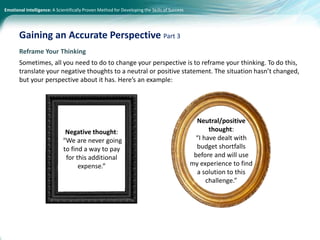
Sometimes, all you need to do to change your perspective is to reframe your thinking. To do this,
translate your negative thoughts to a neutral or positive statement. The situation hasn’t changed,
but your perspective about it has. Here’s an example:
Gaining an Accurate Perspective Part 3
Negative thought:
“We are never going
to find a way to pay
for this additional
expense.”
Neutral/positive
thought:
“I have dealt with
budget shortfalls
before and will use
my experience to find
a solution to this
challenge.”
Emotional Intelligence: A Scientifically Proven Method for Developing the Skills of Success
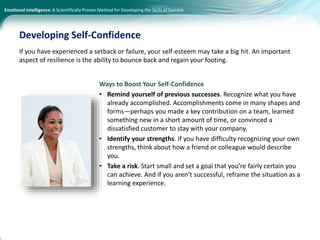
If you have experienced a setback or failure, your self-esteem may take a big hit. An important
aspect of resilience is the ability to bounce back and regain your footing.
Ways to Boost Your Self-Confidence
• Remind yourself of previous successes. Recognize what you have
already accomplished. Accomplishments come in many shapes and
forms—perhaps you made a key contribution on a team, learned
something new in a short amount of time, or convinced a
dissatisfied customer to stay with your company.
• Identify your strengths. If you have difficulty recognizing your own
strengths, think about how a friend or colleague would describe
you.
• Take a risk. Start small and set a goal that you’re fairly certain you
can achieve. And if you aren’t successful, reframe the situation as a
learning experience.
Developing Self-Confidence
Emotional Intelligence: A Scientifically Proven Method for Developing the Skills of Success
• Think positive and in the present tense.
o Incorrect: “I’m not shy.”
o Incorrect: “I’m going to try to be
confident.
o Correct: “I am confident.”
• Change “I can’t” to “I can.”
o Incorrect: “I can’t work with Joe.”
o Correct: “I can work with Joe when I stay
focused on the task.”
• Change “problem” to “challenge” or
“opportunity.”
o Incorrect: “This is a big problem.”
o Correct: “This is a big challenge.”
• Change “have to” to “want to.”
o Incorrect: “I have to finish this report.”
o Correct: “I want to finish this report.”
Change Your Self-Talk
According to Val Kinjerski, PhD, we have 65,000 thoughts a day and 65 percent of them are
negative.viii You can increase your self-confidence by minimizing negative thoughts (2011).
Emotional Intelligence: A Scientifically Proven Method for Developing the Skills of Success
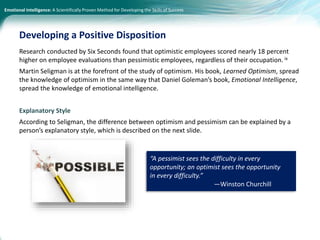
Research conducted by Six Seconds found that optimistic employees scored nearly 18 percent
higher on employee evaluations than pessimistic employees, regardless of their occupation. ix
Martin Seligman is at the forefront of the study of optimism. His book, Learned Optimism, spread
the knowledge of optimism in the same way that Daniel Goleman’s book, Emotional Intelligence,
spread the knowledge of emotional intelligence.
Explanatory Style
According to Seligman, the difference between optimism and pessimism can be explained by a
person’s explanatory style, which is described on the next slide.
Developing a Positive Disposition
“A pessimist sees the difficulty in every
opportunity; an optimist sees the opportunity
in every difficulty.”
—Winston Churchill
Emotional Intelligence: A Scientifically Proven Method for Developing the Skills of Success
Explanatory Style (continued)
• Permanence: Optimistic people view setbacks or failure as temporary, while pessimistic
people see setbacks as more permanent. In addition, optimists connect negative events to
temporary causes, while pessimistic people believe the cause is permanent. On the flip side,
optimists associate positive events with permanent causes, while pessimists associate them
with temporary causes.
• Pervasiveness: Optimistic people keep setbacks separate
from the rest of their life—in other words, a setback in one
part of their job or life doesn’t mean their entire life or job is
a failure. Pessimists believe the opposite—one bad event
means their whole life or job is a failure.
• Personalization: Optimistic people attribute positive events
to their own abilities and negative events to external
circumstances. Pessimistic people are just the opposite—they
attribute negative events to themselves (blame) and positive
events to external circumstances.
Developing a Positive Disposition Part 2
Emotional Intelligence: A Scientifically Proven Method for Developing the Skills of Success
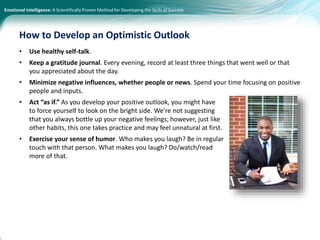
• Use healthy self-talk.
• Keep a gratitude journal. Every evening, record at least three things that went well or that
you appreciated about the day.
• Minimize negative influences, whether people or news. Spend your time focusing on positive
people and inputs.
• Act “as if.” As you develop your positive outlook, you might have
to force yourself to look on the bright side. We’re not suggesting
that you always bottle up your negative feelings; however, just like
other habits, this one takes practice and may feel unnatural at first.
• Exercise your sense of humor. Who makes you laugh? Be in regular
touch with that person. What makes you laugh? Do/watch/read
more of that.
How to Develop an Optimistic Outlook
Emotional Intelligence: A Scientifically Proven Method for Developing the Skills of Success
Read the question, then click on the answer.
Which of the following is an example of effective self-talk?
Test Your Knowledge
A. “I have to be on time more often.”
B. “I arrive on time to meetings.”
C. “I hope I will be on time more often.”
D. “I will quit being late to meetings.”
Emotional Intelligence: A Scientifically Proven Method for Developing the Skills of Success
Review
Emotional Intelligence: A Scientifically Proven Method for Developing the Skills of Success
Read the case study and answer the questions that follow in order to put your emotional
intelligence skills into practice.
Organization: The corporate headquarters of an office supply company.
People: Emily, a project manager. Matt, Emily’s boss. David and Jennifer, Emily’s coworkers.
Situation: Matt is leading a meeting with his team, Emily, David, and Jennifer.
CASE STUDY—Apply What You’ve Learned
Emotional Intelligence: A Scientifically Proven Method for Developing the Skills of Success
Matt: “Our next agenda item is a report from David about the new project management
software.”
Emily: “Hey, Bub, tell us what you’ve got, big boy.”
Everybody looks at Emily but she doesn’t notice.
David: “Well, uh, I’m piloting the software and so far it’s working pretty well. The main issue I see
is in estimating costs.”
Emily: “And you haven’t fixed it yet? What have you been doing?”
Matt: “Emily, that’s uncalled for.””
Emily: “I’m joking! Just trying to lighten up the meeting. Everyone is so serious.”
Later, Emily meets with Matt in her regular one-on-one meeting.
Matt: “So, let’s review the last week. What went well and what could have gone better?”
Emily: “Well, I closed out the LRM project. We even had money left in the contingency fund. So
that was good. On the other hand, I’m struggling with Jennifer at the moment. Sometimes she
makes me so mad.”
CASE STUDY—Apply What You’ve Learned Part 2
Emotional Intelligence: A Scientifically Proven Method for Developing the Skills of Success
Matt: “From what I’ve heard, that’s a two-way street. She isn’t thrilled with
you either.”
Emily: “Maybe it’s because we’re both competing for that promotion. But
I’m way more qualified. Her efficiency numbers are not even close to mine.”
Matt: “We’re not here to talk about Jennifer’s qualifications. This one-on-one
is for you. But surely you must realize that a promotion to supervisor will be
based on more than individual efficiency numbers.”
Emily: “Why wouldn’t you want to promote the top
performer?”
Matt: “A successful supervisor has a different skill set from a top-notch project
manager.”
Emily: “But aren’t you always saying ‘past experience is the best predictor of
future success’?”
Matt: “It may be frustrating to feel like you’re not rewarded for performance.
But think about it—what qualities do you want in a supervisor? And how
would you rate yourself in terms of those qualities?”
CASE STUDY—Apply What You’ve Learned Part 3
Emotional Intelligence: A Scientifically Proven Method for Developing the Skills of Success
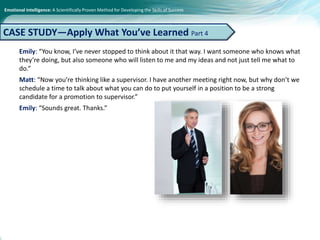
Emily: “You know, I’ve never stopped to think about it that way. I want someone who knows what
they’re doing, but also someone who will listen to me and my ideas and not just tell me what to
do.”
Matt: “Now you’re thinking like a supervisor. I have another meeting right now, but why don’t we
schedule a time to talk about what you can do to put yourself in a position to be a strong
candidate for a promotion to supervisor.”
Emily: “Sounds great. Thanks.”
CASE STUDY—Apply What You’ve Learned Part 4
Emotional Intelligence: A Scientifically Proven Method for Developing the Skills of Success
1. What traits of emotional intelligence were evident in Emily? What aspects of emotional
intelligence were absent? Give examples.
2. What signs of emotional intelligence did Matt exhibit? What was absent? Give examples.
3. What could Emily do to make herself a more desirable candidate for promotion?
Review the ideas and suggested answers provided on the following slides.
CASE STUDY—Questions to Consider
Emotional Intelligence: A Scientifically Proven Method for Developing the Skills of Success
1. What traits of emotional intelligence were evident in Emily? What aspects of emotional
intelligence were absent? Give examples.
Emily didn’t show many signs of emotional intelligence. In particular she seemed unaware of
how her language and interactions were viewed by others. For example, when she used the
words “Bub” and “big boy” everyone looked at her, but she didn’t notice. Then she made,
what she thought was, a joke but no one else thought it was funny.
In addition, when she met with Matt, she mentioned that Jennifer made her mad, indicating
a lack of self-awareness that her thoughts about people and situations drive her emotions,
not the people or situations themselves.
On the plus side, Emily showed that she was capable of recognizing emotional intelligence
when she mentioned that listening is an important skill. It doesn’t guarantee that she uses it
herself, but awareness is a good first step. And she seemed ready to be flexible (a sign of
emotional intelligence) when she was willing to discuss what she needed to do to be a better
candidate for a supervisory position.
CASE STUDY—Suggested Answers
Emotional Intelligence: A Scientifically Proven Method for Developing the Skills of Success
2. What signs of emotional intelligence did Matt exhibit? What was absent? Give examples.
In general, Matt exhibited emotional intelligence. Matt recognized that Emily’s comment to
David, although apparently intended as a joke, could make David feel uncomfortable, and
called Emily on it.
In addition, Matt exhibited emotional intelligence when he met with Emily— he showed
empathy by asking her questions to better understand her point of view (rather than simply
offer advice or tell her what to do), and by putting himself in her place (“it must be
frustrating…”).
On the other hand, his comment to Emily that Jennifer wasn’t thrilled with her may have
been accurate, but wasn’t particularly helpful. He could have been more diplomatic, as well
as more effective, by helping Emily see how her thoughts connected to her feelings.
CASE STUDY—Suggested Answers Part 2
Emotional Intelligence: A Scientifically Proven Method for Developing the Skills of Success
3. What could Emily do to make herself a more desirable candidate for promotion?
Primarily, Emily needs to develop her ability to read the social cues and emotional responses
of those she interacts with. She needs to work on showing empathy and connecting with
others in a meaningful way, and avoid using humor until she is sure she is on the same page
as others.
In addition, Emily would benefit from increasing her self-awareness. Although she didn’t
show any signs of a lack of self-control, supervisors face many stressful situations and she is
likely to handle those more effectively if she can separate her thoughts and emotions.
Emily seems capable of learning and adjusting (two signs of emotional intelligence) so her
goal of being promoted appears to be completely reasonable and within reach.
CASE STUDY—Suggested Answers Part 3
Emotional Intelligence: A Scientifically Proven Method for Developing the Skills of Success
By now you should be able to:
• Manage your emotions by recognizing how thoughts and emotions are connected.
• Improve your self-control by identifying physical cues that indicate your emotions may be
taking over.
• Discover how emotional intelligence can help you develop more positive relationships at work
and a more optimistic outlook.
• Learn how to use assertive communication to express your needs and feelings appropriately.
• Explore how to use emotional intelligence to bounce back from setbacks.
Congratulations!
Emotional Intelligence: A Scientifically Proven Method for Developing the Skills of Success
Appendix
Emotional Intelligence: A Scientifically Proven Method for Developing the Skills of Success
Bradberry, Travis and Jean Greaves. Emotional Intelligence 2.0. San Diego, CA: TalentSmart, 2009.
Cornwall, Michael. Go Suck a Lemon: Strategies for Improving Your Emotional Intelligence. CreateSpace Independent Publishing Platform,
2012.
Goleman, Daniel. Working with Emotional Intelligence. New York: Bantam Books, 1998.
Hughes, Marcia, L. Bonita Patterson, and James Bradford Terrell. Emotional Intelligence in Action: Training and Coaching Activities for Leaders
and Managers. San Francisco, CA: Pfeiffer, 2005.
Lynn, Adele B. The Emotional Intelligence Activity Book: 50 Activities for Promoting EQ at Work. New York: AMACOM, 2002.
Weisinger, Hendrie., Ph.D. Emotional Intelligence at Work: The Untapped Edge for Success. San Francisco, CA: Jossey-Bass Publishers, 1998.
i Emotional Intelligence & MSCEIT. “EI.” Last modified 2009. http://www.emotionaliq.org/EI.htm.
ii Center for Creative Leadership. “Leadership Skills & Emotional Intelligence.” Last modified 2003.
http://www.ccl.org/leadership/pdf/assessments/skills_intelligence.pdf.
iii Gresham, Tom. “Study: Emotional Intelligence Predicts Job Performance.” VCU News (2013).
http://www.news.vcu.edu/article/Study_Emotional_Intelligence_Predicts_Job_Performance.
iv The Free Dicionary by Farlex, s.v. “Reasonable Person,” accessed September 5, 2013,
http://legal-dictionary.thefreedictionary.com/Reasonable+person+standard.
v PT Staff. “How to Be a Better Mind Reader: The ABCs of Reading Another’s Emotions, Thoughts, and Feelings.” Psychology Today (2007).
http://www.psychologytoday.com/articles/200709/how-be-better-mind-reader.
vi Ubel, Peter. “Do Starbucks Employees Have More Emotional Intelligence than Your Physician?” Forbes (2012).
http://www.forbes.com/sites/peterubel/2012/11/02/do-starbucks-employees-have-more-emotional-intelligence-than-your-physician/.
vii Arefnasab, Zahra, Hosein Zare, and Abdolreza Babamahmoodi. “Emotional Intelligence and Problem Solving Strategy: A Comparative Study
Based on ‘Tower of Hanoi’ Test.” Iranian Journal of Psychiatry and Behavioral Sciences 6, no. 2 (2012): 62–68.
References
Emotional Intelligence: A Scientifically Proven Method for Developing the Skills of Success
viii Kinjerski, Val. “What Are You Thinking?” Rethinking Your Work: Getting to the Hear of What Matters (blog), February 7, 2011.
http://www.rethinkingyourwork.com/tag/negative-self-talk/.
ix Six Seconds. “Research Shows Optimistic Employees Earn Higher Performance Scores, (2007).”
http://www.6seconds.org/2007/03/19/research-shows-optimistic-employees-earn-higher-performance-scores/.
References Part 2
Emotional Intelligence: A Scientifically Proven Method for Developing the Skills of Success
© 2013, 2014 HRDQ. All rights reserved.
Published by HRDQ.
HRDQ and the HRDQ logo are registered trademarks of Organization Design and Development, Inc.
This publication is distributed under the terms and conditions of the Reproducible Content End User License Agreement (EULA). For specific
details, visit www.hrdq.com/legal.
For more information about this publication or to order additional copies, please contact the HRDQ Customer Service Team by phone at 610-
279-2002 or by email at custserv@hrdq.com.
For more information about HRDQ products, visit www.hrdq.com.
ISBN 978-1-58854-626-5
Title slide image: wavebreakmedia/Shutterstock.com. Images used under license from Shutterstock.com.
Microsoft®, Word®, PowerPoint®, and Outlook® are registered trademarks of Microsoft Corporation.
2750E1EMI
EN-01-NV-18

emotional-intelligence-supplemental-self-study-presentation.ppsx

  • 1.
    Supplemental Self-Study Presentation EmotionalIntelligence A Scientifically Proven Method for Developing the Skills of Success
  • 2.
    Emotional Intelligence: AScientifically Proven Method for Developing the Skills of Success Overview
  • 3.
    Emotional Intelligence: AScientifically Proven Method for Developing the Skills of Success Motivated business professionals are looking for every edge to be successful in the workplace. Naturally, many develop expertise in technical or task-oriented skills in order to enhance their careers. However, those who have a high level of awareness and control over their emotions, and use their emotions to connect with others and develop positive relationships, will find even greater success in the workplace. This soft skill is known as emotional intelligence, and it is an essential element in the business world, especially in high-stress environments. If you are unable to control your emotions, they can preoccupy your thoughts and interfere with your ability to evaluate a situation objectively. On the contrary, knowing what triggers your emotional responses and understanding how to exercise self-control over them enables you to confront difficult issues and manage change with clarity and composure. Introduction
  • 4.
    Emotional Intelligence: AScientifically Proven Method for Developing the Skills of Success This program is designed to provide you with the knowledge and tools to develop your emotional intelligence. You’ll learn how to avoid self-sabotaging outcomes by altering how you perceive and respond to emotionally-charged situations. In addition, you’ll improve your ability to resolve conflict constructively, create a productive work environment, build and mend relationships, and bounce back from setbacks and disappointment. Introduction Part 2 “No doubt emotional intelligence is more rare than book smarts, but my experience says it is actually more important in the making of a leader. You just can’t ignore it.” —Jack Welch, former CEO of General Electric
  • 5.
    Emotional Intelligence: AScientifically Proven Method for Developing the Skills of Success The concept of emotional intelligence was popularized by Daniel Goleman in his 1995 book, Emotional Intelligence: Why It Can Matter More than IQ. His book was based primarily on the work of two psychologists, John Mayer, PhD, and Peter Salovey, PhD. Since then, many books, articles, and studies have emerged and much research has been done on the topic, resulting in many different definitions and descriptions of emotional intelligence. For this program, we will use the following definition, developed by Mayer and Salovey in 1990: “Emotional intelligence (EI) is the ability to monitor one’s own and others’ feelings and emotions, to discriminate among them and to use this information to guide one’s thinking and actions”. i Definition of Emotional Intelligence
  • 6.
    Emotional Intelligence: AScientifically Proven Method for Developing the Skills of Success An in-depth analysis of 302 managers conducted by the Center for Creative Leadership (CCL) found that higher levels of emotional intelligence are associated with better performance in the following areas: ii The research found that emotional intelligence may be especially important in the service sector and other jobs where employees interact with customers. These examples are just a few of the many studies that demonstrate the positive impact that emotional intelligence has in the workplace. Business Case for Emotional Intelligence • Self-awareness • Putting people at ease • Straightforwardness and composure • Building and mending relationships • Confronting problem employees • Change management A study conducted at the Virginia Commonwealth University School of Business found that emotional intelligence is a strong predictor of job performance. iii
  • 7.
    Emotional Intelligence: AScientifically Proven Method for Developing the Skills of Success Emotional intelligence has been described in many different ways over the years, but it has always had two common components: self-awareness and social awareness. We have split the program into four components based on these two components. Intrapersonal Skills: Self-awareness is the ability to recognize your emotions as they occur. This skill helps you gain self-control in emotional situations. Interpersonal Skills: Social awareness is the ability to recognize others’ emotions. Showing empathy enables you to have more positive relationships and minimize unproductive conflict. Adaptability: Flexibility is the ability to adapt to changing conditions. This enables you to problem-solve more effectively, as well as manage your stress more productively. Resilience: Resilience is the ability to bounce back from setbacks. Having resilience increases your self-confidence and allows you to maintain a positive perspective even in the face of negative events or attitudes. Aspects of Emotional Intelligence
  • 8.
    Emotional Intelligence: AScientifically Proven Method for Developing the Skills of Success Module 1: Intrapersonal Skills
  • 9.
    Emotional Intelligence: AScientifically Proven Method for Developing the Skills of Success A program on emotional intelligence has to start with building an awareness of your own emotions—not only recognizing what you are feeling, but why you are feeling it. You need to be able to do this in the moment, not afterwards. Take a moment to think about how you are feeling right now. Name the emotion and consider why you might be feeling it. Get in the habit of taking a moment in any situation to gauge your feelings before acting or making a decision. Self-Awareness
  • 10.
    Emotional Intelligence: AScientifically Proven Method for Developing the Skills of Success Do you agree or disagree with this quote?  Thoughts Drive Feelings What situations cause fear? Jealousy? Excitement? Chances are, if you asked your coworkers, they would all answer differently. What does that mean? That it is the meaning you assign to the situation, not the situation itself, that causes your feelings. A classic work example is giving a presentation. That situation causes some people to feel fear, and others excitement, based on their personal interpretation. It can take practice to get used to the idea that your own interpretation drives your emotions. For example, how many times have you thought, “He makes me so mad!”? You’re certain the person’s behavior is the cause of your anger. However, if you found another explanation for his behavior, you might not feel angry at all. You can probably think of a time when you have been mistaken or changed your thoughts about a situation, which in turn changed your feelings. Connecting Thoughts and Emotions He makes me so mad! “There is nothing either good or bad, but thinking makes it so.” —William Shakespeare, Hamlet Act 2, Scene 2
  • 11.
    Emotional Intelligence: AScientifically Proven Method for Developing the Skills of Success Once you get in the habit of identifying your emotions and the thoughts behind them, you need to decide if your thoughts and feelings are reasonable. Use the “reasonable person” standard—defined by the Free Dictionary as a legal standard referring to “a hypothetical person in society who exercises average care, skill, and judgment in conduct.” iv It reflects how a typical person should behave in a particular situation. Your goal is to prevent “emotional hijacking”—what happens when you act or make decisions based on an emotional reaction that you haven’t stopped to analyze. This doesn’t mean that all emotions are irrational. What you feel about a situation is what you feel; emotions are a natural human response. It does mean that the thoughts that led you to feel that particular emotion may be irrational—and that’s what you want to monitor and adjust. Note: “Emotional hijacking” is a variation of “amygdala hijacking” – a term coined by Daniel Goleman in his 1996 book Emotional Intelligence: Why It Can Matter More than IQ. Making Judgments about Your Emotions
  • 12.
    Emotional Intelligence: AScientifically Proven Method for Developing the Skills of Success Another important way to recognize your emotions and take time before you act is to identify your physical cues associated with particular emotions. Recognizing the signals that occur as emotions arise can help you avoid being “emotionally hijacked.” A classic example of managing your emotions is when you’re in a heated discussion with someone and the phone rings. You probably answer the call in a pleasant tone of voice, unrelated to the feelings you were just experiencing. Recognizing Your Physical Cues Typical physiological changes associated with unpleasant emotions (such as anger, fear, and frustration) are: • Increased heart rate • Butterflies in stomach • Flushed skin • Tense muscles • Sweating • Voice rising, getting louder or more intense Self-Control
  • 13.
    Emotional Intelligence: AScientifically Proven Method for Developing the Skills of Success An emotional hijacking may hinder you from choosing an effective response, action, or decision. To prevent this, you must take some time to recognize the cues that your emotions are taking over. • Take a deep breath. • Silently count to ten. An oldie, but goodie! • Train yourself to use a gesture to remind yourself to pause and breathe. For example, when you feel your emotions rising, tap your leg. • Close your eyes and visualize a scene that is pleasant and calming to you. Quick visualization, combined with deep breathing, will go a long way toward giving you time to catch up with your emotions and consciously decide how to respond in a particular situation. Preventing Emotional Hijacking
  • 14.
    Emotional Intelligence: AScientifically Proven Method for Developing the Skills of Success Read the question, then click on the answer. Which of the following is an accurate statement about your emotions? Test Your Knowledge A. How others behave triggers your emotions. B. Once it begins, you cannot stop being “emotionally hijacked.” C. Your interpretation of a situation, not the situation itself, causes your feelings. D. All emotions are irrational.
  • 15.
    Emotional Intelligence: AScientifically Proven Method for Developing the Skills of Success Module 2: Interpersonal Skills
  • 16.
    Emotional Intelligence: AScientifically Proven Method for Developing the Skills of Success In addition to recognizing and managing your own emotions, another goal of emotional intelligence is to develop more positive relationships with others at work. One of the primary ways to do that is to increase your empathy. Connecting with another person on an emotional level allows you to develop a meaningful, trusting relationship. The definition of empathy is the ability to recognize the emotions that another person is experiencing; it is the ability to “walk a mile in another person’s shoes.” Get in the habit of consciously tuning in to others’ emotions. How to Recognize Others’ Emotions • Get to know the other person. A one-time observation isn’t as likely to be as accurate as observations made over time. • Pay special attention to the upper part of the face. According to Calin Prodan, a professor of neurology at the University of Oklahoma Health Sciences Center, “primary” or true emotions are expressed in the upper half of the face.v Increasing Your Empathy
  • 17.
    Emotional Intelligence: AScientifically Proven Method for Developing the Skills of Success • Ask for feedback. Find out whether your perceptions are correct. For instance, “It sounds like you’re worried about the upcoming budget review. Is that how you’re feeling?” • Be expressive yourself. People are more likely to let their guard down and share their true emotions if you are willing to disclose your own. How to Demonstrate Empathy Follow these tips to proactively show others that you care about them. • Don’t offer advice, judge them, or tell them they shouldn’t be feeling what they’re feeling. You don’t necessarily have to agree or fully understand their situation to be empathetic. • Listen. Ask open-ended questions that allow the other person to talk. Respond without judging. Validate their feelings as real to them (even if they don’t make sense to you). • Use words and gestures to show you care. Make eye contact, smile or nod, give a light touch, or perhaps a hug (if appropriate). Finally, ask if there is anything you can do to help. Offer advice only if they ask for it. Increasing Your Empathy Part 2
  • 18.
    Emotional Intelligence: AScientifically Proven Method for Developing the Skills of Success In The Power of Habit by Charles Duhigg, he described how Starbucks employees receive training in how to recognize and respond to customers’ emotions and needs.vi Their system is called the “latte method”: Listen to the customer. Acknowledge their complaint. Take action by solving the problem. Thank them. Explain why the problem occurred. Empathy in Action
  • 19.
    Emotional Intelligence: AScientifically Proven Method for Developing the Skills of Success Connecting and Communicating Improve your interactions with others by tuning into their thoughts, feelings, and needs. • Meet them where they are. o If the other person is communicating at a “just the facts” level, start there as well. They probably aren’t ready to disclose information that would make them feel vulnerable. Once you’ve connected with them at their level, use self-disclosure and open-ended questions to seek out their feelings and needs. o If they’re already sharing their thoughts and feelings, be receptive and accepting, not judgmental and critical. • Watch for non-verbal cues that communicate emotions—facial expressions, eye contact, body language and gestures, tone of voice, volume, pace, etc. • If you have negative or unpleasant information to share, prepare them for it instead of surprising them. Example: “I have the report on customer satisfaction, and it isn’t good.” Empathy in Action Part 2
  • 20.
    Emotional Intelligence: AScientifically Proven Method for Developing the Skills of Success Assertiveness is the ability to communicate your feelings and needs clearly to another person while remaining respectful of that person’s feelings and needs. It is the middle ground between passiveness—ignoring your own feelings and needs—and aggressiveness—ignoring the other person’s feelings and needs. Empathy and assertiveness may seem incompatible on the surface, but as we’ll see, assertiveness takes into consideration the other person’s feelings and needs—in other words, being empathetic. Assertive Communication Process • State the issue or problem. Example: “I find myself waiting for you whenever we have to go to a client and make a presentation together.” • Show you understand the other person’s perspective. Example: “I know you are always trying to do a million things at once and fall behind schedule easily.” • State what you need in specific, behavioral terms. Example: “From now on, let’s agree on a time to leave, and if you’re not ready, I’ll go ahead and leave and you can meet me there.” Assertive Communication
  • 21.
    Emotional Intelligence: AScientifically Proven Method for Developing the Skills of Success Assertive Communication Techniques • Use “I” messages. This keeps the focus on your own feelings and needs, rather than blaming or accusing the other person. Example: “I get frustrated when I have to wait for you and worry about being late for our appointment.” • Exhibit assertive body language. As you know, much of your message is delivered through your tone of voice and body language. Make sure it supports your words and intention by making eye contact, maintaining an upright, but not uptight, posture, and speaking in a calm and steady tone of voice. • Share observations and examples, not judgments or accusations. Example: “Last week we arrived five minutes late for our meeting and almost missed our chance to meet with the client. And we didn’t get the sale.” Assertive Communication Part 2 Non-Assertive Assertive
  • 22.
    Emotional Intelligence: AScientifically Proven Method for Developing the Skills of Success When You Don’t Get the Response You Want If you have used assertive communication techniques, yet are not getting your desired outcome, try these strategies: • Persevere. You may have to repeat yourself and remind the other person of the agreement or consequence you established. • Deflect criticism. If the other person gets defensive and tries to criticize you, acknowledge their statement without agreeing with the content. Example: “That is one way to look at it.” Or even, “You may be right; however, I’m going to…” (whatever behavior or action you previously discussed). • De-escalate heated discussions. If the conversation is getting intense, switch the focus of the conversation. Example: “What just happened? How did we get from discussing scheduling to arguing over who has more power?” Assertive Communication Part 3
  • 23.
    Emotional Intelligence: AScientifically Proven Method for Developing the Skills of Success Many strategies for resolving conflict are based on a strictly rational (non-emotional) approach. But how motivated are you to resolve a conflict if you feel nothing about it? Or if the resolution doesn’t meet your needs? Emotionally intelligent people use their emotions as a tool to improve the conflict resolution process. (Of course, this doesn’t mean letting your emotions overrun the process.) Conflict Management Connecting Emotions and Needs • Successful conflict resolution is based on meeting each person’s needs. • Your emotions can provide a clue to your needs. For example, if you’re feeling anxious, you might need reassurance about a situation. If you’re feeling angry, you might need someone to listen to you and acknowledge your point of view. • If you’re out of touch with your feelings and how they are connected to your needs, then you won’t be able to articulate your needs and resolve the conflict successfully.
  • 24.
    Emotional Intelligence: AScientifically Proven Method for Developing the Skills of Success Unproductive Ways of Dealing with Conflict These behaviors indicate a low degree of emotional intelligence. • Inability to recognize—or intentional rejection of—issues that are important to another person. • Negative, reactive responses to disagreement or conflict, such as anger, defensiveness, resentment, or jealousy. • Aggression, withdrawal, or other behaviors that indicate an assumption of an unsuccessful outcome. Conflict Management Part 2
  • 25.
    Emotional Intelligence: AScientifically Proven Method for Developing the Skills of Success Elements of Successful Conflict Resolution Follow these tips to help ensure that the conflict is resolved productively. • Be aware of your emotions while remaining composed—manage your emotions and behavior. • Be aware of the other person’s emotions. • Communicate your needs clearly and respectfully. Communication includes body language. • Make sure your priority is to meet the other person’s needs as well as your own rather than “winning.” Conflict Management Part 3 “Anybody can become angry—that is easy, but to be angry with the right person and to the right degree and at the right time and for the right purpose, and in the right way—that is not within everybody’s power and is not easy.” —Aristotle
  • 26.
    Emotional Intelligence: AScientifically Proven Method for Developing the Skills of Success Elements of Successful Conflict Resolution (continued) • Follow a process: o Encourage the other person to state what is bothering them. Example: “I want to understand why you’re upset.” o Ask questions to clarify. Example: “What happened then?” o Reflect and validate their feelings. Example: “It sounds like you felt as though others were taking advantage of you. That must have been upsetting.” o Restate to confirm you have understood them accurately. Example: “It sounds like you weren’t prepared to address that situation.” o Pursue a mutually beneficial resolution. Example: “How about if I commit to discussing change orders before I send them out?” Conflict Management Part 4
  • 27.
    Emotional Intelligence: AScientifically Proven Method for Developing the Skills of Success Rules for Emotionally Intelligent “Fighting” • Don’t drag unrelated issues, past or present, into the conversation. o The best way to avoid this is to address any issue as it arises; don’t store up grievances without addressing them, or else they are likely to all spill out at once. • Discuss the issue in specific, realistic terms instead of generalities. Use examples whenever possible. • Listen to the other person without getting defensive. Ask questions to determine the other person’s true needs. • Don’t attack or make sarcastic comments or other statements that you know will hurt the other person. Conflict Management Part 5
  • 28.
    Emotional Intelligence: AScientifically Proven Method for Developing the Skills of Success D. Tell them their feelings are off-base to help them “get a grip” on their emotions. Read the question, then click on the answer. Which of the following is the best way to demonstrate empathy for another person? Test Your Knowledge A. Listen and respond without judging. B. Tell them what to do so they don’t make a mistake. C. Try to avoid displaying any emotion so they know you are concentrating on them.
  • 29.
    Emotional Intelligence: AScientifically Proven Method for Developing the Skills of Success Module 3: Adaptability
  • 30.
    Emotional Intelligence: AScientifically Proven Method for Developing the Skills of Success Flexibility is the ability to adjust your thoughts, feelings, and behavior to unfamiliar, unpredictable, or changing conditions. In today’s business environment, change and uncertainty are the norm. People with higher levels of emotional intelligence tend to respond more quickly and positively when they have to shift priorities or change tactics to adapt to new situations. Characteristics of Flexible People • Open-minded • Focused on outcomes, not processes • Willing to put aside the need to be “right” • Unwilling to compromise principles or values Increase Your Flexibility
  • 31.
    Emotional Intelligence: AScientifically Proven Method for Developing the Skills of Success Cultivating Different Perspectives • Listen to people who disagree with you. Try to see the situation from their point of view. Then, find areas of agreement and use them to create a new perspective. • Eliminate “either/or” thinking. Change to “both and…” • Question yourself. Ask, “Why do I think this? Is there another point of view? Is there something I’m missing? Do I need to be concerned about this issue at all?“ • Play devil’s advocate. Evaluate your justifications, reasoning, assumptions, etc. • Look at the situation from different “altitudes.” Look at the details (“ground level”) and the big picture (“birds-eye view”) to get different perspectives on the situation. Chances are, looking from the birds-eye view will inspire more options. • Use your intuition and logic. If you tend to always use step-by-step reasoning, try listening to your intuition. If you always trust your gut, try creating a spreadsheet of information related to the issue or situation. Increase Your Flexibility Part 2
  • 32.
    Emotional Intelligence: AScientifically Proven Method for Developing the Skills of Success People with high levels of emotional intelligence have a greater ability to keep their composure and stay focused in stressful or high-pressure situations. How to Handle Stress Effectively • Recognize when you’re stressed. The physical cues you identified in the first module usually also signal when you’re stressed (e.g., heart racing, upset stomach, sweating, flushed cheeks, and muscle tension). • Recognize typical ineffective responses: o Withdrawing o Getting angry o Eating o Shopping o Procrastinating o Acting rashly Manage Your Stress
  • 33.
    Emotional Intelligence: AScientifically Proven Method for Developing the Skills of Success How to Handle Stress Effectively (continued) • Replace your typical ineffective response with a more effective one. o Often, choosing a response that is the opposite of your ineffective response is a good starting place. So if you tend to feel frantic, choose soothing activities, such as sipping a cup of hot tea or listening to calming music. If you tend to freeze or feel depressed, choose stimulating activities, such as exercise or listening to uplifting music. Manage Your Stress Part 2 Soothing Activities Stimulating Activities
  • 34.
    Emotional Intelligence: AScientifically Proven Method for Developing the Skills of Success A study published in the Iranian Journal of Psychiatry and Behavioral Sciences found that people with high emotional intelligence solve problems significantly better than people with low emotional intelligence.vii This is probably because people with higher levels of emotional intelligence possess better observation skills—taking in data and assessing the overall context of the problem—enabling them to generate a broader range of potential solutions. This might seem counterintuitive because we tend to think of effective problem solving as strictly rational and logical. Improve Your Problem Solving Skills
  • 35.
    Emotional Intelligence: AScientifically Proven Method for Developing the Skills of Success Basic Problem Solving Process Follow these steps to help ensure a thorough approach to solving problems. • Define the problem. What, specifically, is the issue? What isn’t part of the problem? • Gather information. What are the facts? What interpretations and judgments are you making about the facts? What interpretations and judgments are others making? How do you feel about the situation? How do others feel? • Brainstorm options. • Evaluate potential solutions. What is the ideal outcome? What are the benefits and risks associated with each option? Which option would create the greatest level of satisfaction among those affected? Which option would create the lowest level of satisfaction? • Choose and implement the best option. Improve Your Problem Solving Skills Part 2
  • 36.
    Emotional Intelligence: AScientifically Proven Method for Developing the Skills of Success Read the question, then click on the answer. The ability to keep your composure and stay focused in stressful situations is a sign of emotional intelligence. Which of the following is an effective way to manage stress? Test Your Knowledge A. Allow yourself to blow off steam immediately to get it out of your system. B. Tell yourself to quit feeling stressed. C. Indulge in your favorite activity, whatever it is. D. Engage in an activity that is the opposite of your typical stress response.
  • 37.
    Emotional Intelligence: AScientifically Proven Method for Developing the Skills of Success Module 4: Resilience
  • 38.
    Emotional Intelligence: AScientifically Proven Method for Developing the Skills of Success Perhaps the greatest strength of emotionally intelligent people is their ability to avoid distorted thinking, change their perspective, and bounce back from setbacks—this is how we define resilience. Resilient people are able to find a silver lining and see a hopeful future despite their current circumstances. Analyze Your Thinking The first aspect of resilience that we’ll look at is gaining an accurate perspective. To do this, assess your negative feelings to determine if they are working for or against you. When you have negative feelings, stop and analyze why you’re having them. • Picture a stop sign to consciously stop and evaluate your thinking. • Then, ask yourself three questions: o What am I feeling? o What do I want to feel? o What do I need to feel that way? Gaining an Accurate Perspective
  • 39.
    Emotional Intelligence: AScientifically Proven Method for Developing the Skills of Success Practice Analyzing Your Thinking Think of a situation that you have had negative thoughts about. Answer the three questions: What am I feeling? What do I want to feel? What do I need to feel that way? The last question will probably be the most difficult to answer. Use the following formula to help you answer the question. “I’m feeling _____________________ because ___________________________. I want to feel __________________________. I can use my strengths doing ________________ and count on the support of _______________________________________ to help me feel that way.” Example: “I’m feeling anxious because my boss wants me to make a presentation to upper management. I want to feel calm and confident. I can use my strengths doing lots of practice and remembering the successful presentation I gave to our department and count on the support of Tyler and Maria to help me feel that way.” Gaining an Accurate Perspective Part 2
  • 40.
    Emotional Intelligence: AScientifically Proven Method for Developing the Skills of Success Reframe Your Thinking Sometimes, all you need to do to change your perspective is to reframe your thinking. To do this, translate your negative thoughts to a neutral or positive statement. The situation hasn’t changed, but your perspective about it has. Here’s an example: Gaining an Accurate Perspective Part 3 Negative thought: “We are never going to find a way to pay for this additional expense.” Neutral/positive thought: “I have dealt with budget shortfalls before and will use my experience to find a solution to this challenge.”
  • 41.
    Emotional Intelligence: AScientifically Proven Method for Developing the Skills of Success If you have experienced a setback or failure, your self-esteem may take a big hit. An important aspect of resilience is the ability to bounce back and regain your footing. Ways to Boost Your Self-Confidence • Remind yourself of previous successes. Recognize what you have already accomplished. Accomplishments come in many shapes and forms—perhaps you made a key contribution on a team, learned something new in a short amount of time, or convinced a dissatisfied customer to stay with your company. • Identify your strengths. If you have difficulty recognizing your own strengths, think about how a friend or colleague would describe you. • Take a risk. Start small and set a goal that you’re fairly certain you can achieve. And if you aren’t successful, reframe the situation as a learning experience. Developing Self-Confidence
  • 42.
    Emotional Intelligence: AScientifically Proven Method for Developing the Skills of Success • Think positive and in the present tense. o Incorrect: “I’m not shy.” o Incorrect: “I’m going to try to be confident. o Correct: “I am confident.” • Change “I can’t” to “I can.” o Incorrect: “I can’t work with Joe.” o Correct: “I can work with Joe when I stay focused on the task.” • Change “problem” to “challenge” or “opportunity.” o Incorrect: “This is a big problem.” o Correct: “This is a big challenge.” • Change “have to” to “want to.” o Incorrect: “I have to finish this report.” o Correct: “I want to finish this report.” Change Your Self-Talk According to Val Kinjerski, PhD, we have 65,000 thoughts a day and 65 percent of them are negative.viii You can increase your self-confidence by minimizing negative thoughts (2011).
  • 43.
    Emotional Intelligence: AScientifically Proven Method for Developing the Skills of Success Research conducted by Six Seconds found that optimistic employees scored nearly 18 percent higher on employee evaluations than pessimistic employees, regardless of their occupation. ix Martin Seligman is at the forefront of the study of optimism. His book, Learned Optimism, spread the knowledge of optimism in the same way that Daniel Goleman’s book, Emotional Intelligence, spread the knowledge of emotional intelligence. Explanatory Style According to Seligman, the difference between optimism and pessimism can be explained by a person’s explanatory style, which is described on the next slide. Developing a Positive Disposition “A pessimist sees the difficulty in every opportunity; an optimist sees the opportunity in every difficulty.” —Winston Churchill
  • 44.
    Emotional Intelligence: AScientifically Proven Method for Developing the Skills of Success Explanatory Style (continued) • Permanence: Optimistic people view setbacks or failure as temporary, while pessimistic people see setbacks as more permanent. In addition, optimists connect negative events to temporary causes, while pessimistic people believe the cause is permanent. On the flip side, optimists associate positive events with permanent causes, while pessimists associate them with temporary causes. • Pervasiveness: Optimistic people keep setbacks separate from the rest of their life—in other words, a setback in one part of their job or life doesn’t mean their entire life or job is a failure. Pessimists believe the opposite—one bad event means their whole life or job is a failure. • Personalization: Optimistic people attribute positive events to their own abilities and negative events to external circumstances. Pessimistic people are just the opposite—they attribute negative events to themselves (blame) and positive events to external circumstances. Developing a Positive Disposition Part 2
  • 45.
    Emotional Intelligence: AScientifically Proven Method for Developing the Skills of Success • Use healthy self-talk. • Keep a gratitude journal. Every evening, record at least three things that went well or that you appreciated about the day. • Minimize negative influences, whether people or news. Spend your time focusing on positive people and inputs. • Act “as if.” As you develop your positive outlook, you might have to force yourself to look on the bright side. We’re not suggesting that you always bottle up your negative feelings; however, just like other habits, this one takes practice and may feel unnatural at first. • Exercise your sense of humor. Who makes you laugh? Be in regular touch with that person. What makes you laugh? Do/watch/read more of that. How to Develop an Optimistic Outlook
  • 46.
    Emotional Intelligence: AScientifically Proven Method for Developing the Skills of Success Read the question, then click on the answer. Which of the following is an example of effective self-talk? Test Your Knowledge A. “I have to be on time more often.” B. “I arrive on time to meetings.” C. “I hope I will be on time more often.” D. “I will quit being late to meetings.”
  • 47.
    Emotional Intelligence: AScientifically Proven Method for Developing the Skills of Success Review
  • 48.
    Emotional Intelligence: AScientifically Proven Method for Developing the Skills of Success Read the case study and answer the questions that follow in order to put your emotional intelligence skills into practice. Organization: The corporate headquarters of an office supply company. People: Emily, a project manager. Matt, Emily’s boss. David and Jennifer, Emily’s coworkers. Situation: Matt is leading a meeting with his team, Emily, David, and Jennifer. CASE STUDY—Apply What You’ve Learned
  • 49.
    Emotional Intelligence: AScientifically Proven Method for Developing the Skills of Success Matt: “Our next agenda item is a report from David about the new project management software.” Emily: “Hey, Bub, tell us what you’ve got, big boy.” Everybody looks at Emily but she doesn’t notice. David: “Well, uh, I’m piloting the software and so far it’s working pretty well. The main issue I see is in estimating costs.” Emily: “And you haven’t fixed it yet? What have you been doing?” Matt: “Emily, that’s uncalled for.”” Emily: “I’m joking! Just trying to lighten up the meeting. Everyone is so serious.” Later, Emily meets with Matt in her regular one-on-one meeting. Matt: “So, let’s review the last week. What went well and what could have gone better?” Emily: “Well, I closed out the LRM project. We even had money left in the contingency fund. So that was good. On the other hand, I’m struggling with Jennifer at the moment. Sometimes she makes me so mad.” CASE STUDY—Apply What You’ve Learned Part 2
  • 50.
    Emotional Intelligence: AScientifically Proven Method for Developing the Skills of Success Matt: “From what I’ve heard, that’s a two-way street. She isn’t thrilled with you either.” Emily: “Maybe it’s because we’re both competing for that promotion. But I’m way more qualified. Her efficiency numbers are not even close to mine.” Matt: “We’re not here to talk about Jennifer’s qualifications. This one-on-one is for you. But surely you must realize that a promotion to supervisor will be based on more than individual efficiency numbers.” Emily: “Why wouldn’t you want to promote the top performer?” Matt: “A successful supervisor has a different skill set from a top-notch project manager.” Emily: “But aren’t you always saying ‘past experience is the best predictor of future success’?” Matt: “It may be frustrating to feel like you’re not rewarded for performance. But think about it—what qualities do you want in a supervisor? And how would you rate yourself in terms of those qualities?” CASE STUDY—Apply What You’ve Learned Part 3
  • 51.
    Emotional Intelligence: AScientifically Proven Method for Developing the Skills of Success Emily: “You know, I’ve never stopped to think about it that way. I want someone who knows what they’re doing, but also someone who will listen to me and my ideas and not just tell me what to do.” Matt: “Now you’re thinking like a supervisor. I have another meeting right now, but why don’t we schedule a time to talk about what you can do to put yourself in a position to be a strong candidate for a promotion to supervisor.” Emily: “Sounds great. Thanks.” CASE STUDY—Apply What You’ve Learned Part 4
  • 52.
    Emotional Intelligence: AScientifically Proven Method for Developing the Skills of Success 1. What traits of emotional intelligence were evident in Emily? What aspects of emotional intelligence were absent? Give examples. 2. What signs of emotional intelligence did Matt exhibit? What was absent? Give examples. 3. What could Emily do to make herself a more desirable candidate for promotion? Review the ideas and suggested answers provided on the following slides. CASE STUDY—Questions to Consider
  • 53.
    Emotional Intelligence: AScientifically Proven Method for Developing the Skills of Success 1. What traits of emotional intelligence were evident in Emily? What aspects of emotional intelligence were absent? Give examples. Emily didn’t show many signs of emotional intelligence. In particular she seemed unaware of how her language and interactions were viewed by others. For example, when she used the words “Bub” and “big boy” everyone looked at her, but she didn’t notice. Then she made, what she thought was, a joke but no one else thought it was funny. In addition, when she met with Matt, she mentioned that Jennifer made her mad, indicating a lack of self-awareness that her thoughts about people and situations drive her emotions, not the people or situations themselves. On the plus side, Emily showed that she was capable of recognizing emotional intelligence when she mentioned that listening is an important skill. It doesn’t guarantee that she uses it herself, but awareness is a good first step. And she seemed ready to be flexible (a sign of emotional intelligence) when she was willing to discuss what she needed to do to be a better candidate for a supervisory position. CASE STUDY—Suggested Answers
  • 54.
    Emotional Intelligence: AScientifically Proven Method for Developing the Skills of Success 2. What signs of emotional intelligence did Matt exhibit? What was absent? Give examples. In general, Matt exhibited emotional intelligence. Matt recognized that Emily’s comment to David, although apparently intended as a joke, could make David feel uncomfortable, and called Emily on it. In addition, Matt exhibited emotional intelligence when he met with Emily— he showed empathy by asking her questions to better understand her point of view (rather than simply offer advice or tell her what to do), and by putting himself in her place (“it must be frustrating…”). On the other hand, his comment to Emily that Jennifer wasn’t thrilled with her may have been accurate, but wasn’t particularly helpful. He could have been more diplomatic, as well as more effective, by helping Emily see how her thoughts connected to her feelings. CASE STUDY—Suggested Answers Part 2
  • 55.
    Emotional Intelligence: AScientifically Proven Method for Developing the Skills of Success 3. What could Emily do to make herself a more desirable candidate for promotion? Primarily, Emily needs to develop her ability to read the social cues and emotional responses of those she interacts with. She needs to work on showing empathy and connecting with others in a meaningful way, and avoid using humor until she is sure she is on the same page as others. In addition, Emily would benefit from increasing her self-awareness. Although she didn’t show any signs of a lack of self-control, supervisors face many stressful situations and she is likely to handle those more effectively if she can separate her thoughts and emotions. Emily seems capable of learning and adjusting (two signs of emotional intelligence) so her goal of being promoted appears to be completely reasonable and within reach. CASE STUDY—Suggested Answers Part 3
  • 56.
    Emotional Intelligence: AScientifically Proven Method for Developing the Skills of Success By now you should be able to: • Manage your emotions by recognizing how thoughts and emotions are connected. • Improve your self-control by identifying physical cues that indicate your emotions may be taking over. • Discover how emotional intelligence can help you develop more positive relationships at work and a more optimistic outlook. • Learn how to use assertive communication to express your needs and feelings appropriately. • Explore how to use emotional intelligence to bounce back from setbacks. Congratulations!
  • 57.
    Emotional Intelligence: AScientifically Proven Method for Developing the Skills of Success Appendix
  • 58.
    Emotional Intelligence: AScientifically Proven Method for Developing the Skills of Success Bradberry, Travis and Jean Greaves. Emotional Intelligence 2.0. San Diego, CA: TalentSmart, 2009. Cornwall, Michael. Go Suck a Lemon: Strategies for Improving Your Emotional Intelligence. CreateSpace Independent Publishing Platform, 2012. Goleman, Daniel. Working with Emotional Intelligence. New York: Bantam Books, 1998. Hughes, Marcia, L. Bonita Patterson, and James Bradford Terrell. Emotional Intelligence in Action: Training and Coaching Activities for Leaders and Managers. San Francisco, CA: Pfeiffer, 2005. Lynn, Adele B. The Emotional Intelligence Activity Book: 50 Activities for Promoting EQ at Work. New York: AMACOM, 2002. Weisinger, Hendrie., Ph.D. Emotional Intelligence at Work: The Untapped Edge for Success. San Francisco, CA: Jossey-Bass Publishers, 1998. i Emotional Intelligence & MSCEIT. “EI.” Last modified 2009. http://www.emotionaliq.org/EI.htm. ii Center for Creative Leadership. “Leadership Skills & Emotional Intelligence.” Last modified 2003. http://www.ccl.org/leadership/pdf/assessments/skills_intelligence.pdf. iii Gresham, Tom. “Study: Emotional Intelligence Predicts Job Performance.” VCU News (2013). http://www.news.vcu.edu/article/Study_Emotional_Intelligence_Predicts_Job_Performance. iv The Free Dicionary by Farlex, s.v. “Reasonable Person,” accessed September 5, 2013, http://legal-dictionary.thefreedictionary.com/Reasonable+person+standard. v PT Staff. “How to Be a Better Mind Reader: The ABCs of Reading Another’s Emotions, Thoughts, and Feelings.” Psychology Today (2007). http://www.psychologytoday.com/articles/200709/how-be-better-mind-reader. vi Ubel, Peter. “Do Starbucks Employees Have More Emotional Intelligence than Your Physician?” Forbes (2012). http://www.forbes.com/sites/peterubel/2012/11/02/do-starbucks-employees-have-more-emotional-intelligence-than-your-physician/. vii Arefnasab, Zahra, Hosein Zare, and Abdolreza Babamahmoodi. “Emotional Intelligence and Problem Solving Strategy: A Comparative Study Based on ‘Tower of Hanoi’ Test.” Iranian Journal of Psychiatry and Behavioral Sciences 6, no. 2 (2012): 62–68. References
  • 59.
    Emotional Intelligence: AScientifically Proven Method for Developing the Skills of Success viii Kinjerski, Val. “What Are You Thinking?” Rethinking Your Work: Getting to the Hear of What Matters (blog), February 7, 2011. http://www.rethinkingyourwork.com/tag/negative-self-talk/. ix Six Seconds. “Research Shows Optimistic Employees Earn Higher Performance Scores, (2007).” http://www.6seconds.org/2007/03/19/research-shows-optimistic-employees-earn-higher-performance-scores/. References Part 2
  • 60.
    Emotional Intelligence: AScientifically Proven Method for Developing the Skills of Success © 2013, 2014 HRDQ. All rights reserved. Published by HRDQ. HRDQ and the HRDQ logo are registered trademarks of Organization Design and Development, Inc. This publication is distributed under the terms and conditions of the Reproducible Content End User License Agreement (EULA). For specific details, visit www.hrdq.com/legal. For more information about this publication or to order additional copies, please contact the HRDQ Customer Service Team by phone at 610- 279-2002 or by email at custserv@hrdq.com. For more information about HRDQ products, visit www.hrdq.com. ISBN 978-1-58854-626-5 Title slide image: wavebreakmedia/Shutterstock.com. Images used under license from Shutterstock.com. Microsoft®, Word®, PowerPoint®, and Outlook® are registered trademarks of Microsoft Corporation. 2750E1EMI EN-01-NV-18