EmotionalEmotional
IntelligenceIntelligence
A Leader’sA Leader’s
PrimerPrimer
Feelings are indispensable
for rational decision
making. They are like a
compass, they guide us in
the right direction.
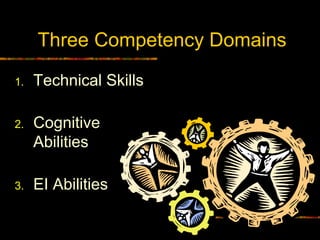
Three Competency Domains
1. Technical Skills
2. Cognitive
Abilities
3. EI Abilities
Studies* show:
 For all levels of jobs, EI
competencies are twice as
effective as IQ in
determining an individual’s
success rate.
 The higher the level of a
position in an organization,
the more EI seems to matter.
 Executive Leaders show an
85% correlation between EI
competency and success.
EI Competencies
 Self-Awareness
 Self-Management
 Social Awareness
 Relationship
Management
EI
Self-Awareness
Knowing one’s internal states, preferences,
resources and intuitions
 Emotional Self-Awareness
 Accurate Self-Assessment
 Realistic Self-Confidence
Knowing one’s internal states, preferences,
resources and intuitions
 Emotional Self-Awareness –
Recognize your own inner signals,
note how decisions and values match
 Accurate Self-Assessment – Know
your real limits and strengths, be
graceful in learning, know when to ask
for help
 Realistic Self-Confidence – Be
willing and able to play to your
strengths, admit you have them!
Self-Management
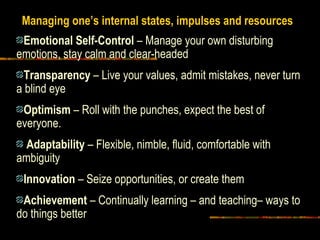
Managing one’s internal states, impulses and
resources
 Emotional Self-Control
 Transparency
 Optimism
 Adaptability
 Innovation
 Achievement
Emotional Self-Control – Manage your own disturbing
emotions, stay calm and clear-headed
Transparency – Live your values, admit mistakes, never turn
a blind eye
Optimism – Roll with the punches, expect the best of
everyone.
Adaptability – Flexible, nimble, fluid, comfortable with
ambiguity
Innovation – Seize opportunities, or create them
Achievement – Continually learning – and teaching– ways to
do things better
Managing one’s internal states, impulses and resources
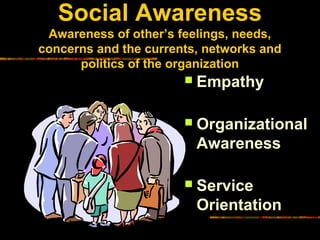
Social Awareness
Awareness of other’s feelings, needs,
concerns and the currents, networks and
politics of the organization
 Empathy
 Organizational
Awareness
 Service
Orientation
Awareness of other’s feelings, needs,
concerns and the currents, networks and
politics of the organization
 Empathy – Listen, attune, grasp other’s
perspectives
 Organizational Awareness – “PP”olitically
and “pp”olitically astute, know the values
and unspoken rules
 Service Orientation – be available to
your staff, serve to receive excellent
service
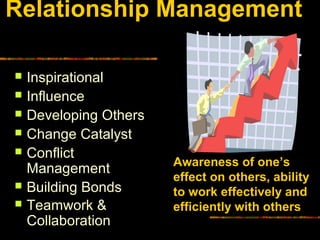
Relationship Management
 Inspirational
 Influence
 Developing Others
 Change Catalyst
 Conflict
Management
 Building Bonds
 Teamwork &
Collaboration
Awareness of one’s
effect on others, ability
to work effectively and
efficiently with others
Awareness of one’s effect on others, ability to
work effectively and efficiently with others
 Inspirational – Embody what you ask of others
 Influence – Be persuasive and engaging
 Developing Others – Cultivate people’s abilities
 Change Catalyst – Recognize the need for
change, challenge the status quo
 Conflict Management – acknowledge and
redirect
 Building Bonds – Cultivate the web of
relationships
 Teamwork & Collaboration – Be a model of
respect, helpfulness and cooperation
Your goals… or
what do you really want
 Jot down three areas
where you’d like to be
more effective (work
and / or personal life)
 Prepare to discuss
some of these goals
with the group
 Provide your insights
to participants
Self Assessment Opportunity
 Self assessment available at:
http://www.utne.com/azEQ.tmpl
 Slideshow available at:
http://www.psers.state.pa.us/ei.ppt
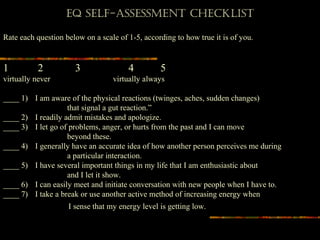
EQ SElf-ASSESSmEnt ChECkliSt
 
Rate each question below on a scale of 1-5, according to how true it is of you.
1 2 3 4 5
virtually never virtually always
____ 1) I am aware of the physical reactions (twinges, aches, sudden changes)
that signal a gut reaction.”
____ 2) I readily admit mistakes and apologize.
____ 3) I let go of problems, anger, or hurts from the past and I can move
beyond these.
____ 4) I generally have an accurate idea of how another person perceives me during
a particular interaction.
____ 5) I have several important things in my life that I am enthusiastic about
and I let it show.
____ 6) I can easily meet and initiate conversation with new people when I have to.
____ 7) I take a break or use another active method of increasing energy when
I sense that my energy level is getting low.
Assessment Discussion
 Is self-assessment a
valuable tool?
 How are comparisons of
group scores useful?
 Is it worth the time to
develop “soft” skill sets?
 What resources are out
there for us?
Discuss these questions in groups:
How can wewe use
Emotional Intelligence Concepts
in a Leadership Context???
 EIEI is our ability to acquire
and apply knowledge
from our emotions and
the emotions of others in
order to solve problems,
and live a more
successful, fulfilling life.
Issues affecting HR professionals
 Brainstorm issues
 How can we
incorporate EI
“tactics” to help us do
our jobs effectively?
 How can we use EI
competencies to
“shield” us from the
traumatic energy that
comes our way?
EI Competencies
 Self-Awareness
 Self-Management
 Social Awareness
 Relationship
Management
(from Primal LeadershipPrimal Leadership Goleman, Boyatzis and McKee 2002)
EI
A chance to question our answers
 What issues do you see arising
in attempting to institute an EI
competency in your agency?
 What value do you see in
developing EI competencies for
yourself and those staff who
work with you?
 What are your questions /
concerns / comments about this
presentation?
EI !EI !
EmotionalEmotional
IntelligenceIntelligence
A Leader’sA Leader’s
PrimerPrimer

Emotional intelligence

  • 1.
  • 2.
    Feelings are indispensable forrational decision making. They are like a compass, they guide us in the right direction.
  • 3.
    Three Competency Domains 1.Technical Skills 2. Cognitive Abilities 3. EI Abilities
  • 4.
    Studies* show:  Forall levels of jobs, EI competencies are twice as effective as IQ in determining an individual’s success rate.  The higher the level of a position in an organization, the more EI seems to matter.  Executive Leaders show an 85% correlation between EI competency and success.
  • 5.
    EI Competencies  Self-Awareness Self-Management  Social Awareness  Relationship Management EI
  • 6.
    Self-Awareness Knowing one’s internalstates, preferences, resources and intuitions  Emotional Self-Awareness  Accurate Self-Assessment  Realistic Self-Confidence
  • 7.
    Knowing one’s internalstates, preferences, resources and intuitions  Emotional Self-Awareness – Recognize your own inner signals, note how decisions and values match  Accurate Self-Assessment – Know your real limits and strengths, be graceful in learning, know when to ask for help  Realistic Self-Confidence – Be willing and able to play to your strengths, admit you have them!
  • 8.
    Self-Management Managing one’s internalstates, impulses and resources  Emotional Self-Control  Transparency  Optimism  Adaptability  Innovation  Achievement
  • 9.
    Emotional Self-Control –Manage your own disturbing emotions, stay calm and clear-headed Transparency – Live your values, admit mistakes, never turn a blind eye Optimism – Roll with the punches, expect the best of everyone. Adaptability – Flexible, nimble, fluid, comfortable with ambiguity Innovation – Seize opportunities, or create them Achievement – Continually learning – and teaching– ways to do things better Managing one’s internal states, impulses and resources
  • 10.
    Social Awareness Awareness ofother’s feelings, needs, concerns and the currents, networks and politics of the organization  Empathy  Organizational Awareness  Service Orientation
  • 11.
    Awareness of other’sfeelings, needs, concerns and the currents, networks and politics of the organization  Empathy – Listen, attune, grasp other’s perspectives  Organizational Awareness – “PP”olitically and “pp”olitically astute, know the values and unspoken rules  Service Orientation – be available to your staff, serve to receive excellent service
  • 12.
    Relationship Management  Inspirational Influence  Developing Others  Change Catalyst  Conflict Management  Building Bonds  Teamwork & Collaboration Awareness of one’s effect on others, ability to work effectively and efficiently with others
  • 13.
    Awareness of one’seffect on others, ability to work effectively and efficiently with others  Inspirational – Embody what you ask of others  Influence – Be persuasive and engaging  Developing Others – Cultivate people’s abilities  Change Catalyst – Recognize the need for change, challenge the status quo  Conflict Management – acknowledge and redirect  Building Bonds – Cultivate the web of relationships  Teamwork & Collaboration – Be a model of respect, helpfulness and cooperation
  • 14.
    Your goals… or whatdo you really want  Jot down three areas where you’d like to be more effective (work and / or personal life)  Prepare to discuss some of these goals with the group  Provide your insights to participants
  • 15.
    Self Assessment Opportunity Self assessment available at: http://www.utne.com/azEQ.tmpl  Slideshow available at: http://www.psers.state.pa.us/ei.ppt
  • 16.
    EQ SElf-ASSESSmEnt ChECkliSt   Rateeach question below on a scale of 1-5, according to how true it is of you. 1 2 3 4 5 virtually never virtually always ____ 1) I am aware of the physical reactions (twinges, aches, sudden changes) that signal a gut reaction.” ____ 2) I readily admit mistakes and apologize. ____ 3) I let go of problems, anger, or hurts from the past and I can move beyond these. ____ 4) I generally have an accurate idea of how another person perceives me during a particular interaction. ____ 5) I have several important things in my life that I am enthusiastic about and I let it show. ____ 6) I can easily meet and initiate conversation with new people when I have to. ____ 7) I take a break or use another active method of increasing energy when I sense that my energy level is getting low.
  • 17.
    Assessment Discussion  Isself-assessment a valuable tool?  How are comparisons of group scores useful?  Is it worth the time to develop “soft” skill sets?  What resources are out there for us? Discuss these questions in groups:
  • 18.
    How can weweuse Emotional Intelligence Concepts in a Leadership Context???  EIEI is our ability to acquire and apply knowledge from our emotions and the emotions of others in order to solve problems, and live a more successful, fulfilling life.
  • 19.
    Issues affecting HRprofessionals  Brainstorm issues  How can we incorporate EI “tactics” to help us do our jobs effectively?  How can we use EI competencies to “shield” us from the traumatic energy that comes our way?
  • 20.
    EI Competencies  Self-Awareness Self-Management  Social Awareness  Relationship Management (from Primal LeadershipPrimal Leadership Goleman, Boyatzis and McKee 2002) EI
  • 21.
    A chance toquestion our answers  What issues do you see arising in attempting to institute an EI competency in your agency?  What value do you see in developing EI competencies for yourself and those staff who work with you?  What are your questions / concerns / comments about this presentation? EI !EI !
  • 22.