The views expressed in this presentation are the views of the author/s and do not necessarily reflect the views or policies of the Asian
Development Bank, or its Board of Governors, or the governments they represent. ADB does not guarantee the accuracy of the data included
in this presentation and accepts no responsibility for any consequence of their use. The countries listed in this presentation do not imply any
view on ADB's part as to sovereignty or independent status or necessarily conform to ADB's terminology.
Emotional Intelligence 101
Olivier Serrat
2015
A Brief History of Intelligence
Testing
When psychologists began to think about intelligence in the
early 1900s they focused attention on cognitive aspects such as
attention, memory, and problem solving.
The intelligence quotient, or IQ, that Alfred Binet first developed
with Theodore Simon in 1903 is a score derived from one of
several different standardized tests to measure intelligence. With
a number of revisions over the years since its inception, it has
since been used to assess giftedness, and sometimes underpin
recruitment.
Many have argued that IQ, or conventional intelligence, is too
narrow: some people are academically brilliant yet socially and
interpersonally inept. And we know that success does not
automatically follow those who possess a high IQ rating.
Enter Emotional Intelligence
However, wider areas of intelligence enable or dictate how
successful we are. Toughness, determination, and vision help;
but emotional intelligence, often measured as an emotional
intelligence quotient, or EQ, is more and more relevant to
important work-related outcomes such as individual
performance, organizational productivity, and developing people
because its principles provide a new way to understand and
assess the behaviors, management styles, attitudes,
interpersonal skills, and potential of people.
If your emotional abilities aren't in hand, if you don't have self-
awareness, if you are not able to manage your distressing emotions, if
you can't have empathy and have effective relationships, then no
matter how smart you are, you are not going to get very far.—Daniel
Goleman
Define:EQ
Emotional intelligence describes the ability, capacity, skill, or self-
perceived ability to identify, assess, and manage the emotions of
one's self, of others, and of groups.
By developing their emotional intelligence individuals can
become more productive and successful at what they do (and
help others become so too). The process and outcomes of
emotional intelligence development also contain many elements
known to reduce stress by moderating conflict; promoting
understanding and relationships; and fostering stability,
continuity, and harmony. Last but not least, it links strongly with
concepts of love and spirituality.
Emotions have taught mankind to reason.—Marquis de Vauvenargues
Can Emotional Intelligence Be
Learned?
A common question relates to whether people are born with
high EQ or whether it can be learned. The truth is that some will
be more naturally gifted than others but the good news are that
emotional intelligence skills can be learned. (This must be so
because emotional intelligence is shown to increase with age.)
However, for this to happen, people must be personally
motivated, practice extensively what they learn, receive
feedback, and reinforce their new skills.
Nothing great was ever achieved without enthusiasm.—Ralph Waldo
Emerson
Comfort in expressing your emotions will allow you to share the best
of yourself with others, but not being able to control your emotions
will reveal your worst.—Bryant H. McGill
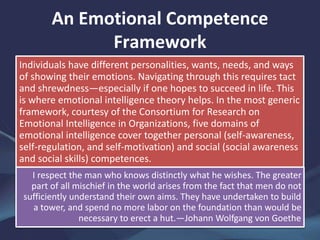
An Emotional Competence
Framework
Individuals have different personalities, wants, needs, and ways
of showing their emotions. Navigating through this requires tact
and shrewdness—especially if one hopes to succeed in life. This
is where emotional intelligence theory helps. In the most generic
framework, courtesy of the Consortium for Research on
Emotional Intelligence in Organizations, five domains of
emotional intelligence cover together personal (self-awareness,
self-regulation, and self-motivation) and social (social awareness
and social skills) competences.
I respect the man who knows distinctly what he wishes. The greater
part of all mischief in the world arises from the fact that men do not
sufficiently understand their own aims. They have undertaken to build
a tower, and spend no more labor on the foundation than would be
necessary to erect a hut.—Johann Wolfgang von Goethe
An Emotional Competence
Framework
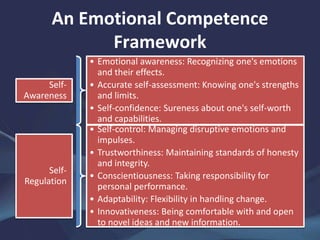
Self-
Awareness
• Emotional awareness: Recognizing one's emotions
and their effects.
• Accurate self-assessment: Knowing one's strengths
and limits.
• Self-confidence: Sureness about one's self-worth
and capabilities.
Self-
Regulation
• Self-control: Managing disruptive emotions and
impulses.
• Trustworthiness: Maintaining standards of honesty
and integrity.
• Conscientiousness: Taking responsibility for
personal performance.
• Adaptability: Flexibility in handling change.
• Innovativeness: Being comfortable with and open
to novel ideas and new information.
An Emotional Competence
Framework
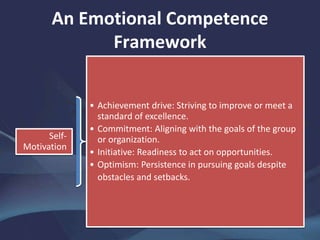
Self-
Motivation
• Achievement drive: Striving to improve or meet a
standard of excellence.
• Commitment: Aligning with the goals of the group
or organization.
• Initiative: Readiness to act on opportunities.
• Optimism: Persistence in pursuing goals despite
obstacles and setbacks.
An Emotional Competence
Framework
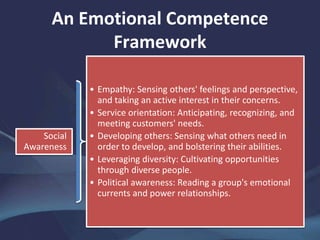
Social
Awareness
• Empathy: Sensing others' feelings and perspective,
and taking an active interest in their concerns.
• Service orientation: Anticipating, recognizing, and
meeting customers' needs.
• Developing others: Sensing what others need in
order to develop, and bolstering their abilities.
• Leveraging diversity: Cultivating opportunities
through diverse people.
• Political awareness: Reading a group's emotional
currents and power relationships.
An Emotional Competence
Framework
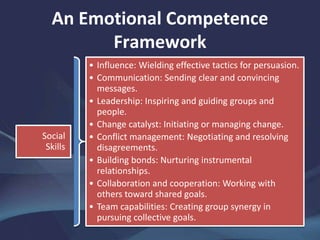
Social
Skills
• Influence: Wielding effective tactics for persuasion.
• Communication: Sending clear and convincing
messages.
• Leadership: Inspiring and guiding groups and
people.
• Change catalyst: Initiating or managing change.
• Conflict management: Negotiating and resolving
disagreements.
• Building bonds: Nurturing instrumental
relationships.
• Collaboration and cooperation: Working with
others toward shared goals.
• Team capabilities: Creating group synergy in
pursuing collective goals.
Further Reading
• ADB. 2009. Working in Teams. Manila.
www.adb.org/publications/working-teams
• ——. 2009. Understanding and Developing Emotional
Intelligence. Manila.
www.adb.org/publications/understanding-and-developing-
emotional-intelligence
• ——. 2009. Building Trust in the Workplace. Manila.
www.adb.org/publications/building-trust-workplace
• ——. 2010. A Primer on Social Neuroscience. Manila.
www.adb.org/publications/primer-social-neuroscience
Further Reading
• ADB. 2011. Conflict in Organizations. Manila.
www.adb.org/publications/conflict-organizations
• Consortium for Research on Emotional Intelligence in
Organizations. 1998. Emotional Competence Framework.
• Daniel Goleman. 1995. Emotional Intelligence: Why It Can
Matter More Than IQ. Bantam Books.
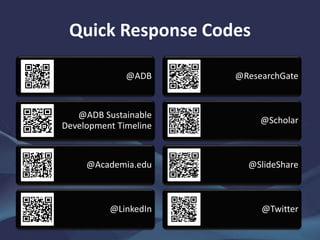
Quick Response Codes
@ADB
@ADB Sustainable
Development Timeline
@Academia.edu
@LinkedIn
@ResearchGate
@Scholar
@SlideShare
@Twitter

Emotional Intelligence 101

  • 1.
    The views expressedin this presentation are the views of the author/s and do not necessarily reflect the views or policies of the Asian Development Bank, or its Board of Governors, or the governments they represent. ADB does not guarantee the accuracy of the data included in this presentation and accepts no responsibility for any consequence of their use. The countries listed in this presentation do not imply any view on ADB's part as to sovereignty or independent status or necessarily conform to ADB's terminology. Emotional Intelligence 101 Olivier Serrat 2015
  • 2.
    A Brief Historyof Intelligence Testing When psychologists began to think about intelligence in the early 1900s they focused attention on cognitive aspects such as attention, memory, and problem solving. The intelligence quotient, or IQ, that Alfred Binet first developed with Theodore Simon in 1903 is a score derived from one of several different standardized tests to measure intelligence. With a number of revisions over the years since its inception, it has since been used to assess giftedness, and sometimes underpin recruitment. Many have argued that IQ, or conventional intelligence, is too narrow: some people are academically brilliant yet socially and interpersonally inept. And we know that success does not automatically follow those who possess a high IQ rating.
  • 3.
    Enter Emotional Intelligence However,wider areas of intelligence enable or dictate how successful we are. Toughness, determination, and vision help; but emotional intelligence, often measured as an emotional intelligence quotient, or EQ, is more and more relevant to important work-related outcomes such as individual performance, organizational productivity, and developing people because its principles provide a new way to understand and assess the behaviors, management styles, attitudes, interpersonal skills, and potential of people. If your emotional abilities aren't in hand, if you don't have self- awareness, if you are not able to manage your distressing emotions, if you can't have empathy and have effective relationships, then no matter how smart you are, you are not going to get very far.—Daniel Goleman
  • 4.
    Define:EQ Emotional intelligence describesthe ability, capacity, skill, or self- perceived ability to identify, assess, and manage the emotions of one's self, of others, and of groups. By developing their emotional intelligence individuals can become more productive and successful at what they do (and help others become so too). The process and outcomes of emotional intelligence development also contain many elements known to reduce stress by moderating conflict; promoting understanding and relationships; and fostering stability, continuity, and harmony. Last but not least, it links strongly with concepts of love and spirituality. Emotions have taught mankind to reason.—Marquis de Vauvenargues
  • 5.
    Can Emotional IntelligenceBe Learned? A common question relates to whether people are born with high EQ or whether it can be learned. The truth is that some will be more naturally gifted than others but the good news are that emotional intelligence skills can be learned. (This must be so because emotional intelligence is shown to increase with age.) However, for this to happen, people must be personally motivated, practice extensively what they learn, receive feedback, and reinforce their new skills. Nothing great was ever achieved without enthusiasm.—Ralph Waldo Emerson Comfort in expressing your emotions will allow you to share the best of yourself with others, but not being able to control your emotions will reveal your worst.—Bryant H. McGill
  • 6.
    An Emotional Competence Framework Individualshave different personalities, wants, needs, and ways of showing their emotions. Navigating through this requires tact and shrewdness—especially if one hopes to succeed in life. This is where emotional intelligence theory helps. In the most generic framework, courtesy of the Consortium for Research on Emotional Intelligence in Organizations, five domains of emotional intelligence cover together personal (self-awareness, self-regulation, and self-motivation) and social (social awareness and social skills) competences. I respect the man who knows distinctly what he wishes. The greater part of all mischief in the world arises from the fact that men do not sufficiently understand their own aims. They have undertaken to build a tower, and spend no more labor on the foundation than would be necessary to erect a hut.—Johann Wolfgang von Goethe
  • 7.
    An Emotional Competence Framework Self- Awareness •Emotional awareness: Recognizing one's emotions and their effects. • Accurate self-assessment: Knowing one's strengths and limits. • Self-confidence: Sureness about one's self-worth and capabilities. Self- Regulation • Self-control: Managing disruptive emotions and impulses. • Trustworthiness: Maintaining standards of honesty and integrity. • Conscientiousness: Taking responsibility for personal performance. • Adaptability: Flexibility in handling change. • Innovativeness: Being comfortable with and open to novel ideas and new information.
  • 8.
    An Emotional Competence Framework Self- Motivation •Achievement drive: Striving to improve or meet a standard of excellence. • Commitment: Aligning with the goals of the group or organization. • Initiative: Readiness to act on opportunities. • Optimism: Persistence in pursuing goals despite obstacles and setbacks.
  • 9.
    An Emotional Competence Framework Social Awareness •Empathy: Sensing others' feelings and perspective, and taking an active interest in their concerns. • Service orientation: Anticipating, recognizing, and meeting customers' needs. • Developing others: Sensing what others need in order to develop, and bolstering their abilities. • Leveraging diversity: Cultivating opportunities through diverse people. • Political awareness: Reading a group's emotional currents and power relationships.
  • 10.
    An Emotional Competence Framework Social Skills •Influence: Wielding effective tactics for persuasion. • Communication: Sending clear and convincing messages. • Leadership: Inspiring and guiding groups and people. • Change catalyst: Initiating or managing change. • Conflict management: Negotiating and resolving disagreements. • Building bonds: Nurturing instrumental relationships. • Collaboration and cooperation: Working with others toward shared goals. • Team capabilities: Creating group synergy in pursuing collective goals.
  • 11.
    Further Reading • ADB.2009. Working in Teams. Manila. www.adb.org/publications/working-teams • ——. 2009. Understanding and Developing Emotional Intelligence. Manila. www.adb.org/publications/understanding-and-developing- emotional-intelligence • ——. 2009. Building Trust in the Workplace. Manila. www.adb.org/publications/building-trust-workplace • ——. 2010. A Primer on Social Neuroscience. Manila. www.adb.org/publications/primer-social-neuroscience
  • 12.
    Further Reading • ADB.2011. Conflict in Organizations. Manila. www.adb.org/publications/conflict-organizations • Consortium for Research on Emotional Intelligence in Organizations. 1998. Emotional Competence Framework. • Daniel Goleman. 1995. Emotional Intelligence: Why It Can Matter More Than IQ. Bantam Books.
  • 13.
    Quick Response Codes @ADB @ADBSustainable Development Timeline @Academia.edu @LinkedIn @ResearchGate @Scholar @SlideShare @Twitter