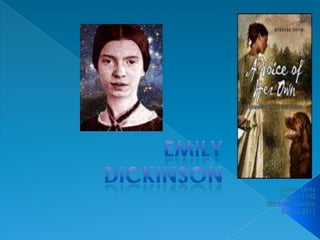
Emily DickinsonKayon Gray English 1102Elizabeth Owens 8 May 2011
Content :Who was Emily DickinsonHer style of writingEmily’s literary elementsHer inspirationExample of her poetryWhy her poems were editedConclusionWorks Cited
Who is Emily Dickinson?Emily Dickinson is a passionate poet whose poetry is like no other. Although she lived in seclusion, she shared herself through her poetry. Many people thought that writing was a way for her to get away from all the stresses and disappointments in life.
Emily Dickinson’s style of writingRandom capitalizationUnusual grammar Rhyming meterUse of dashesUse of metaphorNo titles
Emily’s literary elementsSimiles MetaphorsPersonificationExtended metaphors
Her inspiration comes from
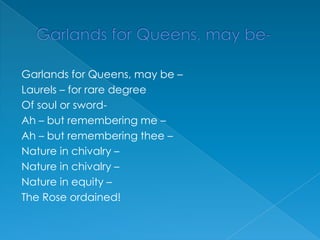
Garlands for Queens, may be-Garlands for Queens, may be –Laurels – for rare degreeOf soul or sword-Ah – but remembering me –Ah – but remembering thee –Nature in chivalry –Nature in chivalry –Nature in equity –The Rose ordained!
The editing of Emily’s poemsEmily Dickinson’s poems have since been edited heavily because of her use of dashes in place of punctuation, her grammar, and her capitalization mid sentence.
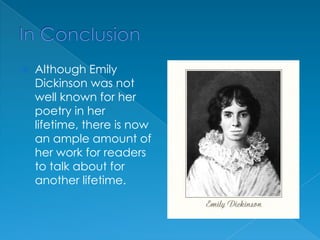
In ConclusionAlthough Emily Dickinson was not well known for her poetry in her lifetime, there is now an ample amount of her work for readers to talk about for another lifetime.
Works CitedCady, Edwin H., and Louis J. Budd. On Dickinson: The Best from American Literature Durham: Duke UP, 1990.Cooley, Carolyn Lindley. The Music of Emily Dickinson's Poems and Letters: A Study of Imagery and Form. Jefferson, NC: McFarland, 2003.Duchac, Joseph. The Poems of Emily Dickinson: An Annotated Guide to Commentary Published in English, 1978-1989. New York, NY: G.K. Hall, 1993.Franke, William: “The Missing All” Emily Dickinson’s Apophatic Poetics: Christianity and Literature Vol. 58, No. 1 (Autumn 2008)Franklin, R. W. The Poems of Emily Dickinson Cambridge, MA: Harvard UP, 1999.Garbowsky, Maryanne. The House Without the Door: A Study of Emily Dickinson and the Illness of Agoraphobia. Rutherford, NJ: Associated University Presses, 1989.Guthrie, James R. Emily Dickinson's Vision: Illness and Identity in Her Poetry.  Gainesville, FL: UP of Florida, 1998.Melani, Lilia. "Emily Dickinson: An Oerview." Department of English: Lilia Melani. Brooklyn College, 24 Feb. 2009. Web. 24 Mar. 2010. <http://academic.brooklyn.cuny.edu/english/melani/cs6/dickinson.html>.
Emily Dickinson

Emily Dickinson

  • 1.
    Emily DickinsonKayon GrayEnglish 1102Elizabeth Owens 8 May 2011
  • 2.
    Content :Who wasEmily DickinsonHer style of writingEmily’s literary elementsHer inspirationExample of her poetryWhy her poems were editedConclusionWorks Cited
  • 3.
    Who is EmilyDickinson?Emily Dickinson is a passionate poet whose poetry is like no other. Although she lived in seclusion, she shared herself through her poetry. Many people thought that writing was a way for her to get away from all the stresses and disappointments in life.
  • 4.
    Emily Dickinson’s styleof writingRandom capitalizationUnusual grammar Rhyming meterUse of dashesUse of metaphorNo titles
  • 5.
    Emily’s literary elementsSimilesMetaphorsPersonificationExtended metaphors
  • 6.
  • 7.
    Garlands for Queens,may be-Garlands for Queens, may be –Laurels – for rare degreeOf soul or sword-Ah – but remembering me –Ah – but remembering thee –Nature in chivalry –Nature in chivalry –Nature in equity –The Rose ordained!
  • 8.
    The editing ofEmily’s poemsEmily Dickinson’s poems have since been edited heavily because of her use of dashes in place of punctuation, her grammar, and her capitalization mid sentence.
  • 9.
    In ConclusionAlthough EmilyDickinson was not well known for her poetry in her lifetime, there is now an ample amount of her work for readers to talk about for another lifetime.
  • 10.
    Works CitedCady, EdwinH., and Louis J. Budd. On Dickinson: The Best from American Literature Durham: Duke UP, 1990.Cooley, Carolyn Lindley. The Music of Emily Dickinson's Poems and Letters: A Study of Imagery and Form. Jefferson, NC: McFarland, 2003.Duchac, Joseph. The Poems of Emily Dickinson: An Annotated Guide to Commentary Published in English, 1978-1989. New York, NY: G.K. Hall, 1993.Franke, William: “The Missing All” Emily Dickinson’s Apophatic Poetics: Christianity and Literature Vol. 58, No. 1 (Autumn 2008)Franklin, R. W. The Poems of Emily Dickinson Cambridge, MA: Harvard UP, 1999.Garbowsky, Maryanne. The House Without the Door: A Study of Emily Dickinson and the Illness of Agoraphobia. Rutherford, NJ: Associated University Presses, 1989.Guthrie, James R. Emily Dickinson's Vision: Illness and Identity in Her Poetry.  Gainesville, FL: UP of Florida, 1998.Melani, Lilia. "Emily Dickinson: An Oerview." Department of English: Lilia Melani. Brooklyn College, 24 Feb. 2009. Web. 24 Mar. 2010. <http://academic.brooklyn.cuny.edu/english/melani/cs6/dickinson.html>.