A Biography
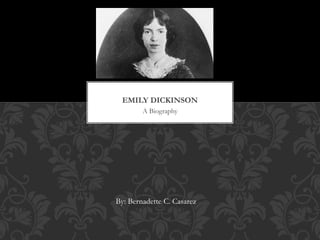
EMILY DICKINSON
By: Bernadette C. Casarez
• Emily Dickinson, born in 1830 on December 10th, in Amherst,
Massachusetts.
• In Emily’s early life she abandoned school life as a teenager.
• Emily wrote letters and poems that could fill countless of
notebooks
• Attended school at Amherst Academy and at the Mount
Holyoke Female Seminary.
• Although Emily missed school due to depression and illness
from time to time, it is believed that she was an excellent
student.
THE EARLY LIFE OF EMILY
DICKINSON
• Emily’s writing career began in her teenage years.
• Some influences for Emily’s writing are Leonard
Humphrey, principal of Amherst Academy, and family
friend named Benjamin Franklin Newton.
• In 1855, Emily traveled to Philadelphia, Pennsylvania.
Where she met and befriended a minister named
Charles Wadsworth who became a cherished
correspondent.
INSPIRATION
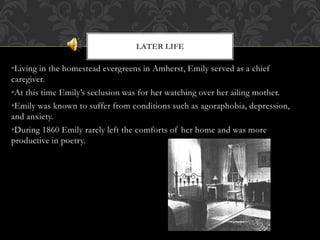
•Living in the homestead evergreens in Amherst, Emily served as a chief
caregiver.
•At this time Emily’s seclusion was for her watching over her ailing mother.
•Emily was known to suffer from conditions such as agoraphobia, depression,
and anxiety.
•During 1860 Emily rarely left the comforts of her home and was more
productive in poetry.
LATER LIFE
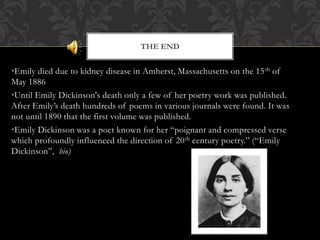
•Emily died due to kidney disease in Amherst, Massachusetts on the 15th of
May 1886
•Until Emily Dickinson's death only a few of her poetry work was published.
After Emily’s death hundreds of poems in various journals were found. It was
not until 1890 that the first volume was published.
•Emily Dickinson was a poet known for her “poignant and compressed verse
which profoundly influenced the direction of 20th century poetry.” (“Emily
Dickinson”, bio)
THE END
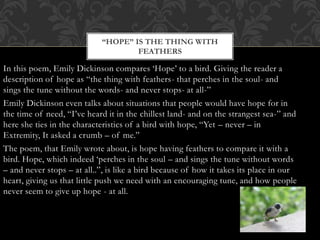
In this poem, Emily Dickinson compares ‘Hope’ to a bird. Giving the reader a
description of hope as “the thing with feathers- that perches in the soul- and
sings the tune without the words- and never stops- at all-”
Emily Dickinson even talks about situations that people would have hope for in
the time of need, “I’ve heard it in the chillest land- and on the strangest sea-” and
here she ties in the characteristics of a bird with hope, “Yet – never – in
Extremity, It asked a crumb – of me.”
The poem, that Emily wrote about, is hope having feathers to compare it with a
bird. Hope, which indeed ‘perches in the soul – and sings the tune without words
– and never stops – at all..”, is like a bird because of how it takes its place in our
heart, giving us that little push we need with an encouraging tune, and how people
never seem to give up hope - at all.
“HOPE” IS THE THING WITH
FEATHERS
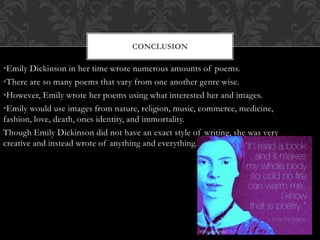
•Emily Dickinson in her time wrote numerous amounts of poems.
•There are so many poems that vary from one another genre wise.
•However, Emily wrote her poems using what interested her and images.
•Emily would use images from nature, religion, music, commerce, medicine,
fashion, love, death, ones identity, and immortality.
Though Emily Dickinson did not have an exact style of writing, she was very
creative and instead wrote of anything and everything.
CONCLUSION
• "Emily Dickinson." Bio. A&E Television Networks, 2015. Web. 13 Feb. 2015.
• “Emily Dickinson”. Poets.org. Academy of American Poets. N.d . Web. 13 Feb.
2015
• “’Hope’ – is the thing with feathers – (314)”. PoetryFoundation. Poetry Foundation,
n.d. Web. 13 Feb. 2015
“Major Characteristics of Dickinson’s Poetry.” Emily Dickinson Museum the
Homestead and the Evergreens. Trustees of Amherst College, 2008. Web. 13 Feb. 2015
WORKS CITED

Emily Dickinson

  • 1.
    A Biography EMILY DICKINSON By:Bernadette C. Casarez
  • 2.
    • Emily Dickinson,born in 1830 on December 10th, in Amherst, Massachusetts. • In Emily’s early life she abandoned school life as a teenager. • Emily wrote letters and poems that could fill countless of notebooks • Attended school at Amherst Academy and at the Mount Holyoke Female Seminary. • Although Emily missed school due to depression and illness from time to time, it is believed that she was an excellent student. THE EARLY LIFE OF EMILY DICKINSON
  • 3.
    • Emily’s writingcareer began in her teenage years. • Some influences for Emily’s writing are Leonard Humphrey, principal of Amherst Academy, and family friend named Benjamin Franklin Newton. • In 1855, Emily traveled to Philadelphia, Pennsylvania. Where she met and befriended a minister named Charles Wadsworth who became a cherished correspondent. INSPIRATION
  • 4.
    •Living in thehomestead evergreens in Amherst, Emily served as a chief caregiver. •At this time Emily’s seclusion was for her watching over her ailing mother. •Emily was known to suffer from conditions such as agoraphobia, depression, and anxiety. •During 1860 Emily rarely left the comforts of her home and was more productive in poetry. LATER LIFE
  • 5.
    •Emily died dueto kidney disease in Amherst, Massachusetts on the 15th of May 1886 •Until Emily Dickinson's death only a few of her poetry work was published. After Emily’s death hundreds of poems in various journals were found. It was not until 1890 that the first volume was published. •Emily Dickinson was a poet known for her “poignant and compressed verse which profoundly influenced the direction of 20th century poetry.” (“Emily Dickinson”, bio) THE END
  • 6.
    In this poem,Emily Dickinson compares ‘Hope’ to a bird. Giving the reader a description of hope as “the thing with feathers- that perches in the soul- and sings the tune without the words- and never stops- at all-” Emily Dickinson even talks about situations that people would have hope for in the time of need, “I’ve heard it in the chillest land- and on the strangest sea-” and here she ties in the characteristics of a bird with hope, “Yet – never – in Extremity, It asked a crumb – of me.” The poem, that Emily wrote about, is hope having feathers to compare it with a bird. Hope, which indeed ‘perches in the soul – and sings the tune without words – and never stops – at all..”, is like a bird because of how it takes its place in our heart, giving us that little push we need with an encouraging tune, and how people never seem to give up hope - at all. “HOPE” IS THE THING WITH FEATHERS
  • 7.
    •Emily Dickinson inher time wrote numerous amounts of poems. •There are so many poems that vary from one another genre wise. •However, Emily wrote her poems using what interested her and images. •Emily would use images from nature, religion, music, commerce, medicine, fashion, love, death, ones identity, and immortality. Though Emily Dickinson did not have an exact style of writing, she was very creative and instead wrote of anything and everything. CONCLUSION
  • 8.
    • "Emily Dickinson."Bio. A&E Television Networks, 2015. Web. 13 Feb. 2015. • “Emily Dickinson”. Poets.org. Academy of American Poets. N.d . Web. 13 Feb. 2015 • “’Hope’ – is the thing with feathers – (314)”. PoetryFoundation. Poetry Foundation, n.d. Web. 13 Feb. 2015 “Major Characteristics of Dickinson’s Poetry.” Emily Dickinson Museum the Homestead and the Evergreens. Trustees of Amherst College, 2008. Web. 13 Feb. 2015 WORKS CITED