Walt Whitman
American English Poet
Amna Fayyaz
Department of English
GCWUF
Introduction
• Walt Whitman was an American poet whose
verse collection 'Leaves of Grass' is a landmark
in the history of American literature.
• Born on Long Island, Whitman grew up in
Brooklyn and received limited formal
education. His occupations during his lifetime
included printer, schoolteacher, reporter, and
editor.
Background and Early Years
• Called the "Bard of Democracy" and
considered one of America's most influential
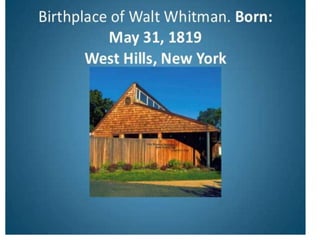
poets, Walt Whitman was born on May 31,
1819, in West Hills, Long Island, New York. The
second of Louisa Van Velsor's and Walter
Whitman's eight surviving children, he grew
up in a family of modest means.
Conti…
• Walt Whitman is America’s world poet—a latter-day
successor to Homer, Virgil, Dante, and Shakespeare.
In Leaves of Grass (1855, 1891-2), he celebrated
democracy, nature, love, and friendship. This
monumental work chanted praises to the body as well
as to the soul, and found beauty and reassurance even
in death. Along with Emily Dickinson, Whitman is
regarded as one of America’s most significant 19th-
century poets and would influence later many poets,
including Ezra Pound, William Carlos Williams, Allen
Ginsberg, Simon Ortiz, C.K. Williams, and Martín
Espada.
Why Walt Whitman Called America
the ‘Greatest Poem’
• Whitman is perhaps America’s first democratic
poet. The free verse he adopts in his work
reflects a newly naturalized and accessible
poetic language. His overarching themes—the
individual, the nation, the body, the soul, and
everyday life and work—mirror the primary
values of America’s founding. Then and now,
his poetry is for everyone.
Dominant Themes In Whitman's
Poetry Essay
• The dominant themes that are more pervasive
in Whitman’s poetry are democracy, life/death
cycles, individualism, and nature. These
themes play major roles in some of his more
notable poems such as “Songs of Myself” or
“Crossing Brooklyn Ferry.” He used democracy
as a theme to bring society together, and unite
everyone based on their general beliefs. He
depicted life and death cycles to merge
society together on a spiritual level.
Conti….
• Despite his eagerness to unite society he also
embraced individualism, and is also a
persistent theme in most of his poetry. Nature
was an important concept that Whitman used
to convince people who there were more
important things to life than class structure.
Democracy As a Way of Life
• Whitman envisioned democracy not just as a political
system but as a way of experiencing the world. In the
early nineteenth century, people still harbored many
doubts about whether the United States could survive
as a country and about whether democracy could
thrive as a political system. To allay those fears and to
praise democracy, Whitman tried to be democratic in
both life and poetry. He imagined democracy as a way
of interpersonal interaction and as a way for individuals
to integrate their beliefs into their everyday lives.
“Song of Myself” notes that democracy must include
all individuals equally, or else it will fail.
Conti….
• In his poetry, Whitman widened the possibilities of Poeticdiction by
including slang, colloquialisms, and regional dialects, rather than
employing the stiff, erudite language so often found in nineteenth-
century verse. Similarly, he broadened the possibilities of subject
matter by describing myriad people and places. Like William
Wordsworth, Whitman believed that everyday life and everyday
people were fit subjects for poetry. Although much of Whitman’s
work does not explicitly discuss politics, most of it implicitly deals
with democracy: it describes communities of people coming
together, and it imagines many voices pouring into a unified whole.
For Whitman, democracy was an idea that could and should
permeate the world beyond politics, making itself felt in the ways
we think, speak, work, fight, and even make art.
The Cycle of Growth and Death
• Whitman’s poetry reflects the vitality and growth of the early
United States. During the nineteenth century, America expanded at
a tremendous rate, and its growth and potential seemed limitless.
But sectionalism and the violence of the Civil War threatened to
break apart and destroy the boundless possibilities of the United
States. As a way of dealing with both the population growth and the
massive deaths during the Civil War, Whitman focused on the life
cycles of individuals: people are born, they age and reproduce, and
they die. Such poems as “When Lilacs Last in the Dooryard
Bloom’d” imagine death as an integral part of life. The Speaker of
“When Lilacs Last in the Dooryard Bloom’d” realizes that flowers die
in the winter, but they rebloom in the springtime, and he vows to
mourn his fallen friends every year just as new buds are appearing.
Describing the life cycle of nature helped Whitman contextualize
the severe injuries and trauma he witnessed during the Civil War—
linking death to life helped give the deaths of so many soldiers
The Beauty of the Individual
• Throughout his poetry, Whitman praised the individual. He imagined a
democratic nation as a unified whole composed of unique but equal
individuals. “Song of Myself” opens in a triumphant paean to the
individual: “I celebrate myself, and sing myself” (1). Elsewhere the speaker
of that exuberant poem identifies himself as Walt Whitman and claims
that, through him, the voices of many will speak. In this way, many
individuals make up the individual democracy, a single entity composed of
myriad parts. Every voice and every part will carry the same weight within
the single democracy—and thus every voice and every individual is equally
beautiful. Despite this pluralist view, Whitman still singled out specific
individuals for praise in his poetry, particularly Abraham Lincoln. In 1865,
Lincoln was assassinated, and Whitman began composing several Elegies,
including “O Captain! My Captain!” Although all individuals were beautiful
and worthy of praise, some individuals merited their own poems because
of their contributions to society and democracy.
Walt whitman introduction

Walt whitman introduction

  • 1.
    Walt Whitman American EnglishPoet Amna Fayyaz Department of English GCWUF
  • 2.
    Introduction • Walt Whitmanwas an American poet whose verse collection 'Leaves of Grass' is a landmark in the history of American literature. • Born on Long Island, Whitman grew up in Brooklyn and received limited formal education. His occupations during his lifetime included printer, schoolteacher, reporter, and editor.
  • 5.
    Background and EarlyYears • Called the "Bard of Democracy" and considered one of America's most influential poets, Walt Whitman was born on May 31, 1819, in West Hills, Long Island, New York. The second of Louisa Van Velsor's and Walter Whitman's eight surviving children, he grew up in a family of modest means.
  • 6.
    Conti… • Walt Whitmanis America’s world poet—a latter-day successor to Homer, Virgil, Dante, and Shakespeare. In Leaves of Grass (1855, 1891-2), he celebrated democracy, nature, love, and friendship. This monumental work chanted praises to the body as well as to the soul, and found beauty and reassurance even in death. Along with Emily Dickinson, Whitman is regarded as one of America’s most significant 19th- century poets and would influence later many poets, including Ezra Pound, William Carlos Williams, Allen Ginsberg, Simon Ortiz, C.K. Williams, and Martín Espada.
  • 7.
    Why Walt WhitmanCalled America the ‘Greatest Poem’ • Whitman is perhaps America’s first democratic poet. The free verse he adopts in his work reflects a newly naturalized and accessible poetic language. His overarching themes—the individual, the nation, the body, the soul, and everyday life and work—mirror the primary values of America’s founding. Then and now, his poetry is for everyone.
  • 8.
    Dominant Themes InWhitman's Poetry Essay • The dominant themes that are more pervasive in Whitman’s poetry are democracy, life/death cycles, individualism, and nature. These themes play major roles in some of his more notable poems such as “Songs of Myself” or “Crossing Brooklyn Ferry.” He used democracy as a theme to bring society together, and unite everyone based on their general beliefs. He depicted life and death cycles to merge society together on a spiritual level.
  • 9.
    Conti…. • Despite hiseagerness to unite society he also embraced individualism, and is also a persistent theme in most of his poetry. Nature was an important concept that Whitman used to convince people who there were more important things to life than class structure.
  • 10.
    Democracy As aWay of Life • Whitman envisioned democracy not just as a political system but as a way of experiencing the world. In the early nineteenth century, people still harbored many doubts about whether the United States could survive as a country and about whether democracy could thrive as a political system. To allay those fears and to praise democracy, Whitman tried to be democratic in both life and poetry. He imagined democracy as a way of interpersonal interaction and as a way for individuals to integrate their beliefs into their everyday lives. “Song of Myself” notes that democracy must include all individuals equally, or else it will fail.
  • 11.
    Conti…. • In hispoetry, Whitman widened the possibilities of Poeticdiction by including slang, colloquialisms, and regional dialects, rather than employing the stiff, erudite language so often found in nineteenth- century verse. Similarly, he broadened the possibilities of subject matter by describing myriad people and places. Like William Wordsworth, Whitman believed that everyday life and everyday people were fit subjects for poetry. Although much of Whitman’s work does not explicitly discuss politics, most of it implicitly deals with democracy: it describes communities of people coming together, and it imagines many voices pouring into a unified whole. For Whitman, democracy was an idea that could and should permeate the world beyond politics, making itself felt in the ways we think, speak, work, fight, and even make art.
  • 12.
    The Cycle ofGrowth and Death • Whitman’s poetry reflects the vitality and growth of the early United States. During the nineteenth century, America expanded at a tremendous rate, and its growth and potential seemed limitless. But sectionalism and the violence of the Civil War threatened to break apart and destroy the boundless possibilities of the United States. As a way of dealing with both the population growth and the massive deaths during the Civil War, Whitman focused on the life cycles of individuals: people are born, they age and reproduce, and they die. Such poems as “When Lilacs Last in the Dooryard Bloom’d” imagine death as an integral part of life. The Speaker of “When Lilacs Last in the Dooryard Bloom’d” realizes that flowers die in the winter, but they rebloom in the springtime, and he vows to mourn his fallen friends every year just as new buds are appearing. Describing the life cycle of nature helped Whitman contextualize the severe injuries and trauma he witnessed during the Civil War— linking death to life helped give the deaths of so many soldiers
  • 13.
    The Beauty ofthe Individual • Throughout his poetry, Whitman praised the individual. He imagined a democratic nation as a unified whole composed of unique but equal individuals. “Song of Myself” opens in a triumphant paean to the individual: “I celebrate myself, and sing myself” (1). Elsewhere the speaker of that exuberant poem identifies himself as Walt Whitman and claims that, through him, the voices of many will speak. In this way, many individuals make up the individual democracy, a single entity composed of myriad parts. Every voice and every part will carry the same weight within the single democracy—and thus every voice and every individual is equally beautiful. Despite this pluralist view, Whitman still singled out specific individuals for praise in his poetry, particularly Abraham Lincoln. In 1865, Lincoln was assassinated, and Whitman began composing several Elegies, including “O Captain! My Captain!” Although all individuals were beautiful and worthy of praise, some individuals merited their own poems because of their contributions to society and democracy.