

TO THE LIGHT HOUSE
BY
VIRGINIA WOOLF
Prepared By
Yesha Bhatt
INTRODUCTION – AUTHOR
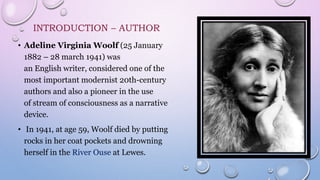
• Adeline Virginia Woolf (25 January
1882 – 28 march 1941) was
an English writer, considered one of the
most important modernist 20th-century
authors and also a pioneer in the use
of stream of consciousness as a narrative
device.
• In 1941, at age 59, Woolf died by putting
rocks in her coat pockets and drowning
herself in the River Ouse at Lewes.
INTRODUCTION - NOVEL
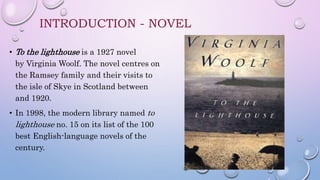
• To the lighthouse is a 1927 novel
by Virginia Woolf. The novel centres on
the Ramsey family and their visits to
the isle of Skye in Scotland between
and 1920.
• In 1998, the modern library named to
lighthouse no. 15 on its list of the 100
best English-language novels of the
century.
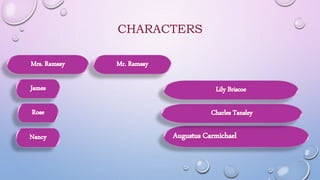
CHARACTERS
PLOT OVERVIEW
• The window
- The window” opens just before the start of world war I. Mr. Ramsay and
Mrs. Ramsay bring their eight children to their summer home in the
Hebrides
- James wants to visit “the light house” – Mr. Ramsay denies – (weather)
- Lily started painting of Mrs. Ramsay and James
- Mr. Ramsay behaves rudely with Augustus Carmichael
- Mr. Ramsay wants his wife to tell him that she loves him but she didn’t
• Time passes
- War breaks across the Europe
- Mrs. Ramsay dies suddenly one night. Andrew Ramsey, her oldest son, is
killed in battle, and his sister Prue dies from an illness related to
childbirth.
- Ten years pass before the family returns. Mrs. McNab, the housekeeper,
employs a few other women to help set the house in order.
• The lighthouse
- Time returns to the slow detail of shifting points of view.
- Mr. Ramsay declares that he and James and Cam, one of his
daughters, will journey to the lighthouse
- Mr. Ramsay appeals to Lily for sympathy, but, unlike Mrs. Ramsay,
she is unable to provide him with what he needs.
- Lily set herself to complete the painting
- Mr. Ramsay praises James for his skill as a sailor
- Lily put the finishing touch on her painting. She makes a definitive
stroke on the canvas and put her brush down, finally having
achieved her vision.
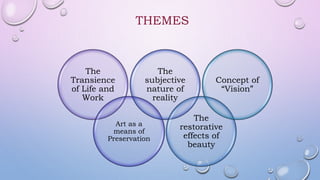
THEMES
The
Transience
of Life and
Work
Art as a
means of
Preservation
The
subjective
nature of
reality
The
restorative
effects of
beauty
Concept of
“Vision”
THE TRANSIENCE OF LIFE AND WORK
• Mr. Ramsay and Mrs. Ramsay take completely different
approaches to life: he relies on his intellect, while she depends
on her emotions
• Mr. Ramsay reflects that even the most enduring of
reputations, this realization accounts for the bitter aspect of his
character.
THE SUBJECTIVE NATURE OF REALITY
• Toward the end of the novel, lily reflects that in order to see
Mrs. Ramsay clearly—to understand her character
completely—she would need at least fifty pairs of eyes
• Woolf’s technique in structuring the story mirrors lily’s
assertion. – With various perspectives
ART AS A MEANS OF
PRESERVATION
• In the face of an existence that is inherently without order or meaning,
Mr. And Mrs. Ramsay employ different strategies for making
their lives significant. Mr. Ramsay devotes himself to his progression
through the course of human thought, while Mrs. Ramsay cultivates
memorable experiences from social interactions.
• Only Lily Briscoe finds a way to preserve her experience, and that way is
through her art. As lily begins her portrait of Mrs. Ramsay at the
beginning of the novel, Woolf notes the scope of the project: Lily means to
order and connect elements that have no necessary relation in the world—
“hedges and houses and mothers and children.”
THE RESTORATIVE EFFECTS OF
BEAUTY
• At the beginning of the novel, both Mr. Ramsay and Lily Briscoe are
drawn out of moments of irritation by an image of extreme beauty. The
image, in both cases, is a vision of Mrs. Ramsay.
• Very beautiful arrangement of fruit basket Can, at dinner party
• Lily later complicates the notion of beauty as restorative by suggesting
that beauty has the unfortunate consequence of simplifying the truth.
• Lily continues on her quest to “still” or “freeze” a moment from life and
make it beautiful.
CONCEPT OF “VISION”
• Vision of James to wards Mr. Ramsay and Mrs. Ramsay
• Vision of Mrs. Ramsay
• Vision of Lily Briscoe
• Vision of James after Mrs. Ramsay’s death
• Vision of lily Briscoe (I have had my vision)
SYMBOLS
• Lighthouse: titular significance
• lily’s painting
• Ramsay’s summer house
• The sea, the storms, the rock, reefs and shallow water
• The boar’s skull
• Rose’s arrangement of the grapes and pears
• Refrigerator
• fisherman & his wife
STREAM OF CONSCIOUSNESS
• The novel lacks an omniscient narrator, the lack of an omniscient
narrator means that, throughout the novel, no clear guide exists for
the reader and that only through character development can readers
formulate their own opinions and views because much is ambiguous
(not clear).
• In part I, the novel is concerned with illustrating the relationship
between the character experiencing and the actual experience and
surroundings, part II, 'time passes', having no characters to relate
to, presents events differently. Unrelated to any people, intending
that events be seen in relation to time. For that reason the narrating
voice is unfocused and distorted, providing an example of what
Woolf called 'life as it is when we have no part in it. ‘Major events
THANK YOU

To the light house ppt

  • 1.
    TO THE LIGHTHOUSE BY VIRGINIA WOOLF Prepared By Yesha Bhatt
  • 2.
    INTRODUCTION – AUTHOR •Adeline Virginia Woolf (25 January 1882 – 28 march 1941) was an English writer, considered one of the most important modernist 20th-century authors and also a pioneer in the use of stream of consciousness as a narrative device. • In 1941, at age 59, Woolf died by putting rocks in her coat pockets and drowning herself in the River Ouse at Lewes.
  • 3.
    INTRODUCTION - NOVEL •To the lighthouse is a 1927 novel by Virginia Woolf. The novel centres on the Ramsey family and their visits to the isle of Skye in Scotland between and 1920. • In 1998, the modern library named to lighthouse no. 15 on its list of the 100 best English-language novels of the century.
  • 4.
  • 5.
    PLOT OVERVIEW • Thewindow - The window” opens just before the start of world war I. Mr. Ramsay and Mrs. Ramsay bring their eight children to their summer home in the Hebrides - James wants to visit “the light house” – Mr. Ramsay denies – (weather) - Lily started painting of Mrs. Ramsay and James - Mr. Ramsay behaves rudely with Augustus Carmichael - Mr. Ramsay wants his wife to tell him that she loves him but she didn’t
  • 6.
    • Time passes -War breaks across the Europe - Mrs. Ramsay dies suddenly one night. Andrew Ramsey, her oldest son, is killed in battle, and his sister Prue dies from an illness related to childbirth. - Ten years pass before the family returns. Mrs. McNab, the housekeeper, employs a few other women to help set the house in order. • The lighthouse - Time returns to the slow detail of shifting points of view.
  • 7.
    - Mr. Ramsaydeclares that he and James and Cam, one of his daughters, will journey to the lighthouse - Mr. Ramsay appeals to Lily for sympathy, but, unlike Mrs. Ramsay, she is unable to provide him with what he needs. - Lily set herself to complete the painting - Mr. Ramsay praises James for his skill as a sailor - Lily put the finishing touch on her painting. She makes a definitive stroke on the canvas and put her brush down, finally having achieved her vision.
  • 8.
    THEMES The Transience of Life and Work Artas a means of Preservation The subjective nature of reality The restorative effects of beauty Concept of “Vision”
  • 9.
    THE TRANSIENCE OFLIFE AND WORK • Mr. Ramsay and Mrs. Ramsay take completely different approaches to life: he relies on his intellect, while she depends on her emotions • Mr. Ramsay reflects that even the most enduring of reputations, this realization accounts for the bitter aspect of his character.
  • 10.
    THE SUBJECTIVE NATUREOF REALITY • Toward the end of the novel, lily reflects that in order to see Mrs. Ramsay clearly—to understand her character completely—she would need at least fifty pairs of eyes • Woolf’s technique in structuring the story mirrors lily’s assertion. – With various perspectives
  • 11.
    ART AS AMEANS OF PRESERVATION • In the face of an existence that is inherently without order or meaning, Mr. And Mrs. Ramsay employ different strategies for making their lives significant. Mr. Ramsay devotes himself to his progression through the course of human thought, while Mrs. Ramsay cultivates memorable experiences from social interactions. • Only Lily Briscoe finds a way to preserve her experience, and that way is through her art. As lily begins her portrait of Mrs. Ramsay at the beginning of the novel, Woolf notes the scope of the project: Lily means to order and connect elements that have no necessary relation in the world— “hedges and houses and mothers and children.”
  • 12.
    THE RESTORATIVE EFFECTSOF BEAUTY • At the beginning of the novel, both Mr. Ramsay and Lily Briscoe are drawn out of moments of irritation by an image of extreme beauty. The image, in both cases, is a vision of Mrs. Ramsay. • Very beautiful arrangement of fruit basket Can, at dinner party • Lily later complicates the notion of beauty as restorative by suggesting that beauty has the unfortunate consequence of simplifying the truth. • Lily continues on her quest to “still” or “freeze” a moment from life and make it beautiful.
  • 13.
    CONCEPT OF “VISION” •Vision of James to wards Mr. Ramsay and Mrs. Ramsay • Vision of Mrs. Ramsay • Vision of Lily Briscoe • Vision of James after Mrs. Ramsay’s death • Vision of lily Briscoe (I have had my vision)
  • 14.
    SYMBOLS • Lighthouse: titularsignificance • lily’s painting • Ramsay’s summer house • The sea, the storms, the rock, reefs and shallow water • The boar’s skull • Rose’s arrangement of the grapes and pears • Refrigerator • fisherman & his wife
  • 15.
    STREAM OF CONSCIOUSNESS •The novel lacks an omniscient narrator, the lack of an omniscient narrator means that, throughout the novel, no clear guide exists for the reader and that only through character development can readers formulate their own opinions and views because much is ambiguous (not clear). • In part I, the novel is concerned with illustrating the relationship between the character experiencing and the actual experience and surroundings, part II, 'time passes', having no characters to relate to, presents events differently. Unrelated to any people, intending that events be seen in relation to time. For that reason the narrating voice is unfocused and distorted, providing an example of what Woolf called 'life as it is when we have no part in it. ‘Major events
  • 16.