When Lilacs Last in the
          Dooryard Bloom’d
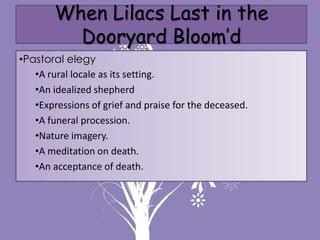
•Pastoral elegy
   •A rural locale as its setting.
   •An idealized shepherd
   •Expressions of grief and praise for the deceased.
   •A funeral procession.
   •Nature imagery.
   •A meditation on death.
   •An acceptance of death.
When Lilacs Last in the
          Dooryard Bloom’d
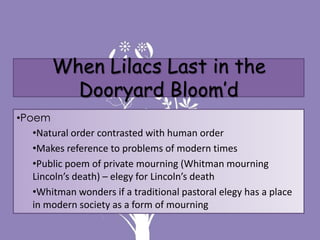
•Poem
   •Natural order contrasted with human order
   •Makes reference to problems of modern times
   •Public poem of private mourning (Whitman mourning
   Lincoln’s death) – elegy for Lincoln’s death
   •Whitman wonders if a traditional pastoral elegy has a place
   in modern society as a form of mourning
When Lilacs Last in the
          Dooryard Bloom’d
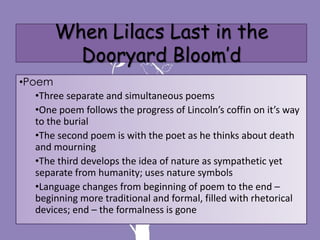
•Poem
   •Three separate and simultaneous poems
   •One poem follows the progress of Lincoln’s coffin on it’s way
   to the burial
   •The second poem is with the poet as he thinks about death
   and mourning
   •The third develops the idea of nature as sympathetic yet
   separate from humanity; uses nature symbols
   •Language changes from beginning of poem to the end –
   beginning more traditional and formal, filled with rhetorical
   devices; end – the formalness is gone
When Lilacs Last in the
         Dooryard Bloom’d
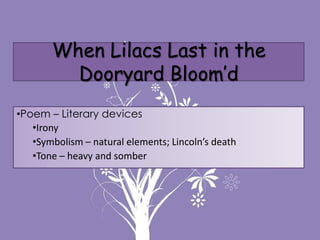
•Poem – Literary devices
   •Irony
   •Symbolism – natural elements; Lincoln’s death
   •Tone – heavy and somber

When lilacs last in dooryard

  • 1.
    When Lilacs Lastin the Dooryard Bloom’d •Pastoral elegy •A rural locale as its setting. •An idealized shepherd •Expressions of grief and praise for the deceased. •A funeral procession. •Nature imagery. •A meditation on death. •An acceptance of death.
  • 2.
    When Lilacs Lastin the Dooryard Bloom’d •Poem •Natural order contrasted with human order •Makes reference to problems of modern times •Public poem of private mourning (Whitman mourning Lincoln’s death) – elegy for Lincoln’s death •Whitman wonders if a traditional pastoral elegy has a place in modern society as a form of mourning
  • 3.
    When Lilacs Lastin the Dooryard Bloom’d •Poem •Three separate and simultaneous poems •One poem follows the progress of Lincoln’s coffin on it’s way to the burial •The second poem is with the poet as he thinks about death and mourning •The third develops the idea of nature as sympathetic yet separate from humanity; uses nature symbols •Language changes from beginning of poem to the end – beginning more traditional and formal, filled with rhetorical devices; end – the formalness is gone
  • 4.
    When Lilacs Lastin the Dooryard Bloom’d •Poem – Literary devices •Irony •Symbolism – natural elements; Lincoln’s death •Tone – heavy and somber

Editor's Notes

  • #2 Idealistic – more romantic, noble – not realistic or grounded in reality.
  • #3 Idealistic – more romantic, noble – not realistic or grounded in reality.
  • #4 Idealistic – more romantic, noble – not realistic or grounded in reality.
  • #5 Idealistic – more romantic, noble – not realistic or grounded in reality.