Find your way in Graph
labyrinths
with SQL, SPARQL, and Gremlin
who we are?
Daniel Camarda
daniel.camarda@gmail.com
https://github.com/mdread
Alfredo Serafini
seralf@gmail.com
https://github.com/seralf
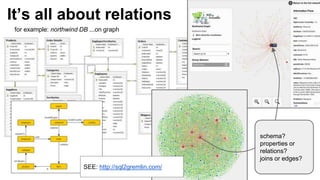
It’s all about relations
for example: northwind DB ...on graph
SEE: http://sql2gremlin.com/
schema?
properties or
relations?
joins or edges?
SQL 1. - ER: tables for Entity and Relations
A table is really similar in practice to a flat CSV. But:
● It introduces types.
● Can be used to materialize important relations, not only entities, normalizing data (=avoiding
duplications)
● Can be fast to access using Indexes
● Logical Entity can be physically splitted into many different Tables, after normalization.
● Relations are not explicit they are:
○ materialized as properties/tables
○ expressed by constraints
○ retrieved by joins
ROW -> TUPLE!
SEE: Northwind schema
RDF 1. - modeling
But tuples can be more “atomic”, if we think differently.
RDF (Resource Description Framework): introduces a conceptual data modeling approach inspired by
several best practices, including the well-known dublin-core.
Similar role to ER schemas (mostly used on relational DB), or class diagram (mostly used in software
design).
RDF is based upon describing resources, by making statements about them: both data and metadata
can be described this way (self-described).
Then we have TUPLEs -> TRIPLEs! (actually QUADs, at least)
subject -> predicate -> object (+ context!)
Thus it is a multigraph labeled and directed: it's the best architecture for managing ontologies, and it
can be also managed more or less as a property graph.
RDF 2. - schema
Have you said schema?
What is a Schema?
● A schema describes your model
● A schema can defines constraints and data types on your model
● A schema provides a good abstraction on the raw data (to be handled manually)
What is the best language to describe schemas?
● XML: DTD is not XML, XSD is XML
● DDL is SQL, but dialect, dictionary and schema changes
● RDF can describe both data and metadata (schema)
○ Are we afraid of standards? Why? Are they too much complex?
○ Schema must be mantained!
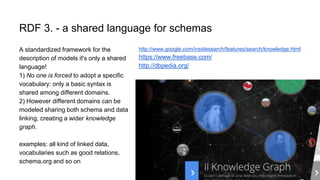
RDF 3. - a shared language for schemas
A standardized framework for the
description of models it's only a shared
language!
1) No one is forced to adopt a specific
vocabulary: only a basic syntax is
shared among different domains.
2) However different domains can be
modeled sharing both schema and data
linking, creating a wider knowledge
graph.
examples: all kind of linked data,
vocabularies such as good relations,
schema.org and so on
http://www.google.com/insidesearch/features/search/knowledge.html
https://www.freebase.com/
http://dbpedia.org/
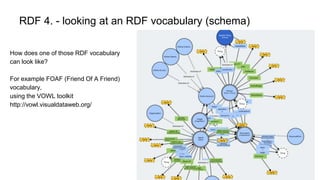
RDF 4. - looking at an RDF vocabulary (schema)
How does one of those RDF vocabulary
can look like?
For example FOAF (Friend Of A Friend)
vocabulary,
using the VOWL toolkit
http://vowl.visualdataweb.org/
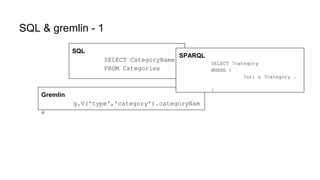
SQL & gremlin - 1
SQL
SELECT CategoryName
FROM Categories
Gremlin
g.V('type','category').categoryName
SPARQL
SELECT ?category
WHERE {
?uri a ?category .
}
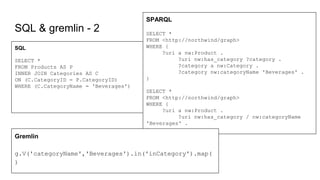
SQL & gremlin - 2
SQL
SELECT *
FROM Products AS P
INNER JOIN Categories AS C
ON (C.CategoryID = P.CategoryID)
WHERE (C.CategoryName = 'Beverages')
SPARQL
SELECT *
FROM <http://northwind/graph>
WHERE {
?uri a nw:Product .
?uri nw:has_category ?category .
?category a nw:Category .
?category nw:categoryName 'Beverages' .
}
SELECT *
FROM <http://northwind/graph>
WHERE {
?uri a nw:Product .
?uri nw:has_category / nw:categoryName
'Beverages' .
}
Gremlin
g.V('categoryName','Beverages').in('inCategory').map()
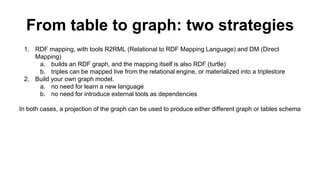
From table to graph: two strategies
1. RDF mapping, with tools R2RML (Relational to RDF Mapping Language) and DM (Direct
Mapping)
a. builds an RDF graph, and the mapping itself is also RDF (turtle)
b. triples can be mapped live from the relational engine, or materialized into a triplestore
2. Build your own graph model.
a. no need for learn a new language
b. no need for introduce external tools as dependencies
In both cases, a projection of the graph can be used to produce either different graph or tables
schema
Example: Github graph
The idea
search for repositories on github, get information about those repos along with collaborators and
library dependencies
Why?
Github has lots of interesting data, analyzing it can give us insights on how the opensource
community is evolving. A graph is the best way to represent this kind of deeply interconnected
community
How it works?
Tinkerpop is used on top of OrientDB which is the backend graph engine. The data is retrieved by a
small Scala application
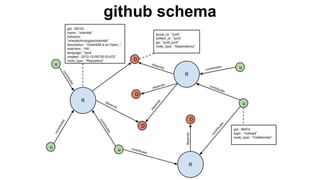
github schema
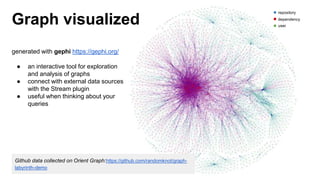
Graph visualized
generated with gephi https://gephi.org/
● an interactive tool for exploration
and analysis of graphs
● connect with external data sources
with the Stream plugin
● useful when thinking about your
queries
repository
dependency
user
Github data collected on Orient Graph:
https://github.com/randomknot/graph-labyrinth-demo
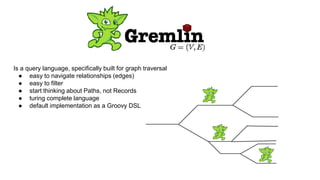
Is a query language, specifically built for graph traversal
● easy to navigate relationships (edges)
● easy to filter
● start thinking about Paths, not Records
● turing complete language
● default implementation as a Groovy DSL
examples 1
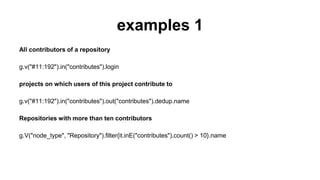
All contributors of a repository
g.v("#11:192").in("contributes").login
projects on which users of this project contribute to
g.v("#11:192").in("contributes").out("contributes").dedup.name
Repositories with more than ten contributors
g.V("node_type", "Repository").filter{it.inE("contributes").count() > 10}.name
examples 2
common contributors of two projects
g.v('#11:47').in("contributes").as("x").out.retain([g.v('#11:57')]).back("x").login
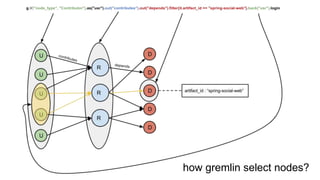
users who work on projects, using a specific library
g.V("node_type", "Contributor").as("usr")
.out("contributes")
.out("depends")
.filter{it.artifact_id == "spring-social-web"}
.back("usr")
.login
how gremlin select nodes?
examples 3
five most used libraries
g.V("node_type", "Dependency").inE("depends").inV.groupCount{it.artifact_id}.cap.orderMap(T.
decr)[0..4]
contributors of projects with more than ten contributors
g.V("node_type", "Repository").filter{it.inE("contributes").count() > 10}.in("contributes").login
The end
references
● Freebase knowledge base
https://www.freebase.com/
● Google Knowledge Graph
http://www.google.com/insidesearch/features/search/knowledge.html
● RDF
○ RDF primer
http://www.w3.org/TR/2014/NOTE-rdf11-primer-20140225/
○ VOWL
http://vowl.visualdataweb.org/
○ FOAF - Friend Of A Friend
http://www.foaf-project.org/
● dbeaver
http://dbeaver.jkiss.org/
references
● gremlin documentation
https://github.com/tinkerpop/gremlin/wiki
http://gremlindocs.com/
● sql2gremlin
http://sql2gremlin.com/
○ visualization: http://sql2gremlin.com/graph/
○ joins: http://sql2gremlin.com/#joining/inner-join
● gremlin examples
http://www.fromdev.com/2013/09/Gremlin-Example-Query-Snippets-Graph-DB.html
● SPARQL + gremlin
https://github.com/tinkerpop/gremlin/wiki/SPARQL-vs.-Gremlin
● using SPARQL qith gephi to visualize co-authorship
http://data.linkededucation.org/linkedup/devtalk/?p=31
● mining github followers in tinkerpop (with R, github, neo4j)
http://patrick.wagstrom.net/weblog/2012/05/13/mining-github-followers-in-tinkerpop/

Find your way in Graph labyrinths

  • 1.
    Find your wayin Graph labyrinths with SQL, SPARQL, and Gremlin
  • 2.
    who we are? DanielCamarda daniel.camarda@gmail.com https://github.com/mdread Alfredo Serafini seralf@gmail.com https://github.com/seralf
  • 3.
    It’s all aboutrelations for example: northwind DB ...on graph SEE: http://sql2gremlin.com/ schema? properties or relations? joins or edges?
  • 4.
    SQL 1. -ER: tables for Entity and Relations A table is really similar in practice to a flat CSV. But: ● It introduces types. ● Can be used to materialize important relations, not only entities, normalizing data (=avoiding duplications) ● Can be fast to access using Indexes ● Logical Entity can be physically splitted into many different Tables, after normalization. ● Relations are not explicit they are: ○ materialized as properties/tables ○ expressed by constraints ○ retrieved by joins ROW -> TUPLE! SEE: Northwind schema
  • 5.
    RDF 1. -modeling But tuples can be more “atomic”, if we think differently. RDF (Resource Description Framework): introduces a conceptual data modeling approach inspired by several best practices, including the well-known dublin-core. Similar role to ER schemas (mostly used on relational DB), or class diagram (mostly used in software design). RDF is based upon describing resources, by making statements about them: both data and metadata can be described this way (self-described). Then we have TUPLEs -> TRIPLEs! (actually QUADs, at least) subject -> predicate -> object (+ context!) Thus it is a multigraph labeled and directed: it's the best architecture for managing ontologies, and it can be also managed more or less as a property graph.
  • 6.
    RDF 2. -schema Have you said schema? What is a Schema? ● A schema describes your model ● A schema can defines constraints and data types on your model ● A schema provides a good abstraction on the raw data (to be handled manually) What is the best language to describe schemas? ● XML: DTD is not XML, XSD is XML ● DDL is SQL, but dialect, dictionary and schema changes ● RDF can describe both data and metadata (schema) ○ Are we afraid of standards? Why? Are they too much complex? ○ Schema must be mantained!
  • 7.
    RDF 3. -a shared language for schemas A standardized framework for the description of models it's only a shared language! 1) No one is forced to adopt a specific vocabulary: only a basic syntax is shared among different domains. 2) However different domains can be modeled sharing both schema and data linking, creating a wider knowledge graph. examples: all kind of linked data, vocabularies such as good relations, schema.org and so on http://www.google.com/insidesearch/features/search/knowledge.html https://www.freebase.com/ http://dbpedia.org/
  • 8.
    RDF 4. -looking at an RDF vocabulary (schema) How does one of those RDF vocabulary can look like? For example FOAF (Friend Of A Friend) vocabulary, using the VOWL toolkit http://vowl.visualdataweb.org/
  • 9.
    SQL & gremlin- 1 SQL SELECT CategoryName FROM Categories Gremlin g.V('type','category').categoryName SPARQL SELECT ?category WHERE { ?uri a ?category . }
  • 10.
    SQL & gremlin- 2 SQL SELECT * FROM Products AS P INNER JOIN Categories AS C ON (C.CategoryID = P.CategoryID) WHERE (C.CategoryName = 'Beverages') SPARQL SELECT * FROM <http://northwind/graph> WHERE { ?uri a nw:Product . ?uri nw:has_category ?category . ?category a nw:Category . ?category nw:categoryName 'Beverages' . } SELECT * FROM <http://northwind/graph> WHERE { ?uri a nw:Product . ?uri nw:has_category / nw:categoryName 'Beverages' . } Gremlin g.V('categoryName','Beverages').in('inCategory').map()
  • 11.
    From table tograph: two strategies 1. RDF mapping, with tools R2RML (Relational to RDF Mapping Language) and DM (Direct Mapping) a. builds an RDF graph, and the mapping itself is also RDF (turtle) b. triples can be mapped live from the relational engine, or materialized into a triplestore 2. Build your own graph model. a. no need for learn a new language b. no need for introduce external tools as dependencies In both cases, a projection of the graph can be used to produce either different graph or tables schema
  • 12.
    Example: Github graph Theidea search for repositories on github, get information about those repos along with collaborators and library dependencies Why? Github has lots of interesting data, analyzing it can give us insights on how the opensource community is evolving. A graph is the best way to represent this kind of deeply interconnected community How it works? Tinkerpop is used on top of OrientDB which is the backend graph engine. The data is retrieved by a small Scala application
  • 13.
  • 14.
    Graph visualized generated withgephi https://gephi.org/ ● an interactive tool for exploration and analysis of graphs ● connect with external data sources with the Stream plugin ● useful when thinking about your queries repository dependency user Github data collected on Orient Graph: https://github.com/randomknot/graph-labyrinth-demo
  • 15.
    Is a querylanguage, specifically built for graph traversal ● easy to navigate relationships (edges) ● easy to filter ● start thinking about Paths, not Records ● turing complete language ● default implementation as a Groovy DSL
  • 16.
    examples 1 All contributorsof a repository g.v("#11:192").in("contributes").login projects on which users of this project contribute to g.v("#11:192").in("contributes").out("contributes").dedup.name Repositories with more than ten contributors g.V("node_type", "Repository").filter{it.inE("contributes").count() > 10}.name
  • 17.
    examples 2 common contributorsof two projects g.v('#11:47').in("contributes").as("x").out.retain([g.v('#11:57')]).back("x").login users who work on projects, using a specific library g.V("node_type", "Contributor").as("usr") .out("contributes") .out("depends") .filter{it.artifact_id == "spring-social-web"} .back("usr") .login
  • 18.
  • 19.
    examples 3 five mostused libraries g.V("node_type", "Dependency").inE("depends").inV.groupCount{it.artifact_id}.cap.orderMap(T. decr)[0..4] contributors of projects with more than ten contributors g.V("node_type", "Repository").filter{it.inE("contributes").count() > 10}.in("contributes").login
  • 20.
  • 21.
    references ● Freebase knowledgebase https://www.freebase.com/ ● Google Knowledge Graph http://www.google.com/insidesearch/features/search/knowledge.html ● RDF ○ RDF primer http://www.w3.org/TR/2014/NOTE-rdf11-primer-20140225/ ○ VOWL http://vowl.visualdataweb.org/ ○ FOAF - Friend Of A Friend http://www.foaf-project.org/ ● dbeaver http://dbeaver.jkiss.org/
  • 22.
    references ● gremlin documentation https://github.com/tinkerpop/gremlin/wiki http://gremlindocs.com/ ●sql2gremlin http://sql2gremlin.com/ ○ visualization: http://sql2gremlin.com/graph/ ○ joins: http://sql2gremlin.com/#joining/inner-join ● gremlin examples http://www.fromdev.com/2013/09/Gremlin-Example-Query-Snippets-Graph-DB.html ● SPARQL + gremlin https://github.com/tinkerpop/gremlin/wiki/SPARQL-vs.-Gremlin ● using SPARQL qith gephi to visualize co-authorship http://data.linkededucation.org/linkedup/devtalk/?p=31 ● mining github followers in tinkerpop (with R, github, neo4j) http://patrick.wagstrom.net/weblog/2012/05/13/mining-github-followers-in-tinkerpop/