Identifiability in Dynamic Causal Networks
Gilles Blondel, Marta Arias, Ricard Gavaldà
Universitat Politècnica de Catalunya, Barcelona
4th Graph-TA, Barcelona, March 2016
Contact: gblondel@cs.upc.edu
1 / 13
Causality vs Correlation
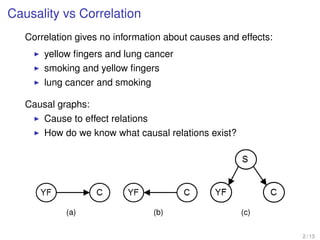
Correlation gives no information about causes and effects:
yellow fingers and lung cancer
smoking and yellow fingers
lung cancer and smoking
Causal graphs:
Cause to effect relations
How do we know what causal relations exist?
(a) (b) (c)
2 / 13
Causal Graphs and Interventions
How to scientifically establish causal links and graphs?
Example - World Heatlh Organisation: "Processed meat
causes cancer"
Result based on experiments (animals, cell based
research); not on observation alone
Domain Experiments:
Intervention: force a variable X and measure the effects
All observed and hidden causes of X are disabled
Confounder: hidden variable, having an effect on several
observed variables
Experiments allow us to disable confounders
3 / 13
Identification of Causal Effects in Graphs
Can we predict the effect of experiments ?
In some cases YES !
Algorithm ID for identification of causal effects in causal
networks
Algorithm DCN-ID for Dynamic Causal Network
identification
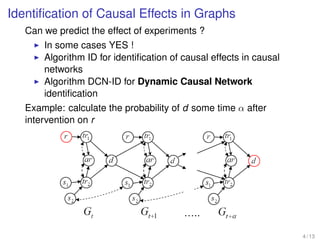
Example: calculate the probability of d some time α after
intervention on r
4 / 13
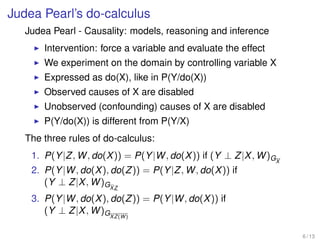
Causality and Causal Graphs
Causality:
Statistics and machine learning: statistical correlation
Causality: cause to effect relationships
Statistical correlation is only a hint towards causal relations
Causes may be more interesting than correlations (causes
of cancer more interesting than correlation to cancer)
Causal Graphs:
Bayesian networks
Used to describe causal relationships
Edges represent causality
Directed Acyclic Graphs (DAG)
Application: predict the effect of interventions
5 / 13
Judea Pearl’s do-calculus
Judea Pearl - Causality: models, reasoning and inference
Intervention: force a variable and evaluate the effect
We experiment on the domain by controlling variable X
Expressed as do(X), like in P(Y/do(X))
Observed causes of X are disabled
Unobserved (confounding) causes of X are disabled
P(Y/do(X)) is different from P(Y/X)
The three rules of do-calculus:
1. P(Y|Z, W, do(X)) = P(Y|W, do(X)) if (Y ⊥ Z|X, W)GX
2. P(Y|W, do(X), do(Z)) = P(Y|Z, W, do(X)) if
(Y ⊥ Z|X, W)GXZ
3. P(Y|W, do(X), do(Z)) = P(Y|W, do(X)) if
(Y ⊥ Z|X, W)GXZ(W)
6 / 13
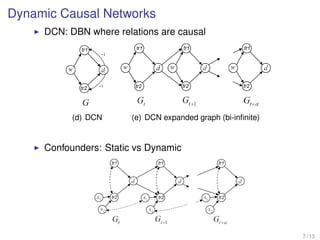
Dynamic Causal Networks
DCN: DBN where relations are causal
(d) DCN (e) DCN expanded graph (bi-infinite)
Confounders: Static vs Dynamic
7 / 13
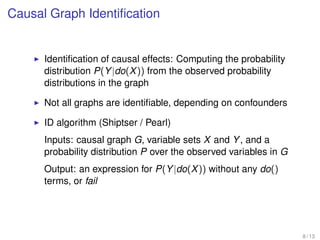
Causal Graph Identification
Identification of causal effects: Computing the probability
distribution P(Y|do(X)) from the observed probability
distributions in the graph
Not all graphs are identifiable, depending on confounders
ID algorithm (Shiptser / Pearl)
Inputs: causal graph G, variable sets X and Y, and a
probability distribution P over the observed variables in G
Output: an expression for P(Y|do(X)) without any do()
terms, or fail
8 / 13
DCN analysis with do calculus
How to apply do-calculus to DCN:
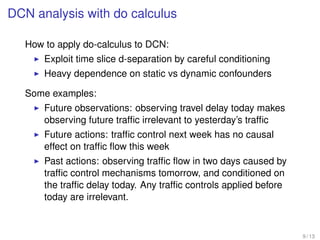
Exploit time slice d-separation by careful conditioning
Heavy dependence on static vs dynamic confounders
Some examples:
Future observations: observing travel delay today makes
observing future traffic irrelevant to yesterday’s traffic
Future actions: traffic control next week has no causal
effect on traffic flow this week
Past actions: observing traffic flow in two days caused by
traffic control mechanisms tomorrow, and conditioned on
the traffic delay today. Any traffic controls applied before
today are irrelevant.
9 / 13
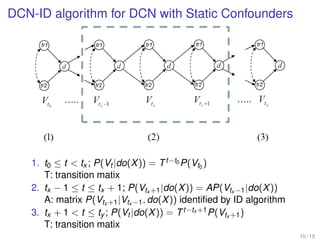
DCN-ID algorithm for DCN with Static Confounders
1. t0 ≤ t < tx ; P(Vt |do(X)) = Tt−t0 P(Vt0
)
T: transition matix
2. tx − 1 ≤ t ≤ tx + 1; P(Vtx +1|do(X)) = AP(Vtx −1|do(X))
A: matrix P(Vtx +1|Vtx −1, do(X)) identified by ID algorithm
3. tx + 1 < t ≤ ty ; P(Vt |do(X)) = Tt−tx +1P(Vtx +1)
T: transition matix
10 / 13
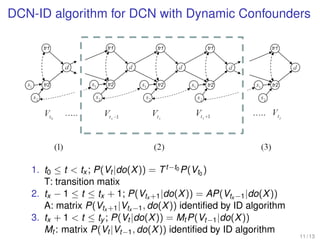
DCN-ID algorithm for DCN with Dynamic Confounders
1. t0 ≤ t < tx ; P(Vt |do(X)) = Tt−t0 P(Vt0
)
T: transition matix
2. tx − 1 ≤ t ≤ tx + 1; P(Vtx +1|do(X)) = AP(Vtx −1|do(X))
A: matrix P(Vtx +1|Vtx −1, do(X)) identified by ID algorithm
3. tx + 1 < t ≤ ty ; P(Vt |do(X)) = Mt P(Vt−1|do(X))
Mt : matrix P(Vt |Vt−1, do(X)) identified by ID algorithm
11 / 13
Conclusions
We have developed a sound a complete algorithm for
identification of Dynamic Causal Networks
DCN-ID algorithm valid for DCNs with static, dynamic
confounders
DCNs do not need to be time-invariant
However our algorithm reveals some properties of
time-invariant DCNs:
1) DCNs with static confounders recover time invariant
behaviour after intervention
2) DCNs with dynamic confounders do not recover
time-invariant behaviour after the intervention
12 / 13
Identifiability in Dynamic Causal Networks
Gilles Blondel, Marta Arias, Ricard Gavaldà
Universitat Politècnica de Catalunya, Barcelona
4th Graph-TA, Barcelona, March 2016
Contact: gblondel@cs.upc.edu
13 / 13

Identifiability in Dynamic Casual Networks

  • 1.
    Identifiability in DynamicCausal Networks Gilles Blondel, Marta Arias, Ricard Gavaldà Universitat Politècnica de Catalunya, Barcelona 4th Graph-TA, Barcelona, March 2016 Contact: gblondel@cs.upc.edu 1 / 13
  • 2.
    Causality vs Correlation Correlationgives no information about causes and effects: yellow fingers and lung cancer smoking and yellow fingers lung cancer and smoking Causal graphs: Cause to effect relations How do we know what causal relations exist? (a) (b) (c) 2 / 13
  • 3.
    Causal Graphs andInterventions How to scientifically establish causal links and graphs? Example - World Heatlh Organisation: "Processed meat causes cancer" Result based on experiments (animals, cell based research); not on observation alone Domain Experiments: Intervention: force a variable X and measure the effects All observed and hidden causes of X are disabled Confounder: hidden variable, having an effect on several observed variables Experiments allow us to disable confounders 3 / 13
  • 4.
    Identification of CausalEffects in Graphs Can we predict the effect of experiments ? In some cases YES ! Algorithm ID for identification of causal effects in causal networks Algorithm DCN-ID for Dynamic Causal Network identification Example: calculate the probability of d some time α after intervention on r 4 / 13
  • 5.
    Causality and CausalGraphs Causality: Statistics and machine learning: statistical correlation Causality: cause to effect relationships Statistical correlation is only a hint towards causal relations Causes may be more interesting than correlations (causes of cancer more interesting than correlation to cancer) Causal Graphs: Bayesian networks Used to describe causal relationships Edges represent causality Directed Acyclic Graphs (DAG) Application: predict the effect of interventions 5 / 13
  • 6.
    Judea Pearl’s do-calculus JudeaPearl - Causality: models, reasoning and inference Intervention: force a variable and evaluate the effect We experiment on the domain by controlling variable X Expressed as do(X), like in P(Y/do(X)) Observed causes of X are disabled Unobserved (confounding) causes of X are disabled P(Y/do(X)) is different from P(Y/X) The three rules of do-calculus: 1. P(Y|Z, W, do(X)) = P(Y|W, do(X)) if (Y ⊥ Z|X, W)GX 2. P(Y|W, do(X), do(Z)) = P(Y|Z, W, do(X)) if (Y ⊥ Z|X, W)GXZ 3. P(Y|W, do(X), do(Z)) = P(Y|W, do(X)) if (Y ⊥ Z|X, W)GXZ(W) 6 / 13
  • 7.
    Dynamic Causal Networks DCN:DBN where relations are causal (d) DCN (e) DCN expanded graph (bi-infinite) Confounders: Static vs Dynamic 7 / 13
  • 8.
    Causal Graph Identification Identificationof causal effects: Computing the probability distribution P(Y|do(X)) from the observed probability distributions in the graph Not all graphs are identifiable, depending on confounders ID algorithm (Shiptser / Pearl) Inputs: causal graph G, variable sets X and Y, and a probability distribution P over the observed variables in G Output: an expression for P(Y|do(X)) without any do() terms, or fail 8 / 13
  • 9.
    DCN analysis withdo calculus How to apply do-calculus to DCN: Exploit time slice d-separation by careful conditioning Heavy dependence on static vs dynamic confounders Some examples: Future observations: observing travel delay today makes observing future traffic irrelevant to yesterday’s traffic Future actions: traffic control next week has no causal effect on traffic flow this week Past actions: observing traffic flow in two days caused by traffic control mechanisms tomorrow, and conditioned on the traffic delay today. Any traffic controls applied before today are irrelevant. 9 / 13
  • 10.
    DCN-ID algorithm forDCN with Static Confounders 1. t0 ≤ t < tx ; P(Vt |do(X)) = Tt−t0 P(Vt0 ) T: transition matix 2. tx − 1 ≤ t ≤ tx + 1; P(Vtx +1|do(X)) = AP(Vtx −1|do(X)) A: matrix P(Vtx +1|Vtx −1, do(X)) identified by ID algorithm 3. tx + 1 < t ≤ ty ; P(Vt |do(X)) = Tt−tx +1P(Vtx +1) T: transition matix 10 / 13
  • 11.
    DCN-ID algorithm forDCN with Dynamic Confounders 1. t0 ≤ t < tx ; P(Vt |do(X)) = Tt−t0 P(Vt0 ) T: transition matix 2. tx − 1 ≤ t ≤ tx + 1; P(Vtx +1|do(X)) = AP(Vtx −1|do(X)) A: matrix P(Vtx +1|Vtx −1, do(X)) identified by ID algorithm 3. tx + 1 < t ≤ ty ; P(Vt |do(X)) = Mt P(Vt−1|do(X)) Mt : matrix P(Vt |Vt−1, do(X)) identified by ID algorithm 11 / 13
  • 12.
    Conclusions We have developeda sound a complete algorithm for identification of Dynamic Causal Networks DCN-ID algorithm valid for DCNs with static, dynamic confounders DCNs do not need to be time-invariant However our algorithm reveals some properties of time-invariant DCNs: 1) DCNs with static confounders recover time invariant behaviour after intervention 2) DCNs with dynamic confounders do not recover time-invariant behaviour after the intervention 12 / 13
  • 13.
    Identifiability in DynamicCausal Networks Gilles Blondel, Marta Arias, Ricard Gavaldà Universitat Politècnica de Catalunya, Barcelona 4th Graph-TA, Barcelona, March 2016 Contact: gblondel@cs.upc.edu 13 / 13