Groin Hernias: Do all Need to be Fixed? Abeezar I Sarela MD FRCS
Groin Hernia Repair What are we seeking to achieve? Relief of discomfort or pain Is pain truly due to a hernia? Chronic groin pain after hernia repair Prevention of future complications ?Sudden-onset strangulation is rare
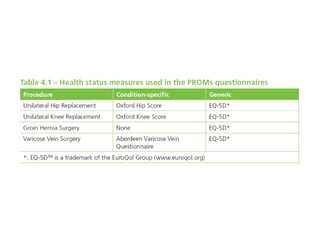
All licensed providers of NHS-funded Unilateral Hip replacements, Unilateral Knee replacements, Groin Hernia Surgery or Varicose Vein Surgery (“Providers”) are expected to invite patients undergoing one of these procedures to complete a preoperative PROMs questionnaires from April 2009 in accordance with this guidance. For non-Foundation Trust NHS Acute Trusts, the PROMs data collection has been given mandatory collection status by the Review
self-completed questionnaires  administered to Patients to assess their self-reported health status before and after certain  elective  healthcare interventions funded by the NHS.  provides an indication of the outcomes or quality of care delivered to NHS Patients.
 
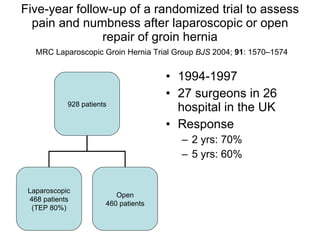
Five-year follow-up of a randomized trial to assess pain and numbness after laparoscopic or open repair of groin hernia   MRC Laparoscopic Groin Hernia Trial Group  BJS  2004;  91 : 1570–1574 1994-1997 27 surgeons in 26 hospital in the UK Response 2 yrs: 70% 5 yrs: 60% 928 patients Laparoscopic 468 patients (TEP 80%) Open 460 patients
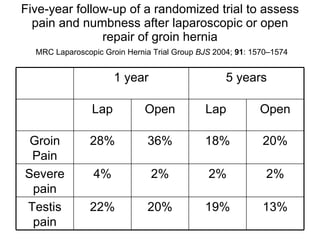
Five-year follow-up of a randomized trial to assess pain and numbness after laparoscopic or open repair of groin hernia   MRC Laparoscopic Groin Hernia Trial Group  BJS  2004;  91 : 1570–1574 13% 19% 20% 22% Testis pain 2% 2% 2% 4% Severe pain 20% 18% 36% 28% Groin Pain Open Lap  Open Lap 5 years 1 year
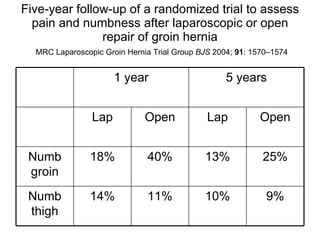
Five-year follow-up of a randomized trial to assess pain and numbness after laparoscopic or open repair of groin hernia   MRC Laparoscopic Groin Hernia Trial Group  BJS  2004;  91 : 1570–1574 9% 10% 11% 14% Numb thigh 25% 13% 40% 18% Numb groin Open Lap Open Lap 5 years 1 year
Risk factors for long-term pain after hernia surgery Ann Surg 2006;244:212-219 Swedish Hernia Registry: 2000 10,000 hernia operation Exclude: bilateral operations or previous/subsequent contralateral operation Eligible: 7000 patients Random selection: 3000 patients Postal questionnaire (DIBS) - 2003
Risk factors for long-term pain after hernia surgery Ann Surg 2006;244:212-219 Comparison with contra-lateral groin Some pain: 31% Pain interfering with daily activity: 6% Predictors of pain Young (age below median) High level of pre-op. pain Any post-op complication Open surgery
RCT: Observation or Operation for Patients with an Asymptomatic Inguinal Hernia O’Dwyer et al. Ann Surg 2006;244:167-173 Inclusion Male > 55 years No pain at rest or movement Reducible Randomization of 160 patients Operation: Open Lichtenstein repair Observation: Crossover if pain, interference with activity, irreducibility Primary end-point: Pain at one year
RCT: Observation or Operation for Patients with an Asymptomatic Inguinal Hernia O’Dwyer et al. Ann Surg 2006;244:167-173 No difference in pain at rest or movement at 12 months  (~1/3 in both groups had pain > 2mm on a 10cm VAPS) HRQoL (SF36) significantly improved after operation
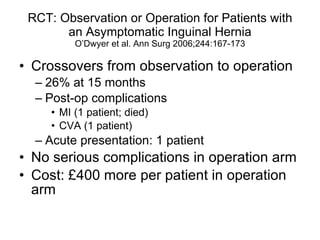
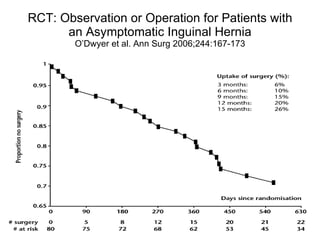
RCT: Observation or Operation for Patients with an Asymptomatic Inguinal Hernia O’Dwyer et al. Ann Surg 2006;244:167-173 Crossovers from observation to operation 26% at 15 months Post-op complications MI (1 patient; died) CVA (1 patient) Acute presentation: 1 patient No serious complications in operation arm Cost: £400 more per patient in operation arm
RCT: Observation or Operation for Patients with an Asymptomatic Inguinal Hernia O’Dwyer et al. Ann Surg 2006;244:167-173
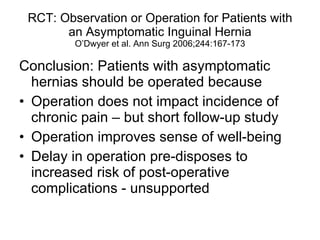
RCT: Observation or Operation for Patients with an Asymptomatic Inguinal Hernia O’Dwyer et al. Ann Surg 2006;244:167-173 Conclusion: Patients with asymptomatic hernias should be operated because Operation does not impact incidence of chronic pain – but short follow-up study Operation improves sense of well-being Delay in operation pre-disposes to increased risk of post-operative complications - unsupported
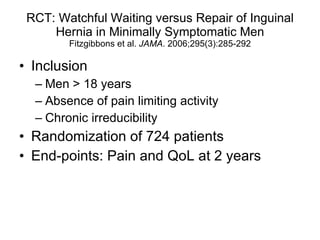
RCT: Watchful Waiting versus Repair of Inguinal Hernia in Minimally Symptomatic Men Fitzgibbons et al.  JAMA . 2006;295(3):285-292 Inclusion Men > 18 years Absence of pain limiting activity Chronic irreducibility Randomization of 724 patients End-points: Pain and QoL at 2 years
RCT: Watchful Waiting versus Repair of Inguinal Hernia in Minimally Symptomatic Men Fitzgibbons et al.  JAMA . 2006;295(3):285-292 No significant difference in pain interfering with activity in patients assigned to operation (2.2%) vs. waiting (5.1%) Both groups had less pain at 2 years than at baseline For crossovers, significant decrease in pain after operation No significant difference in HRQoL (SF36) Crossovers had significantly greater improvement than assigned operation
RCT: Watchful Waiting versus Repair of Inguinal Hernia in Minimally Symptomatic Men Fitzgibbons et al.  JAMA . 2006;295(3):285-292 Crossovers from waiting to operation: 23% Beyond 2 years: 4% crossover/year One acute event (no obstruction) < 2 years One acute event (obstruction) > 2 years No difference in complications after assigned vs. crossover operations Crossover from assigned operation to waiting: 17%
RCT: Watchful Waiting versus Repair of Inguinal Hernia in Minimally Symptomatic Men Fitzgibbons et al.  JAMA . 2006;295(3):285-292 Conclusion A strategy of watching waiting is an acceptable option and should be offered to men with asymptomatic or minimally symptomatic hernias Does this apply to the elderly, infirm, incapable? Does size of the hernia matter? What about women?
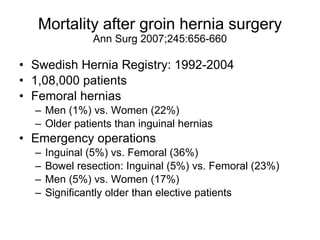
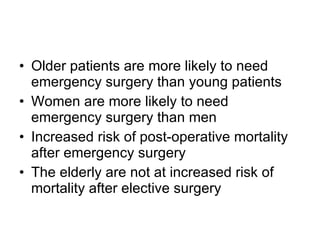
Mortality after groin hernia surgery Ann Surg 2007;245:656-660 Standardized mortality ratio (SMR) = observed/expected death within 30 days for surgery adjusted for age and gender No increase in SMR after elective surgery, even in older patients SMR increased 6-9X after emergency op. SMR increased 20X after emergency op. with bowel resection
Mortality after groin hernia surgery Ann Surg 2007;245:656-660 Swedish Hernia Registry: 1992-2004 1,08,000 patients Femoral hernias Men (1%) vs. Women (22%) Older patients than inguinal hernias Emergency operations Inguinal (5%) vs. Femoral (36%) Bowel resection: Inguinal (5%) vs. Femoral (23%) Men (5%) vs. Women (17%) Significantly older than elective patients
Older patients are more likely to need emergency surgery than young patients Women are more likely to need emergency surgery than men Increased risk of post-operative mortality after emergency surgery The elderly are not at increased risk of mortality after elective surgery
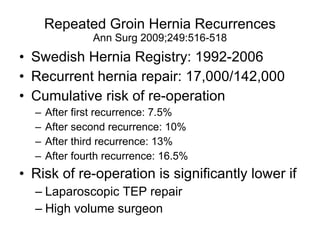
Repeated Groin Hernia Recurrences Ann Surg 2009;249:516-518 Swedish Hernia Registry: 1992-2006 Recurrent hernia repair: 17,000/142,000 Cumulative risk of re-operation After first recurrence: 7.5% After second recurrence: 10% After third recurrence: 13% After fourth recurrence: 16.5% Risk of re-operation is significantly lower if Laparoscopic TEP repair High volume surgeon
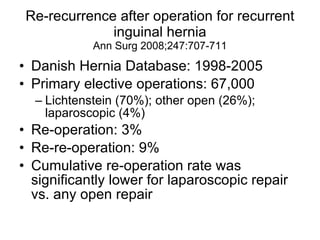
Re-recurrence after operation for recurrent inguinal hernia Ann Surg 2008;247:707-711 Danish Hernia Database: 1998-2005 Primary elective operations: 67,000 Lichtenstein (70%); other open (26%); laparoscopic (4%) Re-operation: 3% Re-re-operation: 9% Cumulative re-operation rate was significantly lower for laparoscopic repair vs. any open repair
Recurrence after Lichtenstein repair – should laparoscopic TEP repair be the accepted standard of care? Limited data for treatment of recurrences after laparoscopic repair or open non-Lichtenstein repair

Groin hernia repair

  • 1.
    Groin Hernias: Doall Need to be Fixed? Abeezar I Sarela MD FRCS
  • 2.
    Groin Hernia RepairWhat are we seeking to achieve? Relief of discomfort or pain Is pain truly due to a hernia? Chronic groin pain after hernia repair Prevention of future complications ?Sudden-onset strangulation is rare
  • 3.
    All licensed providersof NHS-funded Unilateral Hip replacements, Unilateral Knee replacements, Groin Hernia Surgery or Varicose Vein Surgery (“Providers”) are expected to invite patients undergoing one of these procedures to complete a preoperative PROMs questionnaires from April 2009 in accordance with this guidance. For non-Foundation Trust NHS Acute Trusts, the PROMs data collection has been given mandatory collection status by the Review
  • 4.
    self-completed questionnaires administered to Patients to assess their self-reported health status before and after certain elective healthcare interventions funded by the NHS. provides an indication of the outcomes or quality of care delivered to NHS Patients.
  • 5.
  • 6.
    Five-year follow-up ofa randomized trial to assess pain and numbness after laparoscopic or open repair of groin hernia MRC Laparoscopic Groin Hernia Trial Group BJS 2004; 91 : 1570–1574 1994-1997 27 surgeons in 26 hospital in the UK Response 2 yrs: 70% 5 yrs: 60% 928 patients Laparoscopic 468 patients (TEP 80%) Open 460 patients
  • 7.
    Five-year follow-up ofa randomized trial to assess pain and numbness after laparoscopic or open repair of groin hernia MRC Laparoscopic Groin Hernia Trial Group BJS 2004; 91 : 1570–1574 13% 19% 20% 22% Testis pain 2% 2% 2% 4% Severe pain 20% 18% 36% 28% Groin Pain Open Lap Open Lap 5 years 1 year
  • 8.
    Five-year follow-up ofa randomized trial to assess pain and numbness after laparoscopic or open repair of groin hernia MRC Laparoscopic Groin Hernia Trial Group BJS 2004; 91 : 1570–1574 9% 10% 11% 14% Numb thigh 25% 13% 40% 18% Numb groin Open Lap Open Lap 5 years 1 year
  • 9.
    Risk factors forlong-term pain after hernia surgery Ann Surg 2006;244:212-219 Swedish Hernia Registry: 2000 10,000 hernia operation Exclude: bilateral operations or previous/subsequent contralateral operation Eligible: 7000 patients Random selection: 3000 patients Postal questionnaire (DIBS) - 2003
  • 10.
    Risk factors forlong-term pain after hernia surgery Ann Surg 2006;244:212-219 Comparison with contra-lateral groin Some pain: 31% Pain interfering with daily activity: 6% Predictors of pain Young (age below median) High level of pre-op. pain Any post-op complication Open surgery
  • 11.
    RCT: Observation orOperation for Patients with an Asymptomatic Inguinal Hernia O’Dwyer et al. Ann Surg 2006;244:167-173 Inclusion Male > 55 years No pain at rest or movement Reducible Randomization of 160 patients Operation: Open Lichtenstein repair Observation: Crossover if pain, interference with activity, irreducibility Primary end-point: Pain at one year
  • 12.
    RCT: Observation orOperation for Patients with an Asymptomatic Inguinal Hernia O’Dwyer et al. Ann Surg 2006;244:167-173 No difference in pain at rest or movement at 12 months (~1/3 in both groups had pain > 2mm on a 10cm VAPS) HRQoL (SF36) significantly improved after operation
  • 13.
    RCT: Observation orOperation for Patients with an Asymptomatic Inguinal Hernia O’Dwyer et al. Ann Surg 2006;244:167-173 Crossovers from observation to operation 26% at 15 months Post-op complications MI (1 patient; died) CVA (1 patient) Acute presentation: 1 patient No serious complications in operation arm Cost: £400 more per patient in operation arm
  • 14.
    RCT: Observation orOperation for Patients with an Asymptomatic Inguinal Hernia O’Dwyer et al. Ann Surg 2006;244:167-173
  • 15.
    RCT: Observation orOperation for Patients with an Asymptomatic Inguinal Hernia O’Dwyer et al. Ann Surg 2006;244:167-173 Conclusion: Patients with asymptomatic hernias should be operated because Operation does not impact incidence of chronic pain – but short follow-up study Operation improves sense of well-being Delay in operation pre-disposes to increased risk of post-operative complications - unsupported
  • 16.
    RCT: Watchful Waitingversus Repair of Inguinal Hernia in Minimally Symptomatic Men Fitzgibbons et al. JAMA . 2006;295(3):285-292 Inclusion Men > 18 years Absence of pain limiting activity Chronic irreducibility Randomization of 724 patients End-points: Pain and QoL at 2 years
  • 17.
    RCT: Watchful Waitingversus Repair of Inguinal Hernia in Minimally Symptomatic Men Fitzgibbons et al. JAMA . 2006;295(3):285-292 No significant difference in pain interfering with activity in patients assigned to operation (2.2%) vs. waiting (5.1%) Both groups had less pain at 2 years than at baseline For crossovers, significant decrease in pain after operation No significant difference in HRQoL (SF36) Crossovers had significantly greater improvement than assigned operation
  • 18.
    RCT: Watchful Waitingversus Repair of Inguinal Hernia in Minimally Symptomatic Men Fitzgibbons et al. JAMA . 2006;295(3):285-292 Crossovers from waiting to operation: 23% Beyond 2 years: 4% crossover/year One acute event (no obstruction) < 2 years One acute event (obstruction) > 2 years No difference in complications after assigned vs. crossover operations Crossover from assigned operation to waiting: 17%
  • 19.
    RCT: Watchful Waitingversus Repair of Inguinal Hernia in Minimally Symptomatic Men Fitzgibbons et al. JAMA . 2006;295(3):285-292 Conclusion A strategy of watching waiting is an acceptable option and should be offered to men with asymptomatic or minimally symptomatic hernias Does this apply to the elderly, infirm, incapable? Does size of the hernia matter? What about women?
  • 20.
    Mortality after groinhernia surgery Ann Surg 2007;245:656-660 Standardized mortality ratio (SMR) = observed/expected death within 30 days for surgery adjusted for age and gender No increase in SMR after elective surgery, even in older patients SMR increased 6-9X after emergency op. SMR increased 20X after emergency op. with bowel resection
  • 21.
    Mortality after groinhernia surgery Ann Surg 2007;245:656-660 Swedish Hernia Registry: 1992-2004 1,08,000 patients Femoral hernias Men (1%) vs. Women (22%) Older patients than inguinal hernias Emergency operations Inguinal (5%) vs. Femoral (36%) Bowel resection: Inguinal (5%) vs. Femoral (23%) Men (5%) vs. Women (17%) Significantly older than elective patients
  • 22.
    Older patients aremore likely to need emergency surgery than young patients Women are more likely to need emergency surgery than men Increased risk of post-operative mortality after emergency surgery The elderly are not at increased risk of mortality after elective surgery
  • 23.
    Repeated Groin HerniaRecurrences Ann Surg 2009;249:516-518 Swedish Hernia Registry: 1992-2006 Recurrent hernia repair: 17,000/142,000 Cumulative risk of re-operation After first recurrence: 7.5% After second recurrence: 10% After third recurrence: 13% After fourth recurrence: 16.5% Risk of re-operation is significantly lower if Laparoscopic TEP repair High volume surgeon
  • 24.
    Re-recurrence after operationfor recurrent inguinal hernia Ann Surg 2008;247:707-711 Danish Hernia Database: 1998-2005 Primary elective operations: 67,000 Lichtenstein (70%); other open (26%); laparoscopic (4%) Re-operation: 3% Re-re-operation: 9% Cumulative re-operation rate was significantly lower for laparoscopic repair vs. any open repair
  • 25.
    Recurrence after Lichtensteinrepair – should laparoscopic TEP repair be the accepted standard of care? Limited data for treatment of recurrences after laparoscopic repair or open non-Lichtenstein repair