Measuring Labor
Productivity for Rural
Workers
Ellen McCullough, University of Georgia
Presentation to RULIS consultation
8 November, FAO, Rome, Italy
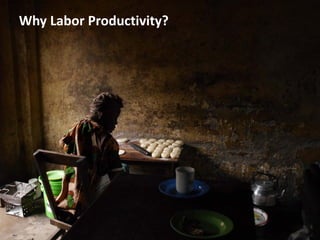
Why Labor Productivity?
• The poor are endowed with labor
• Poverty reduction is strongly associated with
growth in returns to labor and employment
levels
• Changing patterns of labor supply are associated
with development process (structural change)
Why Labor Productivity?
As Seen in Research…
• Structural change
• Occupational choices and returns to labor
• Impact Evaluation
• Key outcome along the impact pathway
• Efficiency and technology
• Understanding labor as major factor of production
• Human capital
• Understanding heterogeneity in returns to labor
• Demographic transitions
• Aging of agriculture labor force, unemployed youth in cities
• Income smoothing
• Livelihood specialization and diversification
• Intervention targeting
• Understanding when labor is scarce and slack
Important types of labor earnings
in developing countries
• Farming self employment
• Self produced or non-traded inputs
• Substitutability hired labor
• Auto-consumed or non-traded outputs and inputs
• Farming wage employment
• Non-farming self employment
• Enterprise accounting
• Non-farming wage employment
Integrating GPS and self-reported measures of
land area in
household surveys
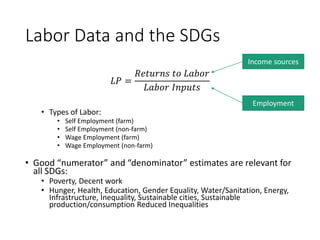
Labor Data and the SDGs
𝐿𝐿𝐿𝐿 =
𝑅𝑅𝑅𝑅𝑅𝑅𝑅𝑅𝑅𝑅𝑅𝑅𝑅𝑅 𝑡𝑡𝑡𝑡 𝐿𝐿𝐿𝐿𝐿𝐿𝐿𝐿𝐿𝐿
𝐿𝐿𝐿𝐿𝐿𝐿𝐿𝐿𝐿𝐿 𝐼𝐼𝐼𝐼𝐼𝐼𝐼𝐼𝐼𝐼𝐼𝐼
• Types of Labor:
• Self Employment (farm)
• Self Employment (non-farm)
• Wage Employment (farm)
• Wage Employment (non-farm)
• Good “numerator” and “denominator” estimates are relevant for
all SDGs:
• Poverty, Decent work
• Hunger, Health, Education, Gender Equality, Water/Sanitation, Energy,
Infrastructure, Inequality, Sustainable cities, Sustainable
production/consumption Reduced Inequalities
Income sources
Employment
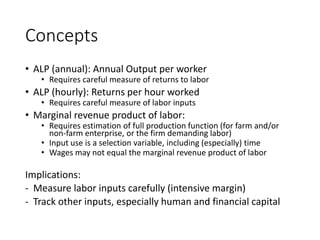
Concepts
• ALP (annual): Annual Output per worker
• Requires careful measure of returns to labor
• ALP (hourly): Returns per hour worked
• Requires careful measure of labor inputs
• Marginal revenue product of labor:
• Requires estimation of full production function (for farm and/or
non-farm enterprise, or the firm demanding labor)
• Input use is a selection variable, including (especially) time
• Wages may not equal the marginal revenue product of labor
Implications:
- Measure labor inputs carefully (intensive margin)
- Track other inputs, especially human and financial capital
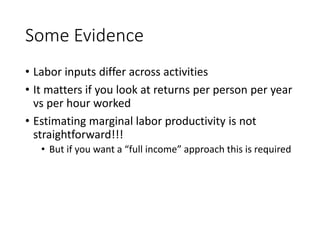
Some Evidence
• Labor inputs differ across activities
• It matters if you look at returns per person per year
vs per hour worked
• Estimating marginal labor productivity is not
straightforward!!!
• But if you want a “full income” approach this is required
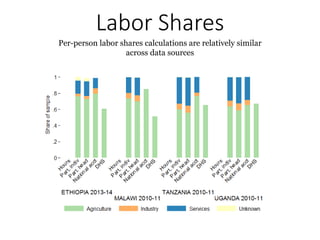
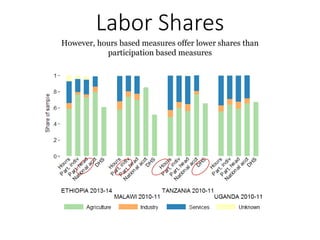
Per-person labor shares calculations are relatively similar
across data sources
Labor Shares
However, hours based measures offer lower shares than
participation based measures
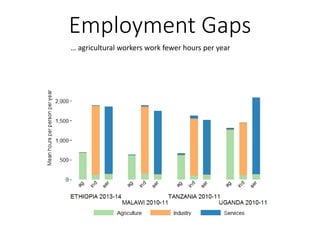
Labor Shares
… agricultural workers work fewer hours per year
Employment Gaps
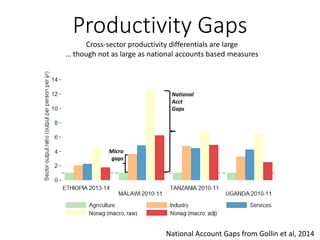
Cross-sector productivity differentials are large
… though not as large as national accounts based measures
Micro
gaps
National
Acct
Gaps
Productivity Gaps
National Account Gaps from Gollin et al, 2014
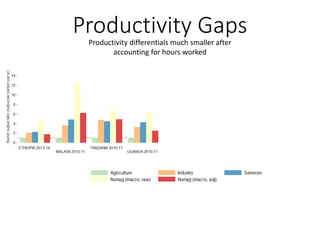
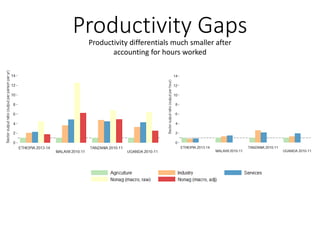
Productivity differentials much smaller after
accounting for hours worked
Productivity Gaps
Productivity differentials much smaller after
accounting for hours worked
Productivity Gaps
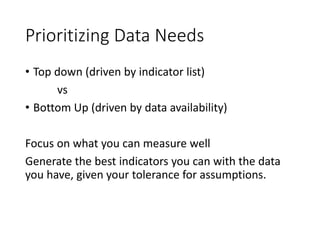
Prioritizing Data Needs
• Top down (driven by indicator list)
vs
• Bottom Up (driven by data availability)
Focus on what you can measure well
Generate the best indicators you can with the data
you have, given your tolerance for assumptions.
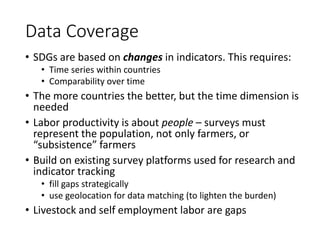
Data Coverage
• SDGs are based on changes in indicators. This requires:
• Time series within countries
• Comparability over time
• The more countries the better, but the time dimension is
needed
• Labor productivity is about people – surveys must
represent the population, not only farmers, or
“subsistence” farmers
• Build on existing survey platforms used for research and
indicator tracking
• fill gaps strategically
• use geolocation for data matching (to lighten the burden)
• Livestock and self employment labor are gaps
From Data to Indicators
• Need a RIGA (or RIGA-like) function!!!
• Generate indicators using scripts from a processed micro
dataset
• Make assumptions clear (e.g. hours per day)
• “Best” aggregate vs comparable aggregate (e.g. recall
ag family labor in hours or days)
• Valuing family labor and other non-purchased inputs?
• Technically need to estimate production functions, this is a
serious undertaking. Challenge of net income measures…
• Classifying employment (strict vs relaxed).
• Want to be ILO compatible
• Also want to be appropriate to context
Indicator List
• Focus on labor inputs (participation, time)
• Focus on labor returns (income, income shares, wages)
• Careful with overly prescriptive definitions of
employment
• Most returns to labor generated through self employment
• Underemployment disguised as self employment in farming,
services
• Is all casual labor precarious?
• “Unpaid family labor” only tracked for crop production.
• What about non-farm self employment labor? Livestock?
Other family labor?
Additional issues
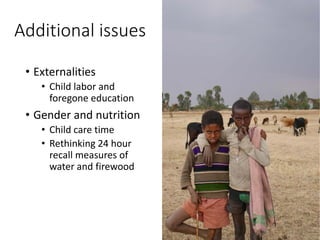
• Externalities
• Child labor and
foregone education
• Gender and nutrition
• Child care time
• Rethinking 24 hour
recall measures of
water and firewood
Measuring Labor Productivity for Rural Workers (Ellen McCullough, Uni Georgia)

Measuring Labor Productivity for Rural Workers (Ellen McCullough, Uni Georgia)

  • 1.
    Measuring Labor Productivity forRural Workers Ellen McCullough, University of Georgia Presentation to RULIS consultation 8 November, FAO, Rome, Italy
  • 2.
  • 3.
    • The poorare endowed with labor • Poverty reduction is strongly associated with growth in returns to labor and employment levels • Changing patterns of labor supply are associated with development process (structural change) Why Labor Productivity?
  • 4.
    As Seen inResearch… • Structural change • Occupational choices and returns to labor • Impact Evaluation • Key outcome along the impact pathway • Efficiency and technology • Understanding labor as major factor of production • Human capital • Understanding heterogeneity in returns to labor • Demographic transitions • Aging of agriculture labor force, unemployed youth in cities • Income smoothing • Livelihood specialization and diversification • Intervention targeting • Understanding when labor is scarce and slack
  • 5.
    Important types oflabor earnings in developing countries • Farming self employment • Self produced or non-traded inputs • Substitutability hired labor • Auto-consumed or non-traded outputs and inputs • Farming wage employment • Non-farming self employment • Enterprise accounting • Non-farming wage employment Integrating GPS and self-reported measures of land area in household surveys
  • 6.
    Labor Data andthe SDGs 𝐿𝐿𝐿𝐿 = 𝑅𝑅𝑅𝑅𝑅𝑅𝑅𝑅𝑅𝑅𝑅𝑅𝑅𝑅 𝑡𝑡𝑡𝑡 𝐿𝐿𝐿𝐿𝐿𝐿𝐿𝐿𝐿𝐿 𝐿𝐿𝐿𝐿𝐿𝐿𝐿𝐿𝐿𝐿 𝐼𝐼𝐼𝐼𝐼𝐼𝐼𝐼𝐼𝐼𝐼𝐼 • Types of Labor: • Self Employment (farm) • Self Employment (non-farm) • Wage Employment (farm) • Wage Employment (non-farm) • Good “numerator” and “denominator” estimates are relevant for all SDGs: • Poverty, Decent work • Hunger, Health, Education, Gender Equality, Water/Sanitation, Energy, Infrastructure, Inequality, Sustainable cities, Sustainable production/consumption Reduced Inequalities Income sources Employment
  • 7.
    Concepts • ALP (annual):Annual Output per worker • Requires careful measure of returns to labor • ALP (hourly): Returns per hour worked • Requires careful measure of labor inputs • Marginal revenue product of labor: • Requires estimation of full production function (for farm and/or non-farm enterprise, or the firm demanding labor) • Input use is a selection variable, including (especially) time • Wages may not equal the marginal revenue product of labor Implications: - Measure labor inputs carefully (intensive margin) - Track other inputs, especially human and financial capital
  • 8.
    Some Evidence • Laborinputs differ across activities • It matters if you look at returns per person per year vs per hour worked • Estimating marginal labor productivity is not straightforward!!! • But if you want a “full income” approach this is required
  • 9.
    Per-person labor sharescalculations are relatively similar across data sources Labor Shares
  • 10.
    However, hours basedmeasures offer lower shares than participation based measures Labor Shares
  • 11.
    … agricultural workerswork fewer hours per year Employment Gaps
  • 12.
    Cross-sector productivity differentialsare large … though not as large as national accounts based measures Micro gaps National Acct Gaps Productivity Gaps National Account Gaps from Gollin et al, 2014
  • 13.
    Productivity differentials muchsmaller after accounting for hours worked Productivity Gaps
  • 14.
    Productivity differentials muchsmaller after accounting for hours worked Productivity Gaps
  • 15.
    Prioritizing Data Needs •Top down (driven by indicator list) vs • Bottom Up (driven by data availability) Focus on what you can measure well Generate the best indicators you can with the data you have, given your tolerance for assumptions.
  • 16.
    Data Coverage • SDGsare based on changes in indicators. This requires: • Time series within countries • Comparability over time • The more countries the better, but the time dimension is needed • Labor productivity is about people – surveys must represent the population, not only farmers, or “subsistence” farmers • Build on existing survey platforms used for research and indicator tracking • fill gaps strategically • use geolocation for data matching (to lighten the burden) • Livestock and self employment labor are gaps
  • 19.
    From Data toIndicators • Need a RIGA (or RIGA-like) function!!! • Generate indicators using scripts from a processed micro dataset • Make assumptions clear (e.g. hours per day) • “Best” aggregate vs comparable aggregate (e.g. recall ag family labor in hours or days) • Valuing family labor and other non-purchased inputs? • Technically need to estimate production functions, this is a serious undertaking. Challenge of net income measures… • Classifying employment (strict vs relaxed). • Want to be ILO compatible • Also want to be appropriate to context
  • 20.
    Indicator List • Focuson labor inputs (participation, time) • Focus on labor returns (income, income shares, wages) • Careful with overly prescriptive definitions of employment • Most returns to labor generated through self employment • Underemployment disguised as self employment in farming, services • Is all casual labor precarious? • “Unpaid family labor” only tracked for crop production. • What about non-farm self employment labor? Livestock? Other family labor?
  • 21.
    Additional issues • Externalities •Child labor and foregone education • Gender and nutrition • Child care time • Rethinking 24 hour recall measures of water and firewood