Viet Vu
Consultant to United Nations’ Statistics
               Division
          15-17 March 2010
Importance of reliable measurement
of informal activities at regional
levels in developing countries
 At national level (*)
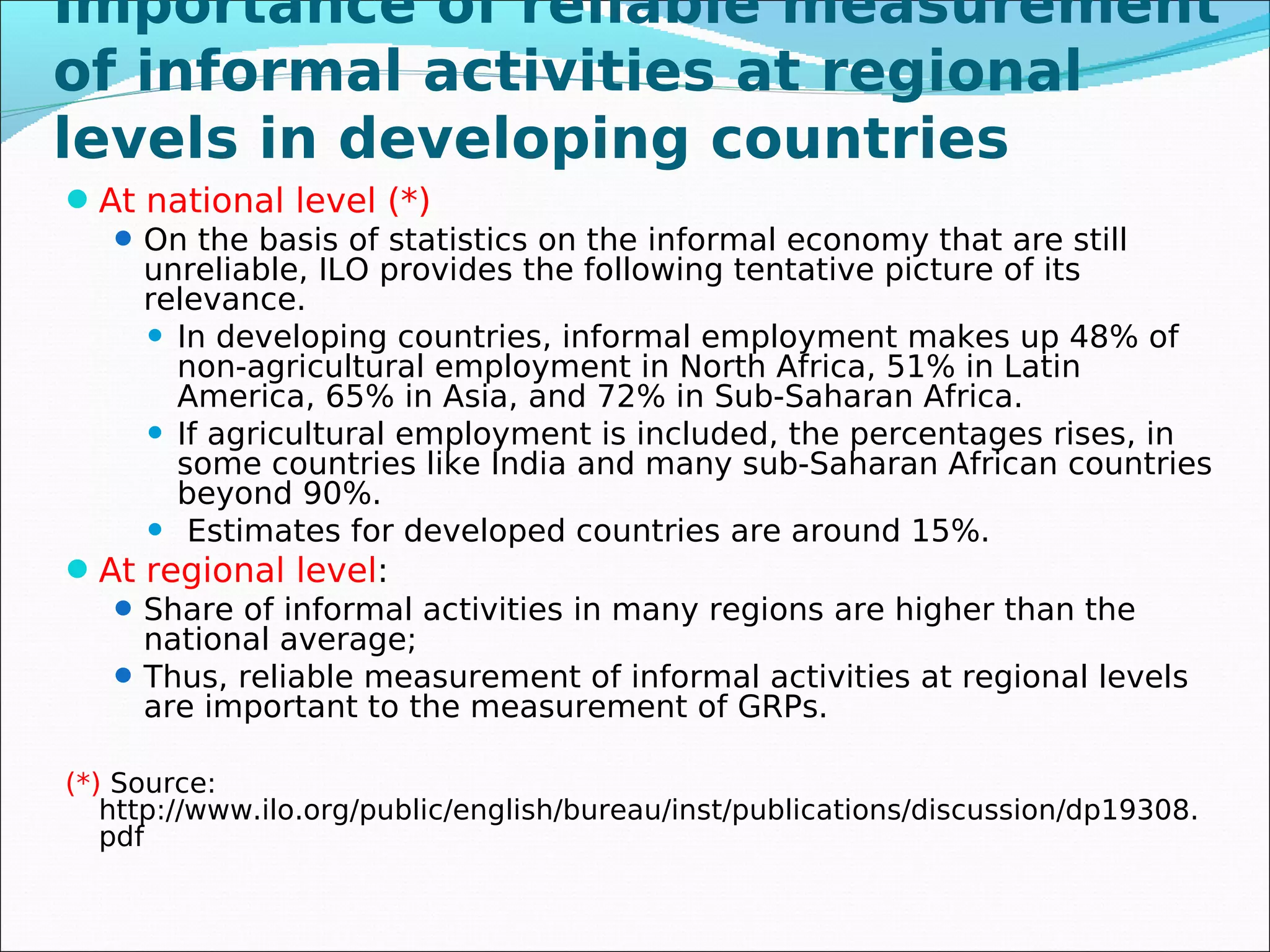
    On the basis of statistics on the informal economy that are still
     unreliable, ILO provides the following tentative picture of its
     relevance.
      In developing countries, informal employment makes up 48% of
       non-agricultural employment in North Africa, 51% in Latin
       America, 65% in Asia, and 72% in Sub-Saharan Africa.
      If agricultural employment is included, the percentages rises, in
       some countries like India and many sub-Saharan African countries
       beyond 90%.
      Estimates for developed countries are around 15%.

 At regional level:
    Share of informal activities in many regions are higher than the
     national average;
    Thus, reliable measurement of informal activities at regional levels
     are important to the measurement of GRPs.

(*) Source:
   http://www.ilo.org/public/english/bureau/inst/publications/discussion/dp19308.
   pdf
Households as statistical units in SNA
 production framework: refined definition
Area SNA household sector                      SNA         SNA
subje
                                           corporations general
ct to
1-2
                                              sector governmen
surve                                                   t sector
y                                                     and NPISH
                                                         sector
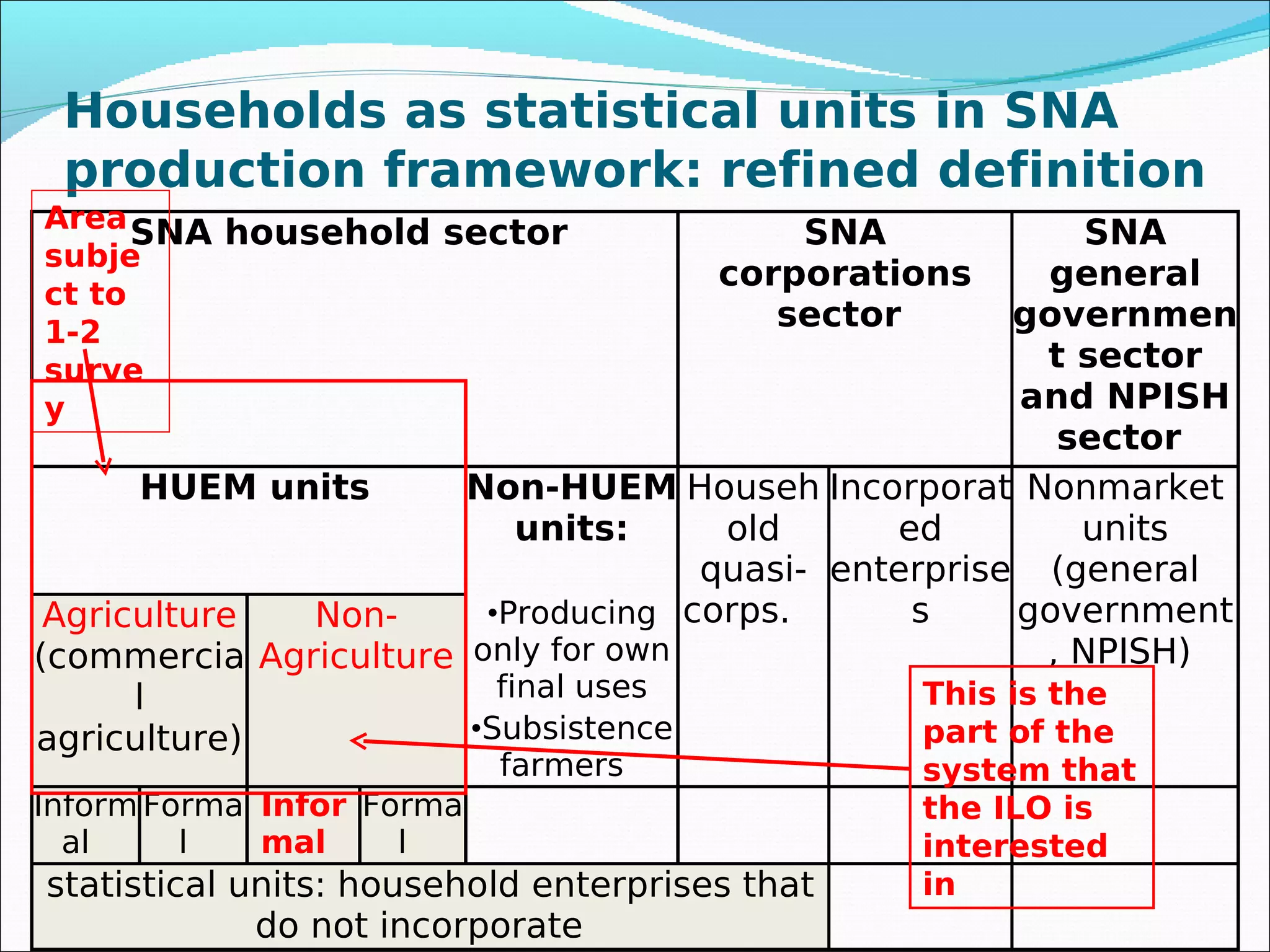
       HUEM units      Non-HUEM Househ Incorporat Nonmarket
                           units:    old      ed          units
                                    quasi- enterprise (general
 Agriculture  Non-      •Producing corps.      s      government
(commercia Agriculture only for own                     , NPISH)
       l                 final uses             This is the
agriculture)           •Subsistence             part of the
                             farmers                system that
Inform Forma Infor Forma                                  
                                                    the ILO is
  al     l   mal     l                              interested
statistical units: household enterprises that       in    
             do not incorporate
General practices in
economic statistics
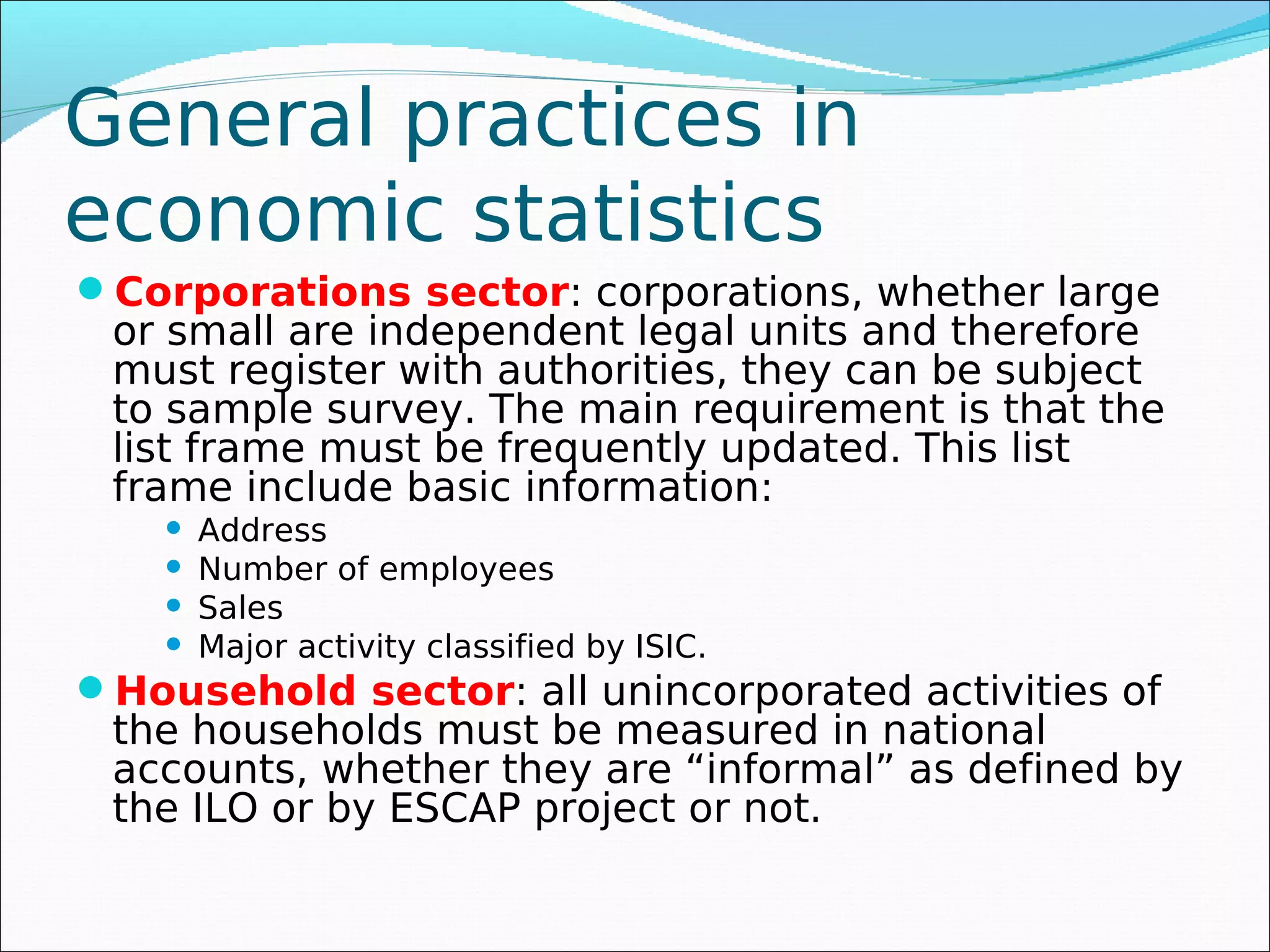
Corporations sector: corporations, whether large
 or small are independent legal units and therefore
 must register with authorities, they can be subject
 to sample survey. The main requirement is that the
 list frame must be frequently updated. This list
 frame include basic information:
       Address
       Number of employees
       Sales
       Major activity classified by ISIC.
Household sector: all unincorporated activities of
 the households must be measured in national
 accounts, whether they are “informal” as defined by
 the ILO or by ESCAP project or not.
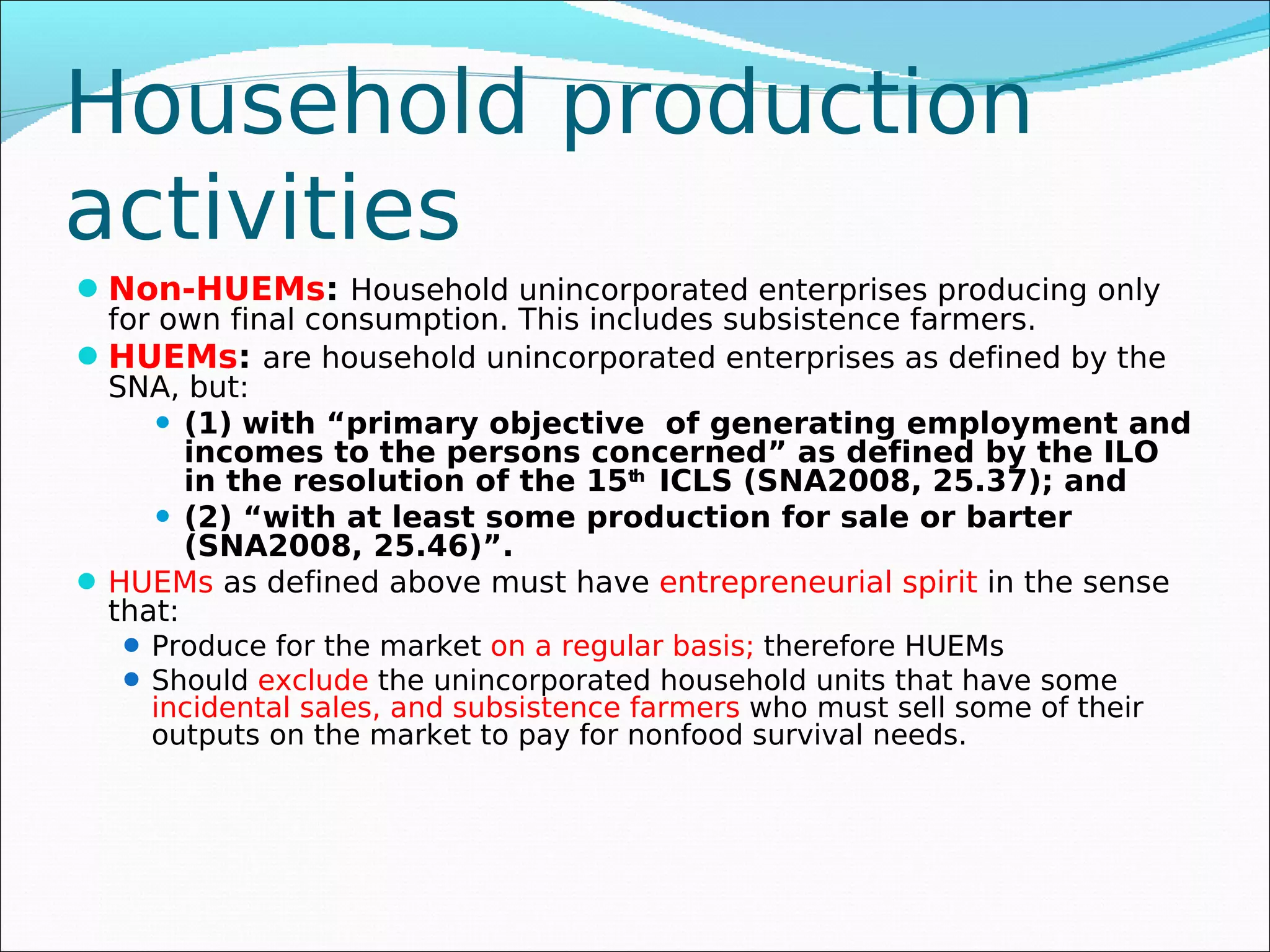
Household production
activities
 Non-HUEMs: Household unincorporated enterprises producing only
  for own final consumption. This includes subsistence farmers.
 HUEMs: are household unincorporated enterprises as defined by the
  SNA, but:
       (1) with “primary objective of generating employment and
        incomes to the persons concerned” as defined by the ILO
        in the resolution of the 15th ICLS (SNA2008, 25.37); and
       (2) “with at least some production for sale or barter
        (SNA2008, 25.46)”.
 HUEMs as defined above must have entrepreneurial spirit in the sense
  that:
   Produce for the market on a regular basis; therefore HUEMs
   Should exclude the unincorporated household units that have some
    incidental sales, and subsistence farmers who must sell some of their
    outputs on the market to pay for nonfood survival needs.
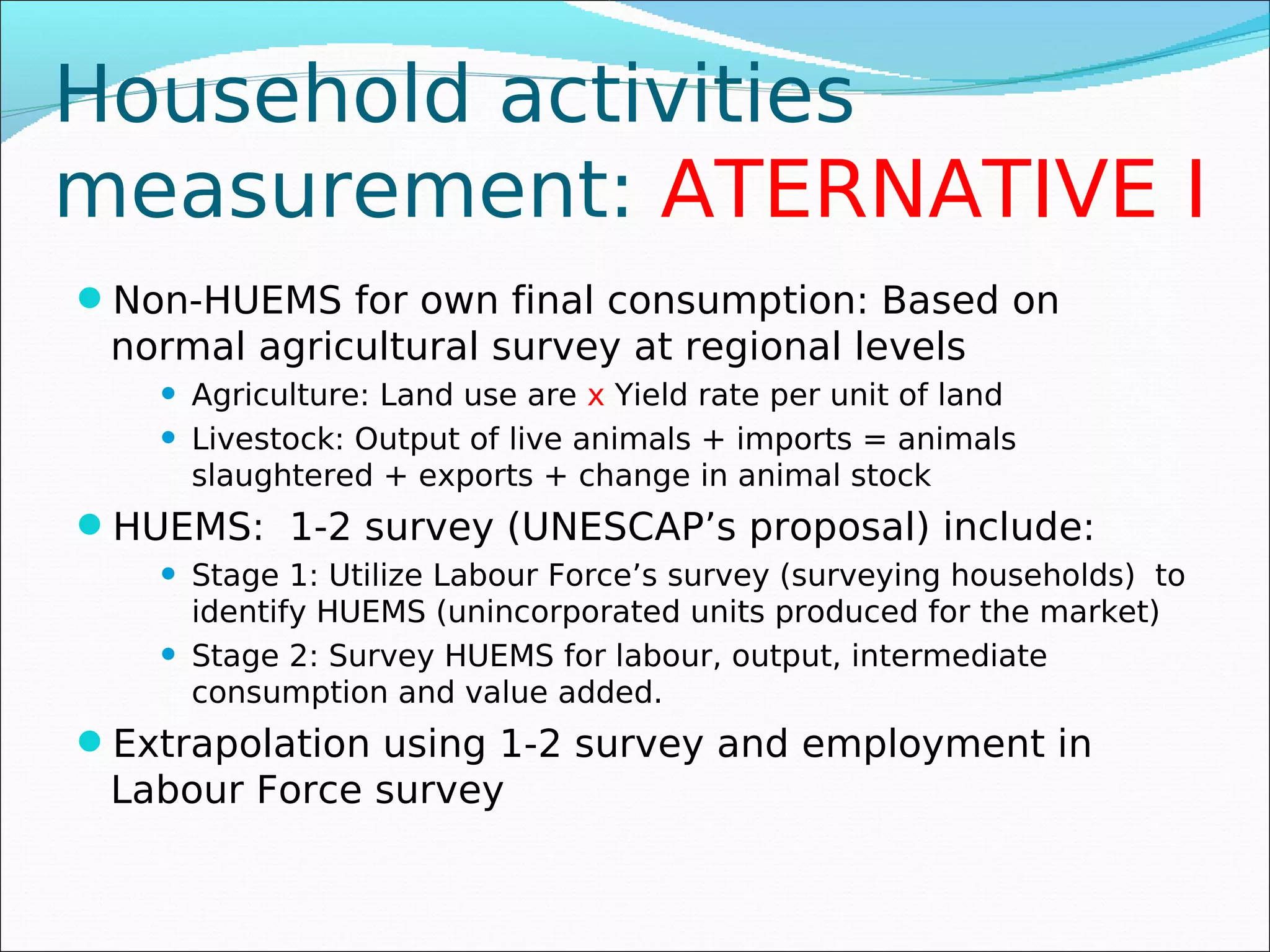
Household activities
measurement: ATERNATIVE I
Non-HUEMS for own final consumption: Based on
 normal agricultural survey at regional levels
       Agriculture: Land use are x Yield rate per unit of land
       Livestock: Output of live animals + imports = animals
        slaughtered + exports + change in animal stock
HUEMS: 1-2 survey (UNESCAP’s proposal) include:
       Stage 1: Utilize Labour Force’s survey (surveying households) to
        identify HUEMS (unincorporated units produced for the market)
       Stage 2: Survey HUEMS for labour, output, intermediate
        consumption and value added.
Extrapolation using 1-2 survey and employment in
 Labour Force survey
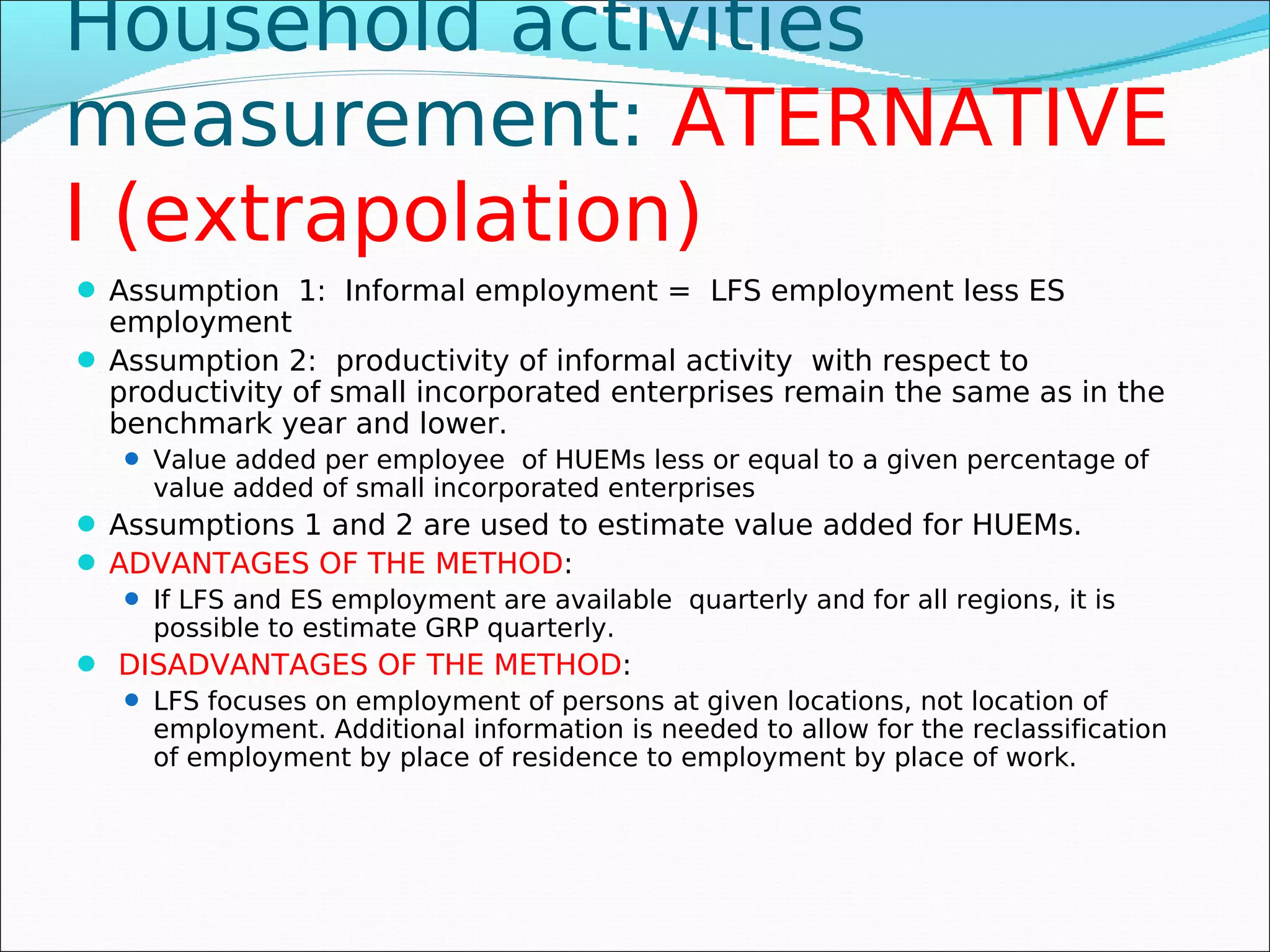
Household activities
measurement: ATERNATIVE
I (extrapolation)
 Assumption 1: Informal employment = LFS employment less ES
  employment
 Assumption 2: productivity of informal activity with respect to
  productivity of small incorporated enterprises remain the same as in the
  benchmark year and lower.
    Value added per employee of HUEMs less or equal to a given percentage of
     value added of small incorporated enterprises
 Assumptions 1 and 2 are used to estimate value added for HUEMs.
 ADVANTAGES OF THE METHOD:
    If LFS and ES employment are available quarterly and for all regions, it is
     possible to estimate GRP quarterly.
 DISADVANTAGES OF THE METHOD:
    LFS focuses on employment of persons at given locations, not location of
     employment. Additional information is needed to allow for the reclassification
     of employment by place of residence to employment by place of work.
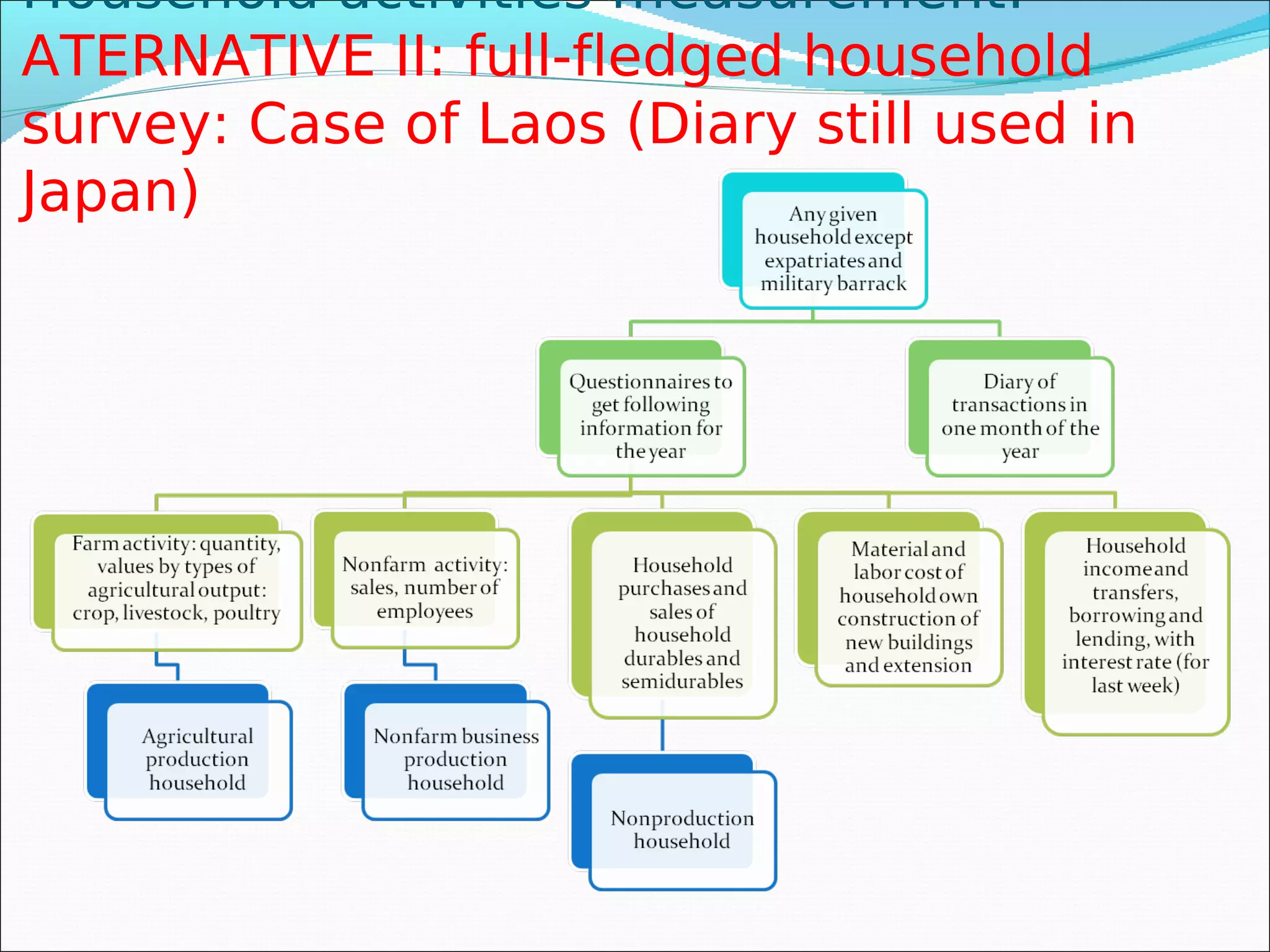
Household activities measurement:
ATERNATIVE II: full-fledged household
survey: Case of Laos (Diary still used in
Japan)
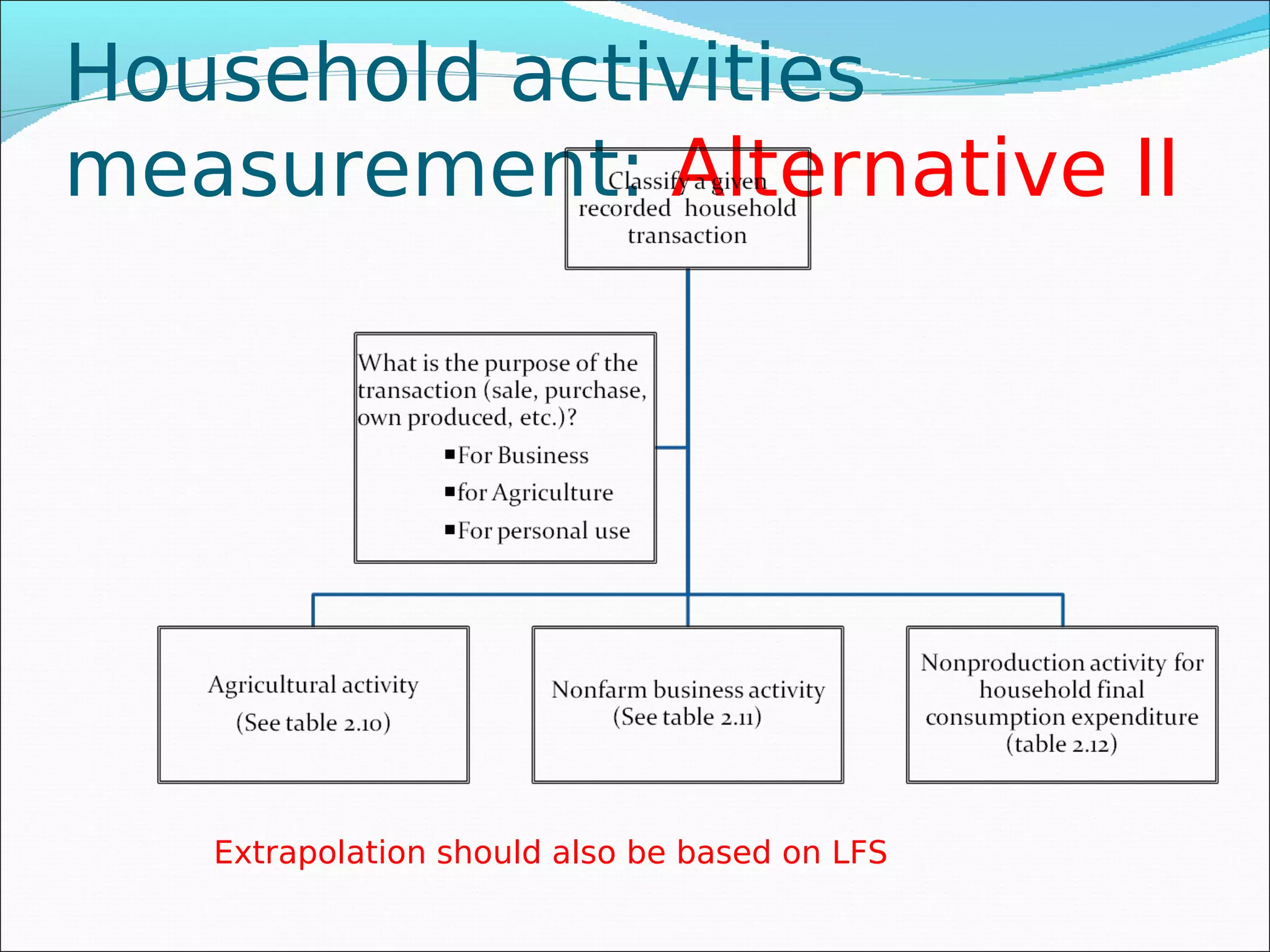
Household activities
measurement: Alternative II


   Extrapolation should also be based on LFS
An integrated survey program
to satisfy both national and
regional accounts
Benchmark surveys: every five years. Benchmark
 household survey (whatever form) may take place
 every five years.
Quarterly and annual estimation, separately for:
       Agriculture (cultivated land area and yield rate)
       Other non-agricultural own final consumption (a fixed ratio
        of agriculture?)
        Unincorporated informal activities: employment
       Incorporated activities: sampling survey
       Government activities: budget data
       Non-profit institutions serving HH: employment
Countries need to collect employment data by
 developing both regular Establishment Survey and
 Labor Force Survey. Probably the most economic
 way to collect information on household activities.
Application on regional
value added
estimation/extrapolation
Assumption: Informal employment is assumed to be the
 difference between LFS employment and ES employment.
Productivity adjustment: Productivity difference between
 formal and informal activities by activity need to be
 introduced to estimate corporate employment equivalent.
 This can be done at:
   Industry average for corporations or
   Industry average for only small incorporated enterprises if
   data are regularly available.
Use corporate employment equivalent to estimate regional
 output and value added.

D2,5.measurement of informal activities2003

  • 1.
    Viet Vu Consultant toUnited Nations’ Statistics Division 15-17 March 2010
  • 2.
    Importance of reliablemeasurement of informal activities at regional levels in developing countries  At national level (*)  On the basis of statistics on the informal economy that are still unreliable, ILO provides the following tentative picture of its relevance.  In developing countries, informal employment makes up 48% of non-agricultural employment in North Africa, 51% in Latin America, 65% in Asia, and 72% in Sub-Saharan Africa.  If agricultural employment is included, the percentages rises, in some countries like India and many sub-Saharan African countries beyond 90%.  Estimates for developed countries are around 15%.  At regional level:  Share of informal activities in many regions are higher than the national average;  Thus, reliable measurement of informal activities at regional levels are important to the measurement of GRPs. (*) Source: http://www.ilo.org/public/english/bureau/inst/publications/discussion/dp19308. pdf
  • 3.
    Households as statisticalunits in SNA production framework: refined definition Area SNA household sector SNA SNA subje corporations general ct to 1-2 sector governmen surve t sector y and NPISH sector  HUEM units Non-HUEM Househ Incorporat Nonmarket units: old ed units quasi- enterprise (general Agriculture Non- •Producing corps. s government (commercia Agriculture only for own , NPISH) l final uses This is the agriculture)   •Subsistence part of the farmers system that Inform Forma Infor Forma         the ILO is al l mal l interested statistical units: household enterprises that   in   do not incorporate
  • 4.
    General practices in economicstatistics Corporations sector: corporations, whether large or small are independent legal units and therefore must register with authorities, they can be subject to sample survey. The main requirement is that the list frame must be frequently updated. This list frame include basic information:  Address  Number of employees  Sales  Major activity classified by ISIC. Household sector: all unincorporated activities of the households must be measured in national accounts, whether they are “informal” as defined by the ILO or by ESCAP project or not.
  • 5.
    Household production activities  Non-HUEMs:Household unincorporated enterprises producing only for own final consumption. This includes subsistence farmers.  HUEMs: are household unincorporated enterprises as defined by the SNA, but:  (1) with “primary objective of generating employment and incomes to the persons concerned” as defined by the ILO in the resolution of the 15th ICLS (SNA2008, 25.37); and  (2) “with at least some production for sale or barter (SNA2008, 25.46)”.  HUEMs as defined above must have entrepreneurial spirit in the sense that:  Produce for the market on a regular basis; therefore HUEMs  Should exclude the unincorporated household units that have some incidental sales, and subsistence farmers who must sell some of their outputs on the market to pay for nonfood survival needs.
  • 6.
    Household activities measurement: ATERNATIVEI Non-HUEMS for own final consumption: Based on normal agricultural survey at regional levels  Agriculture: Land use are x Yield rate per unit of land  Livestock: Output of live animals + imports = animals slaughtered + exports + change in animal stock HUEMS: 1-2 survey (UNESCAP’s proposal) include:  Stage 1: Utilize Labour Force’s survey (surveying households) to identify HUEMS (unincorporated units produced for the market)  Stage 2: Survey HUEMS for labour, output, intermediate consumption and value added. Extrapolation using 1-2 survey and employment in Labour Force survey
  • 7.
    Household activities measurement: ATERNATIVE I(extrapolation)  Assumption 1: Informal employment = LFS employment less ES employment  Assumption 2: productivity of informal activity with respect to productivity of small incorporated enterprises remain the same as in the benchmark year and lower.  Value added per employee of HUEMs less or equal to a given percentage of value added of small incorporated enterprises  Assumptions 1 and 2 are used to estimate value added for HUEMs.  ADVANTAGES OF THE METHOD:  If LFS and ES employment are available quarterly and for all regions, it is possible to estimate GRP quarterly.  DISADVANTAGES OF THE METHOD:  LFS focuses on employment of persons at given locations, not location of employment. Additional information is needed to allow for the reclassification of employment by place of residence to employment by place of work.
  • 8.
    Household activities measurement: ATERNATIVEII: full-fledged household survey: Case of Laos (Diary still used in Japan)
  • 9.
    Household activities measurement: AlternativeII Extrapolation should also be based on LFS
  • 10.
    An integrated surveyprogram to satisfy both national and regional accounts Benchmark surveys: every five years. Benchmark household survey (whatever form) may take place every five years. Quarterly and annual estimation, separately for:  Agriculture (cultivated land area and yield rate)  Other non-agricultural own final consumption (a fixed ratio of agriculture?)  Unincorporated informal activities: employment  Incorporated activities: sampling survey  Government activities: budget data  Non-profit institutions serving HH: employment Countries need to collect employment data by developing both regular Establishment Survey and Labor Force Survey. Probably the most economic way to collect information on household activities.
  • 11.
    Application on regional valueadded estimation/extrapolation Assumption: Informal employment is assumed to be the difference between LFS employment and ES employment. Productivity adjustment: Productivity difference between formal and informal activities by activity need to be introduced to estimate corporate employment equivalent. This can be done at:  Industry average for corporations or  Industry average for only small incorporated enterprises if data are regularly available. Use corporate employment equivalent to estimate regional output and value added.