Pitfalls of
PGTa
Dr Kaberi Banerjee
WHAT IS PGS WHAT IS PGTA PROBLEMS
WITH PGTA
VARIOUS
STUDIES
The Earlier
names of
Genetic Tests
on Embryos
Current names of Genetic Tests on the
Embryo
PGTa claims to reduce
implantation failure in IVF and
reduce the risk of miscarriages.
It is a very expensive test!
Is it true?
Some Facts of
PGTa
• All cells in any embryo doesn’t
demonstrate aneuploidies i.e
chromosomal abnormalities.
There are only small number of
cells which shows abnormalities.
If embryo biopsy shows abnormal
DNA, it is not the whole cell will
be abnormal.
Some Facts of
PGTa
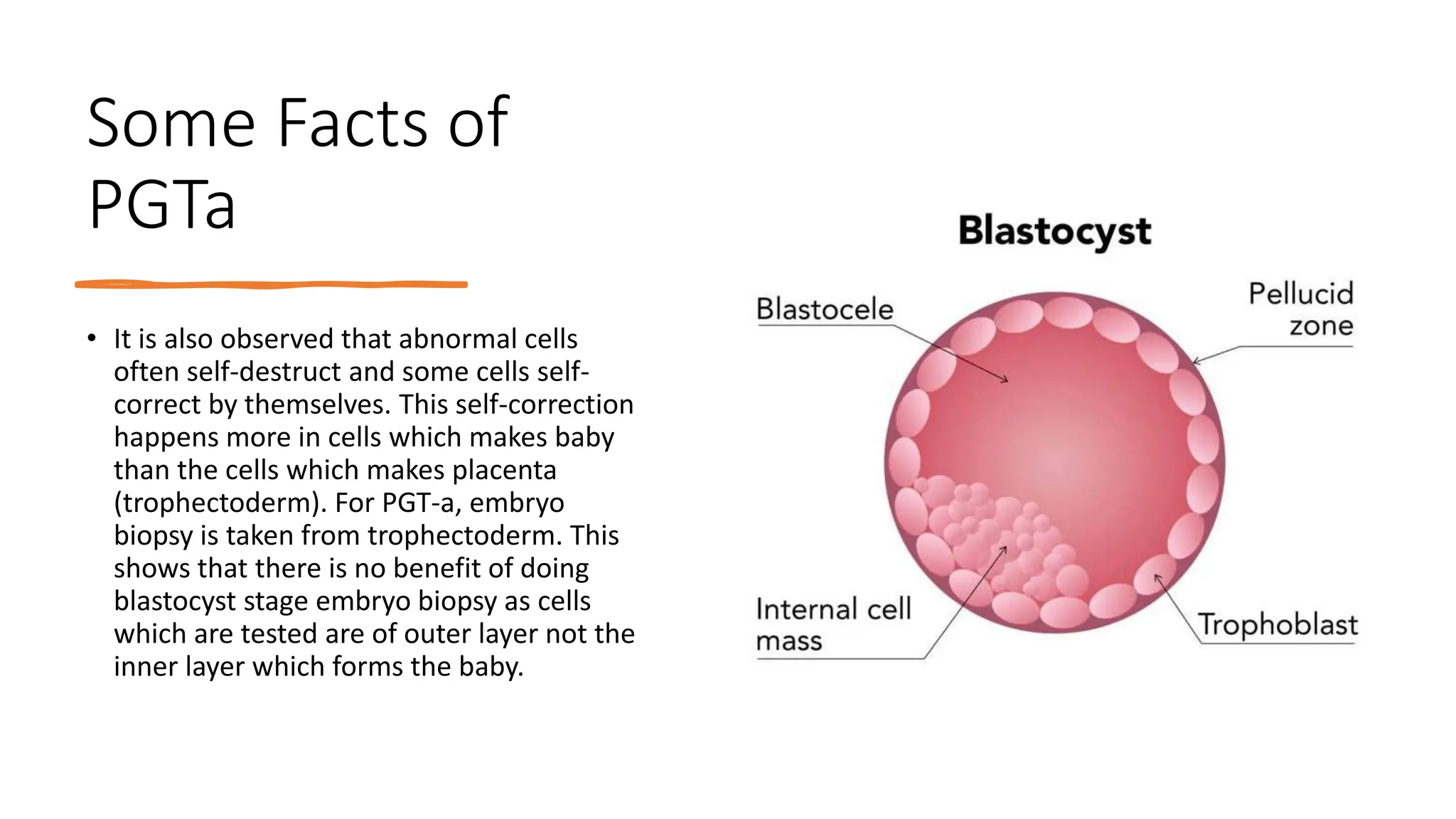
• It is also observed that abnormal cells
often self-destruct and some cells self-
correct by themselves. This self-correction
happens more in cells which makes baby
than the cells which makes placenta
(trophectoderm). For PGT-a, embryo
biopsy is taken from trophectoderm. This
shows that there is no benefit of doing
blastocyst stage embryo biopsy as cells
which are tested are of outer layer not the
inner layer which forms the baby.
Overall same , but can show as 50% and 100%
Depends which data you want to show!
Non PGS-50%?
10
8
6
4
2+2
-ve/+ve
PGS-100%?
10
8
6
4
2
+ve
Extra Cost
Freezing
Transfer Time
Extra Cost
PGS
Personnel
Laboratory
WaitingTime
The STAR Study
• A total of 661 women (average age 33.7
± 3.6 years) were randomized to PGT-A (n
= 330) or morphology alone (n = 331).
• PGT-A did not improve overall
pregnancy outcomes in all women, as
analyzed per embryo transfer or per ITT.
There was a significant increase in OPR
per embryo transfer with the use of PGT-
A in the subgroup of women aged 35-40
years who had two or more embryos that
could be biopsied, but this was not
significant when analyzed by ITT.
• The STAR study thus reveals that
PGT-A does not beneficially affect
IVF outcomes in confirmation of
another relatively recent study in
women 37 years and older by Kang
et al. Like the STAR study, Kang et
al. reported seemingly improved
live birth rates following PGT-A but
this outcome advantage, actually,
reversed itself after correct intent-
to-treat analysis of outcomes with
reference cycle start: Pregnancy as
well as live birth rates, indeed,
ended up to be significantly higher
in control non-PGT-A patients (49.5
vs 21.5% and 39.8 vs 19.9%).
• Considering all presented
evidence here, it is difficult to
understand what further argument
can be made for the continuous
routine clinical utilization of PGT-A
to improve IVF outcomes.
•
• Errors may occur during the genetic analysis of the small
amount of DNA collected.
• Mitotic mosaicism may lead to sampling errors
• Some normal embryos will be discarded, leading to an
overall decrease in the cumulative pregnancy rate
achievable by the eventual transfer of all embryos in the
cohort.
• Real possibility of damage to the blastocyst as result of the
trophectoderm biopsy.
• No studies have addressed the impact of trophectoderm
biopsy in embryos with less than ideal morphologic
characteristics, in older patients, or after an intervening
cryopreservation procedure.
Assumptions
• Blastulation Rate- 47%
• Aneuploidy Rate- 59%
• IR-D3 21-50%,
• Non PGS D5 38-47%,
• PGS D5 39-65%
• Mosaicism and Technical
Errors reduce LBR
• Any Intervention that claims to
increase the pregnancy rate in IVF
must stand the test of time…till
then must be clearly offered as an
experimental test and at least
should not financially drain the
patient.

Preimplantation Genetic Testing - Dr Kaberi Banerjee

  • 1.
  • 2.
    WHAT IS PGSWHAT IS PGTA PROBLEMS WITH PGTA VARIOUS STUDIES
  • 3.
  • 4.
    Current names ofGenetic Tests on the Embryo
  • 5.
    PGTa claims toreduce implantation failure in IVF and reduce the risk of miscarriages. It is a very expensive test! Is it true?
  • 7.
    Some Facts of PGTa •All cells in any embryo doesn’t demonstrate aneuploidies i.e chromosomal abnormalities. There are only small number of cells which shows abnormalities. If embryo biopsy shows abnormal DNA, it is not the whole cell will be abnormal.
  • 8.
    Some Facts of PGTa •It is also observed that abnormal cells often self-destruct and some cells self- correct by themselves. This self-correction happens more in cells which makes baby than the cells which makes placenta (trophectoderm). For PGT-a, embryo biopsy is taken from trophectoderm. This shows that there is no benefit of doing blastocyst stage embryo biopsy as cells which are tested are of outer layer not the inner layer which forms the baby.
  • 9.
    Overall same ,but can show as 50% and 100% Depends which data you want to show! Non PGS-50%? 10 8 6 4 2+2 -ve/+ve PGS-100%? 10 8 6 4 2 +ve Extra Cost Freezing Transfer Time Extra Cost PGS Personnel Laboratory WaitingTime
  • 10.
    The STAR Study •A total of 661 women (average age 33.7 ± 3.6 years) were randomized to PGT-A (n = 330) or morphology alone (n = 331). • PGT-A did not improve overall pregnancy outcomes in all women, as analyzed per embryo transfer or per ITT. There was a significant increase in OPR per embryo transfer with the use of PGT- A in the subgroup of women aged 35-40 years who had two or more embryos that could be biopsied, but this was not significant when analyzed by ITT.
  • 11.
    • The STARstudy thus reveals that PGT-A does not beneficially affect IVF outcomes in confirmation of another relatively recent study in women 37 years and older by Kang et al. Like the STAR study, Kang et al. reported seemingly improved live birth rates following PGT-A but this outcome advantage, actually, reversed itself after correct intent- to-treat analysis of outcomes with reference cycle start: Pregnancy as well as live birth rates, indeed, ended up to be significantly higher in control non-PGT-A patients (49.5 vs 21.5% and 39.8 vs 19.9%). • Considering all presented evidence here, it is difficult to understand what further argument can be made for the continuous routine clinical utilization of PGT-A to improve IVF outcomes. •
  • 12.
    • Errors mayoccur during the genetic analysis of the small amount of DNA collected. • Mitotic mosaicism may lead to sampling errors • Some normal embryos will be discarded, leading to an overall decrease in the cumulative pregnancy rate achievable by the eventual transfer of all embryos in the cohort. • Real possibility of damage to the blastocyst as result of the trophectoderm biopsy. • No studies have addressed the impact of trophectoderm biopsy in embryos with less than ideal morphologic characteristics, in older patients, or after an intervening cryopreservation procedure.
  • 13.
    Assumptions • Blastulation Rate-47% • Aneuploidy Rate- 59% • IR-D3 21-50%, • Non PGS D5 38-47%, • PGS D5 39-65% • Mosaicism and Technical Errors reduce LBR
  • 16.
    • Any Interventionthat claims to increase the pregnancy rate in IVF must stand the test of time…till then must be clearly offered as an experimental test and at least should not financially drain the patient.