Patient preparation before IVF
Prof Aboubakr Elnashar
Benha University, Egypt
Aboubakr Elnashar
CONTENTS
I. COUNSELING & INFORMATION
II. EVALUATION
1. History
2. Examination
3. Investigation
Screening for HBV &HCV
III. MANAGEMENT OF ASSOCIATED CONDITIONS
IV. PREVENTIVE TREATMENT.
Semen analysis 1. ORT
2. Hormonal.
3. TVS.
4. Hysteroscopy??
4
Aboubakr Elnashar
I. COUNSELING & PATIENT INFORMATION
 How pregnancy occur
 Indication of the procedure
 The steps of the procedures
 PR in general and that for their condition
 The possible problems:
sensitive and nonthreatening way
 Financial information.
 Handbook for information
Aboubakr Elnashar
Indications of IVF/ICSI
I. Male factor infertility:
1.Severe semen:
NF: ≤2% (4), C: ≤5m (15), M: ≤10% (40)
2.Azoospermia
II. Endometriosis
1. Moderate and Severe
2. Other factors: Poor ORT, abnormal semen, tubal dis
3. Failure of conception after 6-18 m of surgery
Aboubakr Elnashar
III. PCOS:
1. Other factors: tubal factor, male factor
(Tannys, 2010)
2. Failure to conceive despite at least 6 ovulatory cycles
IV. Tubal factor infertility:
1. Moderate to severe tubal disease:
tubal block, pelvic adhesions, hydrosalpinx
2. Other factors:
abnormal semen, age >36 yr
Aboubakr Elnashar
V. Unexplained infertility
1. ≤35 y: failure of 6 trials of (HMG, IUI)
2. 35-39: failure of 4
3. ≥39: failure of 2
Aboubakr Elnashar
Prediction of success
(NICE, 2013)
1. Female age
Success falls with rising female age
2. Number of previous tt cycles
Success: falls as the number of unsuccessful cycles increases.
3. Previous pregnancy history
Success: higher
Aboubakr Elnashar
4. BMI
Ideal: 19–30
BMI outside: reduce the success.
5. Lifestyle factors
i. Maternal and paternal smoking
ii. Maternal caffeine consumption can adversely affect
success rate.
6. Advanced Paternal age
(Liu et al, 2011)
 > 40y risks: small. (II-2C)
Spontaneous abortion
Autosomal dominant conditions
Autism spectrum disorders
Schizophrenia. Aboubakr Elnashar
II. EVALUATION
1. History taking
 Surgical: laparotomies
 Medical: Hepatitis, DM, thyroid disease, SLE
 Current and Previous TT
2. Examination
 Speculum
 Trial ET
Aboubakr Elnashar
3. Investigations
For both:
Screening for HBV and HCV
 protect the uninfected partner and the future
child
 prevent contamination of samples
Aboubakr Elnashar
 For husband:
Semen analysis
(WHO, 2010)
:
:
Lower reference limitParameter
1.5 mlVolume
7.2pH
15 million/mlConcentration
39 million/ejaculateTotal sperm number
40% or
32%
Total Motility: (PR+NP)
PR
58% live spermatozoaVitality
4% (strict criteria).Normal Forms
Aboubakr Elnashar
 For wife:
1. Ovarian reserve testing
 Woman’s age:
Predictor of
 quality of oocytes
 success of
 natural conception
 IVF
Aboubakr Elnashar
 OR T:
Predictors of:
quantity of oocytes
ovarian response to Gnt stimulation
(NICE, 2013)
High responseLow response
16 or more4 or lessTotal AFC
3.5 or more
25
0.8 or less
5.5
AMH
ng/ml
pmol/l
Conversion ratio:7
4 or less8.9 or moreFSH IU/L
Aboubakr Elnashar
Indications:
 ≥ 35 ys or
< 35 years
1. Endometriosis
2. Unexplained infertility
3. Poor response to FSH,
4. Single ovary
5. Previous ovarian surgery,
6. Previous exposure to chemotherapy or
radiation.
(Iii-b)
Aboubakr Elnashar
2. Hormonal assay
 Day 3:
 FSH, LH: Only in irregular prolonged cycles
 E2
 Prolactin: Only in
ovulatory disorder
galactorrhoea or
pituitary tumour
 TSH: only if
symptoms of thyroid disease
(NICE, 2013)
Aboubakr Elnashar
Information
Uterus Assessment: Dimension, Endometrial: thickness, appearance
Abnormalities: Anomalies, Tumors
Ovaries Assessment: Position, Mobility, Volume, AFC
Abnormalities: PCOS, Cysts, Tumors
Tube Hydrosalpinx, Patency
Pelvis Free fluid, Mass
3. Basal Vaginal U/S
The Pivotal US (performed D8-12)
± Saline infusion sonography (SIS)
Aboubakr Elnashar
4. Hysteroscopy
Before the 1st trial of IVF?
(inSIGHT): a multicentre, RCT
(Smit et al, 2016, Lancet)
750 women who had a normal TVS of the uterine cavity undergo
either hysteroscopy (with treatment of any detected abnormalities, such
as polyps) before starting IVF, or immediate IVF
LBR did not differ significantly between the groups (roughly 55%)
Routine hysteroscopy does not improve LBR in infertile women with a
normal TVS of the uterine cavity scheduled for a first IVF treatment.
Women with a normal TVS should not be offered
routine hysteroscopy.
Aboubakr Elnashar
Before IVF in women with RIF (2-4):
(TROPHY): multicentre, RCT (8 hospitals in the UK, Belgium, Italy,
and the Czech Republic) assigned 350 women to hysteroscopy and
352 to control.
LBR: 29% in each group, no significant difference between
either group (relative risk 1.0; 95% CI 0・79–1.25; p=0.96).
Hysteroscopy before IVF in women with a normal
TVS and a history of unsuccessful IVF does not
improve LBR.
(El-Toukhy , 2016, Lancet)
Aboubakr Elnashar
3. MANAGEMENT OF ASSOCIATED
CONDITION
 HABITS
 PSYCHOLOGY
 PCOS
 OBESITY
 DM
 THYROID DISEASE
 HEPATITIS
 SLE
 Thrombophylia
 Heart disease
 Hyperprolactinaemia
ENDOMETRIOMA
HYDROSALPINGES
FIBROID & POLYP
CERVICAL
STENOSIS
UTERINE
PROBLEMS
Aboubakr Elnashar
HABITS
Smoking:
 ↓ conception rate
 ↑abortion and Gnt dose
 stop before IVF.
Caffeine:
 use ≤ 2mg (one cup of decaf coffee):
No deleterious effect
Aboubakr Elnashar
PSYCHO-SOCIAL ASPECTS
Stress, anxiety, and depression
linked to lower IVF outcomes
Psychological intervention improves success
(Sanders et al.1999; Klonoff-Cohen 2001; Smeenk et al.2001; Domar et
al. 2000)
Aboubakr Elnashar
OBESITY
Decrease:
CPR , LBR
Increase:
miscarriage rate
duration and dose of Gnt
(Rittenberg et al, 2011)
33 studies including 47,967 tt cycles
Unethical to refuse to accept a patient solely because
she is obese
(ACOG, 2014)
Violation of Articles Human Rights
12 (Right to marry and found a family)
14 (Prohibition of discrimination).
Aboubakr Elnashar
Before starting IVF cycle:
1. Above 35y:
tt rather than unsuccessful attempts to lose wt.
{Age stronger negative effect on oocyte number, number of mature &
fertilized oocytes, CPR and LBR}
(Sneed et al., 2008).
2. Counseling
unbiased manner, avoiding blame and maintaining her dignity
Impact of: raised BMI on IVF outcome
 wt loss on IVF tt outcome.
 raised BMI on pregnancy
Wt loss should be encouraged
3. Informed consent:
I wish to proceed under these circumstances
Aboubakr Elnashar
Management
Preconceptional
Screen for:
DM and optimization of glucose control
Thyroid disease.
Healthy diet and lifestyle
Prenatal vitamins
Aboubakr Elnashar
Weight loss:
1. Hypo-caloric diet:
2. Lifestyle changes, Exercise program
3. Pharmacologic agents Orlistat (Xenical):
4. Bariatric surgery
 Metformin:
not a wt loss drug
 Gonadotopins dose:
Increased after exclusion of PCOS
Aboubakr Elnashar
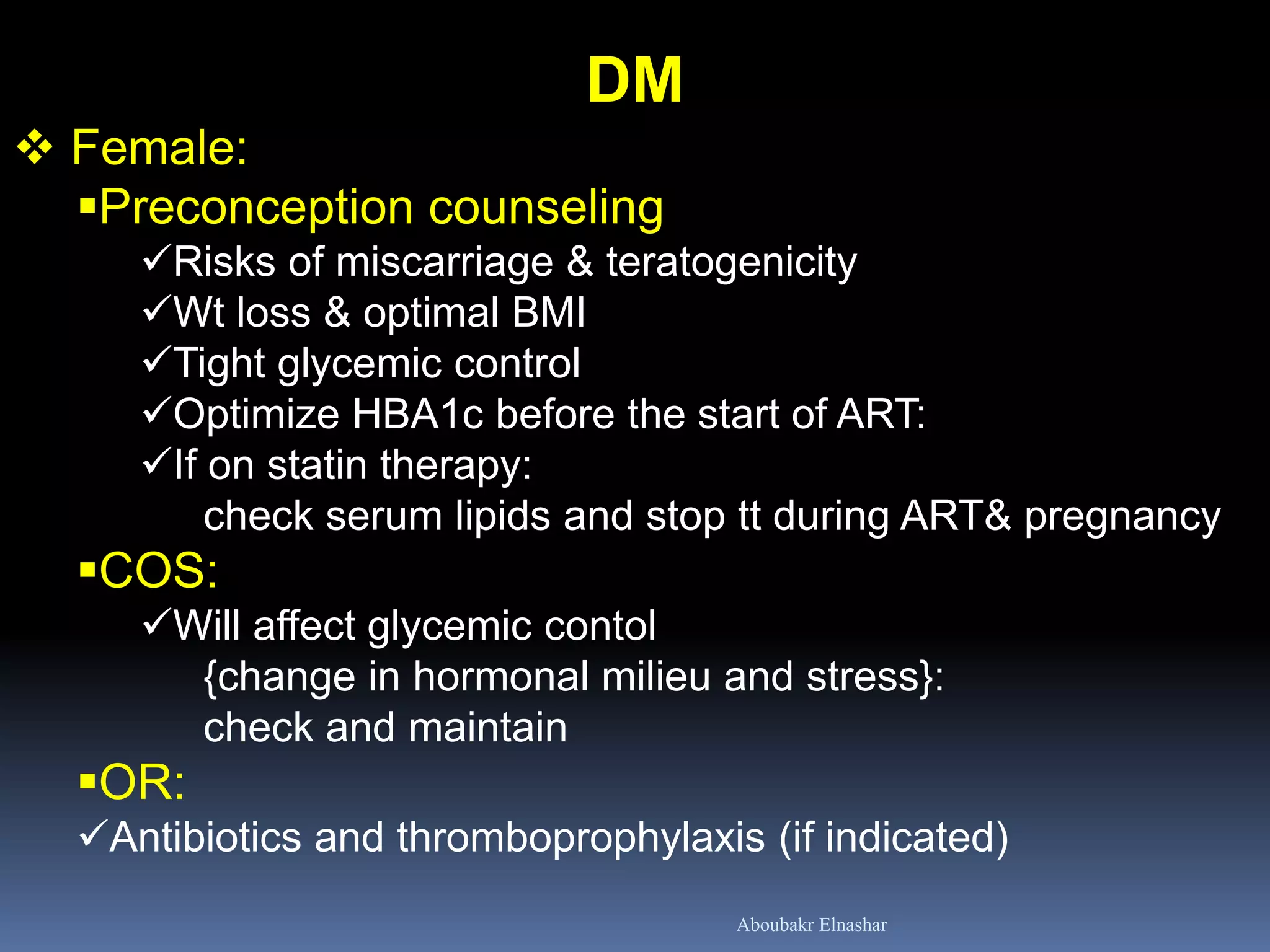
DM
 Female:
Preconception counseling
Risks of miscarriage & teratogenicity
Wt loss & optimal BMI
Tight glycemic control
Optimize HBA1c before the start of ART:
If on statin therapy:
check serum lipids and stop tt during ART& pregnancy
COS:
Will affect glycemic contol
{change in hormonal milieu and stress}:
check and maintain
OR:
Antibiotics and thromboprophylaxis (if indicated)
Aboubakr Elnashar
Men
Optimal BMI:
control DM
improve ED and T levels
Check androgen status
TT of ED:
phosphodiestrase inhibitors
If on statin therapy:
{can reduce T levels}
check serum lipids:
if normal: stop temporarily
Aboubakr Elnashar
ENDOMETRIOMA
Check:
 previous surgical or medical tt
ORT
Avoid surgery if:
previous history of surgeries
reduced ovarian reserve
COS protocol according to AMH:
During OR:
Avoid puncturing or drainage of endometrioma
Give IV antibiotics
Aboubakr Elnashar
HYDROSALPINX
Prior to starting IVF:
Salpingectomy
Tubal occlusion
During ovarian stimulation
TV aspiration at OR
Freeze all embryos
surgery for HS
freeze-thaw cycle
Laparoscopic salpingectomy should be considered for all women with
hydrosalpinges prior to IVF
(Cochrane Systematic Reviews 2008 )
Occlusion of the proximal tube seems to be equally effective
US guided aspiration of hydrosalpinges during OR improves PR (20 v43%)
(Hammadieh et al , 2008)
Aboubakr Elnashar
Fibroid
Myomectomy:
1. Distorting the cavity
Submucous:
(Gambadauro,2012).
Intramural:
2. Not distorting .
1. >5 cm
2. Multiple >3 (3cm)
(Bajekal & Li, 2000)
UAE:
infertility is a relative contraindication
Reproductive outcome is less favorable with UAE
than myomectomy
Aboubakr Elnashar
CERVICAL STENOSIS
History
previous surgery
difficult or painful cervical instrumentation
Mock ET
Before the start of IVF
identify cases: plan action
1. Cervical dilatation:
 At the start of IVF cycles:
ET easier and increase PR
{allow time for the endometrium to recover from any trauma,
inflammation or bacterial contamination resulting from dilatation at time
of OR}
At the time of OR:
ET easier but does not increase PR
Aboubakr Elnashar
2. Tramsmyometrial ET: Towako method
Under TVS guidance
overcome the most difficult or impossible cases
{bypass the cervix}:
PR similar to easy transcervical transfers
 The echogenic line represents the needle equipped with an
ET catheter protruding into the uterine cavity.
Aboubakr Elnashar
3. Tubal ET:
Cases with normal fallopian tubes
requires laparoscopy and GA
4. Hysteroscopic canalization of the cervix:
cases associated with
amenorhea or
significant dysmenorhea
Operative hysteroscopic shaving of the cx to create
a new canal
(Pabucca et al, 2005)
Aboubakr Elnashar
IV. PREVENTIVE TREATMENT
Day 1 For both partners
 Doxycyclin: 100mg 1x2x7d.
 Diflucan or Flucoral one caps.
 Flagentyl 4 tablet
Folic acid 0.5mg
Aspirin 75mg /day are continued
Prevention of OHSS in PCOS:
 Metformin: given in the period prior to ART
(Cochrane Systematic reviews Costello et al2010)
Aboubakr Elnashar

Patient preparation before IVF

  • 1.
    Patient preparation beforeIVF Prof Aboubakr Elnashar Benha University, Egypt Aboubakr Elnashar
  • 2.
    CONTENTS I. COUNSELING &INFORMATION II. EVALUATION 1. History 2. Examination 3. Investigation Screening for HBV &HCV III. MANAGEMENT OF ASSOCIATED CONDITIONS IV. PREVENTIVE TREATMENT. Semen analysis 1. ORT 2. Hormonal. 3. TVS. 4. Hysteroscopy?? 4 Aboubakr Elnashar
  • 3.
    I. COUNSELING &PATIENT INFORMATION  How pregnancy occur  Indication of the procedure  The steps of the procedures  PR in general and that for their condition  The possible problems: sensitive and nonthreatening way  Financial information.  Handbook for information Aboubakr Elnashar
  • 4.
    Indications of IVF/ICSI I.Male factor infertility: 1.Severe semen: NF: ≤2% (4), C: ≤5m (15), M: ≤10% (40) 2.Azoospermia II. Endometriosis 1. Moderate and Severe 2. Other factors: Poor ORT, abnormal semen, tubal dis 3. Failure of conception after 6-18 m of surgery Aboubakr Elnashar
  • 5.
    III. PCOS: 1. Otherfactors: tubal factor, male factor (Tannys, 2010) 2. Failure to conceive despite at least 6 ovulatory cycles IV. Tubal factor infertility: 1. Moderate to severe tubal disease: tubal block, pelvic adhesions, hydrosalpinx 2. Other factors: abnormal semen, age >36 yr Aboubakr Elnashar
  • 6.
    V. Unexplained infertility 1.≤35 y: failure of 6 trials of (HMG, IUI) 2. 35-39: failure of 4 3. ≥39: failure of 2 Aboubakr Elnashar
  • 7.
    Prediction of success (NICE,2013) 1. Female age Success falls with rising female age 2. Number of previous tt cycles Success: falls as the number of unsuccessful cycles increases. 3. Previous pregnancy history Success: higher Aboubakr Elnashar
  • 8.
    4. BMI Ideal: 19–30 BMIoutside: reduce the success. 5. Lifestyle factors i. Maternal and paternal smoking ii. Maternal caffeine consumption can adversely affect success rate. 6. Advanced Paternal age (Liu et al, 2011)  > 40y risks: small. (II-2C) Spontaneous abortion Autosomal dominant conditions Autism spectrum disorders Schizophrenia. Aboubakr Elnashar
  • 9.
    II. EVALUATION 1. Historytaking  Surgical: laparotomies  Medical: Hepatitis, DM, thyroid disease, SLE  Current and Previous TT 2. Examination  Speculum  Trial ET Aboubakr Elnashar
  • 10.
    3. Investigations For both: Screeningfor HBV and HCV  protect the uninfected partner and the future child  prevent contamination of samples Aboubakr Elnashar
  • 11.
     For husband: Semenanalysis (WHO, 2010) : : Lower reference limitParameter 1.5 mlVolume 7.2pH 15 million/mlConcentration 39 million/ejaculateTotal sperm number 40% or 32% Total Motility: (PR+NP) PR 58% live spermatozoaVitality 4% (strict criteria).Normal Forms Aboubakr Elnashar
  • 12.
     For wife: 1.Ovarian reserve testing  Woman’s age: Predictor of  quality of oocytes  success of  natural conception  IVF Aboubakr Elnashar
  • 13.
     OR T: Predictorsof: quantity of oocytes ovarian response to Gnt stimulation (NICE, 2013) High responseLow response 16 or more4 or lessTotal AFC 3.5 or more 25 0.8 or less 5.5 AMH ng/ml pmol/l Conversion ratio:7 4 or less8.9 or moreFSH IU/L Aboubakr Elnashar
  • 14.
    Indications:  ≥ 35ys or < 35 years 1. Endometriosis 2. Unexplained infertility 3. Poor response to FSH, 4. Single ovary 5. Previous ovarian surgery, 6. Previous exposure to chemotherapy or radiation. (Iii-b) Aboubakr Elnashar
  • 15.
    2. Hormonal assay Day 3:  FSH, LH: Only in irregular prolonged cycles  E2  Prolactin: Only in ovulatory disorder galactorrhoea or pituitary tumour  TSH: only if symptoms of thyroid disease (NICE, 2013) Aboubakr Elnashar
  • 16.
    Information Uterus Assessment: Dimension,Endometrial: thickness, appearance Abnormalities: Anomalies, Tumors Ovaries Assessment: Position, Mobility, Volume, AFC Abnormalities: PCOS, Cysts, Tumors Tube Hydrosalpinx, Patency Pelvis Free fluid, Mass 3. Basal Vaginal U/S The Pivotal US (performed D8-12) ± Saline infusion sonography (SIS) Aboubakr Elnashar
  • 17.
    4. Hysteroscopy Before the1st trial of IVF? (inSIGHT): a multicentre, RCT (Smit et al, 2016, Lancet) 750 women who had a normal TVS of the uterine cavity undergo either hysteroscopy (with treatment of any detected abnormalities, such as polyps) before starting IVF, or immediate IVF LBR did not differ significantly between the groups (roughly 55%) Routine hysteroscopy does not improve LBR in infertile women with a normal TVS of the uterine cavity scheduled for a first IVF treatment. Women with a normal TVS should not be offered routine hysteroscopy. Aboubakr Elnashar
  • 18.
    Before IVF inwomen with RIF (2-4): (TROPHY): multicentre, RCT (8 hospitals in the UK, Belgium, Italy, and the Czech Republic) assigned 350 women to hysteroscopy and 352 to control. LBR: 29% in each group, no significant difference between either group (relative risk 1.0; 95% CI 0・79–1.25; p=0.96). Hysteroscopy before IVF in women with a normal TVS and a history of unsuccessful IVF does not improve LBR. (El-Toukhy , 2016, Lancet) Aboubakr Elnashar
  • 19.
    3. MANAGEMENT OFASSOCIATED CONDITION  HABITS  PSYCHOLOGY  PCOS  OBESITY  DM  THYROID DISEASE  HEPATITIS  SLE  Thrombophylia  Heart disease  Hyperprolactinaemia ENDOMETRIOMA HYDROSALPINGES FIBROID & POLYP CERVICAL STENOSIS UTERINE PROBLEMS Aboubakr Elnashar
  • 20.
    HABITS Smoking:  ↓ conceptionrate  ↑abortion and Gnt dose  stop before IVF. Caffeine:  use ≤ 2mg (one cup of decaf coffee): No deleterious effect Aboubakr Elnashar
  • 21.
    PSYCHO-SOCIAL ASPECTS Stress, anxiety,and depression linked to lower IVF outcomes Psychological intervention improves success (Sanders et al.1999; Klonoff-Cohen 2001; Smeenk et al.2001; Domar et al. 2000) Aboubakr Elnashar
  • 22.
    OBESITY Decrease: CPR , LBR Increase: miscarriagerate duration and dose of Gnt (Rittenberg et al, 2011) 33 studies including 47,967 tt cycles Unethical to refuse to accept a patient solely because she is obese (ACOG, 2014) Violation of Articles Human Rights 12 (Right to marry and found a family) 14 (Prohibition of discrimination). Aboubakr Elnashar
  • 23.
    Before starting IVFcycle: 1. Above 35y: tt rather than unsuccessful attempts to lose wt. {Age stronger negative effect on oocyte number, number of mature & fertilized oocytes, CPR and LBR} (Sneed et al., 2008). 2. Counseling unbiased manner, avoiding blame and maintaining her dignity Impact of: raised BMI on IVF outcome  wt loss on IVF tt outcome.  raised BMI on pregnancy Wt loss should be encouraged 3. Informed consent: I wish to proceed under these circumstances Aboubakr Elnashar
  • 24.
    Management Preconceptional Screen for: DM andoptimization of glucose control Thyroid disease. Healthy diet and lifestyle Prenatal vitamins Aboubakr Elnashar
  • 25.
    Weight loss: 1. Hypo-caloricdiet: 2. Lifestyle changes, Exercise program 3. Pharmacologic agents Orlistat (Xenical): 4. Bariatric surgery  Metformin: not a wt loss drug  Gonadotopins dose: Increased after exclusion of PCOS Aboubakr Elnashar
  • 26.
    DM  Female: Preconception counseling Risksof miscarriage & teratogenicity Wt loss & optimal BMI Tight glycemic control Optimize HBA1c before the start of ART: If on statin therapy: check serum lipids and stop tt during ART& pregnancy COS: Will affect glycemic contol {change in hormonal milieu and stress}: check and maintain OR: Antibiotics and thromboprophylaxis (if indicated) Aboubakr Elnashar
  • 27.
    Men Optimal BMI: control DM improveED and T levels Check androgen status TT of ED: phosphodiestrase inhibitors If on statin therapy: {can reduce T levels} check serum lipids: if normal: stop temporarily Aboubakr Elnashar
  • 28.
    ENDOMETRIOMA Check:  previous surgicalor medical tt ORT Avoid surgery if: previous history of surgeries reduced ovarian reserve COS protocol according to AMH: During OR: Avoid puncturing or drainage of endometrioma Give IV antibiotics Aboubakr Elnashar
  • 29.
    HYDROSALPINX Prior to startingIVF: Salpingectomy Tubal occlusion During ovarian stimulation TV aspiration at OR Freeze all embryos surgery for HS freeze-thaw cycle Laparoscopic salpingectomy should be considered for all women with hydrosalpinges prior to IVF (Cochrane Systematic Reviews 2008 ) Occlusion of the proximal tube seems to be equally effective US guided aspiration of hydrosalpinges during OR improves PR (20 v43%) (Hammadieh et al , 2008) Aboubakr Elnashar
  • 30.
    Fibroid Myomectomy: 1. Distorting thecavity Submucous: (Gambadauro,2012). Intramural: 2. Not distorting . 1. >5 cm 2. Multiple >3 (3cm) (Bajekal & Li, 2000) UAE: infertility is a relative contraindication Reproductive outcome is less favorable with UAE than myomectomy Aboubakr Elnashar
  • 31.
    CERVICAL STENOSIS History previous surgery difficultor painful cervical instrumentation Mock ET Before the start of IVF identify cases: plan action 1. Cervical dilatation:  At the start of IVF cycles: ET easier and increase PR {allow time for the endometrium to recover from any trauma, inflammation or bacterial contamination resulting from dilatation at time of OR} At the time of OR: ET easier but does not increase PR Aboubakr Elnashar
  • 32.
    2. Tramsmyometrial ET:Towako method Under TVS guidance overcome the most difficult or impossible cases {bypass the cervix}: PR similar to easy transcervical transfers  The echogenic line represents the needle equipped with an ET catheter protruding into the uterine cavity. Aboubakr Elnashar
  • 33.
    3. Tubal ET: Caseswith normal fallopian tubes requires laparoscopy and GA 4. Hysteroscopic canalization of the cervix: cases associated with amenorhea or significant dysmenorhea Operative hysteroscopic shaving of the cx to create a new canal (Pabucca et al, 2005) Aboubakr Elnashar
  • 34.
    IV. PREVENTIVE TREATMENT Day1 For both partners  Doxycyclin: 100mg 1x2x7d.  Diflucan or Flucoral one caps.  Flagentyl 4 tablet Folic acid 0.5mg Aspirin 75mg /day are continued Prevention of OHSS in PCOS:  Metformin: given in the period prior to ART (Cochrane Systematic reviews Costello et al2010) Aboubakr Elnashar